Chemical processing of
knitted fabrics
BY:OLIYAD EBBA
ETHIOPIAN TEXTILE INDUSTRY
DEVELOPMENT INSTITUTE
Features of knit fabric
• Knitted fabrics are more elastic and unstable mainly
because of the basic element of knitted fabric i.e. loop.
• This loop structure made knitted fabric to have the
following main properties:
• too stretchable and cannot bear any undue tension.
• Knitted fabrics are highly elastic but if they are stretched
beyond the elastic limits, it is impossible for them to return
to stable state and consequently elongation remains.
• Knitted fabrics suffer from inherent spirality problem due
to the factors such as yarn structure, twist, knit pattern,
loose structure and extent of stress applied
• knitted fabric is inherently easy to distort such , bow,
excessive shrinkage, etc.
Chemical Processing of knitted
fabrics
• Preparatory/pre-treatment Process
• Dyeing
• Printing
• Finishing
Preparatory/pre-treatment
process
• What is the objective of
fabric preparation in textile
processing?
Objectives of fabric preparation:
• To remove the natural and added impurities from
fibers.
• To achieve high and uniform dye uptake
• To get required brightness of shade in the fabric
after dyeing
• To impart good hydrophilic properties combined
with high absorbency
• To produce acceptable degree of whiteness
• It is a process of making the fabric ready for
dyeing or printing by mechanical or chemical
action.
• What will happen if the impurities are not
removed properly ?
….
• If the impurities are not removed, the
material will not be receptive to the
subsequent processes – dyeing / printing /
finishing.
• Impurities are also to be removed to
improve the appearance
What are these impurities?
• In knitted cotton fabric
Impurities in knitted cotton fabric
• In Fibers – natural impurities such as wax,
oils, pectin's, pentose's, vegetable matter
and COLOURING MATTER (Yellowish /
Brownish)
• Processing impurities–traces of lubricants -
like oils & greases, rust, dirt, etc.,
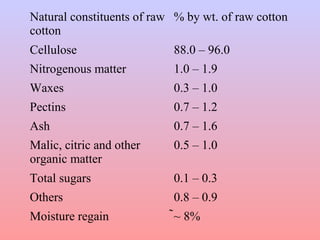
Natural constituents of raw
cotton
% by wt. of raw cotton
Cellulose 88.0 – 96.0
Nitrogenous matter 1.0 – 1.9
Waxes 0.3 – 1.0
Pectins 0.7 – 1.2
Ash 0.7 – 1.6
Malic, citric and other
organic matter
0.5 – 1.0
Total sugars 0.1 – 0.3
Others 0.8 – 0.9
Moisture regain ̃~ 8%
what are the steps to be taken before
going to wet processing?
Following are the steps to be taken:
Grey inspection
Stitching
Shearing and cropping
GREY FABRIC INSPECTION
• Fabric is inspected for defects before it
is dyed i.e. grey stage.
• Longer yarns can be cut
• A record of the defects in a fabric length
is kept to determine its quality .
• The process of giving points and
assigning a quality level is called fabric
grading.
Fabric Stitching
• Most of the machines in preparatory section
are huge capacity machines. Therefore to
utilize them to its full capacity it is
necessary to feed them with suitable lots
prepared by stitching together of fabrics
from different job orders but of similar
quality and same preparatory sequence
requirement, thus enabling us to process
them in a single batch
Shearing and cropping
• This is used for removing loose yarns of
length up to 8cm from the surface of the
fabric
What are the various
operations in knitted fabric
preparatory process?
The various operations in knitted
preparatory process are:
Singeing
Heat setting
Scouring
Bio polishing
Bleaching
Mercerization
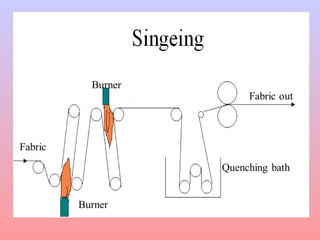
Singeing
• Burning of protruding fibers from the
surface of fabric or yarn - A mechanical
process
What it do?
• Makes fabrics smooth
• Prevents pilling
• Improves luster
What should control during
singeing operation?
• Intensity and uniformity of flame
• Working speed of the fabric to be singed
• Effectiveness of singeing : should not add
harshness in the fabric
• Should not damage the synthetic filament
yarn in the fabric
• More care should be taken while singeing
blended fabrics,
What is Bio polishing?
It is an enzyme treatment designed to
improve fabric quality and provide
following advantages:
• Improve pilling resistance
• A clear, lint and fuzz-free surface structure
• Improved drape and softness
• The effect are durable
When it should be carried out?
• It can be carried out at any time, but after
bleaching is most popular
• After dyeing shade may be affected
Process
• Cellulase enzyme is used
• Enzyme dosage 1-2% owf
• pH 4.5-5.5
• Temperature 40-55o
C
• Time 30-60 min.
It is similar to singeing as it also provide
similar effect on the fabric
SCOURING
• It is process to remove all undesirable
impurities except COLOURING MATTER. After
scouring, oils and waxes are removed and hence
the material becomes receptive to water, dyes and
chemicals. In other words, the absorption capacity
of the material is improves.
• Natural Impurities: Based on the
composition of natural material like cotton,
wool, silk etc.
Objectives of Scouring:
• To make the fabric highly hydrophilic.
• To remove impurities such as oils, waxes, gum,
husks as nearly as possible.
• To increase absorbency of fabric or textile
materials without physical and chemical
damage.
• To produce a clean material by adding alkali.
• To make the fabric ready for next process.
• To remove non-cellulosic substance in case of
cotton.
Mechanism:
Saponification:
The vegetable oil, which is immiscible with
water, is glyceride of fatty acids. When such
oils are heated with a solution of sodium
hydroxide in water, the oil splits up into its
constituents-fatty acid and glycerine. Glycerine
is miscible with water easily and the fatty acids
reacts with sodium hydroxide present in the
solution forming its sodium salt i.e.soap which
is also soluble in water. Thus oil is removed.
…cont
Emulsification:
• Wax and non saponifiable oils are
removed by emulsification as they are
immiscible in water. Normal washing
soap is used as a emulsifying agent
which makes emulsion of them.
What are the changes
occurring during scouring?
Changes occurs during scouring
• Saponifiable oils & free fatty acids are
converted into soap and glycerol
• Pectic substances(pectin, pectose and
pectates)converted into soluble salts of
pectic or meta pectic acids
• Proteins are degraded to simple soluble
amino acids
…Cont
• Mineral matter is dissolved
• Unsaponifiable oils & waxes are
emulsified by soaps
• Adventitious dirt is removed and
retained in suspension by the soap
• Other added impurities are broken
down into soluble products
Scouring process depends on:
• The type of cotton.
• The color of cotton.
• The cleanliness of cotton.
• The twist and count of the yarn.
• The construction of the fabric.
• The shade % and type of shade of finished
product
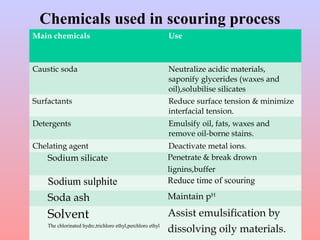
Chemicals used in scouring process
Main chemicals Use
Caustic soda Neutralize acidic materials,
saponify glycerides (waxes and
oil),solubilise silicates
Surfactants Reduce surface tension & minimize
interfacial tension.
Detergents Emulsify oil, fats, waxes and
remove oil-borne stains.
Chelating agent Deactivate metal ions.
Sodium silicate Penetrate & break drown
lignins,buffer
Sodium sulphite Reduce time of scouring
Soda ash Maintain pH
Solvent
The chlorinated hydrc,trichloro ethyl,perchloro ethyl
Assist emulsification by
dissolving oily materials.
Souring:
• The treatment/the process by which the
fabric, after processing with alkali or
scouring, is treated with Acetic Acid,
Hydrochloric acid or dilute H2SO4 for
removing alkali or neutralization of
alkali is souring.
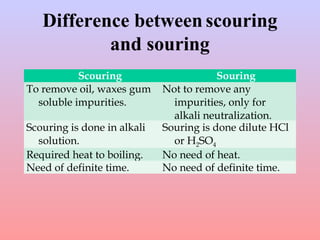
Difference between scouring
and souring
Scouring Souring
To remove oil, waxes gum
soluble impurities.
Not to remove any
impurities, only for
alkali neutralization.
Scouring is done in alkali
solution.
Souring is done dilute HCl
or H2SO4
Required heat to boiling. No need of heat.
Need of definite time. No need of definite time.
Bleaching
• Natural fibers are off-white in color due to
color bodies present in the fiber.
• This yellowish and brown discoloration is
related to:
 flavone pigments of the cotton flower.
The climate, soil, drought and frost can
also cause various degrees of yellowness.
may also come from dirt, dust, insects or
from harvesting or processing equipment in
the form of oils and greases.
Objective of bleaching
• The object of bleaching is to produce
white fabrics by destroying the
coloring matter with the help of
bleaching agents with minimum
degradation of the fiber.
Mechanism of Bleaching
• The mechanism of bleaching is very complicated
and not completely understood.
• One opinion is that the color producing agents in
natural fibers are often organic compounds
containing conjugated double bonds. .
• The bleaching agents either oxidize or reduce the
coloring matter … thus whiteness obtained is of
permanent nature.
• Oxidative bleaches oxidize color bodies into
colorless cpds.
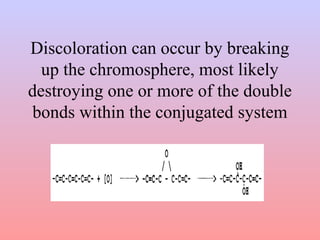
Discoloration can occur by breaking
up the chromosphere, most likely
destroying one or more of the double
bonds within the conjugated system
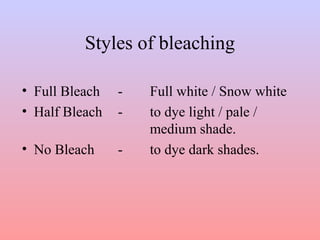
Styles of bleaching
• Full Bleach - Full white / Snow white
• Half Bleach - to dye light / pale /
medium shade.
• No Bleach - to dye dark shades.
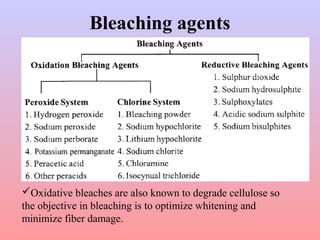
Bleaching agents
Oxidative bleaches are also known to degrade cellulose so
the objective in bleaching is to optimize whitening and
minimize fiber damage.
Bleaching agents…
• Oxidative bleaching – the bleaching agent
is a chemical reagent which decomposes in
alkali solution and produce active oxygen.
• The active oxygen is in fact the intrinsic
bleaching agent as it will further destroy
partly or completely the coloring matter
present in the textile material.
• Reductive bleaching – the bleaching agent
will destroy the coloring matter by
reductive reaction of SO2.
Bleaching with Hypochlorites
• Hypochlorite bleaching (OCl-
) is the oldest industrial
method of bleaching cotton.
• Originally, calcium hypochlorite, Ca(OCl)2 (bleaching
powder) was used.
• Until 1940 most cotton fabrics were bleached with NaOCl
… today only 10 % of the cotton.
• It is however the main stay of home laundry bleaching
products.
• Their use is declining because of anti-chlorine lobby and
environmental pressures.
• Hypochlorites are excellent cidal agents for mildew and
other bacteria and are used as disinfectants and to control
bacteria in swimming pools.
Bleaching with Hydrogen Peroxide
(H2O2)
• By 1940, about 65% and to-day about 90 - 95 % of all
cotton and cotton/synthetic blends are bleached with H2O2.
• It is available commercially as 35, 50 and 70 % solutions.
• It is a corrosive, oxidizing agent which may cause
combustion when allowed to dry out on oxidizable organic
matter.
• H2O2 is an irritant to the skin and mucous membranes and
dangerous to the eyes.
 H2O2- Ecologically acceptable
- Economically feasible
Cont…
• But require higher temperature near boiling
• Hydrogen peroxide is used along with NaOH (to
maintain pH 10-11)
Drawback: Poor stability for small amount of Iron
and copper present in the textiles or the processing
water. Cause catalytically decomposition of the
peroxide, This loss of H2O2 mean less available
bleaching agent. To prevent it Sodium silicate is
used as stabilizer along EDTA.
Mechanism of peroxide
bleaching
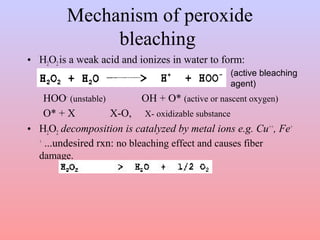
• H2O2is a weak acid and ionizes in water to form:
HOO-
(unstable) OH + O* (active or nascent oxygen)
O* + X X-O, X- oxidizable substance
• H2O2 decomposition is catalyzed by metal ions e.g. Cu++
, Fe+
+
...undesired rxn: no bleaching effect and causes fiber
damage.
(active bleaching
agent)
Calculation of active oxygen
content in H2O2-solutions
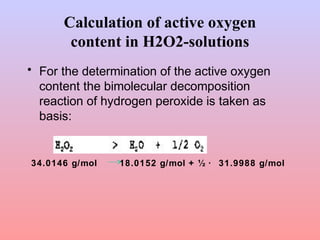
• For the determination of the active oxygen
content the bimolecular decomposition
reaction of hydrogen peroxide is taken as
basis:
34.0146 g/mol 18.0152 g/mol + ½ · 31.9988 g/mol
• Out of 34.0146g H2O2 100 % result from
½ · 31.9988g =15.9994g of so-called
active oxygen.
• The conversion factor of % by weight of
H2O2-solution in active oxygen is the
following:
active oxygen [g/kg] = % in weight H2O2
solution *4.704
Examples:
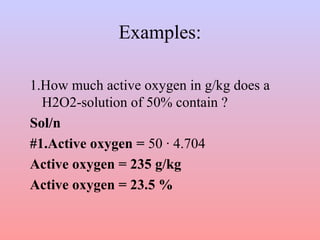
1.How much active oxygen in g/kg does a
H2O2-solution of 50% contain ?
Sol/n
#1.Active oxygen = 50 · 4.704
Active oxygen = 235 g/kg
Active oxygen = 23.5 %
Effect of pH on H2O2
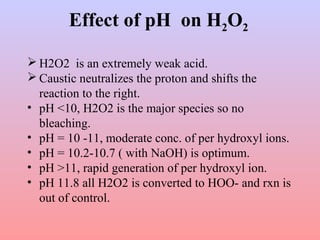
 H2O2 is an extremely weak acid.
 Caustic neutralizes the proton and shifts the
reaction to the right.
• pH <10, H2O2 is the major species so no
bleaching.
• pH = 10 -11, moderate conc. of per hydroxyl ions.
• pH = 10.2-10.7 ( with NaOH) is optimum.
• pH >11, rapid generation of per hydroxyl ion.
• pH 11.8 all H2O2 is converted to HOO- and rxn is
out of control.
Effect of Temperature on H2O2
• Stabilized H2O2does not decompose at high
temperature therefore faster and better
bleaching occurs at 95 to 100 0
C… ideal for
continuous operations.
• Temp - rate of bleaching … but solution
becomes unstable and degradation of cotton
increases.
• Below 80 0
C the evolution of per hydroxyl
ion is very slow so also the rate of
bleaching.
• temp. of bleaching bath time of bleaching
Auxiliaries for Bleaching With
H2O2
1. Stabilizers
• To control the decomposition of H2O2.
Provide buffering action to control the pH
and to complex with trace metals which
catalyze the degradation of the fibers.
Sodium silicate, organic compounds and
phosphates
Cont.
2.Activator: provide alkalinity
 NaOH, Na2
CO3
, Na3
PO4
,etc.
3. Sequestering agent: organic stabilizers or
separate
 EDTA, Sodium hexa meta phosphate.
4. Wetting agent – to provide wetting and
detergency
Scour/ Bleach
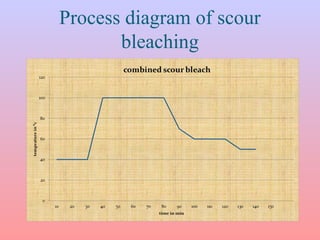
Scour bleaching recipe on jet.
Material to liquor ration:1:6
Wetting agent : 1 gpl
Sequestering agent:1 gpl
Stabilizer :0.2 gpl
Lubricant : 1 gpl
Caustic soda : 2gpl
Hydrogen peroxide:2 gpl
Acetic acid: 0.5 gpl
Peroxide killer:0.5 gpl
Process diagram of scour
bleaching
Common tests should be done after
pretreatment
PH : for reactive dyeing the dye start ph should
be in the range of 5.5-6.5,electronic ph meter of
litmus paper can be used.
Peroxide residue: there shouldn’t be any residual
peroxide for it result in unlevel dyeing. Peroxide
stick can be used.
Hydrophility : water or methyl blue reagent can be
used to under go water drop test. The water
should be absorbed in three seconds time to assure
the fabric for dyeing.
Cont.…
The liquor amount is very important. The pick up,
water used for dye stuff , soda dissolution should
be subtracted from the total liquor volume (fabric
weight*M:L ratio).
Whiteness /refractive index: to check for the
standard whiteness to be achieved before dyeing.
If brilliant white finish is required in textile, then
bleaching is not sufficient. For this purpose
Fluorescent brightening agents are used
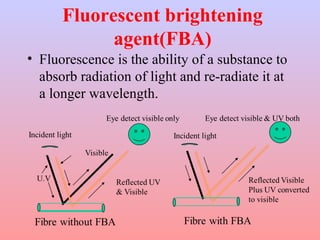
Fluorescent brightening
agent(FBA)
• Fluorescence is the ability of a substance to
absorb radiation of light and re-radiate it at
a longer wavelength.
Mechanism
• OBAs absorb in the UV range (300–400 nm) and re-emit
into longer visible (400–500 nm) wavelengths.
• Optical brighteners increase the apparent reflectance of the
textile in the visible region by converting UV-radiation in
the visible light and so increase the whiteness or
brightness.
Recipe of full bleach
Wetting agent : 1 gpl
Stabilizer : 1gpl
Lubricant : 1 gpl
Hydrogen peroxide( 50 % concentration):4gpl
Caustic soda( flake ) :4 gpl
Optical brighter : 0.3%
Acetic acid :0.5 gpl
Material to liquor ratio: 1:6
Change in properties after bleaching
• Whiteness Increases
• Absorption Increases
• Drop in strength
Relation between Whiteness and
Strength
• Increase in whiteness is directly
proportional to loss in strength. That is
higher the degree of whiteness achieved,
higher will be the loss in strength.
Why loss in Strength after
Bleaching?
• The oxidizing agent not only oxidizes the
natural coloring matter present in cotton but
also oxidizes the cotton cellulose. Thus
cellulose is chemically damaged.
• The chemical damage is seen in terms of
drop in molecular chain length (DP) and
conversion of cellulose into oxy cellulose
What are the adverse effects of
Oxy Cellulose formation?
• Drop in reactive dye up take
• Drop in moisture absorption
• Drop in reactivity
These changes are due to conversion of
hydroxyl groups into carboxyl and aldehyde
groups.
Acceptable quality after bleaching
• Minimum loss in strength – 5 to 10 % depending
upon
– desired degree of whiteness &
– fabric construction (coarse, medium & fine)
• Permanent whiteness – (no yellowness on
exposure to sun light)
• High degree of absorption
• Fluidity less than 4 or 4.5 depending upon
whiteness required
Conversion of g/l into % or %
into g/l
• On discontinuous bleaching proceses (and
of course on dyeing and finishing
processes), the chemicals, auxiliaries,
optical brighteners, dyestuffs etc. are either
stated in percent (%) related to the fabric
weight or in g/l resp. ml/l.
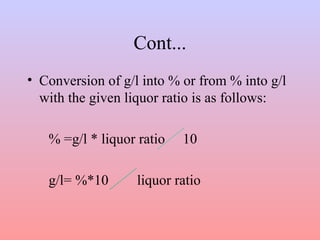
Cont...
• Conversion of g/l into % or from % into g/l
with the given liquor ratio is as follows:
% =g/l * liquor ratio 10
g/l= %*10 liquor ratio
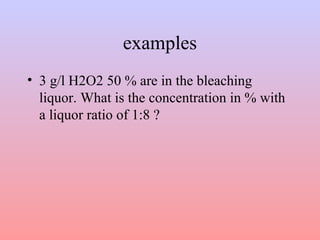
examples
• 3 g/l H2O2 50 % are in the bleaching
liquor. What is the concentration in % with
a liquor ratio of 1:8 ?
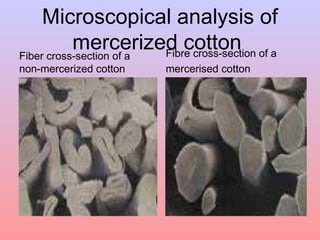
MERCERISATION
• This is the process applicable only on
cellulosic fibers especially cotton
• The main purpose of mercerization is
converting the inter fiber structure from
alpha-cellulose to a thermodynamically
more favorable beta-cellulose polymorph.
Mercerizing results in the swelling of the
cell wall of the cotton fiber. This causes
increase in the surface area and reflectance,
and gives the fiber a softer feel
Microscopical analysis of
mercerized cottonFiber cross-section of a
non-mercerized cotton
Fibre cross-section of a
mercerised cotton

Cotton preparation ppt

  • 1.
    Chemical processing of knittedfabrics BY:OLIYAD EBBA ETHIOPIAN TEXTILE INDUSTRY DEVELOPMENT INSTITUTE
  • 2.
    Features of knitfabric • Knitted fabrics are more elastic and unstable mainly because of the basic element of knitted fabric i.e. loop. • This loop structure made knitted fabric to have the following main properties: • too stretchable and cannot bear any undue tension. • Knitted fabrics are highly elastic but if they are stretched beyond the elastic limits, it is impossible for them to return to stable state and consequently elongation remains. • Knitted fabrics suffer from inherent spirality problem due to the factors such as yarn structure, twist, knit pattern, loose structure and extent of stress applied • knitted fabric is inherently easy to distort such , bow, excessive shrinkage, etc.
  • 3.
    Chemical Processing ofknitted fabrics • Preparatory/pre-treatment Process • Dyeing • Printing • Finishing
  • 4.
    Preparatory/pre-treatment process • What isthe objective of fabric preparation in textile processing?
  • 5.
    Objectives of fabricpreparation: • To remove the natural and added impurities from fibers. • To achieve high and uniform dye uptake • To get required brightness of shade in the fabric after dyeing • To impart good hydrophilic properties combined with high absorbency • To produce acceptable degree of whiteness • It is a process of making the fabric ready for dyeing or printing by mechanical or chemical action.
  • 6.
    • What willhappen if the impurities are not removed properly ?
  • 7.
    …. • If theimpurities are not removed, the material will not be receptive to the subsequent processes – dyeing / printing / finishing. • Impurities are also to be removed to improve the appearance
  • 8.
    What are theseimpurities? • In knitted cotton fabric
  • 9.
    Impurities in knittedcotton fabric • In Fibers – natural impurities such as wax, oils, pectin's, pentose's, vegetable matter and COLOURING MATTER (Yellowish / Brownish) • Processing impurities–traces of lubricants - like oils & greases, rust, dirt, etc.,
  • 10.
    Natural constituents ofraw cotton % by wt. of raw cotton Cellulose 88.0 – 96.0 Nitrogenous matter 1.0 – 1.9 Waxes 0.3 – 1.0 Pectins 0.7 – 1.2 Ash 0.7 – 1.6 Malic, citric and other organic matter 0.5 – 1.0 Total sugars 0.1 – 0.3 Others 0.8 – 0.9 Moisture regain ̃~ 8%
  • 11.
    what are thesteps to be taken before going to wet processing?
  • 12.
    Following are thesteps to be taken: Grey inspection Stitching Shearing and cropping
  • 13.
    GREY FABRIC INSPECTION •Fabric is inspected for defects before it is dyed i.e. grey stage. • Longer yarns can be cut • A record of the defects in a fabric length is kept to determine its quality . • The process of giving points and assigning a quality level is called fabric grading.
  • 14.
    Fabric Stitching • Mostof the machines in preparatory section are huge capacity machines. Therefore to utilize them to its full capacity it is necessary to feed them with suitable lots prepared by stitching together of fabrics from different job orders but of similar quality and same preparatory sequence requirement, thus enabling us to process them in a single batch
  • 15.
    Shearing and cropping •This is used for removing loose yarns of length up to 8cm from the surface of the fabric
  • 16.
    What are thevarious operations in knitted fabric preparatory process?
  • 17.
    The various operationsin knitted preparatory process are: Singeing Heat setting Scouring Bio polishing Bleaching Mercerization
  • 18.
    Singeing • Burning ofprotruding fibers from the surface of fabric or yarn - A mechanical process What it do?
  • 19.
    • Makes fabricssmooth • Prevents pilling • Improves luster
  • 21.
    What should controlduring singeing operation?
  • 22.
    • Intensity anduniformity of flame • Working speed of the fabric to be singed • Effectiveness of singeing : should not add harshness in the fabric • Should not damage the synthetic filament yarn in the fabric • More care should be taken while singeing blended fabrics,
  • 23.
    What is Biopolishing? It is an enzyme treatment designed to improve fabric quality and provide following advantages: • Improve pilling resistance • A clear, lint and fuzz-free surface structure • Improved drape and softness • The effect are durable
  • 24.
    When it shouldbe carried out? • It can be carried out at any time, but after bleaching is most popular • After dyeing shade may be affected
  • 25.
    Process • Cellulase enzymeis used • Enzyme dosage 1-2% owf • pH 4.5-5.5 • Temperature 40-55o C • Time 30-60 min. It is similar to singeing as it also provide similar effect on the fabric
  • 26.
    SCOURING • It isprocess to remove all undesirable impurities except COLOURING MATTER. After scouring, oils and waxes are removed and hence the material becomes receptive to water, dyes and chemicals. In other words, the absorption capacity of the material is improves. • Natural Impurities: Based on the composition of natural material like cotton, wool, silk etc.
  • 27.
  • 28.
    • To makethe fabric highly hydrophilic. • To remove impurities such as oils, waxes, gum, husks as nearly as possible. • To increase absorbency of fabric or textile materials without physical and chemical damage. • To produce a clean material by adding alkali. • To make the fabric ready for next process. • To remove non-cellulosic substance in case of cotton.
  • 29.
    Mechanism: Saponification: The vegetable oil,which is immiscible with water, is glyceride of fatty acids. When such oils are heated with a solution of sodium hydroxide in water, the oil splits up into its constituents-fatty acid and glycerine. Glycerine is miscible with water easily and the fatty acids reacts with sodium hydroxide present in the solution forming its sodium salt i.e.soap which is also soluble in water. Thus oil is removed.
  • 30.
    …cont Emulsification: • Wax andnon saponifiable oils are removed by emulsification as they are immiscible in water. Normal washing soap is used as a emulsifying agent which makes emulsion of them.
  • 31.
    What are thechanges occurring during scouring?
  • 32.
    Changes occurs duringscouring • Saponifiable oils & free fatty acids are converted into soap and glycerol • Pectic substances(pectin, pectose and pectates)converted into soluble salts of pectic or meta pectic acids • Proteins are degraded to simple soluble amino acids
  • 33.
    …Cont • Mineral matteris dissolved • Unsaponifiable oils & waxes are emulsified by soaps • Adventitious dirt is removed and retained in suspension by the soap • Other added impurities are broken down into soluble products
  • 34.
    Scouring process dependson: • The type of cotton. • The color of cotton. • The cleanliness of cotton. • The twist and count of the yarn. • The construction of the fabric. • The shade % and type of shade of finished product
  • 35.
    Chemicals used inscouring process Main chemicals Use Caustic soda Neutralize acidic materials, saponify glycerides (waxes and oil),solubilise silicates Surfactants Reduce surface tension & minimize interfacial tension. Detergents Emulsify oil, fats, waxes and remove oil-borne stains. Chelating agent Deactivate metal ions. Sodium silicate Penetrate & break drown lignins,buffer Sodium sulphite Reduce time of scouring Soda ash Maintain pH Solvent The chlorinated hydrc,trichloro ethyl,perchloro ethyl Assist emulsification by dissolving oily materials.
  • 36.
    Souring: • The treatment/theprocess by which the fabric, after processing with alkali or scouring, is treated with Acetic Acid, Hydrochloric acid or dilute H2SO4 for removing alkali or neutralization of alkali is souring.
  • 37.
    Difference between scouring andsouring Scouring Souring To remove oil, waxes gum soluble impurities. Not to remove any impurities, only for alkali neutralization. Scouring is done in alkali solution. Souring is done dilute HCl or H2SO4 Required heat to boiling. No need of heat. Need of definite time. No need of definite time.
  • 38.
    Bleaching • Natural fibersare off-white in color due to color bodies present in the fiber. • This yellowish and brown discoloration is related to:  flavone pigments of the cotton flower. The climate, soil, drought and frost can also cause various degrees of yellowness. may also come from dirt, dust, insects or from harvesting or processing equipment in the form of oils and greases.
  • 39.
    Objective of bleaching •The object of bleaching is to produce white fabrics by destroying the coloring matter with the help of bleaching agents with minimum degradation of the fiber.
  • 40.
    Mechanism of Bleaching •The mechanism of bleaching is very complicated and not completely understood. • One opinion is that the color producing agents in natural fibers are often organic compounds containing conjugated double bonds. . • The bleaching agents either oxidize or reduce the coloring matter … thus whiteness obtained is of permanent nature. • Oxidative bleaches oxidize color bodies into colorless cpds.
  • 41.
    Discoloration can occurby breaking up the chromosphere, most likely destroying one or more of the double bonds within the conjugated system
  • 42.
    Styles of bleaching •Full Bleach - Full white / Snow white • Half Bleach - to dye light / pale / medium shade. • No Bleach - to dye dark shades.
  • 43.
    Bleaching agents Oxidative bleachesare also known to degrade cellulose so the objective in bleaching is to optimize whitening and minimize fiber damage.
  • 44.
    Bleaching agents… • Oxidativebleaching – the bleaching agent is a chemical reagent which decomposes in alkali solution and produce active oxygen. • The active oxygen is in fact the intrinsic bleaching agent as it will further destroy partly or completely the coloring matter present in the textile material. • Reductive bleaching – the bleaching agent will destroy the coloring matter by reductive reaction of SO2.
  • 45.
    Bleaching with Hypochlorites •Hypochlorite bleaching (OCl- ) is the oldest industrial method of bleaching cotton. • Originally, calcium hypochlorite, Ca(OCl)2 (bleaching powder) was used. • Until 1940 most cotton fabrics were bleached with NaOCl … today only 10 % of the cotton. • It is however the main stay of home laundry bleaching products. • Their use is declining because of anti-chlorine lobby and environmental pressures. • Hypochlorites are excellent cidal agents for mildew and other bacteria and are used as disinfectants and to control bacteria in swimming pools.
  • 46.
    Bleaching with HydrogenPeroxide (H2O2) • By 1940, about 65% and to-day about 90 - 95 % of all cotton and cotton/synthetic blends are bleached with H2O2. • It is available commercially as 35, 50 and 70 % solutions. • It is a corrosive, oxidizing agent which may cause combustion when allowed to dry out on oxidizable organic matter. • H2O2 is an irritant to the skin and mucous membranes and dangerous to the eyes.  H2O2- Ecologically acceptable - Economically feasible
  • 47.
    Cont… • But requirehigher temperature near boiling • Hydrogen peroxide is used along with NaOH (to maintain pH 10-11) Drawback: Poor stability for small amount of Iron and copper present in the textiles or the processing water. Cause catalytically decomposition of the peroxide, This loss of H2O2 mean less available bleaching agent. To prevent it Sodium silicate is used as stabilizer along EDTA.
  • 48.
    Mechanism of peroxide bleaching •H2O2is a weak acid and ionizes in water to form: HOO- (unstable) OH + O* (active or nascent oxygen) O* + X X-O, X- oxidizable substance • H2O2 decomposition is catalyzed by metal ions e.g. Cu++ , Fe+ + ...undesired rxn: no bleaching effect and causes fiber damage. (active bleaching agent)
  • 49.
    Calculation of activeoxygen content in H2O2-solutions • For the determination of the active oxygen content the bimolecular decomposition reaction of hydrogen peroxide is taken as basis: 34.0146 g/mol 18.0152 g/mol + ½ · 31.9988 g/mol
  • 50.
    • Out of34.0146g H2O2 100 % result from ½ · 31.9988g =15.9994g of so-called active oxygen. • The conversion factor of % by weight of H2O2-solution in active oxygen is the following: active oxygen [g/kg] = % in weight H2O2 solution *4.704
  • 51.
    Examples: 1.How much activeoxygen in g/kg does a H2O2-solution of 50% contain ? Sol/n #1.Active oxygen = 50 · 4.704 Active oxygen = 235 g/kg Active oxygen = 23.5 %
  • 52.
    Effect of pHon H2O2  H2O2 is an extremely weak acid.  Caustic neutralizes the proton and shifts the reaction to the right. • pH <10, H2O2 is the major species so no bleaching. • pH = 10 -11, moderate conc. of per hydroxyl ions. • pH = 10.2-10.7 ( with NaOH) is optimum. • pH >11, rapid generation of per hydroxyl ion. • pH 11.8 all H2O2 is converted to HOO- and rxn is out of control.
  • 53.
    Effect of Temperatureon H2O2 • Stabilized H2O2does not decompose at high temperature therefore faster and better bleaching occurs at 95 to 100 0 C… ideal for continuous operations. • Temp - rate of bleaching … but solution becomes unstable and degradation of cotton increases. • Below 80 0 C the evolution of per hydroxyl ion is very slow so also the rate of bleaching. • temp. of bleaching bath time of bleaching
  • 54.
    Auxiliaries for BleachingWith H2O2 1. Stabilizers • To control the decomposition of H2O2. Provide buffering action to control the pH and to complex with trace metals which catalyze the degradation of the fibers. Sodium silicate, organic compounds and phosphates
  • 55.
    Cont. 2.Activator: provide alkalinity NaOH, Na2 CO3 , Na3 PO4 ,etc. 3. Sequestering agent: organic stabilizers or separate  EDTA, Sodium hexa meta phosphate. 4. Wetting agent – to provide wetting and detergency
  • 56.
    Scour/ Bleach Scour bleachingrecipe on jet. Material to liquor ration:1:6 Wetting agent : 1 gpl Sequestering agent:1 gpl Stabilizer :0.2 gpl Lubricant : 1 gpl Caustic soda : 2gpl Hydrogen peroxide:2 gpl Acetic acid: 0.5 gpl Peroxide killer:0.5 gpl
  • 57.
    Process diagram ofscour bleaching
  • 58.
    Common tests shouldbe done after pretreatment PH : for reactive dyeing the dye start ph should be in the range of 5.5-6.5,electronic ph meter of litmus paper can be used. Peroxide residue: there shouldn’t be any residual peroxide for it result in unlevel dyeing. Peroxide stick can be used. Hydrophility : water or methyl blue reagent can be used to under go water drop test. The water should be absorbed in three seconds time to assure the fabric for dyeing.
  • 59.
    Cont.… The liquor amountis very important. The pick up, water used for dye stuff , soda dissolution should be subtracted from the total liquor volume (fabric weight*M:L ratio). Whiteness /refractive index: to check for the standard whiteness to be achieved before dyeing.
  • 60.
    If brilliant whitefinish is required in textile, then bleaching is not sufficient. For this purpose Fluorescent brightening agents are used
  • 61.
    Fluorescent brightening agent(FBA) • Fluorescenceis the ability of a substance to absorb radiation of light and re-radiate it at a longer wavelength.
  • 62.
    Mechanism • OBAs absorbin the UV range (300–400 nm) and re-emit into longer visible (400–500 nm) wavelengths. • Optical brighteners increase the apparent reflectance of the textile in the visible region by converting UV-radiation in the visible light and so increase the whiteness or brightness.
  • 63.
    Recipe of fullbleach Wetting agent : 1 gpl Stabilizer : 1gpl Lubricant : 1 gpl Hydrogen peroxide( 50 % concentration):4gpl Caustic soda( flake ) :4 gpl Optical brighter : 0.3% Acetic acid :0.5 gpl Material to liquor ratio: 1:6
  • 64.
    Change in propertiesafter bleaching • Whiteness Increases • Absorption Increases • Drop in strength
  • 65.
    Relation between Whitenessand Strength • Increase in whiteness is directly proportional to loss in strength. That is higher the degree of whiteness achieved, higher will be the loss in strength.
  • 66.
    Why loss inStrength after Bleaching? • The oxidizing agent not only oxidizes the natural coloring matter present in cotton but also oxidizes the cotton cellulose. Thus cellulose is chemically damaged. • The chemical damage is seen in terms of drop in molecular chain length (DP) and conversion of cellulose into oxy cellulose
  • 67.
    What are theadverse effects of Oxy Cellulose formation? • Drop in reactive dye up take • Drop in moisture absorption • Drop in reactivity These changes are due to conversion of hydroxyl groups into carboxyl and aldehyde groups.
  • 68.
    Acceptable quality afterbleaching • Minimum loss in strength – 5 to 10 % depending upon – desired degree of whiteness & – fabric construction (coarse, medium & fine) • Permanent whiteness – (no yellowness on exposure to sun light) • High degree of absorption • Fluidity less than 4 or 4.5 depending upon whiteness required
  • 69.
    Conversion of g/linto % or % into g/l • On discontinuous bleaching proceses (and of course on dyeing and finishing processes), the chemicals, auxiliaries, optical brighteners, dyestuffs etc. are either stated in percent (%) related to the fabric weight or in g/l resp. ml/l.
  • 70.
    Cont... • Conversion ofg/l into % or from % into g/l with the given liquor ratio is as follows: % =g/l * liquor ratio 10 g/l= %*10 liquor ratio
  • 71.
    examples • 3 g/lH2O2 50 % are in the bleaching liquor. What is the concentration in % with a liquor ratio of 1:8 ?
  • 72.
    MERCERISATION • This isthe process applicable only on cellulosic fibers especially cotton • The main purpose of mercerization is converting the inter fiber structure from alpha-cellulose to a thermodynamically more favorable beta-cellulose polymorph. Mercerizing results in the swelling of the cell wall of the cotton fiber. This causes increase in the surface area and reflectance, and gives the fiber a softer feel
  • 73.
    Microscopical analysis of mercerizedcottonFiber cross-section of a non-mercerized cotton Fibre cross-section of a mercerised cotton