1
1
SCOURING PROCESS OF COTTON FABRIC
LECTURE – 4
By Robel L.
Faculty of Textile and Fashion Technology
Aksum University
2020
3/5/2020
SCOURING
3/5/2020 2
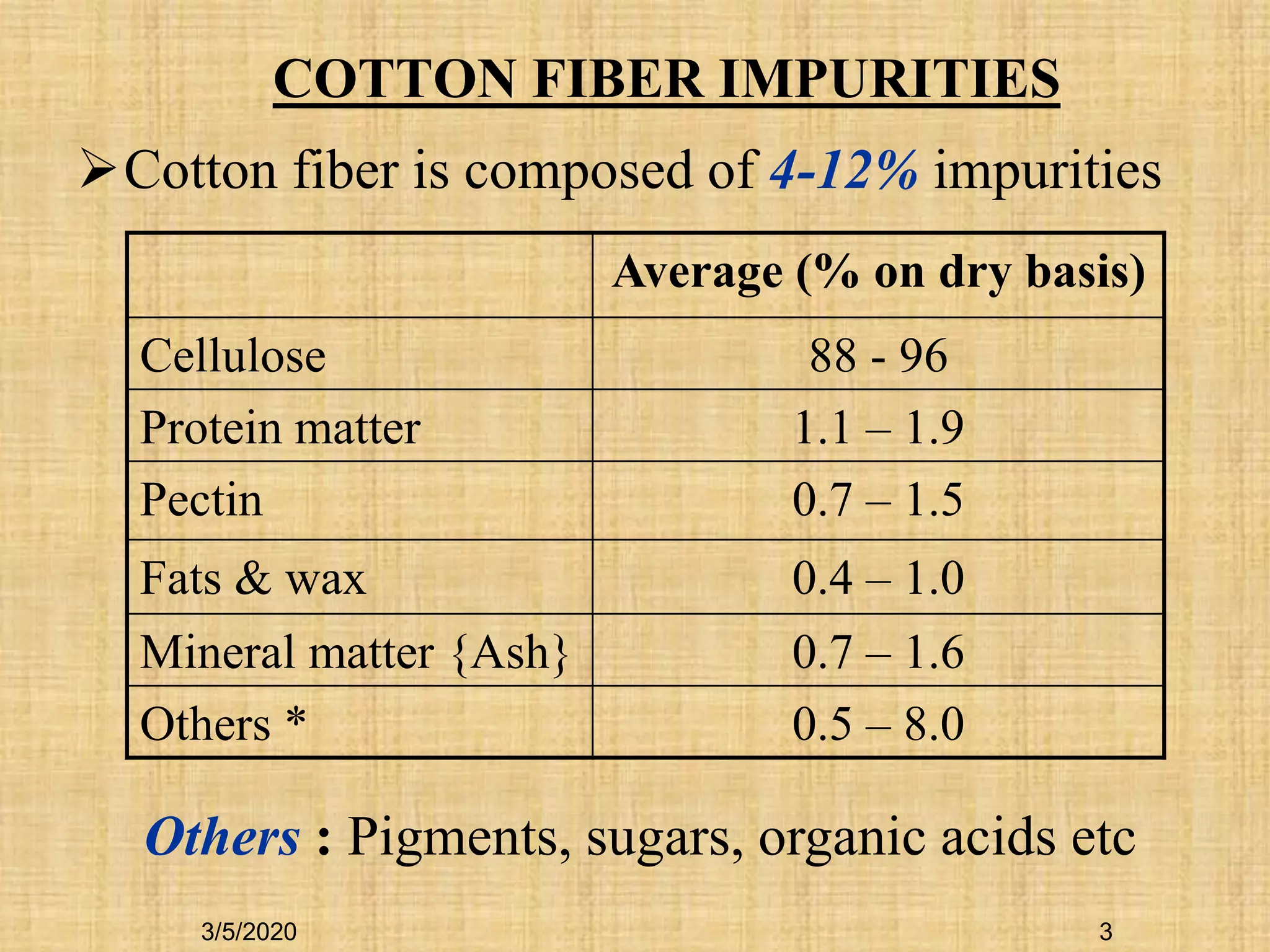
COTTON FIBER IMPURITIES
Cotton fiber is composed of 4-12% impurities
Average (% on dry basis)
Cellulose 88 - 96
Protein matter 1.1 – 1.9
Pectin 0.7 – 1.5
Fats & wax 0.4 – 1.0
Mineral matter {Ash} 0.7 – 1.6
Others * 0.5 – 8.0
Others : Pigments, sugars, organic acids etc
3/5/2020 3
3/5/2020 4
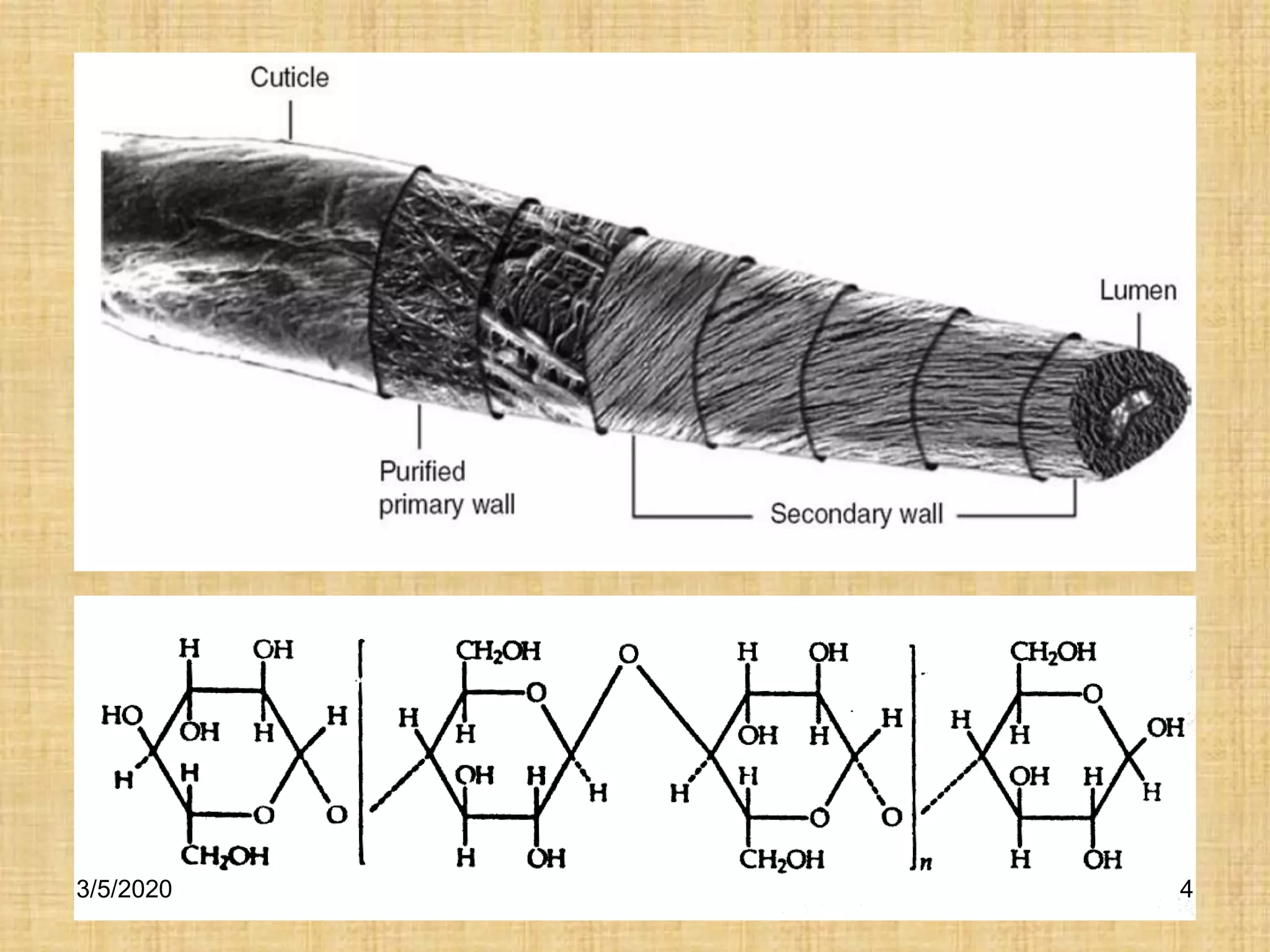
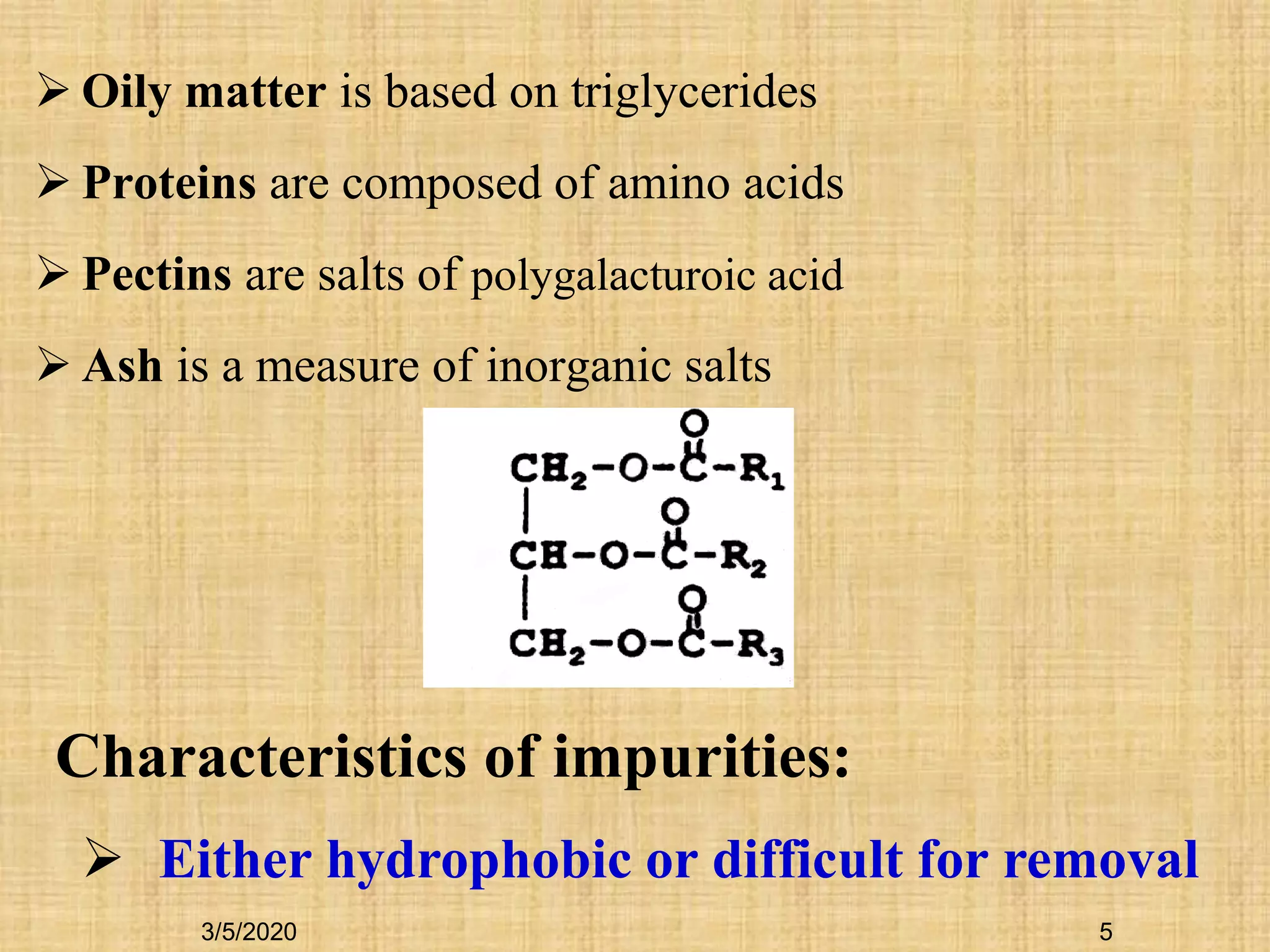
 Oily matter is based on triglycerides
 Proteins are composed of amino acids
 Pectins are salts of polygalacturoic acid
 Ash is a measure of inorganic salts
Characteristics of impurities:
 Either hydrophobic or difficult for removal
3/5/2020 5
SCOURING PROCESS
 The mentioned impurities together with added lubricants are
removed by the so called scouring process.
 In general, scouring removes fat/wax based hydrophobic
impurities & other impurities in association in the fiber.
 Varity of scouring agents can be used for cotton.
 [Alkalis, surfactants, organic solvents]
 The classical scouring method is aqueous alkaline
scouring using caustic soda (NaOH) as alkali.
3/5/2020 6
7
 To remove natural as well as added impurities of
essentially hydrophobic character as completely as
possible.
 To increase absorbency of textile materials.
 To leave the fabric in a highly hydrophilic condition
without undergoing physical or chemical treatment or
damage.
 To make the suitable situation for next bleaching, dyeing,
printing, and finishing process.
Objective of scouring
3/5/2020
8
Method of scouring
 Aqueous scouring
 Solvent scouring
AQUEOUS ALKALINE SCOURING
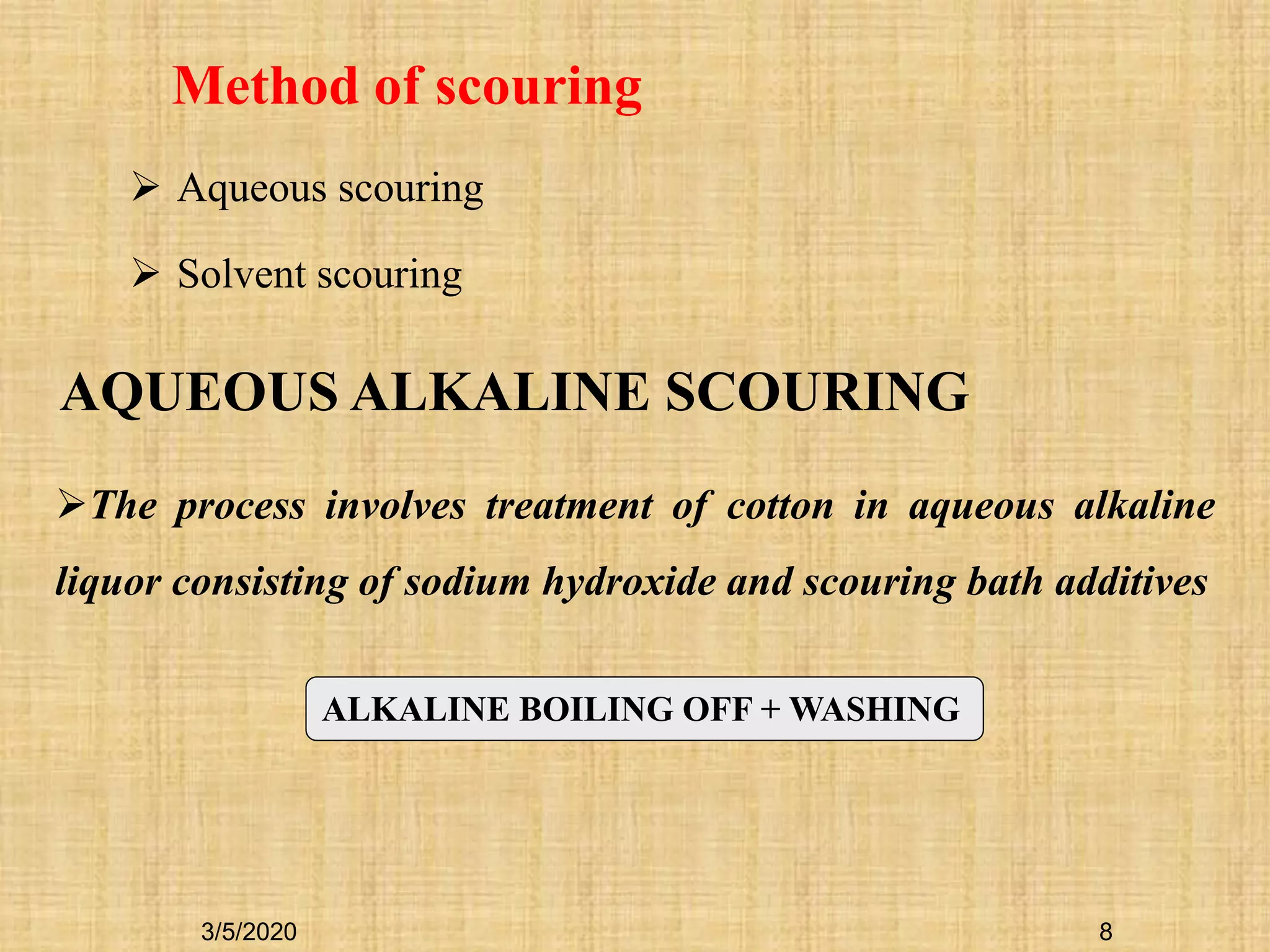
The process involves treatment of cotton in aqueous alkaline
liquor consisting of sodium hydroxide and scouring bath additives
ALKALINE BOILING OFF + WASHING
3/5/2020
9
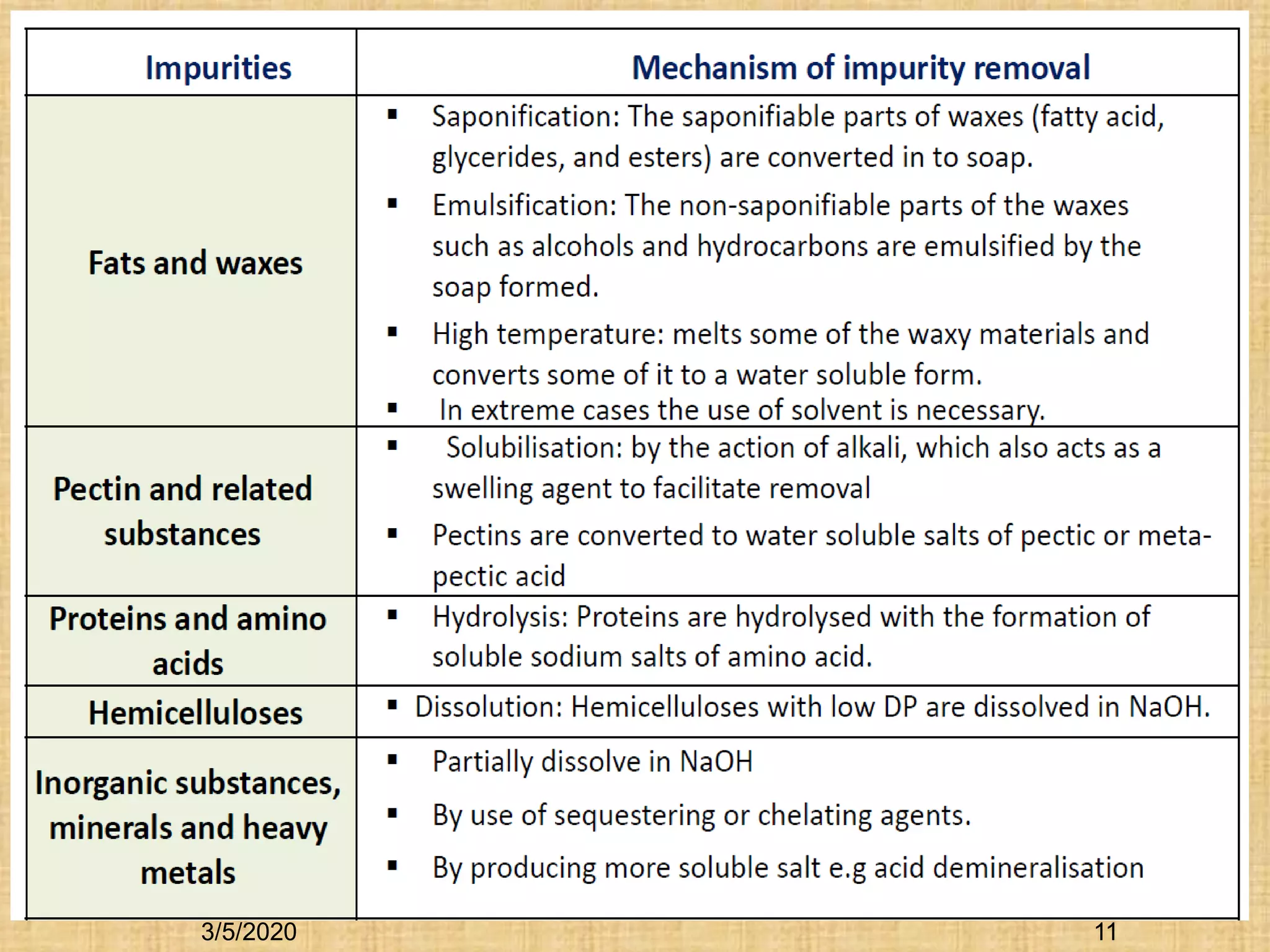
Mechanism of impurity removal
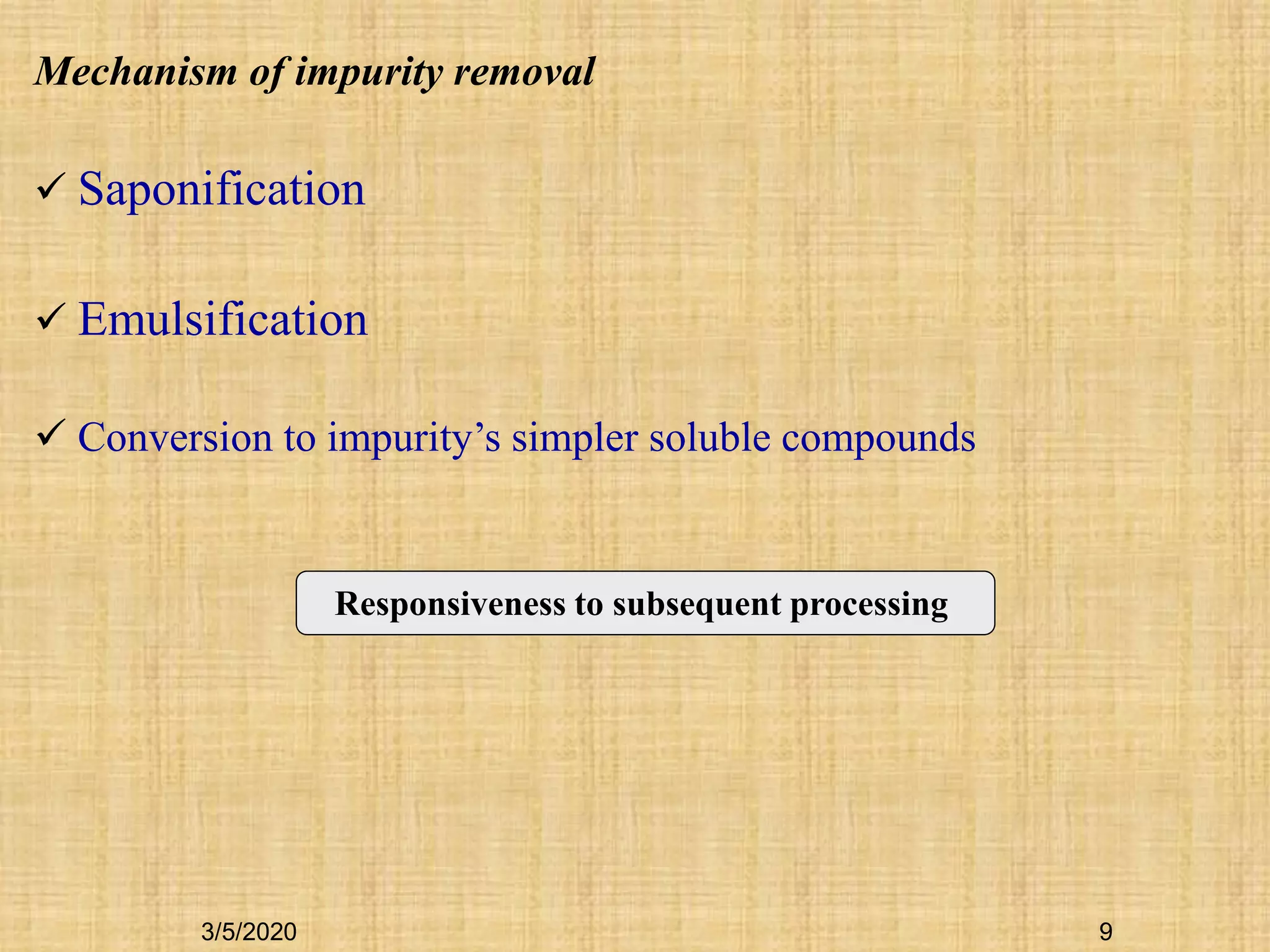
 Saponification
 Emulsification
 Conversion to impurity’s simpler soluble compounds
Responsiveness to subsequent processing
3/5/2020
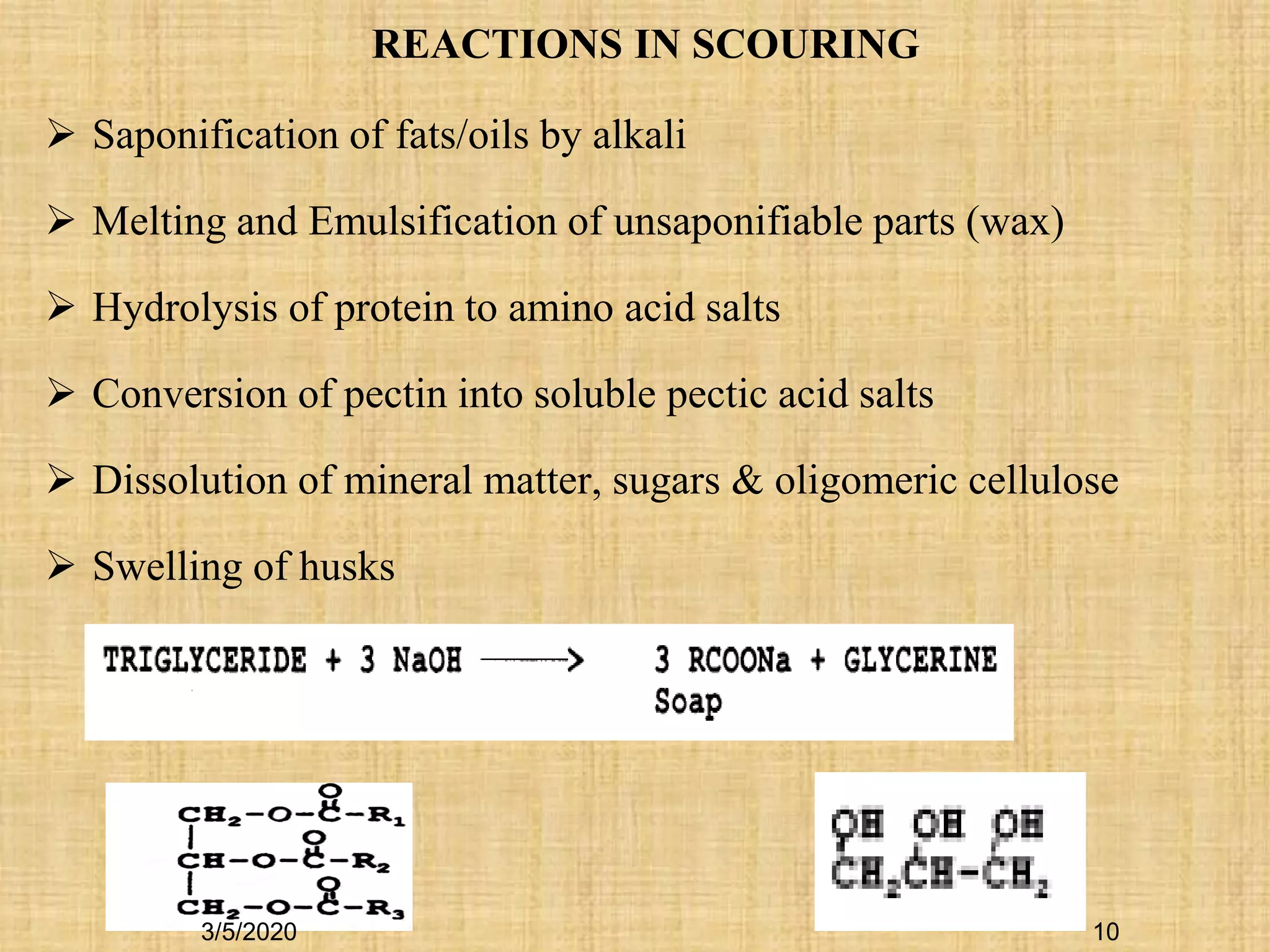
 Saponification of fats/oils by alkali
 Melting and Emulsification of unsaponifiable parts (wax)
 Hydrolysis of protein to amino acid salts
 Conversion of pectin into soluble pectic acid salts
 Dissolution of mineral matter, sugars & oligomeric cellulose
 Swelling of husks
REACTIONS IN SCOURING
3/5/2020 10
11
3/5/2020
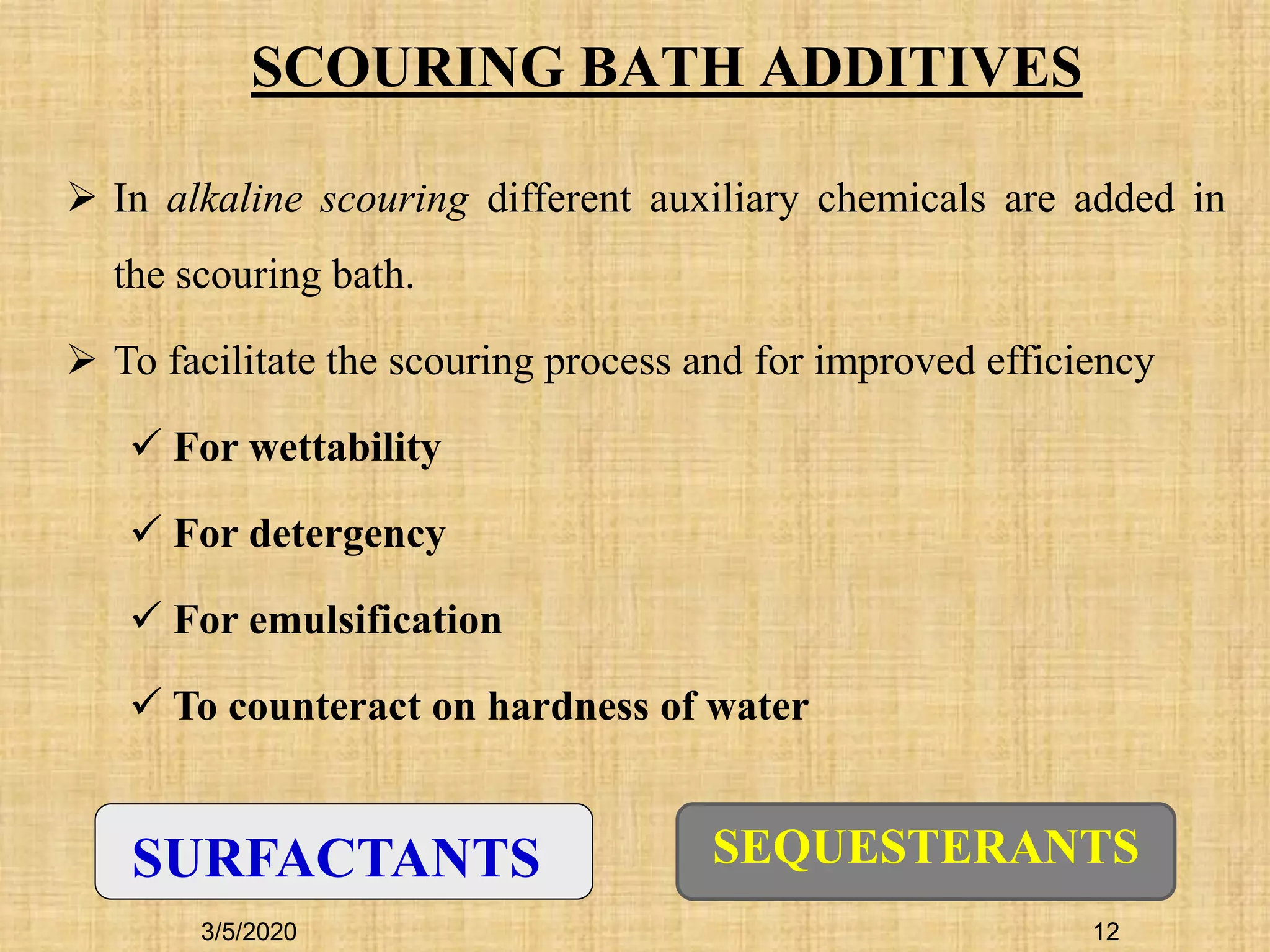
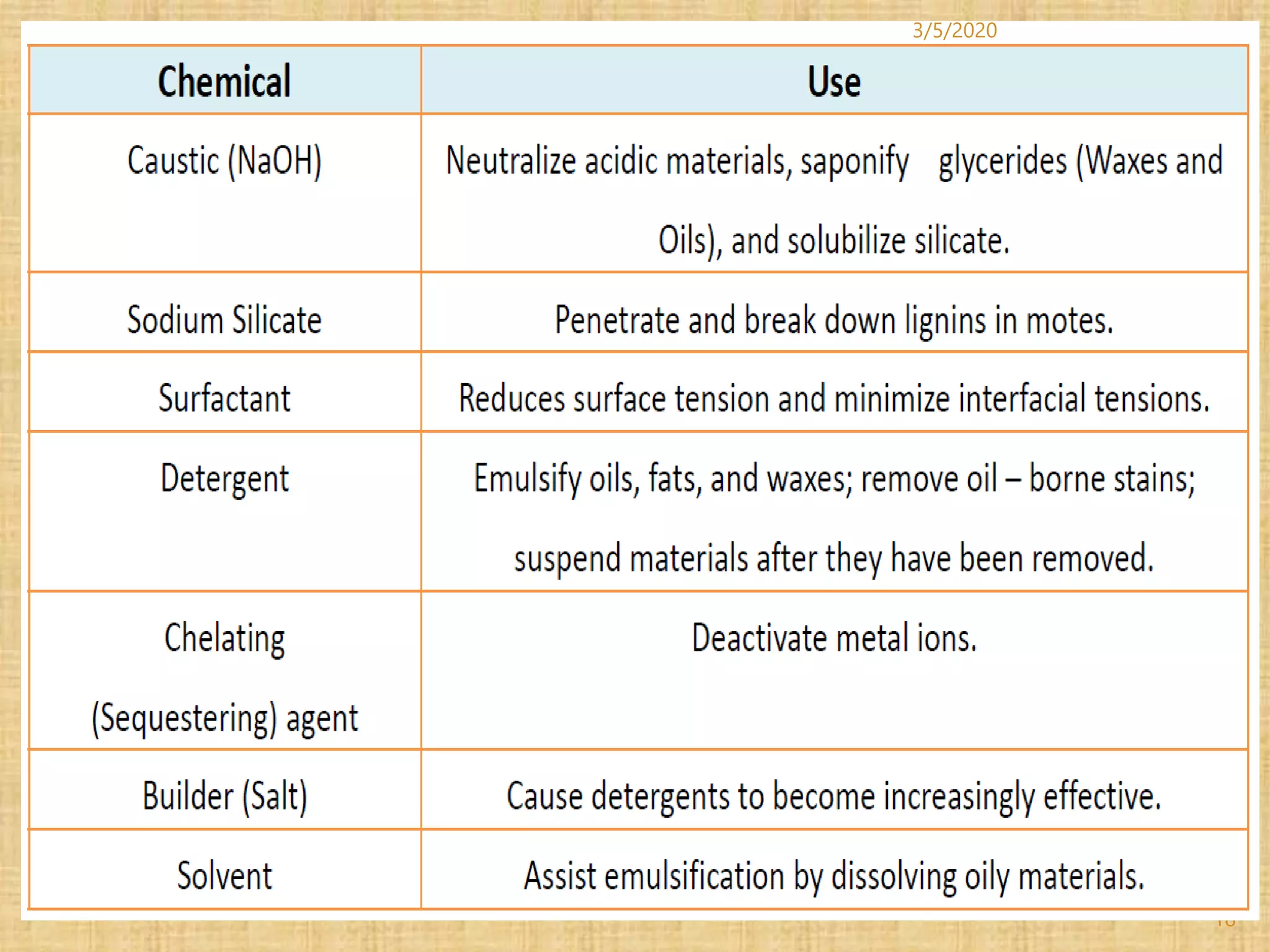
SCOURING BATH ADDITIVES
SURFACTANTS SEQUESTERANTS
 In alkaline scouring different auxiliary chemicals are added in
the scouring bath.
 To facilitate the scouring process and for improved efficiency
 For wettability
 For detergency
 For emulsification
 To counteract on hardness of water
3/5/2020 12
13
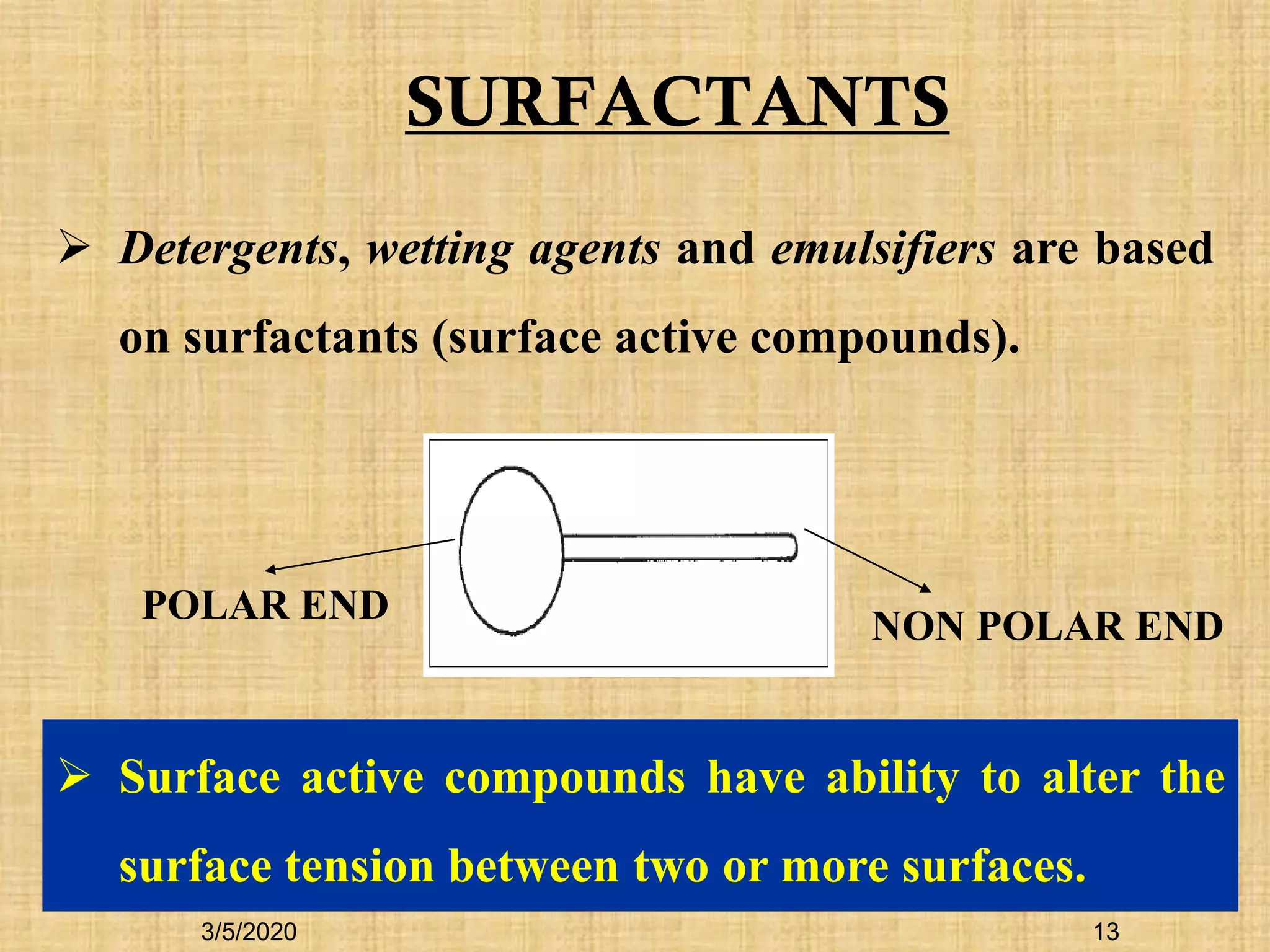
POLAR END NON POLAR END
 Detergents, wetting agents and emulsifiers are based
on surfactants (surface active compounds).
SURFACTANTS
 Surface active compounds have ability to alter the
surface tension between two or more surfaces.
3/5/2020
14
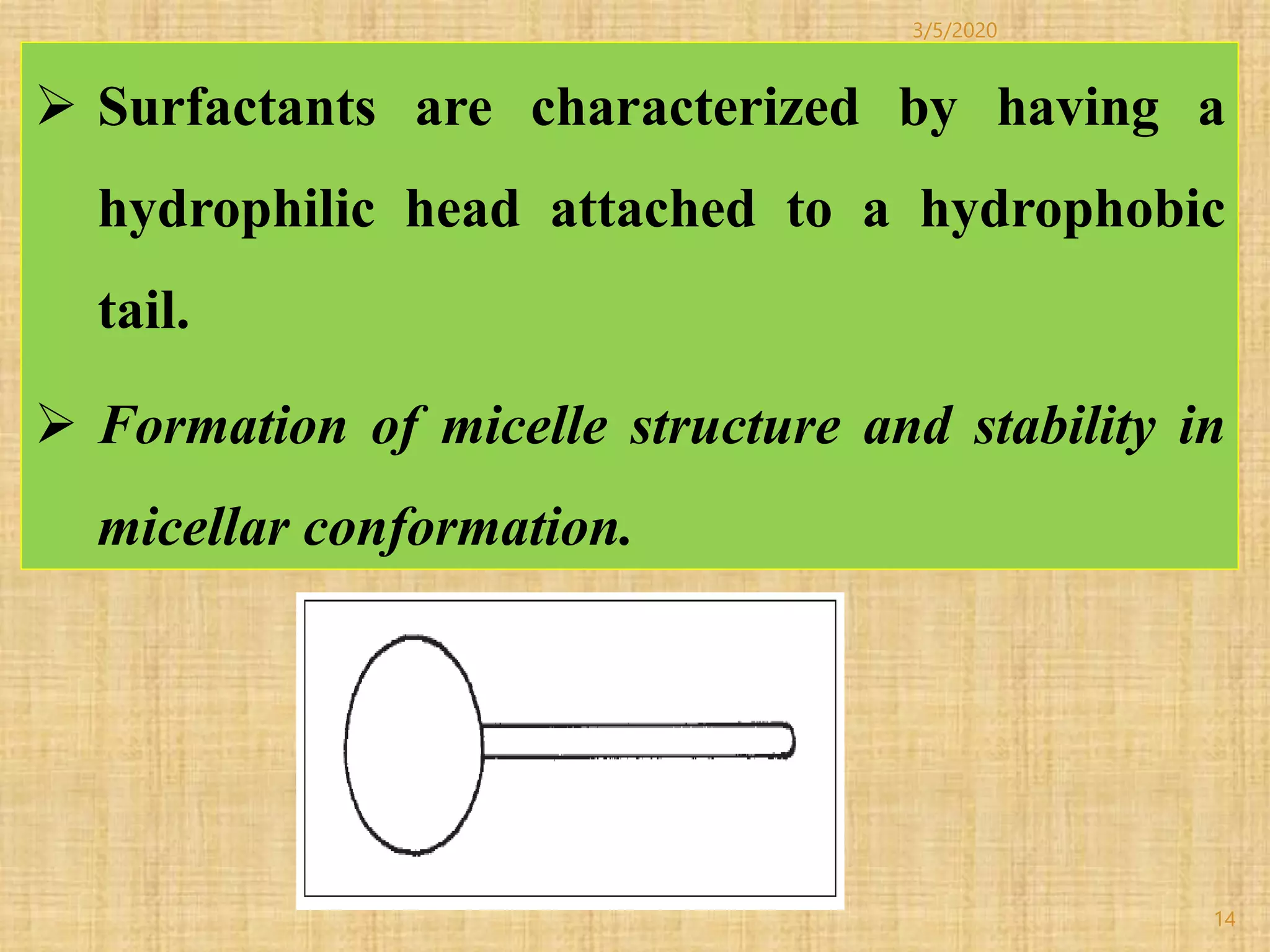
 Surfactants are characterized by having a
hydrophilic head attached to a hydrophobic
tail.
 Formation of micelle structure and stability in
micellar conformation.
3/5/2020
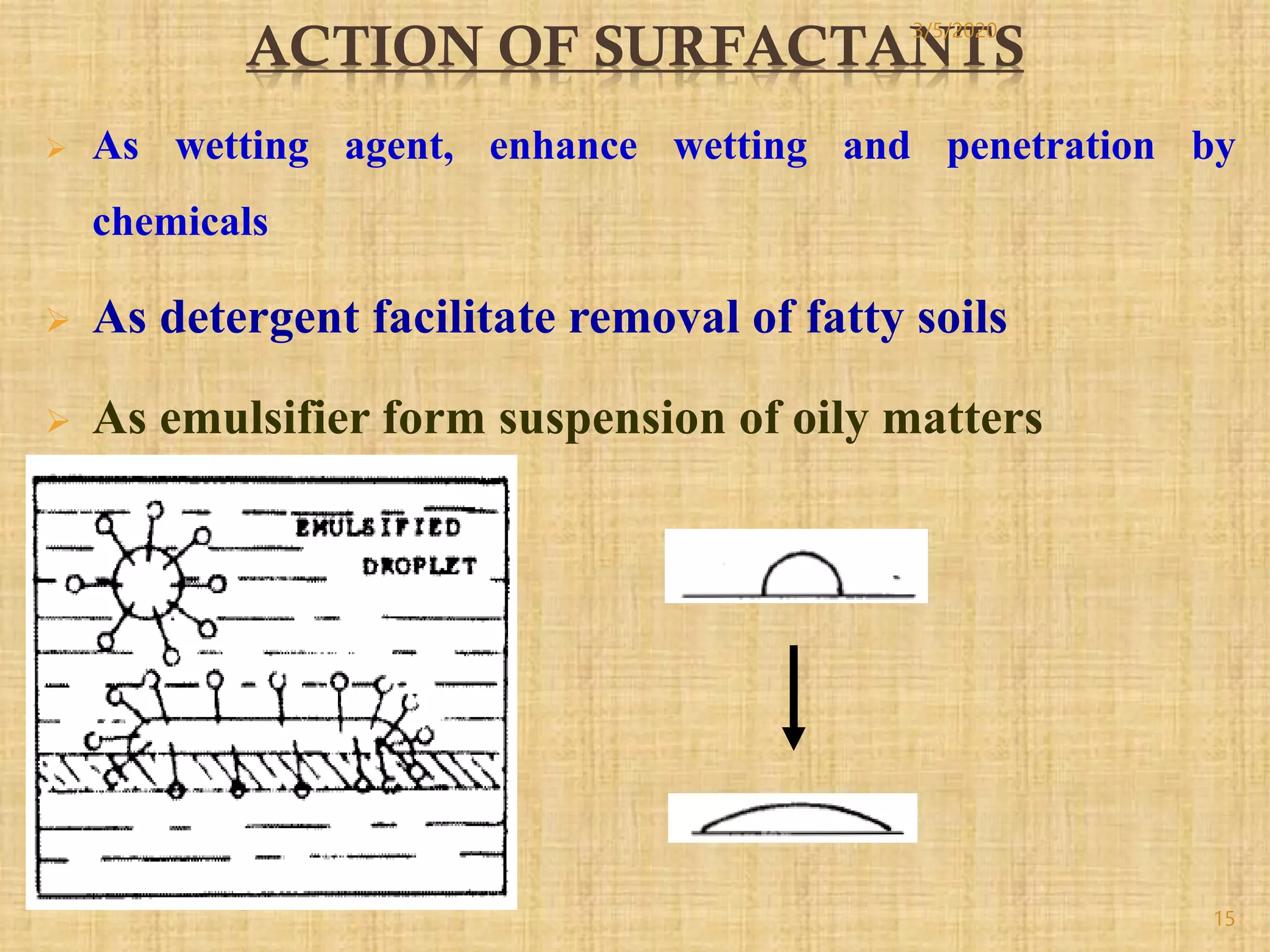
 As wetting agent, enhance wetting and penetration by
chemicals
 As detergent facilitate removal of fatty soils
 As emulsifier form suspension of oily matters
ACTION OF SURFACTANTS
3/5/2020
15
SEQUESTERANTS
 Metal ions in water interfere with smooth alkaline
scouring
 Polyvalent metal ions in water
 Sequesterants are used for removing metal ions
 Complexing or chelating agents remove polyvalent metal
ions from water during scouring process
 Examples: EDTA (Ethylene diamine tetracetic acid),
Polyphosphates
Water Hardness
3/5/2020
16
17
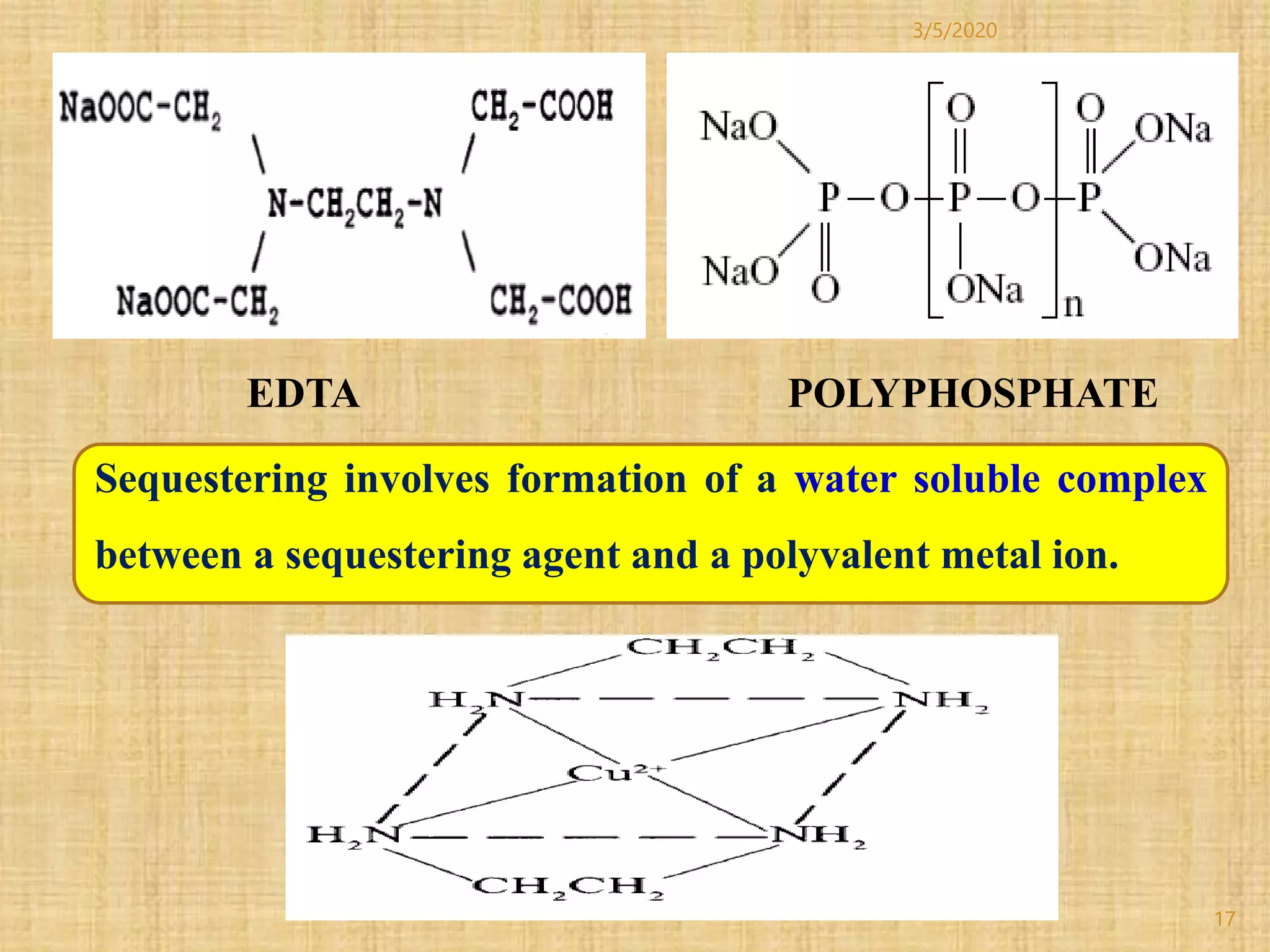
Sequestering involves formation of a water soluble complex
between a sequestering agent and a polyvalent metal ion.
EDTA POLYPHOSPHATE
3/5/2020
18
3/5/2020
19
 Concentration of alkali
 Temperature
Time
 Type and amount of additives
 Machine type [Material liquor ratio, MLR]
AQUEOUS ALKALINE SCORING CONTROLLING PARAMETERS
3/5/2020
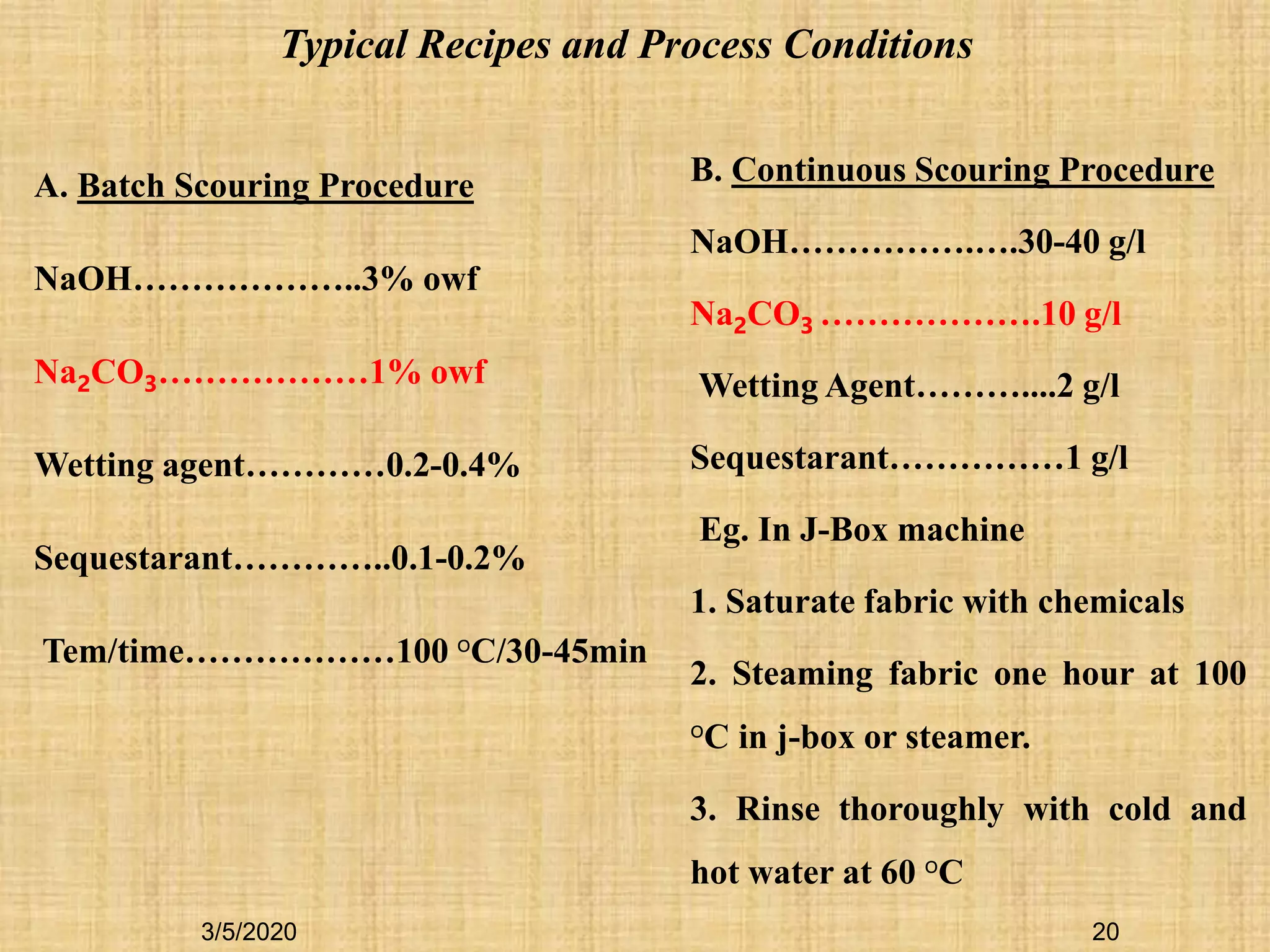
A. Batch Scouring Procedure
NaOH………………..3% owf
Na2CO3………………1% owf
Wetting agent…………0.2-0.4%
Sequestarant…………..0.1-0.2%
Tem/time………………100 oC/30-45min
Typical Recipes and Process Conditions
B. Continuous Scouring Procedure
NaOH…………….….30-40 g/l
Na2CO3 ……………….10 g/l
Wetting Agent………....2 g/l
Sequestarant……………1 g/l
Eg. In J-Box machine
1. Saturate fabric with chemicals
2. Steaming fabric one hour at 100
oC in j-box or steamer.
3. Rinse thoroughly with cold and
hot water at 60 oC
3/5/2020 20
21
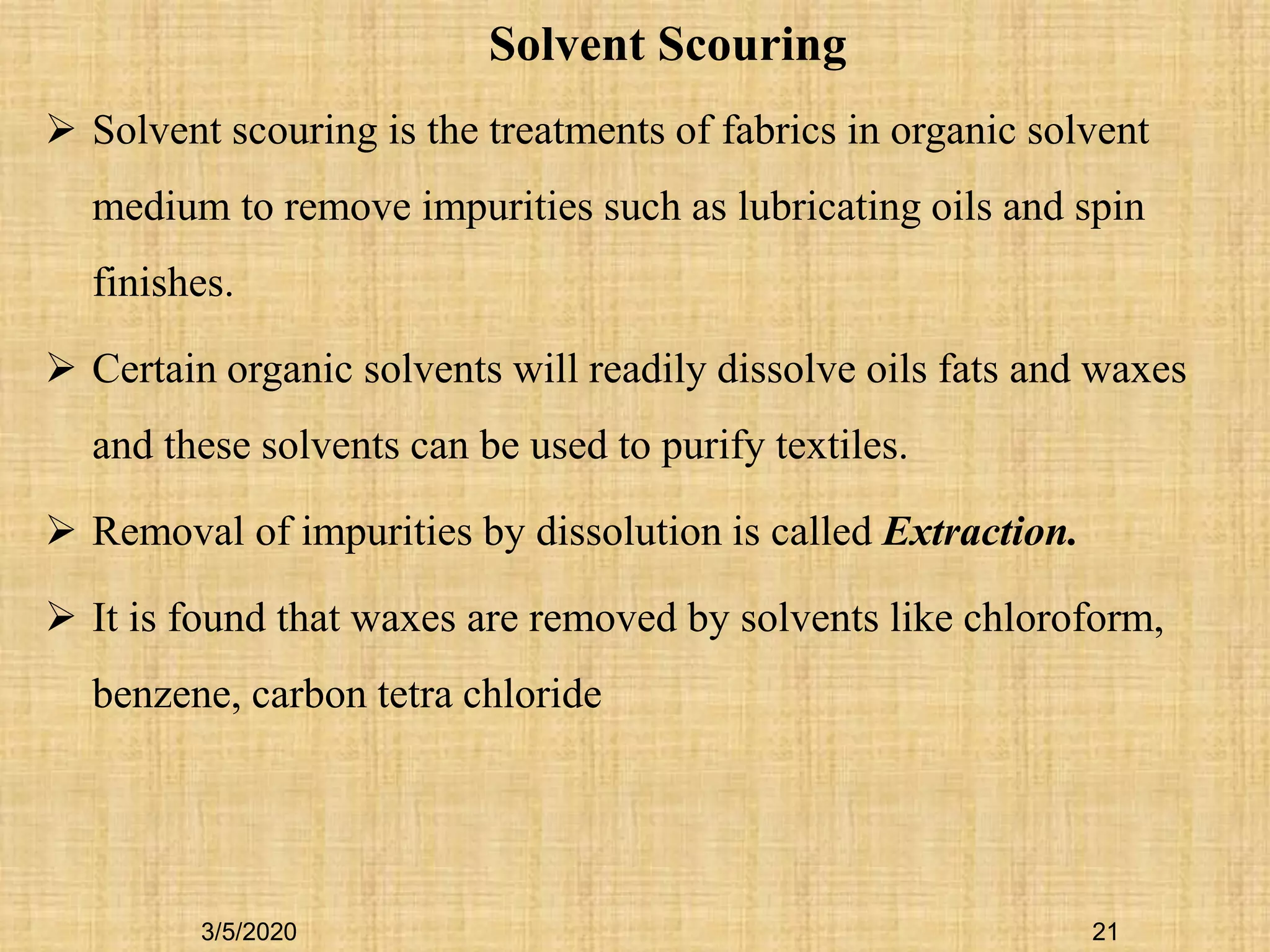
Solvent Scouring
 Solvent scouring is the treatments of fabrics in organic solvent
medium to remove impurities such as lubricating oils and spin
finishes.
 Certain organic solvents will readily dissolve oils fats and waxes
and these solvents can be used to purify textiles.
 Removal of impurities by dissolution is called Extraction.
 It is found that waxes are removed by solvents like chloroform,
benzene, carbon tetra chloride
3/5/2020
22
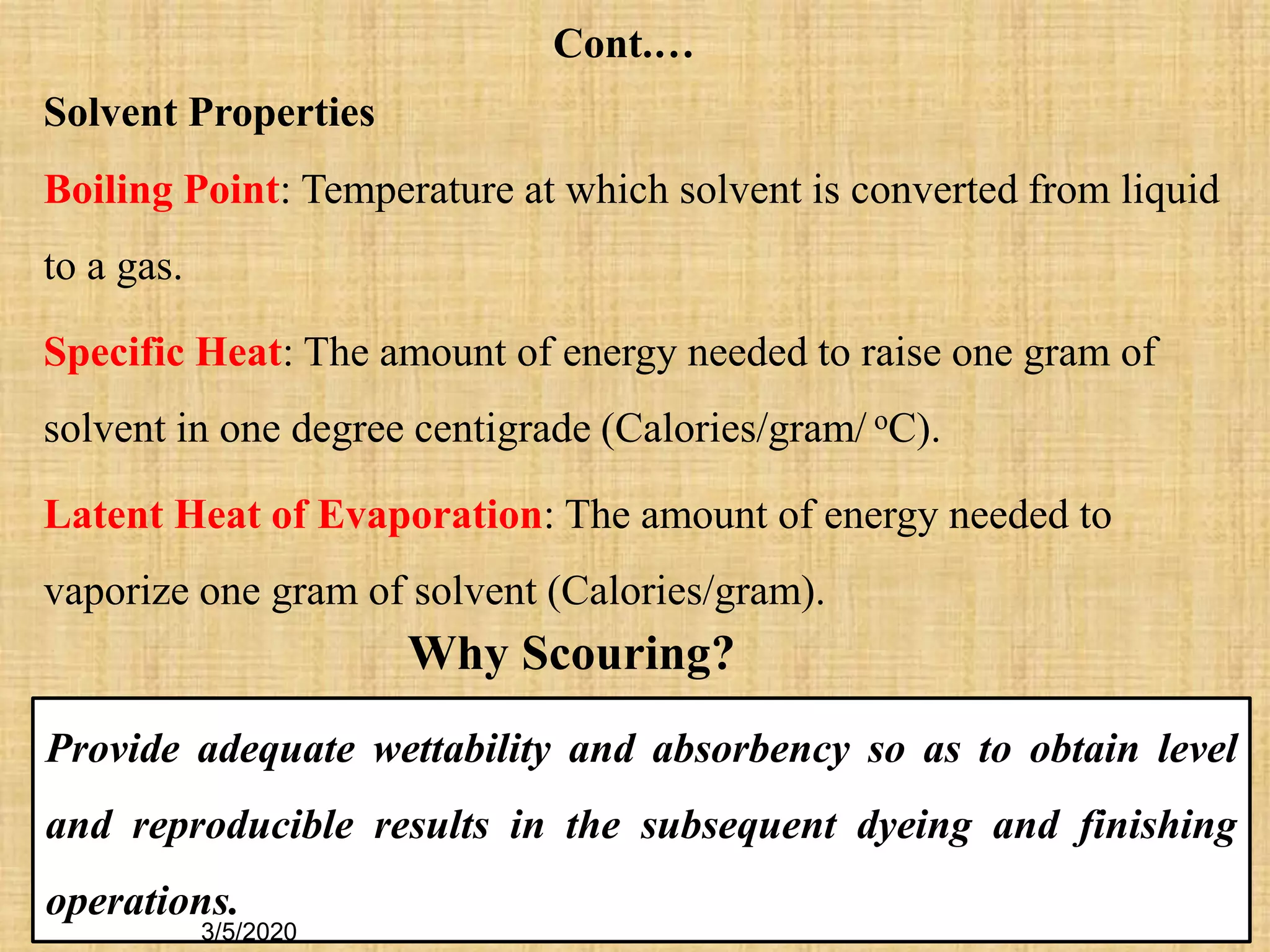
Provide adequate wettability and absorbency so as to obtain level
and reproducible results in the subsequent dyeing and finishing
operations.
Solvent Properties
Boiling Point: Temperature at which solvent is converted from liquid
to a gas.
Specific Heat: The amount of energy needed to raise one gram of
solvent in one degree centigrade (Calories/gram/ oC).
Latent Heat of Evaporation: The amount of energy needed to
vaporize one gram of solvent (Calories/gram).
Why Scouring?
Cont.…
3/5/2020
TEST FOR SCOURING EFFICIENCY
 Scouring efficiency is measured by absorbency
Drop test
Capillary action in fixed time
Sinking test
 A drop of water is placed on fabric and the time it takes for the
drop to penetrate fabric is recorded.
 The faster the wetting time, the more absorbent the
fabric.
3/5/2020 23
24
END
3/5/2020

Scouring lecture 4

  • 1.
    1 1 SCOURING PROCESS OFCOTTON FABRIC LECTURE – 4 By Robel L. Faculty of Textile and Fashion Technology Aksum University 2020 3/5/2020
  • 2.
  • 3.
    COTTON FIBER IMPURITIES Cottonfiber is composed of 4-12% impurities Average (% on dry basis) Cellulose 88 - 96 Protein matter 1.1 – 1.9 Pectin 0.7 – 1.5 Fats & wax 0.4 – 1.0 Mineral matter {Ash} 0.7 – 1.6 Others * 0.5 – 8.0 Others : Pigments, sugars, organic acids etc 3/5/2020 3
  • 4.
  • 5.
     Oily matteris based on triglycerides  Proteins are composed of amino acids  Pectins are salts of polygalacturoic acid  Ash is a measure of inorganic salts Characteristics of impurities:  Either hydrophobic or difficult for removal 3/5/2020 5
  • 6.
    SCOURING PROCESS  Thementioned impurities together with added lubricants are removed by the so called scouring process.  In general, scouring removes fat/wax based hydrophobic impurities & other impurities in association in the fiber.  Varity of scouring agents can be used for cotton.  [Alkalis, surfactants, organic solvents]  The classical scouring method is aqueous alkaline scouring using caustic soda (NaOH) as alkali. 3/5/2020 6
  • 7.
    7  To removenatural as well as added impurities of essentially hydrophobic character as completely as possible.  To increase absorbency of textile materials.  To leave the fabric in a highly hydrophilic condition without undergoing physical or chemical treatment or damage.  To make the suitable situation for next bleaching, dyeing, printing, and finishing process. Objective of scouring 3/5/2020
  • 8.
    8 Method of scouring Aqueous scouring  Solvent scouring AQUEOUS ALKALINE SCOURING The process involves treatment of cotton in aqueous alkaline liquor consisting of sodium hydroxide and scouring bath additives ALKALINE BOILING OFF + WASHING 3/5/2020
  • 9.
    9 Mechanism of impurityremoval  Saponification  Emulsification  Conversion to impurity’s simpler soluble compounds Responsiveness to subsequent processing 3/5/2020
  • 10.
     Saponification offats/oils by alkali  Melting and Emulsification of unsaponifiable parts (wax)  Hydrolysis of protein to amino acid salts  Conversion of pectin into soluble pectic acid salts  Dissolution of mineral matter, sugars & oligomeric cellulose  Swelling of husks REACTIONS IN SCOURING 3/5/2020 10
  • 11.
  • 12.
    SCOURING BATH ADDITIVES SURFACTANTSSEQUESTERANTS  In alkaline scouring different auxiliary chemicals are added in the scouring bath.  To facilitate the scouring process and for improved efficiency  For wettability  For detergency  For emulsification  To counteract on hardness of water 3/5/2020 12
  • 13.
    13 POLAR END NONPOLAR END  Detergents, wetting agents and emulsifiers are based on surfactants (surface active compounds). SURFACTANTS  Surface active compounds have ability to alter the surface tension between two or more surfaces. 3/5/2020
  • 14.
    14  Surfactants arecharacterized by having a hydrophilic head attached to a hydrophobic tail.  Formation of micelle structure and stability in micellar conformation. 3/5/2020
  • 15.
     As wettingagent, enhance wetting and penetration by chemicals  As detergent facilitate removal of fatty soils  As emulsifier form suspension of oily matters ACTION OF SURFACTANTS 3/5/2020 15
  • 16.
    SEQUESTERANTS  Metal ionsin water interfere with smooth alkaline scouring  Polyvalent metal ions in water  Sequesterants are used for removing metal ions  Complexing or chelating agents remove polyvalent metal ions from water during scouring process  Examples: EDTA (Ethylene diamine tetracetic acid), Polyphosphates Water Hardness 3/5/2020 16
  • 17.
    17 Sequestering involves formationof a water soluble complex between a sequestering agent and a polyvalent metal ion. EDTA POLYPHOSPHATE 3/5/2020
  • 18.
  • 19.
    19  Concentration ofalkali  Temperature Time  Type and amount of additives  Machine type [Material liquor ratio, MLR] AQUEOUS ALKALINE SCORING CONTROLLING PARAMETERS 3/5/2020
  • 20.
    A. Batch ScouringProcedure NaOH………………..3% owf Na2CO3………………1% owf Wetting agent…………0.2-0.4% Sequestarant…………..0.1-0.2% Tem/time………………100 oC/30-45min Typical Recipes and Process Conditions B. Continuous Scouring Procedure NaOH…………….….30-40 g/l Na2CO3 ……………….10 g/l Wetting Agent………....2 g/l Sequestarant……………1 g/l Eg. In J-Box machine 1. Saturate fabric with chemicals 2. Steaming fabric one hour at 100 oC in j-box or steamer. 3. Rinse thoroughly with cold and hot water at 60 oC 3/5/2020 20
  • 21.
    21 Solvent Scouring  Solventscouring is the treatments of fabrics in organic solvent medium to remove impurities such as lubricating oils and spin finishes.  Certain organic solvents will readily dissolve oils fats and waxes and these solvents can be used to purify textiles.  Removal of impurities by dissolution is called Extraction.  It is found that waxes are removed by solvents like chloroform, benzene, carbon tetra chloride 3/5/2020
  • 22.
    22 Provide adequate wettabilityand absorbency so as to obtain level and reproducible results in the subsequent dyeing and finishing operations. Solvent Properties Boiling Point: Temperature at which solvent is converted from liquid to a gas. Specific Heat: The amount of energy needed to raise one gram of solvent in one degree centigrade (Calories/gram/ oC). Latent Heat of Evaporation: The amount of energy needed to vaporize one gram of solvent (Calories/gram). Why Scouring? Cont.… 3/5/2020
  • 23.
    TEST FOR SCOURINGEFFICIENCY  Scouring efficiency is measured by absorbency Drop test Capillary action in fixed time Sinking test  A drop of water is placed on fabric and the time it takes for the drop to penetrate fabric is recorded.  The faster the wetting time, the more absorbent the fabric. 3/5/2020 23
  • 24.