Amanuzzaman
ID- 69/17
Level 2, Term 1
Welcome
To My
Presentation Shyamoli Textile Engineering College
SCOURING
A
ch
ve
at,
to
an
he
g
B
C
SCOURING
A
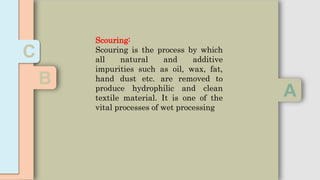
Scouring:
Scouring is the process by which
all natural and additive
impurities such as oil, wax, fat,
hand dust etc. are removed to
produce hydrophilic and clean
textile material. It is one of the
vital processes of wet processing
B
C
SCOURING
A
Scouring:
Scouring is the process by which
all natural and additive
impurities such as oil, wax, fat,
hand dust etc. are removed to
produce hydrophilic and clean
textile material. It is one of the
vital processes of wet processing
B
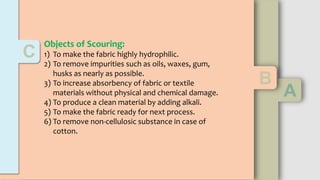
Objects of Scouring:
1) To make the fabric highly hydrophilic.
2) To remove impurities such as oils, waxes, gum,
husks as nearly as possible.
3) To increase absorbency of fabric or textile
materials without physical and chemical damage.
4) To produce a clean material by adding alkali.
5) To make the fabric ready for next process.
6) To remove non-cellulosic substance in case of
cotton.
C
SCOURING
A
Scouring:
Scouring is the process by which
all natural and additive
impurities such as oil, wax, fat,
hand dust etc. are removed to
produce hydrophilic and clean
textile material. It is one of the
vital processes of wet processing
B
Objects of Scouring:
1) To make the fabric highly hydrophilic.
2) To remove impurities such as oils, waxes, gum,
husks as nearly as possible.
3) To increase absorbency of fabric or textile
materials without physical and chemical damage.
4) To produce a clean material by adding alkali.
5) To make the fabric ready for next process.
6) To remove non-cellulosic substance in case of
cotton.
CScouring process depends on:
The type of cotton.
The color of cotton.
The cleanliness of cotton.
The twist and count of the yarn.
The construction of the fabric.
The shade % and type of shade of finished product.
4321
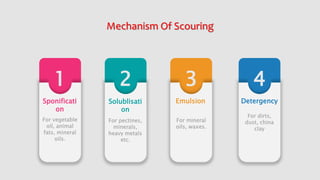
Sponificati
on
For vegetable
oil, animal
fats, mineral
oils.
Solublisati
on
For pectines,
minerals,
heavy metals
etc.
Emulsion
For mineral
oils, waxes.
Detergency
For dirts,
dust, china
clay
Mechanism Of Scouring
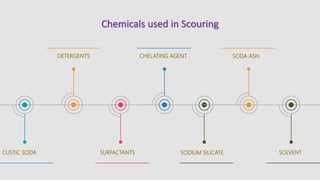
Chemicals used in Scouring
CUSTIC SODA
DETERGENTS
SURFACTANTS
CHELATING AGENT
SODIUM SILICATE
SODA ASH
SOLVENT
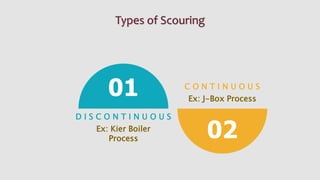
02
01
D I S C O N T I N U O U S
Ex: Kier Boiler
Process
C O N T I N U O U S
Ex: J-Box Process
Types of Scouring
Working principle Kier Boiler Process:
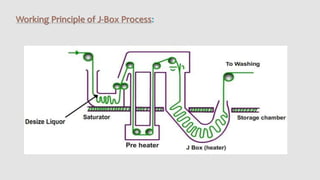
Working Principle of J-Box Process:
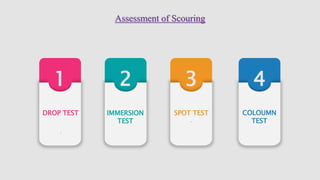
4321
DROP TEST
.
IMMERSION
TEST
SPOT TEST
.
COLOUMN
TEST
Assessment of Scouring
Advantage of Scouring
• The process is a continuous process. So consumes less time
• The process is economical
• Scouring, desizing and bleaching performed at a time
THANK
YOU

Presentation on Textile Scouring

  • 1.
    Amanuzzaman ID- 69/17 Level 2,Term 1 Welcome To My Presentation Shyamoli Textile Engineering College
  • 2.
  • 3.
    SCOURING A Scouring: Scouring is theprocess by which all natural and additive impurities such as oil, wax, fat, hand dust etc. are removed to produce hydrophilic and clean textile material. It is one of the vital processes of wet processing B C
  • 4.
    SCOURING A Scouring: Scouring is theprocess by which all natural and additive impurities such as oil, wax, fat, hand dust etc. are removed to produce hydrophilic and clean textile material. It is one of the vital processes of wet processing B Objects of Scouring: 1) To make the fabric highly hydrophilic. 2) To remove impurities such as oils, waxes, gum, husks as nearly as possible. 3) To increase absorbency of fabric or textile materials without physical and chemical damage. 4) To produce a clean material by adding alkali. 5) To make the fabric ready for next process. 6) To remove non-cellulosic substance in case of cotton. C
  • 5.
    SCOURING A Scouring: Scouring is theprocess by which all natural and additive impurities such as oil, wax, fat, hand dust etc. are removed to produce hydrophilic and clean textile material. It is one of the vital processes of wet processing B Objects of Scouring: 1) To make the fabric highly hydrophilic. 2) To remove impurities such as oils, waxes, gum, husks as nearly as possible. 3) To increase absorbency of fabric or textile materials without physical and chemical damage. 4) To produce a clean material by adding alkali. 5) To make the fabric ready for next process. 6) To remove non-cellulosic substance in case of cotton. CScouring process depends on: The type of cotton. The color of cotton. The cleanliness of cotton. The twist and count of the yarn. The construction of the fabric. The shade % and type of shade of finished product.
  • 6.
    4321 Sponificati on For vegetable oil, animal fats,mineral oils. Solublisati on For pectines, minerals, heavy metals etc. Emulsion For mineral oils, waxes. Detergency For dirts, dust, china clay Mechanism Of Scouring
  • 7.
    Chemicals used inScouring CUSTIC SODA DETERGENTS SURFACTANTS CHELATING AGENT SODIUM SILICATE SODA ASH SOLVENT
  • 8.
    02 01 D I SC O N T I N U O U S Ex: Kier Boiler Process C O N T I N U O U S Ex: J-Box Process Types of Scouring
  • 9.
    Working principle KierBoiler Process:
  • 10.
    Working Principle ofJ-Box Process:
  • 11.
  • 12.
    Advantage of Scouring •The process is a continuous process. So consumes less time • The process is economical • Scouring, desizing and bleaching performed at a time
  • 13.