1
Presented by:-
Shahrukh khan (1248900058)
Md. Zeeshan Qumer (1248900035)
Tarique Ali (1248900066)
Sadique Aziz (1248900052)
2
DESIGN ASPECTS OF FLEXIBLE PAVEMENT
AND QUALITY CONTROL MANAGEMENT
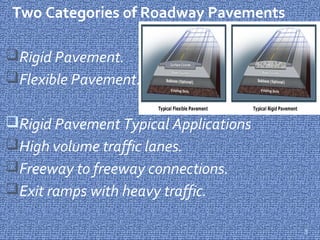
Two Categories of Roadway Pavements
Rigid Pavement.
Flexible Pavement.
Rigid Pavement Typical Applications
High volume traffic lanes.
Freeway to freeway connections.
Exit ramps with heavy traffic.
3
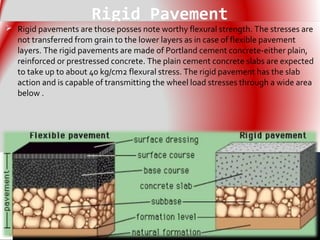
Rigid Pavement
 Rigid pavements are those posses note worthy flexural strength. The stresses are
not transferred from grain to the lower layers as in case of flexible pavement
layers. The rigid pavements are made of Portland cement concrete-either plain,
reinforced or prestressed concrete. The plain cement concrete slabs are expected
to take up to about 40 kg/cm2 flexural stress. The rigid pavement has the slab
action and is capable of transmitting the wheel load stresses through a wide area
below .
4
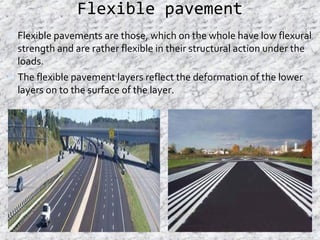
Flexible pavement
 Flexible pavements are those, which on the whole have low flexural
strength and are rather flexible in their structural action under the
loads.
 The flexible pavement layers reflect the deformation of the lower
layers on to the surface of the layer.
5
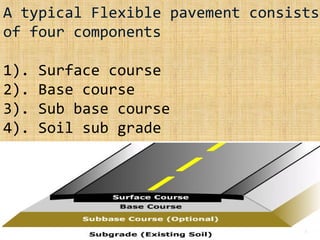
A typical Flexible pavement consists
of four components
1). Surface course
2). Base course
3). Sub base course
4). Soil sub grade
6
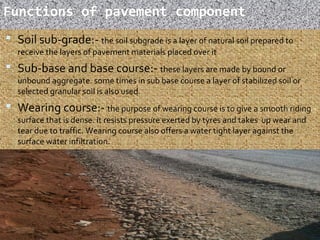
Functions of pavement component
 Soil sub-grade:- the soil subgrade is a layer of natural soil prepared to
receive the layers of pavement materials placed over it
 Sub-base and base course:- these layers are made by bound or
unbound aggregate. some times in sub base course a layer of stabilized soil or
selected granular soil is also used.
 Wearing course:- the purpose of wearing course is to give a smooth riding
surface that is dense. it resists pressure exerted by tyres and takes up wear and
tear due to traffic. Wearing course also offers a water tight layer against the
surface water infiltration.
7
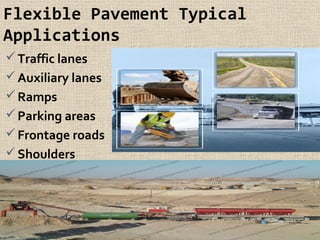
Flexible Pavement Typical
Applications
Traffic lanes
Auxiliary lanes
Ramps
Parking areas
Frontage roads
Shoulders
8
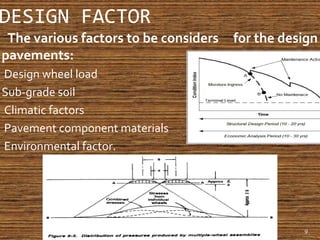
DESIGN FACTOR
 The various factors to be considers for the design
pavements:
Design wheel load
Sub-grade soil
Climatic factors
Pavement component materials
Environmental factor.
9
CROSS SECTIONAL ELEMENTS
LANE WIDTH
WIDTH OF SHOULDER
SIDE SLOPES
REDUCTION OF CROSS SECTION
CAMBER
ROAD LAND WIDTH
WIDTH OF MEDIAN AND EDGE STRIP
BASIC PRINCIPLES OF GEOMETRIC DESIGN
10
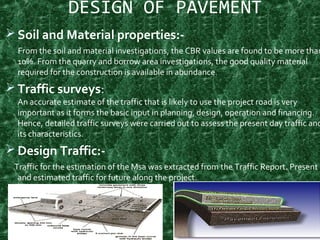
DESIGN OF PAVEMENT
 Soil and Material properties:-
From the soil and material investigations, the CBR values are found to be more than
10%. From the quarry and borrow area investigations, the good quality material
required for the construction is available in abundance.
 Traffic surveys:
An accurate estimate of the traffic that is likely to use the project road is very
important as it forms the basic input in planning, design, operation and financing.
Hence, detailed traffic surveys were carried out to assess the present day traffic and
its characteristics.
 Design Traffic:-
Traffic for the estimation of the Msa was extracted from the Traffic Report. Present
and estimated traffic for future along the project.
11
12
IRC: 37-2001
Flexible pavement design has been carried out using the IRC: 37-2001
and AASHTO design methods. IRC: 37-2001, a modification to IRC: 37-
1984 has been revised to incorporate the mechanistic design
approach.
The scope of pavement design
in this project can be divided into the following sections
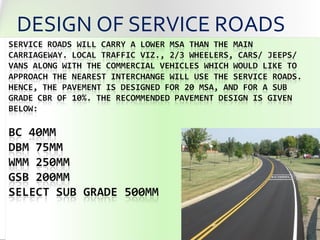
Design of Flexible Pavement for Service roads
Design of Flexible Pavement for the Main carriageway design.
Design period:-
A 20-year design period (2015 - 2035) is assumed for the design of
flexible pavement.
Sub-grade strength:-
The new pavement will be constructed on a sub
grade with minimum soaked CBR of 10
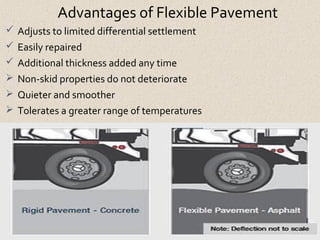
Advantages of Flexible Pavement
 Adjusts to limited differential settlement
 Easily repaired
 Additional thickness added any time
 Non-skid properties do not deteriorate
 Quieter and smoother
 Tolerates a greater range of temperatures
13
Disadvantages of Flexible Pavement
Loses some flexibility and cohesion with time
Needs resurfacing sooner than PC concrete
Not normally chosen where water is expected
14
15
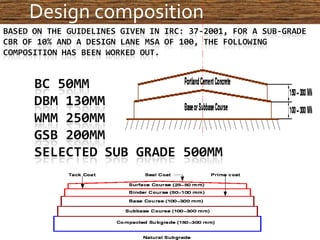
Design composition
16
DESIGN OF SERVICE ROADS
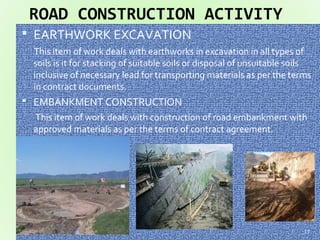
ROAD CONSTRUCTION ACTIVITY
 EARTHWORK EXCAVATION
This item of work deals with earthworks in excavation in all types of
soils is it for stacking of suitable soils or disposal of unsuitable soils
inclusive of necessary lead for transporting materials as per the terms
in contract documents.
 EMBANKMENT CONSTRUCTION
This item of work deals with construction of road embankment with
approved materials as per the terms of contract agreement.
17
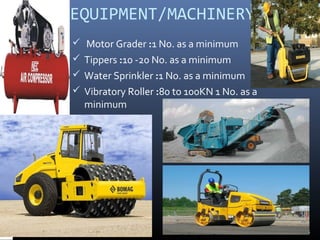
EQUIPMENT/MACHINERY
 Motor Grader :1 No. as a minimum
 Tippers :10 -20 No. as a minimum
 Water Sprinkler :1 No. as a minimum
 Vibratory Roller :80 to 100KN 1 No. as a
minimum
18
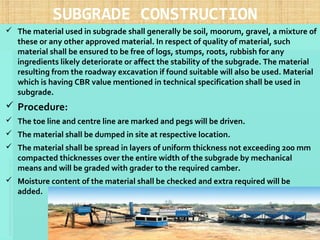
SUBGRADE CONSTRUCTION
 The material used in subgrade shall generally be soil, moorum, gravel, a mixture of
these or any other approved material. In respect of quality of material, such
material shall be ensured to be free of logs, stumps, roots, rubbish for any
ingredients likely deteriorate or affect the stability of the subgrade. The material
resulting from the roadway excavation if found suitable will also be used. Material
which is having CBR value mentioned in technical specification shall be used in
subgrade.
 Procedure:
 The toe line and centre line are marked and pegs will be driven.
 The material shall be dumped in site at respective location.
 The material shall be spread in layers of uniform thickness not exceeding 200 mm
compacted thicknesses over the entire width of the subgrade by mechanical
means and will be graded with grader to the required camber.
 Moisture content of the material shall be checked and extra required will be
added.  
19
 The moisture content of each layer shall be checked and it should be within the range of 
OMC +1% to OMC -2 percent. If moisture content is found out of these limits the same will 
be brought within limits by addition of water or by aeration as the case may be. 
 The compaction shall be done with the help of vibratory roller of 8 to 10 ton static weight. 
Each layer shall be thoroughly compacted to the densities specified in the specifications 
which are mentioned at the end of this document for reference. The rolling pattern will be 
finalized in trial stretch. 
 On compaction of the particular stretch necessary field testing shall be carried out Field 
density shall be done in the manner and frequency as specified below.  
 If the required field density is not achieved, compaction shall be continued till required 
density is achieved.  
 Loose pockets if any will be removed and replaced with approved material.  
 The above stages shall be repeated till the top level of the subgrade is reached to the 
specified levels and grades. The top levels shall be checked and shall be within +20mm to 
-25mm of designed level. 
 All relevant QA and QC documents will be maintained for all stages of subgrade 
Construction. 
20
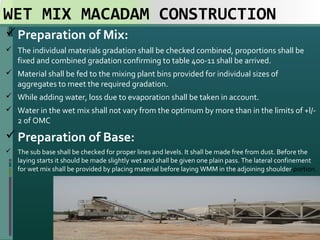
WET MIX MACADAM CONSTRUCTION
Preparation of Mix:
 The individual materials gradation shall be checked combined, proportions shall be 
fixed and combined gradation confirming to table 400-11 shall be arrived. 
 Material shall be fed to the mixing plant bins provided for individual sizes of 
aggregates to meet the required gradation. 
 While adding water, loss due to evaporation shall be taken in account. 
 Water in the wet mix shall not vary from the optimum by more than in the limits of +l/-
2 of OMC
Preparation of Base:
 The sub base shall be checked for proper lines and levels. It shall be made free from dust. Before the 
laying starts it should be made slightly wet and shall be given one plain pass. The lateral confinement 
for wet mix shall be provided by placing material before laying WMM in the adjoining shoulder portion. 
21
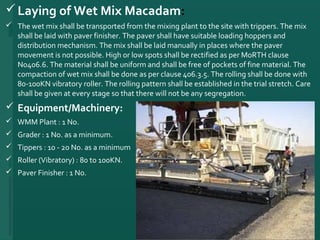
Laying of Wet Mix Macadam:
 The wet mix shall be transported from the mixing plant to the site with trippers. The mix 
shall be laid with paver finisher. The paver shall have suitable loading hoppers and 
distribution mechanism. The mix shall be laid manually in places where the paver 
movement is not possible. High or low spots shall be rectified as per MoRTH clause 
No406.6. The material shall be uniform and shall be free of pockets of fine material. The 
compaction of wet mix shall be done as per clause 406.3.5. The rolling shall be done with 
80-100KN vibratory roller. The rolling pattern shall be established in the trial stretch. Care 
shall be given at every stage so that there will not be any segregation. 
 Equipment/Machinery:
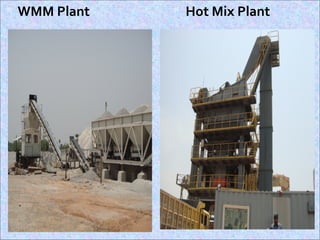
 WMM Plant : 1 No. 
 Grader : 1 No. as a minimum. 
 Tippers : 10 - 20 No. as a minimum 
 Roller (Vibratory) : 80 to 100KN.
 Paver Finisher : 1 No.
22
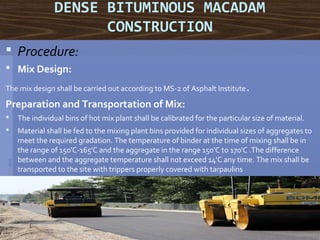
DENSE BITUMINOUS MACADAM
CONSTRUCTION
 Procedure:
 Mix Design:
The mix design shall be carried out according to MS-2 of Asphalt Institute. 
Preparation and Transportation of Mix:
 The individual bins of hot mix plant shall be calibrated for the particular size of material. 
 Material shall be fed to the mixing plant bins provided for individual sizes of aggregates to 
meet the required gradation. The temperature of binder at the time of mixing shall be in 
the range of 150'C-165'C and the aggregate in the range 150'C to 170'C .The difference 
between and the aggregate temperature shall not exceed 14'C any time. The mix shall be 
transported to the site with trippers properly covered with tarpaulins
23
 Preparation of Base:
 The sub base shall be checked for proper lines and levels. The surface shall be swept free 
from dust with air compressor. The tack coat shall be done if the WMM surface was 
primed and left for quite some time. 
 Laying of Dense Bituminous Macadam:
 The mix shall be laid with paver finisher. The paver shall have suitable loading hoppers 
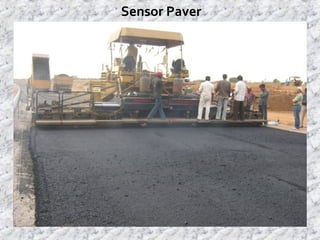
and distribution mechanism. The paver shall have electronic sensor paver and string wire 
shall be run on steel pegs driven on both sides at 10m interval in straight portions and 
5m interval in curved portions. The mix shall be laid manually in places where the paver 
movement is not possible. The finished layer shall be checked for compaction. The 
compaction shall be checked by taking cores for every 250sq.m area and the degree of 
compaction shall not be less than 98% of lab Marshall Density or as specified by 
technical specification. 
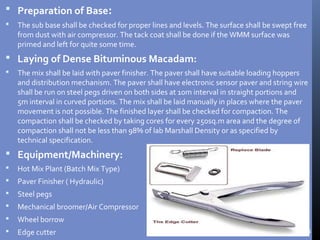
 Equipment/Machinery:
 Hot Mix Plant (Batch Mix Type) 
 Paver Finisher ( Hydraulic) 
 Steel pegs
 Mechanical broomer/Air Compressor 
 Wheel borrow
 Edge cutter  24
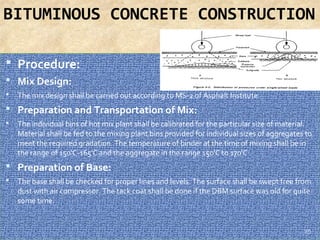
BITUMINOUS CONCRETE CONSTRUCTION
 Procedure:
 Mix Design:
 The mix design shall be carried out according to MS-2 of Asphalt Institute.
 Preparation and Transportation of Mix:
 The individual bins of hot mix plant shall be calibrated for the particular size of material. 
Material shall be fed to the mixing plant bins provided for individual sizes of aggregates to 
meet the required gradation. The temperature of binder at the time of mixing shall be in 
the range of 150'C-165'C and the aggregate in the range 150'C to 170'C .
 Preparation of Base:
 The base shall be checked for proper lines and levels. The surface shall be swept free from 
dust with air compressor. The tack coat shall be done if the DBM surface was old for quite 
some time. 
25
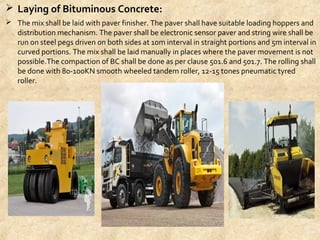
 Laying of Bituminous Concrete:
 The mix shall be laid with paver finisher. The paver shall have suitable loading hoppers and 
distribution mechanism. The paver shall be electronic sensor paver and string wire shall be 
run on steel pegs driven on both sides at 10m interval in straight portions and 5m interval in 
curved portions. The mix shall be laid manually in places where the paver movement is not 
possible.The compaction of BC shall be done as per clause 501.6 and 501.7. The rolling shall 
be done with 80-100KN smooth wheeled tandem roller, 12-15 tones pneumatic tyred 
roller.
26
Equipment/Machinery:
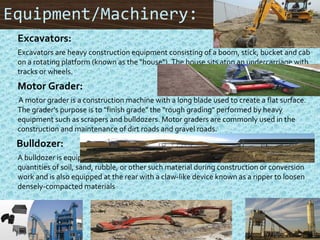
 Excavators:
 Excavators are heavy construction equipment consisting of a boom, stick, bucket and cab 
on a rotating platform (known as the "house"). The house sits atop an undercarriage with 
tracks or wheels.
 Motor Grader:
        A motor grader is a construction machine with a long blade used to create a flat surface. 
The grader's purpose is to "finish grade" the "rough grading" performed by heavy 
equipment such as scrapers and bulldozers. Motor graders are commonly used in the 
construction and maintenance of dirt roads and gravel roads.
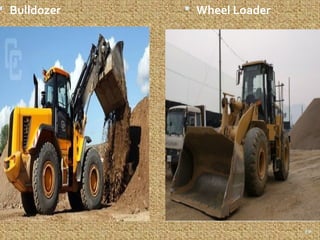
Bulldozer:
 A bulldozer is equipped with a substantial metal plate known as a blade used to push large 
quantities of soil, sand, rubble, or other such material during construction or conversion 
work and is also equipped at the rear with a claw-like device known as a ripper to loosen 
densely-compacted materials
27
Equipment/Machinery
 Motor Grader
28
 Excavator
 Bulldozer  Wheel Loader
29
 WMM Plant  Hot Mix Plant
30
Sensor Paver
31
Quality Management
 The Globalization and developing Technology in the Construction Industry is
leading to High competition in the Current market. The best response to a
competitive challenge in the Construction Industry is to become more
competitive. The best means of achieving this is by improving the product quality
and meeting the project schedule through a well designed Quality Management
system. The Quality Management system shall focus on providing improved
control on processes and practices, thus enhancing customer satisfaction through
its effective implementation.
Quality Policy
Quality System
Quality Strategy
32
CONCLUSION
 Design of flexible pavement as per IRC-37and quality control methods for
construction of fully access control express highway as ORR –package
(@km 72 to 83)
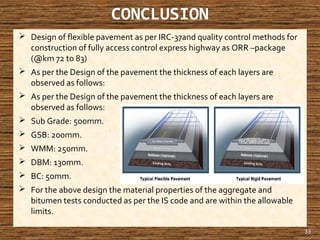
 As per the Design of the pavement the thickness of each layers are
observed as follows:
 As per the Design of the pavement the thickness of each layers are
observed as follows:
 Sub Grade: 500mm.
 GSB: 200mm.
 WMM: 250mm.
 DBM: 130mm.
 BC: 50mm.
 For the above design the material properties of the aggregate and
bitumen tests conducted as per the IS code and are within the allowable
limits.
33
THANK
YOU
34

presentation on road pavement (zeeshan)

  • 1.
    1 Presented by:- Shahrukh khan(1248900058) Md. Zeeshan Qumer (1248900035) Tarique Ali (1248900066) Sadique Aziz (1248900052)
  • 2.
    2 DESIGN ASPECTS OFFLEXIBLE PAVEMENT AND QUALITY CONTROL MANAGEMENT
  • 3.
    Two Categories ofRoadway Pavements Rigid Pavement. Flexible Pavement. Rigid Pavement Typical Applications High volume traffic lanes. Freeway to freeway connections. Exit ramps with heavy traffic. 3
  • 4.
    Rigid Pavement  Rigidpavements are those posses note worthy flexural strength. The stresses are not transferred from grain to the lower layers as in case of flexible pavement layers. The rigid pavements are made of Portland cement concrete-either plain, reinforced or prestressed concrete. The plain cement concrete slabs are expected to take up to about 40 kg/cm2 flexural stress. The rigid pavement has the slab action and is capable of transmitting the wheel load stresses through a wide area below . 4
  • 5.
    Flexible pavement  Flexiblepavements are those, which on the whole have low flexural strength and are rather flexible in their structural action under the loads.  The flexible pavement layers reflect the deformation of the lower layers on to the surface of the layer. 5
  • 6.
    A typical Flexiblepavement consists of four components 1). Surface course 2). Base course 3). Sub base course 4). Soil sub grade 6
  • 7.
    Functions of pavementcomponent  Soil sub-grade:- the soil subgrade is a layer of natural soil prepared to receive the layers of pavement materials placed over it  Sub-base and base course:- these layers are made by bound or unbound aggregate. some times in sub base course a layer of stabilized soil or selected granular soil is also used.  Wearing course:- the purpose of wearing course is to give a smooth riding surface that is dense. it resists pressure exerted by tyres and takes up wear and tear due to traffic. Wearing course also offers a water tight layer against the surface water infiltration. 7
  • 8.
    Flexible Pavement Typical Applications Trafficlanes Auxiliary lanes Ramps Parking areas Frontage roads Shoulders 8
  • 9.
    DESIGN FACTOR  Thevarious factors to be considers for the design pavements: Design wheel load Sub-grade soil Climatic factors Pavement component materials Environmental factor. 9
  • 10.
    CROSS SECTIONAL ELEMENTS LANEWIDTH WIDTH OF SHOULDER SIDE SLOPES REDUCTION OF CROSS SECTION CAMBER ROAD LAND WIDTH WIDTH OF MEDIAN AND EDGE STRIP BASIC PRINCIPLES OF GEOMETRIC DESIGN 10
  • 11.
    DESIGN OF PAVEMENT Soil and Material properties:- From the soil and material investigations, the CBR values are found to be more than 10%. From the quarry and borrow area investigations, the good quality material required for the construction is available in abundance.  Traffic surveys: An accurate estimate of the traffic that is likely to use the project road is very important as it forms the basic input in planning, design, operation and financing. Hence, detailed traffic surveys were carried out to assess the present day traffic and its characteristics.  Design Traffic:- Traffic for the estimation of the Msa was extracted from the Traffic Report. Present and estimated traffic for future along the project. 11
  • 12.
    12 IRC: 37-2001 Flexible pavementdesign has been carried out using the IRC: 37-2001 and AASHTO design methods. IRC: 37-2001, a modification to IRC: 37- 1984 has been revised to incorporate the mechanistic design approach. The scope of pavement design in this project can be divided into the following sections Design of Flexible Pavement for Service roads Design of Flexible Pavement for the Main carriageway design. Design period:- A 20-year design period (2015 - 2035) is assumed for the design of flexible pavement. Sub-grade strength:- The new pavement will be constructed on a sub grade with minimum soaked CBR of 10
  • 13.
    Advantages of FlexiblePavement  Adjusts to limited differential settlement  Easily repaired  Additional thickness added any time  Non-skid properties do not deteriorate  Quieter and smoother  Tolerates a greater range of temperatures 13
  • 14.
    Disadvantages of FlexiblePavement Loses some flexibility and cohesion with time Needs resurfacing sooner than PC concrete Not normally chosen where water is expected 14
  • 15.
  • 16.
  • 17.
    ROAD CONSTRUCTION ACTIVITY EARTHWORK EXCAVATION This item of work deals with earthworks in excavation in all types of soils is it for stacking of suitable soils or disposal of unsuitable soils inclusive of necessary lead for transporting materials as per the terms in contract documents.  EMBANKMENT CONSTRUCTION This item of work deals with construction of road embankment with approved materials as per the terms of contract agreement. 17
  • 18.
    EQUIPMENT/MACHINERY  Motor Grader:1 No. as a minimum  Tippers :10 -20 No. as a minimum  Water Sprinkler :1 No. as a minimum  Vibratory Roller :80 to 100KN 1 No. as a minimum 18
  • 19.
    SUBGRADE CONSTRUCTION  Thematerial used in subgrade shall generally be soil, moorum, gravel, a mixture of these or any other approved material. In respect of quality of material, such material shall be ensured to be free of logs, stumps, roots, rubbish for any ingredients likely deteriorate or affect the stability of the subgrade. The material resulting from the roadway excavation if found suitable will also be used. Material which is having CBR value mentioned in technical specification shall be used in subgrade.  Procedure:  The toe line and centre line are marked and pegs will be driven.  The material shall be dumped in site at respective location.  The material shall be spread in layers of uniform thickness not exceeding 200 mm compacted thicknesses over the entire width of the subgrade by mechanical means and will be graded with grader to the required camber.  Moisture content of the material shall be checked and extra required will be added.   19
  • 20.
     The moisture content of each layer shall be checked and it should be within the range of  OMC +1% to OMC -2 percent. If moisture content is found out of these limits the same will  be brought within limits by addition of water or by aeration as the case may be.   The compaction shall be done with the help of vibratory roller of 8 to 10 ton static weight.  Each layer shall be thoroughly compacted to the densities specified in the specifications  which are mentioned at the end of this document for reference. The rolling pattern will be  finalized in trial stretch.  On compaction of the particular stretch necessary field testing shall be carried out Field  density shall be done in the manner and frequency as specified below.    If the required field density is not achieved, compaction shall be continued till required  density is achieved.    Loose pockets if any will be removed and replaced with approved material.    The above stages shall be repeated till the top level of the subgrade is reached to the  specified levels and grades. The top levels shall be checked and shall be within +20mm to  -25mm of designed level.   All relevant QA and QC documents will be maintained for all stages of subgrade  Construction.  20

  • 21.
    WET MIX MACADAMCONSTRUCTION Preparation of Mix:  The individual materials gradation shall be checked combined, proportions shall be  fixed and combined gradation confirming to table 400-11 shall be arrived.   Material shall be fed to the mixing plant bins provided for individual sizes of  aggregates to meet the required gradation.   While adding water, loss due to evaporation shall be taken in account.   Water in the wet mix shall not vary from the optimum by more than in the limits of +l/- 2 of OMC Preparation of Base:  The sub base shall be checked for proper lines and levels. It shall be made free from dust. Before the  laying starts it should be made slightly wet and shall be given one plain pass. The lateral confinement  for wet mix shall be provided by placing material before laying WMM in the adjoining shoulder portion.  21
  • 22.
    Laying of WetMix Macadam:  The wet mix shall be transported from the mixing plant to the site with trippers. The mix  shall be laid with paver finisher. The paver shall have suitable loading hoppers and  distribution mechanism. The mix shall be laid manually in places where the paver  movement is not possible. High or low spots shall be rectified as per MoRTH clause  No406.6. The material shall be uniform and shall be free of pockets of fine material. The  compaction of wet mix shall be done as per clause 406.3.5. The rolling shall be done with  80-100KN vibratory roller. The rolling pattern shall be established in the trial stretch. Care  shall be given at every stage so that there will not be any segregation.   Equipment/Machinery:  WMM Plant : 1 No.   Grader : 1 No. as a minimum.   Tippers : 10 - 20 No. as a minimum   Roller (Vibratory) : 80 to 100KN.  Paver Finisher : 1 No. 22
  • 23.
    DENSE BITUMINOUS MACADAM CONSTRUCTION Procedure:  Mix Design: The mix design shall be carried out according to MS-2 of Asphalt Institute.  Preparation and Transportation of Mix:  The individual bins of hot mix plant shall be calibrated for the particular size of material.   Material shall be fed to the mixing plant bins provided for individual sizes of aggregates to  meet the required gradation. The temperature of binder at the time of mixing shall be in  the range of 150'C-165'C and the aggregate in the range 150'C to 170'C .The difference  between and the aggregate temperature shall not exceed 14'C any time. The mix shall be  transported to the site with trippers properly covered with tarpaulins 23
  • 24.
     Preparation ofBase:  The sub base shall be checked for proper lines and levels. The surface shall be swept free  from dust with air compressor. The tack coat shall be done if the WMM surface was  primed and left for quite some time.   Laying of Dense Bituminous Macadam:  The mix shall be laid with paver finisher. The paver shall have suitable loading hoppers  and distribution mechanism. The paver shall have electronic sensor paver and string wire  shall be run on steel pegs driven on both sides at 10m interval in straight portions and  5m interval in curved portions. The mix shall be laid manually in places where the paver  movement is not possible. The finished layer shall be checked for compaction. The  compaction shall be checked by taking cores for every 250sq.m area and the degree of  compaction shall not be less than 98% of lab Marshall Density or as specified by  technical specification.   Equipment/Machinery:  Hot Mix Plant (Batch Mix Type)   Paver Finisher ( Hydraulic)   Steel pegs  Mechanical broomer/Air Compressor   Wheel borrow  Edge cutter  24

  • 25.
    BITUMINOUS CONCRETE CONSTRUCTION Procedure:  Mix Design:  The mix design shall be carried out according to MS-2 of Asphalt Institute.  Preparation and Transportation of Mix:  The individual bins of hot mix plant shall be calibrated for the particular size of material.  Material shall be fed to the mixing plant bins provided for individual sizes of aggregates to  meet the required gradation. The temperature of binder at the time of mixing shall be in  the range of 150'C-165'C and the aggregate in the range 150'C to 170'C .  Preparation of Base:  The base shall be checked for proper lines and levels. The surface shall be swept free from  dust with air compressor. The tack coat shall be done if the DBM surface was old for quite  some time.  25
  • 26.
     Laying ofBituminous Concrete:  The mix shall be laid with paver finisher. The paver shall have suitable loading hoppers and  distribution mechanism. The paver shall be electronic sensor paver and string wire shall be  run on steel pegs driven on both sides at 10m interval in straight portions and 5m interval in  curved portions. The mix shall be laid manually in places where the paver movement is not  possible.The compaction of BC shall be done as per clause 501.6 and 501.7. The rolling shall  be done with 80-100KN smooth wheeled tandem roller, 12-15 tones pneumatic tyred  roller. 26
  • 27.
    Equipment/Machinery:  Excavators:  Excavators are heavy construction equipment consisting of a boom, stick, bucket and cab  on a rotating platform (known as the "house"). The house sits atop an undercarriage with  tracks or wheels. Motor Grader:         A motor grader is a construction machine with a long blade used to create a flat surface.  The grader's purpose is to "finish grade" the "rough grading" performed by heavy  equipment such as scrapers and bulldozers. Motor graders are commonly used in the  construction and maintenance of dirt roads and gravel roads. Bulldozer:  A bulldozer is equipped with a substantial metal plate known as a blade used to push large  quantities of soil, sand, rubble, or other such material during construction or conversion  work and is also equipped at the rear with a claw-like device known as a ripper to loosen  densely-compacted materials 27
  • 28.
  • 29.
     Bulldozer Wheel Loader 29
  • 30.
     WMM Plant Hot Mix Plant 30
  • 31.
  • 32.
    Quality Management  TheGlobalization and developing Technology in the Construction Industry is leading to High competition in the Current market. The best response to a competitive challenge in the Construction Industry is to become more competitive. The best means of achieving this is by improving the product quality and meeting the project schedule through a well designed Quality Management system. The Quality Management system shall focus on providing improved control on processes and practices, thus enhancing customer satisfaction through its effective implementation. Quality Policy Quality System Quality Strategy 32
  • 33.
    CONCLUSION  Design offlexible pavement as per IRC-37and quality control methods for construction of fully access control express highway as ORR –package (@km 72 to 83)  As per the Design of the pavement the thickness of each layers are observed as follows:  As per the Design of the pavement the thickness of each layers are observed as follows:  Sub Grade: 500mm.  GSB: 200mm.  WMM: 250mm.  DBM: 130mm.  BC: 50mm.  For the above design the material properties of the aggregate and bitumen tests conducted as per the IS code and are within the allowable limits. 33
  • 34.