

A
Presentation
On
“ INTRODUCTION OF PAVEMENT DESIGN ”
- Introduction of Pavement Design
- Functions of the Pavement
- Requirement of Pavement
- Types of Pavement
- Component of Flexible Pavement
- Load Distribution
CONTENT
INRODUCTION OF PAVEMENT DESIGN
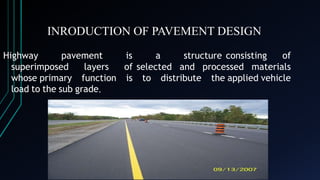
Highway pavement is a structure consisting of
superimposed layers of selected and processed materials
whose primary function is to distribute the applied vehicle
load to the sub grade.
What is a Pavement?
4
Pavement is the upper part of roadway,
airport or parking area structure
It includes all layers resting on the
original ground
– It consists of all structural elements or
layers, including shoulders
Functions of the Pavement
5
Reduce and distribute the traffic loading so as not to damage the
subgrade
– Provide vehicle access between two points under all-weather
conditions
– Provide safe, smooth and comfortable ride to road users without
undue delays and excessive wear & tear
– Meet environmental and aesthetics requirement
– Limited noise and air pollution
– Reasonable economy
An ideal pavement should meet the following requirements :-
1. Long design life with low maintenance cost,
2. Produce least noise from moving vehicles,
3. Smooth surface to provide comfort to road users even at high speed,
4. Adequate coefficient of friction to prevent skidding of vehicles,
5. Structurally strong to withstand all types of stresses imposed upon it,
6. Sufficient thickness to distribute the wheel load stresses to a safe value on the sub-
grade soil,
7. Impervious surface, so that sub-grade soil is well protected.
REQUIREMENT OF PAVEMENT:-
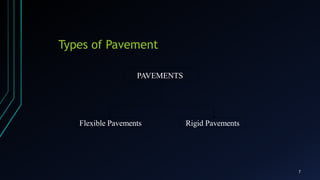
Types of Pavement
Flexible Pavements
PAVEMENTS
Rigid Pavements
7
Flexible Pavement
8
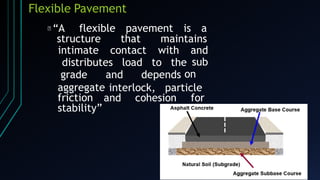
“A flexible pavement is a
structure that maintains
intimate contact with and
subdistributes load to the
grade and depends on
aggregate
friction
stability”
interlock, particle
and cohesion for
OR
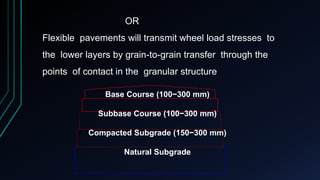
Flexible pavements will transmit wheel load stresses to
the lower layers by grain-to-grain transfer through the
points of contact in the granular structure
Base Course (100−300 mm)
Subbase Course (100−300 mm)
Compacted Subgrade (150−300 mm)
Natural Subgrade
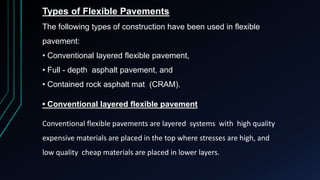
Types of Flexible Pavements
The following types of construction have been used in flexible
pavement:
• Conventional layered flexible pavement,
• Full - depth asphalt pavement, and
• Contained rock asphalt mat (CRAM).
Conventional flexible pavements are layered systems with high quality
expensive materials are placed in the top where stresses are high, and
low quality cheap materials are placed in lower layers.
• Conventional layered flexible pavement
Full - depth asphalt pavements are constructed by placing bituminous
layers directly on the soil sub- grade. This is more suitable when there
is high traffic and local materials are not available.
Contained rock asphalt mats are constructed by placing dense/open
graded aggregate layers in between two asphalt layers. Modified
dense graded asphalt concrete is placed above the sub-grade will
significantly reduce the vertical compressive strain on soil sub-grade
and protect from surface water.
• Contained rock asphalt mat (CRAM)
• Full - depth asphalt pavement
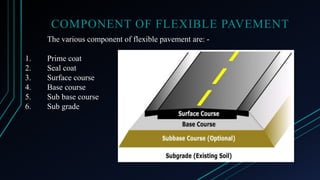
The various component of flexible pavement are: -
1. Prime coat
2. Seal coat
3. Surface course
4. Base course
5. Sub base course
6. Sub grade
COMPONENT OF FLEXIBLE PAVEMENT
Rigid pavements
DEFINATION--
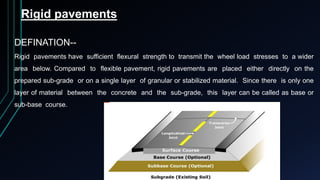
Rigid pavements have sufficient flexural strength to transmit the wheel load stresses to a wider
area below. Compared to flexible pavement, rigid pavements are placed either directly on the
prepared sub-grade or on a single layer of granular or stabilized material. Since there is only one
layer of material between the concrete and the sub-grade, this layer can be called as base or
sub-base course.
Rigid Pavements
14
Because of its relative rigidity, the pavement
structure distributes loads over a wide area with
only one, or at most two, structural layers.
There are other types of surfaces also i.e.;
reinforced, continuously reinforced etc.
Structure of Rigid Pavement
15
Surface course. This is the top layer, which consists of the
PCC slab, reinforced or continuously reinforced slabs .
Base course. This is the layer directly below the PCC layer and
generally consists of aggregate or stabilized sub-grade.
Sub-base course. This is the layer (or layers) under the base
layer. A sub-base is not always needed and therefore may
often be omitted.
Types of Rigid Pavements
Rigid pavements can be classified into four types:
•Jointed plain concrete pavement (JPCP),
• Jointed reinforced concrete pavement (JRCP),
• Continuous reinforced concrete pavement (CRCP), and
• Pre-stressed concrete pavement (PCP).
VARIABLES CONSIDERED INA PAVEMENT DESIGN
• Material characteristics
• Traffic volume
• Factors related to axle and wheel loads
• Concept of equivalemt Single Wheel Load(ESWL)
• Effect of moving transistent loads
• Factors related to surrounding environment
Pavements Comparison
53
Flexible pavements:
•
•
•
Deep foundations / multi layer construction
Energy consumption due to transportation of materials
Increasing cost of asphalt due to high oil prices
Rigid pavements
•
•
•
Single layer Generally last longer
May require asphalt topping due to noise / comfort
issues
Types of Pavement Failure
19
Failure criteria
Flexible Pavements Fatigue
Cracking, Rutting,
Thermal Cracking,
Rigid Pavements
Fatigue Cracking, Pumping or
Erosion
Others: Faulting, spalling,
joint deterioration
Thank
you

PAVEMENT DESIGN & TYPES

  • 1.
  • 2.
    - Introduction ofPavement Design - Functions of the Pavement - Requirement of Pavement - Types of Pavement - Component of Flexible Pavement - Load Distribution CONTENT
  • 3.
    INRODUCTION OF PAVEMENTDESIGN Highway pavement is a structure consisting of superimposed layers of selected and processed materials whose primary function is to distribute the applied vehicle load to the sub grade.
  • 4.
    What is aPavement? 4 Pavement is the upper part of roadway, airport or parking area structure It includes all layers resting on the original ground – It consists of all structural elements or layers, including shoulders
  • 5.
    Functions of thePavement 5 Reduce and distribute the traffic loading so as not to damage the subgrade – Provide vehicle access between two points under all-weather conditions – Provide safe, smooth and comfortable ride to road users without undue delays and excessive wear & tear – Meet environmental and aesthetics requirement – Limited noise and air pollution – Reasonable economy
  • 6.
    An ideal pavementshould meet the following requirements :- 1. Long design life with low maintenance cost, 2. Produce least noise from moving vehicles, 3. Smooth surface to provide comfort to road users even at high speed, 4. Adequate coefficient of friction to prevent skidding of vehicles, 5. Structurally strong to withstand all types of stresses imposed upon it, 6. Sufficient thickness to distribute the wheel load stresses to a safe value on the sub- grade soil, 7. Impervious surface, so that sub-grade soil is well protected. REQUIREMENT OF PAVEMENT:-
  • 7.
    Types of Pavement FlexiblePavements PAVEMENTS Rigid Pavements 7
  • 8.
    Flexible Pavement 8 “A flexiblepavement is a structure that maintains intimate contact with and subdistributes load to the grade and depends on aggregate friction stability” interlock, particle and cohesion for
  • 9.
    OR Flexible pavements willtransmit wheel load stresses to the lower layers by grain-to-grain transfer through the points of contact in the granular structure Base Course (100−300 mm) Subbase Course (100−300 mm) Compacted Subgrade (150−300 mm) Natural Subgrade
  • 10.
    Types of FlexiblePavements The following types of construction have been used in flexible pavement: • Conventional layered flexible pavement, • Full - depth asphalt pavement, and • Contained rock asphalt mat (CRAM). Conventional flexible pavements are layered systems with high quality expensive materials are placed in the top where stresses are high, and low quality cheap materials are placed in lower layers. • Conventional layered flexible pavement
  • 11.
    Full - depthasphalt pavements are constructed by placing bituminous layers directly on the soil sub- grade. This is more suitable when there is high traffic and local materials are not available. Contained rock asphalt mats are constructed by placing dense/open graded aggregate layers in between two asphalt layers. Modified dense graded asphalt concrete is placed above the sub-grade will significantly reduce the vertical compressive strain on soil sub-grade and protect from surface water. • Contained rock asphalt mat (CRAM) • Full - depth asphalt pavement
  • 12.
    The various componentof flexible pavement are: - 1. Prime coat 2. Seal coat 3. Surface course 4. Base course 5. Sub base course 6. Sub grade COMPONENT OF FLEXIBLE PAVEMENT
  • 13.
    Rigid pavements DEFINATION-- Rigid pavementshave sufficient flexural strength to transmit the wheel load stresses to a wider area below. Compared to flexible pavement, rigid pavements are placed either directly on the prepared sub-grade or on a single layer of granular or stabilized material. Since there is only one layer of material between the concrete and the sub-grade, this layer can be called as base or sub-base course.
  • 14.
    Rigid Pavements 14 Because ofits relative rigidity, the pavement structure distributes loads over a wide area with only one, or at most two, structural layers. There are other types of surfaces also i.e.; reinforced, continuously reinforced etc.
  • 15.
    Structure of RigidPavement 15 Surface course. This is the top layer, which consists of the PCC slab, reinforced or continuously reinforced slabs . Base course. This is the layer directly below the PCC layer and generally consists of aggregate or stabilized sub-grade. Sub-base course. This is the layer (or layers) under the base layer. A sub-base is not always needed and therefore may often be omitted.
  • 16.
    Types of RigidPavements Rigid pavements can be classified into four types: •Jointed plain concrete pavement (JPCP), • Jointed reinforced concrete pavement (JRCP), • Continuous reinforced concrete pavement (CRCP), and • Pre-stressed concrete pavement (PCP).
  • 17.
    VARIABLES CONSIDERED INAPAVEMENT DESIGN • Material characteristics • Traffic volume • Factors related to axle and wheel loads • Concept of equivalemt Single Wheel Load(ESWL) • Effect of moving transistent loads • Factors related to surrounding environment
  • 18.
    Pavements Comparison 53 Flexible pavements: • • • Deepfoundations / multi layer construction Energy consumption due to transportation of materials Increasing cost of asphalt due to high oil prices Rigid pavements • • • Single layer Generally last longer May require asphalt topping due to noise / comfort issues
  • 19.
    Types of PavementFailure 19 Failure criteria Flexible Pavements Fatigue Cracking, Rutting, Thermal Cracking, Rigid Pavements Fatigue Cracking, Pumping or Erosion Others: Faulting, spalling, joint deterioration
  • 20.