
Click to edit Master title style
1
Dowel Bars, Tie Bars
and Their Design
P a v e m e n t D e s i g n
Bhavya S. Jaiswal
Btech civil, Mtech Transportation
Engineering
Click to edit Master title style
2
Dowel bars and its design
2
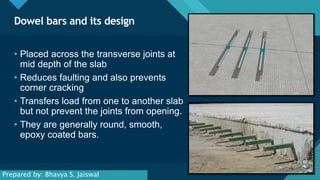
• Placed across the transverse joints at
mid depth of the slab
• Reduces faulting and also prevents
corner cracking
• Transfers load from one to another slab
but not prevent the joints from opening.
• They are generally round, smooth,
epoxy coated bars.
Prepared by: Bhavya S. Jaiswal
Click to edit Master title style
3
Design of the dowel bars
3
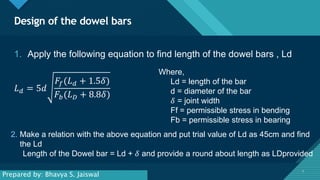
1. Apply the following equation to find length of the dowel bars , Ld
𝐿𝑑 = 5𝑑
𝐹𝑓(𝐿𝑑 + 1.5𝛿)
𝐹𝑏(𝐿𝐷 + 8.8𝛿)
Where,
Ld = length of the bar
d = diameter of the bar
𝛿 = joint width
Ff = permissible stress in bending
Fb = permissible stress in bearing
2. Make a relation with the above equation and put trial value of Ld as 45cm and find
the Ld
Length of the Dowel bar = Ld + 𝛿 and provide a round about length as LDprovided
Prepared by: Bhavya S. Jaiswal
Click to edit Master title style
4
Design of the dowel bars
4
3. Find the load transfer capacity by the equations…
𝑃𝑆 = 0.785 × 𝑑2 × 𝐹𝑠
𝑃𝑓 =
2 × 𝑑3 × 𝐹𝑓
𝐿𝑑 + 8.8𝛿
𝑃𝑏 =
𝐹𝑏 × 𝐿𝑑
2
× 𝑑
12.5(𝐿𝑑 + 1.5𝛿)
Fs = permissible
stress in Shear
Prepared by: Bhavya S. Jaiswal
Click to edit Master title style
5
Design of the dowel bars
5
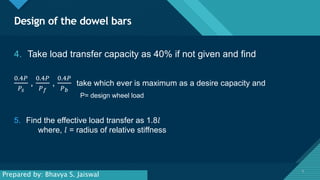
4. Take load transfer capacity as 40% if not given and find
0.4𝑃
𝑃𝑠
,
0.4𝑃
𝑃𝑓
,
0.4𝑃
𝑃𝑏
take which ever is maximum as a desire capacity and
P= design wheel load
5. Find the effective load transfer as 1.8𝑙
where, 𝑙 = radius of relative stiffness
Prepared by: Bhavya S. Jaiswal
Click to edit Master title style
6
Design of the dowel bars
6
Actual
capacity = [1 +
1.8𝑙 − 35
1.8𝑙
+
1.8𝑙 − 70
1.8𝑙
+
1.8𝑙 − 105
1.8𝑙
+
1.8𝑙 − 140
1.8𝑙
]
Assume 35cm spacing and find the actual capacity…
Check if Actual capacity > Required capacity
if it is not greater than reduce the spacing and check it again
Prepared by: Bhavya S. Jaiswal
Click to edit Master title style
7
Tie bars and design of tie bar
7
• Placed across longitudinal joints at
mid depth of the pavement.
• It reduces the transverse cracking.
• Prevents lane separation and also at
the same time prevents differential
deflection in the pavement.
• Generally, such bars are made up of
deformed epoxy coated steel.
Prepared by: Bhavya S. Jaiswal
Click to edit Master title style
8
Design of the Tie bars
8
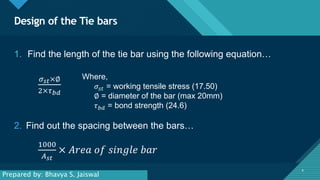
1. Find the length of the tie bar using the following equation…
𝜎𝑠𝑡×∅
2×𝜏𝑏𝑑
Where,
𝜎𝑠𝑡 = working tensile stress (17.50)
∅ = diameter of the bar (max 20mm)
𝜏𝑏𝑑 = bond strength (24.6)
2. Find out the spacing between the bars…
1000
𝐴𝑠𝑡
× 𝐴𝑟𝑒𝑎 𝑜𝑓 𝑠𝑖𝑛𝑔𝑙𝑒 𝑏𝑎𝑟
Prepared by: Bhavya S. Jaiswal
Click to edit Master title style
9
Design of the Tie bars
9
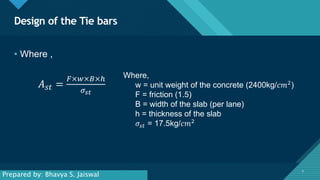
• Where ,
𝐴𝑠𝑡 =
𝐹×𝑤×𝐵×ℎ
𝜎𝑠𝑡
Where,
w = unit weight of the concrete (2400kg/𝑐𝑚2)
F = friction (1.5)
B = width of the slab (per lane)
h = thickness of the slab
𝜎𝑠𝑡 = 17.5kg/𝑐𝑚2
Prepared by: Bhavya S. Jaiswal
Click to edit Master title style
10
References
10
• IRC-58:2012
• The constructor : https://theconstructor.org/practical-guide/tie-bar-
constructions/37378/
• Engineerwing : https://www.engineerwing.com/2017/05/types-of-
concrete-pavement-uses.html
• Dowel bars : pavement interactive;
https://pavementinteractive.org/reference-desk/pavement-types-
and-history/pavement-types/dowel-bar/
Prepared by: Bhavya S. Jaiswal

Dowel bars, tie bars and their design

  • 1.
    Click to editMaster title style 1 Dowel Bars, Tie Bars and Their Design P a v e m e n t D e s i g n Bhavya S. Jaiswal Btech civil, Mtech Transportation Engineering
  • 2.
    Click to editMaster title style 2 Dowel bars and its design 2 • Placed across the transverse joints at mid depth of the slab • Reduces faulting and also prevents corner cracking • Transfers load from one to another slab but not prevent the joints from opening. • They are generally round, smooth, epoxy coated bars. Prepared by: Bhavya S. Jaiswal
  • 3.
    Click to editMaster title style 3 Design of the dowel bars 3 1. Apply the following equation to find length of the dowel bars , Ld 𝐿𝑑 = 5𝑑 𝐹𝑓(𝐿𝑑 + 1.5𝛿) 𝐹𝑏(𝐿𝐷 + 8.8𝛿) Where, Ld = length of the bar d = diameter of the bar 𝛿 = joint width Ff = permissible stress in bending Fb = permissible stress in bearing 2. Make a relation with the above equation and put trial value of Ld as 45cm and find the Ld Length of the Dowel bar = Ld + 𝛿 and provide a round about length as LDprovided Prepared by: Bhavya S. Jaiswal
  • 4.
    Click to editMaster title style 4 Design of the dowel bars 4 3. Find the load transfer capacity by the equations… 𝑃𝑆 = 0.785 × 𝑑2 × 𝐹𝑠 𝑃𝑓 = 2 × 𝑑3 × 𝐹𝑓 𝐿𝑑 + 8.8𝛿 𝑃𝑏 = 𝐹𝑏 × 𝐿𝑑 2 × 𝑑 12.5(𝐿𝑑 + 1.5𝛿) Fs = permissible stress in Shear Prepared by: Bhavya S. Jaiswal
  • 5.
    Click to editMaster title style 5 Design of the dowel bars 5 4. Take load transfer capacity as 40% if not given and find 0.4𝑃 𝑃𝑠 , 0.4𝑃 𝑃𝑓 , 0.4𝑃 𝑃𝑏 take which ever is maximum as a desire capacity and P= design wheel load 5. Find the effective load transfer as 1.8𝑙 where, 𝑙 = radius of relative stiffness Prepared by: Bhavya S. Jaiswal
  • 6.
    Click to editMaster title style 6 Design of the dowel bars 6 Actual capacity = [1 + 1.8𝑙 − 35 1.8𝑙 + 1.8𝑙 − 70 1.8𝑙 + 1.8𝑙 − 105 1.8𝑙 + 1.8𝑙 − 140 1.8𝑙 ] Assume 35cm spacing and find the actual capacity… Check if Actual capacity > Required capacity if it is not greater than reduce the spacing and check it again Prepared by: Bhavya S. Jaiswal
  • 7.
    Click to editMaster title style 7 Tie bars and design of tie bar 7 • Placed across longitudinal joints at mid depth of the pavement. • It reduces the transverse cracking. • Prevents lane separation and also at the same time prevents differential deflection in the pavement. • Generally, such bars are made up of deformed epoxy coated steel. Prepared by: Bhavya S. Jaiswal
  • 8.
    Click to editMaster title style 8 Design of the Tie bars 8 1. Find the length of the tie bar using the following equation… 𝜎𝑠𝑡×∅ 2×𝜏𝑏𝑑 Where, 𝜎𝑠𝑡 = working tensile stress (17.50) ∅ = diameter of the bar (max 20mm) 𝜏𝑏𝑑 = bond strength (24.6) 2. Find out the spacing between the bars… 1000 𝐴𝑠𝑡 × 𝐴𝑟𝑒𝑎 𝑜𝑓 𝑠𝑖𝑛𝑔𝑙𝑒 𝑏𝑎𝑟 Prepared by: Bhavya S. Jaiswal
  • 9.
    Click to editMaster title style 9 Design of the Tie bars 9 • Where , 𝐴𝑠𝑡 = 𝐹×𝑤×𝐵×ℎ 𝜎𝑠𝑡 Where, w = unit weight of the concrete (2400kg/𝑐𝑚2) F = friction (1.5) B = width of the slab (per lane) h = thickness of the slab 𝜎𝑠𝑡 = 17.5kg/𝑐𝑚2 Prepared by: Bhavya S. Jaiswal
  • 10.
    Click to editMaster title style 10 References 10 • IRC-58:2012 • The constructor : https://theconstructor.org/practical-guide/tie-bar- constructions/37378/ • Engineerwing : https://www.engineerwing.com/2017/05/types-of- concrete-pavement-uses.html • Dowel bars : pavement interactive; https://pavementinteractive.org/reference-desk/pavement-types- and-history/pavement-types/dowel-bar/ Prepared by: Bhavya S. Jaiswal