COMPONENTS OF CONCRETE
PAVEMENT
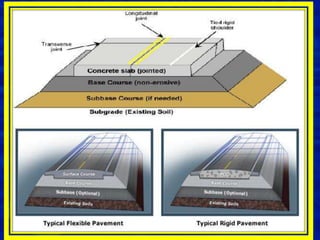
A. Concrete slabs with a determinedthickness
Concrete is a construction material that is made of portland
cement ,aggregate s and water mixed in predetermined
proportions. Concrete solidifies and hardens after mixing
and placement due to a chemical process known asb
hydration.
B. Joints (both transverse and longitudinal)
Concrete slabs will crack randomly from natural
actions such as shrinkage or curling.
Therefore, joints are vital elements introduced into
CP to control cracking and horizontal
movements of the slabs.
Transverse Joints Perpendicular to Lane
Lines and Longitudinal Joints
Longitudinal Joint at Lane Line
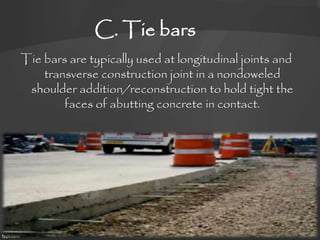
Tie bars are typically used at longitudinal joints and
transverse construction joint in a nondoweled
shoulder addition/reconstruction to hold tight the
faces of abutting concrete in contact.
C. Tie bars
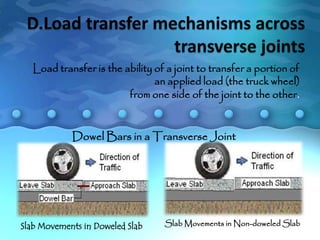
Load transfer is the ability of a joint to transfer a portion of
an applied load (the truck wheel)
from one side of the joint to the other.
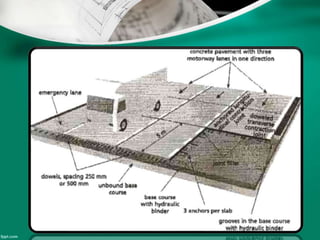
Dowel Bars in a Transverse Joint
Slab Movements in Non-doweled SlabSlab Movements in Doweled Slab
E. Base layer
~It can provide a stable platform for the
concrete paving, provides for additional load
distribution, and contributes to drainage (if
permeable base is used) and frost resistance.
F.Subbase layer (if required),
~the subbase layer is a planned thickness of
specified material that is placed on the subgrade
or under the basement material.
G.Subgrade
~greater subgrade structural capacity can
result in more economical pavement structures.
The general pavement
Construction
practices involve:
• subgrade, base and subbase preparation
conforming to the thickness and cross section
requirements,
• proper placement of tie bars and dowel bars to
be embedded, carefully examining for bending
which could injure the material, oil, dirt, rust and
other coatings that would prevent or reduce
bonding to concrete.
• proper concrete placement including
consolidation, finishing, texturing, curing and
jointing essential for a strong durable pavement
Sub-grade, Sub-base and Base Preparation
Sub-grade Preparation
~ minimum depth of 0.5 feet below the grading plane
for the width between the outer edges of shoulders, or
~ minimum depth of 2.5 feet below the finished grade for
the width of the traveled way and auxiliary lanes
including 3 feet on both sides as specified in Section
19-5.03 of the Standard Specifications
Sub-base Layer Preparation
•The Department uses Aggregate Sub-base (AS)
for use in JPCP construction to provide a foundation
or working platform for the base when the sub-grade R-
value is less than 40.
•The maximum thickness of any one layer should not
exceed 0.50 foot after watering and compaction.
Where the required thickness is more than 0.50 foot,
spreading, watering and compaction should be
conducted in 2 or more lifts of approximately equal
thickness.
Base Layer Preparation
The Department uses Hot Mix Asphalt (HMA) Type A,
Lean Concrete Base (LCB), Asphalt Treated Permeable Base
(ATPB), and Aggregate Base (AB) to provide a construction
platform underneath the CP.
•Hot Mix Asphalt Type A (HMA-A)
HMA-Type A consists of one or more layers
placed on a prepared sub-base or sub-grade in conformity
with the alignment and grades shown on the project plans.
HMA-A is placed at a 20 temperature of no less than 310
°F and only when the sub-base or sub-grade surface is dry
and in satisfactory condition.
•Lean Concrete Base (LCB) ~ LCB is placed,
constructed and finished in no less than 12-foot widths
separated by contact joints. Widths that are greater than
26 feet are constructed with longitudinal weakened plane
joints at no more than 3 feet from the centerline of the
width being constructed.
•Aggregate Base (AB) ~ where the required thickness
is 0.50-foot or less, is spread and compacted in one layer.
If the required thickness is more than 0.50-foot, spread
and compact AB in two or more lifts in approximately
equal thickness, and each lift shall not exceed 0.50-foot.
Steel Placement
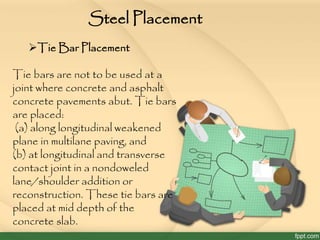
Tie Bar Placement
Tie bars are not to be used at a
joint where concrete and asphalt
concrete pavements abut. Tie bars
are placed:
(a) along longitudinal weakened
plane in multilane paving, and
(b) at longitudinal and transverse
contact joint in a nondoweled
lane/shoulder addition or
reconstruction. These tie bars are
placed at mid depth of the
concrete slab.
• Dowel Bar Placement
Dowel bars are placed as shown on the plans
by using either dowel bar baskets, drilling and
bonding, or mechanical insertion.
• Bar Reinforcement Placement
Although CP does not typically have bar
reinforcement, bar reinforcement can be
found in a few situations such as pavement
transitions ,gore areas, and around drainage
inlets.
• Concrete Placement ~ Concrete is transported to
the paving site by dump trucks or ready-mix trucks
with the goal to deliver a uniform, well-mixed and
workable concrete from batch to batch.
• Consolidation ~ it is the process that compacts
fresh concrete to mold it within the forms and
around steel reinforcements and to remove
undesirable voids.
• Finishing ~it involves any equipment or procedures
used to impart desirable surface characteristics.
• Curing ~ it is the maintenance of satisfactory
moisture and temperature in the concrete as it sets
and hardens such that the desired properties can
develop.
Flexible pavement design
This section describes the design for both asphalt
concrete pavements and surface treatments which
carry significant levels of traffic over the
performance period
Modifications Included in Flexible Pavement
design procedures
• The soil support number is replaced by the resilient modulus
to provide a rational testing procedure that may be used by an
agency to define the material properties.
• The layer coefficients for the various materials are defined in
terms of resilient modulus as well as standard methods (CBR
and R-value).
• The environmental factors of moisture and temperature
objectively included in the Guide so that the environmental
consdiderations could be ratioanally accounted for in the
design procedure.
• Reliability is introduced to permit the designer to use the
concept of risk analysis for various classes of roadways.
• Stage construction design procedures are incorporated.
Design Of Flexible Pavement
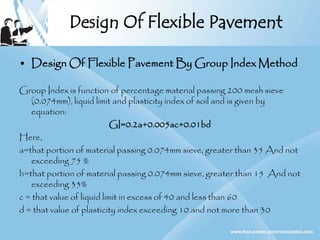
• Design Of Flexible Pavement By Group Index Method
Group Index is function of percentage material passing 200 mesh sieve
(0.074mm), liquid limit and plasticity index of soil and is given by
equation:
GI=0.2a+0.005ac+0.01bd
Here,
a=that portion of material passing 0.074mm sieve, greater than 35 And not
exceeding 75 %
b=that portion of material passing 0.074mm sieve, greater than 15 And not
exceeding 35%
c = that value of liquid limit in excess of 40 and less than 60
d = that value of plasticity index exceeding 10 and not more than 30
California Resistance Value Method
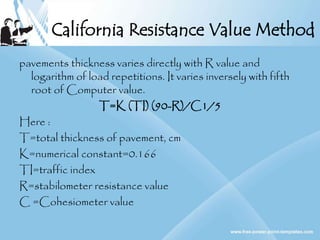
pavements thickness varies directly with R value and
logarithm of load repetitions. It varies inversely with fifth
root of Computer value.
T=K (TI) (90-R)/C1/5
Here :
T=total thickness of pavement, cm
K=numerical constant=0.166
TI=traffic index
R=stabilometer resistance value
C =Cohesiometer value
Triaxial Method
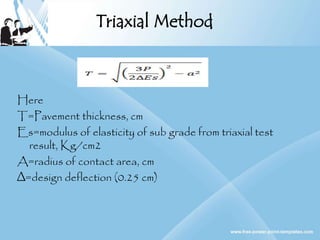
Here
T=Pavement thickness, cm
Es=modulus of elasticity of sub grade from triaxial test
result, Kg/cm2
A=radius of contact area, cm
∆=design deflection (0.25 cm)
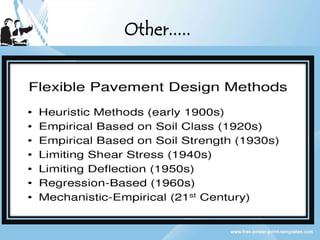
Other.....
Rigid pavement design
As the name implies, rigid pavements are rigid , they do not
extend much under loading like flexible pavements. They are
constructed using cement concrete. In this case, the load carrying
capacity is mainly due to the rigidity and high modulus of elasticity
of the slab (slab action).
Modifications Included in Rigid
Pavement design procedures:
• Reliability concepts identical to those used
for the flexible pavements are introduced.
• The environmental aspects of design are
introduced in the same format as for flexible
pavements.
• The design procedure is modified to include
such factors as tied shoulders, subbase
erosion, and lean subbase designs.
Rigid Pavement Response
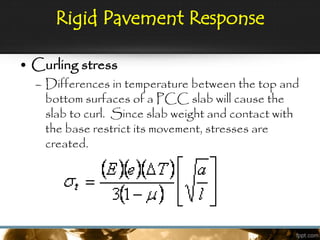
• Curling stress
– Differences in temperature between the top and
bottom surfaces of a PCC slab will cause the
slab to curl. Since slab weight and contact with
the base restrict its movement, stresses are
created.
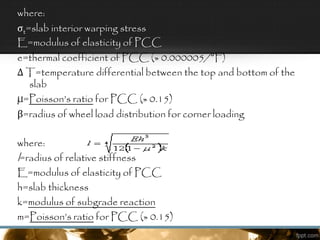
where:
σt=slab interior warping stress
E=modulus of elasticity of PCC
e=thermal coefficient of PCC (» 0.000005/°F)
Δ T=temperature differential between the top and bottom of the
slab
µ=Poisson’s ratio for PCC (» 0.15)
β=radius of wheel load distribution for corner loading
where:
l=radius of relative stiffness
E=modulus of elasticity of PCC
h=slab thickness
k=modulus of subgrade reaction
m=Poisson’s ratio for PCC (» 0.15)
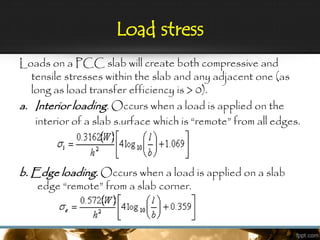
Load stress
Loads on a PCC slab will create both compressive and
tensile stresses within the slab and any adjacent one (as
long as load transfer efficiency is > 0).
a. Interior loading. Occurs when a load is applied on the
interior of a slab s.urface which is “remote” from all edges.
b. Edge loading. Occurs when a load is applied on a slab
edge “remote” from a slab corner.
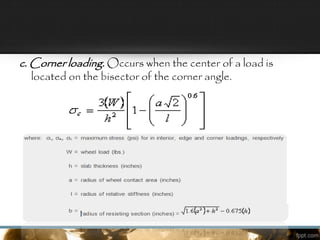
c. Corner loading. Occurs when the center of a load is
located on the bisector of the corner angle.
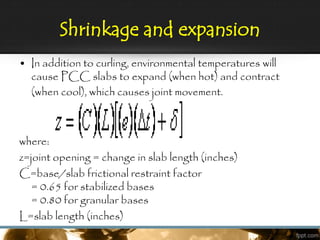
Shrinkage and expansion
• In addition to curling, environmental temperatures will
cause PCC slabs to expand (when hot) and contract
(when cool), which causes joint movement.
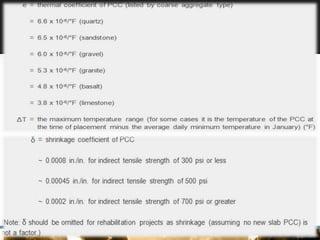
where:
z=joint opening = change in slab length (inches)
C=base/slab frictional restraint factor
= 0.65 for stabilized bases
= 0.80 for granular bases
L=slab length (inches)
It is observed that flexible pavements are more economical for
lesser volume of traffic.The life of flexible pavement is near about 15
years whose initial cost is low needs a periodic maintenance after a
certain period and maintenance costs very high.
The life of rigid pavement is much more than the
flexible pavement of about 40 years approx 2.5 times life of
flexible pavement whose initial cost is much more then the
flexible pavement but maintenance cost is very less.
References:
http://www.pavementinteractive.org/article/rigid
-pavement-response/#sthash.ISwV8mbT.dpuf
pavement-procedures-construction-and-re-
construction.pdf
“Start by doing what’s necessary;
then do what’s possible;
and suddenly your are doing the
impossible.”
~Francis of Assisi~
Prepared by:
FONTE, EDDIE RED
ZULUETA, ERWIN JOHN

PAVEMENT DESIGN (Group 9)

  • 2.
  • 3.
    A. Concrete slabswith a determinedthickness Concrete is a construction material that is made of portland cement ,aggregate s and water mixed in predetermined proportions. Concrete solidifies and hardens after mixing and placement due to a chemical process known asb hydration.
  • 4.
    B. Joints (bothtransverse and longitudinal) Concrete slabs will crack randomly from natural actions such as shrinkage or curling. Therefore, joints are vital elements introduced into CP to control cracking and horizontal movements of the slabs. Transverse Joints Perpendicular to Lane Lines and Longitudinal Joints Longitudinal Joint at Lane Line
  • 5.
    Tie bars aretypically used at longitudinal joints and transverse construction joint in a nondoweled shoulder addition/reconstruction to hold tight the faces of abutting concrete in contact. C. Tie bars
  • 6.
    Load transfer isthe ability of a joint to transfer a portion of an applied load (the truck wheel) from one side of the joint to the other. Dowel Bars in a Transverse Joint Slab Movements in Non-doweled SlabSlab Movements in Doweled Slab
  • 7.
    E. Base layer ~Itcan provide a stable platform for the concrete paving, provides for additional load distribution, and contributes to drainage (if permeable base is used) and frost resistance. F.Subbase layer (if required), ~the subbase layer is a planned thickness of specified material that is placed on the subgrade or under the basement material. G.Subgrade ~greater subgrade structural capacity can result in more economical pavement structures.
  • 9.
  • 10.
    • subgrade, baseand subbase preparation conforming to the thickness and cross section requirements, • proper placement of tie bars and dowel bars to be embedded, carefully examining for bending which could injure the material, oil, dirt, rust and other coatings that would prevent or reduce bonding to concrete. • proper concrete placement including consolidation, finishing, texturing, curing and jointing essential for a strong durable pavement
  • 11.
    Sub-grade, Sub-base andBase Preparation Sub-grade Preparation ~ minimum depth of 0.5 feet below the grading plane for the width between the outer edges of shoulders, or ~ minimum depth of 2.5 feet below the finished grade for the width of the traveled way and auxiliary lanes including 3 feet on both sides as specified in Section 19-5.03 of the Standard Specifications
  • 12.
    Sub-base Layer Preparation •TheDepartment uses Aggregate Sub-base (AS) for use in JPCP construction to provide a foundation or working platform for the base when the sub-grade R- value is less than 40. •The maximum thickness of any one layer should not exceed 0.50 foot after watering and compaction. Where the required thickness is more than 0.50 foot, spreading, watering and compaction should be conducted in 2 or more lifts of approximately equal thickness.
  • 13.
    Base Layer Preparation TheDepartment uses Hot Mix Asphalt (HMA) Type A, Lean Concrete Base (LCB), Asphalt Treated Permeable Base (ATPB), and Aggregate Base (AB) to provide a construction platform underneath the CP. •Hot Mix Asphalt Type A (HMA-A) HMA-Type A consists of one or more layers placed on a prepared sub-base or sub-grade in conformity with the alignment and grades shown on the project plans. HMA-A is placed at a 20 temperature of no less than 310 °F and only when the sub-base or sub-grade surface is dry and in satisfactory condition.
  • 14.
    •Lean Concrete Base(LCB) ~ LCB is placed, constructed and finished in no less than 12-foot widths separated by contact joints. Widths that are greater than 26 feet are constructed with longitudinal weakened plane joints at no more than 3 feet from the centerline of the width being constructed. •Aggregate Base (AB) ~ where the required thickness is 0.50-foot or less, is spread and compacted in one layer. If the required thickness is more than 0.50-foot, spread and compact AB in two or more lifts in approximately equal thickness, and each lift shall not exceed 0.50-foot.
  • 15.
    Steel Placement Tie BarPlacement Tie bars are not to be used at a joint where concrete and asphalt concrete pavements abut. Tie bars are placed: (a) along longitudinal weakened plane in multilane paving, and (b) at longitudinal and transverse contact joint in a nondoweled lane/shoulder addition or reconstruction. These tie bars are placed at mid depth of the concrete slab.
  • 16.
    • Dowel BarPlacement Dowel bars are placed as shown on the plans by using either dowel bar baskets, drilling and bonding, or mechanical insertion. • Bar Reinforcement Placement Although CP does not typically have bar reinforcement, bar reinforcement can be found in a few situations such as pavement transitions ,gore areas, and around drainage inlets.
  • 17.
    • Concrete Placement~ Concrete is transported to the paving site by dump trucks or ready-mix trucks with the goal to deliver a uniform, well-mixed and workable concrete from batch to batch. • Consolidation ~ it is the process that compacts fresh concrete to mold it within the forms and around steel reinforcements and to remove undesirable voids. • Finishing ~it involves any equipment or procedures used to impart desirable surface characteristics. • Curing ~ it is the maintenance of satisfactory moisture and temperature in the concrete as it sets and hardens such that the desired properties can develop.
  • 19.
    Flexible pavement design Thissection describes the design for both asphalt concrete pavements and surface treatments which carry significant levels of traffic over the performance period
  • 20.
    Modifications Included inFlexible Pavement design procedures • The soil support number is replaced by the resilient modulus to provide a rational testing procedure that may be used by an agency to define the material properties. • The layer coefficients for the various materials are defined in terms of resilient modulus as well as standard methods (CBR and R-value). • The environmental factors of moisture and temperature objectively included in the Guide so that the environmental consdiderations could be ratioanally accounted for in the design procedure. • Reliability is introduced to permit the designer to use the concept of risk analysis for various classes of roadways. • Stage construction design procedures are incorporated.
  • 21.
    Design Of FlexiblePavement • Design Of Flexible Pavement By Group Index Method Group Index is function of percentage material passing 200 mesh sieve (0.074mm), liquid limit and plasticity index of soil and is given by equation: GI=0.2a+0.005ac+0.01bd Here, a=that portion of material passing 0.074mm sieve, greater than 35 And not exceeding 75 % b=that portion of material passing 0.074mm sieve, greater than 15 And not exceeding 35% c = that value of liquid limit in excess of 40 and less than 60 d = that value of plasticity index exceeding 10 and not more than 30
  • 22.
    California Resistance ValueMethod pavements thickness varies directly with R value and logarithm of load repetitions. It varies inversely with fifth root of Computer value. T=K (TI) (90-R)/C1/5 Here : T=total thickness of pavement, cm K=numerical constant=0.166 TI=traffic index R=stabilometer resistance value C =Cohesiometer value
  • 23.
    Triaxial Method Here T=Pavement thickness,cm Es=modulus of elasticity of sub grade from triaxial test result, Kg/cm2 A=radius of contact area, cm ∆=design deflection (0.25 cm)
  • 24.
  • 25.
    Rigid pavement design Asthe name implies, rigid pavements are rigid , they do not extend much under loading like flexible pavements. They are constructed using cement concrete. In this case, the load carrying capacity is mainly due to the rigidity and high modulus of elasticity of the slab (slab action).
  • 26.
    Modifications Included inRigid Pavement design procedures: • Reliability concepts identical to those used for the flexible pavements are introduced. • The environmental aspects of design are introduced in the same format as for flexible pavements. • The design procedure is modified to include such factors as tied shoulders, subbase erosion, and lean subbase designs.
  • 27.
    Rigid Pavement Response •Curling stress – Differences in temperature between the top and bottom surfaces of a PCC slab will cause the slab to curl. Since slab weight and contact with the base restrict its movement, stresses are created.
  • 28.
    where: σt=slab interior warpingstress E=modulus of elasticity of PCC e=thermal coefficient of PCC (» 0.000005/°F) Δ T=temperature differential between the top and bottom of the slab µ=Poisson’s ratio for PCC (» 0.15) β=radius of wheel load distribution for corner loading where: l=radius of relative stiffness E=modulus of elasticity of PCC h=slab thickness k=modulus of subgrade reaction m=Poisson’s ratio for PCC (» 0.15)
  • 29.
    Load stress Loads ona PCC slab will create both compressive and tensile stresses within the slab and any adjacent one (as long as load transfer efficiency is > 0). a. Interior loading. Occurs when a load is applied on the interior of a slab s.urface which is “remote” from all edges. b. Edge loading. Occurs when a load is applied on a slab edge “remote” from a slab corner.
  • 30.
    c. Corner loading.Occurs when the center of a load is located on the bisector of the corner angle.
  • 31.
    Shrinkage and expansion •In addition to curling, environmental temperatures will cause PCC slabs to expand (when hot) and contract (when cool), which causes joint movement. where: z=joint opening = change in slab length (inches) C=base/slab frictional restraint factor = 0.65 for stabilized bases = 0.80 for granular bases L=slab length (inches)
  • 34.
    It is observedthat flexible pavements are more economical for lesser volume of traffic.The life of flexible pavement is near about 15 years whose initial cost is low needs a periodic maintenance after a certain period and maintenance costs very high. The life of rigid pavement is much more than the flexible pavement of about 40 years approx 2.5 times life of flexible pavement whose initial cost is much more then the flexible pavement but maintenance cost is very less.
  • 35.
  • 36.
    “Start by doingwhat’s necessary; then do what’s possible; and suddenly your are doing the impossible.” ~Francis of Assisi~ Prepared by: FONTE, EDDIE RED ZULUETA, ERWIN JOHN

Editor's Notes