A 
SUMMER TRAINING REPORT 
ON 
ROAD DEVELOPMENT AND MAINTENACE IN RURAL AREAS 
At 
UTTAR PRADESH PUBLIC WORKS DEPARTMENT 
CONSTRUCTION DIVISION-4 
Submitted for Partial Fulfilment of 
Bachelor of Technology 
CIVIL ENGINEERING 
SUBMITTED TO: SUBMITTED BY: 
DEPARTMENT OF CIVIL ENGINEERING AMIT KUMAR YADAV 
GLA UNIVERSITY B.TECH. 4TH YEAR 
MATHURA 111000015
ACKNOWLEDGEMENT 
I, AMIT KUMAR YADAV shows my greatest thanks to Executive Engineer Mr. 
Sunil Kumar and all the PWD engineers associated with this summer training for his 
proper guidance, useful suggestions and timely treatment where ever required during 
the entire training. My best wishes to UPPWD for giving me a chance for this summer 
training and know about flexible pavement construction. My special thanks goes to 
Mr. Jwala Prasad Ji J.E. UPPWD Construction Division 4 and last but not least the 
workers for a great coordination at site irrespective of their daily working. 
DATE : 28 June 2014 Amit Kumar Yadav
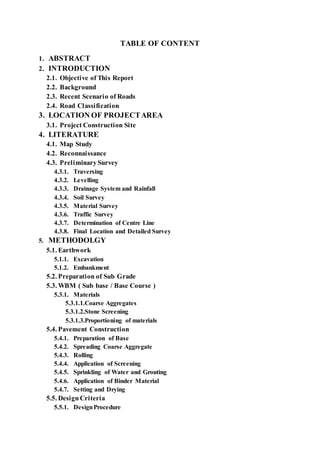
TABLE OF CONTENT 
1. ABSTRACT 
2. INTRODUCTION 
2.1. Objective of This Report 
2.2. Background 
2.3. Recent Scenario of Roads 
2.4. Road Classification 
3. LOCATION OF PROJECT AREA 
3.1. Project Construction Site 
4. LITERATURE 
4.1. Map Study 
4.2. Reconnaissance 
4.3. Preliminary Survey 
4.3.1. Traversing 
4.3.2. Levelling 
4.3.3. Drainage System and Rainfall 
4.3.4. Soil Survey 
4.3.5. Material Survey 
4.3.6. Traffic Survey 
4.3.7. Determination of Centre Line 
4.3.8. Final Location and Detailed Survey 
5. METHODOLGY 
5.1. Earthwork 
5.1.1. Excavation 
5.1.2. Embankment 
5.2. Preparation of Sub Grade 
5.3. WBM ( Sub base / Base Course ) 
5.3.1. Materials 
5.3.1.1.Coarse Aggregates 
5.3.1.2.Stone Screening 
5.3.1.3.Proportioning of materials 
5.4. Pavement Construction 
5.4.1. Preparation of Base 
5.4.2. Spreading Coarse Aggregate 
5.4.3. Rolling 
5.4.4. Application of Screening 
5.4.5. Sprinkling of Water and Grouting 
5.4.6. Application of Binder Material 
5.4.7. Setting and Drying 
5.5. Design Criteria 
5.5.1. Design Procedure
5.5.2. Design Traffic 
5.5.3. Design Life 
6. CONCLUSION 
7. REFERENCES
1. ABSTRACT 
Rural Connectivity becomes a critical component in the socio-economic development of rural people 
by providing access to amenities like education, health, marketing etc. It has been established that 
investments in rural roads lifts rural people above the poverty line. The evidence also indicates that as 
the rural connectivity improves, the rural poverty levels come down. There had been imbalanced 
development of the rural road network in country. Some States provided cent per cent connectivity 
while some others did not have enough financial resources at their disposal and consequently 
connectivity remained at low levels. 
Village roads constructed in any places are constructed by two types pavement based on CBR. These 
two methods are- 
1. Flexible pavement construction 
2. Rigid pavement construction 
This report deals with the flexible pavement type construction which is used where soil are enough to 
sustain loads and did not settle down more or where the soil used is not sandy or clayey. Soil having 
CBR good i.e. up to 7 or high this type of pavement is provided, Generally VR is flexible pavement 
roads. I have done my training on Flexible pavement type construction. In this type of construction we 
use WBM, GSB, MSB etc.
2. INTRODUCTION 
Rural development has become a matter of growing urgency for considerations of social justice, 
national integration, and economic rising and inclusive growth. For rural development, the provision 
of rural road network is a key component to enable the rural people to have access to schools, health 
centres and markets. Rural roads serve as an entry point for poverty alleviation since lack of access is 
accepted universally as a fundamental factor in continuation of poverty. India launched the era of 
planned development in 1951, a few ports and around 400,000 KMS of serviceable road network. 
Accessibility to villages was poor as only about 20 percent of them had all weather road links. The 
Government laid down a framework for accelerated growth through investments in irrigation, power, 
heavy industry and transport. Side by side, stress was laid on provision of social infrastructure 
(education and health) and integrated rural development including agriculture. Rural roads act as a 
facilitator to promote and sustain agricultural growth, improve basic health, provide access to schools 
and economic opportunities and thus holds the key to accelerated poverty reduction, achievements of 
MDG , socio-economic transformation, national integration and breaking the isolation of village 
communities and holistic and inclusive rural development. A major thrust to the development of rural 
roads was accorded at the beginning of the Fifth Five Year Plan in 1974 when it was made a part of 
the Minimum Needs Programme. In 1996, this was merged with the BMS programmes. The works of 
village tracks were also taken up under several employment creation and poverty alleviation 
programmes of the Central and State Governments. 
2.1. Objectives of This Report 
The objective of this report is to show you what I have learnt through my Industrial Training. What 
are the various methods to implement in the road constructions, pavement designing, providing 
camber, shoulder, and mixing of bitumen with the aggregates and providing various coats like prime 
coat, tack coat and seal coat and various other ways to construct VR. 
2.2. Background 
In the year 2000, around 40 per cent of the 825,000 villages in India lacked all-weather access roads. 
This constrained economic activities and access to essential services. Nearly 74 per cent of India’s 
rural population, constituting the majority of India’s poor, were not fully integrated into the national 
economy. The rural roads sector, which is a State subject, also lacked adequate planning and 
management due to poor coordination between multiple funding streams and agencies. Investing in 
rural roads was given low priority and viewed in isolation from the need for State and National 
Highways. 
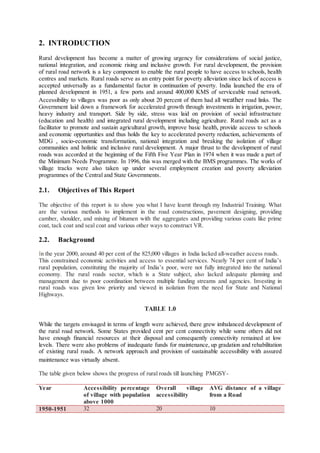
TABLE 1.0 
While the targets envisaged in terms of length were achieved, there grew imbalanced development of 
the rural road network. Some States provided cent per cent connectivity while some others did not 
have enough financial resources at their disposal and consequently connectivity remained at low 
levels. There were also problems of inadequate funds for maintenance, up gradation and rehabilitation 
of existing rural roads. A network approach and provision of sustainable accessibility with assured 
maintenance was virtually absent. 
The table given below shows the progress of rural roads till launching PMGSY-Year 
Accessibility percentage 
of village with population 
above 1000 
Overall village 
accessibility 
AVG distance of a village 
from a Road 
1950-1951 32 20 10
1960-1961 36 22 8 
1970-1971 40 25 5 
1980-1981 46 28 4 
1990-1991 73 44 3 
2000-2001 90 54 2 
2.3. Recent Scenario of Roads 
Recently the road development scenario is like this- 
Road Development Plan Vision: 2021 formulated by Chief Engineer in-charge of roads under the 
aegis of the Indian Roads Congress has served as sound reference framework for the Central and State 
Governments to formulate their successive Five Year Plans. As a result, the road network now stands 
at 3.3 million KMS. Of this, rural roads comprise around 2.7 million KMS, i.e. about 85 percent. 
Overall village accessibility stood at 54 percent in the year 2000, although position in respect of 
accessibility to large size habitations has been much better. 
2.4. Road Classification 
Road classification is primarily based on a variety of criteria, such as, traffic volume, road-width 
and surface type and also on links between specific locations. If warranted, the roads are reclassified 
to the next higher category keeping in view the traffic density, tourist usage, and industrial 
importance. 
The roads in the State of Uttar Pradesh are classified into the following five categories based on 
functional and administrative criteria: 
• National Highways (NH) 
• State Highways (SH) 
• Major District Roads (MDR) 
• Othe r Dis trict Roads (ODR) 
• Village Roads (VR) 
The Public Works Department (PWD) is the major department dealing with the State Highways , 
Major District Roads, Other District Roads and a part of the Village Roads in the state. 
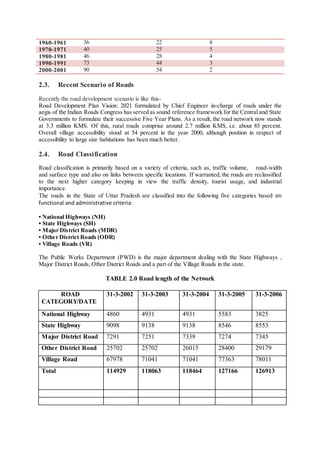
TABLE 2.0 Road length of the Network 
ROAD 
CATEGORY/DATE 
31-3-2002 31-3-2003 31-3-2004 31-3-2005 31-3-2006 
National Highway 4860 4931 4931 5583 3825 
State Highway 9098 9138 9138 8546 8553 
Major District Road 7291 7251 7339 7274 7345 
Other District Road 25702 25702 26015 28400 29179 
Village Road 67978 71041 71041 77363 78011 
Total 114929 118063 118464 127166 126913
3. LOCATION OF PROJECT AREA 
Construction work done by UPPWD was going on various sites. These sites are mainly in rural areas 
where proper construction of roads are not in sufficient amount means a lot of villages , there is no 
proper road in these areas. This is not for only one village actually this is the story of every two 
villages. Saying that this is the story of every two village is also not right. Each village has no proper 
roads various agencies are working to link up the villages with cities these are NAREGA, NABARD, 
MGNAREGA and PWD- construction part etc. In my city construction was going at various places 
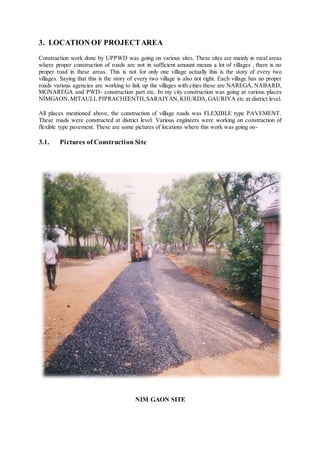
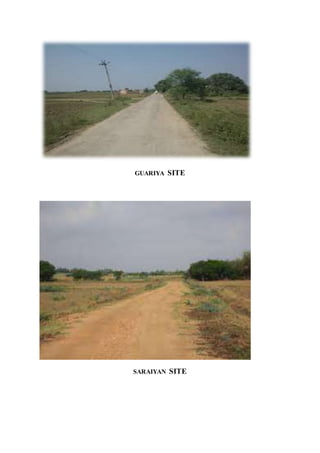
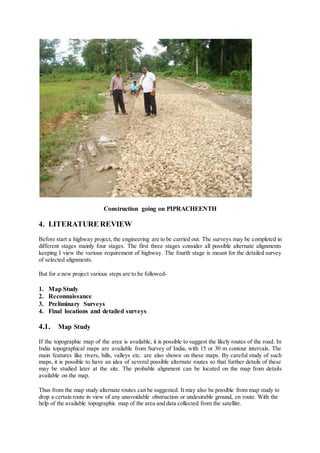
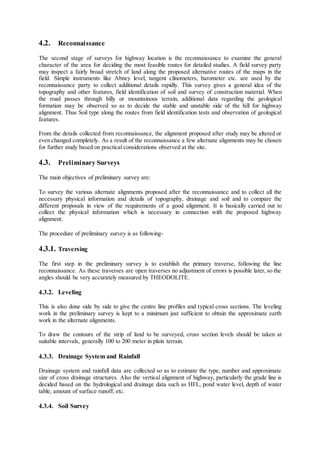
NIMGAON, MITAULI, PIPRACHEENTH, SARAIYAN, KHURDA, GAURIYA etc at district level. 
All places mentioned above, the construction of village roads was FLEXIBLE type PAVEMENT. 
These roads were constructed at district level. Various engineers were working on construction of 
flexible type pavement. These are some pictures of locations where this work was going on- 
3.1. Pictures of Construction Site 
NIM GAON SITE
GUARIYA SITE 
SARAIYAN SITE
Construction going on PIPRACHEENTH 
4. LITERATURE REVIEW 
Before start a highway project, the engineering are to be carried out. The surveys may be completed in 
different stages mainly four stages. The first three stages consider all possible alternate alignments 
keeping I view the various requirement of highway. The fourth stage is meant for the detailed survey 
of selected alignments. 
But for a new project various steps are to be followed- 
1. Map Study 
2. Reconnaissance 
3. Preliminary Surveys 
4. Final locations and detailed surveys 
4.1. Map Study 
If the topographic map of the area is available, it is possible to suggest the likely routes of the road. In 
India topographical maps are available from Survey of India, with 15 or 30 m contour intervals. The 
main features like rivers, hills, valleys etc. are also shown on these maps. By careful study of such 
maps, it is possible to have an idea of several possible alternate routes so that further details of these 
may be studied later at the site. The probable alignment can be located on the map from details 
available on the map. 
Thus from the map study alternate routes can be suggested. It may also be possible from map study to 
drop a certain route in view of any unavoidable obstruction or undesirable ground, en route. With the 
help of the available topographic map of the area and data collected from the satellite.
4.2. Reconnaissance 
The second stage of surveys for highway location is the reconnaissance to examine the general 
character of the area for deciding the most feasible routes for detailed studies. A field survey party 
may inspect a fairly broad stretch of land along the proposed alternative routes of the maps in the 
field. Simple instruments like Abney level, tangent clinometers, barometer etc. are used by the 
reconnaissance party to collect additional details rapidly. This survey gives a general idea of the 
topography and other features, field identification of soil and survey of construction material. When 
the road passes through hilly or mountainous terrain, additional data regarding the geological 
formation may be observed so as to decide the stable and unstable side of the hill for highway 
alignment. Thus Soil type along the routes from field identification tests and observation of geological 
features. 
From the details collected from reconnaissance, the alignment proposed after study may be altered or 
even changed completely. As a result of the reconnaissance a few alternate alignments may be chosen 
for further study based on practical considerations observed at the site. 
4.3. Preliminary Surveys 
The main objectives of preliminary survey are: 
To survey the various alternate alignments proposed after the reconnaissance and to collect all the 
necessary physical information and details of topography, drainage and soil and to compare the 
different proposals in view of the requirements of a good alignment. It is basically carried out to 
collect the physical information which is necessary in connection with the proposed highway 
alignment. 
The procedure of preliminary survey is as following- 
4.3.1. Traversing 
The first step in the preliminary survey is to establish the primary traverse, following the line 
reconnaissance. As these traverses are open traverses no adjustment of errors is possible later, so the 
angles should be very accurately measured by THEODOLITE. 
4.3.2. Leveling 
This is also done side by side to give the centre line profiles and typical cross sections. The leveling 
work in the preliminary survey is kept to a minimum just sufficient to obtain the approximate earth 
work in the alternate alignments. 
To draw the contours of the strip of land to be surveyed, cross section levels should be taken at 
suitable intervals, generally 100 to 200 meter in plain terrain. 
4.3.3. Drainage System and Rainfall 
Drainage system and rainfall data are collected so as to estimate the type, number and approximate 
size of cross drainage structures. Also the vertical alignment of highway, particularly the grade line is 
decided based on the hydrological and drainage data such as HFL, pond water level, depth of water 
table, amount of surface runoff, etc. 
4.3.4. Soil Survey
Soil survey is an essential part of the preliminary survey as the suitability of the proposed location is 
to be finally decided based on the soil survey data. 
The soil sample collected during the field work are subjected to identification and classification test in 
the laboratory. Soil profile is obtained by drawing the longitudinal section along the proposed road 
alignment up to the depth of exploration. 
4.3.5. Material Survey 
Survey for naturally occurring materials like stone aggregates, soft aggregates, etc. and 
identification of suitable quarries should be made. Also availability of manufactured 
materials like cement lime, brick, etc. and their locations may be ascertained. 
4.3.6. Traffic Survey 
Traffic surveys conducted in the region from the basis for deciding the number of traffic lanes and 
roadway width, pavement design and economic analysis of highway project. Traffic volume counts of 
the classified vehicles are to be carried out on all the existing roads in the region, preferably for 24 
hours per day for seven days. 
4.3.7. Determination of Centre Line 
After completing the preliminary surveys and conducting the comparative studies of alternative 
alignment the final centre line of the road is to be decided in the office before the final location 
survey. After selecting the final alignment, the grade lines are drawn and the geometric elements of 
the elements of the horizontal and vertical alignment of the road are designed. 
4.4. Final Location and Detailed Survey 
Transfer of the alignment from the drawings to the ground by driving pegs along the centre line of 
finally chosen alignment, setting out geometric design elements by location of tangent point, apex 
point. 
Temporary bench marks are fixed at intervals of about 250 meters and at all drainage and under pass 
structures. Levels along the final centre line should be taken at all staked points. Leveling work is of 
great importance as the vertical alignment, earth work calculations and drainage details are to be 
worked out from the level notes. The cross sections level is taken up to the desired width. 
A detailed survey is carried out to enable drawing of the soil profile. The data during detailed survey 
should be elaborate and complete for preparing detailed plans, design and estimates of the project. 
5. METHEDOLOGY 
5.1. Earthwork 
The sub grade soil is prepared by bringing is to desired grade and camber and by compacting 
adequately. The sub grade may be either in embankment or in excavation. It is necessary to decide 
the limits of economical haul and lift. Now we discuss about two terms highlighted above: 
5.1.1. Excavation
It is the process of cutting or loosening and removing earth including rock from its original position, 
transporting and damping it as a fill or spoil bank. Earth excavation work may be divided as 
excavation or cutting, grading and compaction. Excavation equipments commonly used in highway 
projects or any other simple road constructions are bull dozers, scarpers, power shovels, draglines, 
clamshells, and hoes. 
5.1.2. Embankment 
When it is required to raise the grade line of a highway above the existing ground it becomes 
necessary to construct embankments. The grade line may be raised due to any reason- to keep the sub 
grade above the high ground water table, to prevent damage due to surface water and capillary water, 
to maintain design standard. 
The design elements in highway embankments are: 
1. HEIGHT, 
2. FILL MATERIAL, 
3. SETTLEMENT, 
4. STABILITY OF FOUNDATIONS, AND 
5. STABILITY OF SLOPES. 
5.2. Preparation of Sub grade 
The optimum moisture content should always be maintained by sprinkling requisite quantity of water 
in order to keep the sub-grade in established condition in accordance with the direction of Engineer-in- 
Charge. The sub-grade must not be allowed to become dry and break-up for want of cohesion. The 
final sectioning should be done to proper camber, gradient and super elevation with the help of 
template and strings. The rate of preparation and consolidation of sub-grade includes earth work in 
cutting and filling up to 22.5 cm thickness, if necessary, in order to achieve the desired profile. The 
dressed surface should be properly consolidated by rolling with power road roller of minimum 80-100 
KN capacity. 
5.3. WBM ( Sub-Base / Base Course) 
This work shall consist of clean, crushed aggregates mechanically interlocked by rolling and bonding 
together with screening, binding material where necessary and water laid on a properly prepared sub 
grade and finished in accordance with the requirements of these specifications and in close conformity 
with the lines, grades, cross-sections and thickness as per approved plans or as directed by Engineer-in- 
Charge. It is not desirable to lay Water Bound Macadam on an existing thin black topped surface 
without providing adequate drainage facility for water that would get accumulated at the interface of 
exiting bituminous surface and WBM. 
5.3.1. Mate rials 
5.3.1.1. Coarse Aggregate 
Coarse Aggregates shall conform to the grading requirement as set forth in TABLE-3.0 
Table -3 COARSE AGGREGATES based on the ir grading 
Size of Scre e nings IS Sie ve De s ignation % by Weight Pas s ing 
IS Sie ve
13.2 mm 13.2 mm 
5.3.1.2. Stone Scre ening 
11.2 mm 
5.6 mm 
180 micron 
100 
95-100 
15-35 
0-10 
Screening to fill voids in the coarse aggregates shall generally consist of the same material 
as the coarse aggregate. Screening shall conform to the grading requir ements as set forth in 
Table – 4. 
Table – 4 Stone scre ening based on the ir pe rcent pas s 
Size of Aggre gate IS Sie ve Des ignation % by Weight Pas s ing 
Grade – I (45 mm to 90 mm) 
Grade – II (45 mm to 63 mm) 
100 mm 
80 mm 
63 mm 
40 mm 
20 mm 
80 mm 
63 mm 
50 mm 
40 mm 
20 mm 
5.3.1.3. Proportioning of Mate rials 
IS Sie ve 
100 
65-85 
25-60 
0-15 
0-05 
100 
90-100 
35-70 
0-15 
0-05 
Approximate quantities of coarse aggregate and stone screenings required for Water Bound 
Macadam base / sub-base course shall be as mentioned in Table -5. 
Table – 5 (Quantity for 10 sq m Area) 
Clas sific 
ation 
Size / 
Range 
Compac 
te d 
Thickne 
s s 
Ne t 
Quantit 
y* 
Stone Scre e ning Binding 
Grading Mate rial 
Clas sification 
& Size 
For WBM Sub-bas 
e / Bas e 
Cours e 
(Ne t Quantity) 
Grade – 
I 
45 mm 
– 90 
mm 
100 mm 1.245 m3 Type-A 
(13.2 mm) 
0.285 m3 0.10 m3 
Grade – 
II 
45 mm 
– 63 
mm 
75 mm 0.935 m3 Type-A 
(13.2 mm) 
0.135 m3 0.09 m3 
* Net quantity means – the quantity of metal measured in stacks and reduced by 7.5%.
5.4. Pavement Construction Operations 
5.4.1. Preparation of Base 
The surface of the sub grade / sub-base base to receive the Water Bound Macadam course 
shall be prepared to the specified lines grades & camber and made free of dust and other 
extraneous material. Any soft yielding places shall be corrected in an approved manner and 
rolled until firm surface is obtained if necessary by sprinkling water. Any sub 
base/base/sur face irregularities, where predominant shall be made good by providing 
appropriate type of profile corrective course (levelling course) . 
5.4.2. Spreading Coarse Aggregate s 
The coarse aggregate shall be spread uniformly and evenly upon the prepared sub -grade to 
proper profile by using templates placed across the road about 6m apart in such quantities 
such that the thickness of each compact layer is not more than 100mm for Grade -I and 75 
mm for Grade-II. Wherever possible, approved mechanical devices such as aggregate 
spreader shall be used to spread the aggregates uniformly so as to minimize the need for 
manual rectification afterwards. 
The surface of the aggregates spread shall be carefully checked with templates and all high 
or low spots remedied by removing or adding aggregates as may be required. The surface 
shall be checked frequently with a straight -edge while spreading and rolling so as to ensure 
a finished surface as per approved drawings. 
The course aggregates shall not normally be spread more than 3 days in advance of the 
subsequent construction operations. 
5.4.3. Rolling 
Immediately following the spreading of the coarse aggregates, rolling shall be started with 
three wheeled Power Roller of 80-100 KN capacity or Vibratory Rollers of 80-100 KN 
static weight. The type of roller to be used shall be approved by the Engineer -in-Charge 
based on trial run Rolling shall be discontinued when the aggregates are partially 
compacted with sufficient void space in them to permit the application of stone screenings. 
The rolled surface shall be checked transversely and longitudinally, with templates and any 
irregularities corrected by loosening the surface, adding or removing necessary amount of 
aggregates and re -rolling until the entire surface conforms to desired grade and camb er. In 
no case shall be use of screenings be permitted to make up depressions. Material which gets 
crushed excessively during compaction or becomes segregated shall be removed and 
replaced with suitable aggregates. 
5.4.4. Application of Scre enings 
After the coarse aggregate has been rolled completely, screenings to completely fill the 
interstices shall be applied gradually over the surface. These shall not be damp or wet at the 
time of application. Dry rolling shall be done while the screenings are being spread so that 
vibrations of the roller cause them to settle into the voids of the coarse aggregates. The
screenings shall not be dumped in piles but be spread uniformly in successive thin layers 
either by the spreading motions of hand shovels or by mechanical spre aders. 
The screenings shall be applied at a slope and uniform rate (in three or more applications) 
so as to ensure filling of all voids. This shall be accompanied by dry rolling and broom with 
mechanical or hand brooms. 
5.4.5. Sprinkling of Wate r and Grouting 
After the screenings have been applied the surface shall be copiously sprinkled with water 
swept and rolled. Hand brooms shall be used to sweep the wet screenings into voids and to 
distribute them evenly. The sprinkling, sweeping and rolling operations shall be continued, 
with additional screenings applied as necessary until the coarse aggregate has been 
thoroughly keyed, well bonded and firmly set in its full depth and a grout has been formed 
of screenings. Care shall be taken to see that the base or sub -grade does not get damaged 
due to the addition of excessive quantity of water during construction. 
5.4.6. Application of binde r Mate rial 
After the application of stone screening in accordance with Clauses 8.034 and 8.035 the 
binding material where it is required to be used shall be applied successively in two or 
more thin layers at a slow and uniform rate. After each application, the surface shall be 
copiously sprinkled with water, the resulting slurry swept in with hand brooms or 
mechanical brooms to fill the voids properly and rolled during which water shall be applied 
to the wheels of the roller if necessary to wash down the binding material sticking to them. 
These operations shall continue until the resulting slurry after filling of voids forms a wave 
ahead of the wheels of the moving roller. 
5.4.7. Se tting and Drying 
After the final compaction of Water Bound Macadam course the pavement shall be allowed 
to dry overnight. Next morning hungry spots shall be filled with screenings or bending 
materials as directed, lightly sprinkled with water if necessary and rolled. No traffic shall 
be allowed on the road until the macadam has set . 
5.5. Design Criteria 
Design detail of embankment and cut slopes, foundation of embankments and bridges and pavement 
layers. Here we dealt with the design of pavements i.e. flexible pavement on which I have done my 
training. The pavements have been modelled as a three layer structure and stresses and strains at 
critical locations have been computed using the linear elastic model. To give proper consideration to 
the aspects of performance, the following three types of pavement distress resulting from repeated 
(cyclic) application of loads are considered: 
1. Vertical compressive strain at the top of the sub-grade which can cause sub-grade deformation 
resulting in permanent deformation at the pavement surface. 
2. Horizontal tensile strain or stress at the bottom of the bituminous layer which can cause fracture 
of the bituminous layer. 
3. Pavement deformation within the bituminous layer. 
5.5.1. Design procedure
Based on the performance of existing designs and using analytical approach, simple design charts and 
a catalogue of pavement designs are added in the code. The pavement designs are given for sub grade 
CBR values ranging from 2% to 10% and design traffic ranging from 1 MSA to 150 MSA for an 
average annual pavement temperature of 35 C. The later thicknesses obtained from the analysis have 
been slightly modified to adapt the designs to stage construction. Using the following simple input 
parameters, appropriate designs could be chosen for the given traffic and soil strength: Design traffic 
in terms of cumulative number of standard axles; and CBR value of sub grade. 
5.5.2. Design Traffic 
The method considers traffic in terms of the cumulative number of standard axles (8160 kg) to be 
carried by the pavement during the design life. This requires the following information: 
1. Initial traffic in terms of CVPD 
2. Traffic growth rate during the design life 
3. Design life in number of years 
4. Vehicle damage factor (VDF) 
5. Distribution of commercial traffic over the carriage way. 
Initial traffic is determined in terms of commercial vehicles per day (CVPD). For the structural design 
of the pavement only commercial vehicles are considered assuming laden weight of three tonnes or 
more and their axle loading will be considered. Estimate of the initial daily average traffic for any 
road should normally be based on 7-day 24-hour classified traffic counts (ADT). In case of new roads, 
traffic estimates can be made on the basis of potential land use and traffic on existing routes in the 
area. 
Traffic growth rates can be estimated as: 
1. By studying the past trends of traffic growth, and 
2. By establishing econometric models. If adequate data is not available, it is recommended that an 
average annual growth rate of 7.5 percent may be adopted. 
5.5.3. Design life 
For the purpose of the pavement design, the design life is defined in terms of the cumulative number 
of standard axles that can be carried before strengthening of the pavement is necessary. It is 
recommended that pavements for arterial roads like NH, SH should be designed for a life of 15 years, 
EH and urban roads for 20 years and other categories of roads for 10 to 15 years.
6. CONCLUSION 
PMGSY is being implemented since the Year 2000. The projects for 109010 habitations have been 
sanctioned out of total 136464 eligible habitations by clearing the proposals for 420637 KMS roads. 
In order to achieve the targets, Rs. 84,731 Crores were released up to March 2011 against the 
sanctioned projects of Rs. 1,18,949 crore. 
Rural roads comprise over 85 % of the road network and their being kept in serviceable condition is 
crucial to the rural / agricultural growth and affording means of access to millions of rural people to 
social facilities viz. medical, education as also to market. Assessment criteria of bid capacity of 
contractors may be relaxed so that smaller contractors can also participate in PMGSY works. The 
time period of execution of road works in these districts may be enhanced from the existing 18 
months to 24 months. Specific clauses may be added in the Standard Bidding document to provide for 
insurance coverage to machinery engaged in PMGSY works. 
With a view to formulate the 12th Five Year Plan and improve the delivery mechanism for effective 
implementation of the programme, the Working Group has been constituted under the Chairmanship 
of Secretary, Rural Development with members from different organizations and subject experts. The 
Working Group, in turn constituted sub-committees on different aspects of rural roads.
7. REFERENCES 
1. IRC: 19-2005 Standard Specification and Code of Practice for Water Bound Macadam 
(Third Revision) 
2. IRC: 37-2001 Guidelines for the Design of Flexible Pavements (Second Revision) 
3. Working Group on Rural Roads In the 12th FIVE YEAR (Government of India, 
Planning Commission, Ministry of Rural Development October 2011) 
4. Highway Engineering (C.E.G. Justo and S.K. Khanna) 
5. www.useit.umeciv.maine.edu/ashcrete.html 
6. Technical Assistance for Implementation of Institutional Reforms in the Road 
Sector of UP PWD 
7. IRC method of design of flexible pavements by NPTEL.

Road Development and Maintenance of Rural Areas

  • 1.
    A SUMMER TRAININGREPORT ON ROAD DEVELOPMENT AND MAINTENACE IN RURAL AREAS At UTTAR PRADESH PUBLIC WORKS DEPARTMENT CONSTRUCTION DIVISION-4 Submitted for Partial Fulfilment of Bachelor of Technology CIVIL ENGINEERING SUBMITTED TO: SUBMITTED BY: DEPARTMENT OF CIVIL ENGINEERING AMIT KUMAR YADAV GLA UNIVERSITY B.TECH. 4TH YEAR MATHURA 111000015
  • 2.
    ACKNOWLEDGEMENT I, AMITKUMAR YADAV shows my greatest thanks to Executive Engineer Mr. Sunil Kumar and all the PWD engineers associated with this summer training for his proper guidance, useful suggestions and timely treatment where ever required during the entire training. My best wishes to UPPWD for giving me a chance for this summer training and know about flexible pavement construction. My special thanks goes to Mr. Jwala Prasad Ji J.E. UPPWD Construction Division 4 and last but not least the workers for a great coordination at site irrespective of their daily working. DATE : 28 June 2014 Amit Kumar Yadav
  • 3.
    TABLE OF CONTENT 1. ABSTRACT 2. INTRODUCTION 2.1. Objective of This Report 2.2. Background 2.3. Recent Scenario of Roads 2.4. Road Classification 3. LOCATION OF PROJECT AREA 3.1. Project Construction Site 4. LITERATURE 4.1. Map Study 4.2. Reconnaissance 4.3. Preliminary Survey 4.3.1. Traversing 4.3.2. Levelling 4.3.3. Drainage System and Rainfall 4.3.4. Soil Survey 4.3.5. Material Survey 4.3.6. Traffic Survey 4.3.7. Determination of Centre Line 4.3.8. Final Location and Detailed Survey 5. METHODOLGY 5.1. Earthwork 5.1.1. Excavation 5.1.2. Embankment 5.2. Preparation of Sub Grade 5.3. WBM ( Sub base / Base Course ) 5.3.1. Materials 5.3.1.1.Coarse Aggregates 5.3.1.2.Stone Screening 5.3.1.3.Proportioning of materials 5.4. Pavement Construction 5.4.1. Preparation of Base 5.4.2. Spreading Coarse Aggregate 5.4.3. Rolling 5.4.4. Application of Screening 5.4.5. Sprinkling of Water and Grouting 5.4.6. Application of Binder Material 5.4.7. Setting and Drying 5.5. Design Criteria 5.5.1. Design Procedure
  • 4.
    5.5.2. Design Traffic 5.5.3. Design Life 6. CONCLUSION 7. REFERENCES
  • 5.
    1. ABSTRACT RuralConnectivity becomes a critical component in the socio-economic development of rural people by providing access to amenities like education, health, marketing etc. It has been established that investments in rural roads lifts rural people above the poverty line. The evidence also indicates that as the rural connectivity improves, the rural poverty levels come down. There had been imbalanced development of the rural road network in country. Some States provided cent per cent connectivity while some others did not have enough financial resources at their disposal and consequently connectivity remained at low levels. Village roads constructed in any places are constructed by two types pavement based on CBR. These two methods are- 1. Flexible pavement construction 2. Rigid pavement construction This report deals with the flexible pavement type construction which is used where soil are enough to sustain loads and did not settle down more or where the soil used is not sandy or clayey. Soil having CBR good i.e. up to 7 or high this type of pavement is provided, Generally VR is flexible pavement roads. I have done my training on Flexible pavement type construction. In this type of construction we use WBM, GSB, MSB etc.
  • 6.
    2. INTRODUCTION Ruraldevelopment has become a matter of growing urgency for considerations of social justice, national integration, and economic rising and inclusive growth. For rural development, the provision of rural road network is a key component to enable the rural people to have access to schools, health centres and markets. Rural roads serve as an entry point for poverty alleviation since lack of access is accepted universally as a fundamental factor in continuation of poverty. India launched the era of planned development in 1951, a few ports and around 400,000 KMS of serviceable road network. Accessibility to villages was poor as only about 20 percent of them had all weather road links. The Government laid down a framework for accelerated growth through investments in irrigation, power, heavy industry and transport. Side by side, stress was laid on provision of social infrastructure (education and health) and integrated rural development including agriculture. Rural roads act as a facilitator to promote and sustain agricultural growth, improve basic health, provide access to schools and economic opportunities and thus holds the key to accelerated poverty reduction, achievements of MDG , socio-economic transformation, national integration and breaking the isolation of village communities and holistic and inclusive rural development. A major thrust to the development of rural roads was accorded at the beginning of the Fifth Five Year Plan in 1974 when it was made a part of the Minimum Needs Programme. In 1996, this was merged with the BMS programmes. The works of village tracks were also taken up under several employment creation and poverty alleviation programmes of the Central and State Governments. 2.1. Objectives of This Report The objective of this report is to show you what I have learnt through my Industrial Training. What are the various methods to implement in the road constructions, pavement designing, providing camber, shoulder, and mixing of bitumen with the aggregates and providing various coats like prime coat, tack coat and seal coat and various other ways to construct VR. 2.2. Background In the year 2000, around 40 per cent of the 825,000 villages in India lacked all-weather access roads. This constrained economic activities and access to essential services. Nearly 74 per cent of India’s rural population, constituting the majority of India’s poor, were not fully integrated into the national economy. The rural roads sector, which is a State subject, also lacked adequate planning and management due to poor coordination between multiple funding streams and agencies. Investing in rural roads was given low priority and viewed in isolation from the need for State and National Highways. TABLE 1.0 While the targets envisaged in terms of length were achieved, there grew imbalanced development of the rural road network. Some States provided cent per cent connectivity while some others did not have enough financial resources at their disposal and consequently connectivity remained at low levels. There were also problems of inadequate funds for maintenance, up gradation and rehabilitation of existing rural roads. A network approach and provision of sustainable accessibility with assured maintenance was virtually absent. The table given below shows the progress of rural roads till launching PMGSY-Year Accessibility percentage of village with population above 1000 Overall village accessibility AVG distance of a village from a Road 1950-1951 32 20 10
  • 7.
    1960-1961 36 228 1970-1971 40 25 5 1980-1981 46 28 4 1990-1991 73 44 3 2000-2001 90 54 2 2.3. Recent Scenario of Roads Recently the road development scenario is like this- Road Development Plan Vision: 2021 formulated by Chief Engineer in-charge of roads under the aegis of the Indian Roads Congress has served as sound reference framework for the Central and State Governments to formulate their successive Five Year Plans. As a result, the road network now stands at 3.3 million KMS. Of this, rural roads comprise around 2.7 million KMS, i.e. about 85 percent. Overall village accessibility stood at 54 percent in the year 2000, although position in respect of accessibility to large size habitations has been much better. 2.4. Road Classification Road classification is primarily based on a variety of criteria, such as, traffic volume, road-width and surface type and also on links between specific locations. If warranted, the roads are reclassified to the next higher category keeping in view the traffic density, tourist usage, and industrial importance. The roads in the State of Uttar Pradesh are classified into the following five categories based on functional and administrative criteria: • National Highways (NH) • State Highways (SH) • Major District Roads (MDR) • Othe r Dis trict Roads (ODR) • Village Roads (VR) The Public Works Department (PWD) is the major department dealing with the State Highways , Major District Roads, Other District Roads and a part of the Village Roads in the state. TABLE 2.0 Road length of the Network ROAD CATEGORY/DATE 31-3-2002 31-3-2003 31-3-2004 31-3-2005 31-3-2006 National Highway 4860 4931 4931 5583 3825 State Highway 9098 9138 9138 8546 8553 Major District Road 7291 7251 7339 7274 7345 Other District Road 25702 25702 26015 28400 29179 Village Road 67978 71041 71041 77363 78011 Total 114929 118063 118464 127166 126913
  • 8.
    3. LOCATION OFPROJECT AREA Construction work done by UPPWD was going on various sites. These sites are mainly in rural areas where proper construction of roads are not in sufficient amount means a lot of villages , there is no proper road in these areas. This is not for only one village actually this is the story of every two villages. Saying that this is the story of every two village is also not right. Each village has no proper roads various agencies are working to link up the villages with cities these are NAREGA, NABARD, MGNAREGA and PWD- construction part etc. In my city construction was going at various places NIMGAON, MITAULI, PIPRACHEENTH, SARAIYAN, KHURDA, GAURIYA etc at district level. All places mentioned above, the construction of village roads was FLEXIBLE type PAVEMENT. These roads were constructed at district level. Various engineers were working on construction of flexible type pavement. These are some pictures of locations where this work was going on- 3.1. Pictures of Construction Site NIM GAON SITE
  • 9.
  • 10.
    Construction going onPIPRACHEENTH 4. LITERATURE REVIEW Before start a highway project, the engineering are to be carried out. The surveys may be completed in different stages mainly four stages. The first three stages consider all possible alternate alignments keeping I view the various requirement of highway. The fourth stage is meant for the detailed survey of selected alignments. But for a new project various steps are to be followed- 1. Map Study 2. Reconnaissance 3. Preliminary Surveys 4. Final locations and detailed surveys 4.1. Map Study If the topographic map of the area is available, it is possible to suggest the likely routes of the road. In India topographical maps are available from Survey of India, with 15 or 30 m contour intervals. The main features like rivers, hills, valleys etc. are also shown on these maps. By careful study of such maps, it is possible to have an idea of several possible alternate routes so that further details of these may be studied later at the site. The probable alignment can be located on the map from details available on the map. Thus from the map study alternate routes can be suggested. It may also be possible from map study to drop a certain route in view of any unavoidable obstruction or undesirable ground, en route. With the help of the available topographic map of the area and data collected from the satellite.
  • 11.
    4.2. Reconnaissance Thesecond stage of surveys for highway location is the reconnaissance to examine the general character of the area for deciding the most feasible routes for detailed studies. A field survey party may inspect a fairly broad stretch of land along the proposed alternative routes of the maps in the field. Simple instruments like Abney level, tangent clinometers, barometer etc. are used by the reconnaissance party to collect additional details rapidly. This survey gives a general idea of the topography and other features, field identification of soil and survey of construction material. When the road passes through hilly or mountainous terrain, additional data regarding the geological formation may be observed so as to decide the stable and unstable side of the hill for highway alignment. Thus Soil type along the routes from field identification tests and observation of geological features. From the details collected from reconnaissance, the alignment proposed after study may be altered or even changed completely. As a result of the reconnaissance a few alternate alignments may be chosen for further study based on practical considerations observed at the site. 4.3. Preliminary Surveys The main objectives of preliminary survey are: To survey the various alternate alignments proposed after the reconnaissance and to collect all the necessary physical information and details of topography, drainage and soil and to compare the different proposals in view of the requirements of a good alignment. It is basically carried out to collect the physical information which is necessary in connection with the proposed highway alignment. The procedure of preliminary survey is as following- 4.3.1. Traversing The first step in the preliminary survey is to establish the primary traverse, following the line reconnaissance. As these traverses are open traverses no adjustment of errors is possible later, so the angles should be very accurately measured by THEODOLITE. 4.3.2. Leveling This is also done side by side to give the centre line profiles and typical cross sections. The leveling work in the preliminary survey is kept to a minimum just sufficient to obtain the approximate earth work in the alternate alignments. To draw the contours of the strip of land to be surveyed, cross section levels should be taken at suitable intervals, generally 100 to 200 meter in plain terrain. 4.3.3. Drainage System and Rainfall Drainage system and rainfall data are collected so as to estimate the type, number and approximate size of cross drainage structures. Also the vertical alignment of highway, particularly the grade line is decided based on the hydrological and drainage data such as HFL, pond water level, depth of water table, amount of surface runoff, etc. 4.3.4. Soil Survey
  • 12.
    Soil survey isan essential part of the preliminary survey as the suitability of the proposed location is to be finally decided based on the soil survey data. The soil sample collected during the field work are subjected to identification and classification test in the laboratory. Soil profile is obtained by drawing the longitudinal section along the proposed road alignment up to the depth of exploration. 4.3.5. Material Survey Survey for naturally occurring materials like stone aggregates, soft aggregates, etc. and identification of suitable quarries should be made. Also availability of manufactured materials like cement lime, brick, etc. and their locations may be ascertained. 4.3.6. Traffic Survey Traffic surveys conducted in the region from the basis for deciding the number of traffic lanes and roadway width, pavement design and economic analysis of highway project. Traffic volume counts of the classified vehicles are to be carried out on all the existing roads in the region, preferably for 24 hours per day for seven days. 4.3.7. Determination of Centre Line After completing the preliminary surveys and conducting the comparative studies of alternative alignment the final centre line of the road is to be decided in the office before the final location survey. After selecting the final alignment, the grade lines are drawn and the geometric elements of the elements of the horizontal and vertical alignment of the road are designed. 4.4. Final Location and Detailed Survey Transfer of the alignment from the drawings to the ground by driving pegs along the centre line of finally chosen alignment, setting out geometric design elements by location of tangent point, apex point. Temporary bench marks are fixed at intervals of about 250 meters and at all drainage and under pass structures. Levels along the final centre line should be taken at all staked points. Leveling work is of great importance as the vertical alignment, earth work calculations and drainage details are to be worked out from the level notes. The cross sections level is taken up to the desired width. A detailed survey is carried out to enable drawing of the soil profile. The data during detailed survey should be elaborate and complete for preparing detailed plans, design and estimates of the project. 5. METHEDOLOGY 5.1. Earthwork The sub grade soil is prepared by bringing is to desired grade and camber and by compacting adequately. The sub grade may be either in embankment or in excavation. It is necessary to decide the limits of economical haul and lift. Now we discuss about two terms highlighted above: 5.1.1. Excavation
  • 13.
    It is theprocess of cutting or loosening and removing earth including rock from its original position, transporting and damping it as a fill or spoil bank. Earth excavation work may be divided as excavation or cutting, grading and compaction. Excavation equipments commonly used in highway projects or any other simple road constructions are bull dozers, scarpers, power shovels, draglines, clamshells, and hoes. 5.1.2. Embankment When it is required to raise the grade line of a highway above the existing ground it becomes necessary to construct embankments. The grade line may be raised due to any reason- to keep the sub grade above the high ground water table, to prevent damage due to surface water and capillary water, to maintain design standard. The design elements in highway embankments are: 1. HEIGHT, 2. FILL MATERIAL, 3. SETTLEMENT, 4. STABILITY OF FOUNDATIONS, AND 5. STABILITY OF SLOPES. 5.2. Preparation of Sub grade The optimum moisture content should always be maintained by sprinkling requisite quantity of water in order to keep the sub-grade in established condition in accordance with the direction of Engineer-in- Charge. The sub-grade must not be allowed to become dry and break-up for want of cohesion. The final sectioning should be done to proper camber, gradient and super elevation with the help of template and strings. The rate of preparation and consolidation of sub-grade includes earth work in cutting and filling up to 22.5 cm thickness, if necessary, in order to achieve the desired profile. The dressed surface should be properly consolidated by rolling with power road roller of minimum 80-100 KN capacity. 5.3. WBM ( Sub-Base / Base Course) This work shall consist of clean, crushed aggregates mechanically interlocked by rolling and bonding together with screening, binding material where necessary and water laid on a properly prepared sub grade and finished in accordance with the requirements of these specifications and in close conformity with the lines, grades, cross-sections and thickness as per approved plans or as directed by Engineer-in- Charge. It is not desirable to lay Water Bound Macadam on an existing thin black topped surface without providing adequate drainage facility for water that would get accumulated at the interface of exiting bituminous surface and WBM. 5.3.1. Mate rials 5.3.1.1. Coarse Aggregate Coarse Aggregates shall conform to the grading requirement as set forth in TABLE-3.0 Table -3 COARSE AGGREGATES based on the ir grading Size of Scre e nings IS Sie ve De s ignation % by Weight Pas s ing IS Sie ve
  • 14.
    13.2 mm 13.2mm 5.3.1.2. Stone Scre ening 11.2 mm 5.6 mm 180 micron 100 95-100 15-35 0-10 Screening to fill voids in the coarse aggregates shall generally consist of the same material as the coarse aggregate. Screening shall conform to the grading requir ements as set forth in Table – 4. Table – 4 Stone scre ening based on the ir pe rcent pas s Size of Aggre gate IS Sie ve Des ignation % by Weight Pas s ing Grade – I (45 mm to 90 mm) Grade – II (45 mm to 63 mm) 100 mm 80 mm 63 mm 40 mm 20 mm 80 mm 63 mm 50 mm 40 mm 20 mm 5.3.1.3. Proportioning of Mate rials IS Sie ve 100 65-85 25-60 0-15 0-05 100 90-100 35-70 0-15 0-05 Approximate quantities of coarse aggregate and stone screenings required for Water Bound Macadam base / sub-base course shall be as mentioned in Table -5. Table – 5 (Quantity for 10 sq m Area) Clas sific ation Size / Range Compac te d Thickne s s Ne t Quantit y* Stone Scre e ning Binding Grading Mate rial Clas sification & Size For WBM Sub-bas e / Bas e Cours e (Ne t Quantity) Grade – I 45 mm – 90 mm 100 mm 1.245 m3 Type-A (13.2 mm) 0.285 m3 0.10 m3 Grade – II 45 mm – 63 mm 75 mm 0.935 m3 Type-A (13.2 mm) 0.135 m3 0.09 m3 * Net quantity means – the quantity of metal measured in stacks and reduced by 7.5%.
  • 15.
    5.4. Pavement ConstructionOperations 5.4.1. Preparation of Base The surface of the sub grade / sub-base base to receive the Water Bound Macadam course shall be prepared to the specified lines grades & camber and made free of dust and other extraneous material. Any soft yielding places shall be corrected in an approved manner and rolled until firm surface is obtained if necessary by sprinkling water. Any sub base/base/sur face irregularities, where predominant shall be made good by providing appropriate type of profile corrective course (levelling course) . 5.4.2. Spreading Coarse Aggregate s The coarse aggregate shall be spread uniformly and evenly upon the prepared sub -grade to proper profile by using templates placed across the road about 6m apart in such quantities such that the thickness of each compact layer is not more than 100mm for Grade -I and 75 mm for Grade-II. Wherever possible, approved mechanical devices such as aggregate spreader shall be used to spread the aggregates uniformly so as to minimize the need for manual rectification afterwards. The surface of the aggregates spread shall be carefully checked with templates and all high or low spots remedied by removing or adding aggregates as may be required. The surface shall be checked frequently with a straight -edge while spreading and rolling so as to ensure a finished surface as per approved drawings. The course aggregates shall not normally be spread more than 3 days in advance of the subsequent construction operations. 5.4.3. Rolling Immediately following the spreading of the coarse aggregates, rolling shall be started with three wheeled Power Roller of 80-100 KN capacity or Vibratory Rollers of 80-100 KN static weight. The type of roller to be used shall be approved by the Engineer -in-Charge based on trial run Rolling shall be discontinued when the aggregates are partially compacted with sufficient void space in them to permit the application of stone screenings. The rolled surface shall be checked transversely and longitudinally, with templates and any irregularities corrected by loosening the surface, adding or removing necessary amount of aggregates and re -rolling until the entire surface conforms to desired grade and camb er. In no case shall be use of screenings be permitted to make up depressions. Material which gets crushed excessively during compaction or becomes segregated shall be removed and replaced with suitable aggregates. 5.4.4. Application of Scre enings After the coarse aggregate has been rolled completely, screenings to completely fill the interstices shall be applied gradually over the surface. These shall not be damp or wet at the time of application. Dry rolling shall be done while the screenings are being spread so that vibrations of the roller cause them to settle into the voids of the coarse aggregates. The
  • 16.
    screenings shall notbe dumped in piles but be spread uniformly in successive thin layers either by the spreading motions of hand shovels or by mechanical spre aders. The screenings shall be applied at a slope and uniform rate (in three or more applications) so as to ensure filling of all voids. This shall be accompanied by dry rolling and broom with mechanical or hand brooms. 5.4.5. Sprinkling of Wate r and Grouting After the screenings have been applied the surface shall be copiously sprinkled with water swept and rolled. Hand brooms shall be used to sweep the wet screenings into voids and to distribute them evenly. The sprinkling, sweeping and rolling operations shall be continued, with additional screenings applied as necessary until the coarse aggregate has been thoroughly keyed, well bonded and firmly set in its full depth and a grout has been formed of screenings. Care shall be taken to see that the base or sub -grade does not get damaged due to the addition of excessive quantity of water during construction. 5.4.6. Application of binde r Mate rial After the application of stone screening in accordance with Clauses 8.034 and 8.035 the binding material where it is required to be used shall be applied successively in two or more thin layers at a slow and uniform rate. After each application, the surface shall be copiously sprinkled with water, the resulting slurry swept in with hand brooms or mechanical brooms to fill the voids properly and rolled during which water shall be applied to the wheels of the roller if necessary to wash down the binding material sticking to them. These operations shall continue until the resulting slurry after filling of voids forms a wave ahead of the wheels of the moving roller. 5.4.7. Se tting and Drying After the final compaction of Water Bound Macadam course the pavement shall be allowed to dry overnight. Next morning hungry spots shall be filled with screenings or bending materials as directed, lightly sprinkled with water if necessary and rolled. No traffic shall be allowed on the road until the macadam has set . 5.5. Design Criteria Design detail of embankment and cut slopes, foundation of embankments and bridges and pavement layers. Here we dealt with the design of pavements i.e. flexible pavement on which I have done my training. The pavements have been modelled as a three layer structure and stresses and strains at critical locations have been computed using the linear elastic model. To give proper consideration to the aspects of performance, the following three types of pavement distress resulting from repeated (cyclic) application of loads are considered: 1. Vertical compressive strain at the top of the sub-grade which can cause sub-grade deformation resulting in permanent deformation at the pavement surface. 2. Horizontal tensile strain or stress at the bottom of the bituminous layer which can cause fracture of the bituminous layer. 3. Pavement deformation within the bituminous layer. 5.5.1. Design procedure
  • 17.
    Based on theperformance of existing designs and using analytical approach, simple design charts and a catalogue of pavement designs are added in the code. The pavement designs are given for sub grade CBR values ranging from 2% to 10% and design traffic ranging from 1 MSA to 150 MSA for an average annual pavement temperature of 35 C. The later thicknesses obtained from the analysis have been slightly modified to adapt the designs to stage construction. Using the following simple input parameters, appropriate designs could be chosen for the given traffic and soil strength: Design traffic in terms of cumulative number of standard axles; and CBR value of sub grade. 5.5.2. Design Traffic The method considers traffic in terms of the cumulative number of standard axles (8160 kg) to be carried by the pavement during the design life. This requires the following information: 1. Initial traffic in terms of CVPD 2. Traffic growth rate during the design life 3. Design life in number of years 4. Vehicle damage factor (VDF) 5. Distribution of commercial traffic over the carriage way. Initial traffic is determined in terms of commercial vehicles per day (CVPD). For the structural design of the pavement only commercial vehicles are considered assuming laden weight of three tonnes or more and their axle loading will be considered. Estimate of the initial daily average traffic for any road should normally be based on 7-day 24-hour classified traffic counts (ADT). In case of new roads, traffic estimates can be made on the basis of potential land use and traffic on existing routes in the area. Traffic growth rates can be estimated as: 1. By studying the past trends of traffic growth, and 2. By establishing econometric models. If adequate data is not available, it is recommended that an average annual growth rate of 7.5 percent may be adopted. 5.5.3. Design life For the purpose of the pavement design, the design life is defined in terms of the cumulative number of standard axles that can be carried before strengthening of the pavement is necessary. It is recommended that pavements for arterial roads like NH, SH should be designed for a life of 15 years, EH and urban roads for 20 years and other categories of roads for 10 to 15 years.
  • 18.
    6. CONCLUSION PMGSYis being implemented since the Year 2000. The projects for 109010 habitations have been sanctioned out of total 136464 eligible habitations by clearing the proposals for 420637 KMS roads. In order to achieve the targets, Rs. 84,731 Crores were released up to March 2011 against the sanctioned projects of Rs. 1,18,949 crore. Rural roads comprise over 85 % of the road network and their being kept in serviceable condition is crucial to the rural / agricultural growth and affording means of access to millions of rural people to social facilities viz. medical, education as also to market. Assessment criteria of bid capacity of contractors may be relaxed so that smaller contractors can also participate in PMGSY works. The time period of execution of road works in these districts may be enhanced from the existing 18 months to 24 months. Specific clauses may be added in the Standard Bidding document to provide for insurance coverage to machinery engaged in PMGSY works. With a view to formulate the 12th Five Year Plan and improve the delivery mechanism for effective implementation of the programme, the Working Group has been constituted under the Chairmanship of Secretary, Rural Development with members from different organizations and subject experts. The Working Group, in turn constituted sub-committees on different aspects of rural roads.
  • 19.
    7. REFERENCES 1.IRC: 19-2005 Standard Specification and Code of Practice for Water Bound Macadam (Third Revision) 2. IRC: 37-2001 Guidelines for the Design of Flexible Pavements (Second Revision) 3. Working Group on Rural Roads In the 12th FIVE YEAR (Government of India, Planning Commission, Ministry of Rural Development October 2011) 4. Highway Engineering (C.E.G. Justo and S.K. Khanna) 5. www.useit.umeciv.maine.edu/ashcrete.html 6. Technical Assistance for Implementation of Institutional Reforms in the Road Sector of UP PWD 7. IRC method of design of flexible pavements by NPTEL.