UNIT 3.
DESIGN FLEXIBLEAND RIGID PAVEMENTS 9
Design principles
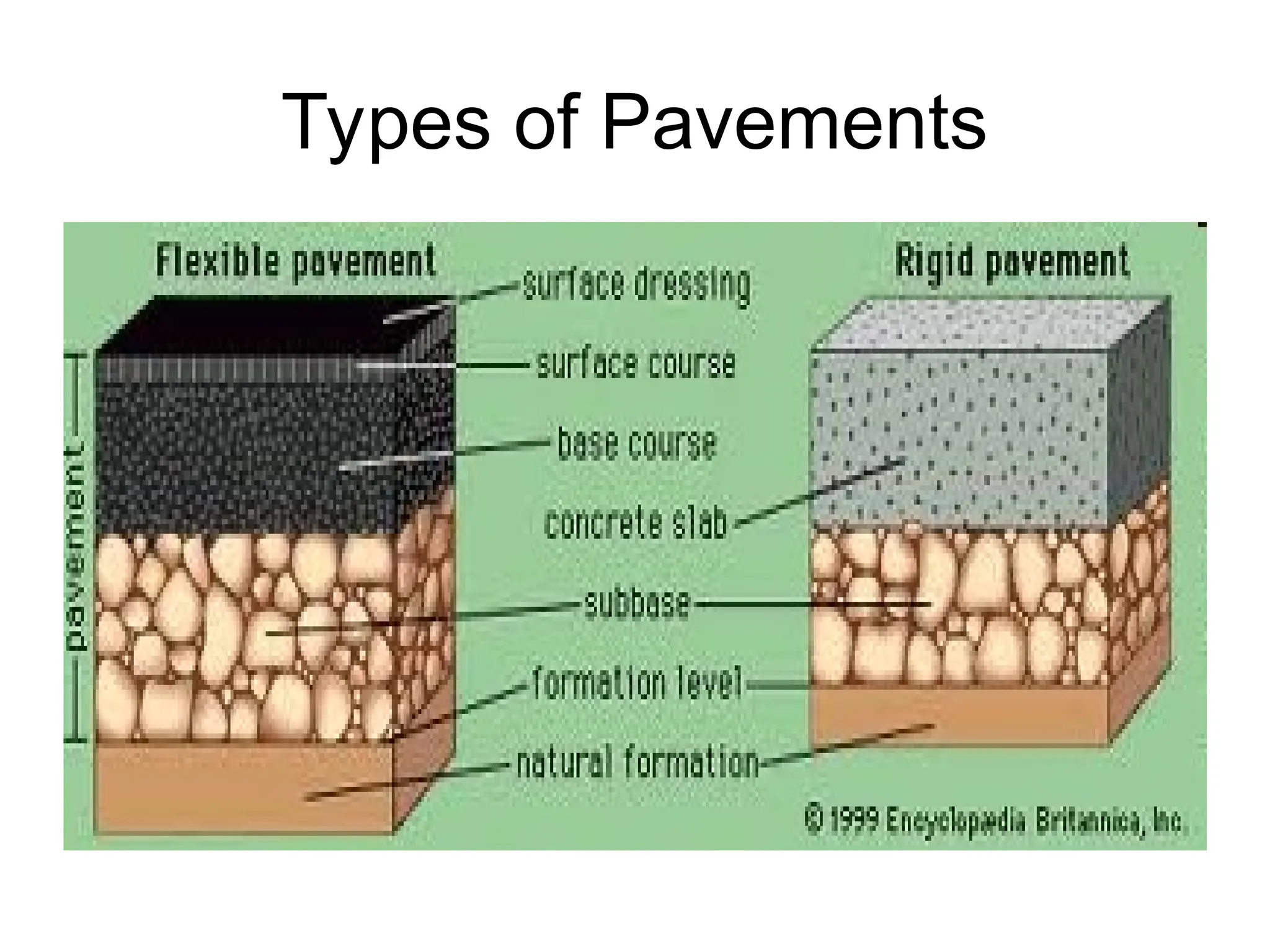
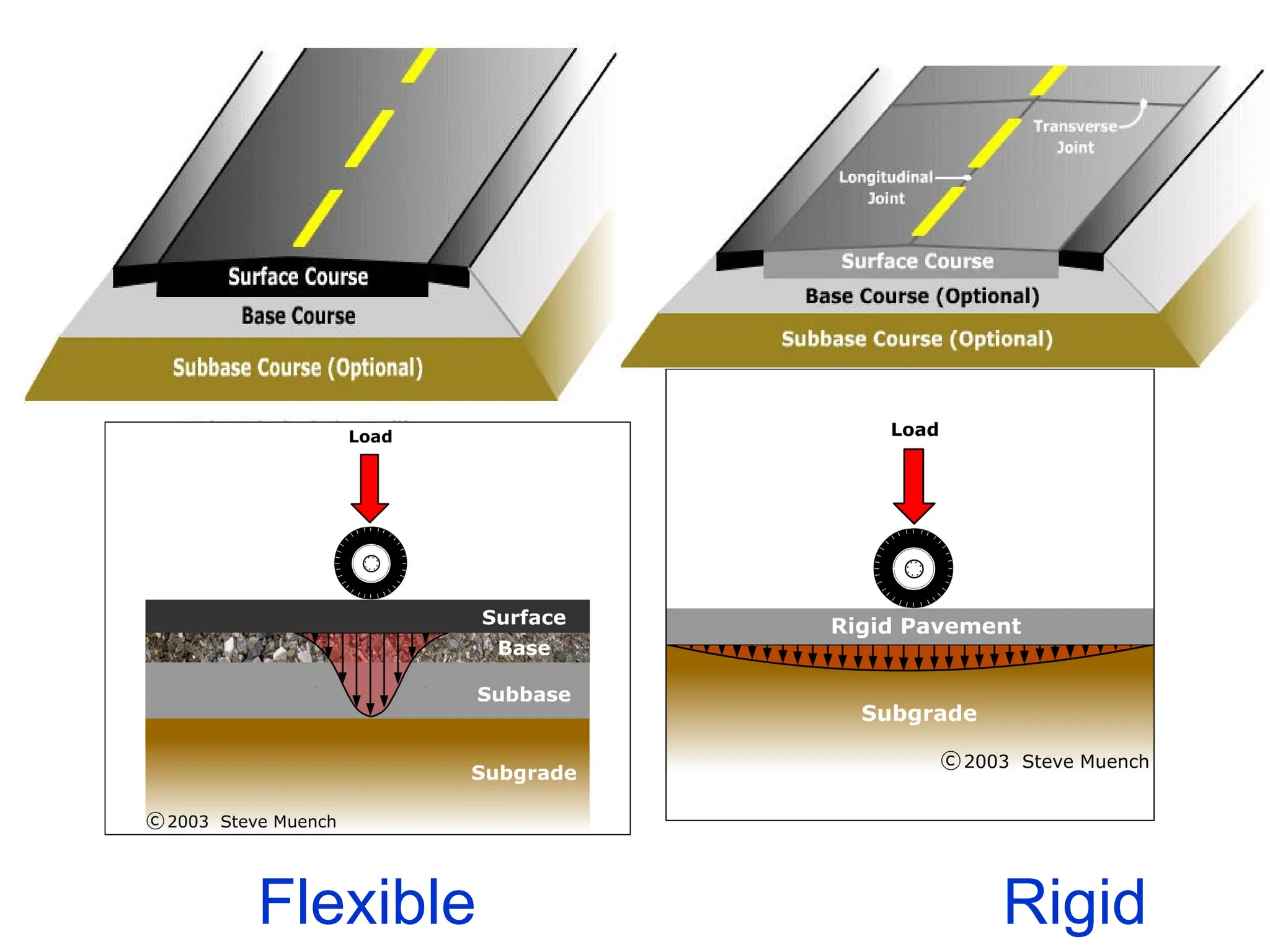
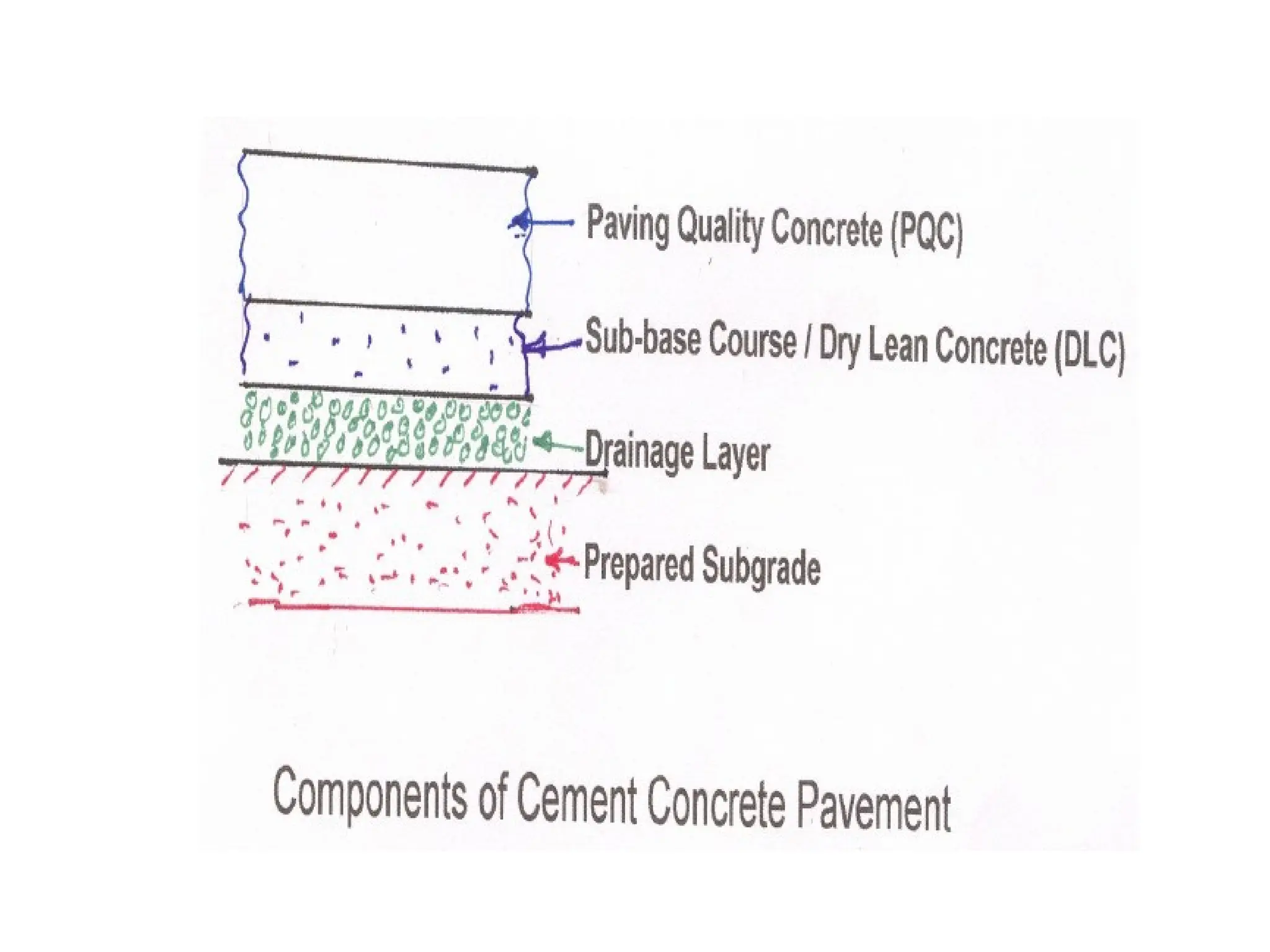
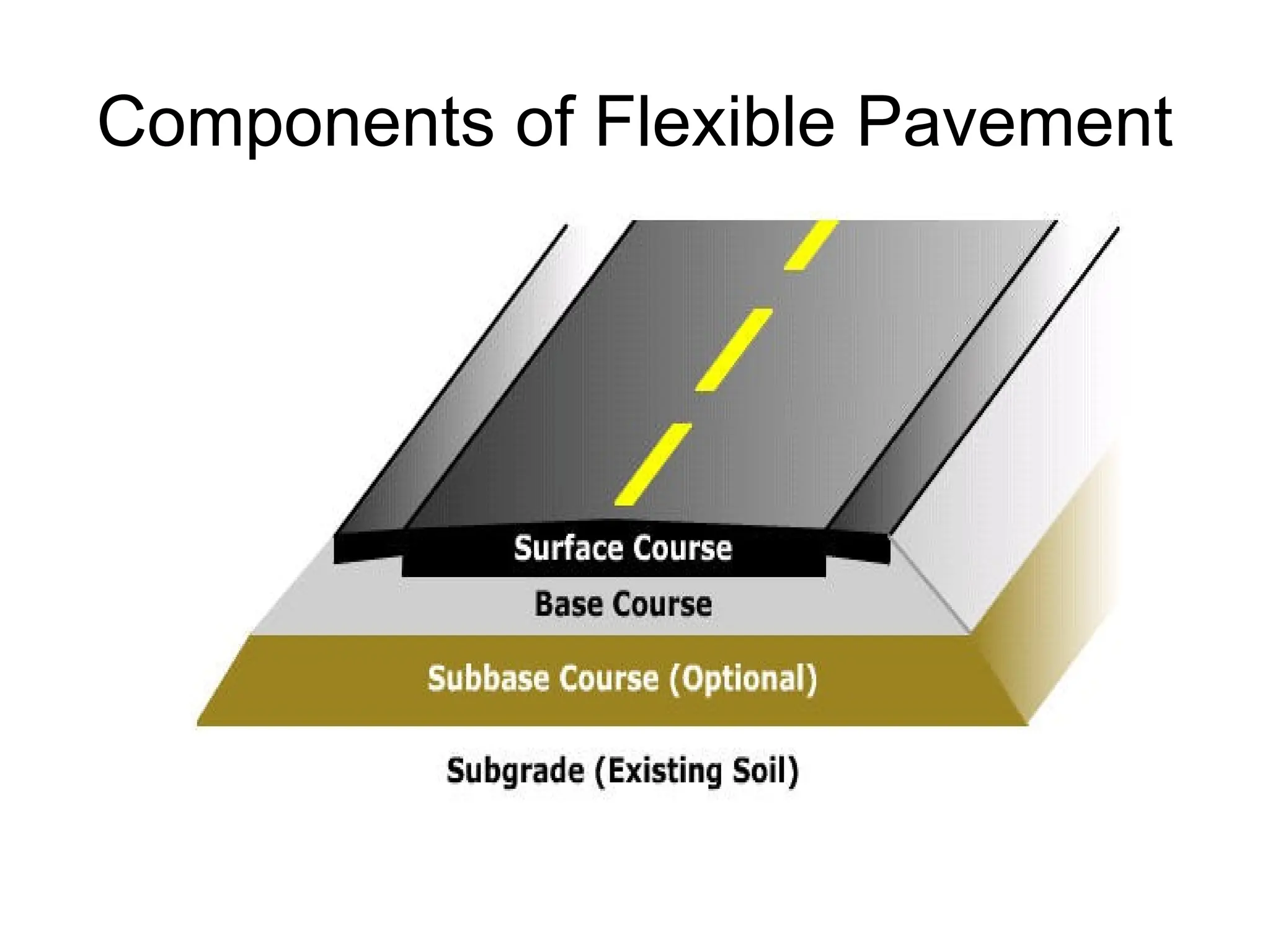
pavement components and their role
Design practice for flexible and rigid pavements, (IRC
methods only).
Properties Flexible Rigid
Design
Principle
Empiricalmethod
Based on load distribution
characteristics of the
components
Designed and analyzed by using the elastic
theory
Material Granular material Made of Cement Concrete either plan,
reinforced or prestressed concrete
Flexural
Strength
Low or negligible flexible
strength
Associated with rigidity or flexural strength
or slab action so the load is distributed over
a wide area of subgrade soil.
Normal
Loading
Elastic deformation Acts as beam or cantilever
Excessive
Loading
Local depression Causes Cracks
Stress Transmits vertical and
compressive stresses to the
lower layers
Tensile Stress and Temperature Increases
Design
Practice
Constructed in number of
layers.
Laid in slabs with steel reinforcement.
Temperature No stress is produced Stress is produced
Force of
Friction
Less. Deformation in the
sub grade is not transferred
to the upper layers.
Friction force is High
Opening to
Traffic
Road can be used for traffic
within 24 hours
Road cannot be used until 14 days of curing
Surfacing Rolling of the surfacing is
needed
Rolling of the surfacing in not needed.
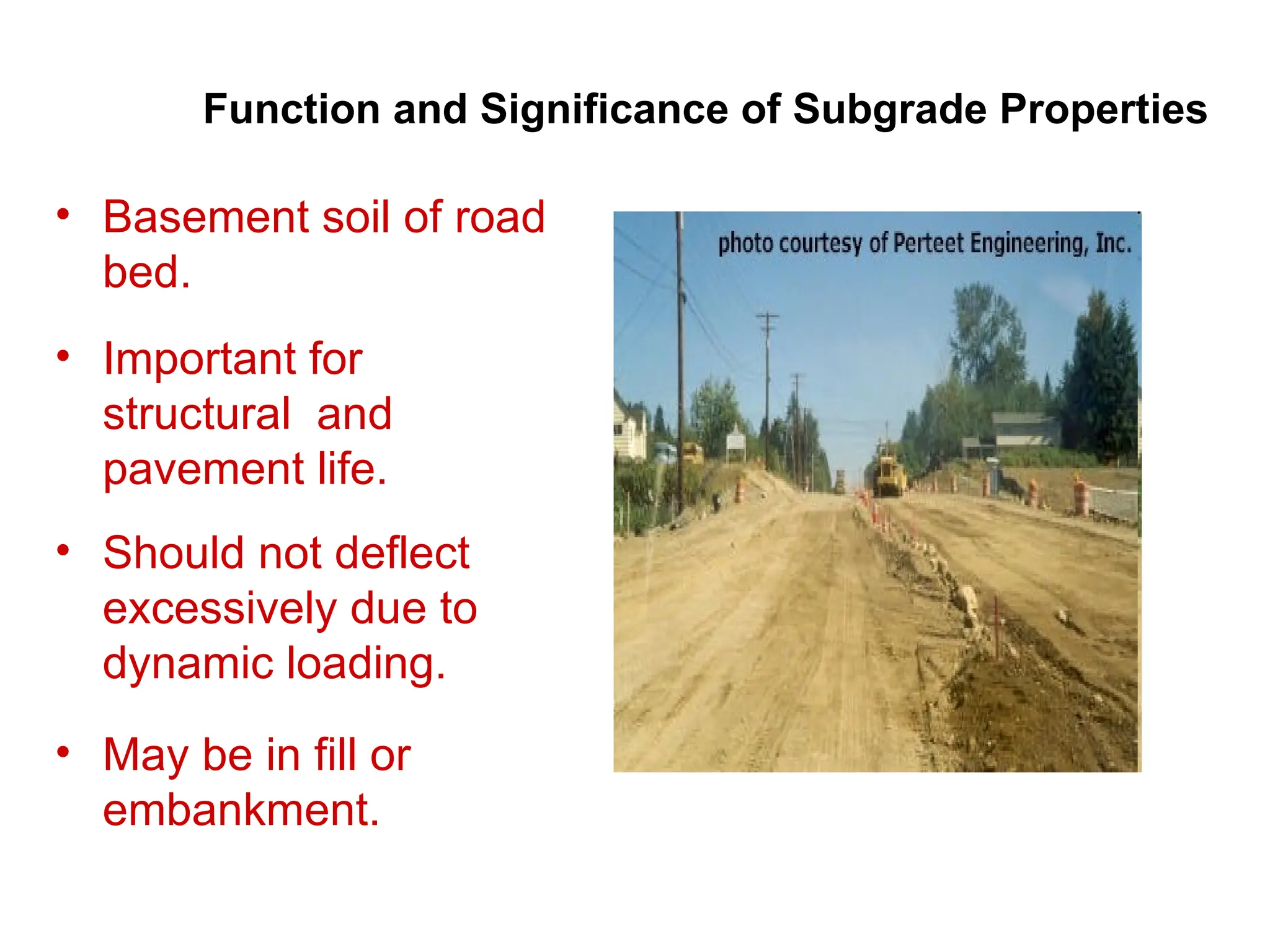
• Basement soilof road
bed.
• Important for
structural and
pavement life.
• Should not deflect
excessively due to
dynamic loading.
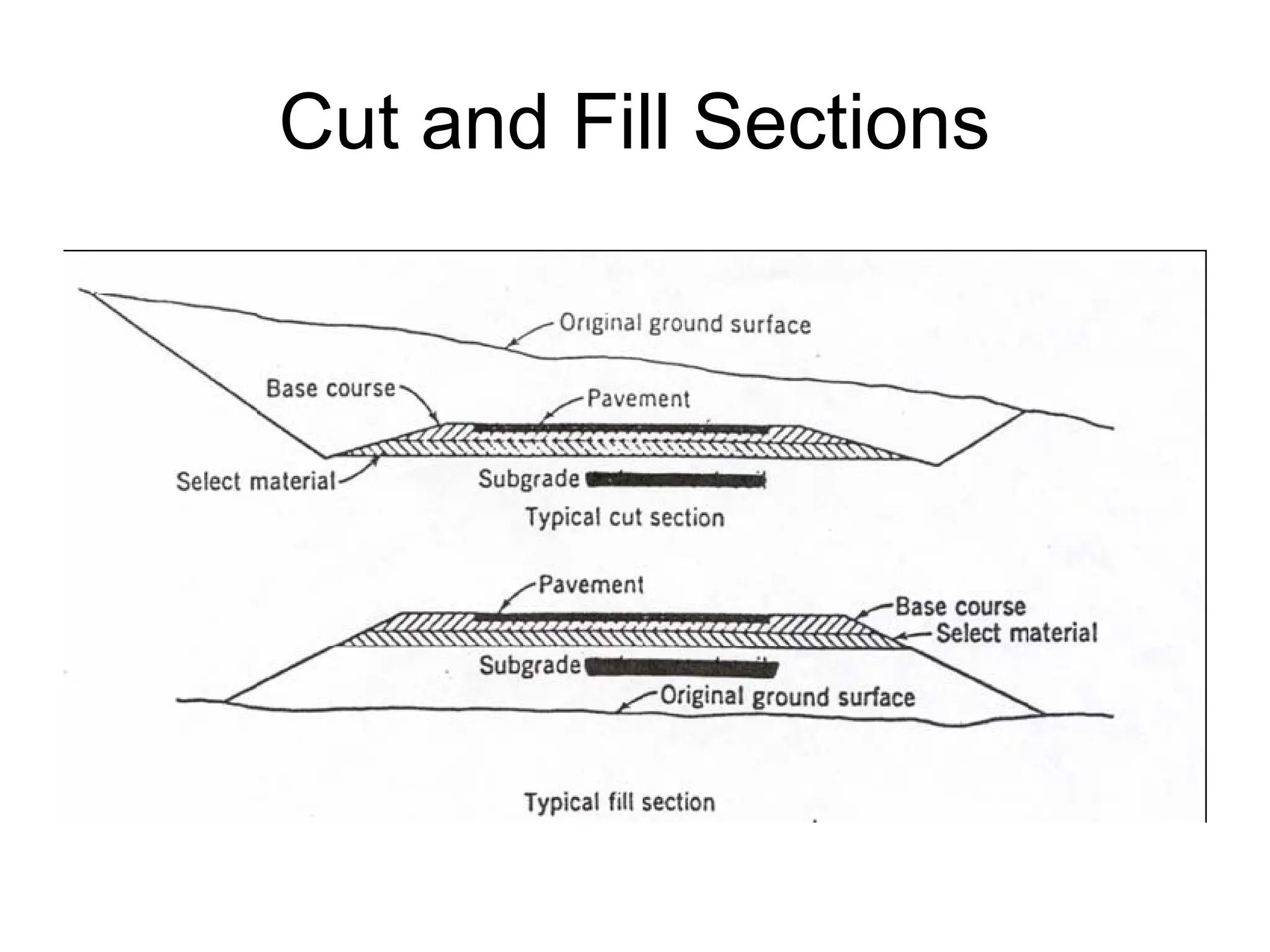
• May be in fill or
embankment.
Function and Significance of Subgrade Properties
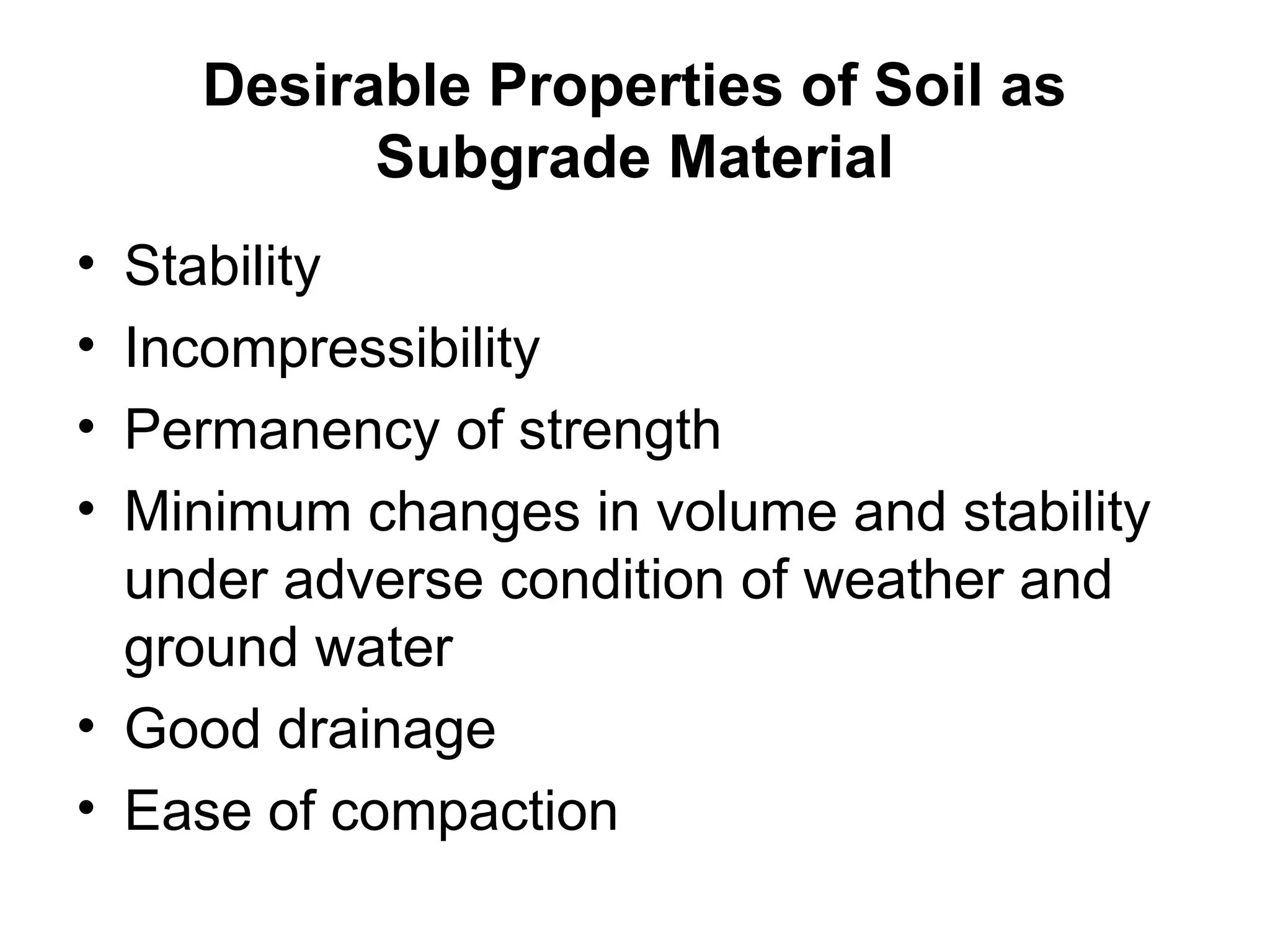
Desirable Properties ofSoil as
Subgrade Material
• Stability
• Incompressibility
• Permanency of strength
• Minimum changes in volume and stability
under adverse condition of weather and
ground water
• Good drainage
• Ease of compaction
17.
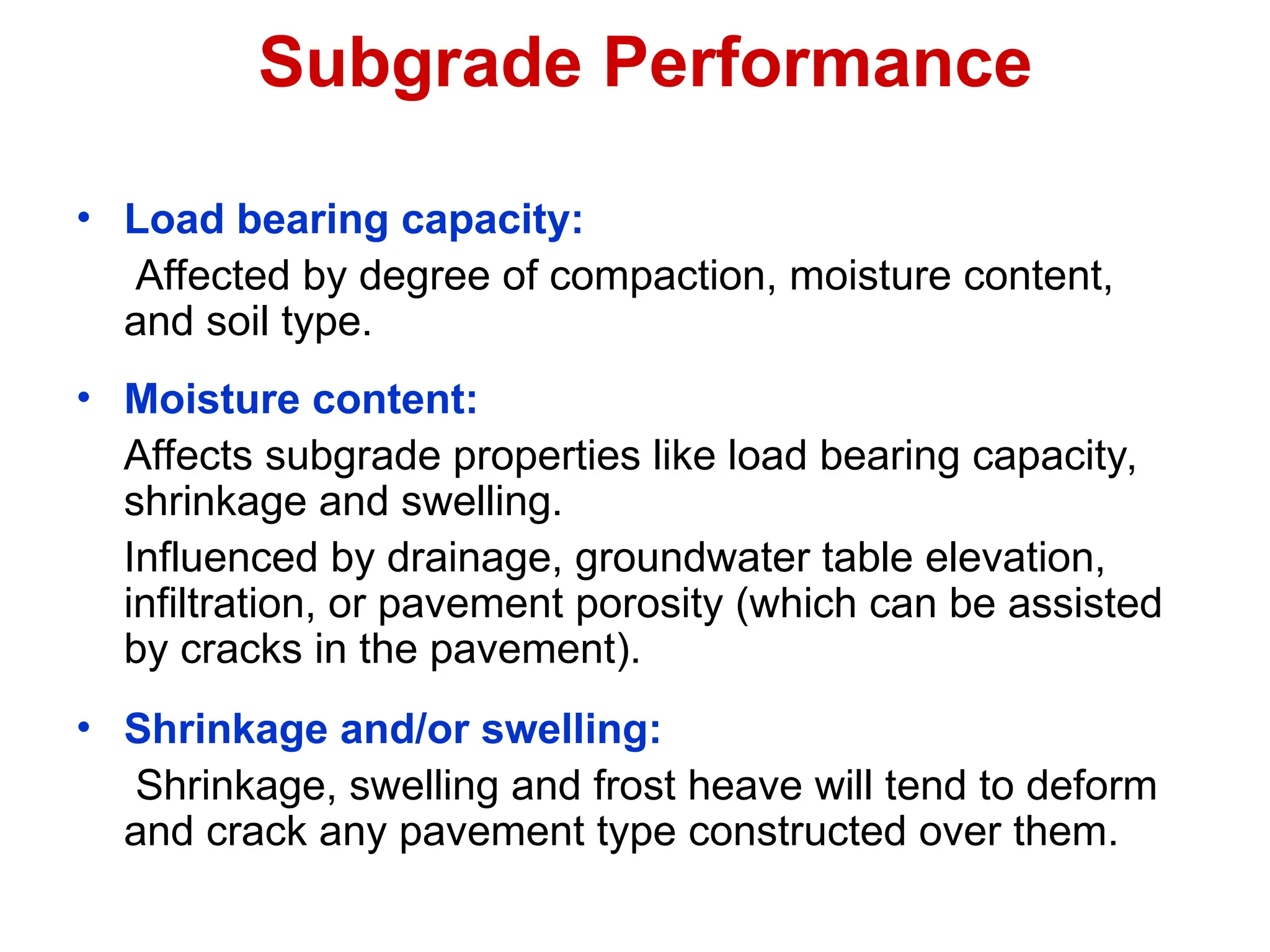
Subgrade Performance
• Loadbearing capacity:
Affected by degree of compaction, moisture content,
and soil type.
• Moisture content:
Affects subgrade properties like load bearing capacity,
shrinkage and swelling.
Influenced by drainage, groundwater table elevation,
infiltration, or pavement porosity (which can be assisted
by cracks in the pavement).
• Shrinkage and/or swelling:
Shrinkage, swelling and frost heave will tend to deform
and crack any pavement type constructed over them.
18.
Subgrade Soil Strength
Assessedin terms of CBR of subgrade
soil for most critical moisture conditions.
• Soil type
• Moisture Content
• Dry Density
• Internal Structure of the soil
• Type and Mode of Stress Application.
IS 2720 Part 8
19.
Flexible Pavement Design
FlexiblePavement Design
IRC (37-2001)
Basic Principles
• Vertical stress or strain on sub-grade
• Tensile stress or strain on surface
course
20.
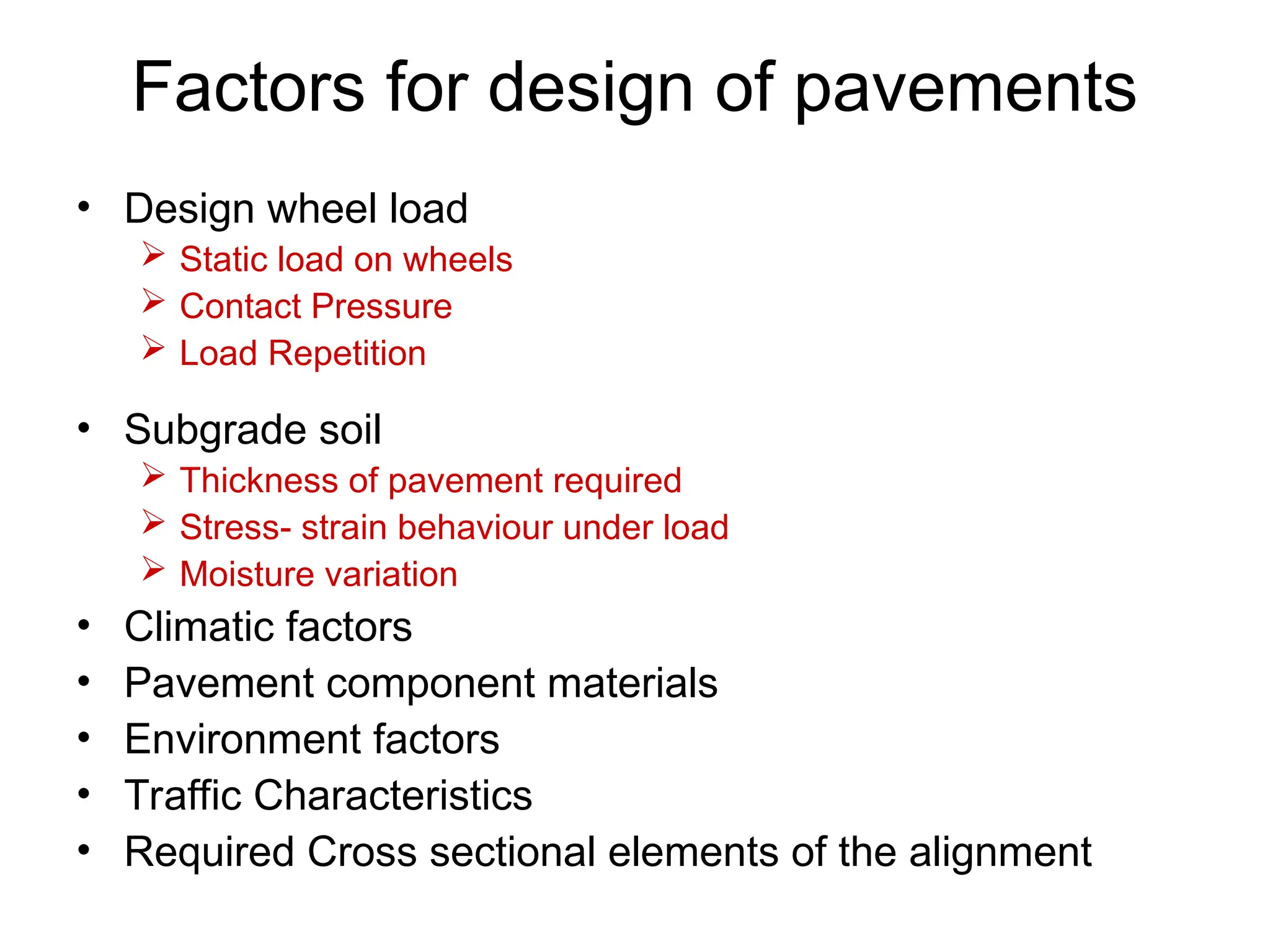
Factors for designof pavements
• Design wheel load
Static load on wheels
Contact Pressure
Load Repetition
• Subgrade soil
Thickness of pavement required
Stress- strain behaviour under load
Moisture variation
• Climatic factors
• Pavement component materials
• Environment factors
• Traffic Characteristics
• Required Cross sectional elements of the alignment
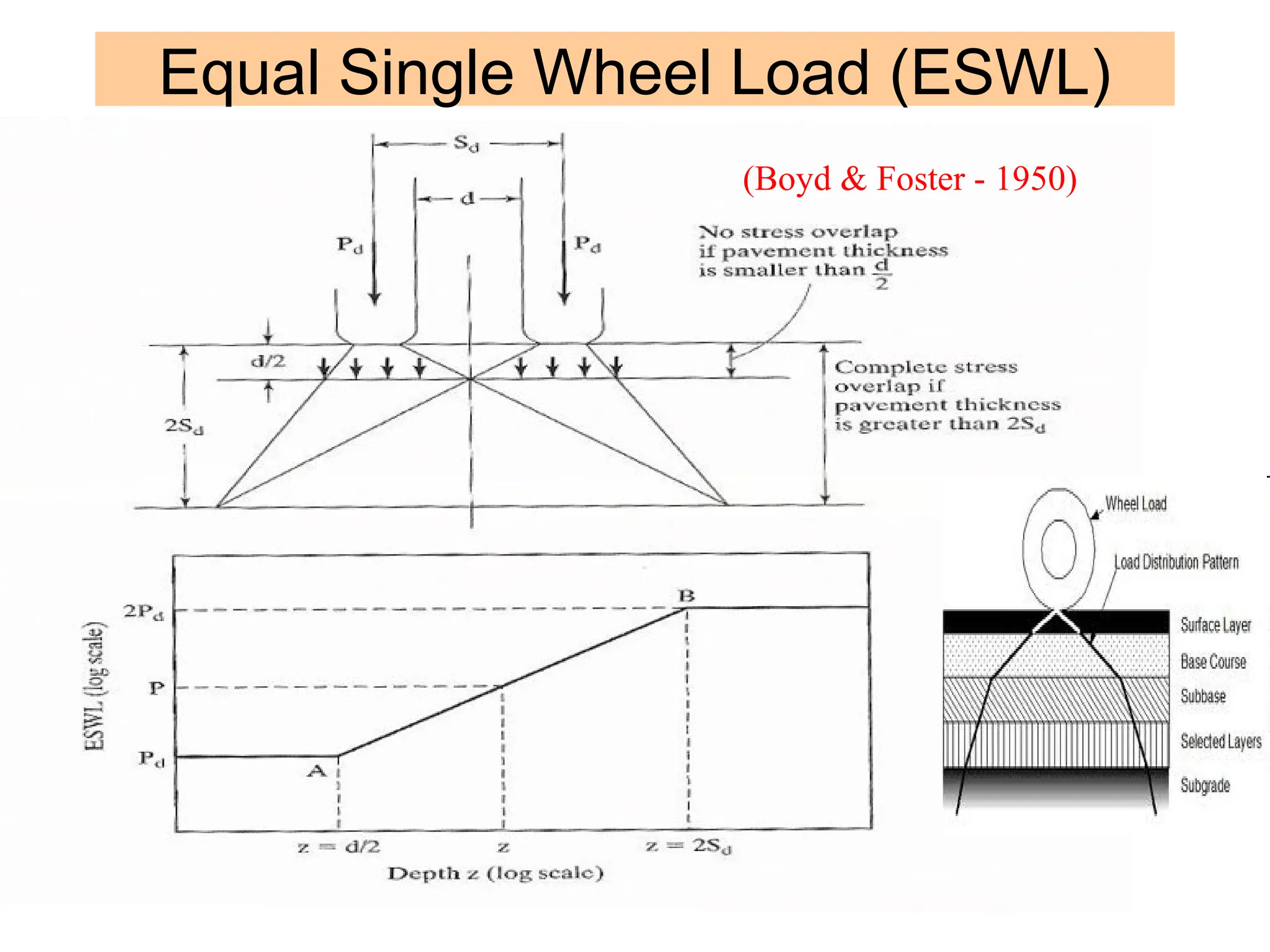
Axle Configurations
Single AxleWith Single Wheel
(Legal Axle Load = 6t)
Single Axle With Dual Wheel
(Legal Axle Load = 10t)
Tandem Axle
(Legal Axle Load = 18t)
Tridem Axle
(Legal Axle Load = 24t)
An axle is a central shaft for a rotating wheel or gear
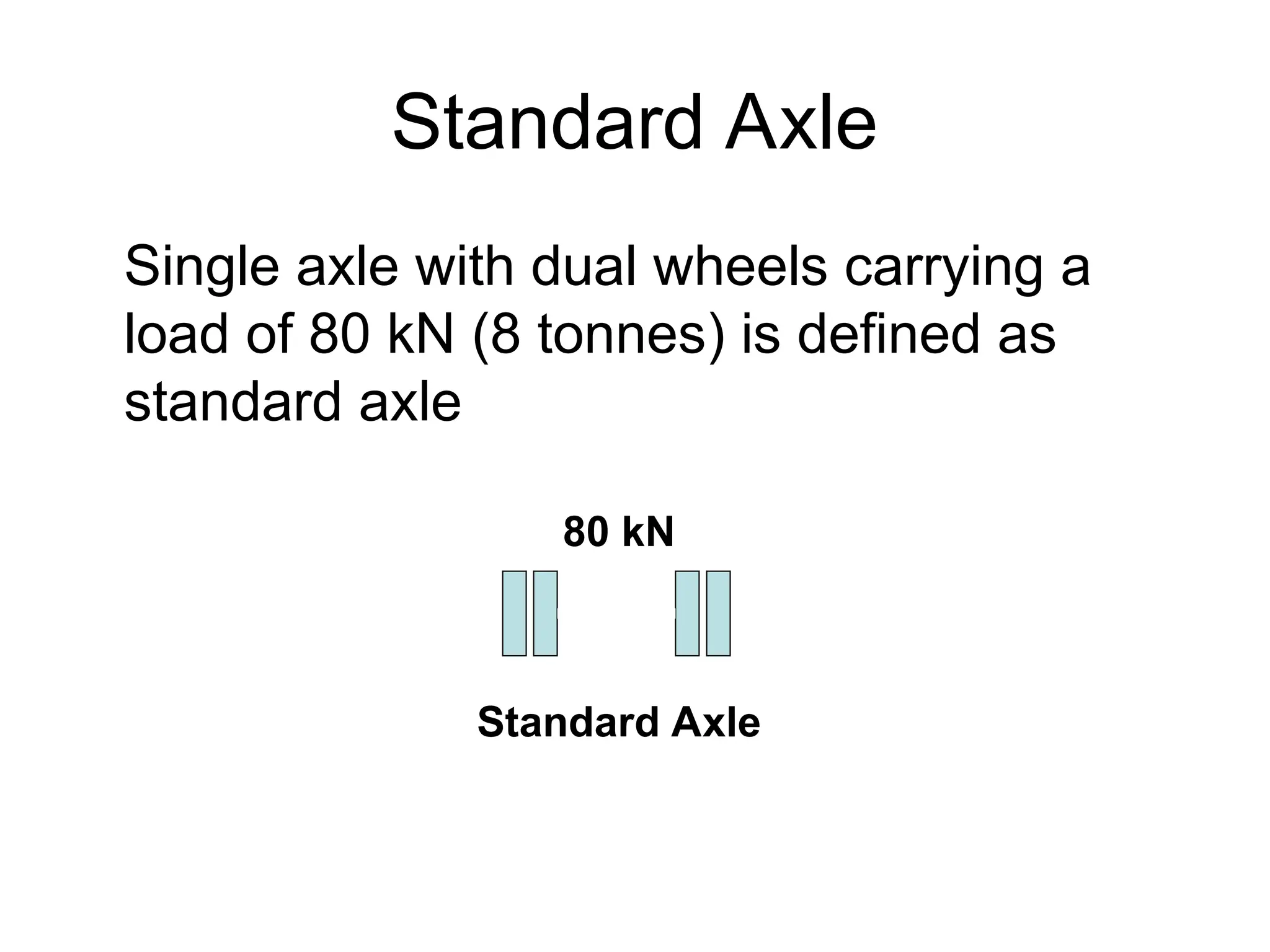
Standard Axle
Single axlewith dual wheels carrying a
load of 80 kN (8 tonnes) is defined as
standard axle
80 kN
Standard Axle
26.
Evaluation Of PavementComponent
Layers
• Sub-grade
• To Receive Layers of Pavement
Materials Placed over it
• Plate Bearing Test
• CBR Test
• Triaxial Compression Test
27.
Evaluation Of PavementComponent Layers
- Sub-base And Base Course
- To Provide Stress Transmitting Medium
- To distribute Wheel Loads
- To Prevent Shear and Consolidation
Deformation
In case of rigid pavements to
- Prevent pumping
- Protect the subgrade against frost action
- Plate Bearing Test
– CBR Test
28.
Wearing Course
• HighResistance to Deformation
• High Resistance to Fatigue; ability to withstand high strains -
flexible
• Sufficient Stiffness to Reduce Stresses in the Underlying Layers
• High Resistance to Environmental Degradation; durable
• Low Permeability - Water Tight Layer against Ingress of Surface
Water
• Good Workability – Allow Adequate Compaction
• Sufficient Surface Texture – Good Skid Resistance in Wet
Weather
- bituminous materials used in wearing course tested by
Marshall test
29.
Flexible Pavement DesignUsing CBR
Value Of Sub-grade Soil
California State Highways
Department Method
Required data
Design Traffic in terms of
cumulative number of standard
axles(CSA)
CBR value of subgarde
30.
Traffic Data
Initial datain terms of number of
commercial vehicles per day (CVPD).
Traffic growth rate during design life in %
Design life in number of years.
Distribution of commercial vehicles over the
carriage way
31.
Traffic – InTerms Of CSA (8160 Kg) During
Design Life
• Initial Traffic
In terms of Cumulative Vehicles/day
Based on 7 days 24 hours Classified Traffic
• Traffic Growth Rate
Establishing Models Based on Anticipated Future
Development or based on past trends
Growth Rate of LCVs, Bus, 2 Axle, 3 Axle, Multi
axle, HCVs are different
7.5 % may be Assumed
32.
Design Life
• NationalHighways – 15 Years
• Expressways and Urban
Roads – 20 Years
• Other Category Roads – 10 –
15 Years
33.
Vehicle Damage Factor(VDF)
Multiplier to Convert No. of
Commercial Vehicles of Different Axle
Loads and Axle Configurations to the
Number of Standard Axle Load
Repetitions indicate VDF Values
Normally = (Axle Load/8.2)n
n = 4 - 5
Single Lane Roads
Total No. of Commercial Vehicles in both Directions
Two-lane Single Carriageway Roads
75% of total No. of Commercial Vehicles in both Directions
Four-lane Single Carriageway Roads
40% of the total No. of Commercial Vehicles in both
Directions
Dual Carriageway Roads
75% of the No. of Commercial Vehicles in each Direction
Distribution Of Traffic
37.
Computation of Trafficfor Use of Pavement
Thickness Design Chart
365 xA[(1+r)n
– 1]
N = --------------------------- x D x F
r
N = Cumulative No. of standard axles to be catered for the
design in terms of msa
D = Lane distribution factor
A = Initial traffic, in the year of completion of construction, in
terms of number of commercial vehicles per day
F = Vehicle Damage Factor
n = Design life in years
r = Annual growth rate of commercial vehicles
38.
CBR Testing Machine
Definition:
Itis the ratio of force per unit area
required to penetrate a soil mass with
standard circular piston at the rate of 1.25
mm/min. to that required for the
corresponding penetration of a standard
material.
39.
CBR
• Basis ofDesign chart:
A material with a given CBR value
requires certain thickness of pavement.
• Chart developed for traffic wheel loads:
Light Traffic - 3175 kg
Heavy traffic – 5443 kg
Medium traffic – 4082 kg
40.
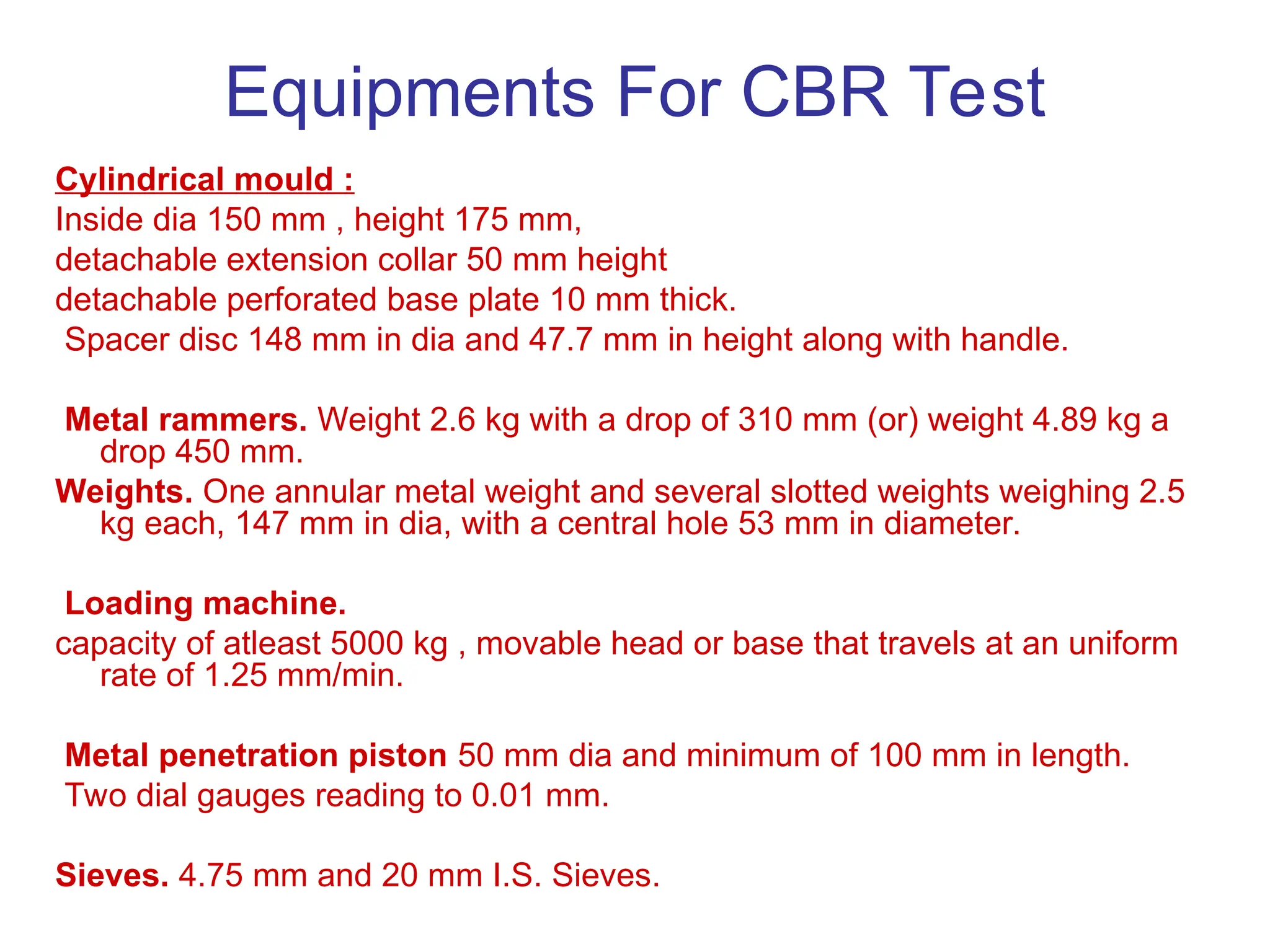
Equipments For CBRTest
Cylindrical mould :
Inside dia 150 mm , height 175 mm,
detachable extension collar 50 mm height
detachable perforated base plate 10 mm thick.
Spacer disc 148 mm in dia and 47.7 mm in height along with handle.
Metal rammers. Weight 2.6 kg with a drop of 310 mm (or) weight 4.89 kg a
drop 450 mm.
Weights. One annular metal weight and several slotted weights weighing 2.5
kg each, 147 mm in dia, with a central hole 53 mm in diameter.
Loading machine.
capacity of atleast 5000 kg , movable head or base that travels at an uniform
rate of 1.25 mm/min.
Metal penetration piston 50 mm dia and minimum of 100 mm in length.
Two dial gauges reading to 0.01 mm.
Sieves. 4.75 mm and 20 mm I.S. Sieves.
41.
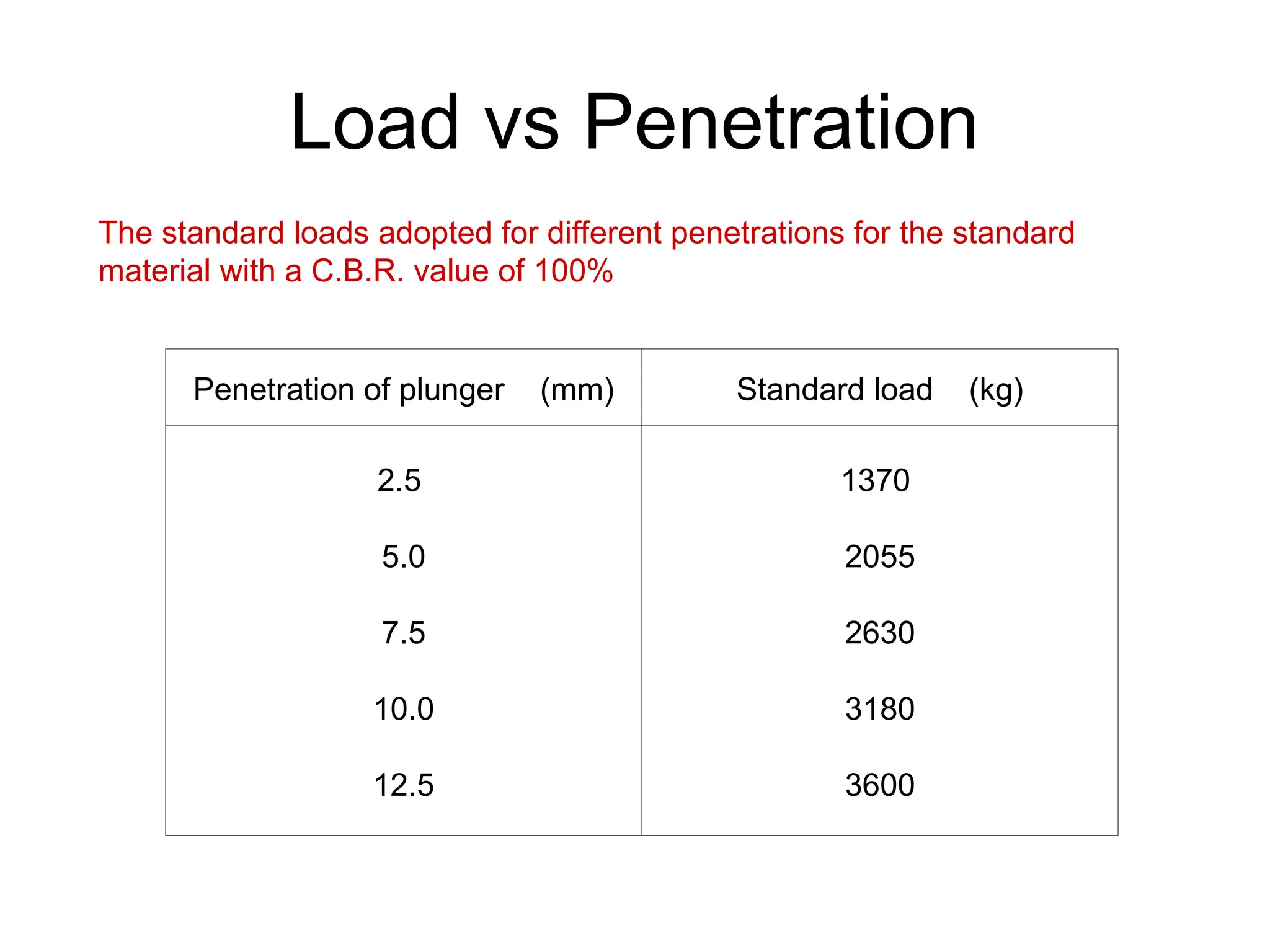
Load vs Penetration
Thestandard loads adopted for different penetrations for the standard
material with a C.B.R. value of 100%
Penetration of plunger (mm) Standard load (kg)
2.5
5.0
7.5
10.0
12.5
1370
2055
2630
3180
3600
42.
Subgrade
• Soak theSpecimen in Water for FOUR
days and CBR to be Determined.
• Use of Expansive Clays NOT to be Used
as Sub-grade
• Non-expansive Soil to be Preferred.
43.
Subgrade
• Subgrade tobe Well Compacted to Utilize its Full
Strength
• Top 500 mm to be Compacted to 97% of MDD
(Modified Proctor).
• Material Should Have a Dry Density of 1.75 gm/cc.
• CBR to be at Critical Moisture Content and Field
Density.
• Strength – Lab. CBR on Remoulded Specimens and
NOT Field CBR
44.
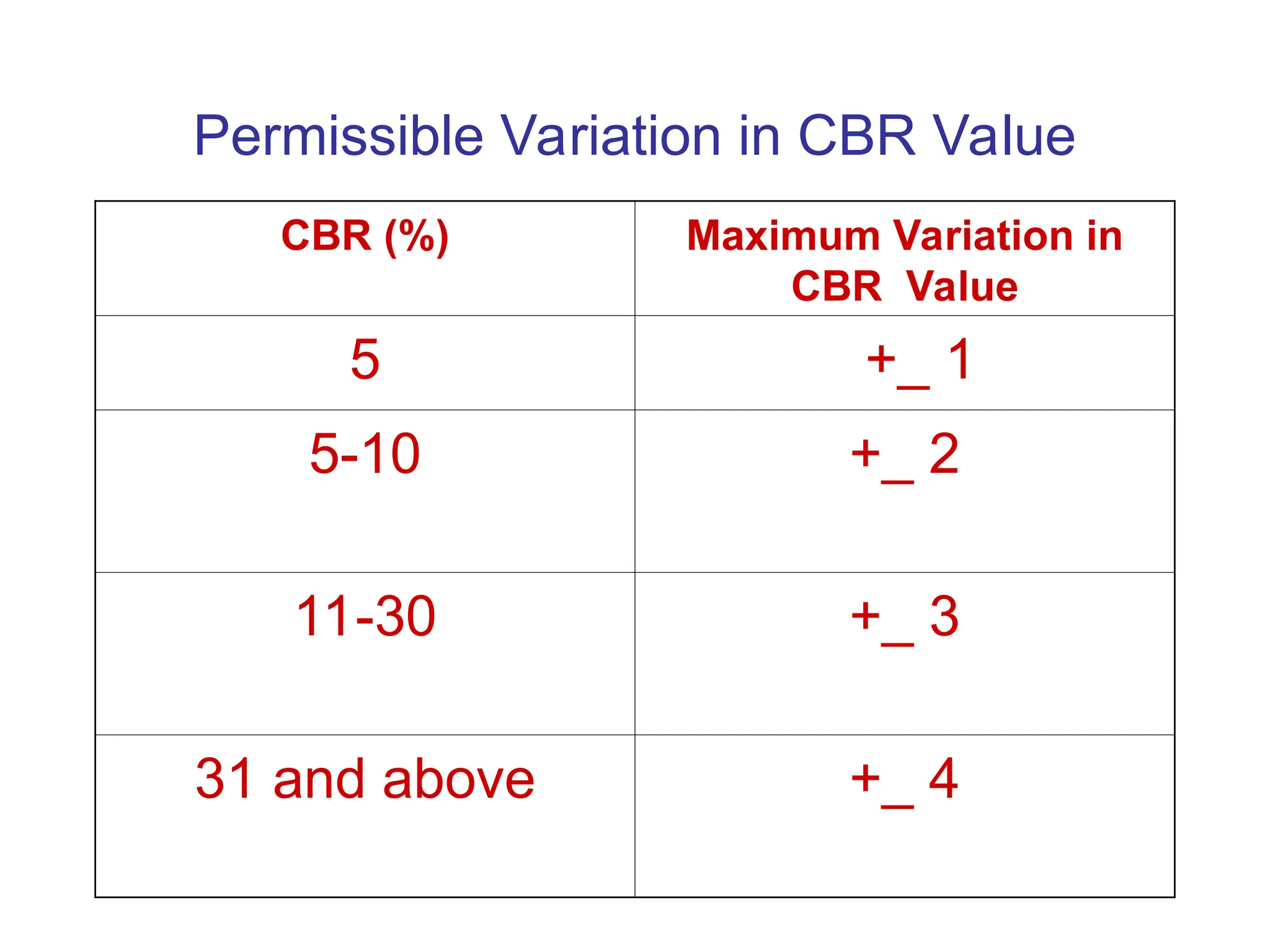
Permissible Variation inCBR Value
CBR (%) Maximum Variation in
CBR Value
5 +_ 1
5-10 +_ 2
11-30 +_ 3
31 and above +_ 4
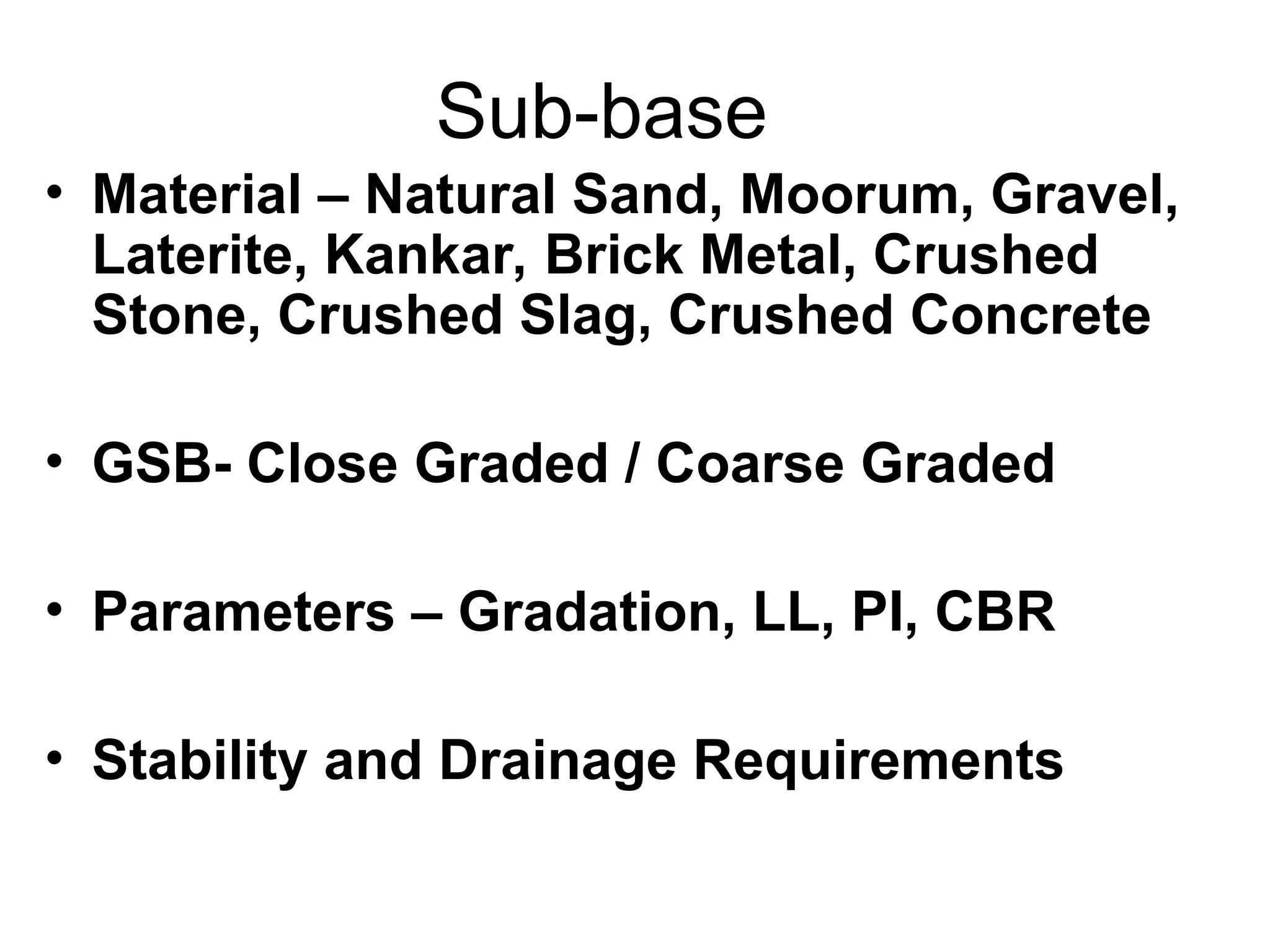
Sub-base
• Min. CBR20 % - Traffic up-to 2 msa
• Min. CBR 30 %- Traffic > 2 msa
• If GSB is Costly, Adopt WBM, WMM
• Should Extend for the FULL Width of
the Formation
• Min. Thickness – 150 mm - <10 msa
• Min. Thickness – 200 mm - >10 msa
53.
Sub-base
• Min. CBR– 2 %
• If CBR < 2% - Pavement Thickness
for 2 % CBR + Capping layer of
150 mm with Min. CBR 10% (in
addition to the Sub-Base)
• In case of Stage Construction –
Thickness of GSB for Full Design
Life
54.
Base Course
• UnboundGranular Bases – WBM /
WMM or any other Granular
Construction
• Min. Thickness – 225 mm – < 2 msa
• Min. Thickness – 250 mm - > 2 msa
• WBM – Min. 300 mm ( 4 layers –
75mm each)
55.
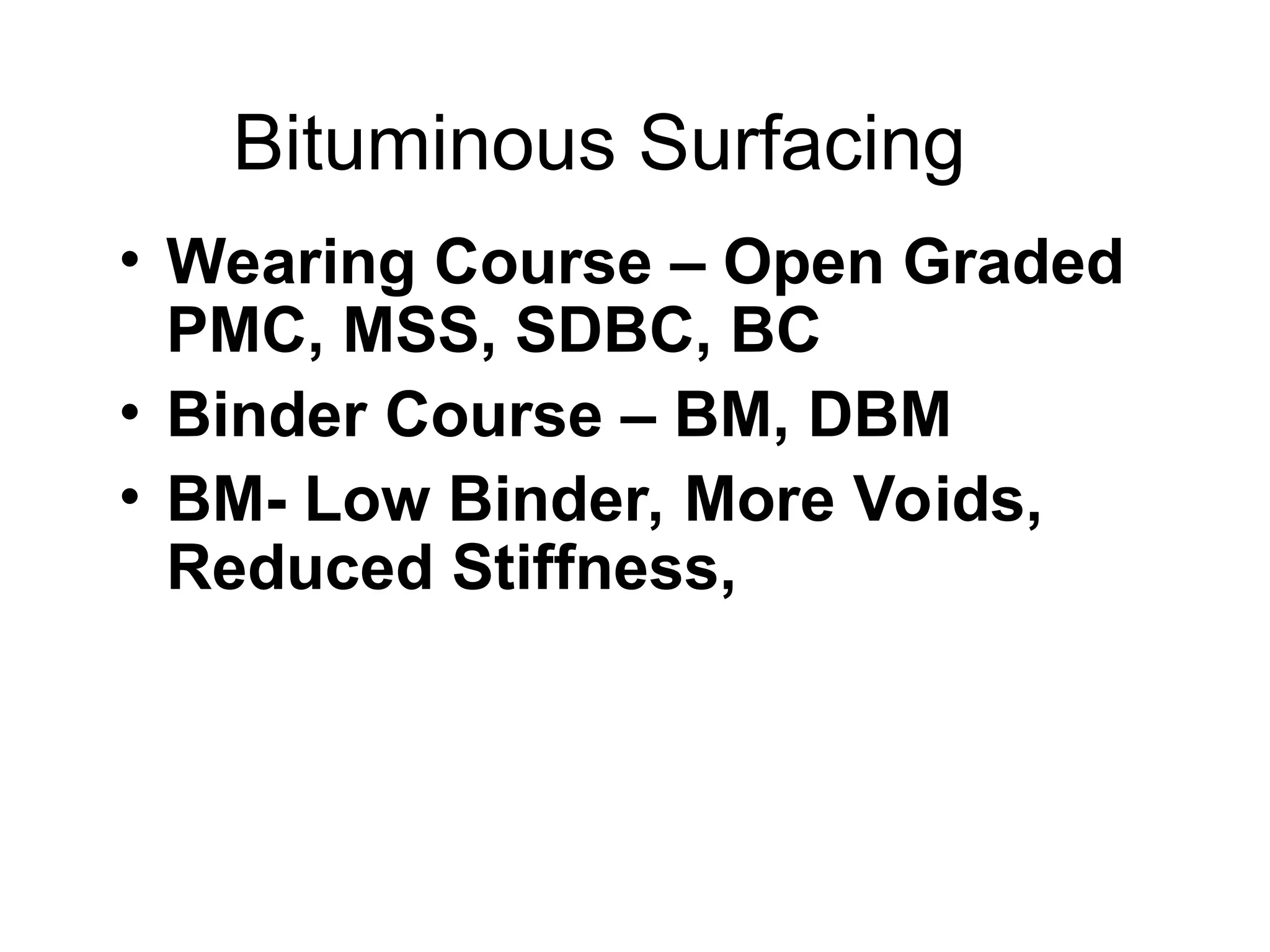
Bituminous Surfacing
• WearingCourse – Open Graded
PMC, MSS, SDBC, BC
• Binder Course – BM, DBM
• BM- Low Binder, More Voids,
Reduced Stiffness,
56.
Bituminous Surfacing
• Provide75 mm BM Before
Laying DBM
• Reduce Thickness of DBM Layer,
when BM is Provided ( 10 mm
BM = 7 mm DBM)
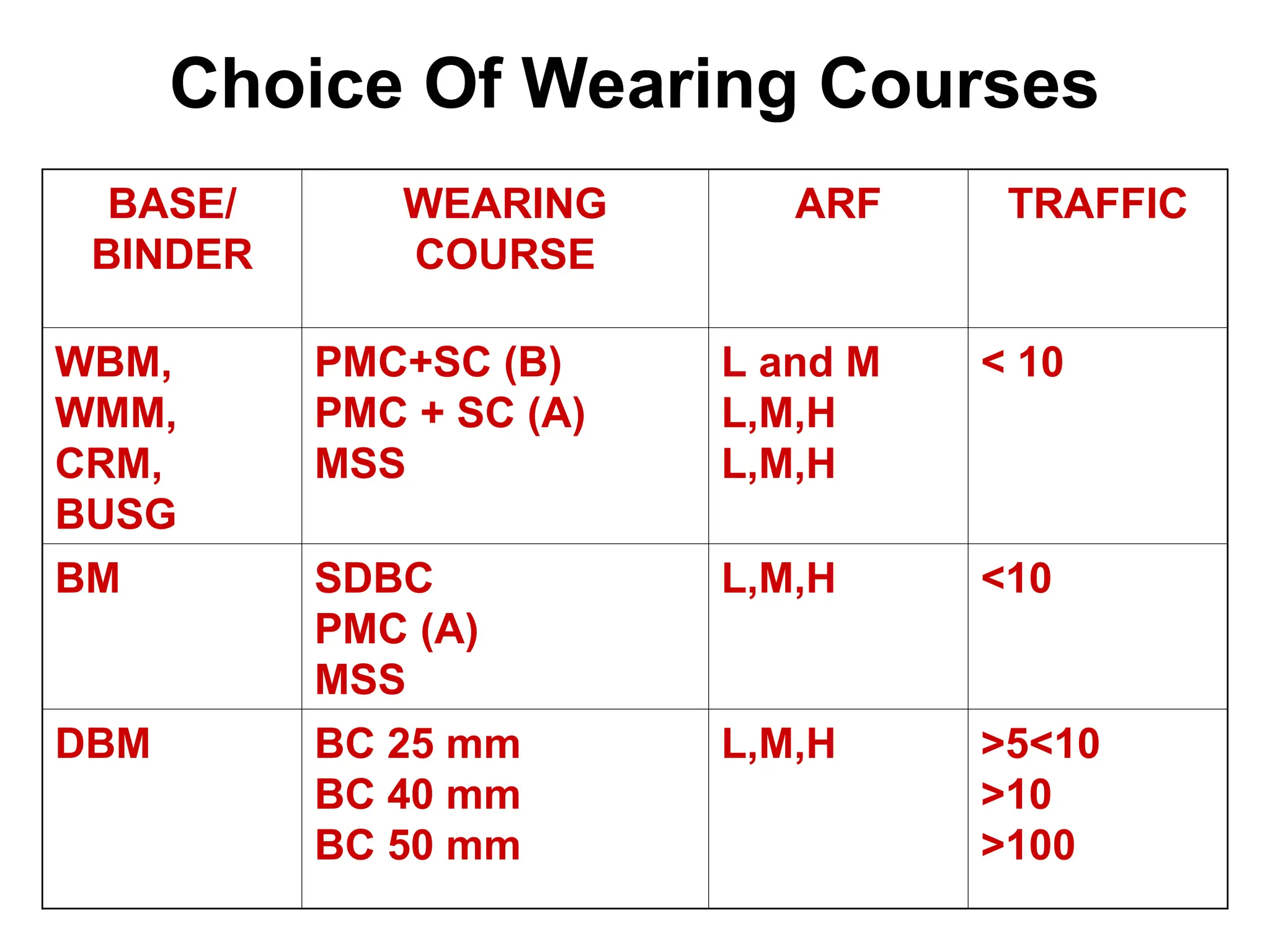
• Choice of Wearing Course –
Design Traffic, Type of Base /
Binder Course, Rainfall etc
57.
Choice Of WearingCourses
BASE/
BINDER
WEARING
COURSE
ARF TRAFFIC
WBM,
WMM,
CRM,
BUSG
PMC+SC (B)
PMC + SC (A)
MSS
L and M
L,M,H
L,M,H
< 10
BM SDBC
PMC (A)
MSS
L,M,H <10
DBM BC 25 mm
BC 40 mm
BC 50 mm
L,M,H >5<10
>10
>100
58.
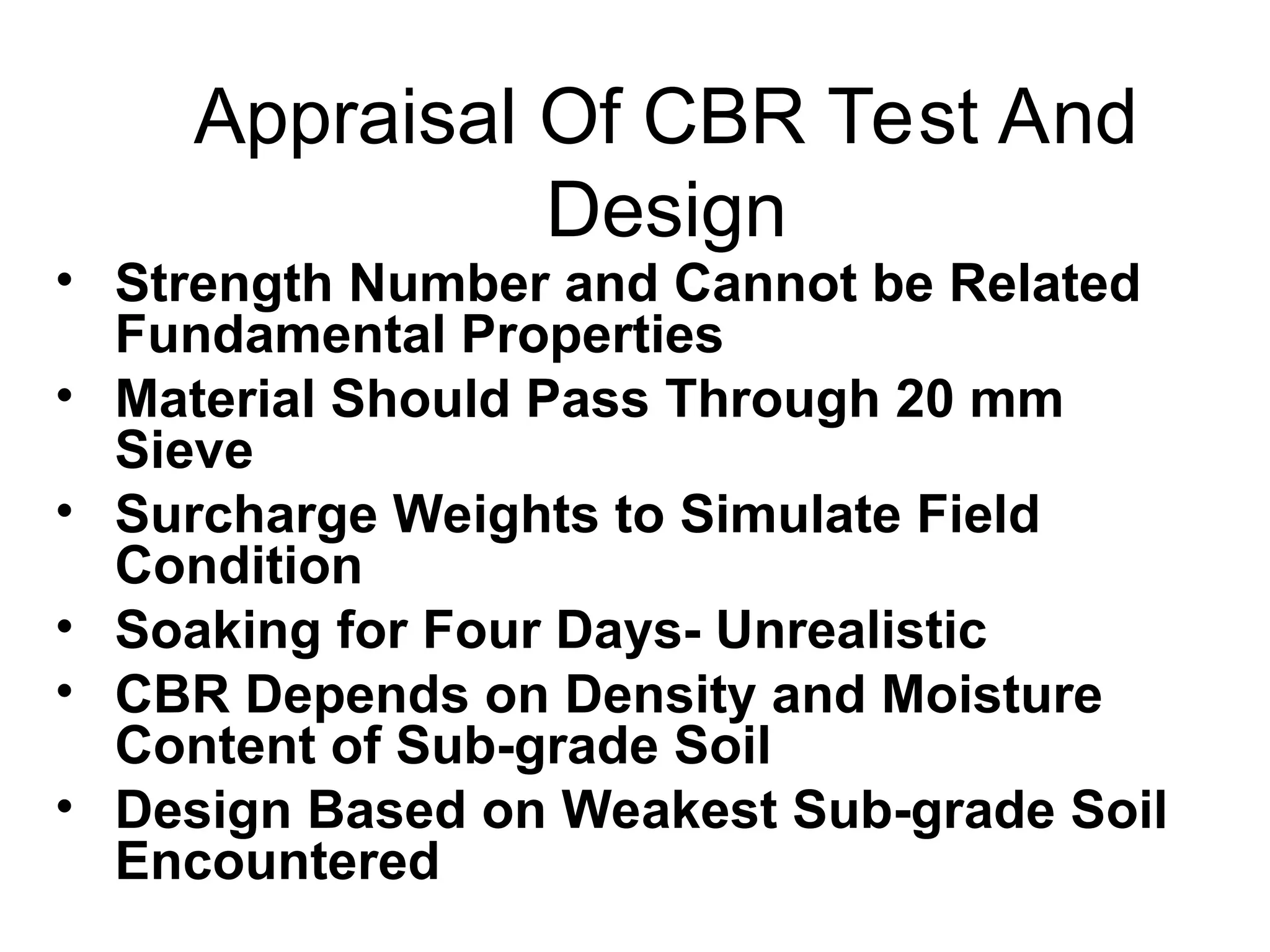
Appraisal Of CBRTest And
Design
• Strength Number and Cannot be Related
Fundamental Properties
• Material Should Pass Through 20 mm
Sieve
• Surcharge Weights to Simulate Field
Condition
• Soaking for Four Days- Unrealistic
• CBR Depends on Density and Moisture
Content of Sub-grade Soil
• Design Based on Weakest Sub-grade Soil
Encountered
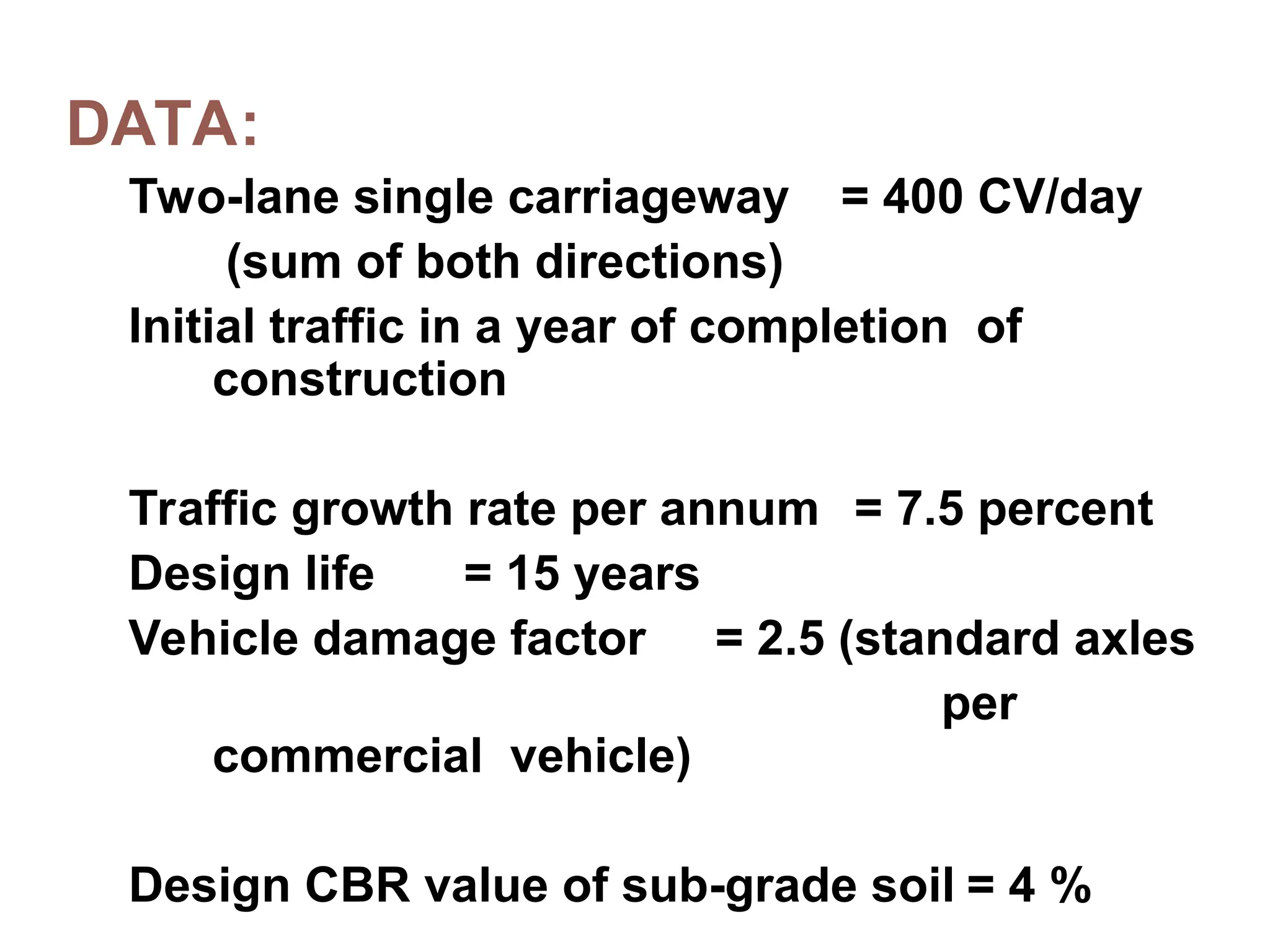
DATA:
Two-lane single carriageway= 400 CV/day
(sum of both directions)
Initial traffic in a year of completion of
construction
Traffic growth rate per annum = 7.5 percent
Design life = 15 years
Vehicle damage factor = 2.5 (standard axles
per
commercial vehicle)
Design CBR value of sub-grade soil = 4 %
61.
Distribution factor =0.75
Cumulative number of standard axles to to be catered
for in the design
365 x [(1+0.075)15
–1]
N = ----------------------------- x 400 x 0.75 x 2.5
0.075
= 7200000 = 7.2 msa
Total pavement thickness for = 660 mm
CBR 4% and Traffic 7.2 msa
62.
Pavement Composition interpolated
FromPlate 1, CBR 4% (IRC37-2001)
Bituminous surfacing = 25 mm
SDBC + 70
mm DBM
Road base, WBM = 250 mm
Sub-base = 315 mm
Data:
i) 4-lane dividedcarriageway
Initial traffic in each directions in the year of =
5600cv / day
Completion of construction
iii)Design life = 10/15yrs
iv)Design CBR of sub-grade soil = 5 %
v) Traffic growth rate = 8 %
vi)Vehicle damage factor = 4.5
(Found out from axle road survey axles per CV on
existing road)
65.
Distribution factor =0.75
VDF = 4.5
CSA for 10 Years = 100 msa
CSA for 15 years = 185 msa
Pavement thickness for CBR 5% and
100 msa for 10 Years = 745 mm
For 185 msa for 15 years = 760 mm
Provide 300 mm GSB + 250 mm WMM + 150
mm DBM + 50 mm BC (10 years)
Provide 300 mm GSB + 250 mm WMM + 170
mm DBM + 50 mm BC (15 years)
66.
References
1.Yoder and Witczak“Principles of Pavement Design”
John Wiley and Sons , second edition
2.IRC :37-2001, Guidelines of Design of
Flexible Pavements”
3.IRC:81 - 1997 “Tentative Guidelines for Strengthening
of Flexible Road Pavements Using Benkelman Beam
Deflection Technique
Editor's Notes
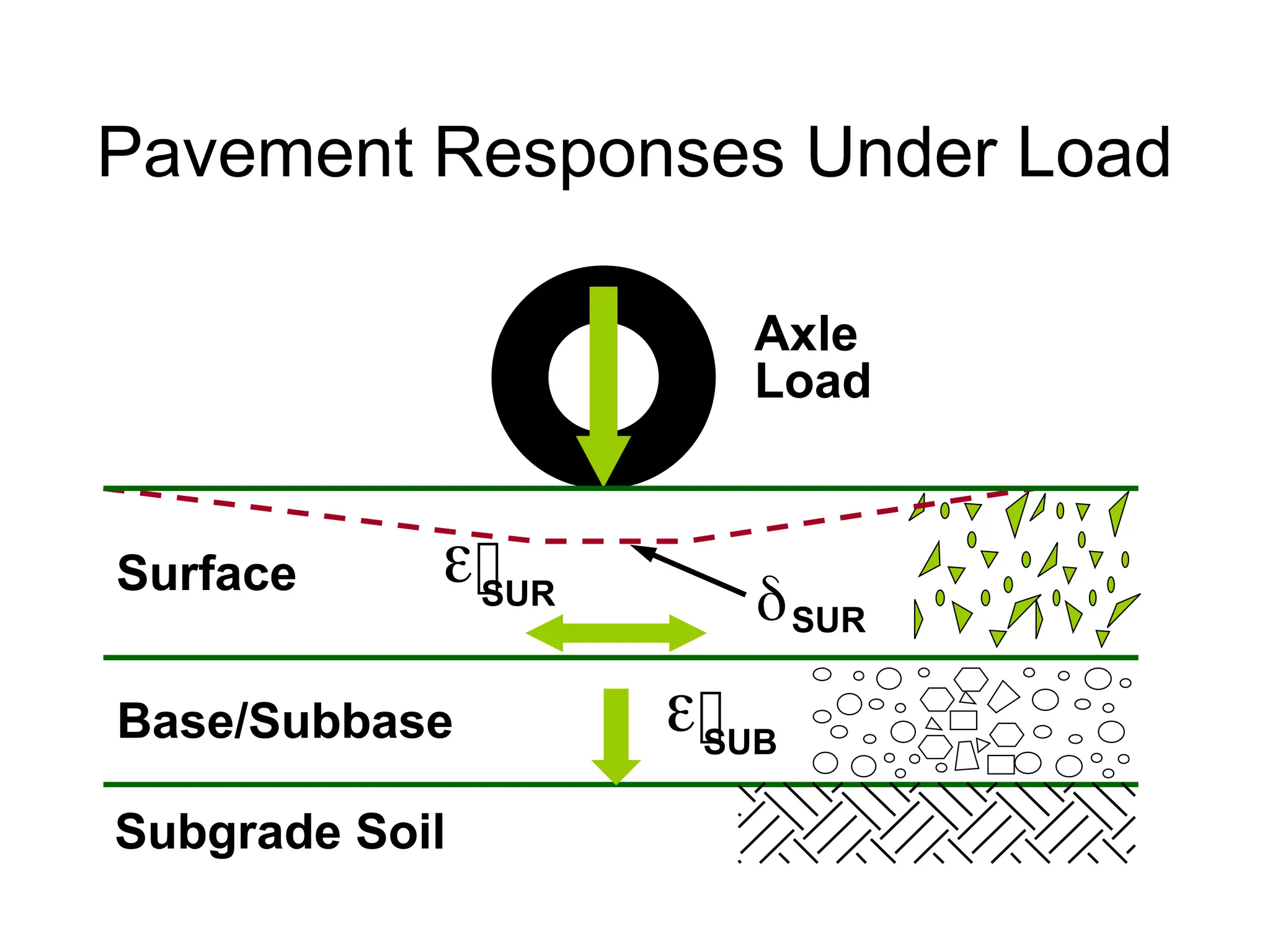
#19 Two critical stresses considered in the design of flexible pavements are vertical compressive stress on the subgrade which results in permanent deformation or rutting and horizontal tensile strain on the surface course resulting in cracks.
#36 An assessment of the distribution of commercial traffic by direction and by lane is necessary as it affects the total equivalent std axle load used in the design
















![Computation of Traffic for Use of Pavement
Thickness Design Chart
365 xA[(1+r)n
– 1]
N = --------------------------- x D x F
r
N = Cumulative No. of standard axles to be catered for the
design in terms of msa
D = Lane distribution factor
A = Initial traffic, in the year of completion of construction, in
terms of number of commercial vehicles per day
F = Vehicle Damage Factor
n = Design life in years
r = Annual growth rate of commercial vehicles](https://image.slidesharecdn.com/ppt1-250303091814-cf311dce/75/DESIGN-FLEXIBLE-AND-RIGID-PAVEMENTS-Design-37-2048.jpg)









![Distribution factor = 0.75
Cumulative number of standard axles to to be catered
for in the design
365 x [(1+0.075)15
–1]
N = ----------------------------- x 400 x 0.75 x 2.5
0.075
= 7200000 = 7.2 msa
Total pavement thickness for = 660 mm
CBR 4% and Traffic 7.2 msa](https://image.slidesharecdn.com/ppt1-250303091814-cf311dce/75/DESIGN-FLEXIBLE-AND-RIGID-PAVEMENTS-Design-61-2048.jpg)