Troy McCain Randy Shane
Pavement Coordinator Technical Marketing Manager
City of Lakeland Asphalt Paving Systems
Pavement Management
• APWA definition in 1983
• Pavement management is a systematic
method for routinely collecting, storing, and
retrieving the kind of decision-making
information needed to make maximum use of
limited maintenance (and construction)
dollars.
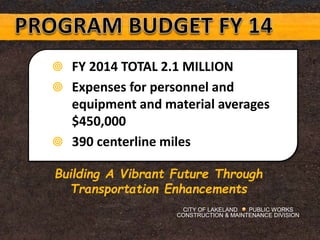
 FY 2014 TOTAL 2.1 MILLION
 Expenses for personnel and
equipment and material averages
$450,000
 390 centerline miles
Building A Vibrant Future Through
Transportation Enhancements
CITY OF LAKELAND PUBLIC WORKS
CONSTRUCTION & MAINTENANCE DIVISION
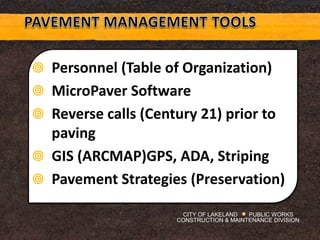
 Personnel (Table of Organization)
 MicroPaver Software
 Reverse calls (Century 21) prior to
paving
 GIS (ARCMAP)GPS, ADA, Striping
 Pavement Strategies (Preservation)
CITY OF LAKELAND PUBLIC WORKS
CONSTRUCTION & MAINTENANCE DIVISION
2-Asphalt Patch Trucks
1- Striping Crew
• Asphalt trucks perform routine maintenance
along with utility cuts from various divisions
• Patch roads prior to microsurfacing
• Striping Crew performs routine maintenance
as well as new construction
• Do have a contractor on hand for some work.
Pavement Section TO
 Began Utilizing 1999
with 632 lane miles
 Continue to use
along with ArcMap
current 741 lane
miles of streets
CITY OF LAKELAND PUBLIC WORKS
CONSTRUCTION & MAINTENANCE DIVISION
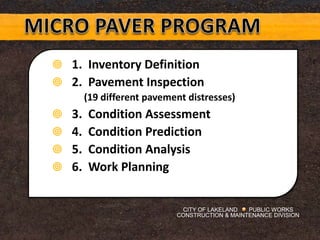
 1. Inventory Definition
 2. Pavement Inspection
(19 different pavement distresses)
 3. Condition Assessment
 4. Condition Prediction
 5. Condition Analysis
 6. Work Planning
CITY OF LAKELAND PUBLIC WORKS
CONSTRUCTION & MAINTENANCE DIVISION
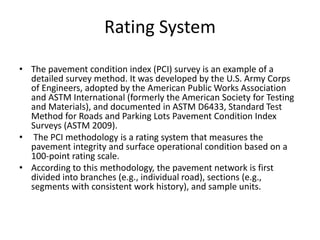
Rating System
• The pavement condition index (PCI) survey is an example of a
detailed survey method. It was developed by the U.S. Army Corps
of Engineers, adopted by the American Public Works Association
and ASTM International (formerly the American Society for Testing
and Materials), and documented in ASTM D6433, Standard Test
Method for Roads and Parking Lots Pavement Condition Index
Surveys (ASTM 2009).
• The PCI methodology is a rating system that measures the
pavement integrity and surface operational condition based on a
100-point rating scale.
• According to this methodology, the pavement network is first
divided into branches (e.g., individual road), sections (e.g.,
segments with consistent work history), and sample units.
Pavement Condition
REVERSE CALLS
PRIOR TO RESURFACING
• Access addresses utilizing GIS
• Use addresses to retrieve phone numbers
from billing system
• Send out 1-2 weeks prior.
• Have contractor place a second notice 24-48
hrs. of actual work.
• Cost of 50 residents is around $15.00
• .30 per number.
Capturing Number of Ramps
Future Resurfacing
Attributes of Ramps
Striping Utilizing GPS
1991 2014
1991 Pavement Program
Pavement Management Strategies Used
• #1 Surface Treatment (1991)
• Cost Approximately $1.50 per sq.
• Expectant life service of seven (7) years.
• This is the application of one to three courses of
carrying size aggregate to the existing pavement. We
have found this to be a very good surface
maintenance product in the past. We discontinued
using it in 1991 not because it wasn’t doing the job
but due to citizen complaints about the loose
aggregate and rough texture on the streets.
Between 1985 and 1991, 88.5 lane miles were
maintained using this method
Pavement Strategies
• #2 Slurry Seal
• A mixture of an approved emulsified asphalt, mineral
aggregate, water and specified additives applied
approximately 1/8” to 1/4” thick.
• Cost Approximately $1.20 per sq. yd.
• Expectant life service of six (6) years.
• The city of Lakeland used exclusively from 1971 to 1988.
This was proven to be very effective while it was being
used. We quit using this product after 1988. The major
drawback to this product is the length of time residents
were required to keep their vehicles off the street which as
an average of eight (8) to nine (9) hours
• Due to ADA stipulations we are again looking at this
product.
Strategies
• #3 Micro-Surfacing
• “A blend of select crushed aggregate and sophisticated chemical
formulation of asphalt cement, cationic emulsifiers, adhesives and
latex applied approximately 3/8” thick.”
• “The City of Lakeland has used this pavement maintenance strategy
for the since 1981
• Cost $1.22 (1986) per sq. yd. single surface (2013-- $2.07)
• $1.77 (1986) per sq. yd. double surface (2013-- $3.25)
• Expectant life surface of seven (7) years.
• “We have found this product to be very effective both cost wise as
well as for public relations. Required to keep their vehicles off the
street for a period of 1-2hours.
• Single surface is recommended for residential streets and double
surface for collectors.”
• Double surfaces we have been averaging 10 years.
Projects Utilizing Microsurface
• We have in past used Micro as a “Band Aid”
on areas where we submitted for CIP (Capital
Improvement)
• Buena Vista St. (Preservation vs Mill/Pave)
• Joker Marchant Stadium. Resurfacing of old
concrete runways.
Pavement Strategies Used
Actual Work Performed
 BUENA VISTA 4111 SQ YDS
 YEAR COST
 Surface Treatment 1983 $1,603
 Double Micro 1996 $5,015
 Cape Seal/Double Micro 2003 $13,607
 Double Micro 2013 $12,086
 30YRS $ 32,311

Estimated Cost to Mill and Overlay same
street 2 times over 30 years
 BUENA VISTA 4111 SQ YDS
 YEAR COST
 1983 $ ------
 1996 $23,638
 2003 $--------
 2013 $41,808
 30YRS $65,446 VS 32,311 (Preservation)
 Saving of $33,135 for single street
Joker Marchant Stadium
Tigertown Complex
Concrete from Runways
Performed Cape Seal 1996
After Cape Seal Prior to Project.
Area prior to Micro
Same area after micro
Finished Project
 1. Started requiring a three year guarantee
verses the one year that we received in past.
 2. Also be more proactive in calibration and
testing of products.
 3. 6% Polymer in Micro
 4.Introduce some type of rejuvenator. Fog
seal/Reclamite
 5. Look at Slurry product again along with
scrub seal/cape seal.
CITY OF LAKELAND PUBLIC WORKS
CONSTRUCTION & MAINTENANCE DIVISION
PROPER PAVEMENT PRESERVATION IS AN
ONGOING PROCESS
2. Calibration
3. Utilizing 6% Polymer (Left)
3. Tire Mark (6% on right.)
6% polymer
DoubleMicro
Double
Microsurface
4. Rejuvenator (cemetery)
Some light cracking present After treatment
5. Scrub Seal/Cape Seal
 Review new ADA issues and how
that will impact budget.
 Increased cost for material
decrease in available funds.
CITY OF LAKELAND PUBLIC WORKS
CONSTRUCTION & MAINTENANCE DIVISION
Full Depth Reclamation(FDR)
Cold in-place Recycling
CITY OF LAKELAND PUBLIC WORKS
CONSTRUCTION & MAINTENANCE DIVISION

Tools for Pavement Preservation

  • 1.
    Troy McCain RandyShane Pavement Coordinator Technical Marketing Manager City of Lakeland Asphalt Paving Systems
  • 2.
    Pavement Management • APWAdefinition in 1983 • Pavement management is a systematic method for routinely collecting, storing, and retrieving the kind of decision-making information needed to make maximum use of limited maintenance (and construction) dollars.
  • 3.
     FY 2014TOTAL 2.1 MILLION  Expenses for personnel and equipment and material averages $450,000  390 centerline miles Building A Vibrant Future Through Transportation Enhancements CITY OF LAKELAND PUBLIC WORKS CONSTRUCTION & MAINTENANCE DIVISION
  • 4.
     Personnel (Tableof Organization)  MicroPaver Software  Reverse calls (Century 21) prior to paving  GIS (ARCMAP)GPS, ADA, Striping  Pavement Strategies (Preservation) CITY OF LAKELAND PUBLIC WORKS CONSTRUCTION & MAINTENANCE DIVISION
  • 5.
    2-Asphalt Patch Trucks 1-Striping Crew • Asphalt trucks perform routine maintenance along with utility cuts from various divisions • Patch roads prior to microsurfacing • Striping Crew performs routine maintenance as well as new construction • Do have a contractor on hand for some work.
  • 6.
  • 7.
     Began Utilizing1999 with 632 lane miles  Continue to use along with ArcMap current 741 lane miles of streets CITY OF LAKELAND PUBLIC WORKS CONSTRUCTION & MAINTENANCE DIVISION
  • 8.
     1. InventoryDefinition  2. Pavement Inspection (19 different pavement distresses)  3. Condition Assessment  4. Condition Prediction  5. Condition Analysis  6. Work Planning CITY OF LAKELAND PUBLIC WORKS CONSTRUCTION & MAINTENANCE DIVISION
  • 9.
    Rating System • Thepavement condition index (PCI) survey is an example of a detailed survey method. It was developed by the U.S. Army Corps of Engineers, adopted by the American Public Works Association and ASTM International (formerly the American Society for Testing and Materials), and documented in ASTM D6433, Standard Test Method for Roads and Parking Lots Pavement Condition Index Surveys (ASTM 2009). • The PCI methodology is a rating system that measures the pavement integrity and surface operational condition based on a 100-point rating scale. • According to this methodology, the pavement network is first divided into branches (e.g., individual road), sections (e.g., segments with consistent work history), and sample units.
  • 10.
  • 11.
  • 12.
    PRIOR TO RESURFACING •Access addresses utilizing GIS • Use addresses to retrieve phone numbers from billing system • Send out 1-2 weeks prior. • Have contractor place a second notice 24-48 hrs. of actual work. • Cost of 50 residents is around $15.00 • .30 per number.
  • 13.
    Capturing Number ofRamps Future Resurfacing
  • 14.
  • 15.
  • 16.
  • 17.
  • 18.
    Pavement Management StrategiesUsed • #1 Surface Treatment (1991) • Cost Approximately $1.50 per sq. • Expectant life service of seven (7) years. • This is the application of one to three courses of carrying size aggregate to the existing pavement. We have found this to be a very good surface maintenance product in the past. We discontinued using it in 1991 not because it wasn’t doing the job but due to citizen complaints about the loose aggregate and rough texture on the streets. Between 1985 and 1991, 88.5 lane miles were maintained using this method
  • 19.
    Pavement Strategies • #2Slurry Seal • A mixture of an approved emulsified asphalt, mineral aggregate, water and specified additives applied approximately 1/8” to 1/4” thick. • Cost Approximately $1.20 per sq. yd. • Expectant life service of six (6) years. • The city of Lakeland used exclusively from 1971 to 1988. This was proven to be very effective while it was being used. We quit using this product after 1988. The major drawback to this product is the length of time residents were required to keep their vehicles off the street which as an average of eight (8) to nine (9) hours • Due to ADA stipulations we are again looking at this product.
  • 20.
    Strategies • #3 Micro-Surfacing •“A blend of select crushed aggregate and sophisticated chemical formulation of asphalt cement, cationic emulsifiers, adhesives and latex applied approximately 3/8” thick.” • “The City of Lakeland has used this pavement maintenance strategy for the since 1981 • Cost $1.22 (1986) per sq. yd. single surface (2013-- $2.07) • $1.77 (1986) per sq. yd. double surface (2013-- $3.25) • Expectant life surface of seven (7) years. • “We have found this product to be very effective both cost wise as well as for public relations. Required to keep their vehicles off the street for a period of 1-2hours. • Single surface is recommended for residential streets and double surface for collectors.” • Double surfaces we have been averaging 10 years.
  • 21.
    Projects Utilizing Microsurface •We have in past used Micro as a “Band Aid” on areas where we submitted for CIP (Capital Improvement) • Buena Vista St. (Preservation vs Mill/Pave) • Joker Marchant Stadium. Resurfacing of old concrete runways.
  • 23.
    Pavement Strategies Used ActualWork Performed  BUENA VISTA 4111 SQ YDS  YEAR COST  Surface Treatment 1983 $1,603  Double Micro 1996 $5,015  Cape Seal/Double Micro 2003 $13,607  Double Micro 2013 $12,086  30YRS $ 32,311 
  • 24.
    Estimated Cost toMill and Overlay same street 2 times over 30 years  BUENA VISTA 4111 SQ YDS  YEAR COST  1983 $ ------  1996 $23,638  2003 $--------  2013 $41,808  30YRS $65,446 VS 32,311 (Preservation)  Saving of $33,135 for single street
  • 25.
  • 26.
  • 27.
  • 28.
    After Cape SealPrior to Project.
  • 29.
  • 30.
  • 32.
  • 33.
     1. Startedrequiring a three year guarantee verses the one year that we received in past.  2. Also be more proactive in calibration and testing of products.  3. 6% Polymer in Micro  4.Introduce some type of rejuvenator. Fog seal/Reclamite  5. Look at Slurry product again along with scrub seal/cape seal. CITY OF LAKELAND PUBLIC WORKS CONSTRUCTION & MAINTENANCE DIVISION PROPER PAVEMENT PRESERVATION IS AN ONGOING PROCESS
  • 34.
  • 35.
    3. Utilizing 6%Polymer (Left)
  • 36.
    3. Tire Mark(6% on right.) 6% polymer DoubleMicro Double Microsurface
  • 37.
    4. Rejuvenator (cemetery) Somelight cracking present After treatment
  • 38.
  • 39.
     Review newADA issues and how that will impact budget.  Increased cost for material decrease in available funds. CITY OF LAKELAND PUBLIC WORKS CONSTRUCTION & MAINTENANCE DIVISION
  • 40.
  • 41.
  • 42.
    CITY OF LAKELANDPUBLIC WORKS CONSTRUCTION & MAINTENANCE DIVISION

Editor's Notes

  • #4 Each year we average 1.6 million on our resurfacing program. We have 92.6 centerline mile of collector streets and 252.4 centerline residential streets to maintain in the city.
  • #8 Lakeland’s pavement management program manages over 741 lanes miles of roadways. We utilize software to record history of work done as well as utilize the pavement plans that can be run in program.