Presentation on
             Paper Chromatography
                  Principle and Rf Value


Presented to:-
Dr. B.M.Gurupadayya,
Dept.of Pharmaceutical Chemistry,
JSSCP, Mysore.
                                               Presented by:-
                                           Tekuri Manoj Kumar,
                                               1st M.Pharm(IP).
Overview:-
•   Introduction.
•   Definition of paper chromatography.
•   Principle involved in paper chromatography.
•   Types of paper chromatography.
•   Advantages of paper chromatography.
•   Rf value.
•   Factors which affect Rf value.
•   References.
Introduction:-
• All the credit for the present status of paper
  chromatography goes to Martin and his co-
  workers viz. Consden, Gorden and Synge.
• Martin and Synge (1941) developed forty-
  plate complicated apparatus for the
  separation of acetylated amino acids.
• Consden, Gorden and Martin (1944) replaced
  silica gel with a filter paper by using n-butanol
  as a mobile phase.
• It was originally used to separate organic
Definition:-
   Paper    chromatography      is  the
 technique in which the separation of an
 unknown substance is mainly carried out
 by the flow of solvents on the specially
 designed chromatographic paper.

 In this case the solvent goes up by
  capillary action.
 The separation is effected by differential
  migration of the substance due to
Theoretical principle:-
 largely        by      partition  coefficient
  phenomenon.
• separation is accomplished by successive
  equilibrations of sample between two phases;
  one of which moves over the other.
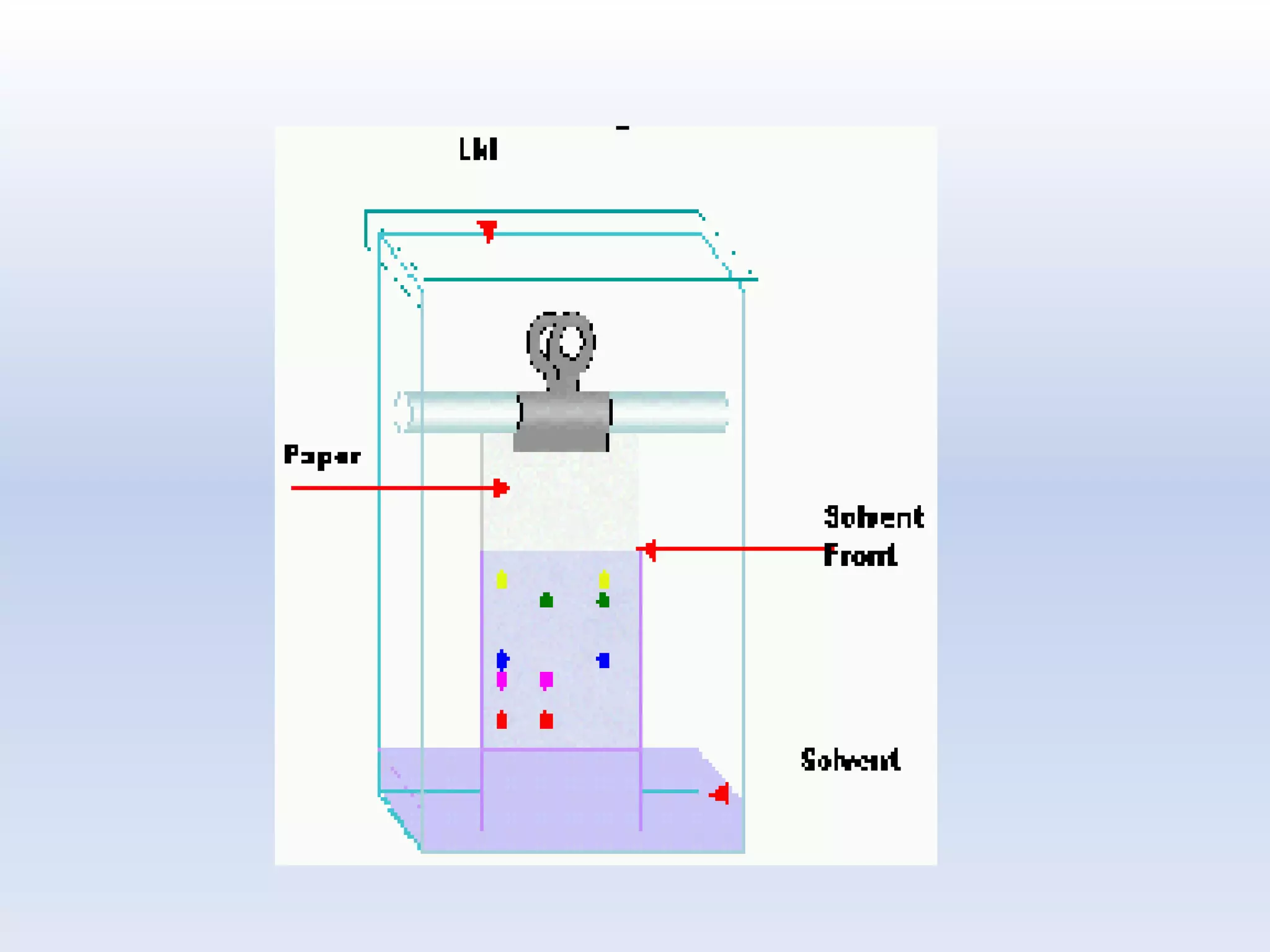
• The stationary phase is made up of the
  solvent held by the paper and mobile phase
  is the irrigating eluent.
• Both these phases are in contact over a very
  large interface on filter paper.
• The water absorbed in amorphous regions of
Types of paper chromatography:-
        Depending upon the migration
 forces     that    are    involved in
 separation, paper chromatography is
 classified into two types.

They are:-
i. Paper partition chromatography.
ii. Paper adsorption chromatography.
Paper partition chromatography:-
      In standard method of analysis where the
 paper is utilized as a support with one solvent
 as mobile phase and other as a stationary
 phase. The migration of substances is due to
 differences in partition coefficients.
Paper adsorption chromatography:-
      In some cases the paper to be used is
 coated or impregnated with adsorbents like
 silica gel or aluminia, is used as an adsorbent
 and the solvent is allowed to flow over the
 unknown components. Thus, migration of
 substances is due to the difference in
 adsorptive powers of substances to be
 separated.
Advantages over other methods:-
i. The equipment is very simple and is
     easily available.
ii. It has high efficiency of separation.
iii. Separation can be effected on macro,
     micro and semi-micro scale.
iv. Closely related homologues, isotopes,
     isomers and very labile and reactive
     substances can be separated readily and
     satisfactorily.
Rf VALUE:-
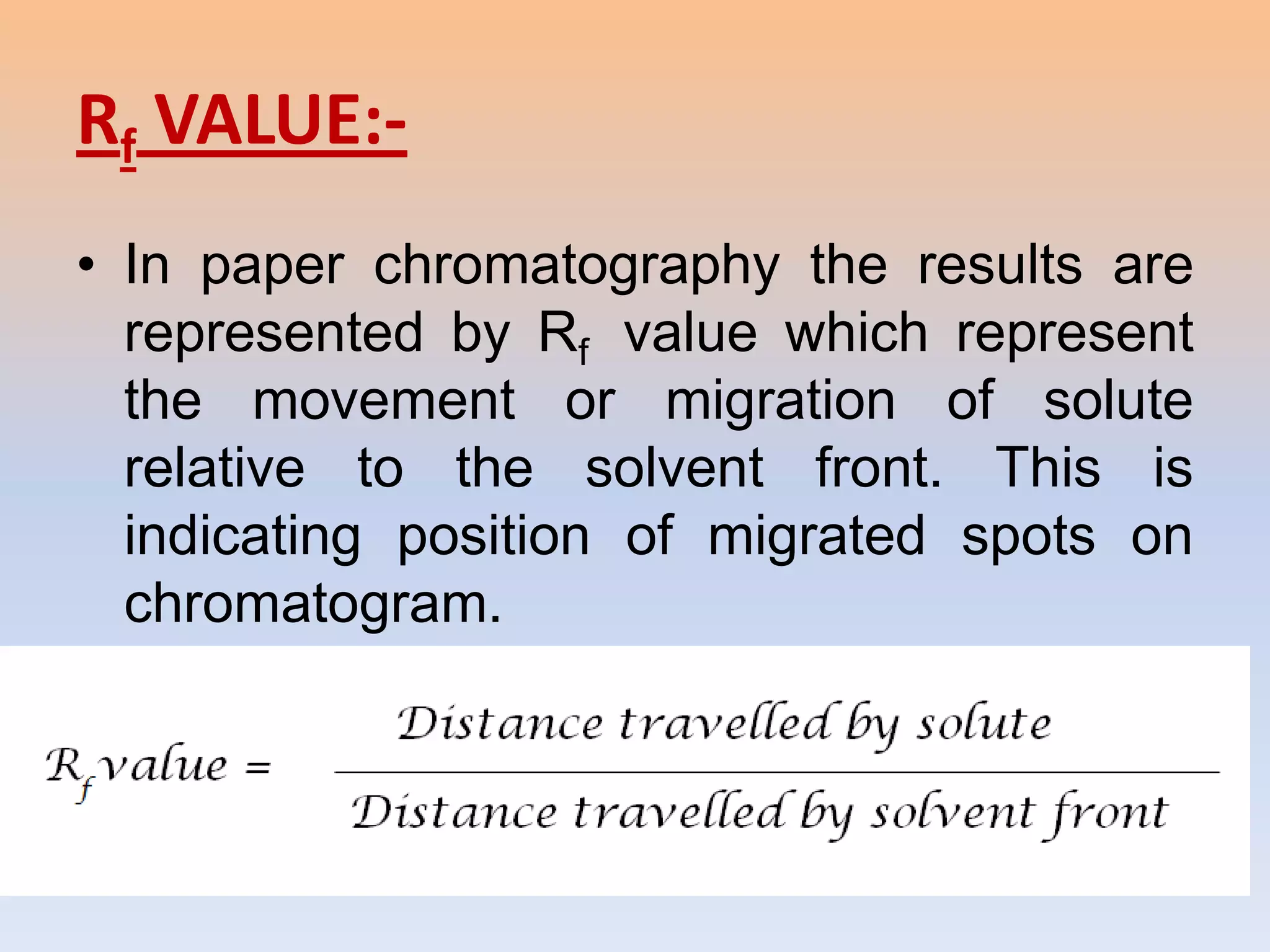
• In paper chromatography the results are
  represented by Rf value which represent
  the movement or migration of solute
  relative to the solvent front. This is
  indicating position of migrated spots on
  chromatogram.
• The Rf value is calculated as:-
• Rf is a function of partition coefficients and
  is     a     constant       for    a     given
  substance, provided the conditions of
  chromatographic        system     are     kept
  constant.
• For greater reliability, reference standards
  are used in parallel runs or as internal
  standards.
• Sometimes the solvent front runs off the
  paper. Then the position of individual spot
  is measured relative to position of
  standard substances.
 Rf value is always less than unity but Rx
factors which affect Rf value are:-
• The    solvent     system and   its
  composition.
• Temperature.
• The quality of the paper.
• Distance through which the solvent
  runs.
• The quality and nature of solvents
  used.
References:-
 A text book of Pharmaceutical
 analysis by Dr. A.V.Kasture.
 Volume – II, page no-31.
….Thank

Presentation on principle of paper chromatography and Rf Value

  • 1.
    Presentation on Paper Chromatography Principle and Rf Value Presented to:- Dr. B.M.Gurupadayya, Dept.of Pharmaceutical Chemistry, JSSCP, Mysore. Presented by:- Tekuri Manoj Kumar, 1st M.Pharm(IP).
  • 2.
    Overview:- • Introduction. • Definition of paper chromatography. • Principle involved in paper chromatography. • Types of paper chromatography. • Advantages of paper chromatography. • Rf value. • Factors which affect Rf value. • References.
  • 3.
    Introduction:- • All thecredit for the present status of paper chromatography goes to Martin and his co- workers viz. Consden, Gorden and Synge. • Martin and Synge (1941) developed forty- plate complicated apparatus for the separation of acetylated amino acids. • Consden, Gorden and Martin (1944) replaced silica gel with a filter paper by using n-butanol as a mobile phase. • It was originally used to separate organic
  • 4.
    Definition:-  Paper chromatography is the technique in which the separation of an unknown substance is mainly carried out by the flow of solvents on the specially designed chromatographic paper.  In this case the solvent goes up by capillary action.  The separation is effected by differential migration of the substance due to
  • 5.
    Theoretical principle:-  largely by partition coefficient phenomenon. • separation is accomplished by successive equilibrations of sample between two phases; one of which moves over the other. • The stationary phase is made up of the solvent held by the paper and mobile phase is the irrigating eluent. • Both these phases are in contact over a very large interface on filter paper. • The water absorbed in amorphous regions of
  • 7.
    Types of paperchromatography:-  Depending upon the migration forces that are involved in separation, paper chromatography is classified into two types. They are:- i. Paper partition chromatography. ii. Paper adsorption chromatography.
  • 8.
    Paper partition chromatography:- In standard method of analysis where the paper is utilized as a support with one solvent as mobile phase and other as a stationary phase. The migration of substances is due to differences in partition coefficients. Paper adsorption chromatography:- In some cases the paper to be used is coated or impregnated with adsorbents like silica gel or aluminia, is used as an adsorbent and the solvent is allowed to flow over the unknown components. Thus, migration of substances is due to the difference in adsorptive powers of substances to be separated.
  • 9.
    Advantages over othermethods:- i. The equipment is very simple and is easily available. ii. It has high efficiency of separation. iii. Separation can be effected on macro, micro and semi-micro scale. iv. Closely related homologues, isotopes, isomers and very labile and reactive substances can be separated readily and satisfactorily.
  • 10.
    Rf VALUE:- • Inpaper chromatography the results are represented by Rf value which represent the movement or migration of solute relative to the solvent front. This is indicating position of migrated spots on chromatogram. • The Rf value is calculated as:-
  • 11.
    • Rf isa function of partition coefficients and is a constant for a given substance, provided the conditions of chromatographic system are kept constant. • For greater reliability, reference standards are used in parallel runs or as internal standards. • Sometimes the solvent front runs off the paper. Then the position of individual spot is measured relative to position of standard substances.  Rf value is always less than unity but Rx
  • 12.
    factors which affectRf value are:- • The solvent system and its composition. • Temperature. • The quality of the paper. • Distance through which the solvent runs. • The quality and nature of solvents used.
  • 13.
    References:- A textbook of Pharmaceutical analysis by Dr. A.V.Kasture. Volume – II, page no-31.
  • 14.