University of Education
LMC Lahore.
Subject : Biological techniques
Assignments topic: “Paper Chromatography”
Contents:
 Chromatography
 Paper Chromatography
 Phases
 Components
 Principle
 Diagram
 Procedure
 Types
 Applications
 Disadvantages
 Limitations
 Conclusion
 References
 Chromatography:
It is a technique for the separation of a mixture by passing it in solution or suspension
through a medium in which the components move at different rates.
 Paper chromatography
“Paper chromatography is an analytical method used to separate colored chemicals or
substances. It is primarily used as a teaching tool, having been replaced by other
chromatography methods, such as thin-layer chromatography”.
OR
“Chromatography technique that uses paper sheets or strips as the adsorbent being the
stationary phase through which a solution is made to pass is called paper
chromatography”.
 Phases:
There are two phases in paper chromatography are:
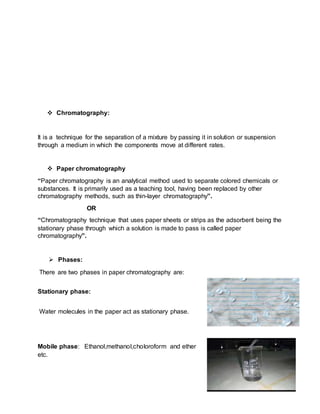
Stationary phase:
Water molecules in the paper act as stationary phase.
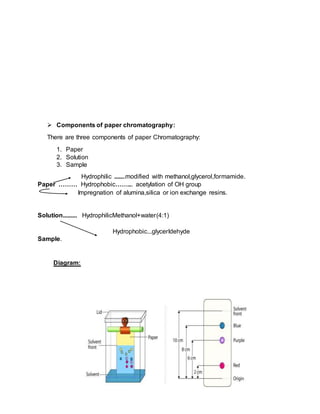
Mobile phase: Ethanol,methanol,choloroform and ether
etc.
 Components of paper chromatography:
There are three components of paper Chromatography:
1. Paper
2. Solution
3. Sample
Hydrophilic .......modified with methanol,glycerol,formamide.
Paper ……… Hydrophobic……... acetylation of OH group
Impregnation of alumina,silica or ion exchange resins.
Solution......... HydrophilicMethanol+water(4:1)
Hydrophobic...glycerldehyde
Sample.
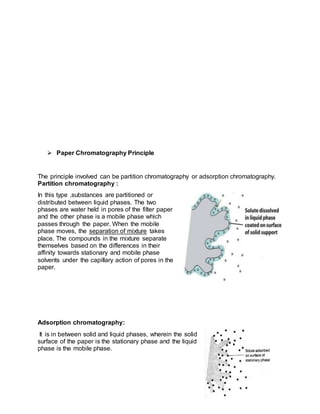
Diagram:
 Paper Chromatography Principle
The principle involved can be partition chromatography or adsorption chromatography.
Partition chromatography :
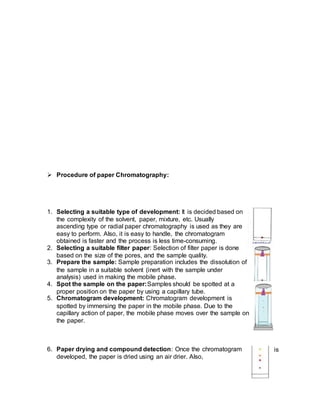
In this type ,substances are partitioned or
distributed between liquid phases. The two
phases are water held in pores of the filter paper
and the other phase is a mobile phase which
passes through the paper. When the mobile
phase moves, the separation of mixture takes
place. The compounds in the mixture separate
themselves based on the differences in their
affinity towards stationary and mobile phase
solvents under the capillary action of pores in the
paper.
Adsorption chromatography:
It is in between solid and liquid phases, wherein the solid
surface of the paper is the stationary phase and the liquid
phase is the mobile phase.
 Procedure of paper Chromatography:
1. Selecting a suitable type of development: It is decided based on
the complexity of the solvent, paper, mixture, etc. Usually
ascending type or radial paper chromatography is used as they are
easy to perform. Also, it is easy to handle, the chromatogram
obtained is faster and the process is less time-consuming.
2. Selecting a suitable filter paper: Selection of filter paper is done
based on the size of the pores, and the sample quality.
3. Prepare the sample: Sample preparation includes the dissolution of
the sample in a suitable solvent (inert with the sample under
analysis) used in making the mobile phase.
4. Spot the sample on the paper:Samples should be spotted at a
proper position on the paper by using a capillary tube.
5. Chromatogram development: Chromatogram development is
spotted by immersing the paper in the mobile phase. Due to the
capillary action of paper, the mobile phase moves over the sample on
the paper.
6. Paper drying and compound detection: Once the chromatogram is
developed, the paper is dried using an air drier. Also,
detecting solution can be sprayed on the chromatogram developed paper and
dried to identify the sample chromatogram spots.
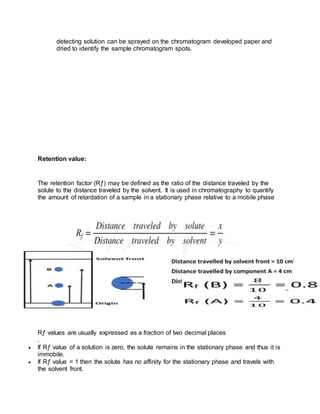
Retention value:
The retention factor (Rƒ) may be defined as the ratio of the distance traveled by the
solute to the distance traveled by the solvent. It is used in chromatography to quantify
the amount of retardation of a sample in a stationary phase relative to a mobile phase
Rƒ values are usually expressed as a fraction of two decimal places
.
 If Rƒ value of a solution is zero, the solute remains in the stationary phase and thus it is
immobile.
 If Rƒ value = 1 then the solute has no affinity for the stationary phase and travels with
the solvent front.
Types of paper Chromatography
 Ascending chromatography: As the name indicates, the chromatogram
ascends. Here, the development of paper occurs due to the solvent movement or
upward travel on the paper. The solvent reservoir is at the bottom of the beaker.
The paper tip with sample spots just dips into the solvent at the bottom so that
spots remain well above the solvent.
 Descending chromatography: Here, the development of paper occurs due to
solvent travel downwards on is at the top. The movement of the solvent is
assisted by gravity besides the capillary action.
 Ascending- descending mode: Here solvent first travels upwards and then
downwards on the paper.
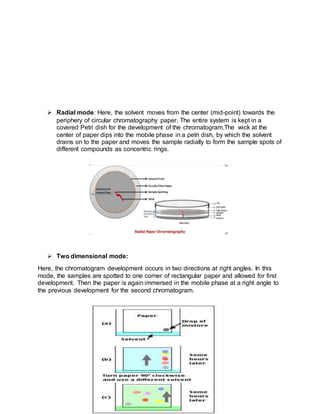
 Radial mode: Here, the solvent moves from the center (mid-point) towards the
periphery of circular chromatography paper. The entire system is kept in a
covered Petri dish for the development of the chromatogram.The wick at the
center of paper dips into the mobile phase in a petri dish, by which the solvent
drains on to the paper and moves the sample radially to form the sample spots of
different compounds as concentric rings.
 Two dimensional mode:
Here, the chromatogram development occurs in two directions at right angles. In this
mode, the samples are spotted to one corner of rectangular paper and allowed for first
development. Then the paper is again immersed in the mobile phase at a right angle to
the previous development for the second chromatogram.
Applications Of Paper Chromatography:
 Separating Colored pigments:
An effective technique used for separating colored pigments from a mixture.
 Reaction Monitoring:
It is Monitoring the rate of a reaction. The rate of a chemical reaction is a measure
of how fast the reactants are being used up and how fast the products are being
made. The rate can be determined by measuring: changes in the concentration of
the reactants or products.
 Qualitative Analysis:
Identification of the constituents, e.g. elements or functional groups, present in a
substance.
 Isolation And Purification:
Concentrate or purify cells, viruses, cell fractions, organelles or biological
macromolecules (e.g. proteins, protein complexes, chromatin, nucleic acids,
carbohydrates or lipids) for subsequent analysis.
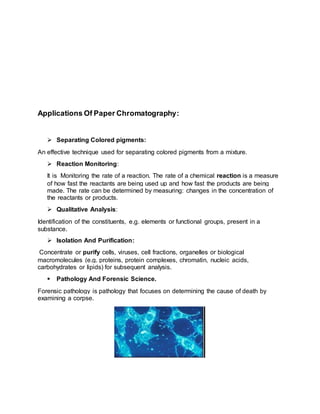
 Pathology And Forensic Science.
Forensic pathology is pathology that focuses on determining the cause of death by
examining a corpse.
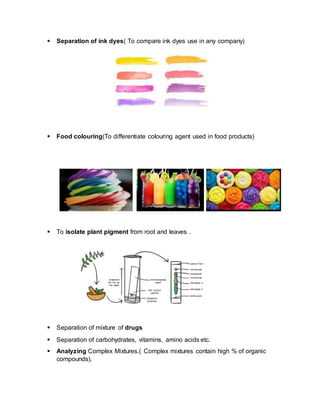
 Separation of ink dyes( To compare ink dyes use in any company)
 Food colouring(To differentiate colouring agent used in food products)
 To isolate plant pigment from root and leaves .
 Separation of mixture of drugs
 Separation of carbohydrates, vitamins, amino acids etc.
 Analyzing Complex Mixtures.( Complex mixtures contain high % of organic
compounds).
 Disadvantages
 The chromatography equipment can only be operated by a trained person.
 Chromatography instruments are expensive.
 An error occurs due to the overloading of the samples.
 Chromatography equipment must be handled with care because of these
parts are expensive and sensitive.
 Limitations of paper Chromatography:
 Large amount of mixture cannot be applied on paper chromatography.
 In quantitative analysis paper chromatography is not effective.
 Complex mixture cannot be separated by paper chromatography.
 Less Accurate compared to HPLC or HPTLC.
 Conclusion:
Initially chromatographic techniques were used to separate substances based on
their color as was the case with herbal pigments. With time its application area was
extended considerably. Nowadays, chromatography is accepted as an extremely
sensitive, and effective separation method.
 References
Paper chromatography | chemistry". Encyclopedia Britannica. Retrieved 2018-06-01.
IUPAC, Compendium of Chemical Terminology, 2nd ed. (the "Gold Book") (1997).
Online corrected version: (2006–) "retention factor, k in column chromatography'".
doi:10.1351/goldbook.R05359
Haslam, Edwin (2007). "Vegetable tannins – Lessons of a phytochemical lifetime".
Photochemistry
McCurry J (2011). Organic chemistry: with biological applications (2nd ed.). Belmont,
CA: Brooks/Cole. pp. 395. ISBN 9780495391470.
Hostettmann K, Marston A, Hostettmann M (1998). Preparative Chromatography
Techniques Applications in Natural Product Isolation (Second ed.). Berlin, Heidelberg:
Springer Berlin Heidelberg. p. 50. ISBN 97836620363

Paper chromatography

  • 1.
    University of Education LMCLahore. Subject : Biological techniques Assignments topic: “Paper Chromatography”
  • 2.
    Contents:  Chromatography  PaperChromatography  Phases  Components  Principle  Diagram  Procedure  Types  Applications  Disadvantages  Limitations  Conclusion  References
  • 3.
     Chromatography: It isa technique for the separation of a mixture by passing it in solution or suspension through a medium in which the components move at different rates.  Paper chromatography “Paper chromatography is an analytical method used to separate colored chemicals or substances. It is primarily used as a teaching tool, having been replaced by other chromatography methods, such as thin-layer chromatography”. OR “Chromatography technique that uses paper sheets or strips as the adsorbent being the stationary phase through which a solution is made to pass is called paper chromatography”.  Phases: There are two phases in paper chromatography are: Stationary phase: Water molecules in the paper act as stationary phase. Mobile phase: Ethanol,methanol,choloroform and ether etc.
  • 4.
     Components ofpaper chromatography: There are three components of paper Chromatography: 1. Paper 2. Solution 3. Sample Hydrophilic .......modified with methanol,glycerol,formamide. Paper ……… Hydrophobic……... acetylation of OH group Impregnation of alumina,silica or ion exchange resins. Solution......... HydrophilicMethanol+water(4:1) Hydrophobic...glycerldehyde Sample. Diagram:
  • 5.
     Paper ChromatographyPrinciple The principle involved can be partition chromatography or adsorption chromatography. Partition chromatography : In this type ,substances are partitioned or distributed between liquid phases. The two phases are water held in pores of the filter paper and the other phase is a mobile phase which passes through the paper. When the mobile phase moves, the separation of mixture takes place. The compounds in the mixture separate themselves based on the differences in their affinity towards stationary and mobile phase solvents under the capillary action of pores in the paper. Adsorption chromatography: It is in between solid and liquid phases, wherein the solid surface of the paper is the stationary phase and the liquid phase is the mobile phase.
  • 6.
     Procedure ofpaper Chromatography: 1. Selecting a suitable type of development: It is decided based on the complexity of the solvent, paper, mixture, etc. Usually ascending type or radial paper chromatography is used as they are easy to perform. Also, it is easy to handle, the chromatogram obtained is faster and the process is less time-consuming. 2. Selecting a suitable filter paper: Selection of filter paper is done based on the size of the pores, and the sample quality. 3. Prepare the sample: Sample preparation includes the dissolution of the sample in a suitable solvent (inert with the sample under analysis) used in making the mobile phase. 4. Spot the sample on the paper:Samples should be spotted at a proper position on the paper by using a capillary tube. 5. Chromatogram development: Chromatogram development is spotted by immersing the paper in the mobile phase. Due to the capillary action of paper, the mobile phase moves over the sample on the paper. 6. Paper drying and compound detection: Once the chromatogram is developed, the paper is dried using an air drier. Also,
  • 7.
    detecting solution canbe sprayed on the chromatogram developed paper and dried to identify the sample chromatogram spots. Retention value: The retention factor (Rƒ) may be defined as the ratio of the distance traveled by the solute to the distance traveled by the solvent. It is used in chromatography to quantify the amount of retardation of a sample in a stationary phase relative to a mobile phase Rƒ values are usually expressed as a fraction of two decimal places .  If Rƒ value of a solution is zero, the solute remains in the stationary phase and thus it is immobile.  If Rƒ value = 1 then the solute has no affinity for the stationary phase and travels with the solvent front.
  • 8.
    Types of paperChromatography  Ascending chromatography: As the name indicates, the chromatogram ascends. Here, the development of paper occurs due to the solvent movement or upward travel on the paper. The solvent reservoir is at the bottom of the beaker. The paper tip with sample spots just dips into the solvent at the bottom so that spots remain well above the solvent.  Descending chromatography: Here, the development of paper occurs due to solvent travel downwards on is at the top. The movement of the solvent is assisted by gravity besides the capillary action.  Ascending- descending mode: Here solvent first travels upwards and then downwards on the paper.
  • 9.
     Radial mode:Here, the solvent moves from the center (mid-point) towards the periphery of circular chromatography paper. The entire system is kept in a covered Petri dish for the development of the chromatogram.The wick at the center of paper dips into the mobile phase in a petri dish, by which the solvent drains on to the paper and moves the sample radially to form the sample spots of different compounds as concentric rings.  Two dimensional mode: Here, the chromatogram development occurs in two directions at right angles. In this mode, the samples are spotted to one corner of rectangular paper and allowed for first development. Then the paper is again immersed in the mobile phase at a right angle to the previous development for the second chromatogram.
  • 10.
    Applications Of PaperChromatography:  Separating Colored pigments: An effective technique used for separating colored pigments from a mixture.  Reaction Monitoring: It is Monitoring the rate of a reaction. The rate of a chemical reaction is a measure of how fast the reactants are being used up and how fast the products are being made. The rate can be determined by measuring: changes in the concentration of the reactants or products.  Qualitative Analysis: Identification of the constituents, e.g. elements or functional groups, present in a substance.  Isolation And Purification: Concentrate or purify cells, viruses, cell fractions, organelles or biological macromolecules (e.g. proteins, protein complexes, chromatin, nucleic acids, carbohydrates or lipids) for subsequent analysis.  Pathology And Forensic Science. Forensic pathology is pathology that focuses on determining the cause of death by examining a corpse.
  • 11.
     Separation ofink dyes( To compare ink dyes use in any company)  Food colouring(To differentiate colouring agent used in food products)  To isolate plant pigment from root and leaves .  Separation of mixture of drugs  Separation of carbohydrates, vitamins, amino acids etc.  Analyzing Complex Mixtures.( Complex mixtures contain high % of organic compounds).
  • 12.
     Disadvantages  Thechromatography equipment can only be operated by a trained person.  Chromatography instruments are expensive.  An error occurs due to the overloading of the samples.  Chromatography equipment must be handled with care because of these parts are expensive and sensitive.  Limitations of paper Chromatography:  Large amount of mixture cannot be applied on paper chromatography.  In quantitative analysis paper chromatography is not effective.  Complex mixture cannot be separated by paper chromatography.  Less Accurate compared to HPLC or HPTLC.  Conclusion: Initially chromatographic techniques were used to separate substances based on their color as was the case with herbal pigments. With time its application area was extended considerably. Nowadays, chromatography is accepted as an extremely sensitive, and effective separation method.  References Paper chromatography | chemistry". Encyclopedia Britannica. Retrieved 2018-06-01. IUPAC, Compendium of Chemical Terminology, 2nd ed. (the "Gold Book") (1997). Online corrected version: (2006–) "retention factor, k in column chromatography'". doi:10.1351/goldbook.R05359 Haslam, Edwin (2007). "Vegetable tannins – Lessons of a phytochemical lifetime". Photochemistry McCurry J (2011). Organic chemistry: with biological applications (2nd ed.). Belmont, CA: Brooks/Cole. pp. 395. ISBN 9780495391470.
  • 13.
    Hostettmann K, MarstonA, Hostettmann M (1998). Preparative Chromatography Techniques Applications in Natural Product Isolation (Second ed.). Berlin, Heidelberg: Springer Berlin Heidelberg. p. 50. ISBN 97836620363