Paper Chromatography
By
Dr. Nidhi Gupta
Assistant Professor
M.M. College of Pharmacy
Maharishi Markandeshwar (Deemed to be University), Mullana,
Ambala, India
Introduction
Chromatography technique that uses paper sheets or strips as the
adsorbent being the stationary phase through which a solution is
made to pass is called paper chromatography. It is an inexpensive
method of separating dissolved chemical substances by their
different migration rates across the sheets of paper. It is a powerful
analytical tool that uses very small quantities of material. Paper
chromatography was discovered by Synge and Martin in the year
1943.
Principle
The principle involved can be partition chromatography or adsorption
chromatography. Partition chromatography because the substances are
partitioned or distributed between liquid phases. The two phases are water held
in pores of the filter paper and the other phase is a mobile phase which passes
through the paper. When the mobile phase moves, the separation of the
mixture takes place. The compounds in the mixture separate themselves based
on the differences in their affinity towards stationary and mobile phase solvents
under the capillary action of pores in the paper. Adsorption chromatography
between solid and liquid phases, wherein the solid surface of the paper is the
stationary phase and the liquid phase is the mobile phase.
Procedure
Below we have explained the procedure to conduct Paper Chromatography
Experiment for easy understanding of students.
Selecting a suitable type of development: It is decided based on the complexity of
the solvent, paper, mixture, etc. Usually ascending type or radial paper
chromatography is used as they are easy to perform. Also, it is easy to handle, the
chromatogram obtained is faster and the process is less time-consuming.
Selecting a suitable filter paper: Selection of filter paper is done based on the size
of the pores and the sample quality.
Prepare the sample: Sample preparation includes the dissolution of the sample in a
suitable solvent (inert with the sample under analysis) used in making the mobile
phase.
Spot the sample on the paper: Samples should be spotted at a proper position on
the paper by using a capillary tube.
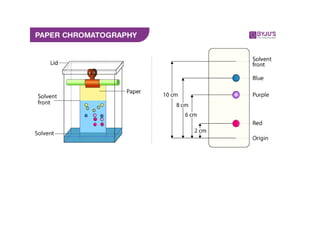
Chromatogram development: Chromatogram development is spotted by immersing
the paper in the mobile phase. Due to the capillary action of paper, the mobile
phase moves over the sample on the paper.
Paper drying and compound detection: Once the chromatogram is developed, the
paper is dried using an air drier. Also, detecting solution can be sprayed on the
chromatogram developed paper and dried to identify the sample chromatogram
spots.
Applications
•There are various applications of paper chromatography. Some of the
uses of Paper Chromatography in different fields are discussed below:
•To study the process of fermentation and ripening.
•To check the purity of pharmaceuticals.
•To inspect cosmetics.
•To detect the adulterants.
•To detect the contaminants in drinks and foods.
•To examine the reaction mixtures in biochemical laboratories.
•To determine dopes and drugs in humans and animals.
Types of paper chromatography:
Ascending Paper Chromatography – The techniques goes with its name as the
solvent moves in an upward direction.
Descending Paper Chromatography – The movement of the flow of solvent
due to gravitational pull and capillary action is downwards, hence the name
descending paper chromatography.
Ascending – Descending Paper Chromatography – In this version of paper
chromatography, movement of solvent occurs in two directions after a
particular point. Initially, the solvent travels upwards on the paper which is
folded over a rod and after crossing the rod it continues with its travel in the
downward direction.
Radial or Circular Paper Chromatography – The sample is deposited at the
centre of the circular filter paper. Once the spot is dried, the filter paper is tied
horizontally on a Petri dish which contains the solvent.
Two Dimensional Paper Chromatography – Substances which have the same
rf values can be resolved with the help of two-dimensional paper
chromatography.
Thank you………..

Paper Chromatography.pptx

  • 1.
    Paper Chromatography By Dr. NidhiGupta Assistant Professor M.M. College of Pharmacy Maharishi Markandeshwar (Deemed to be University), Mullana, Ambala, India
  • 2.
    Introduction Chromatography technique thatuses paper sheets or strips as the adsorbent being the stationary phase through which a solution is made to pass is called paper chromatography. It is an inexpensive method of separating dissolved chemical substances by their different migration rates across the sheets of paper. It is a powerful analytical tool that uses very small quantities of material. Paper chromatography was discovered by Synge and Martin in the year 1943.
  • 3.
    Principle The principle involvedcan be partition chromatography or adsorption chromatography. Partition chromatography because the substances are partitioned or distributed between liquid phases. The two phases are water held in pores of the filter paper and the other phase is a mobile phase which passes through the paper. When the mobile phase moves, the separation of the mixture takes place. The compounds in the mixture separate themselves based on the differences in their affinity towards stationary and mobile phase solvents under the capillary action of pores in the paper. Adsorption chromatography between solid and liquid phases, wherein the solid surface of the paper is the stationary phase and the liquid phase is the mobile phase.
  • 5.
    Procedure Below we haveexplained the procedure to conduct Paper Chromatography Experiment for easy understanding of students. Selecting a suitable type of development: It is decided based on the complexity of the solvent, paper, mixture, etc. Usually ascending type or radial paper chromatography is used as they are easy to perform. Also, it is easy to handle, the chromatogram obtained is faster and the process is less time-consuming. Selecting a suitable filter paper: Selection of filter paper is done based on the size of the pores and the sample quality. Prepare the sample: Sample preparation includes the dissolution of the sample in a suitable solvent (inert with the sample under analysis) used in making the mobile phase. Spot the sample on the paper: Samples should be spotted at a proper position on the paper by using a capillary tube. Chromatogram development: Chromatogram development is spotted by immersing the paper in the mobile phase. Due to the capillary action of paper, the mobile phase moves over the sample on the paper. Paper drying and compound detection: Once the chromatogram is developed, the paper is dried using an air drier. Also, detecting solution can be sprayed on the chromatogram developed paper and dried to identify the sample chromatogram spots.
  • 6.
    Applications •There are variousapplications of paper chromatography. Some of the uses of Paper Chromatography in different fields are discussed below: •To study the process of fermentation and ripening. •To check the purity of pharmaceuticals. •To inspect cosmetics. •To detect the adulterants. •To detect the contaminants in drinks and foods. •To examine the reaction mixtures in biochemical laboratories. •To determine dopes and drugs in humans and animals.
  • 7.
    Types of paperchromatography: Ascending Paper Chromatography – The techniques goes with its name as the solvent moves in an upward direction. Descending Paper Chromatography – The movement of the flow of solvent due to gravitational pull and capillary action is downwards, hence the name descending paper chromatography. Ascending – Descending Paper Chromatography – In this version of paper chromatography, movement of solvent occurs in two directions after a particular point. Initially, the solvent travels upwards on the paper which is folded over a rod and after crossing the rod it continues with its travel in the downward direction. Radial or Circular Paper Chromatography – The sample is deposited at the centre of the circular filter paper. Once the spot is dried, the filter paper is tied horizontally on a Petri dish which contains the solvent. Two Dimensional Paper Chromatography – Substances which have the same rf values can be resolved with the help of two-dimensional paper chromatography.
  • 8.