PAPER CHROMATOGRAPHY
Presented by
Dharti Bandarwar
BSC, 3rd yr.
Faculty of chemistry
S.P
. college Chandrapur
Gondwana University
1
Introduction and history
CHROMATOGRAPHY
2
What are chromatography
 Chromatography is a technique separation components of a mixture
continuous distribution of components  between two phases.
 Mobile phase  mixture to be separated  does move
 Stationary phase the material on which the separation takes place can
be solid, gel or liquid  doesn't move
 Physico-chemical method
chroma color graphing  to write
3
Historical Development
 Important technique  2Nobel prize
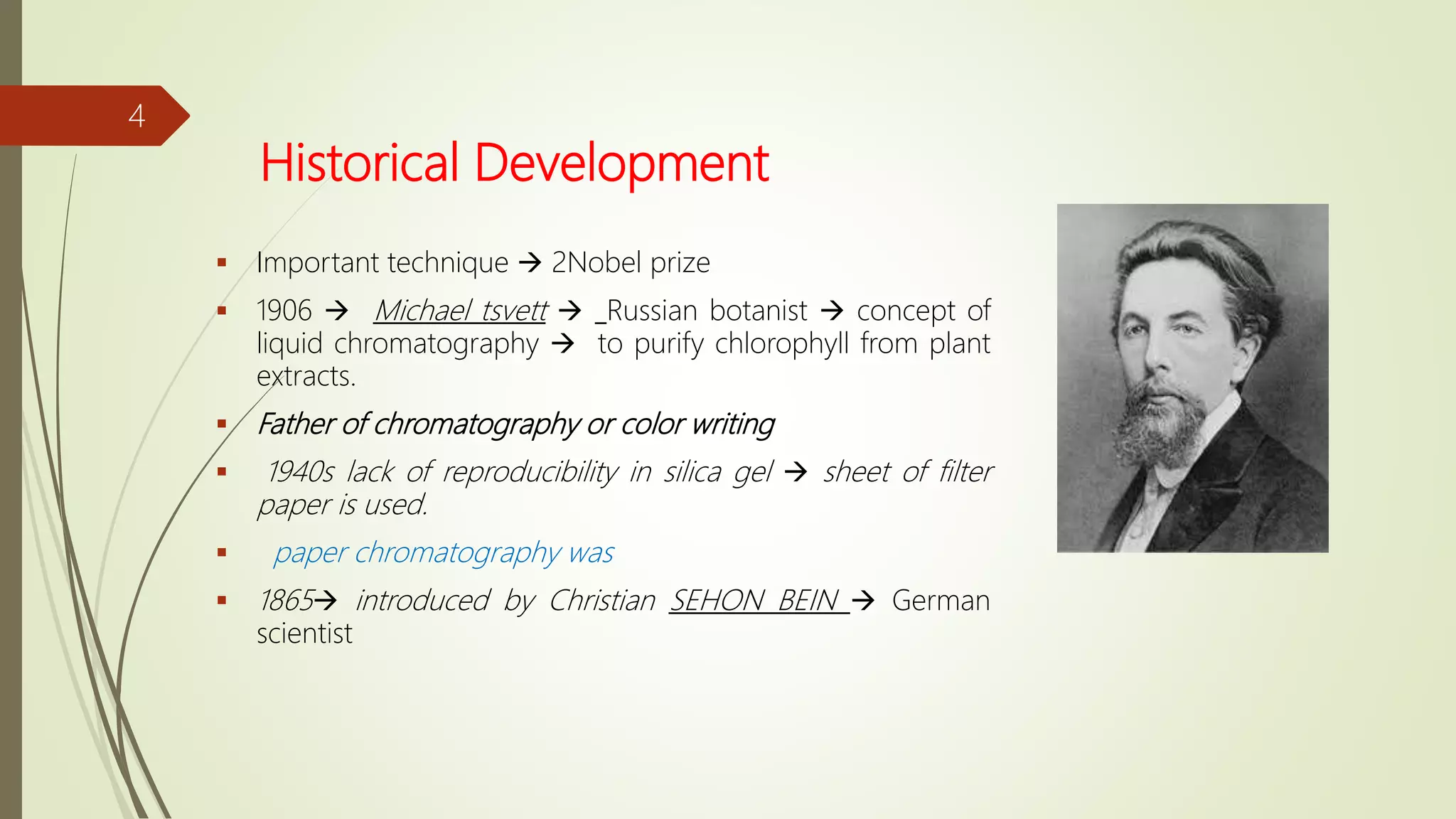
 1906  Michael tsvett  Russian botanist  concept of
liquid chromatography  to purify chlorophyll from plant
extracts.
 Father of chromatography or color writing
 1940s lack of reproducibility in silica gel  sheet of filter
paper is used.
 paper chromatography was
 1865 introduced by Christian SEHON BEIN  German
scientist
4
Technique of chromatography
differ on the basis use of stationary phase
Chromatography
planar
paper
Thin
layer
column
5
 Planer :- it is a liquid chromatography in which the stationary phase is
arranged in the form of a planer or flat bed and the mobile phase
 column :- technique use in the purification of compound based on their
hydrophobicity or polarity ,in this chromatography process the molecule
mixture is separate depends on its differential partitioning between
stationary and mobile phase.
 Thin layer :- is technique use to isolate non-volatile mixture in which the
stationary phases aluminum foil, plastic or glass which are coated with a
thin layer of adsorbent material. the material generally use is aluminum
oxide cellulose or silica gel.
 Paper:- here is a special type of paper is used .
6
PAPER CHROMATOGRAPHY
 Introduction
 Mode of PC
 Principle
 Requirement
 Method
 Rf value & Result
 Application
7
Paper chromatography (PC)
 Paper chromatography  partition chromatography the substance 
separated  different rates of migration  by using paper (Whatman filter
paper).
 Whatman filter paper alpha cellulose, beta cellulose, pentosanes, ashes
 maximum separation.
 Example:- analysis unknown substance  (Cu^2+,Co^2+, Ni^2+) 
carried out mainly by the flow of solvent on the paper.
 On the basis of mode of separation two types of paper
chromatography,
I. Paper adsorption chromatography  [liquid-solid]
Separation occurs on the basis of adsorption
I. Paper partition chromatography  [liquid-liquid]
II. Separation occurs on the basis of partition
8
Whatman filter paper
Modes of PC.
On the basis of flow of solvent
 Ascending chromatography (one way)
solvent travels downward on the paper.
 Descending chromatography  (one Way)
here the solvent travels upward direction of the paper.
 Circular/radial chromatography
circular paper is used nd sample placed at the center
of the paper.
9
Principle
 Based on the principle of separation
 Separation  relative affinity of cpds towards s.p. and m.p.
 Cpds under the influence of m.p.  travel over the surface of s.p.
 During this  cpds with higher affinity to s.p. travel slowly 
while other travel faster.
 Separation of mix.  achieved
 Separation completed  cmpts visualized as spots  at
respective paper.
10
Apparatus & chemical
 Beaker
 Measuring cylinder
 Pipette tank
 Whatman filer paper ( Stationary
phase)
 5% of solution of nitrates of metals
developing solvent ( mobile phase)
 Locating reagent
11
Methodology…
12
Paper
Stationary
phase (paper)
Start
point
End point
[ solvent
front]
sample
Mobile
phase
(solvent)
Stationary
phase
 Size
 Nature
 KD value
Step 1 Step 2 Step 3 Step 4
Migration of
substance
lead
1) First take absorbent paper for the process, this paper may be special
chromatography paper.
2) Then draw a horizontal line near the end [1.5cm from the edge] of the paper. A line
is drawn with the help of pencil because the lead of pencil no contain any type of
dye therefore their will not interfere with result.
3) The sample need to be separated, is place as a small drop on thee line using
capillary tube and the spot dried.
4) The paper is kept in a closed chamber which contain with a swallow layers of solvent
the solvent must be lower then the pencil line or drop on it. The container need to
be covered to avoid solvent to evaporate.
5) As soon as filter paper gets the liquid through the spot of the test solution.
6) Then the various substances moved by solvent system at various speeds. When
solvent has moved substance to the solvent front then the paper dried and the
various spots are visualizes by soluble reagent called visualized reagents.
7) The movement of substance to the solvent is expressed in term of rf values. i.e.
migration parameter.
13
Rf value & Result
 Rf value :- The ration of the distance of the spot the compound to the
distance travel by the solvent front is known as Rf value for that component.
 RF value = 0  immobile
 RF value =1  solute has no affinity for stationary phase  with the solvent
front.
 Rf value = Distance travelled by compound
Distance travelled by a solvent
 Result :-
 1) The spots of Co^2+, Cu^2+, Ni^2+ can be identified by their green,
brown, and blue color respectively.
 2) The Rf value of cation was found.
14
Application
Real-life example of uses for chromatography
1. Widely chemical industry
2. Hospital  detect blood or alcohol in a patients blood stream.
3. Law enforcement to compare a sample found at a crime scene to sample of
suspects.
4. Environmental testing  determining the level of pollutants in the water supply.
5. Manufacturing plant  to purify a chemical needed to make a product.
6. Quality control food industry analyzed additives like vitamins, proteins
preservative aminoacides
7. Pharmaceutical company  determine amount of each chemical found in new
product.
15
16

Chromatography

  • 1.
    PAPER CHROMATOGRAPHY Presented by DhartiBandarwar BSC, 3rd yr. Faculty of chemistry S.P . college Chandrapur Gondwana University 1
  • 2.
  • 3.
    What are chromatography Chromatography is a technique separation components of a mixture continuous distribution of components  between two phases.  Mobile phase  mixture to be separated  does move  Stationary phase the material on which the separation takes place can be solid, gel or liquid  doesn't move  Physico-chemical method chroma color graphing  to write 3
  • 4.
    Historical Development  Importanttechnique  2Nobel prize  1906  Michael tsvett  Russian botanist  concept of liquid chromatography  to purify chlorophyll from plant extracts.  Father of chromatography or color writing  1940s lack of reproducibility in silica gel  sheet of filter paper is used.  paper chromatography was  1865 introduced by Christian SEHON BEIN  German scientist 4
  • 5.
    Technique of chromatography differon the basis use of stationary phase Chromatography planar paper Thin layer column 5
  • 6.
     Planer :-it is a liquid chromatography in which the stationary phase is arranged in the form of a planer or flat bed and the mobile phase  column :- technique use in the purification of compound based on their hydrophobicity or polarity ,in this chromatography process the molecule mixture is separate depends on its differential partitioning between stationary and mobile phase.  Thin layer :- is technique use to isolate non-volatile mixture in which the stationary phases aluminum foil, plastic or glass which are coated with a thin layer of adsorbent material. the material generally use is aluminum oxide cellulose or silica gel.  Paper:- here is a special type of paper is used . 6
  • 7.
    PAPER CHROMATOGRAPHY  Introduction Mode of PC  Principle  Requirement  Method  Rf value & Result  Application 7
  • 8.
    Paper chromatography (PC) Paper chromatography  partition chromatography the substance  separated  different rates of migration  by using paper (Whatman filter paper).  Whatman filter paper alpha cellulose, beta cellulose, pentosanes, ashes  maximum separation.  Example:- analysis unknown substance  (Cu^2+,Co^2+, Ni^2+)  carried out mainly by the flow of solvent on the paper.  On the basis of mode of separation two types of paper chromatography, I. Paper adsorption chromatography  [liquid-solid] Separation occurs on the basis of adsorption I. Paper partition chromatography  [liquid-liquid] II. Separation occurs on the basis of partition 8 Whatman filter paper
  • 9.
    Modes of PC. Onthe basis of flow of solvent  Ascending chromatography (one way) solvent travels downward on the paper.  Descending chromatography  (one Way) here the solvent travels upward direction of the paper.  Circular/radial chromatography circular paper is used nd sample placed at the center of the paper. 9
  • 10.
    Principle  Based onthe principle of separation  Separation  relative affinity of cpds towards s.p. and m.p.  Cpds under the influence of m.p.  travel over the surface of s.p.  During this  cpds with higher affinity to s.p. travel slowly  while other travel faster.  Separation of mix.  achieved  Separation completed  cmpts visualized as spots  at respective paper. 10
  • 11.
    Apparatus & chemical Beaker  Measuring cylinder  Pipette tank  Whatman filer paper ( Stationary phase)  5% of solution of nitrates of metals developing solvent ( mobile phase)  Locating reagent 11
  • 12.
    Methodology… 12 Paper Stationary phase (paper) Start point End point [solvent front] sample Mobile phase (solvent) Stationary phase  Size  Nature  KD value Step 1 Step 2 Step 3 Step 4 Migration of substance lead
  • 13.
    1) First takeabsorbent paper for the process, this paper may be special chromatography paper. 2) Then draw a horizontal line near the end [1.5cm from the edge] of the paper. A line is drawn with the help of pencil because the lead of pencil no contain any type of dye therefore their will not interfere with result. 3) The sample need to be separated, is place as a small drop on thee line using capillary tube and the spot dried. 4) The paper is kept in a closed chamber which contain with a swallow layers of solvent the solvent must be lower then the pencil line or drop on it. The container need to be covered to avoid solvent to evaporate. 5) As soon as filter paper gets the liquid through the spot of the test solution. 6) Then the various substances moved by solvent system at various speeds. When solvent has moved substance to the solvent front then the paper dried and the various spots are visualizes by soluble reagent called visualized reagents. 7) The movement of substance to the solvent is expressed in term of rf values. i.e. migration parameter. 13
  • 14.
    Rf value &Result  Rf value :- The ration of the distance of the spot the compound to the distance travel by the solvent front is known as Rf value for that component.  RF value = 0  immobile  RF value =1  solute has no affinity for stationary phase  with the solvent front.  Rf value = Distance travelled by compound Distance travelled by a solvent  Result :-  1) The spots of Co^2+, Cu^2+, Ni^2+ can be identified by their green, brown, and blue color respectively.  2) The Rf value of cation was found. 14
  • 15.
    Application Real-life example ofuses for chromatography 1. Widely chemical industry 2. Hospital  detect blood or alcohol in a patients blood stream. 3. Law enforcement to compare a sample found at a crime scene to sample of suspects. 4. Environmental testing  determining the level of pollutants in the water supply. 5. Manufacturing plant  to purify a chemical needed to make a product. 6. Quality control food industry analyzed additives like vitamins, proteins preservative aminoacides 7. Pharmaceutical company  determine amount of each chemical found in new product. 15
  • 16.