M.M. COLLEGE OF NURSING
EVIDENCE BASED APPROACH
Presented By: Vipin Goyal
B.Sc. Nursing 4th Year
OUTLINE
Evidence, evidence based practice and evidence based practice nursing
Aim
Need
Steps
Models of EBP
Barriers
Advantages
Disadvantages
INTRODUCTION
During the 1980s, the term “evidence based medicine” emerged to
describe the approach that used scientific evidence to determine the
best practice. Later the term shifted to become “evidence based
practice” as clinicians other than physicians recognized the
importance of scientific evidence in clinical decision making.
Evidence Based Practice (EBP), alternatively known as “Empirically
Supported Treatment (EST)” is the preferential use of mental and
behavioural health interventions for which systematic empirical
research has provided evidence of statistically significant
effectiveness as treatments for specific problems.
DEFINITION
EVIDENCE:
Evidence is something that furnishes proof or legally submitted to ascertain in the truth of matter.
EVIDENCED BASED PRACTICE:
It is systemic interconnecting of scientifically generated evidence with the tacit knowledge of the expert
practitioner to achieve a change in a particular practice for the benefit of a well defined client/ patient
group. (French,1999)
DEFINITION
EVIDENCE BASED NURSING:
It is a process by which nurses make clinical decisions using the best available research evidence, their
clinical expertise and patient preferences.
EVIDENCE BASED NURSING PRACTICE:
EBP is defined as “the conscientious, explicit and judicious use of the current best evidence in making
decisions about the care of individual patients.”
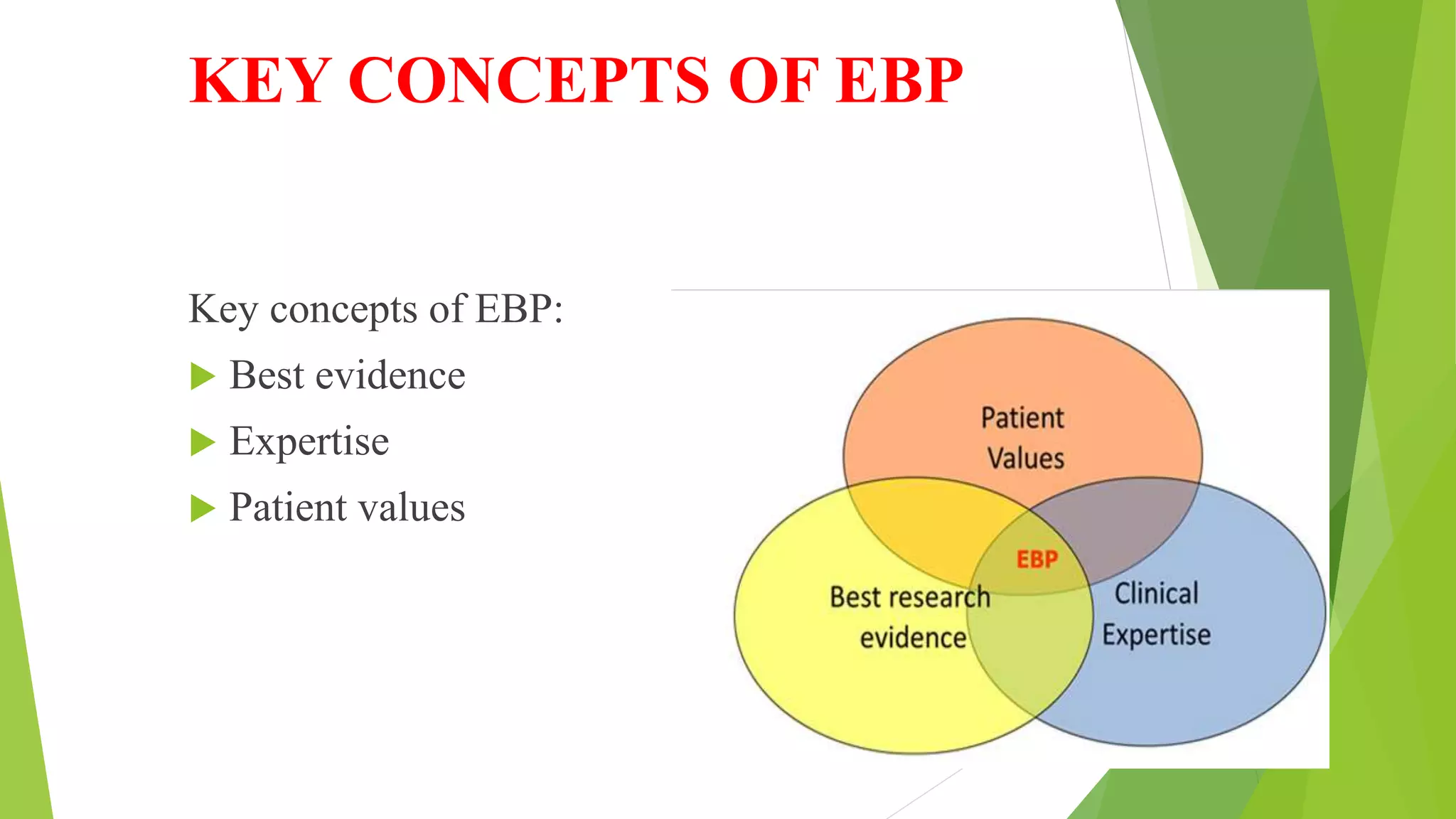
KEY CONCEPTS OF EBP
Key concepts of EBP:
 Best evidence
 Expertise
 Patient values
AIM
The aim of EBP is that the best available evidence, moderated by
patient circumstances and preferences, is applied to improve the
quality of clinical judgements and facilitate cost effective care.
AIM
Others:
To provide the high quality and most efficient nursing care possible.
To advance of care provided by health worker.
To increase satisfaction among parents.
It results in better patient outcomes.
It keeps practice current and relevant.
It increase confidence in decision making.
NEED FOR EBP MODEL
 It helps the nurses to integrate credible evidence into practice.
 Assure complete implementation of EBP projects and optimize the use of nurse’s time and healthcare
resources.
 Helps to promote effective care decision making.
 Update knowledge and is essential for lifelong leaning.
STEPS IN EBP PROCESS
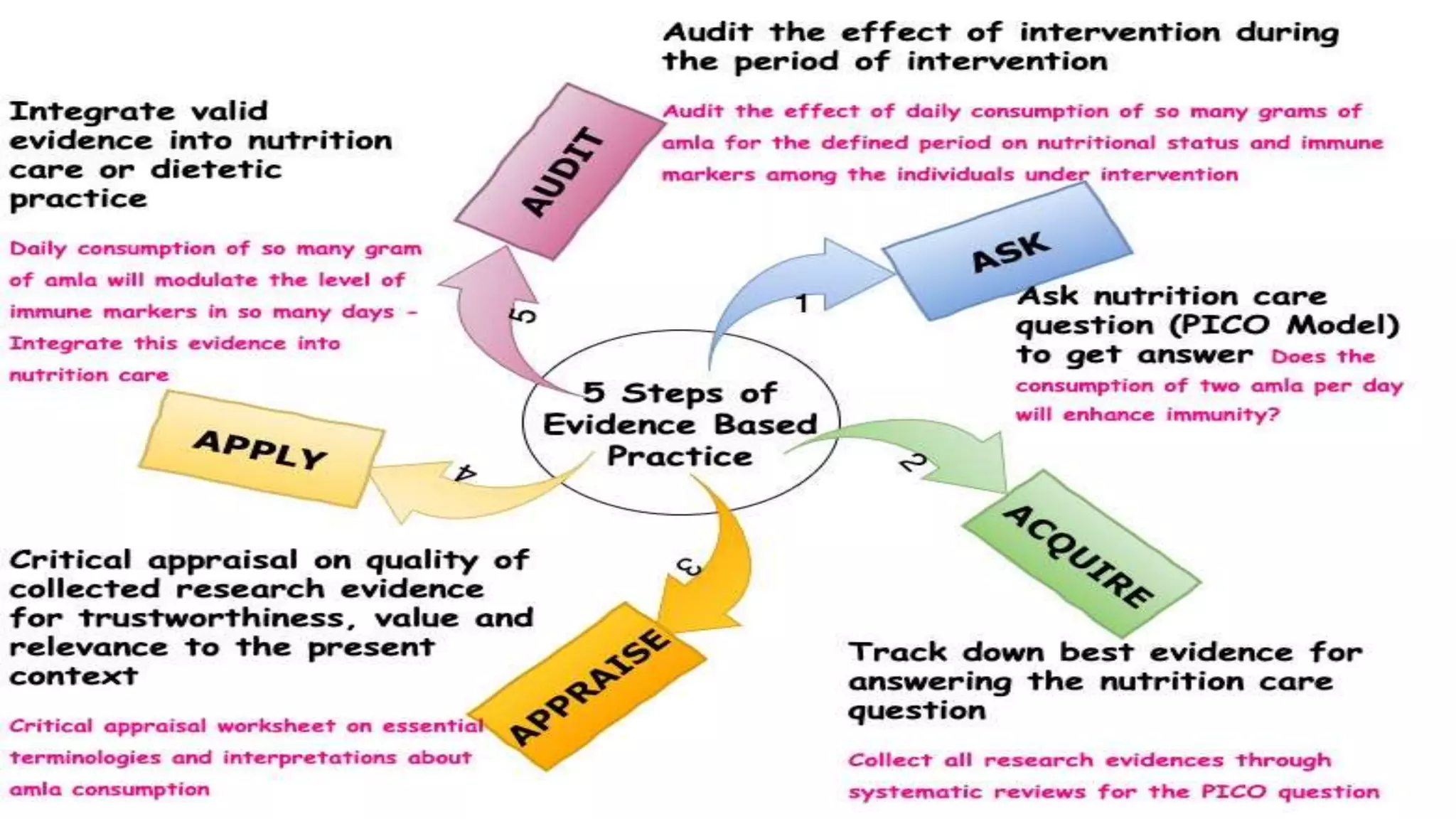
The practice of evidence based practice includes five fundamental steps:
1. ASK: Formulate an answerable clinical question.
2. ACCESS: Track down the best evidence.
3. APPRAISE: Appraise the evidence for its validity and usefulness.
4. APPLY: Integrate the results with your clinical expertise and your patient value/local conditions.
5. ASSESS: Evaluate the effectiveness of the process.
STEPS IN EBP PROCESS
There is a acronym for remembering the steps of EBP:
P- Patient or problem
I- Interventions
C- Comparison of interventions
O- Outcomes
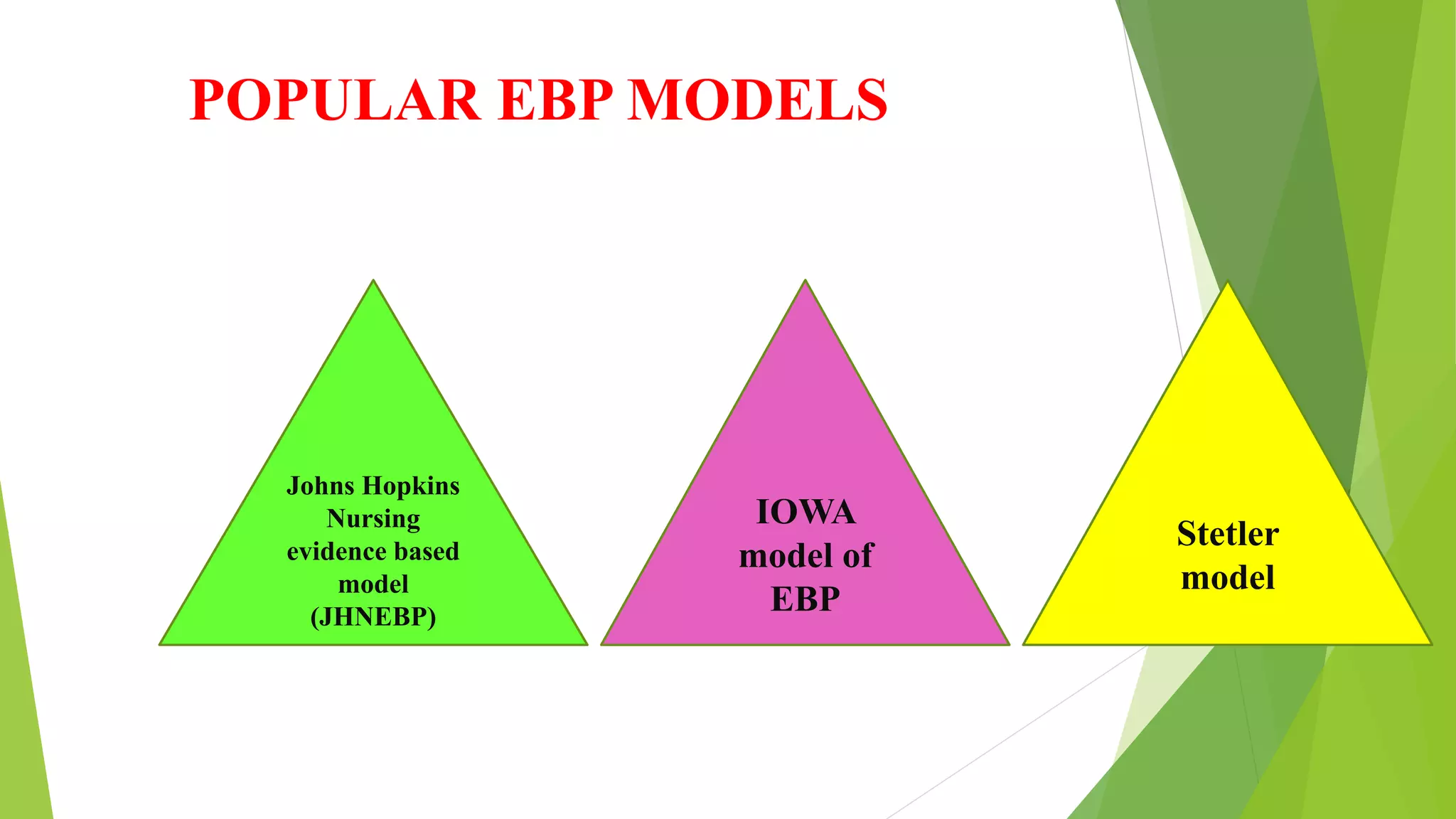
POPULAR EBP MODELS
Johns Hopkins
Nursing
evidence based
model
(JHNEBP)
IOWA
model of
EBP
Stetler
model
JOHN’S HOPKINS EBP
MODEL
INTRODUCTION
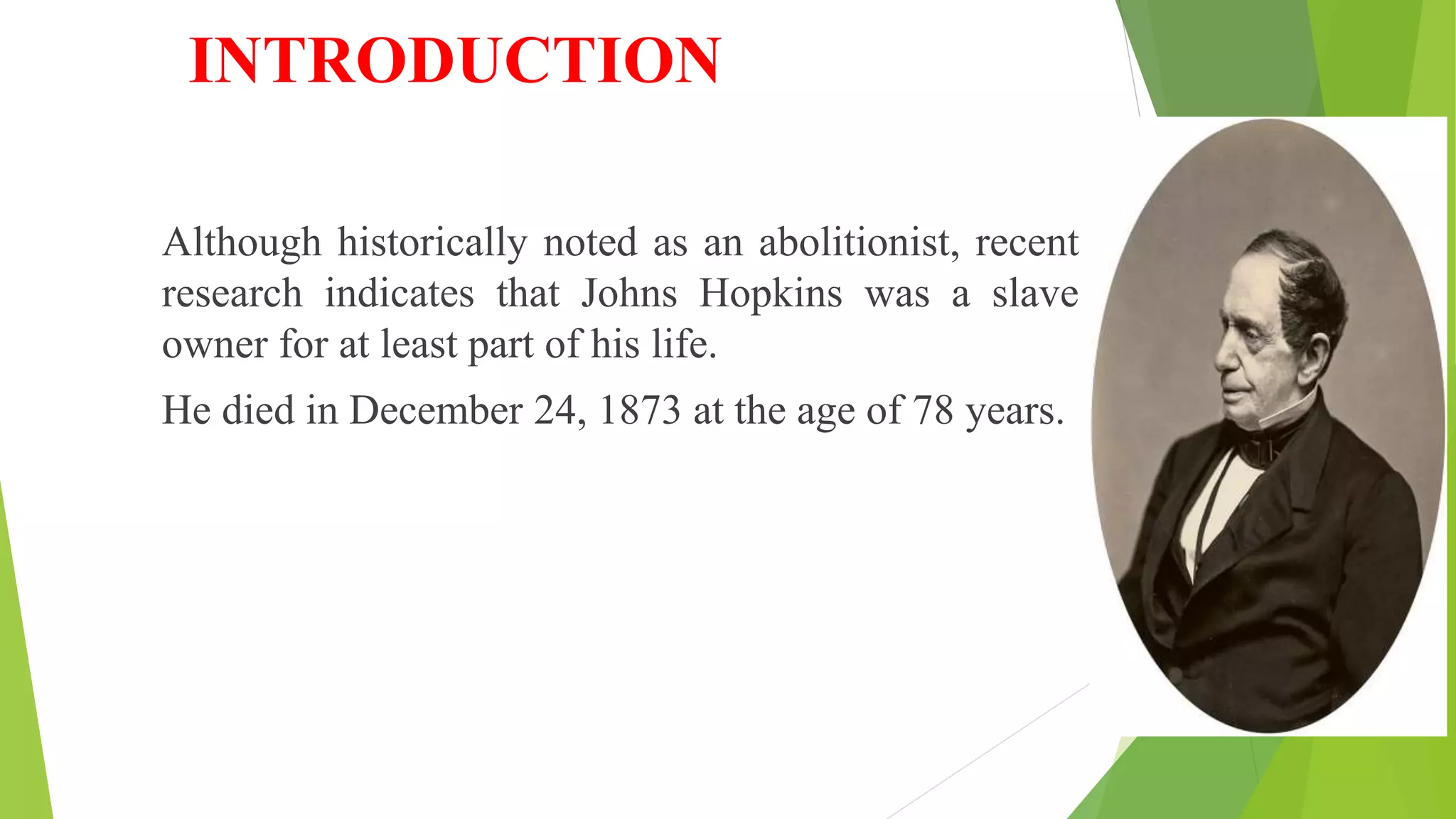
Johns Hopkins (May 19, 1795 – December 24, 1873) was an American
entrepreneur, investor, and philanthropist of Baltimore, Maryland. His
bequests founded numerous institutions bearing his name, most
notably Johns Hopkins Hospital, and Johns Hopkins
University (including its academic divisions such as Johns Hopkins
School of Nursing, Johns Hopkins School of Medicine, Johns
Hopkins Carey Business School, Johns Hopkins Bloomberg School of
Public Health, and Johns Hopkins School of Advanced International
Studies).
INTRODUCTION
Although historically noted as an abolitionist, recent
research indicates that Johns Hopkins was a slave
owner for at least part of his life.
He died in December 24, 1873 at the age of 78 years.
JOHNS HOPKINS EBP MODEL
The JNEBP model is a problem solving approach to clinical decision
making. Developed to accelerate research into nursing practice and
promote nursing autonomy, leadership and engagement with
colleagues.
It combines the nursing process, the ANA standards of practice,
critical thinking and research utilization. Used as a framework to
guide the synthesis and translation of evidence into practice.
PHASES OF JHNEBP
There are three phases to the JHNEBP model:
1. The identification of an answerable question.
2. A systematic review and synthesis of both research and non-
research evidence.
3. Translation includes implementation of the practice change as a
pilot study, measurement of outcomes and dissemination of
findings.
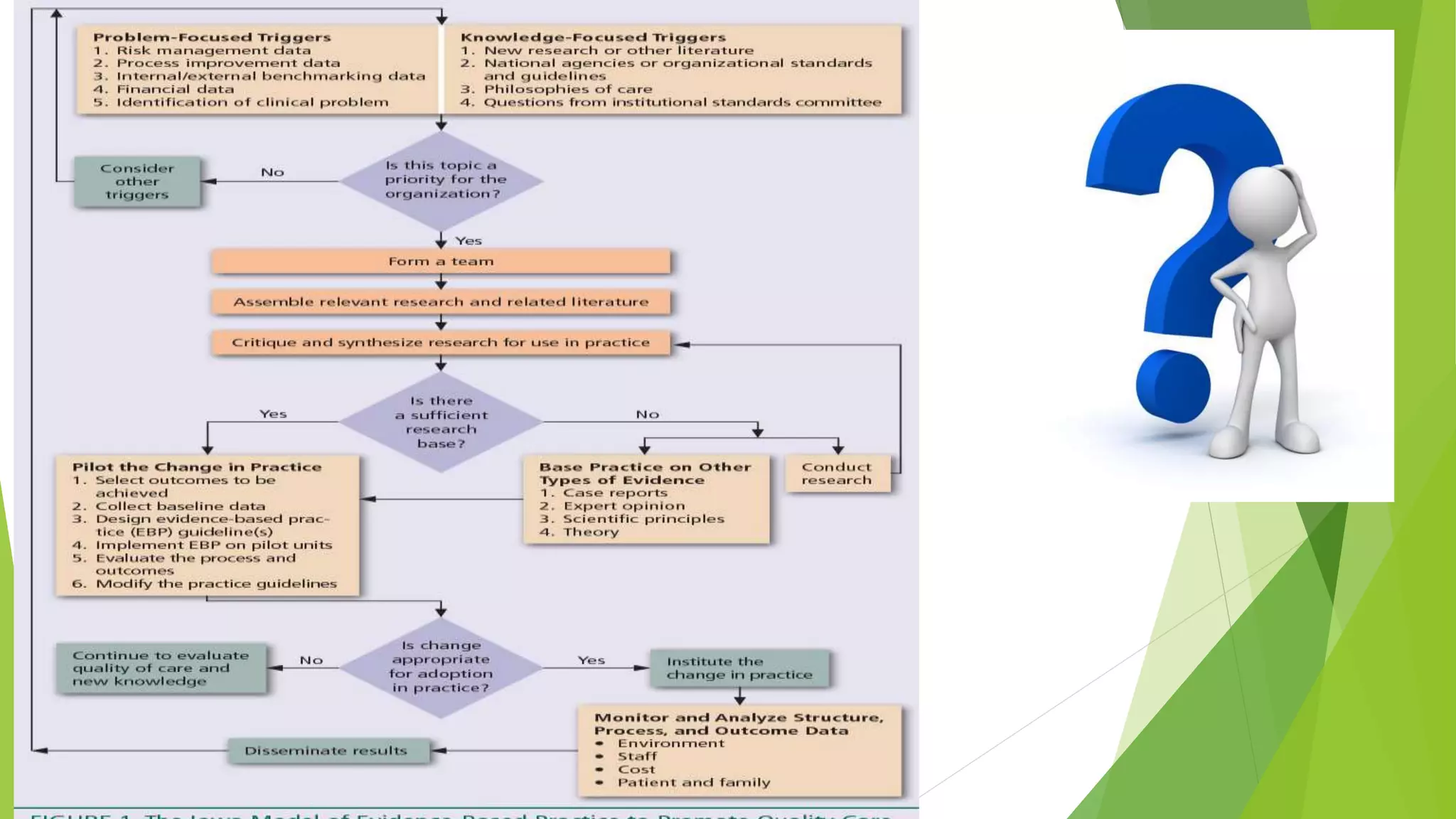
IOWA MODEL
This model is given by Marita G in 1990s at University of IOWA
hospitals and clinics to serve as a guide for nurses to use research
findings to help improve patient care. The IOWA model is widely
used framework for the implementation of evidence based practice
(EBP). It is a systematic multi-step process used capturing
information from the literature and user feedback via an electronic
survey and live work groups.
STETLER MODEL
The Stetler model of research utilization helps practitioners assess how research findings and other relevant
evidence can be applied in practice. This model examines how to use evidence to create formal change
within organizations, as well how individual practitioners can use research on an informal basis as part of
critical thinking and reflective practice.
The model links research use, as a first step, with evidence-informed practice. The Stetler model provides a
way to think about the relationship between research use and evidence-informed practice. These two
concepts are not the same. Integrating both concepts enhances the overall application of research.
STETLER MODEL
The Stetler model of evidence-based practice outlines criteria to
determine the desirability and feasibility of applying a study or
studies to address an issue. These criteria are:
• Substantiating evidence
• Current practice (relates to the extent of need for change)
• Fit of the substantiated evidence for the user group and settings
• Feasibility of implementing the research findings (risk/benefit
assessment, availability of resources, stakeholder readiness).
BARRIERS TO EBP
•Lack of administrative support
•Lack of knowledge
•Lack of time for research
•Difficulty in bringing change
•Many nurses have not receive any formal instruction in research and
they lack still to judge the merits of study
•Organization have failed to motivate or rewards
•There is shortage of nurse role model who can be evaluated for their
success in using or promoting the use of research in clinical practice.
ADVANTAGES OF EBP
•Information explores
•Provide better patient outcome
•Increase the efficiency of nurses
•Making decision based on knowledge
•It keeps nursing practice current to the new trends and updated
guidelines of care.
DISADVANTAGES OF EBP
•Not enough evidence for evidence based practice
•Time consuming
•Reduced client choice
•Reduce professional judgement/autonomy
•Suppress creativity
•Publication bias
CONCLUSION
Evidence based nursing care is lifelong approach to clinical decision
making and excellence in practice. Evidence based nursing care is
informed by research findings, clinical expertise, and patient’s
values and its use can improve patient’s outcomes. Use of research
evidence in clinical practice is an expected standard of practice for
nurses and health care organizations, but numerous barriers exist that
create a gap between new knowledge and implementation of that
knowledge to improve care. Using the levels of evidence, nurses can
determine the strength of research studies, assess the findings and
evaluate the evidence for potential implementation into best practice.
Evidence Based Practice

Evidence Based Practice

  • 1.
    M.M. COLLEGE OFNURSING EVIDENCE BASED APPROACH Presented By: Vipin Goyal B.Sc. Nursing 4th Year
  • 2.
    OUTLINE Evidence, evidence basedpractice and evidence based practice nursing Aim Need Steps Models of EBP Barriers Advantages Disadvantages
  • 3.
    INTRODUCTION During the 1980s,the term “evidence based medicine” emerged to describe the approach that used scientific evidence to determine the best practice. Later the term shifted to become “evidence based practice” as clinicians other than physicians recognized the importance of scientific evidence in clinical decision making. Evidence Based Practice (EBP), alternatively known as “Empirically Supported Treatment (EST)” is the preferential use of mental and behavioural health interventions for which systematic empirical research has provided evidence of statistically significant effectiveness as treatments for specific problems.
  • 4.
    DEFINITION EVIDENCE: Evidence is somethingthat furnishes proof or legally submitted to ascertain in the truth of matter. EVIDENCED BASED PRACTICE: It is systemic interconnecting of scientifically generated evidence with the tacit knowledge of the expert practitioner to achieve a change in a particular practice for the benefit of a well defined client/ patient group. (French,1999)
  • 5.
    DEFINITION EVIDENCE BASED NURSING: Itis a process by which nurses make clinical decisions using the best available research evidence, their clinical expertise and patient preferences. EVIDENCE BASED NURSING PRACTICE: EBP is defined as “the conscientious, explicit and judicious use of the current best evidence in making decisions about the care of individual patients.”
  • 6.
    KEY CONCEPTS OFEBP Key concepts of EBP:  Best evidence  Expertise  Patient values
  • 7.
    AIM The aim ofEBP is that the best available evidence, moderated by patient circumstances and preferences, is applied to improve the quality of clinical judgements and facilitate cost effective care.
  • 8.
    AIM Others: To provide thehigh quality and most efficient nursing care possible. To advance of care provided by health worker. To increase satisfaction among parents. It results in better patient outcomes. It keeps practice current and relevant. It increase confidence in decision making.
  • 9.
    NEED FOR EBPMODEL  It helps the nurses to integrate credible evidence into practice.  Assure complete implementation of EBP projects and optimize the use of nurse’s time and healthcare resources.  Helps to promote effective care decision making.  Update knowledge and is essential for lifelong leaning.
  • 10.
    STEPS IN EBPPROCESS The practice of evidence based practice includes five fundamental steps: 1. ASK: Formulate an answerable clinical question. 2. ACCESS: Track down the best evidence. 3. APPRAISE: Appraise the evidence for its validity and usefulness. 4. APPLY: Integrate the results with your clinical expertise and your patient value/local conditions. 5. ASSESS: Evaluate the effectiveness of the process.
  • 11.
    STEPS IN EBPPROCESS There is a acronym for remembering the steps of EBP: P- Patient or problem I- Interventions C- Comparison of interventions O- Outcomes
  • 13.
    POPULAR EBP MODELS JohnsHopkins Nursing evidence based model (JHNEBP) IOWA model of EBP Stetler model
  • 14.
  • 15.
    INTRODUCTION Johns Hopkins (May19, 1795 – December 24, 1873) was an American entrepreneur, investor, and philanthropist of Baltimore, Maryland. His bequests founded numerous institutions bearing his name, most notably Johns Hopkins Hospital, and Johns Hopkins University (including its academic divisions such as Johns Hopkins School of Nursing, Johns Hopkins School of Medicine, Johns Hopkins Carey Business School, Johns Hopkins Bloomberg School of Public Health, and Johns Hopkins School of Advanced International Studies).
  • 16.
    INTRODUCTION Although historically notedas an abolitionist, recent research indicates that Johns Hopkins was a slave owner for at least part of his life. He died in December 24, 1873 at the age of 78 years.
  • 17.
    JOHNS HOPKINS EBPMODEL The JNEBP model is a problem solving approach to clinical decision making. Developed to accelerate research into nursing practice and promote nursing autonomy, leadership and engagement with colleagues. It combines the nursing process, the ANA standards of practice, critical thinking and research utilization. Used as a framework to guide the synthesis and translation of evidence into practice.
  • 18.
    PHASES OF JHNEBP Thereare three phases to the JHNEBP model: 1. The identification of an answerable question. 2. A systematic review and synthesis of both research and non- research evidence. 3. Translation includes implementation of the practice change as a pilot study, measurement of outcomes and dissemination of findings.
  • 20.
    IOWA MODEL This modelis given by Marita G in 1990s at University of IOWA hospitals and clinics to serve as a guide for nurses to use research findings to help improve patient care. The IOWA model is widely used framework for the implementation of evidence based practice (EBP). It is a systematic multi-step process used capturing information from the literature and user feedback via an electronic survey and live work groups.
  • 22.
    STETLER MODEL The Stetlermodel of research utilization helps practitioners assess how research findings and other relevant evidence can be applied in practice. This model examines how to use evidence to create formal change within organizations, as well how individual practitioners can use research on an informal basis as part of critical thinking and reflective practice. The model links research use, as a first step, with evidence-informed practice. The Stetler model provides a way to think about the relationship between research use and evidence-informed practice. These two concepts are not the same. Integrating both concepts enhances the overall application of research.
  • 23.
    STETLER MODEL The Stetlermodel of evidence-based practice outlines criteria to determine the desirability and feasibility of applying a study or studies to address an issue. These criteria are: • Substantiating evidence • Current practice (relates to the extent of need for change) • Fit of the substantiated evidence for the user group and settings • Feasibility of implementing the research findings (risk/benefit assessment, availability of resources, stakeholder readiness).
  • 25.
    BARRIERS TO EBP •Lackof administrative support •Lack of knowledge •Lack of time for research •Difficulty in bringing change •Many nurses have not receive any formal instruction in research and they lack still to judge the merits of study •Organization have failed to motivate or rewards •There is shortage of nurse role model who can be evaluated for their success in using or promoting the use of research in clinical practice.
  • 26.
    ADVANTAGES OF EBP •Informationexplores •Provide better patient outcome •Increase the efficiency of nurses •Making decision based on knowledge •It keeps nursing practice current to the new trends and updated guidelines of care.
  • 27.
    DISADVANTAGES OF EBP •Notenough evidence for evidence based practice •Time consuming •Reduced client choice •Reduce professional judgement/autonomy •Suppress creativity •Publication bias
  • 28.
    CONCLUSION Evidence based nursingcare is lifelong approach to clinical decision making and excellence in practice. Evidence based nursing care is informed by research findings, clinical expertise, and patient’s values and its use can improve patient’s outcomes. Use of research evidence in clinical practice is an expected standard of practice for nurses and health care organizations, but numerous barriers exist that create a gap between new knowledge and implementation of that knowledge to improve care. Using the levels of evidence, nurses can determine the strength of research studies, assess the findings and evaluate the evidence for potential implementation into best practice.