Subject : Theoretical Foundation of Nursing
Topic – Model of Evidence Based Practice
 Stetler Model of Evidence Based Practice
 Integration of Stetler Model with the following article:
A Quality improvement intervention to address provider behaviour
as it relates to utilisation of CA-MRSA guidelines(Roseann P Velez, Kathleen
Lent Becker, Patricia Davidson and Elizabeth Sloand)
Faculty
Md. Abdul Latif (RN)
MSc (Nursing Admin), PSU, Thailand
PhD (Nursing), PSU, Thailand
Faculty of Nursing Management
NIANER
SL.NO NAME ID
1 Aklima Akter MSN 190501
2 Sageda Akter MSN 190502
3 Rabya Akter Monni MSN 190503
4 Farhana Armin MSN 190504
5 Sabein Islam MSN 190505
6 Most.Rozina Begom MSN 190506
7 Baby Kirttania MSN 190507
8 Morzina Akter MSN 190508
 Number of EBP models have been developed
by nurses encourage translation of nursing
research into practice. There are five models
of EBP includes:
 Academic center for EBP star model
 Advancing Research and clinical pratice
through close collabaration.
 Iowa model
 Jhons Hopkins nursing EBP model
 Stetler model of EBP
Purpose of evidence based practice model:
 To translate research findings into practice.
 To provide framework for understanding the
evidence based practice process.
STETLER MODEL
This is a model of research utilization to facilitate
evidence-based practice (EBP).
 Developed as ‘practitioner oriented’ model in
1994
 Revised in 2001 without a change in its focus on
critical thinking.
 Deemphasized unsystematic clinical
experiences.
 Raised awareness about the importance of
applying research findings in nursing practice.
 The model formulated a series of critical-
thinking and decision-making steps designed
to facilitate safe and effective use of research
findings.
 The Stetler model of evidence-based
practice would help individual public health
practitioners to use evidence in
daily practice to inform program planning and
implementation.
 For example, this model is a useful guide to
using research evidence in developing health
messages for breastfeeding.
MEANING OF ‘EVIDENCE’ AS PER STETLER
MODEL
 ‘Evidence’ is defined as information or facts
that are obtained systematically.
 ‘Evidence’ comes from two different
sources- external and internal evidence
 External evidence: Derived from opinions of
experts.
 Internal evidence: It comes from
systematically obtained facts or information
 This model consists of five phases (Stetler,
2001, p. 276):
 Phase I: Preparation
 Phase II: Validation
 Phase III: Comparative Evaluation/Decision
Making
 Phase IV: Translation/Application
 Phase V: Evaluation
1.Preparation:
 Identify a priority need.
 Review the content in which research
utilization would occur.
 Organize the work.
 Initiate the research systematically.
2.Validation:
• Critique each study systematically.
• Choose and summarize the collected
research that relates to the identified need.
3.Decision making: Make decisions about use
after synthesizing body of summarized
evidence.
4.Translation: Converting findings, planning
their application, putting the plan to use and
then implementing use with an evidence
based practice.
5. Evaluation: Evaluate the plan in terms of
goals.
 Both formal and informal use of research
findings can occur in the practice setting.
 Individual, research utilization competent
practitioners also can use the model’s process
and interaction with others.
 Skills are required for effective use of findings
 Research findings may be used in multiple ways
 Contextual and personal factors can influence
research evidence
 The data provides probabilistic information
about individuals for whom the evidence is
generally believed to fit
 A Quality improvement intervention to address
provider behaviour as it relates to utilisation of CA-
MRSA guidelines(Roseann P Velez, Kathleen Lent Becker, Patricia Davidson
and Elizabeth Sloand)
In this article stetler model is used for raised
awareness about the importance of applying
research findings in nursing practice.
 In this article authors used stetler model
to implement an evidence-based clinical
practice guideline (CPG) in order to minimize
the inappropriate using of antimicrobial agent
prescribing.
 Their goal was to evaluate the impact of a
provider focused quality improvement
educational intervention on appropriate
prescribing for community associated
methicillin-resistant Staphylococcus aureus
infection.
 A quality improvement intervention to address
provider behaviour as it relates to utilisation of
CA-MRSA guidelines.
Here PICOT stands for-
P =Patient,Population(18 medical doctor,
physician assistant and nurse practitioner
providers)/Problem( increase CA-MRSA infection)
 I = Intervention or prognostic factors being
considered/ area of interest(The need to
influence prescribers’ treatment of community
acquired methicillin-resistant Staphylococcus
aureus (CA-MRSA) infection through education.
 C= Comparison(Evaluation revealed treatment of
CA-MRSA by prescribers as inconsistent with
clinical guidelines.
 O = 12 of the 18 (67%) participants showed an
increase in knowledge. Forty three per cent of
prescribers’ charts demonstrated improved
practice through use of the guidelines. Out of 18
prescribers, 44% sent a total of 21 cultures for
abscesses. There was no difference in practice
behaviours between professional groups.
 The Stetler (2001) was used to guide the
development of the intervention.
 The Stetler Research Utilization model
provided a conceptual framework for
integrating evidence based practice findings
using phases of preparation, validation,
comparative evaluation/decision-making,
translation/application, and evaluation.
Preparation phase:
1. Identify priority: The need to influence prescribers’
treatment of community acquired methicillin-resistant
Staphylococcus aureus (CA-MRSA) infection through
education
2. Identify problem:
a. CA-MRSA infection increasing
b. Evidence validating prescribers’ treatment
contributes to CA-MRSA resistance
c. Inconsistent use of clinical guidelines by
prescribers
d. Factors influencing prescribers’ treatment
of CA-MRSA infection
3. Project purpose: Confirmed
Validation phase:
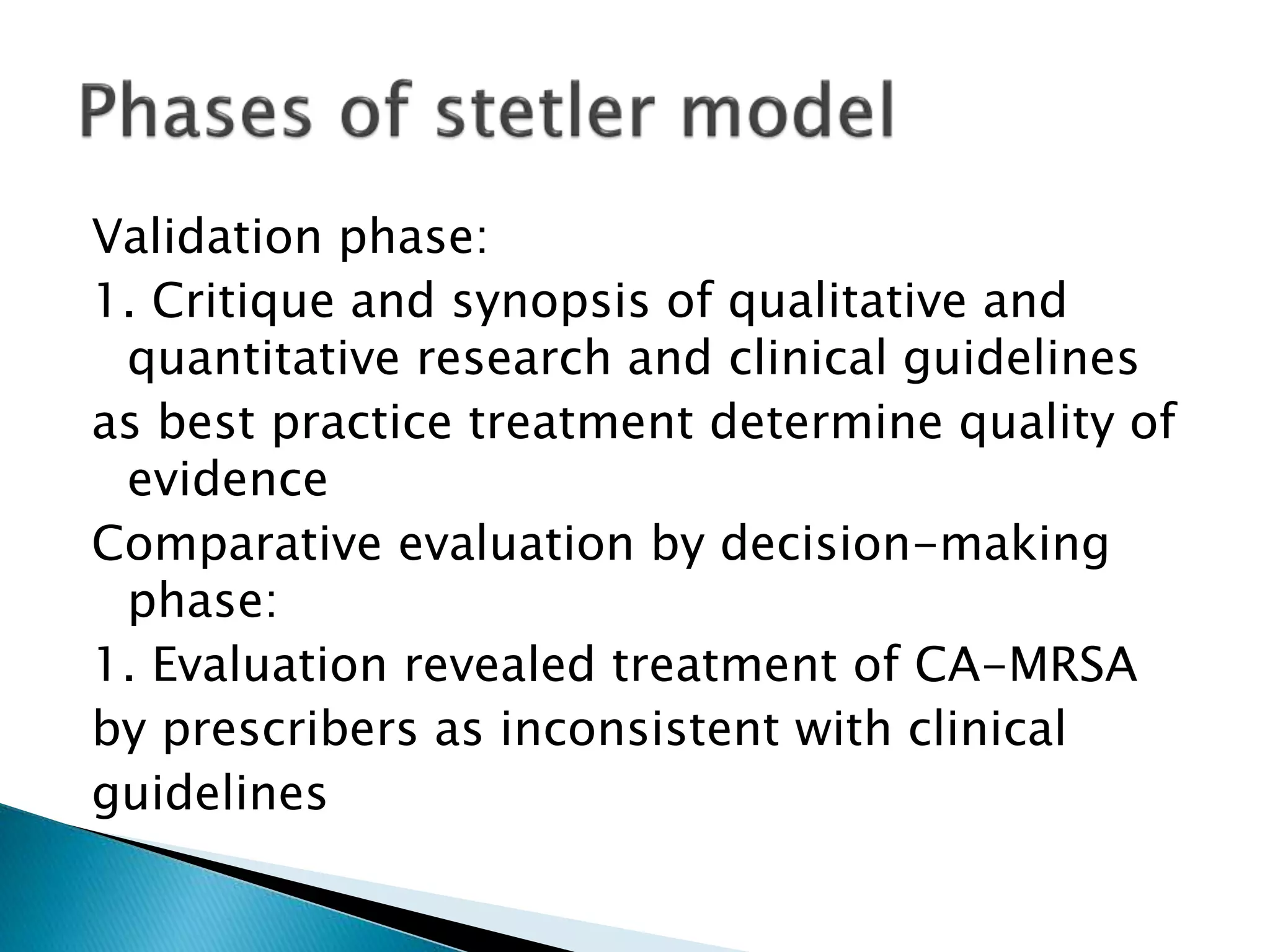
1. Critique and synopsis of qualitative and
quantitative research and clinical guidelines
as best practice treatment determine quality of
evidence
Comparative evaluation by decision-making
phase:
1. Evaluation revealed treatment of CA-MRSA
by prescribers as inconsistent with clinical
guidelines
Translation and application:
1. Project steps planned to reflect the project
guiding inquiry
2. Operational details planned to explain use
of guidelines as best practice treatment for
prescribers rather than current practice
treatment
3. Operational details planned to measure the
influence of education and prescribers’
adherence to clinical guidelines as outcomes
4. Project implementation as per plan
 Evaluation
1. Outcome of education measured by test
scores
2. Outcome of prescriber adherence to clinical
guidelines measured by chart audit
3. Report and dissemination of findings
 According to Abbo et al. 2012.
Studies estimate that up to 30–50% of all
antimicrobial use is inappropriate despite
clinical guideline recommendations, and
multiple studies from various parts of the
world demonstrate the association between
antimicrobial use and resistance at the
community level.
 Public commitment intervention, a new ,low-
cost approach to decrease antibiotic
prescribing, was studied by Meeker et al.
(2014) at the University of Southern
California.
(Reference:Meeker D, Knight T, Friedberg M,
Linder J, Goldstein N, Fox C, Rothfeld D, Diaz
G & Doctor J (2014) Nudging guideline-
concordant antibiotic prescribing.)
 Prescribers globally can implement public
commitment intervention as an effective, low-cost
tool to address AR.
 The evolution of providers’ prescribing habits is such
that the pressure on providers to prescribe antibiotics
is a daily part of clinical practice.
 Influencing prescribing through provider commitment
to best practice can reduce infection and AR and
significantly improve health and economic outcomes.
Reference: Charani E, Edwards R, Sevdalis N, Lexandrou
B, Sibley E, Mullett D & Holmes A (2011) Behavior
change strategies to influence antimicrobial
prescribing in acute care: a systematic review. Clinical
Infectious Diseases 53, 651–662.
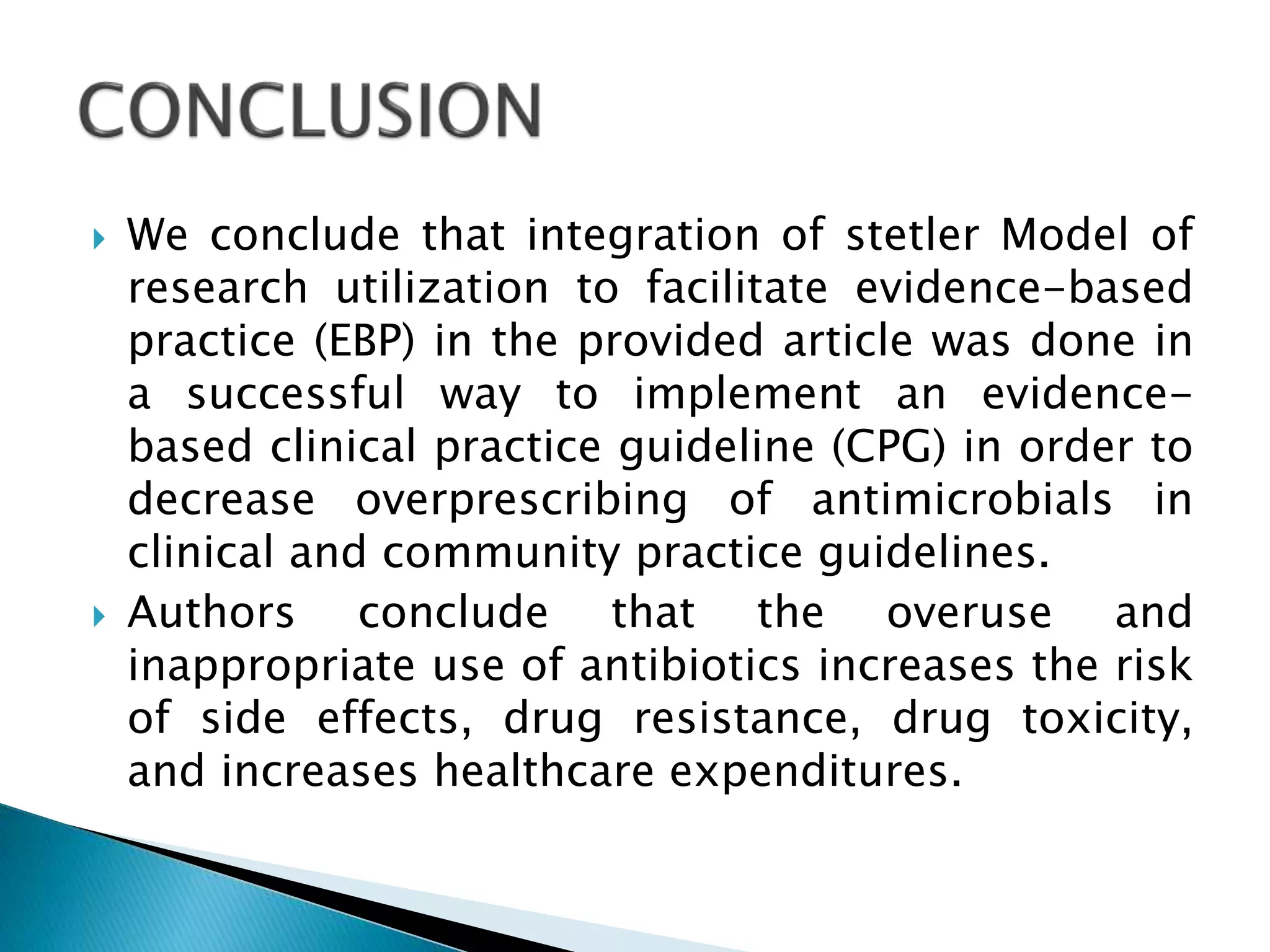
 We conclude that integration of stetler Model of
research utilization to facilitate evidence-based
practice (EBP) in the provided article was done in
a successful way to implement an evidence-
based clinical practice guideline (CPG) in order to
decrease overprescribing of antimicrobials in
clinical and community practice guidelines.
 Authors conclude that the overuse and
inappropriate use of antibiotics increases the risk
of side effects, drug resistance, drug toxicity,
and increases healthcare expenditures.
 Authors also conclude that Community acquired
methicillin resistant Staphylococcus aureus is a
global health threat directly related to
overprescribing of antimicrobials.
 Authors recommended that Public commitment
intervention, a new, low-cost approach to decrease
antibiotic prescribing.
 Prescribers globally can implement public
commitment intervention as an effective, low-cost
tool to address Antibiotic Resistance.
 By practicing public commitment intervention 26
million unnecessary antibiotic prescriptions can be
eliminated, saving $704 million annually on drug
costs (Meeker et al.2014) in united states.
Stetler model ppt latif sir (2)

Stetler model ppt latif sir (2)

  • 1.
    Subject : TheoreticalFoundation of Nursing Topic – Model of Evidence Based Practice  Stetler Model of Evidence Based Practice  Integration of Stetler Model with the following article: A Quality improvement intervention to address provider behaviour as it relates to utilisation of CA-MRSA guidelines(Roseann P Velez, Kathleen Lent Becker, Patricia Davidson and Elizabeth Sloand) Faculty Md. Abdul Latif (RN) MSc (Nursing Admin), PSU, Thailand PhD (Nursing), PSU, Thailand Faculty of Nursing Management NIANER
  • 2.
    SL.NO NAME ID 1Aklima Akter MSN 190501 2 Sageda Akter MSN 190502 3 Rabya Akter Monni MSN 190503 4 Farhana Armin MSN 190504 5 Sabein Islam MSN 190505 6 Most.Rozina Begom MSN 190506 7 Baby Kirttania MSN 190507 8 Morzina Akter MSN 190508
  • 3.
     Number ofEBP models have been developed by nurses encourage translation of nursing research into practice. There are five models of EBP includes:  Academic center for EBP star model  Advancing Research and clinical pratice through close collabaration.  Iowa model  Jhons Hopkins nursing EBP model  Stetler model of EBP
  • 4.
    Purpose of evidencebased practice model:  To translate research findings into practice.  To provide framework for understanding the evidence based practice process.
  • 5.
    STETLER MODEL This isa model of research utilization to facilitate evidence-based practice (EBP).  Developed as ‘practitioner oriented’ model in 1994  Revised in 2001 without a change in its focus on critical thinking.  Deemphasized unsystematic clinical experiences.  Raised awareness about the importance of applying research findings in nursing practice.
  • 6.
     The modelformulated a series of critical- thinking and decision-making steps designed to facilitate safe and effective use of research findings.  The Stetler model of evidence-based practice would help individual public health practitioners to use evidence in daily practice to inform program planning and implementation.  For example, this model is a useful guide to using research evidence in developing health messages for breastfeeding.
  • 7.
    MEANING OF ‘EVIDENCE’AS PER STETLER MODEL  ‘Evidence’ is defined as information or facts that are obtained systematically.  ‘Evidence’ comes from two different sources- external and internal evidence  External evidence: Derived from opinions of experts.  Internal evidence: It comes from systematically obtained facts or information
  • 8.
     This modelconsists of five phases (Stetler, 2001, p. 276):  Phase I: Preparation  Phase II: Validation  Phase III: Comparative Evaluation/Decision Making  Phase IV: Translation/Application  Phase V: Evaluation
  • 9.
    1.Preparation:  Identify apriority need.  Review the content in which research utilization would occur.  Organize the work.  Initiate the research systematically.
  • 10.
    2.Validation: • Critique eachstudy systematically. • Choose and summarize the collected research that relates to the identified need. 3.Decision making: Make decisions about use after synthesizing body of summarized evidence.
  • 11.
    4.Translation: Converting findings,planning their application, putting the plan to use and then implementing use with an evidence based practice. 5. Evaluation: Evaluate the plan in terms of goals.
  • 12.
     Both formaland informal use of research findings can occur in the practice setting.  Individual, research utilization competent practitioners also can use the model’s process and interaction with others.  Skills are required for effective use of findings  Research findings may be used in multiple ways  Contextual and personal factors can influence research evidence  The data provides probabilistic information about individuals for whom the evidence is generally believed to fit
  • 13.
     A Qualityimprovement intervention to address provider behaviour as it relates to utilisation of CA- MRSA guidelines(Roseann P Velez, Kathleen Lent Becker, Patricia Davidson and Elizabeth Sloand) In this article stetler model is used for raised awareness about the importance of applying research findings in nursing practice.
  • 14.
     In thisarticle authors used stetler model to implement an evidence-based clinical practice guideline (CPG) in order to minimize the inappropriate using of antimicrobial agent prescribing.  Their goal was to evaluate the impact of a provider focused quality improvement educational intervention on appropriate prescribing for community associated methicillin-resistant Staphylococcus aureus infection.
  • 15.
     A qualityimprovement intervention to address provider behaviour as it relates to utilisation of CA-MRSA guidelines. Here PICOT stands for- P =Patient,Population(18 medical doctor, physician assistant and nurse practitioner providers)/Problem( increase CA-MRSA infection)  I = Intervention or prognostic factors being considered/ area of interest(The need to influence prescribers’ treatment of community acquired methicillin-resistant Staphylococcus aureus (CA-MRSA) infection through education.
  • 16.
     C= Comparison(Evaluationrevealed treatment of CA-MRSA by prescribers as inconsistent with clinical guidelines.  O = 12 of the 18 (67%) participants showed an increase in knowledge. Forty three per cent of prescribers’ charts demonstrated improved practice through use of the guidelines. Out of 18 prescribers, 44% sent a total of 21 cultures for abscesses. There was no difference in practice behaviours between professional groups.
  • 17.
     The Stetler(2001) was used to guide the development of the intervention.  The Stetler Research Utilization model provided a conceptual framework for integrating evidence based practice findings using phases of preparation, validation, comparative evaluation/decision-making, translation/application, and evaluation.
  • 18.
    Preparation phase: 1. Identifypriority: The need to influence prescribers’ treatment of community acquired methicillin-resistant Staphylococcus aureus (CA-MRSA) infection through education 2. Identify problem: a. CA-MRSA infection increasing b. Evidence validating prescribers’ treatment contributes to CA-MRSA resistance c. Inconsistent use of clinical guidelines by prescribers d. Factors influencing prescribers’ treatment of CA-MRSA infection 3. Project purpose: Confirmed
  • 19.
    Validation phase: 1. Critiqueand synopsis of qualitative and quantitative research and clinical guidelines as best practice treatment determine quality of evidence Comparative evaluation by decision-making phase: 1. Evaluation revealed treatment of CA-MRSA by prescribers as inconsistent with clinical guidelines
  • 20.
    Translation and application: 1.Project steps planned to reflect the project guiding inquiry 2. Operational details planned to explain use of guidelines as best practice treatment for prescribers rather than current practice treatment 3. Operational details planned to measure the influence of education and prescribers’ adherence to clinical guidelines as outcomes 4. Project implementation as per plan
  • 21.
     Evaluation 1. Outcomeof education measured by test scores 2. Outcome of prescriber adherence to clinical guidelines measured by chart audit 3. Report and dissemination of findings
  • 22.
     According toAbbo et al. 2012. Studies estimate that up to 30–50% of all antimicrobial use is inappropriate despite clinical guideline recommendations, and multiple studies from various parts of the world demonstrate the association between antimicrobial use and resistance at the community level.
  • 23.
     Public commitmentintervention, a new ,low- cost approach to decrease antibiotic prescribing, was studied by Meeker et al. (2014) at the University of Southern California. (Reference:Meeker D, Knight T, Friedberg M, Linder J, Goldstein N, Fox C, Rothfeld D, Diaz G & Doctor J (2014) Nudging guideline- concordant antibiotic prescribing.)
  • 24.
     Prescribers globallycan implement public commitment intervention as an effective, low-cost tool to address AR.  The evolution of providers’ prescribing habits is such that the pressure on providers to prescribe antibiotics is a daily part of clinical practice.  Influencing prescribing through provider commitment to best practice can reduce infection and AR and significantly improve health and economic outcomes. Reference: Charani E, Edwards R, Sevdalis N, Lexandrou B, Sibley E, Mullett D & Holmes A (2011) Behavior change strategies to influence antimicrobial prescribing in acute care: a systematic review. Clinical Infectious Diseases 53, 651–662.
  • 25.
     We concludethat integration of stetler Model of research utilization to facilitate evidence-based practice (EBP) in the provided article was done in a successful way to implement an evidence- based clinical practice guideline (CPG) in order to decrease overprescribing of antimicrobials in clinical and community practice guidelines.  Authors conclude that the overuse and inappropriate use of antibiotics increases the risk of side effects, drug resistance, drug toxicity, and increases healthcare expenditures.
  • 26.
     Authors alsoconclude that Community acquired methicillin resistant Staphylococcus aureus is a global health threat directly related to overprescribing of antimicrobials.  Authors recommended that Public commitment intervention, a new, low-cost approach to decrease antibiotic prescribing.  Prescribers globally can implement public commitment intervention as an effective, low-cost tool to address Antibiotic Resistance.  By practicing public commitment intervention 26 million unnecessary antibiotic prescriptions can be eliminated, saving $704 million annually on drug costs (Meeker et al.2014) in united states.