






QUALITY
ASSUREANCE
DEEPAK. K. V
M.ScNURSING
WAHE
TOPIC PRESENTATION ON
INTRODUCTION
DEFINITION OF QUALITY
“It is the degree to which health services for the
individual and populations increase the likelihood
of the desired health outcomes and are
consistent with current professional knowledge.”
-joint commission on accreditation of
health
organizations (2002)
“It is defined as the totality of features and
characteristics of a service that bears on its ability
to satisfy the stated and implied needs of the
patients.”
-international organization for
DEFINITION OF QUALITY
ASSURANCE
“It is an systematic, ongoing and continuous review,
analysis and evaluation of the level of compliance
with the standards set at local national and
international level.”
“It is an ongoing systematic comprehensive
evaluation of healthcare services and the impact
of those services on the health care services.”
-Kozier
“It is defined as all activities undertaken to predate
and prevent poor quality.”
-Neetvert (1992)
CONCEPT OF QUALITY IN HEALTH
CARE
Quality with respect to healthcare is defined as
“The quality of health activity is the complete
satisfaction of needs of those who are in most
need of health services, for the lowest
organizational costs, within the given limit and
guidelines of higher administrative bodies and
those paying.”
COMPONENTS OF QUALITY
HEALTH CARE
 High level of professionalism.
 Efficient use of resources
 Lowest possible risk for the patient.
 Patient satisfaction.
 A positive influence on patients state of health.
ROLE OF NURSE IN QUALITY OF
HEALTH CARE
 An active participation of interdisciplinary quality
improvement team.
 Develop mechanism to monitor the effectiveness
of nursing care.
 Contribute to innovation and improvements in
nursing care.
 Participate in patient safety.
 Participate in CNE and ISE.
 Participate in nursing research
ORGANISATIONS WHICH
DETERMINE QUALITY IN INDIA
 NATIONAL ACCERADITION BOARD FOR
HOSPITALS
 PATIENT SAFETY ALLIENCE
 NATIONAL HEALTH SYSTEM RESOURSE
CENTER
OBJECTIVES OF QUALITY
ASSURANCE
 Ensure quality nursing care.
 Increase the commitment of management and
provider.
 Improves and maintains patients state of
health.
 Maintains patients functional abilities.
 Develops patients psychological conditions.
 Refine existing methods for optimal quality
health care.
 Provide technical assistance in correcting
systemic deficiencies.
PRINCIPALS OF QUALITY
ASSURANCE
 Oriented towards meeting the needs and
expectations of the client.
 Focuses on system and process.
 Uses data to analyze service delivery.
 Encourage the use of teams in problem
solving and quality improvement.
 Effective communication for the improvement
of services.
CONCEPT OF QUALITY
ASSURANCE
 Is an dynamic process
 Is an guarantee to the society that services
provided are being regulated.
 It is an judgment concerning process of care.
 Monitoring the activity of client care to determine
the degree of excellence.
BENEFITS AND PURPOSES
 Improvement of internal quality care.
 Accountability of action
 Promotes achieving goals, strategic planning and
working according to the institutional values.
 Impact on systems
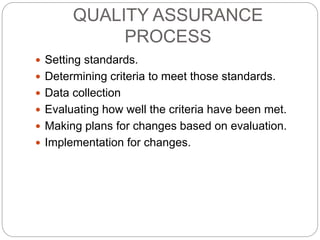
QUALITY ASSURANCE
PROCESS
 Setting standards.
 Determining criteria to meet those standards.
 Data collection
 Evaluating how well the criteria have been met.
 Making plans for changes based on evaluation.
 Implementation for changes.
APPROACHES FOR A QUALITY
ASSURANCE PROGRAM
Two major categories of approaches exist in quality
assurance
 General
 Specific
GENERAL APPROACH
This includes
 Credentialing
 Licensure
 Accreditation
 Certification
SPECIFIC APPROACH
 Peer review committee
 Audit process
 Utilization review: prospective, concurrent,
retrospective.
 Evaluation studies
EVALUATION STUDIES
Three major models
>Donabedian’s structure process outcome model: it
includes the following
1. Structural evaluation
2. Process evaluation
3. Outcome evaluation
>The tracer model: measures both process and
outcome of the care.
>Sentinel method: is an outcome method measure
the specific instance of client care.
EVALUATION STUDIES
 Client satisfaction
 Incident review
 Risk management
 Malpractice litigation
QUALITY IMPROVEMENT
PRINCIPLES AND CONDITIONS
 Continuous quality improvement.
 Knowledge of customer
expectations and needs.
 Process of costumer supplier
relation.
 Belief in people.
 Statistical analysis.
 Cost of poor quality.
MODELS OF QUALITY
ASSURANCE
PURPOSES OF QA MODELS
 Ensure quality nursing care
provided by nurses in order to
meet the expectations of
receiver, management and
regulatory body.
 Intend to increase the
commitment of the provider and
the management.
MODELS OF QUALITY
ASSURANCE
GOALS
 Develop confidence of the receiver
that quality care is being rendered as
per the assurance.
 Develop commitment of the
management towards the quality
care.
 Increase commitment of care
provider to adhere to set standards
for nursing practices and strive for
MODELS OF QA
 System model
 ANA quality assurance model
 JCAHO quality assurance model
 ISO quality assurance model
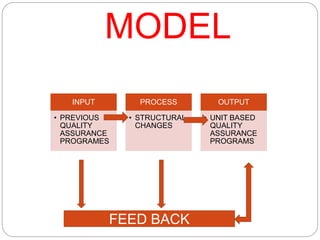
SYSTEM MODEL
 Implementation of the unit based quality
assurance program.
 Involves making changes in organizational
structures and individual roles.
 Method of facilitating and structuring the
change process.
 System approach in which the task is
broken down in to manageable
components based on the defined
objectives.
COMPONENTS OF SYSTEM
MODEL
1. INPUT: can be compared to the
present state of system.
2. THROUGH PUT: the developmental
process.
3. OUTPUT: to the finished product.
4. FEEDBACK: it is the essential
component of the system because it
maintains and nourish the growth.
MODEL
INPUT
• PREVIOUS
QUALITY
ASSURANCE
PROGRAMES
PROCESS
• STRUCTURAL
CHANGES
OUTPUT
• UNIT BASED
QUALITY
ASSURANCE
PROGRAMS
FEED BACK
ANA QUALITY ASSURANCE
MODEL
Developed in 1977 by ANA
Used as an guide to
implement the quality
assurance program.
The first step in the
developing of an QA program
is continuing education.
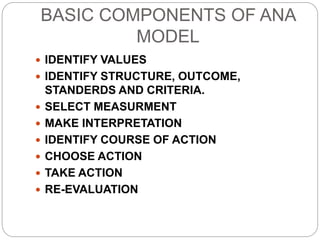
BASIC COMPONENTS OF ANA
MODEL
 IDENTIFY VALUES
 IDENTIFY STRUCTURE, OUTCOME,
STANDERDS AND CRITERIA.
 SELECT MEASURMENT
 MAKE INTERPRETATION
 IDENTIFY COURSE OF ACTION
 CHOOSE ACTION
 TAKE ACTION
 RE-EVALUATION
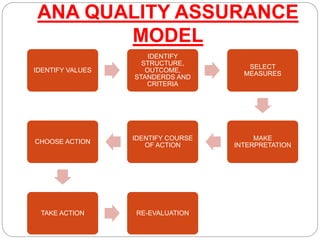
ANA QUALITY ASSURANCE
MODEL
IDENTIFY VALUES
IDENTIFY
STRUCTURE,
OUTCOME,
STANDERDS AND
CRITERIA
SELECT
MEASURES
MAKE
INTERPRETATION
IDENTIFY COURSE
OF ACTION
CHOOSE ACTION
TAKE ACTION RE-EVALUATION
ASSURANCE PROGRAME
MODEL
 Select or develop a structure that fits
with the organizational structure.
 Decide on the format that makes the
best use of resources and manpower.
 Keep format simple and streamlined.
 Use a constant model throughout the
division of the nursing.
SELECTING AN QUALITY
ASSURANCE PROGRAME MODEL
 In an skilled nursing facility, use an
consistency model throughout the
facility.
 It is a tool for assuring and improving
the quality of care.
 Used to monitor and evaluate the
quality and appropriateness of care.
 It is an ongoing process to examine
care to find potential problems and
opportunities for improvement.
FACTORS AFFECTING QUALITY
ASSURANCE IN NURSING
 lack of resources
 Personnel problems.
 Improper maintenance
 Unreasonable patients and
attendants
 Absence of accreditation law.
 Lack of incident review procedures
 Lack of a good hospital information
system.
 Absence of patient satisfaction
FACTORS AFFECTING QUALITY
ASSURANCE IN NURSING
 Lack of nursing care records.
 Lack of good supervision.
 Absence about knowledge about
philosophy of nursing care.
 Lack of policy and administrative manual.
 Standard education and training.
 Lack of evaluation technique.
 Lack of written job description and job
specifications.
 Lack of in-service and continuing
educational programs
CONCLUSIO
N

Topic presentation on quality assureance

  • 1.
  • 3.
  • 4.
    DEFINITION OF QUALITY “Itis the degree to which health services for the individual and populations increase the likelihood of the desired health outcomes and are consistent with current professional knowledge.” -joint commission on accreditation of health organizations (2002) “It is defined as the totality of features and characteristics of a service that bears on its ability to satisfy the stated and implied needs of the patients.” -international organization for
  • 5.
    DEFINITION OF QUALITY ASSURANCE “Itis an systematic, ongoing and continuous review, analysis and evaluation of the level of compliance with the standards set at local national and international level.” “It is an ongoing systematic comprehensive evaluation of healthcare services and the impact of those services on the health care services.” -Kozier “It is defined as all activities undertaken to predate and prevent poor quality.” -Neetvert (1992)
  • 6.
    CONCEPT OF QUALITYIN HEALTH CARE Quality with respect to healthcare is defined as “The quality of health activity is the complete satisfaction of needs of those who are in most need of health services, for the lowest organizational costs, within the given limit and guidelines of higher administrative bodies and those paying.”
  • 7.
    COMPONENTS OF QUALITY HEALTHCARE  High level of professionalism.  Efficient use of resources  Lowest possible risk for the patient.  Patient satisfaction.  A positive influence on patients state of health.
  • 8.
    ROLE OF NURSEIN QUALITY OF HEALTH CARE  An active participation of interdisciplinary quality improvement team.  Develop mechanism to monitor the effectiveness of nursing care.  Contribute to innovation and improvements in nursing care.  Participate in patient safety.  Participate in CNE and ISE.  Participate in nursing research
  • 9.
    ORGANISATIONS WHICH DETERMINE QUALITYIN INDIA  NATIONAL ACCERADITION BOARD FOR HOSPITALS  PATIENT SAFETY ALLIENCE  NATIONAL HEALTH SYSTEM RESOURSE CENTER
  • 10.
    OBJECTIVES OF QUALITY ASSURANCE Ensure quality nursing care.  Increase the commitment of management and provider.  Improves and maintains patients state of health.  Maintains patients functional abilities.  Develops patients psychological conditions.  Refine existing methods for optimal quality health care.  Provide technical assistance in correcting systemic deficiencies.
  • 11.
    PRINCIPALS OF QUALITY ASSURANCE Oriented towards meeting the needs and expectations of the client.  Focuses on system and process.  Uses data to analyze service delivery.  Encourage the use of teams in problem solving and quality improvement.  Effective communication for the improvement of services.
  • 12.
    CONCEPT OF QUALITY ASSURANCE Is an dynamic process  Is an guarantee to the society that services provided are being regulated.  It is an judgment concerning process of care.  Monitoring the activity of client care to determine the degree of excellence.
  • 13.
    BENEFITS AND PURPOSES Improvement of internal quality care.  Accountability of action  Promotes achieving goals, strategic planning and working according to the institutional values.  Impact on systems
  • 14.
    QUALITY ASSURANCE PROCESS  Settingstandards.  Determining criteria to meet those standards.  Data collection  Evaluating how well the criteria have been met.  Making plans for changes based on evaluation.  Implementation for changes.
  • 15.
    APPROACHES FOR AQUALITY ASSURANCE PROGRAM Two major categories of approaches exist in quality assurance  General  Specific
  • 16.
    GENERAL APPROACH This includes Credentialing  Licensure  Accreditation  Certification
  • 17.
    SPECIFIC APPROACH  Peerreview committee  Audit process  Utilization review: prospective, concurrent, retrospective.  Evaluation studies
  • 18.
    EVALUATION STUDIES Three majormodels >Donabedian’s structure process outcome model: it includes the following 1. Structural evaluation 2. Process evaluation 3. Outcome evaluation >The tracer model: measures both process and outcome of the care. >Sentinel method: is an outcome method measure the specific instance of client care.
  • 19.
    EVALUATION STUDIES  Clientsatisfaction  Incident review  Risk management  Malpractice litigation
  • 20.
    QUALITY IMPROVEMENT PRINCIPLES ANDCONDITIONS  Continuous quality improvement.  Knowledge of customer expectations and needs.  Process of costumer supplier relation.  Belief in people.  Statistical analysis.  Cost of poor quality.
  • 21.
    MODELS OF QUALITY ASSURANCE PURPOSESOF QA MODELS  Ensure quality nursing care provided by nurses in order to meet the expectations of receiver, management and regulatory body.  Intend to increase the commitment of the provider and the management.
  • 22.
    MODELS OF QUALITY ASSURANCE GOALS Develop confidence of the receiver that quality care is being rendered as per the assurance.  Develop commitment of the management towards the quality care.  Increase commitment of care provider to adhere to set standards for nursing practices and strive for
  • 23.
    MODELS OF QA System model  ANA quality assurance model  JCAHO quality assurance model  ISO quality assurance model
  • 24.
    SYSTEM MODEL  Implementationof the unit based quality assurance program.  Involves making changes in organizational structures and individual roles.  Method of facilitating and structuring the change process.  System approach in which the task is broken down in to manageable components based on the defined objectives.
  • 25.
    COMPONENTS OF SYSTEM MODEL 1.INPUT: can be compared to the present state of system. 2. THROUGH PUT: the developmental process. 3. OUTPUT: to the finished product. 4. FEEDBACK: it is the essential component of the system because it maintains and nourish the growth.
  • 26.
  • 27.
    ANA QUALITY ASSURANCE MODEL Developedin 1977 by ANA Used as an guide to implement the quality assurance program. The first step in the developing of an QA program is continuing education.
  • 28.
    BASIC COMPONENTS OFANA MODEL  IDENTIFY VALUES  IDENTIFY STRUCTURE, OUTCOME, STANDERDS AND CRITERIA.  SELECT MEASURMENT  MAKE INTERPRETATION  IDENTIFY COURSE OF ACTION  CHOOSE ACTION  TAKE ACTION  RE-EVALUATION
  • 29.
    ANA QUALITY ASSURANCE MODEL IDENTIFYVALUES IDENTIFY STRUCTURE, OUTCOME, STANDERDS AND CRITERIA SELECT MEASURES MAKE INTERPRETATION IDENTIFY COURSE OF ACTION CHOOSE ACTION TAKE ACTION RE-EVALUATION
  • 30.
    ASSURANCE PROGRAME MODEL  Selector develop a structure that fits with the organizational structure.  Decide on the format that makes the best use of resources and manpower.  Keep format simple and streamlined.  Use a constant model throughout the division of the nursing.
  • 31.
    SELECTING AN QUALITY ASSURANCEPROGRAME MODEL  In an skilled nursing facility, use an consistency model throughout the facility.  It is a tool for assuring and improving the quality of care.  Used to monitor and evaluate the quality and appropriateness of care.  It is an ongoing process to examine care to find potential problems and opportunities for improvement.
  • 32.
    FACTORS AFFECTING QUALITY ASSURANCEIN NURSING  lack of resources  Personnel problems.  Improper maintenance  Unreasonable patients and attendants  Absence of accreditation law.  Lack of incident review procedures  Lack of a good hospital information system.  Absence of patient satisfaction
  • 33.
    FACTORS AFFECTING QUALITY ASSURANCEIN NURSING  Lack of nursing care records.  Lack of good supervision.  Absence about knowledge about philosophy of nursing care.  Lack of policy and administrative manual.  Standard education and training.  Lack of evaluation technique.  Lack of written job description and job specifications.  Lack of in-service and continuing educational programs
  • 34.