Optimizing the choice of distributed generation Nadine Croes 23 March 2011
 
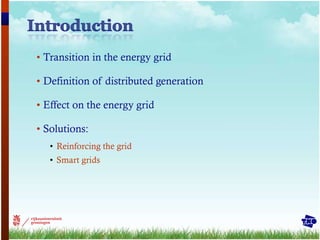
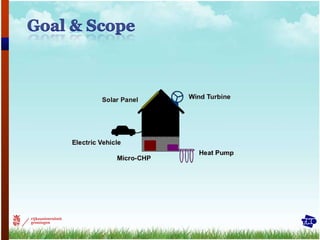
Transition in the energy grid Definition of distributed generation Effect on the energy grid Solutions:  Reinforcing the grid Smart grids
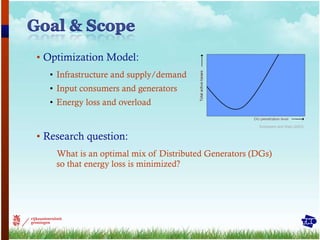
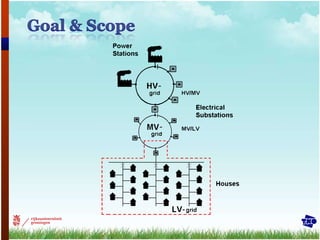
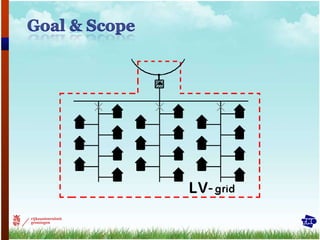
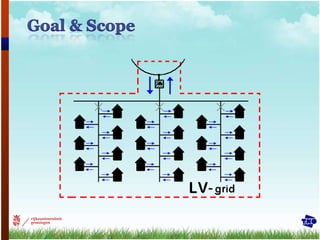
Optimization Model: Infrastructure and supply/demand Input consumers and generators Energy loss and overload Research question: What is an optimal mix of Distributed Generators (DGs)  so that energy loss is minimized? Scheepers and Wals (2003)


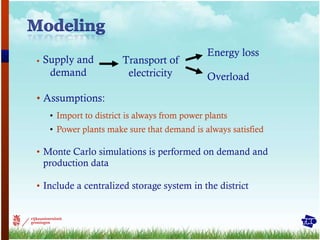
Assumptions: Import to district is always from power plants Power plants make sure that demand is always satisfied Monte Carlo simulations is performed on demand and production data Include a centralized storage system in the district Supply and demand Transport of electricity Energy loss Overload
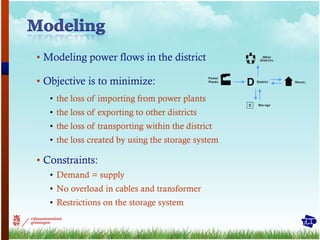
Modeling power flows in the district Objective is to minimize: the loss of importing from power plants the loss of exporting to other districts the loss of transporting within the district the loss created by using the storage system Constraints: Demand = supply No overload in cables and transformer Restrictions on the storage system
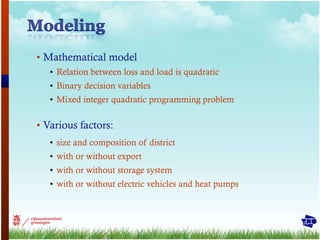
Mathematical model Relation between loss and load is quadratic Binary decision variables Mixed integer quadratic programming problem Various factors: size and composition of district with or without export with or without storage system with or without electric vehicles and heat pumps
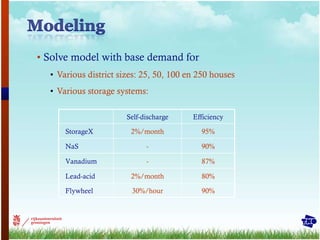
Solve model with base demand for Various district sizes: 25, 50, 100 en 250 houses Various storage systems: Self-discharge Efficiency StorageX 2%/month 95% NaS - 90% Vanadium - 87% Lead-acid 2%/month 80% Flywheel 30%/hour 90%
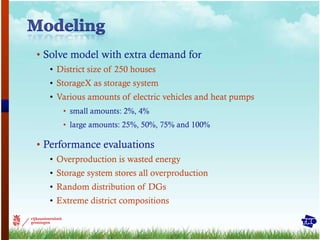
Solve model with extra demand for District size of 250 houses StorageX as storage system Various amounts of electric vehicles and heat pumps small amounts: 2%, 4% large amounts: 25%, 50%, 75% and 100% Performance evaluations Overproduction is wasted energy Storage system stores all overproduction Random distribution of DGs Extreme district compositions
Model with base demand The larger the district, relatively more DGs The larger the district, relatively more use of storage system No overload in cables and transformer in optimal solutions PV solar panels can be used as supplements to other generators [% micro-CHP systems, % PV solar panels] With StorageX No Storage With Export [94%, 100%] [52%, 100%] No Export [92%, 100%] [23%, 54%]
Model with extra demand As many DGs as possible in solutions Micro-CHP systems match better with electric vehicles and heat pumps Overload in cables and transformers [% micro-CHP systems, % PV solar panels] With StorageX No Storage With Export [100%, 100%] [100%, 100%] No Export [100%, 100%] [38%, 3%]
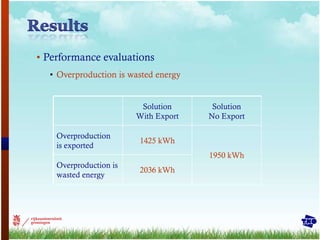
Performance evaluations Overproduction is wasted energy Solution With Export Solution No Export Overproduction is exported 1425 kWh 1950 kWh Overproduction is wasted energy 2036 kWh
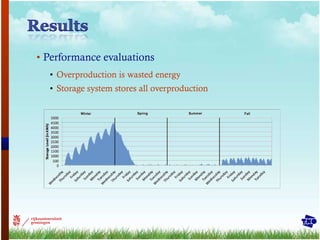
Performance evaluations Overproduction is wasted energy Storage system stores all overproduction
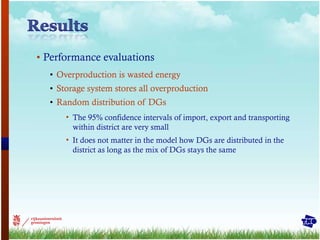
Performance evaluations Overproduction is wasted energy Storage system stores all overproduction Random distribution of DGs The 95% confidence intervals of import, export and transporting within district are very small  It does not matter in the model how DGs are distributed in the district as long as the mix of DGs stays the same
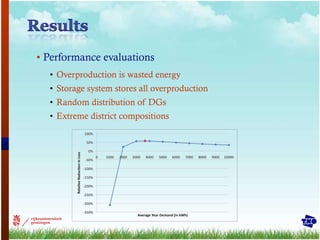
Performance evaluations Overproduction is wasted energy Storage system stores all overproduction Random distribution of DGs Extreme district compositions
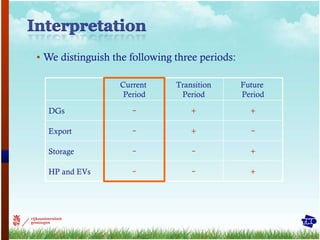
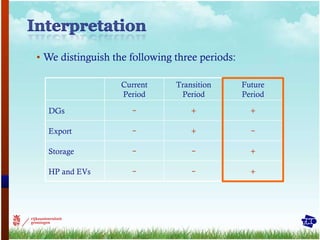
We distinguish the following three periods: Current  Period Transition Period Future  Period DGs − + + Export − + − Storage − − + HP and EVs − − +
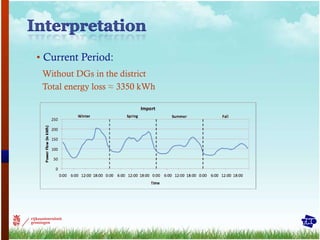
Current Period: Without DGs in the district Total energy loss ≈ 3350 kWh
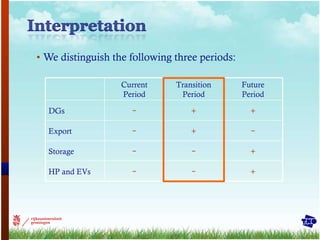
We distinguish the following three periods: Current Period Transition Period Future Period DGs − + + Export − + − Storage − − + HP and EVs − − +
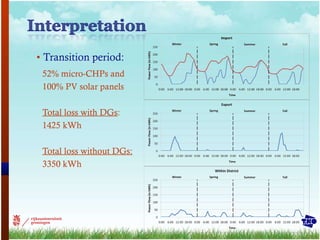
Transition period:  52% micro-CHPs and 100% PV solar panels Total loss with DGs : 1425 kWh Total loss without DGs: 3350 kWh
We distinguish the following three periods: Current Period Transition Period Future Period DGs − + + Export − + − Storage − − + HP and EVs − − +
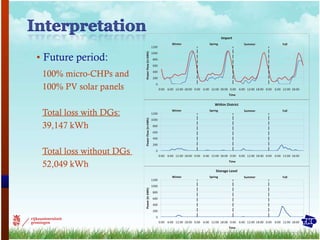
Future period: 100% micro-CHPs and 100% PV solar panels Total loss with DGs: 39,147 kWh Total loss without DGs  52,049 kWh
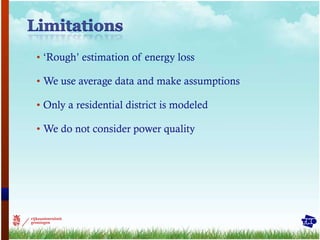
‘ Rough’ estimation of energy loss We use average data and make assumptions Only a residential district is modeled We do not consider power quality
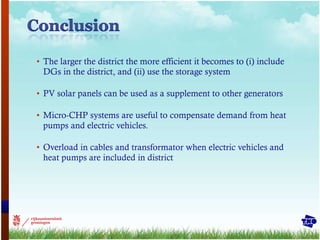
The larger the district the more efficient it becomes to (i) include DGs in the district, and (ii) use the storage system PV solar panels can be used as a supplement to other generators Micro-CHP systems are useful to compensate demand from heat pumps and electric vehicles. Overload in cables and transformator when electric vehicles and heat pumps are included in district
Implementation  In new districts: simply distribute DGs as given by optimal mix In existing districts:  collaboration between homeowners rent rooftops to organizations/companies and let them put their PV solar panels Results indicate that by implementing an optimal mix of DGs substantial reductions in loss can be achieved Collaboration between homeowners is more profitable for the whole district
Include stochasticity Also consider cost and CO 2 -emmision Model heat demand Include technical electrical terms such as current and voltage  -> power quality ‘ Vehicle-to-grid’ Model several districts or include other types of consumers of electricity Reformulate model as a smart grid
Thank you for your attention

Impact of Distributed Generation on Energy Loss

  • 1.
    Optimizing the choiceof distributed generation Nadine Croes 23 March 2011
  • 2.
  • 3.
    Transition in theenergy grid Definition of distributed generation Effect on the energy grid Solutions: Reinforcing the grid Smart grids
  • 4.
    Optimization Model: Infrastructureand supply/demand Input consumers and generators Energy loss and overload Research question: What is an optimal mix of Distributed Generators (DGs) so that energy loss is minimized? Scheepers and Wals (2003)
  • 5.
  • 6.
  • 7.
  • 8.
  • 9.
    Assumptions: Import todistrict is always from power plants Power plants make sure that demand is always satisfied Monte Carlo simulations is performed on demand and production data Include a centralized storage system in the district Supply and demand Transport of electricity Energy loss Overload
  • 10.
    Modeling power flowsin the district Objective is to minimize: the loss of importing from power plants the loss of exporting to other districts the loss of transporting within the district the loss created by using the storage system Constraints: Demand = supply No overload in cables and transformer Restrictions on the storage system
  • 11.
    Mathematical model Relationbetween loss and load is quadratic Binary decision variables Mixed integer quadratic programming problem Various factors: size and composition of district with or without export with or without storage system with or without electric vehicles and heat pumps
  • 12.
    Solve model withbase demand for Various district sizes: 25, 50, 100 en 250 houses Various storage systems: Self-discharge Efficiency StorageX 2%/month 95% NaS - 90% Vanadium - 87% Lead-acid 2%/month 80% Flywheel 30%/hour 90%
  • 13.
    Solve model withextra demand for District size of 250 houses StorageX as storage system Various amounts of electric vehicles and heat pumps small amounts: 2%, 4% large amounts: 25%, 50%, 75% and 100% Performance evaluations Overproduction is wasted energy Storage system stores all overproduction Random distribution of DGs Extreme district compositions
  • 14.
    Model with basedemand The larger the district, relatively more DGs The larger the district, relatively more use of storage system No overload in cables and transformer in optimal solutions PV solar panels can be used as supplements to other generators [% micro-CHP systems, % PV solar panels] With StorageX No Storage With Export [94%, 100%] [52%, 100%] No Export [92%, 100%] [23%, 54%]
  • 15.
    Model with extrademand As many DGs as possible in solutions Micro-CHP systems match better with electric vehicles and heat pumps Overload in cables and transformers [% micro-CHP systems, % PV solar panels] With StorageX No Storage With Export [100%, 100%] [100%, 100%] No Export [100%, 100%] [38%, 3%]
  • 16.
    Performance evaluations Overproductionis wasted energy Solution With Export Solution No Export Overproduction is exported 1425 kWh 1950 kWh Overproduction is wasted energy 2036 kWh
  • 17.
    Performance evaluations Overproductionis wasted energy Storage system stores all overproduction
  • 18.
    Performance evaluations Overproductionis wasted energy Storage system stores all overproduction Random distribution of DGs The 95% confidence intervals of import, export and transporting within district are very small It does not matter in the model how DGs are distributed in the district as long as the mix of DGs stays the same
  • 19.
    Performance evaluations Overproductionis wasted energy Storage system stores all overproduction Random distribution of DGs Extreme district compositions
  • 20.
    We distinguish thefollowing three periods: Current Period Transition Period Future Period DGs − + + Export − + − Storage − − + HP and EVs − − +
  • 21.
    Current Period: WithoutDGs in the district Total energy loss ≈ 3350 kWh
  • 22.
    We distinguish thefollowing three periods: Current Period Transition Period Future Period DGs − + + Export − + − Storage − − + HP and EVs − − +
  • 23.
    Transition period: 52% micro-CHPs and 100% PV solar panels Total loss with DGs : 1425 kWh Total loss without DGs: 3350 kWh
  • 24.
    We distinguish thefollowing three periods: Current Period Transition Period Future Period DGs − + + Export − + − Storage − − + HP and EVs − − +
  • 25.
    Future period: 100%micro-CHPs and 100% PV solar panels Total loss with DGs: 39,147 kWh Total loss without DGs 52,049 kWh
  • 26.
    ‘ Rough’ estimationof energy loss We use average data and make assumptions Only a residential district is modeled We do not consider power quality
  • 27.
    The larger thedistrict the more efficient it becomes to (i) include DGs in the district, and (ii) use the storage system PV solar panels can be used as a supplement to other generators Micro-CHP systems are useful to compensate demand from heat pumps and electric vehicles. Overload in cables and transformator when electric vehicles and heat pumps are included in district
  • 28.
    Implementation Innew districts: simply distribute DGs as given by optimal mix In existing districts: collaboration between homeowners rent rooftops to organizations/companies and let them put their PV solar panels Results indicate that by implementing an optimal mix of DGs substantial reductions in loss can be achieved Collaboration between homeowners is more profitable for the whole district
  • 29.
    Include stochasticity Alsoconsider cost and CO 2 -emmision Model heat demand Include technical electrical terms such as current and voltage -> power quality ‘ Vehicle-to-grid’ Model several districts or include other types of consumers of electricity Reformulate model as a smart grid
  • 30.
    Thank you foryour attention