DESIGN, APPLICATION,
TECHNIQUES AND ECONOMICS
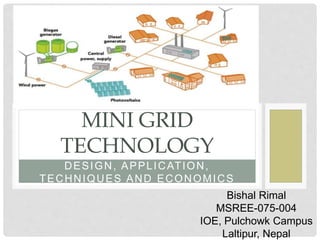
MINI GRID
TECHNOLOGY
Bishal Rimal
MSREE-075-004
IOE, Pulchowk Campus
Laltipur, Nepal
INTRODUCTION
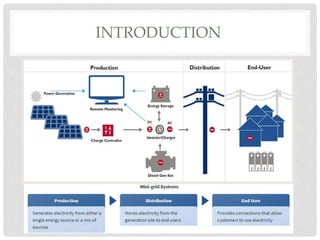
• Mini-grid is an off-grid electricity distribution network
involving small-scale electricity generation. mini-grids
involves small-scale electricity generation (from 10kW
to 10MW), and the distribution of electricity to a limited
number of customers via a distribution grid that can
operate in isolation from national electricity transmission
networks and supply relatively concentrated
settlements with electricity at grid quality level.
(Cooperation, 2014).
INTRODUCTION
COMMON SOURCES OF MINI-GRID
TECHNOLOGY (USAID)
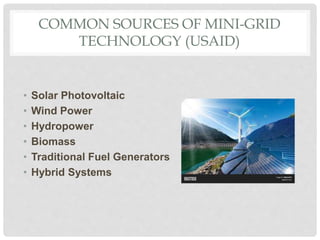
• Solar Photovoltaic
• Wind Power
• Hydropower
• Biomass
• Traditional Fuel Generators
• Hybrid Systems
BENEFITS OF MINI-GRID TECHNOLOGY
• Technical Benefit (Hazelton, Bruce, & MacGill, July 2014)
• Quick and Easy installment
• Can use to improve existing unreliable network
• Equipment lasts longer
• Very low chance of blackouts
• Financial Benefit
• Use multiple energy sources there by reducing LCOE
• Less malfunction and satisfied customers thus high willing ness to
pay
BENEFITS OF MINI-GRID TECHNOLOGY
• Environmental Benefit
• More environment friendly if renewable sources can be
incorporated
• Reduction on air and noise pollution
• Social Benefit
• Establishment of business and organization
• Creation of job and income generating activities
• Benefit to health care technology
• Strengthen community
TYPES OF MINI GRID TECHNOLOGY
• Diesel
• Hydro
• Biomass
• Wind/Solar PV/ Hybrid
DIESEL MINI-GRID
• Relatively low capital investment
• Well-understood technology with widespread technical
operating and maintenance capacity
• Easily ‘hybridised’ with solar PV and/or wind, which can be
added to lower fuel costs
• Potential for bio-diesel fuels
BENIFITS
CHALLANGES
• Escalating costs for fuel and maintenance
• Carbon emissions
• Diversion/theft of fuel reduces efficiency and greatly increases
costs in some business models.
• Intermittent use times, through regular scheduled or random
blackouts.
BIO MASS MINI-GRID
• Relatively low cost power fuel for combustion based systems
• For agro-processing companies, some control over on-site fuel
feedstock
BENIFITS
CHALLANGES
• Medium to high cost for gasifier based systems
• Limited experience to use this technology for rural
electrification
• Location-specific
HYDRO MINI-GRID
• Mature technology
• Low-cost power
• No diesel fuel needs
BENIFITS
CHALLANGES
• Requires constant hydro re-source
• Location-specific
• Often locations are already close to the main grid
• May not be economically viable when community is located
far from hydropower source
WIND/SOLAR PV/HYBRID
MINI GRID
• Flexible systems - can use various fuel sources
• Solar has rapidly falling investment costs per kW
• Lower diesel fuel consumption and lower reliance on external fuel
needs (energy security)
• Ease of operation and maintenance because of solid state
technology (solar, inverters)
BENIFITS
CHALLANGES
• Wind/Solar/Diesel hybrids require considerably more expensive
investments when battery storage is used
• Data needed for reliable assessment of renewable energy potential
MINI-GRID OPERATING MODE
• Isolated mode
• Grid connected mode
DESIGN PROCEDURE
Must consider:
• Trade-off cost
• Ability to develop power on demand
• Operation and Maintenance cost
• Grid connection potential
• Load efficiency and load flexibility
After sizing system, revisit availability and cost
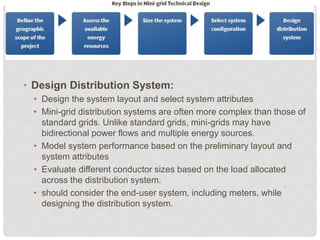
• Define the geographic scope of the project
• Include total number of customer
• Type of customers
• Type of Settlement
• Land Terrain and ease of resources availability
• Consideration of policies and grid extension plans
• Assess the available energy resources
• Assess local energy resources, including quantity, availability, cost,
sustainability and potential conflicting uses.
• Select energy generation technology
• Size the system:
• Should have sufficient installed capacity to meet loads.
• Calculate variations in loads in half-hour intervals and estimate future
load growth
• Consider weather it is likely to connect national grid in near future
• Select System Configuration
• Determined by Generation technology, size, storage system
• Consider tradeoff in cost, maintainance requirement, efficiency, safety
and end use versatality
• AC/DC/AC-DC
• Design Distribution System:
• Design the system layout and select system attributes
• Mini-grid distribution systems are often more complex than those of
standard grids. Unlike standard grids, mini-grids may have
bidirectional power flows and multiple energy sources.
• Model system performance based on the preliminary layout and
system attributes
• Evaluate different conductor sizes based on the load allocated
across the distribution system.
• should consider the end-user system, including meters, while
designing the distribution system.
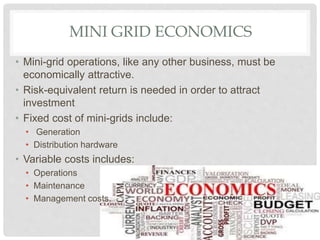
MINI GRID ECONOMICS
• Mini-grid operations, like any other business, must be
economically attractive.
• Risk-equivalent return is needed in order to attract
investment
• Fixed cost of mini-grids include:
• Generation
• Distribution hardware
• Variable costs includes:
• Operations
• Maintenance
• Management costs.
COST EFFECTIVENESS
Mini-grids are not always the most cost-effective choice for rural
electrification
WILLINGNESS TO PAY
• Willingness-to-pay surveys are essential, because the
financial feasibility of a mini-grid project depends largely
on the ability of users to pay a tariff that generates
enough revenue to cover the costs of operations,
maintenance and repairs for the mini-grid system.
• Two approaches of Survey
• maximum amount that a person says he or she is willing to pay
for electricity.
• the actual amount people already pay for kerosene lamps,
candles, flashlight batteries, diesel for a home generator or other
substitutes for mini-grid electricity
LCOE
• The LCOE of a mini-grid depends on the following
variables: (The economics of Mini Grid, 2018)
• Technology used in a mini-grid‟s design
• Size of mini-grid (bigger is generally cheaper due to economies of
scale)
• Cost of capital (high interest rates lead to higher LCOE)
• Tenure of the loan (long loans make for lower LCOE)
• Cost of labor, backup fuel (diesel) and replacement equipment
(batteries)
• Risk factors (political, payment and price variability)
• Project location
LCOE
HOUSEHOLD CONNECTION AND
PRODUCTIVE USE
• a foundation for sustainable economic development by
increasing incomes and improving welfare.
• focus on increased mechanization in the agriculture sector
• new opportunities for value-added processing, storage
and transport.
• lighting for education is a productive use
• Tools such as saws and drills, sewing machines and
larger-scale agricultural processing such as milling and
grinding as well as pumping, welding or modest
refrigeration.
MINI GRID IN NEPAL
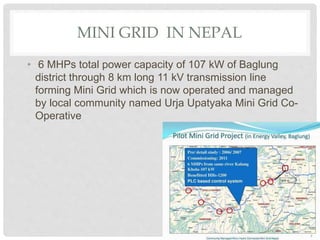
• 6 MHPs total power capacity of 107 kW of Baglung
district through 8 km long 11 kV transmission line
forming Mini Grid which is now operated and managed
by local community named Urja Upatyaka Mini Grid Co-
Operative
MINI GRID IN NEPAL
• Nepal’s Alternative Energy Promotion Center (AEPC)
has helped develop more than 2,000 hydropowered
mini-grids, providing 30 MW of electricity to 1.5 million
people.
• 30-kilowatt capacity solar mini-grid project installed in
Miklajung Rural Municipality-1 in Morang district
• Ongoing 150kWp Solar Mini-grid system for Thabang
Rural Municipality ward No-1&2, Thabang, Rolpa District
THANK YOU!
REFERENCES
• (2011). Rural Electrification with Renewable Energy – Technologies, quality standards and
business. Allience for Rural Electrification.
• The economics of Mini Grid. (2018, Feb 13). Retrieved from USAID:
https://www.usaid.gov/energy/mini-grids/economics
• Bank, T. W. (n.d.). Retrieved 01 11, 2020, from
https://www.worldbank.org/en/news/feature/2016/07/07/mini-grids-bringing-low-cost-timely-
electricity-to-the-rural-poor
• Bank, T. W. (July 2016). Global Facility on Mini-grids. Energy Sector Management Assistance
Program.
• Cooperation, A.-E. R. (2014). Mini Grid Policy Tool Kit. Eschborn.
• Gujar, M., Datta, A., & Mohanty, P. (2013). Smart Mini Grid: An innovative distributed
generation based energy system. IEEE Innovative Smart Grid Technologies-Asia, 1-5.
• Hazelton, J., Bruce, A., & MacGill, I. (July 2014). A review of the potential benefits and risks
of photovoltaic hybrid mini-grid systems. Renewable Energy, 222-229.
• Inversion, A. R. (2000). Mini-Grid Design Manual. Washington D.C.
• Karki, N. R., Karki, R., Verma, A. K., & Choi, J. e. (2017). Reliable and Sustainable Electric
Power and Energy Systems Management. Sustainable Power Systems.
• Nagpal, K. (n.d.). Smart Mini-Grids: Innovative solutions to combat energy shortfall.
Retrieved 01 11, 2020, from Thomson Reuters Foundation:
http://news.trust.org//item/20121025054000-rslkp/
• USAID. (n.d.). Retrieved Janaury 11, 2020, from https://www.usaid.gov/energy/mini-
grids/technical-design/components
•

Mini grid

  • 1.
    DESIGN, APPLICATION, TECHNIQUES ANDECONOMICS MINI GRID TECHNOLOGY Bishal Rimal MSREE-075-004 IOE, Pulchowk Campus Laltipur, Nepal
  • 2.
    INTRODUCTION • Mini-grid isan off-grid electricity distribution network involving small-scale electricity generation. mini-grids involves small-scale electricity generation (from 10kW to 10MW), and the distribution of electricity to a limited number of customers via a distribution grid that can operate in isolation from national electricity transmission networks and supply relatively concentrated settlements with electricity at grid quality level. (Cooperation, 2014).
  • 3.
  • 4.
    COMMON SOURCES OFMINI-GRID TECHNOLOGY (USAID) • Solar Photovoltaic • Wind Power • Hydropower • Biomass • Traditional Fuel Generators • Hybrid Systems
  • 5.
    BENEFITS OF MINI-GRIDTECHNOLOGY • Technical Benefit (Hazelton, Bruce, & MacGill, July 2014) • Quick and Easy installment • Can use to improve existing unreliable network • Equipment lasts longer • Very low chance of blackouts • Financial Benefit • Use multiple energy sources there by reducing LCOE • Less malfunction and satisfied customers thus high willing ness to pay
  • 6.
    BENEFITS OF MINI-GRIDTECHNOLOGY • Environmental Benefit • More environment friendly if renewable sources can be incorporated • Reduction on air and noise pollution • Social Benefit • Establishment of business and organization • Creation of job and income generating activities • Benefit to health care technology • Strengthen community
  • 7.
    TYPES OF MINIGRID TECHNOLOGY • Diesel • Hydro • Biomass • Wind/Solar PV/ Hybrid
  • 8.
    DIESEL MINI-GRID • Relativelylow capital investment • Well-understood technology with widespread technical operating and maintenance capacity • Easily ‘hybridised’ with solar PV and/or wind, which can be added to lower fuel costs • Potential for bio-diesel fuels BENIFITS CHALLANGES • Escalating costs for fuel and maintenance • Carbon emissions • Diversion/theft of fuel reduces efficiency and greatly increases costs in some business models. • Intermittent use times, through regular scheduled or random blackouts.
  • 9.
    BIO MASS MINI-GRID •Relatively low cost power fuel for combustion based systems • For agro-processing companies, some control over on-site fuel feedstock BENIFITS CHALLANGES • Medium to high cost for gasifier based systems • Limited experience to use this technology for rural electrification • Location-specific
  • 10.
    HYDRO MINI-GRID • Maturetechnology • Low-cost power • No diesel fuel needs BENIFITS CHALLANGES • Requires constant hydro re-source • Location-specific • Often locations are already close to the main grid • May not be economically viable when community is located far from hydropower source
  • 11.
    WIND/SOLAR PV/HYBRID MINI GRID •Flexible systems - can use various fuel sources • Solar has rapidly falling investment costs per kW • Lower diesel fuel consumption and lower reliance on external fuel needs (energy security) • Ease of operation and maintenance because of solid state technology (solar, inverters) BENIFITS CHALLANGES • Wind/Solar/Diesel hybrids require considerably more expensive investments when battery storage is used • Data needed for reliable assessment of renewable energy potential
  • 12.
    MINI-GRID OPERATING MODE •Isolated mode • Grid connected mode
  • 13.
    DESIGN PROCEDURE Must consider: •Trade-off cost • Ability to develop power on demand • Operation and Maintenance cost • Grid connection potential • Load efficiency and load flexibility After sizing system, revisit availability and cost
  • 14.
    • Define thegeographic scope of the project • Include total number of customer • Type of customers • Type of Settlement • Land Terrain and ease of resources availability • Consideration of policies and grid extension plans • Assess the available energy resources • Assess local energy resources, including quantity, availability, cost, sustainability and potential conflicting uses. • Select energy generation technology
  • 15.
    • Size thesystem: • Should have sufficient installed capacity to meet loads. • Calculate variations in loads in half-hour intervals and estimate future load growth • Consider weather it is likely to connect national grid in near future • Select System Configuration • Determined by Generation technology, size, storage system • Consider tradeoff in cost, maintainance requirement, efficiency, safety and end use versatality • AC/DC/AC-DC
  • 16.
    • Design DistributionSystem: • Design the system layout and select system attributes • Mini-grid distribution systems are often more complex than those of standard grids. Unlike standard grids, mini-grids may have bidirectional power flows and multiple energy sources. • Model system performance based on the preliminary layout and system attributes • Evaluate different conductor sizes based on the load allocated across the distribution system. • should consider the end-user system, including meters, while designing the distribution system.
  • 17.
    MINI GRID ECONOMICS •Mini-grid operations, like any other business, must be economically attractive. • Risk-equivalent return is needed in order to attract investment • Fixed cost of mini-grids include: • Generation • Distribution hardware • Variable costs includes: • Operations • Maintenance • Management costs.
  • 18.
    COST EFFECTIVENESS Mini-grids arenot always the most cost-effective choice for rural electrification
  • 19.
    WILLINGNESS TO PAY •Willingness-to-pay surveys are essential, because the financial feasibility of a mini-grid project depends largely on the ability of users to pay a tariff that generates enough revenue to cover the costs of operations, maintenance and repairs for the mini-grid system. • Two approaches of Survey • maximum amount that a person says he or she is willing to pay for electricity. • the actual amount people already pay for kerosene lamps, candles, flashlight batteries, diesel for a home generator or other substitutes for mini-grid electricity
  • 20.
    LCOE • The LCOEof a mini-grid depends on the following variables: (The economics of Mini Grid, 2018) • Technology used in a mini-grid‟s design • Size of mini-grid (bigger is generally cheaper due to economies of scale) • Cost of capital (high interest rates lead to higher LCOE) • Tenure of the loan (long loans make for lower LCOE) • Cost of labor, backup fuel (diesel) and replacement equipment (batteries) • Risk factors (political, payment and price variability) • Project location
  • 21.
  • 22.
    HOUSEHOLD CONNECTION AND PRODUCTIVEUSE • a foundation for sustainable economic development by increasing incomes and improving welfare. • focus on increased mechanization in the agriculture sector • new opportunities for value-added processing, storage and transport. • lighting for education is a productive use • Tools such as saws and drills, sewing machines and larger-scale agricultural processing such as milling and grinding as well as pumping, welding or modest refrigeration.
  • 23.
    MINI GRID INNEPAL • 6 MHPs total power capacity of 107 kW of Baglung district through 8 km long 11 kV transmission line forming Mini Grid which is now operated and managed by local community named Urja Upatyaka Mini Grid Co- Operative
  • 24.
    MINI GRID INNEPAL • Nepal’s Alternative Energy Promotion Center (AEPC) has helped develop more than 2,000 hydropowered mini-grids, providing 30 MW of electricity to 1.5 million people. • 30-kilowatt capacity solar mini-grid project installed in Miklajung Rural Municipality-1 in Morang district • Ongoing 150kWp Solar Mini-grid system for Thabang Rural Municipality ward No-1&2, Thabang, Rolpa District
  • 25.
  • 26.
    REFERENCES • (2011). RuralElectrification with Renewable Energy – Technologies, quality standards and business. Allience for Rural Electrification. • The economics of Mini Grid. (2018, Feb 13). Retrieved from USAID: https://www.usaid.gov/energy/mini-grids/economics • Bank, T. W. (n.d.). Retrieved 01 11, 2020, from https://www.worldbank.org/en/news/feature/2016/07/07/mini-grids-bringing-low-cost-timely- electricity-to-the-rural-poor • Bank, T. W. (July 2016). Global Facility on Mini-grids. Energy Sector Management Assistance Program. • Cooperation, A.-E. R. (2014). Mini Grid Policy Tool Kit. Eschborn. • Gujar, M., Datta, A., & Mohanty, P. (2013). Smart Mini Grid: An innovative distributed generation based energy system. IEEE Innovative Smart Grid Technologies-Asia, 1-5. • Hazelton, J., Bruce, A., & MacGill, I. (July 2014). A review of the potential benefits and risks of photovoltaic hybrid mini-grid systems. Renewable Energy, 222-229. • Inversion, A. R. (2000). Mini-Grid Design Manual. Washington D.C. • Karki, N. R., Karki, R., Verma, A. K., & Choi, J. e. (2017). Reliable and Sustainable Electric Power and Energy Systems Management. Sustainable Power Systems. • Nagpal, K. (n.d.). Smart Mini-Grids: Innovative solutions to combat energy shortfall. Retrieved 01 11, 2020, from Thomson Reuters Foundation: http://news.trust.org//item/20121025054000-rslkp/ • USAID. (n.d.). Retrieved Janaury 11, 2020, from https://www.usaid.gov/energy/mini- grids/technical-design/components •

Editor's Notes

  • #14 A trade-off is a situational decision that involves diminishing or losing one quality, quantity or property of a set or design in return for gains in other aspects. In simple terms, a tradeoff is where one thing increases and another must decrease. 
  • #17  design the system layout and select system attributes