Micro-Grids and renewable energy
integration
Budi Supomo – ID ABB, 2014
Global energy challenges
Social, economic and environmental
Month DD, Year | Slide 2
© ABB Group
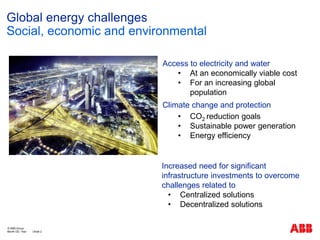
Access to electricity and water
• At an economically viable cost
• For an increasing global
population
Climate change and protection
• CO2 reduction goals
• Sustainable power generation
• Energy efficiency
Increased need for significant
infrastructure investments to overcome
challenges related to
• Centralized solutions
• Decentralized solutions
Micro-Grids
Decentralized, self-sufficient power networks
Month DD, Year | Slide 3
© ABB Group
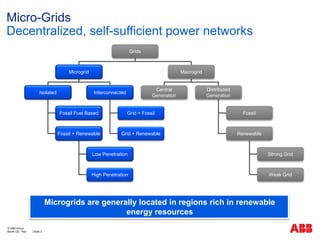
Grids
Microgrid Macrogrid
Central
Generation
Isolated Interconnected
Distributed
Generation
Fossil Fuel Based
Fossil + Renewable
Grid + Fossil
Grid + Renewable
Fossil
Renewable
Strong Grid
Weak Grid
Low Penetration
High Penetration
Microgrid
Isolated Interconnected
Fossil Fuel Based
Fossil + Renewable
Low Penetration
Microgrids are generally located in regions rich in renewable
energy resources
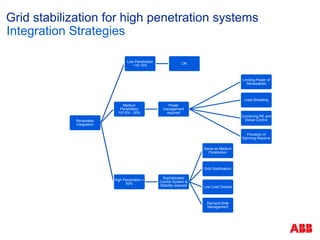
Grid stabilization for high penetration systems
Integration Strategies
Renewable
Integration
Low Penetration
<10-15%
OK
Medium
Penetration
10/15% - 50%
Power
management
required
Limiting Power of
Renewables
Load Shedding
Combining RE and
Diesel Control
Provision of
Spinning Reserve
High Penetration >
50%
Sophisticated
Control System &
Stability required
Same as Medium
Penetration
Grid Stabilisation
Low Load Diesels
Demand Side
Management
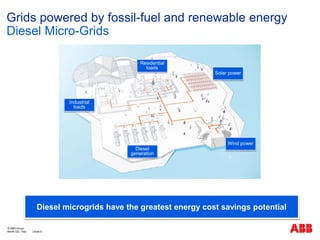
Grids powered by fossil-fuel and renewable energy
Diesel Micro-Grids
Diesel microgrids have the greatest energy cost savings potential
Diesel
generation
Wind power
Solar power
Residential
loads
Industrial
loads
Month DD, Year | Slide 5
© ABB Group
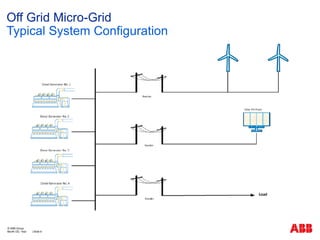
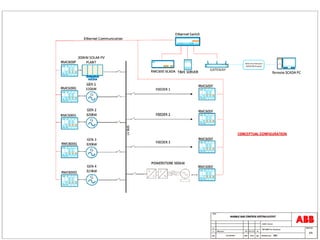
Off Grid Micro-Grid
Typical System Configuration
Month DD, Year | Slide 6
© ABB Group
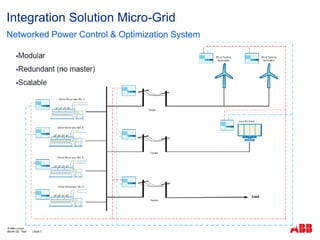
Integration Solution Micro-Grid
Networked Power Control & Optimization System
Month DD, Year | Slide 7
© ABB Group
Integration Solution Micro-Grid
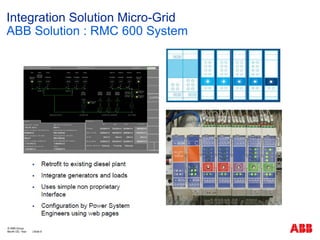
ABB Solution : RMC 600 System
Month DD, Year | Slide 8
© ABB Group
Integration Solution Micro-Grid
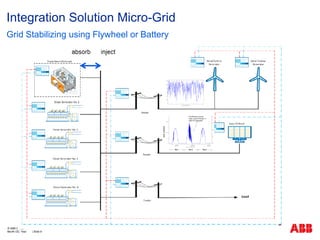
Grid Stabilizing using Flywheel or Battery
Month DD, Year | Slide 9
© ABB Group
Month DD, Year | Slide 10
© ABB Group
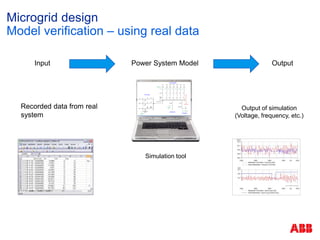
Microgrid design
Model verification – using real data
Simulation tool
Recorded data from real
system
Output of simulation
(Voltage, frequency, etc.)
Input Power System Model Output
HSS
LS Netz
Leitung
Gen1
LS Gen1
G
~
Gen 1
Ltg
LS
G
~
Gen 2
3 ~ 415V / 50 Hz
P-Q Messung
Gen 1
PLL
Grid
P-Q Messung
Netz
LS
G
~
Gen 3
Ltg
LS
G
~
Gen 4
Ltg
LS
G
~
Gen 5
Ltg
LS
G
~
Gen 6
Ltg
LS
G
~
Gen 7
Ltg
f-U
measurement
Leitung Ps1
LS Ps1
Ps 1
P-Q Messung
Ps1
Diesel generator
PowerStore
Isolated gird
Kompensation
WKA 1
LtgLS
G
~
WKA 3
WKA 2
LS
P-Q Messung
WKA 1
G
~
G
~
Ltg
Leitung
WKA1
WKA 1
LS
WKA1
Wind turbine
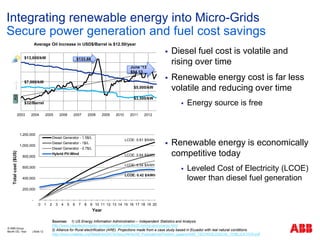
2003 2004 2005 2006 2007 2008 2009 2010 2011 2012
Average Oil Increase in USD$/Barrel is $12.50/year
$133.88
June ‘13
$94.13
$13,000/kW
$5,000/kW
$32/Barrel
$7,000/kW
$3,500/kW
 Diesel fuel cost is volatile and
rising over time
 Renewable energy cost is far less
volatile and reducing over time
 Energy source is free
 Renewable energy is economically
competitive today
 Leveled Cost of Electricity (LCOE)
lower than diesel fuel generation
Integrating renewable energy into Micro-Grids
Secure power generation and fuel cost savings
Month DD, Year | Slide 12
© ABB Group
Sources: 1) US Energy Information Administration – Independent Statistics and Analysis
http://www.cleantechinvestor.com/portal/fuel-cells/6422-mining-and-energy.html
2) Alliance for Rural electrification (ARE). Projections made from a case study based in Ecuador with real natural conditions.
http://www.ruralelec.org/fileadmin/DATA/Documents/06_Publications/Position_papers/ARE_TECHNOLOGICAL_PUBLICATION.pdf
-
200,000
400,000
600,000
800,000
1,000,000
1,200,000
0 1 2 3 4 5 6 7 8 9 10 11 12 13 14 15 16 17 18 19 20
Totalcost($US)
Year
Diesel Generator - 1.5$/L
Diesel Generator - 1$/L
Diesel Generator - 0.7$/L
Hybrid PV-Wind
LCOE: 0.81 $/kWh
LCOE: 0.64 $/kWh
LCOE: 0.54 $/kWh
LCOE: 0.42 $/kWh
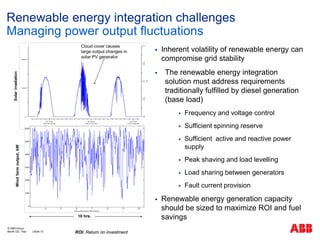
 Inherent volatility of renewable energy can
compromise grid stability
 The renewable energy integration
solution must address requirements
traditionally fulfilled by diesel generation
(base load)
 Frequency and voltage control
 Sufficient spinning reserve
 Sufficient active and reactive power
supply
 Peak shaving and load levelling
 Load sharing between generators
 Fault current provision
 Renewable energy generation capacity
should be sized to maximize ROI and fuel
savings
Renewable energy integration challenges
Managing power output fluctuations
Month DD, Year | Slide 13
© ABB Group
ROI: Return on investment
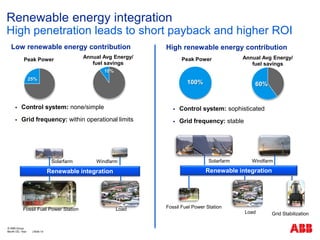
Renewable energy integration
High penetration leads to short payback and higher ROI
Month DD, Year | Slide 14
© ABB Group
Renewable integration
Solarfarm Windfarm
Fossil Fuel Power Station Load
Low renewable energy contribution
25%
Peak Power
10%
Annual Avg Energy/
fuel savings
 Control system: none/simple
 Grid frequency: within operational limits
Solarfarm Windfarm
Fossil Fuel Power Station
Renewable integration
Load Grid Stabilization
Peak Power
100%
High renewable energy contribution
60%
Annual Avg Energy/
fuel savings
 Control system: sophisticated
 Grid frequency: stable
 Renewable energy volatility compromises grid stability
 Integration without intelligent plant control system limits economic
benefits
 Poor integration can damage fossil fuel generators
 Lack of automatic adjustment of spinning reserve results in higher fuel
consumption
 Renewable generation may have to be curtailed to guarantee grid stability
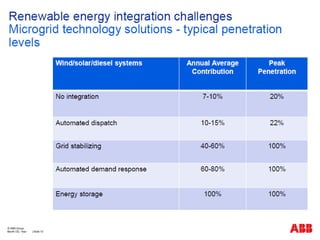
 Use of intelligent control and grid stabilization enables high penetration
systems resulting in shortest payback and highest ROI
 Up to 100% renewable energy peak penetration and 60% annual energy
contribution is typical
Renewable energy integration challenges
Summary
Month DD, Year | Slide 15
© ABB Group
ABB solution
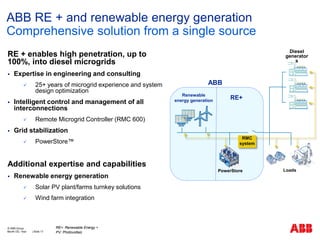
RE + enables high penetration, up to
100%, into diesel microgrids
 Expertise in engineering and consulting
 25+ years of microgrid experience and system
design optimization
 Intelligent control and management of all
interconnections
 Remote Microgrid Controller (RMC 600)
 Grid stabilization
 PowerStore™
Additional expertise and capabilities
 Renewable energy generation
 Solar PV plant/farms turnkey solutions
 Wind farm integration
ABB RE + and renewable energy generation
Comprehensive solution from a single source
Month DD, Year | Slide 17
© ABB Group RE+: Renewable Energy +
PV: Photovoltaic
PowerStore Loads
Diesel
generator
s
Renewable
energy generation
RMC
system
RE+
ABB
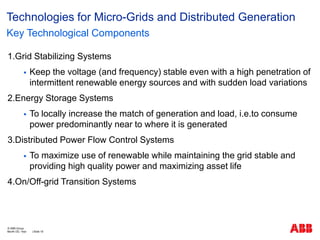
1.Grid Stabilizing Systems
 Keep the voltage (and frequency) stable even with a high penetration of
intermittent renewable energy sources and with sudden load variations
2.Energy Storage Systems
 To locally increase the match of generation and load, i.e.to consume
power predominantly near to where it is generated
3.Distributed Power Flow Control Systems
 To maximize use of renewable while maintaining the grid stable and
providing high quality power and maximizing asset life
4.On/Off-grid Transition Systems
Technologies for Micro-Grids and Distributed Generation
Key Technological Components
Month DD, Year | Slide 18
© ABB Group
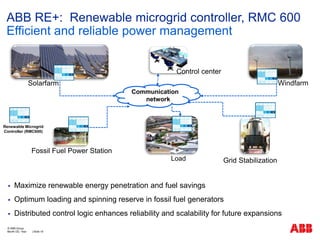
 Maximize renewable energy penetration and fuel savings
 Optimum loading and spinning reserve in fossil fuel generators
 Distributed control logic enhances reliability and scalability for future expansions
ABB RE+: Renewable microgrid controller, RMC 600
Efficient and reliable power management
Month DD, Year | Slide 19
© ABB Group
Solarfarm Windfarm
Fossil Fuel Power Station
Communication
network
Load Grid Stabilization
Control center
Renewable Microgrid
Controller (RMC600)
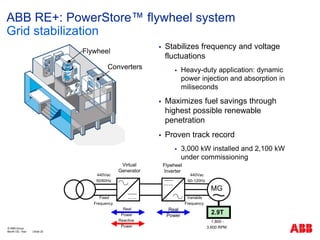
ABB RE+: PowerStore™ flywheel system
Grid stabilization
Month DD, Year | Slide 20
© ABB Group
MG
440Vac
60-120Hz
440Vac
50/60Hz
Reactive
Power
Real
Power
Real
Power
Fixed
Frequency
Variable
Frequency
2.9T
1,800 -
3,600 RPM
Virtual
Generator
Flywheel
Inverter
 Stabilizes frequency and voltage
fluctuations
 Heavy-duty application: dynamic
power injection and absorption in
miliseconds
 Maximizes fuel savings through
highest possible renewable
penetration
 Proven track record
 3,000 kW installed and 2,100 kW
under commissioning
Flywheel
Converters
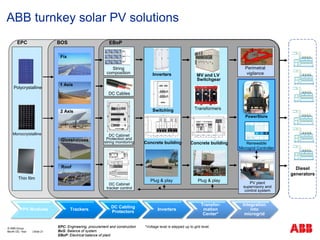
ABB turnkey solar PV solutions
Month DD, Year | Slide 21
© ABB Group
PV Modules Trackers
DC Cabling
Protectors
Inverters
Transfor-
mation
Center*
Integration
into
microgrid
EPC: Engineering, procurement and construction
BoS: Balance of system
EBoP: Electrical balance of plant
*Voltage level is stepped up to grid level.
Monocryistalline
Thin film
Polycrystalline
Fix
1 Axis
2 Axis
Glasshouses
Roof
PowerStore
Plug & play
Inverters
Concrete building
Switching Transformers
MV and LV
Switchgear
Concrete building
Plug & play
Perimetral
vigilance
DC Cabinet
Protection and
string monitoring
String
composition
DC Cables
DC Cabinet
tracker control
Renewable
Microgrid Controller
PV plant
supervisory and
control system
EBoPBOSEPC
Diesel
generators
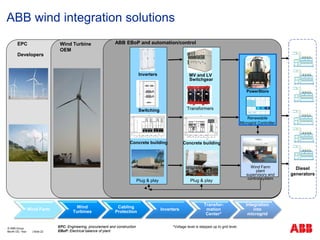
ABB wind integration solutions
Month DD, Year | Slide 22
© ABB Group
Wind Farm
Wind
Turbines
Cabling
Protection
Inverters
Transfor-
mation
Center*
Integration
into
microgrid
EPC: Engineering, procurement and construction
EBoP: Electrical balance of plant
*Voltage level is stepped up to grid level.
Plug & play
Inverters
Concrete building
Switching Transformers
MV and LV
Switchgear
Concrete building
Plug & play
PowerStore
Renewable
Microgrid Controller
Wind Farm
plant
supervisory and
control system
ABB EBoP and automation/controlWind Turbine
OEM
EPC
Developers
Diesel
generators
ABB RE+ and battery energy storage
An alternative solution when applicable
Load
Charge Discharge
t [hrs]
Supply power
Absorb power Absorb power
EnergystoredinESS
ABB’s comprehensive battery energy storage solutions
 Based on proven power converter technology
 Turnkey and modular solutions suitable for all power levels (~25kW to 70 MW)
 Solutions designed and developed independently of battery technology
Month DD, Year | Slide 23
© ABB Group
Applications: peak demand
shaving or load shifting
 Longer stored energy discharge
timescale; minutes to hours
 Enable fossil fuel generators to
run at stable outputs
 Maximize renewable energy load
factor
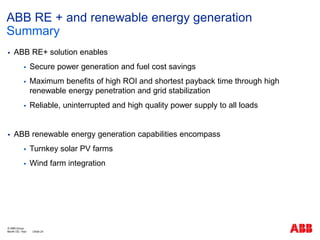
 ABB RE+ solution enables
 Secure power generation and fuel cost savings
 Maximum benefits of high ROI and shortest payback time through high
renewable energy penetration and grid stabilization
 Reliable, uninterrupted and high quality power supply to all loads
 ABB renewable energy generation capabilities encompass
 Turnkey solar PV farms
 Wind farm integration
ABB RE + and renewable energy generation
Summary
Month DD, Year | Slide 24
© ABB Group
References
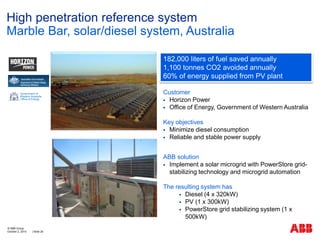
High penetration reference system
Marble Bar, solar/diesel system, Australia
Customer
 Horizon Power
 Office of Energy, Government of Western Australia
Key objectives
 Minimize diesel consumption
 Reliable and stable power supply
ABB solution
 Implement a solar microgrid with PowerStore grid-
stabilizing technology and microgrid automation
The resulting system has
 Diesel (4 x 320kW)
 PV (1 x 300kW)
 PowerStore grid stabilizing system (1 x
500kW)
Government of
Western Australia
Office of Energy
© ABB Group
October 2, 2014 | Slide 26
182,000 liters of fuel saved annually
1,100 tonnes CO2 avoided annually
60% of energy supplied from PV plant
Month DD, Year | Slide 27
© ABB Group
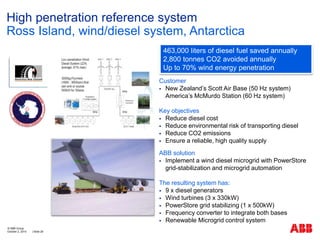
High penetration reference system
Ross Island, wind/diesel system, Antarctica
Customer
 New Zealand’s Scott Air Base (50 Hz system)
America’s McMurdo Station (60 Hz system)
Key objectives
 Reduce diesel cost
 Reduce environmental risk of transporting diesel
 Reduce CO2 emissions
 Ensure a reliable, high quality supply
ABB solution
 Implement a wind diesel microgrid with PowerStore
grid-stabilization and microgrid automation
The resulting system has:
 9 x diesel generators
 Wind turbines (3 x 330kW)
 PowerStore grid stabilizing (1 x 500kW)
 Frequency converter to integrate both bases
 Renewable Microgrid control system
© ABB Group
October 2, 2014 | Slide 28
463,000 liters of diesel fuel saved annually
2,800 tonnes CO2 avoided annually
Up to 70% wind energy penetration
Business cases
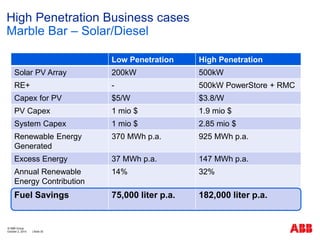
High Penetration Business cases
Low Penetration High Penetration
Solar PV Array 200kW 500kW
RE+ - 500kW PowerStore + RMC
Capex for PV $5/W $3.8/W
PV Capex 1 mio $ 1.9 mio $
System Capex 1 mio $ 2.85 mio $
Renewable Energy
Generated
370 MWh p.a. 925 MWh p.a.
Excess Energy 37 MWh p.a. 147 MWh p.a.
Annual Renewable
Energy Contribution
14% 32%
Fuel Savings 75,000 liter p.a. 182,000 liter p.a.
Marble Bar – Solar/Diesel
© ABB Group
October 2, 2014 | Slide 30
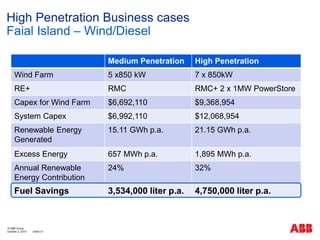
High Penetration Business cases
Medium Penetration High Penetration
Wind Farm 5 x850 kW 7 x 850kW
RE+ RMC RMC+ 2 x 1MW PowerStore
Capex for Wind Farm $6,692,110 $9,368,954
System Capex $6,992,110 $12,068,954
Renewable Energy
Generated
15.11 GWh p.a. 21.15 GWh p.a.
Excess Energy 657 MWh p.a. 1,895 MWh p.a.
Annual Renewable
Energy Contribution
24% 32%
Fuel Savings 3,534,000 liter p.a. 4,750,000 liter p.a.
Faial Island – Wind/Diesel
© ABB Group
October 2, 2014 | Slide 31
Summary
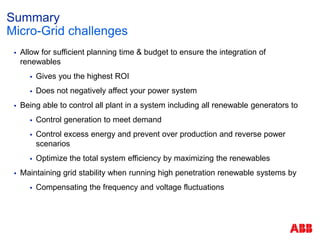
 Allow for sufficient planning time & budget to ensure the integration of
renewables
 Gives you the highest ROI
 Does not negatively affect your power system
 Being able to control all plant in a system including all renewable generators to
 Control generation to meet demand
 Control excess energy and prevent over production and reverse power
scenarios
 Optimize the total system efficiency by maximizing the renewables
 Maintaining grid stability when running high penetration renewable systems by
 Compensating the frequency and voltage fluctuations
Micro-Grid challenges
Grid Stabilization for High Penetration Systems
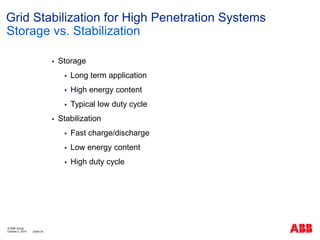
Storage vs. Stabilization
 Storage
 Long term application
 High energy content
 Typical low duty cycle
 Stabilization
 Fast charge/discharge
 Low energy content
 High duty cycle
© ABB Group
October 2, 2014 | Slide 34
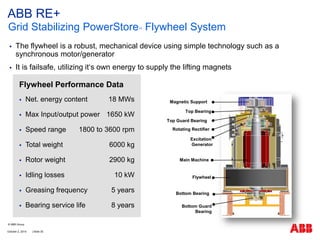
 The flywheel is a robust, mechanical device using simple technology such as a
synchronous motor/generator
 It is failsafe, utilizing it‘s own energy to supply the lifting magnets
Flywheel Performance Data
 Net. energy content 18 MWs
 Max Input/output power 1650 kW
 Speed range 1800 to 3600 rpm
 Total weight 6000 kg
 Rotor weight 2900 kg
 Idling losses 10 kW
 Greasing frequency 5 years
 Bearing service life 8 years
ABB RE+
Grid Stabilizing PowerStoreTM Flywheel System
October 2, 2014 | Slide 35
© ABB Group
18 MWs flywheelMagnetic Support
Top Bearing
Top Guard Bearing
Rotating Rectifier
Excitation
Generator
Main Machine
Flywheel
Bottom Bearing
Bottom Guard
Bearing
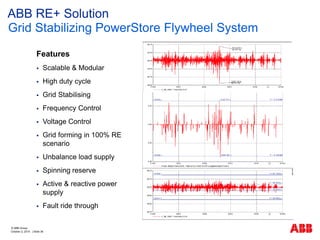
Features
 Scalable & Modular
 High duty cycle
 Grid Stabilising
 Frequency Control
 Voltage Control
 Grid forming in 100% RE
scenario
 Unbalance load supply
 Spinning reserve
 Active & reactive power
supply
 Fault ride through
ABB RE+ Solution
Grid Stabilizing PowerStore Flywheel System
October 2, 2014 | Slide 36
© ABB Group
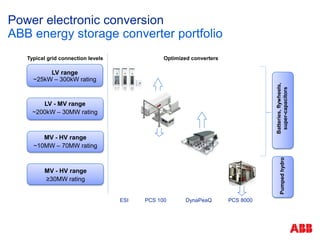
MV - HV range
~10MW – 70MW rating
LV range
~25kW – 300kW rating
LV - MV range
~200kW – 30MW rating
Optimized convertersTypical grid connection levels
ESI PCS 100 DynaPeaQ PCS 8000
Batteries,flywheels,
super-capacitors
MV - HV range
≥30MW rating
Pumpedhydro
Power electronic conversion
ABB energy storage converter portfolio
ESS applications fall into 2 categories
Segmentation between long and short discharge time
ESS = Energy Storage System
100 kW 1 MW 10 MW 100 MW 1000 MW
10
1000
100
10 h
1 h
10 min
Power requirement [MW]
30
300
End-user
peak shaving
Frequency
regulation
Load leveling
(postponement of
grid upgrade)
Renewables integration
Energy
Power
Load leveling
(generation
utilization)
Dischargetime[min]
Energy
Power
100 kW 1 MW 10 MW 100 MW 1000 MW
10
1000
100
10 h
1 h
10 min
Dischargetime[min]
Power requirement [MW]
30
300
Pumped-Hydro
Lithium ion battery
Flow battery / emerging technologies
Sodium Sulfur battery
Lead acid battery
Super-capacitor / flywheel
Right technology for right application
Segmentation on ‘power’ and ‘energy’ technologies
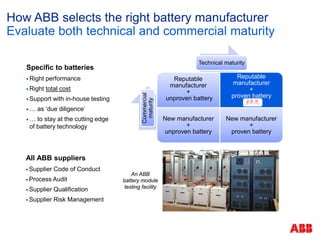
How ABB selects the right battery manufacturer
Evaluate both technical and commercial maturity
Technical maturity
Commercial
maturity
Specific to batteries
 Right performance
 Right total cost
 Support with in-house testing
 … as ‘due diligence’
 … to stay at the cutting edge
of battery technology
All ABB suppliers
 Supplier Code of Conduct
 Process Audit
 Supplier Qualification
 Supplier Risk Management
Reputable
manufacturer
+
unproven battery
Reputable
manufacturer
+
proven battery
New manufacturer
+
unproven battery
New manufacturer
+
proven battery

An ABB
battery module
testing facility

abb micro-grids and-renewable_energy_integration

  • 1.
    Micro-Grids and renewableenergy integration Budi Supomo – ID ABB, 2014
  • 2.
    Global energy challenges Social,economic and environmental Month DD, Year | Slide 2 © ABB Group Access to electricity and water • At an economically viable cost • For an increasing global population Climate change and protection • CO2 reduction goals • Sustainable power generation • Energy efficiency Increased need for significant infrastructure investments to overcome challenges related to • Centralized solutions • Decentralized solutions
  • 3.
    Micro-Grids Decentralized, self-sufficient powernetworks Month DD, Year | Slide 3 © ABB Group Grids Microgrid Macrogrid Central Generation Isolated Interconnected Distributed Generation Fossil Fuel Based Fossil + Renewable Grid + Fossil Grid + Renewable Fossil Renewable Strong Grid Weak Grid Low Penetration High Penetration Microgrid Isolated Interconnected Fossil Fuel Based Fossil + Renewable Low Penetration Microgrids are generally located in regions rich in renewable energy resources
  • 4.
    Grid stabilization forhigh penetration systems Integration Strategies Renewable Integration Low Penetration <10-15% OK Medium Penetration 10/15% - 50% Power management required Limiting Power of Renewables Load Shedding Combining RE and Diesel Control Provision of Spinning Reserve High Penetration > 50% Sophisticated Control System & Stability required Same as Medium Penetration Grid Stabilisation Low Load Diesels Demand Side Management
  • 5.
    Grids powered byfossil-fuel and renewable energy Diesel Micro-Grids Diesel microgrids have the greatest energy cost savings potential Diesel generation Wind power Solar power Residential loads Industrial loads Month DD, Year | Slide 5 © ABB Group
  • 6.
    Off Grid Micro-Grid TypicalSystem Configuration Month DD, Year | Slide 6 © ABB Group
  • 7.
    Integration Solution Micro-Grid NetworkedPower Control & Optimization System Month DD, Year | Slide 7 © ABB Group
  • 8.
    Integration Solution Micro-Grid ABBSolution : RMC 600 System Month DD, Year | Slide 8 © ABB Group
  • 9.
    Integration Solution Micro-Grid GridStabilizing using Flywheel or Battery Month DD, Year | Slide 9 © ABB Group
  • 10.
    Month DD, Year| Slide 10 © ABB Group
  • 11.
    Microgrid design Model verification– using real data Simulation tool Recorded data from real system Output of simulation (Voltage, frequency, etc.) Input Power System Model Output HSS LS Netz Leitung Gen1 LS Gen1 G ~ Gen 1 Ltg LS G ~ Gen 2 3 ~ 415V / 50 Hz P-Q Messung Gen 1 PLL Grid P-Q Messung Netz LS G ~ Gen 3 Ltg LS G ~ Gen 4 Ltg LS G ~ Gen 5 Ltg LS G ~ Gen 6 Ltg LS G ~ Gen 7 Ltg f-U measurement Leitung Ps1 LS Ps1 Ps 1 P-Q Messung Ps1 Diesel generator PowerStore Isolated gird Kompensation WKA 1 LtgLS G ~ WKA 3 WKA 2 LS P-Q Messung WKA 1 G ~ G ~ Ltg Leitung WKA1 WKA 1 LS WKA1 Wind turbine
  • 12.
    2003 2004 20052006 2007 2008 2009 2010 2011 2012 Average Oil Increase in USD$/Barrel is $12.50/year $133.88 June ‘13 $94.13 $13,000/kW $5,000/kW $32/Barrel $7,000/kW $3,500/kW  Diesel fuel cost is volatile and rising over time  Renewable energy cost is far less volatile and reducing over time  Energy source is free  Renewable energy is economically competitive today  Leveled Cost of Electricity (LCOE) lower than diesel fuel generation Integrating renewable energy into Micro-Grids Secure power generation and fuel cost savings Month DD, Year | Slide 12 © ABB Group Sources: 1) US Energy Information Administration – Independent Statistics and Analysis http://www.cleantechinvestor.com/portal/fuel-cells/6422-mining-and-energy.html 2) Alliance for Rural electrification (ARE). Projections made from a case study based in Ecuador with real natural conditions. http://www.ruralelec.org/fileadmin/DATA/Documents/06_Publications/Position_papers/ARE_TECHNOLOGICAL_PUBLICATION.pdf - 200,000 400,000 600,000 800,000 1,000,000 1,200,000 0 1 2 3 4 5 6 7 8 9 10 11 12 13 14 15 16 17 18 19 20 Totalcost($US) Year Diesel Generator - 1.5$/L Diesel Generator - 1$/L Diesel Generator - 0.7$/L Hybrid PV-Wind LCOE: 0.81 $/kWh LCOE: 0.64 $/kWh LCOE: 0.54 $/kWh LCOE: 0.42 $/kWh
  • 13.
     Inherent volatilityof renewable energy can compromise grid stability  The renewable energy integration solution must address requirements traditionally fulfilled by diesel generation (base load)  Frequency and voltage control  Sufficient spinning reserve  Sufficient active and reactive power supply  Peak shaving and load levelling  Load sharing between generators  Fault current provision  Renewable energy generation capacity should be sized to maximize ROI and fuel savings Renewable energy integration challenges Managing power output fluctuations Month DD, Year | Slide 13 © ABB Group ROI: Return on investment
  • 14.
    Renewable energy integration Highpenetration leads to short payback and higher ROI Month DD, Year | Slide 14 © ABB Group Renewable integration Solarfarm Windfarm Fossil Fuel Power Station Load Low renewable energy contribution 25% Peak Power 10% Annual Avg Energy/ fuel savings  Control system: none/simple  Grid frequency: within operational limits Solarfarm Windfarm Fossil Fuel Power Station Renewable integration Load Grid Stabilization Peak Power 100% High renewable energy contribution 60% Annual Avg Energy/ fuel savings  Control system: sophisticated  Grid frequency: stable
  • 15.
     Renewable energyvolatility compromises grid stability  Integration without intelligent plant control system limits economic benefits  Poor integration can damage fossil fuel generators  Lack of automatic adjustment of spinning reserve results in higher fuel consumption  Renewable generation may have to be curtailed to guarantee grid stability  Use of intelligent control and grid stabilization enables high penetration systems resulting in shortest payback and highest ROI  Up to 100% renewable energy peak penetration and 60% annual energy contribution is typical Renewable energy integration challenges Summary Month DD, Year | Slide 15 © ABB Group
  • 16.
  • 17.
    RE + enableshigh penetration, up to 100%, into diesel microgrids  Expertise in engineering and consulting  25+ years of microgrid experience and system design optimization  Intelligent control and management of all interconnections  Remote Microgrid Controller (RMC 600)  Grid stabilization  PowerStore™ Additional expertise and capabilities  Renewable energy generation  Solar PV plant/farms turnkey solutions  Wind farm integration ABB RE + and renewable energy generation Comprehensive solution from a single source Month DD, Year | Slide 17 © ABB Group RE+: Renewable Energy + PV: Photovoltaic PowerStore Loads Diesel generator s Renewable energy generation RMC system RE+ ABB
  • 18.
    1.Grid Stabilizing Systems Keep the voltage (and frequency) stable even with a high penetration of intermittent renewable energy sources and with sudden load variations 2.Energy Storage Systems  To locally increase the match of generation and load, i.e.to consume power predominantly near to where it is generated 3.Distributed Power Flow Control Systems  To maximize use of renewable while maintaining the grid stable and providing high quality power and maximizing asset life 4.On/Off-grid Transition Systems Technologies for Micro-Grids and Distributed Generation Key Technological Components Month DD, Year | Slide 18 © ABB Group
  • 19.
     Maximize renewableenergy penetration and fuel savings  Optimum loading and spinning reserve in fossil fuel generators  Distributed control logic enhances reliability and scalability for future expansions ABB RE+: Renewable microgrid controller, RMC 600 Efficient and reliable power management Month DD, Year | Slide 19 © ABB Group Solarfarm Windfarm Fossil Fuel Power Station Communication network Load Grid Stabilization Control center Renewable Microgrid Controller (RMC600)
  • 20.
    ABB RE+: PowerStore™flywheel system Grid stabilization Month DD, Year | Slide 20 © ABB Group MG 440Vac 60-120Hz 440Vac 50/60Hz Reactive Power Real Power Real Power Fixed Frequency Variable Frequency 2.9T 1,800 - 3,600 RPM Virtual Generator Flywheel Inverter  Stabilizes frequency and voltage fluctuations  Heavy-duty application: dynamic power injection and absorption in miliseconds  Maximizes fuel savings through highest possible renewable penetration  Proven track record  3,000 kW installed and 2,100 kW under commissioning Flywheel Converters
  • 21.
    ABB turnkey solarPV solutions Month DD, Year | Slide 21 © ABB Group PV Modules Trackers DC Cabling Protectors Inverters Transfor- mation Center* Integration into microgrid EPC: Engineering, procurement and construction BoS: Balance of system EBoP: Electrical balance of plant *Voltage level is stepped up to grid level. Monocryistalline Thin film Polycrystalline Fix 1 Axis 2 Axis Glasshouses Roof PowerStore Plug & play Inverters Concrete building Switching Transformers MV and LV Switchgear Concrete building Plug & play Perimetral vigilance DC Cabinet Protection and string monitoring String composition DC Cables DC Cabinet tracker control Renewable Microgrid Controller PV plant supervisory and control system EBoPBOSEPC Diesel generators
  • 22.
    ABB wind integrationsolutions Month DD, Year | Slide 22 © ABB Group Wind Farm Wind Turbines Cabling Protection Inverters Transfor- mation Center* Integration into microgrid EPC: Engineering, procurement and construction EBoP: Electrical balance of plant *Voltage level is stepped up to grid level. Plug & play Inverters Concrete building Switching Transformers MV and LV Switchgear Concrete building Plug & play PowerStore Renewable Microgrid Controller Wind Farm plant supervisory and control system ABB EBoP and automation/controlWind Turbine OEM EPC Developers Diesel generators
  • 23.
    ABB RE+ andbattery energy storage An alternative solution when applicable Load Charge Discharge t [hrs] Supply power Absorb power Absorb power EnergystoredinESS ABB’s comprehensive battery energy storage solutions  Based on proven power converter technology  Turnkey and modular solutions suitable for all power levels (~25kW to 70 MW)  Solutions designed and developed independently of battery technology Month DD, Year | Slide 23 © ABB Group Applications: peak demand shaving or load shifting  Longer stored energy discharge timescale; minutes to hours  Enable fossil fuel generators to run at stable outputs  Maximize renewable energy load factor
  • 24.
     ABB RE+solution enables  Secure power generation and fuel cost savings  Maximum benefits of high ROI and shortest payback time through high renewable energy penetration and grid stabilization  Reliable, uninterrupted and high quality power supply to all loads  ABB renewable energy generation capabilities encompass  Turnkey solar PV farms  Wind farm integration ABB RE + and renewable energy generation Summary Month DD, Year | Slide 24 © ABB Group
  • 25.
  • 26.
    High penetration referencesystem Marble Bar, solar/diesel system, Australia Customer  Horizon Power  Office of Energy, Government of Western Australia Key objectives  Minimize diesel consumption  Reliable and stable power supply ABB solution  Implement a solar microgrid with PowerStore grid- stabilizing technology and microgrid automation The resulting system has  Diesel (4 x 320kW)  PV (1 x 300kW)  PowerStore grid stabilizing system (1 x 500kW) Government of Western Australia Office of Energy © ABB Group October 2, 2014 | Slide 26 182,000 liters of fuel saved annually 1,100 tonnes CO2 avoided annually 60% of energy supplied from PV plant
  • 27.
    Month DD, Year| Slide 27 © ABB Group
  • 28.
    High penetration referencesystem Ross Island, wind/diesel system, Antarctica Customer  New Zealand’s Scott Air Base (50 Hz system) America’s McMurdo Station (60 Hz system) Key objectives  Reduce diesel cost  Reduce environmental risk of transporting diesel  Reduce CO2 emissions  Ensure a reliable, high quality supply ABB solution  Implement a wind diesel microgrid with PowerStore grid-stabilization and microgrid automation The resulting system has:  9 x diesel generators  Wind turbines (3 x 330kW)  PowerStore grid stabilizing (1 x 500kW)  Frequency converter to integrate both bases  Renewable Microgrid control system © ABB Group October 2, 2014 | Slide 28 463,000 liters of diesel fuel saved annually 2,800 tonnes CO2 avoided annually Up to 70% wind energy penetration
  • 29.
  • 30.
    High Penetration Businesscases Low Penetration High Penetration Solar PV Array 200kW 500kW RE+ - 500kW PowerStore + RMC Capex for PV $5/W $3.8/W PV Capex 1 mio $ 1.9 mio $ System Capex 1 mio $ 2.85 mio $ Renewable Energy Generated 370 MWh p.a. 925 MWh p.a. Excess Energy 37 MWh p.a. 147 MWh p.a. Annual Renewable Energy Contribution 14% 32% Fuel Savings 75,000 liter p.a. 182,000 liter p.a. Marble Bar – Solar/Diesel © ABB Group October 2, 2014 | Slide 30
  • 31.
    High Penetration Businesscases Medium Penetration High Penetration Wind Farm 5 x850 kW 7 x 850kW RE+ RMC RMC+ 2 x 1MW PowerStore Capex for Wind Farm $6,692,110 $9,368,954 System Capex $6,992,110 $12,068,954 Renewable Energy Generated 15.11 GWh p.a. 21.15 GWh p.a. Excess Energy 657 MWh p.a. 1,895 MWh p.a. Annual Renewable Energy Contribution 24% 32% Fuel Savings 3,534,000 liter p.a. 4,750,000 liter p.a. Faial Island – Wind/Diesel © ABB Group October 2, 2014 | Slide 31
  • 32.
    Summary  Allow forsufficient planning time & budget to ensure the integration of renewables  Gives you the highest ROI  Does not negatively affect your power system  Being able to control all plant in a system including all renewable generators to  Control generation to meet demand  Control excess energy and prevent over production and reverse power scenarios  Optimize the total system efficiency by maximizing the renewables  Maintaining grid stability when running high penetration renewable systems by  Compensating the frequency and voltage fluctuations Micro-Grid challenges
  • 34.
    Grid Stabilization forHigh Penetration Systems Storage vs. Stabilization  Storage  Long term application  High energy content  Typical low duty cycle  Stabilization  Fast charge/discharge  Low energy content  High duty cycle © ABB Group October 2, 2014 | Slide 34
  • 35.
     The flywheelis a robust, mechanical device using simple technology such as a synchronous motor/generator  It is failsafe, utilizing it‘s own energy to supply the lifting magnets Flywheel Performance Data  Net. energy content 18 MWs  Max Input/output power 1650 kW  Speed range 1800 to 3600 rpm  Total weight 6000 kg  Rotor weight 2900 kg  Idling losses 10 kW  Greasing frequency 5 years  Bearing service life 8 years ABB RE+ Grid Stabilizing PowerStoreTM Flywheel System October 2, 2014 | Slide 35 © ABB Group 18 MWs flywheelMagnetic Support Top Bearing Top Guard Bearing Rotating Rectifier Excitation Generator Main Machine Flywheel Bottom Bearing Bottom Guard Bearing
  • 36.
    Features  Scalable &Modular  High duty cycle  Grid Stabilising  Frequency Control  Voltage Control  Grid forming in 100% RE scenario  Unbalance load supply  Spinning reserve  Active & reactive power supply  Fault ride through ABB RE+ Solution Grid Stabilizing PowerStore Flywheel System October 2, 2014 | Slide 36 © ABB Group
  • 37.
    MV - HVrange ~10MW – 70MW rating LV range ~25kW – 300kW rating LV - MV range ~200kW – 30MW rating Optimized convertersTypical grid connection levels ESI PCS 100 DynaPeaQ PCS 8000 Batteries,flywheels, super-capacitors MV - HV range ≥30MW rating Pumpedhydro Power electronic conversion ABB energy storage converter portfolio
  • 38.
    ESS applications fallinto 2 categories Segmentation between long and short discharge time ESS = Energy Storage System 100 kW 1 MW 10 MW 100 MW 1000 MW 10 1000 100 10 h 1 h 10 min Power requirement [MW] 30 300 End-user peak shaving Frequency regulation Load leveling (postponement of grid upgrade) Renewables integration Energy Power Load leveling (generation utilization) Dischargetime[min]
  • 39.
    Energy Power 100 kW 1MW 10 MW 100 MW 1000 MW 10 1000 100 10 h 1 h 10 min Dischargetime[min] Power requirement [MW] 30 300 Pumped-Hydro Lithium ion battery Flow battery / emerging technologies Sodium Sulfur battery Lead acid battery Super-capacitor / flywheel Right technology for right application Segmentation on ‘power’ and ‘energy’ technologies
  • 40.
    How ABB selectsthe right battery manufacturer Evaluate both technical and commercial maturity Technical maturity Commercial maturity Specific to batteries  Right performance  Right total cost  Support with in-house testing  … as ‘due diligence’  … to stay at the cutting edge of battery technology All ABB suppliers  Supplier Code of Conduct  Process Audit  Supplier Qualification  Supplier Risk Management Reputable manufacturer + unproven battery Reputable manufacturer + proven battery New manufacturer + unproven battery New manufacturer + proven battery  An ABB battery module testing facility