CERVICAL CANCER
………prevention is the best cure
An insight from Indian Menopause Society
www.indianmenopausesociety.org
Prof. M.C. Bansal.
MBBS MS .MICOG.FICOG.
Founder Principal & Controller ;
Jhalawar Medical College and Hospital ,
Jhalawar.
Ex. Principal & Controller;
Mahatma Gandhi Medical College And Hospital
,
Sitapura, Jaipur.
What is Cancer?
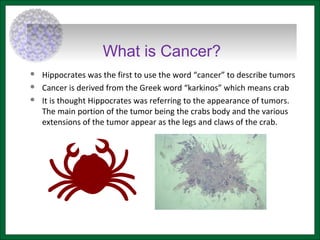
 Hippocrates was the first to use the word “cancer” to describe tumors
 Cancer is derived from the Greek word “karkinos” which means crab
 It is thought Hippocrates was referring to the appearance of tumors.
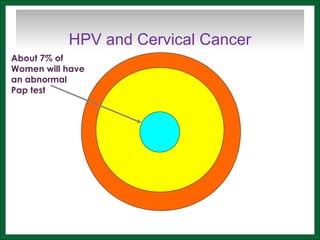
The main portion of the tumor being the crabs body and the various
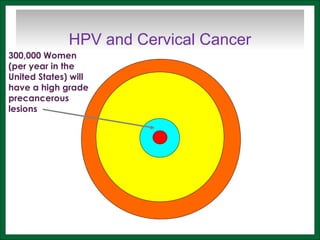
extensions of the tumor appear as the legs and claws of the crab.
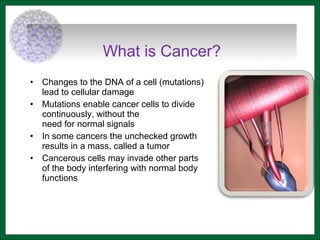
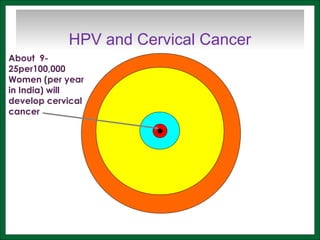
• Changes to the DNA of a cell (mutations)
lead to cellular damage
• Mutations enable cancer cells to divide
continuously, without the
need for normal signals
• In some cancers the unchecked growth
results in a mass, called a tumor
• Cancerous cells may invade other parts
of the body interfering with normal body
functions
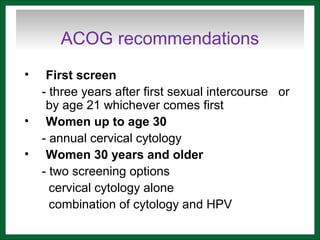
What is Cancer?
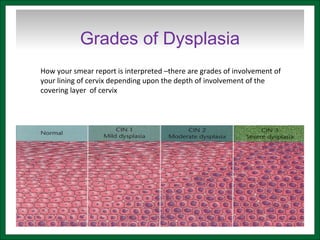
What is Cancer?
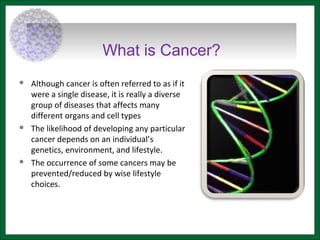
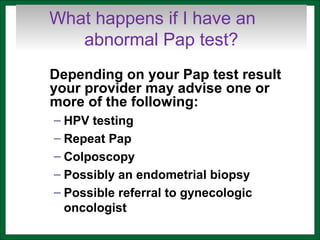
 Although cancer is often referred to as if it
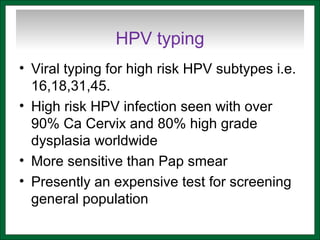
were a single disease, it is really a diverse
group of diseases that affects many
different organs and cell types
 The likelihood of developing any particular
cancer depends on an individual’s
genetics, environment, and lifestyle.
 The occurrence of some cancers may be
prevented/reduced by wise lifestyle
choices.
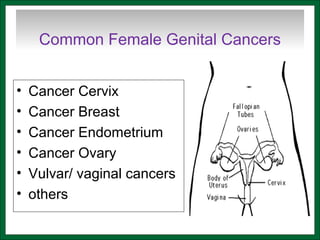
Common Female Genital Cancers
• Cancer Cervix
• Cancer Breast
• Cancer Endometrium
• Cancer Ovary
• Vulvar/ vaginal cancers
• others
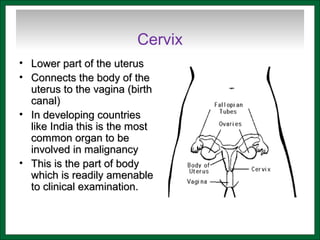
Cervix
• Lower part of the uterusLower part of the uterus
• Connects the body of theConnects the body of the
uterus to the vagina (birthuterus to the vagina (birth
canal)canal)
• In developing countriesIn developing countries
like India this is the mostlike India this is the most
common organ to becommon organ to be
involved in malignancyinvolved in malignancy
• This is the part of bodyThis is the part of body
which is readily amenablewhich is readily amenable
to clinical examination.to clinical examination.
Cancer Cervix
• One of the most preventable and curable
malignancies
• More than 75% cases belong to
developing countries.
• Incidence falling by about 7% per annum
in developed countries due to operational
screening programs
What is Cervical Cancer?
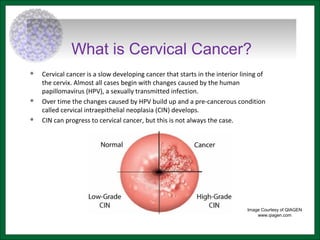
 Cervical cancer is a slow developing cancer that starts in the interior lining of
the cervix. Almost all cases begin with changes caused by the human
papillomavirus (HPV), a sexually transmitted infection.
 Over time the changes caused by HPV build up and a pre-cancerous condition
called cervical intraepithelial neoplasia (CIN) develops.
 CIN can progress to cervical cancer, but this is not always the case.
Image Courtesy of QIAGEN
www.qiagen.com
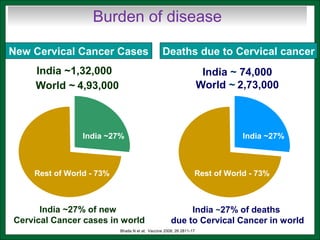
India ~1,32,000
World ~ 4,93,000
India ~27% of new
Cervical Cancer cases in world
India ~ 74,000
World ~ 2,73,000
India ~27%
Rest of World - 73%
India ~27% of deaths
due to Cervical Cancer in world
Rest of World - 73%
India - 27%
Burden of disease
New Cervical Cancer Cases Deaths due to Cervical cancer
India ~27%
Rest of World - 73%
Bhatla N et al; Vaccine 2008; 26 2811-17
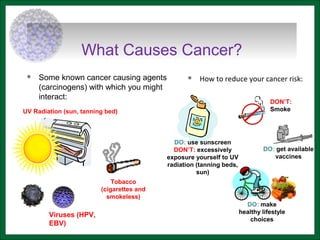
What Causes Cancer?
 Some known cancer causing agents
(carcinogens) with which you might
interact:
 How to reduce your cancer risk:
Tobacco
(cigarettes and
smokeless)
Viruses (HPV,
EBV)
UV Radiation (sun, tanning bed)
DON’T:
Smoke
DO: make
healthy lifestyle
choices
DO: get available
vaccines
DO: use sunscreen
DON’T: excessively
exposure yourself to UV
radiation (tanning beds,
sun)
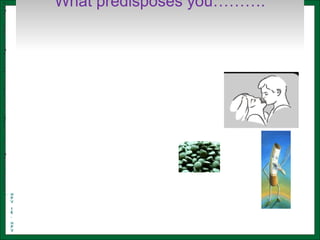
What predisposes you……….HH
uu
mm
aa
nn
pp
aa
pp
ii
ll
ll
oo
mm
aa
vv
ii
rr
uu
ss
ii
nn
ff
ee
cc
tt
ii
oo
nn
((
HH
PP
VV
))
––
PP
rr
ii
mm
aa
rr
yy
ff
aa
cc
tt
oo
rr
– HH
PP
VV
11
66
,,
HH
PP
VV
11
When to consult…….
• Abnormal Vaginal bleedingAbnormal Vaginal bleeding
• Menstrual bleeding is longer and heavier than usualMenstrual bleeding is longer and heavier than usual
• Bleeding after menopause or increased vaginalBleeding after menopause or increased vaginal
dischargedischarge
• Bleeding following intercourse or pelvic examBleeding following intercourse or pelvic exam
• Pain during intercoursePain during intercourse
Source: American Cancer SocietySource: American Cancer Society
14
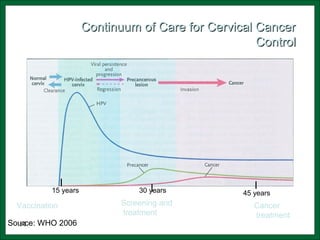
Continuum of Care for Cervical CancerContinuum of Care for Cervical Cancer
ControlControl
15 years 30 years 45 years
Vaccination Screening and
treatment
Cancer
treatment
Source: WHO 2006
All Women
HPV and Cervical Cancer
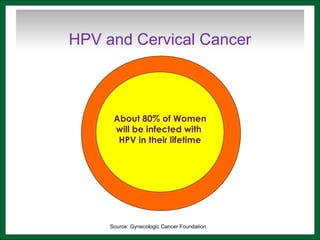
About 80% of Women
will be infected with
HPV in their lifetime
HPV and Cervical Cancer
Source: Gynecologic Cancer Foundation
About 7% of
Women will have
an abnormal
Pap test
HPV and Cervical Cancer
300,000 Women
(per year in the
United States) will
have a high grade
precancerous
lesions
HPV and Cervical Cancer
About 9-
25per100,000
Women (per year
in India) will
develop cervical
cancer
HPV and Cervical Cancer
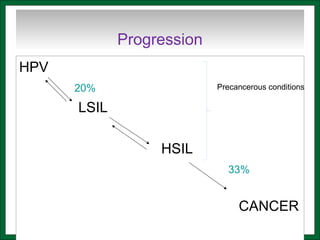
Progression
HPV
20%
LSIL
HSIL
33%
CANCER
Precancerous conditions
Cancer Screening
• Procedure by which cancer can be
detected in precancerous/ early stage to
make the treatment effective.
• According to WHO cervical cancer is the
only preventable cancer of female genital
tract as the precancerous changes of
cervix can be diagnosed way before the
development of cancer by the screening
methods.
Barriers to women’s participation in
screening
• Little understanding of cervical cancer
• Limited understanding of female reproductive organs and
associated diseases
• Lack of access to services
• Shame and fear of a vaginal exam
• Fear of death from cancer
• Lack of trust in health care system
• Lack of community and family support
• Concept of “preventive care” is foreign
Screening tools for cervical cancer
• Visual inspection of cervix
• Pap smear
– Conventional
– Liquid based cytology
• Viral typing for high risk HPV subtypes
• Combination of Pap smear and HPV
• Colposcopy
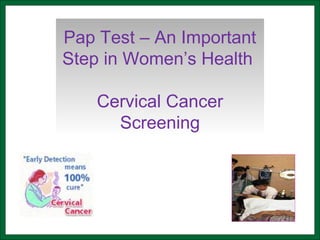
Pap Test – An Important
Step in Women’s Health
Cervical Cancer
Screening
2525
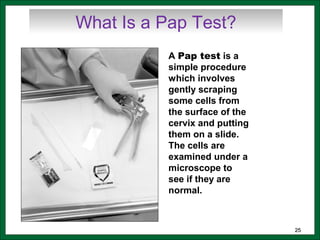
What Is a Pap Test?
A Pap test is a
simple procedure
which involves
gently scraping
some cells from
the surface of the
cervix and putting
them on a slide.
The cells are
examined under a
microscope to
see if they are
normal.
2626
• Cells in the lining of the cervix may gradually
change from normal to precancer to cancer,
usually over several years
• Pre and early cancerous changes in the cervix
can be found by the Pap test (also called the
“Pap smear”)
• Since precancers and very early cervical cancers
are nearly 100% curable, this test can prevent
nearly all deaths from cervical cancer
• Early cervical cancer or precancers usually show
no symptoms or signs
Why is Pap Testing Important?
2727
When to Begin Pap Tests?
How Often?
United States Guidelines
• Begin getting annual Pap tests when you start
to be sexually active, or if you are at least 18
years old
• If three or more annual Pap tests have been
normal, then Pap testing may be done less
frequently if recommended by the doctor
Is there an age when I can stop
having Pap tests?
The American Cancer Society
recommends that screening stop at age
70 if three or more recent tests are
normal, and there have been no abnormal
results in the last 10 years.
ACOG recommendations
• First screen
- three years after first sexual intercourse or
by age 21 whichever comes first
• Women up to age 30
- annual cervical cytology
• Women 30 years and older
- two screening options
cervical cytology alone
combination of cytology and HPV
Grades of Dysplasia
How your smear report is interpreted –there are grades of involvement of
your lining of cervix depending upon the depth of involvement of the
covering layer of cervix
What happens if I have an
abnormal Pap test?
Depending on your Pap test result
your provider may advise one or
more of the following:
– HPV testing
– Repeat Pap
– Colposcopy
– Possibly an endometrial biopsy
– Possible referral to gynecologic
oncologist
HPV typing
• Viral typing for high risk HPV subtypes i.e.
16,18,31,45.
• High risk HPV infection seen with over
90% Ca Cervix and 80% high grade
dysplasia worldwide
• More sensitive than Pap smear
• Presently an expensive test for screening
general population
HPV typing
• 80% HPV infections are transient
• 20% infections convert into CIN
• Regression occurs in majority with-
- low grade lesions
- low risk HPV subtypes mainly 6 & 11
- women under 30 years of age
HPV Vaccines
• Quadrivalent HPV Vaccine – Gardasil
by Merck & Co.
• Bivalent HPV Vaccine – Cervarix by
GSK
Colposcopy
• Not an organized screening tool
• Used to examine surfaces of cervix,
vagina and vulva
• Image reflects the appearance of
connective tissue through a filter formed
by the epithelial layer
• Magnification used is 10-15 fold commonly
• Low specificity i.e. < 50% in low grade CIN
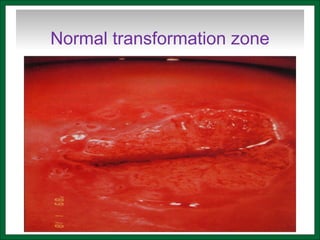
Normal transformation zone
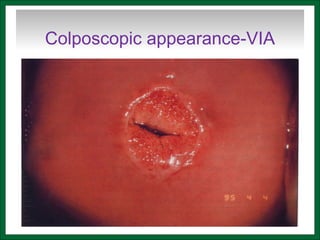
Colposcopic appearance-VIA
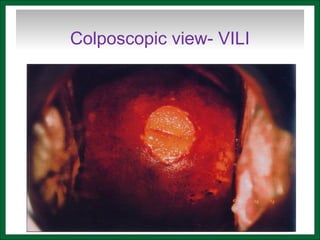
Colposcopic view- VILI
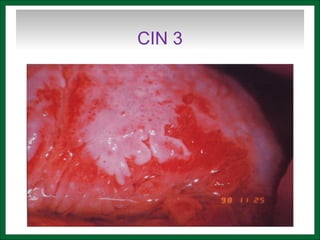
CIN 3
What are the treatment options for
CIN?
• There are a variety of effective options
for treatment. Most are outpatient or
office treatments. Treatment names
that you might hear include:
– LEEP
– Laser
– Cryotherapy
– Cone Biopsy
– Rarely, a hysterectomy may be recommended
What is new in screening and
prevention?
• Liquid cytology-thin layer cytology. This is
where your cervical swab is placed in a
container instead of ‘smeared’ on a slide.
• Combination of HPV test and Pap is now
available for screening women 30 years of
age and older. This helps identify patients at
increased risk for developing cervical
cancer.
• Pap test imaging by computer reviews in
addition to a review by trained personnel.
• Vaccines for cervical cancer
4242
A Woman’s Life Requires Balancing
Important Responsibilities
WorkFamily
Health
Taking care of her health is key
Diet and exercise
4444
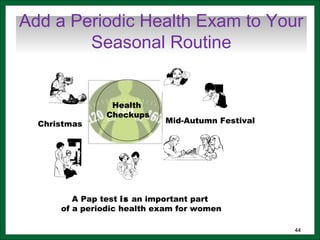
A Pap test is an important part
of a periodic health exam for women
Add a Periodic Health Exam to Your
Seasonal Routine
Health
Checkups
Mid-Autumn FestivalChristmas
Message
• Annual gynaecological check up and
cancer screening a must for all
asymptomatic sexually active and adult
females
• Gynaecological check up indicated for all
symptomatic women
Aim
Females are the essence of life so let us
decide today to instill life in this essence
and vow to eradicate the fear and
suffering from diseases especially
gynaecological cancers.
CONTRIBUTORS
CONCEPT:
Dr. Sunila Khandelwal
President, IMS
DESIGNED BY:
Dr. Ranu Patni
Secy. General, IMS
Dr. Seema Sharma
Chapter Secy. Jaipur, IMS

Presentation for public awareness

  • 1.
    CERVICAL CANCER ………prevention isthe best cure An insight from Indian Menopause Society www.indianmenopausesociety.org
  • 2.
    Prof. M.C. Bansal. MBBSMS .MICOG.FICOG. Founder Principal & Controller ; Jhalawar Medical College and Hospital , Jhalawar. Ex. Principal & Controller; Mahatma Gandhi Medical College And Hospital , Sitapura, Jaipur.
  • 3.
    What is Cancer? Hippocrates was the first to use the word “cancer” to describe tumors  Cancer is derived from the Greek word “karkinos” which means crab  It is thought Hippocrates was referring to the appearance of tumors. The main portion of the tumor being the crabs body and the various extensions of the tumor appear as the legs and claws of the crab.
  • 4.
    • Changes tothe DNA of a cell (mutations) lead to cellular damage • Mutations enable cancer cells to divide continuously, without the need for normal signals • In some cancers the unchecked growth results in a mass, called a tumor • Cancerous cells may invade other parts of the body interfering with normal body functions What is Cancer?
  • 5.
    What is Cancer? Although cancer is often referred to as if it were a single disease, it is really a diverse group of diseases that affects many different organs and cell types  The likelihood of developing any particular cancer depends on an individual’s genetics, environment, and lifestyle.  The occurrence of some cancers may be prevented/reduced by wise lifestyle choices.
  • 6.
    Common Female GenitalCancers • Cancer Cervix • Cancer Breast • Cancer Endometrium • Cancer Ovary • Vulvar/ vaginal cancers • others
  • 7.
    Cervix • Lower partof the uterusLower part of the uterus • Connects the body of theConnects the body of the uterus to the vagina (birthuterus to the vagina (birth canal)canal) • In developing countriesIn developing countries like India this is the mostlike India this is the most common organ to becommon organ to be involved in malignancyinvolved in malignancy • This is the part of bodyThis is the part of body which is readily amenablewhich is readily amenable to clinical examination.to clinical examination.
  • 8.
    Cancer Cervix • Oneof the most preventable and curable malignancies • More than 75% cases belong to developing countries. • Incidence falling by about 7% per annum in developed countries due to operational screening programs
  • 9.
    What is CervicalCancer?  Cervical cancer is a slow developing cancer that starts in the interior lining of the cervix. Almost all cases begin with changes caused by the human papillomavirus (HPV), a sexually transmitted infection.  Over time the changes caused by HPV build up and a pre-cancerous condition called cervical intraepithelial neoplasia (CIN) develops.  CIN can progress to cervical cancer, but this is not always the case. Image Courtesy of QIAGEN www.qiagen.com
  • 10.
    India ~1,32,000 World ~4,93,000 India ~27% of new Cervical Cancer cases in world India ~ 74,000 World ~ 2,73,000 India ~27% Rest of World - 73% India ~27% of deaths due to Cervical Cancer in world Rest of World - 73% India - 27% Burden of disease New Cervical Cancer Cases Deaths due to Cervical cancer India ~27% Rest of World - 73% Bhatla N et al; Vaccine 2008; 26 2811-17
  • 11.
    What Causes Cancer? Some known cancer causing agents (carcinogens) with which you might interact:  How to reduce your cancer risk: Tobacco (cigarettes and smokeless) Viruses (HPV, EBV) UV Radiation (sun, tanning bed) DON’T: Smoke DO: make healthy lifestyle choices DO: get available vaccines DO: use sunscreen DON’T: excessively exposure yourself to UV radiation (tanning beds, sun)
  • 12.
  • 13.
    When to consult……. •Abnormal Vaginal bleedingAbnormal Vaginal bleeding • Menstrual bleeding is longer and heavier than usualMenstrual bleeding is longer and heavier than usual • Bleeding after menopause or increased vaginalBleeding after menopause or increased vaginal dischargedischarge • Bleeding following intercourse or pelvic examBleeding following intercourse or pelvic exam • Pain during intercoursePain during intercourse Source: American Cancer SocietySource: American Cancer Society
  • 14.
    14 Continuum of Carefor Cervical CancerContinuum of Care for Cervical Cancer ControlControl 15 years 30 years 45 years Vaccination Screening and treatment Cancer treatment Source: WHO 2006
  • 15.
    All Women HPV andCervical Cancer
  • 16.
    About 80% ofWomen will be infected with HPV in their lifetime HPV and Cervical Cancer Source: Gynecologic Cancer Foundation
  • 17.
    About 7% of Womenwill have an abnormal Pap test HPV and Cervical Cancer
  • 18.
    300,000 Women (per yearin the United States) will have a high grade precancerous lesions HPV and Cervical Cancer
  • 19.
    About 9- 25per100,000 Women (peryear in India) will develop cervical cancer HPV and Cervical Cancer
  • 20.
  • 21.
    Cancer Screening • Procedureby which cancer can be detected in precancerous/ early stage to make the treatment effective. • According to WHO cervical cancer is the only preventable cancer of female genital tract as the precancerous changes of cervix can be diagnosed way before the development of cancer by the screening methods.
  • 22.
    Barriers to women’sparticipation in screening • Little understanding of cervical cancer • Limited understanding of female reproductive organs and associated diseases • Lack of access to services • Shame and fear of a vaginal exam • Fear of death from cancer • Lack of trust in health care system • Lack of community and family support • Concept of “preventive care” is foreign
  • 23.
    Screening tools forcervical cancer • Visual inspection of cervix • Pap smear – Conventional – Liquid based cytology • Viral typing for high risk HPV subtypes • Combination of Pap smear and HPV • Colposcopy
  • 24.
    Pap Test –An Important Step in Women’s Health Cervical Cancer Screening
  • 25.
    2525 What Is aPap Test? A Pap test is a simple procedure which involves gently scraping some cells from the surface of the cervix and putting them on a slide. The cells are examined under a microscope to see if they are normal.
  • 26.
    2626 • Cells inthe lining of the cervix may gradually change from normal to precancer to cancer, usually over several years • Pre and early cancerous changes in the cervix can be found by the Pap test (also called the “Pap smear”) • Since precancers and very early cervical cancers are nearly 100% curable, this test can prevent nearly all deaths from cervical cancer • Early cervical cancer or precancers usually show no symptoms or signs Why is Pap Testing Important?
  • 27.
    2727 When to BeginPap Tests? How Often? United States Guidelines • Begin getting annual Pap tests when you start to be sexually active, or if you are at least 18 years old • If three or more annual Pap tests have been normal, then Pap testing may be done less frequently if recommended by the doctor
  • 28.
    Is there anage when I can stop having Pap tests? The American Cancer Society recommends that screening stop at age 70 if three or more recent tests are normal, and there have been no abnormal results in the last 10 years.
  • 29.
    ACOG recommendations • Firstscreen - three years after first sexual intercourse or by age 21 whichever comes first • Women up to age 30 - annual cervical cytology • Women 30 years and older - two screening options cervical cytology alone combination of cytology and HPV
  • 30.
    Grades of Dysplasia Howyour smear report is interpreted –there are grades of involvement of your lining of cervix depending upon the depth of involvement of the covering layer of cervix
  • 31.
    What happens ifI have an abnormal Pap test? Depending on your Pap test result your provider may advise one or more of the following: – HPV testing – Repeat Pap – Colposcopy – Possibly an endometrial biopsy – Possible referral to gynecologic oncologist
  • 32.
    HPV typing • Viraltyping for high risk HPV subtypes i.e. 16,18,31,45. • High risk HPV infection seen with over 90% Ca Cervix and 80% high grade dysplasia worldwide • More sensitive than Pap smear • Presently an expensive test for screening general population
  • 33.
    HPV typing • 80%HPV infections are transient • 20% infections convert into CIN • Regression occurs in majority with- - low grade lesions - low risk HPV subtypes mainly 6 & 11 - women under 30 years of age
  • 34.
    HPV Vaccines • QuadrivalentHPV Vaccine – Gardasil by Merck & Co. • Bivalent HPV Vaccine – Cervarix by GSK
  • 35.
    Colposcopy • Not anorganized screening tool • Used to examine surfaces of cervix, vagina and vulva • Image reflects the appearance of connective tissue through a filter formed by the epithelial layer • Magnification used is 10-15 fold commonly • Low specificity i.e. < 50% in low grade CIN
  • 36.
  • 37.
  • 38.
  • 39.
  • 40.
    What are thetreatment options for CIN? • There are a variety of effective options for treatment. Most are outpatient or office treatments. Treatment names that you might hear include: – LEEP – Laser – Cryotherapy – Cone Biopsy – Rarely, a hysterectomy may be recommended
  • 41.
    What is newin screening and prevention? • Liquid cytology-thin layer cytology. This is where your cervical swab is placed in a container instead of ‘smeared’ on a slide. • Combination of HPV test and Pap is now available for screening women 30 years of age and older. This helps identify patients at increased risk for developing cervical cancer. • Pap test imaging by computer reviews in addition to a review by trained personnel. • Vaccines for cervical cancer
  • 42.
    4242 A Woman’s LifeRequires Balancing Important Responsibilities WorkFamily Health Taking care of her health is key
  • 43.
  • 44.
    4444 A Pap testis an important part of a periodic health exam for women Add a Periodic Health Exam to Your Seasonal Routine Health Checkups Mid-Autumn FestivalChristmas
  • 45.
    Message • Annual gynaecologicalcheck up and cancer screening a must for all asymptomatic sexually active and adult females • Gynaecological check up indicated for all symptomatic women
  • 46.
    Aim Females are theessence of life so let us decide today to instill life in this essence and vow to eradicate the fear and suffering from diseases especially gynaecological cancers.
  • 47.
    CONTRIBUTORS CONCEPT: Dr. Sunila Khandelwal President,IMS DESIGNED BY: Dr. Ranu Patni Secy. General, IMS Dr. Seema Sharma Chapter Secy. Jaipur, IMS

Editor's Notes

  • #10 http://www.preventcervicalcancer.ie/what_is_cervical_cancer.asp Old presentation
  • #11 India’s population is approximately 1/6 th of the world burden but the disease burden in India is more than 25%( 1/4 th )
  • #23 Introduction/slide overview : There are many barriers to women’s access to services. Note for bullet 5: Some women fear that they will also be tested for HIV and other STIs as part of a cervical cancer screening exam. Note for bullet 7: Some women experience family pressures discouraging them from seeking health care because of costs or time spent at the clinic, and because gynecological care may be frowned upon. Women’s distance from services may be another reason family members discourage the time spent traveling. Note for bullet 8: Women often only think of going to the doctor once they are sick and may not be familiar with the idea of preventative care.
  • #29 If you are 70 or older with a history of normal results, you are at very low risk of cervical cancer and do not need Pap test. If you have sex with a new partner, this may change your risk. Talk to your healthcare provider about if and when you need a Pap test.
  • #32 There is a spectrum of Pap test results from “normal to “cancer or carcinoma.” In between normal and cancer, there is a range of abnormalities, such as ASC-US (the abbreviation for atypical squamous cells of undetermined significance) or LSIL (low-grade squamous intraepithelial lesions) to more significant cellular changes, such as HSIL (high-grade squamous intraepithelial lesions), AGC (atypical glandular cells) or AIS (adenocarcinoma in situ). A Pap test is only a screening test. Additional tests are needed to determine if there is indeed a pre-cancer change or cancer. The abnormalities called ASC-US sometimes harbor pre-cancer changes, but most often reflect inflammation, hormonal changes or an infection with the human papillomavirus. If your Pap test shows ASC-US, any of the following three management options may be chosen as the next step by you and your doctor: HPV testing, repeat Pap tests at approximately six month intervals or immediate colposcopy. The other abnormalities are almost always caused by HPV. Thus, testing for HPV is not helpful in those cases. The more abnormal tests, such as HSIL, AGC, AIS, and cancer are also more worrisome for true pre-cancer or cancer changes. Any of these Pap test results should be followed by a colposcopy with biopsies. For AGC, an endometrial biopsy may be added. [If cancer is suspected or diagnosed, see a gynecologic oncologists. A gynecologic oncologist is a physician who specializes in the care of women with [reproductive cancers] precancers or cancers and would often be consulted if the Pap test shows AIS or cancer. [Mark—we are trying to say it this way, but am can use the previous language if you prefer.]
  • #41 If you need treatment for CIN, there are multiple treatment options such as LEEP, laser, cryotherapy, and cone biopsy. Options can be divided into two main groups: those that remove the area of abnormality (LEEP, cone biopsy) and those that destroy the area of abnormality (cryotherapy, laser vaporization). Each of those have their indications, advantages and disadvantages, but, importantly, cure rates are comparable. In special circumstances, a hysterectomy may be recommended.
  • #42 Women who are younger may have the liquid-based Pap test, which only needs to be repeated every two years. The Pap test also might be sent to a computer for confirmation of a negative result. [Mark—why are we saying only younger—do we mean only women who still have periods??] If you are 30 or over, it may be useful to combine the HPV DNA test Mark—do we need to say DNA test here?]with a Pap test. It tells you if the cells look normal and if high-risk HPV DNA [ditto] is present. The combination of these tests only needs to be repeated every three years if both tests are negative [or normal?]. Sometimes, the Pap test is now read by new computer reviews. This technology is an added ‘safety-net’ for review of your Pap test. Not all providers offer Pap test imaging. You should talk with your healthcare provider about these advances in cervical cancer prevention. If you decide to have one of the new screening tests, you might want to make sure it will be covered by your insurance plan. Also, not all providers offer all the tests yet. Additionally, your provider may offer to include the cervical cancer vaccine, if you are eligible.
  • #43 Insert drawings/pictures of Chinese women of all ages in different roles. The general introduction: 1. A woman’s life requires balancing important responsibilities. 2. Taking care of your health is key. 3. Routines are seasonal . (picture on next slide)
  • #45 Insert drawings/pictures of Chinese women at each event. Have Powerpoint snazzily add the last sentence “Add a Pap test to your routine.” (If using Powerpoint, the animation feature occurs with a click for the “next slide.” If using overhead transparencies or slides, the last sentence will already be visible.)