GestationalGestational TrophoblasticTrophoblastic
Disease (GTD)Disease (GTD)Disease (GTD)Disease (GTD)
Osama M Warda, MD
Obstetrics & Gynecology department
Mansoura Faculty of Medicine
Types of GTDTypes of GTD
BenignBenign
•• HydatidiformHydatidiform mole/molar pregnancymole/molar pregnancy
(complete or incomplete)(complete or incomplete)(complete or incomplete)(complete or incomplete)
malignantmalignant
•• Invasive moleInvasive mole
•• ChoriocarcinomaChoriocarcinoma ((chorioepitheliomachorioepithelioma))
•• Placental sitePlacental site trophoblastictrophoblastic tumortumor
1919--SepSep--1212 o wardao warda
The termThe term GestationalGestational TrophoblasticTrophoblastic
TumorsTumors has been applied the latterhas been applied the latter
three conditionsthree conditions
AriseArise from thefrom the trophoblastictrophoblastic elementselements
Types of GTDTypes of GTD
AriseArise from thefrom the trophoblastictrophoblastic elementselements
RetainRetain the invasive tendencies of thethe invasive tendencies of the
normal placenta or metastasisnormal placenta or metastasis
Keep secretion of the human chorionicKeep secretion of the human chorionic
gonadotropingonadotropin ((hCGhCG))
1919--SepSep--1212 o wardao warda
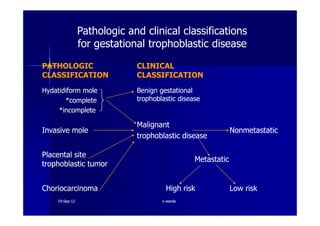
PATHOLOGICPATHOLOGIC
CLASSIFICATIONCLASSIFICATION
CLINICALCLINICAL
CLASSIFICATIONCLASSIFICATION
HydatidiformHydatidiform molemole
*complete*complete
*incomplete*incomplete
Benign gestationalBenign gestational
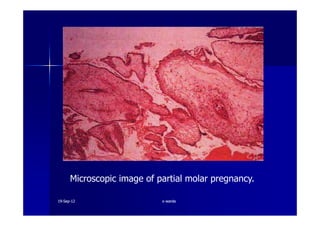
trophoblastic diseasetrophoblastic disease
Pathologic and clinical classifications
for gestational trophoblastic disease
*incomplete*incomplete
Invasive moleInvasive mole
MalignantMalignant
trophoblastic diseasetrophoblastic disease
NonmetastaticNonmetastatic
Placental sitePlacental site
trophoblastic tumortrophoblastic tumor
MetastaticMetastatic
ChoriocarcinomaChoriocarcinoma High riskHigh risk Low riskLow risk
1919--SepSep--1212 o wardao warda
HydatidiformHydatidiform MoleMole
(=vesicular Mole)(=vesicular Mole)(=vesicular Mole)(=vesicular Mole)
(=molar pregnancy)(=molar pregnancy)
1919--SepSep--1212 o wardao warda
Definition and EtiologyDefinition and Etiology
HydatidiformHydatidiform mole is a pregnancymole is a pregnancy
characterized by vesicular swelling ofcharacterized by vesicular swelling of
placentalplacental villivilli and usually the absence ofand usually the absence of
an intact fetus.an intact fetus.an intact fetus.an intact fetus.
The etiology ofThe etiology of hydatidiformhydatidiform molemole
remains unclear, but it appears to be dueremains unclear, but it appears to be due
to abnormalto abnormal gametogenesisgametogenesis andand
fertilizationfertilization
1919--SepSep--1212 o wardao warda
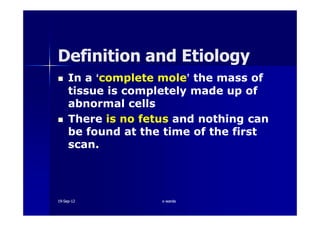
In aIn a ‘‘complete molecomplete mole’’ the mass ofthe mass of
tissue is completely made up oftissue is completely made up of
abnormal cellsabnormal cells
ThereThere is no fetusis no fetus and nothing canand nothing can
Definition and EtiologyDefinition and Etiology
ThereThere is no fetusis no fetus and nothing canand nothing can
be found at the time of the firstbe found at the time of the first
scan.scan.
1919--SepSep--1212 o wardao warda
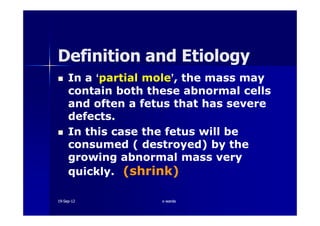
In aIn a ‘‘partial molepartial mole’’,, the mass maythe mass may
contain both these abnormal cellscontain both these abnormal cells
and often a fetus that has severeand often a fetus that has severe
defects.defects.
Definition and EtiologyDefinition and Etiology
defects.defects.
In this case the fetus will beIn this case the fetus will be
consumed ( destroyed) by theconsumed ( destroyed) by the
growing abnormal mass verygrowing abnormal mass very
quickly.quickly. (shrink)(shrink)
1919--SepSep--1212 o wardao warda
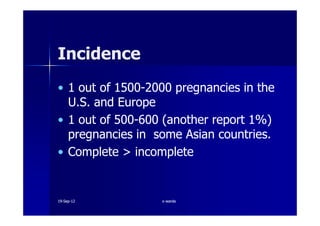
IncidenceIncidence
•• 11 out ofout of 15001500--20002000 pregnancies in thepregnancies in the
U.S. and EuropeU.S. and Europe
•• 11 out ofout of 500500--600600 (another report(another report 11%%))•• 11 out ofout of 500500--600600 (another report(another report 11%%))
pregnancies in some Asian countries.pregnancies in some Asian countries.
•• Complete >Complete > incompleteincomplete
1919--SepSep--1212 o wardao warda
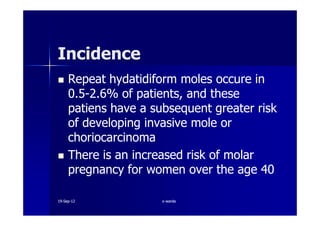
Repeat hydatidiform moles occure inRepeat hydatidiform moles occure in
00..55--22..66% of patients, and these% of patients, and these
patiens have a subsequent greater riskpatiens have a subsequent greater risk
IncidenceIncidence
patiens have a subsequent greater riskpatiens have a subsequent greater risk
of developing invasive mole orof developing invasive mole or
choriocarcinomachoriocarcinoma
There is an increased risk of molarThere is an increased risk of molar
pregnancy for women over the agepregnancy for women over the age 4040
1919--SepSep--1212 o wardao warda
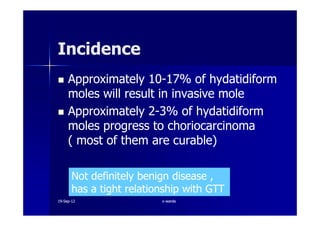
ApproximatelyApproximately 1010--1717% of hydatidiform% of hydatidiform
moles will result in invasive molemoles will result in invasive mole
ApproximatelyApproximately 22--33% of hydatidiform% of hydatidiform
IncidenceIncidence
ApproximatelyApproximately 22--33% of hydatidiform% of hydatidiform
moles progress to choriocarcinomamoles progress to choriocarcinoma
( most of them are curable)( most of them are curable)
Not definitely benign disease ,Not definitely benign disease ,
has a tight relationship with GTThas a tight relationship with GTT
1919--SepSep--1212 o wardao warda
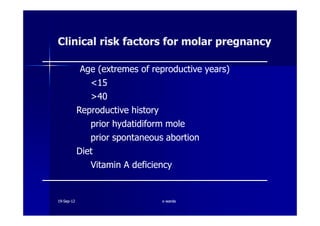
Clinical risk factors for molar pregnancyClinical risk factors for molar pregnancy
Age (extremes of reproductive years)Age (extremes of reproductive years)
<<1515
>>4040
Reproductive historyReproductive historyReproductive historyReproductive history
prior hydatidiform moleprior hydatidiform mole
prior spontaneous abortionprior spontaneous abortion
DietDiet
Vitamin A deficiencyVitamin A deficiency
1919--SepSep--1212 o wardao warda
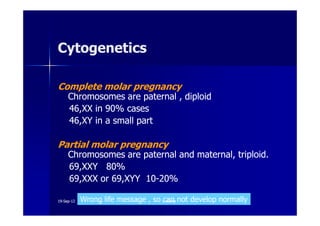
CytogeneticsCytogenetics
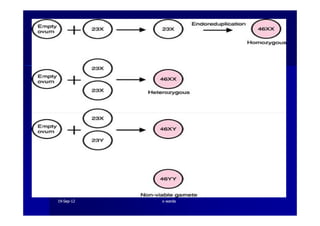
Complete molar pregnancyComplete molar pregnancy
Chromosomes are paternal , diploidChromosomes are paternal , diploid
4646,XX in,XX in 9090% cases% cases4646,XX in,XX in 9090% cases% cases
4646,XY in a small part,XY in a small part
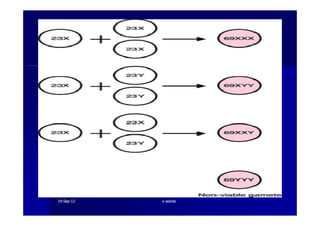
Partial molar pregnancyPartial molar pregnancy
Chromosomes are paternal and maternal, triploid.Chromosomes are paternal and maternal, triploid.
6969,XXY,XXY 8080%%
6969,XXX or,XXX or 6969,XYY,XYY 1010--2020%%
Wrong life message , so can not develop normally1919--SepSep--1212 o wardao warda
1919--SepSep--1212 o wardao warda
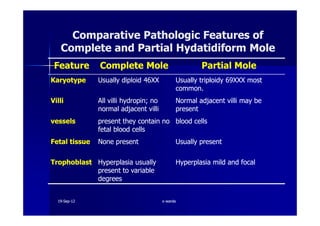
Comparative Pathologic Features ofComparative Pathologic Features of
Complete and Partial Hydatidiform MoleComplete and Partial Hydatidiform Mole
FeatureFeature CompleteComplete MoleMole Partial MolePartial Mole
KaryotypeKaryotype Usually diploidUsually diploid 4646XXXX Usually triploidyUsually triploidy 6969XXX mostXXX most
common.common.
VilliVilli All villi hydropin; noAll villi hydropin; no
normal adjacent villinormal adjacent villi
Normal adjacent villi may beNormal adjacent villi may be
presentpresent
vesselsvessels present they contain nopresent they contain no
fetal blood cellsfetal blood cells
blood cellsblood cells
Fetal tissueFetal tissue None presentNone present Usually presentUsually present
TrophoblastTrophoblast Hyperplasia usuallyHyperplasia usually
present to variablepresent to variable
degreesdegrees
Hyperplasia mild and focalHyperplasia mild and focal
1919--SepSep--1212 o wardao warda
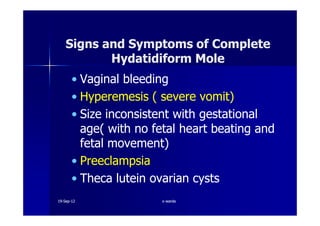
Signs and Symptoms of CompleteSigns and Symptoms of Complete
Hydatidiform MoleHydatidiform Mole
•• Vaginal bleedingVaginal bleeding
•• HyperemesisHyperemesis ( severe vomit)( severe vomit)
•• Size inconsistent with gestationalSize inconsistent with gestational•• Size inconsistent with gestationalSize inconsistent with gestational
age( with no fetal heart beating andage( with no fetal heart beating and
fetal movement)fetal movement)
•• PreeclampsiaPreeclampsia
•• ThecaTheca luteinlutein ovarian cystsovarian cysts
1919--SepSep--1212 o wardao warda
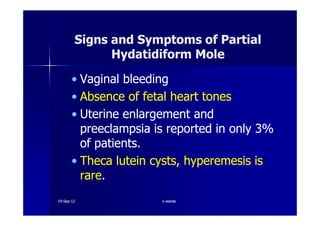
Signs and Symptoms of PartialSigns and Symptoms of Partial
Hydatidiform MoleHydatidiform Mole
•• Vaginal bleedingVaginal bleeding
•• Absence of fetal heart tonesAbsence of fetal heart tones
•• Uterine enlargement andUterine enlargement and•• Uterine enlargement andUterine enlargement and
preeclampsia is reported in onlypreeclampsia is reported in only 33%%
of patients.of patients.
•• ThecaTheca luteinlutein cysts,cysts, hyperemesishyperemesis isis
rarerare..
1919--SepSep--1212 o wardao warda
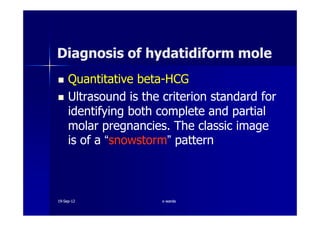
Diagnosis of hydatidiform moleDiagnosis of hydatidiform mole
Quantitative betaQuantitative beta--HCGHCG
Ultrasound is the criterion standard forUltrasound is the criterion standard for
identifying both complete and partialidentifying both complete and partialidentifying both complete and partialidentifying both complete and partial
molar pregnancies. The classic imagemolar pregnancies. The classic image
is of ais of a ““snowstormsnowstorm”” patternpattern
1919--SepSep--1212 o wardao warda
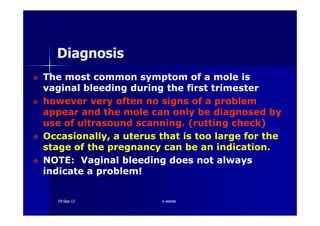
The most common symptom of a mole isThe most common symptom of a mole is
vaginal bleeding during the first trimestervaginal bleeding during the first trimester
however very often no signs of a problemhowever very often no signs of a problem
appear and the mole can only be diagnosed byappear and the mole can only be diagnosed by
DiagnosisDiagnosis
appear and the mole can only be diagnosed byappear and the mole can only be diagnosed by
use of ultrasound scanning. (rutting check)use of ultrasound scanning. (rutting check)
Occasionally, a uterus that is too large for theOccasionally, a uterus that is too large for the
stage of the pregnancy can be an indication.stage of the pregnancy can be an indication.
NOTE: Vaginal bleeding does not alwaysNOTE: Vaginal bleeding does not always
indicate a problem!indicate a problem!
1919--SepSep--1212 o wardao warda
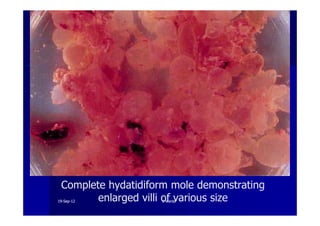
Complete hydatidiform mole demonstrating
enlarged villi of various size1919--SepSep--1212 o wardao warda
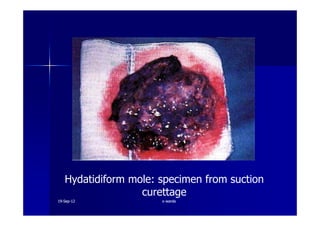
Hydatidiform mole: specimen from suction
curettage
1919--SepSep--1212 o wardao warda
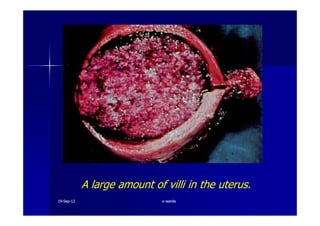
A large amount of villi in the uterus.
1919--SepSep--1212 o wardao warda
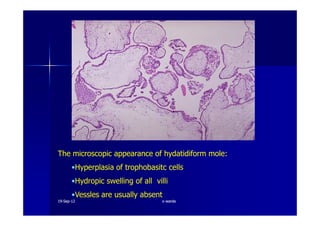
The microscopic appearance of hydatidiform mole:
•Hyperplasia of trophobasitc cells
•Hydropic swelling of all villi
•Vessles are usually absent
1919--SepSep--1212 o wardao warda
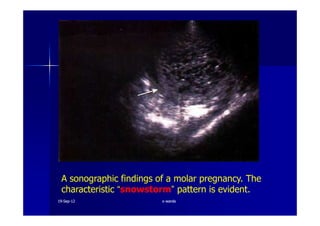
A sonographic findings of a molar pregnancy. The
characteristic “snowstorm” pattern is evident.
1919--SepSep--1212 o wardao warda
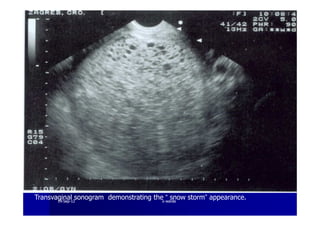
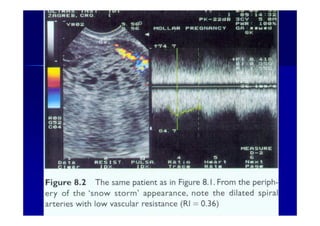
Transvaginal sonogram demonstrating the “ snow storm” appearance.1919--SepSep--1212 o wardao warda
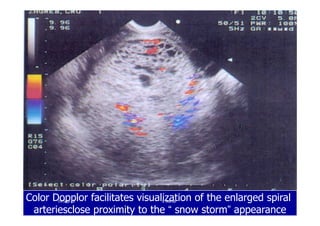
Color Dopplor facilitates visualization of the enlarged spiral
arteriesclose proximity to the “ snow storm” appearance
1919--SepSep--1212 o wardao warda
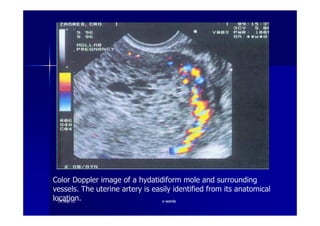
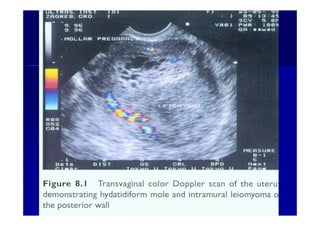
Color Doppler image of a hydatidiform mole and surrounding
vessels. The uterine artery is easily identified from its anatomical
location.1919--SepSep--1212 o wardao warda
1919--SepSep--1212 o wardao warda
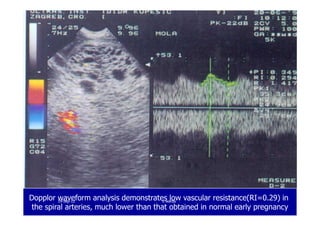
Dopplor waveform analysis demonstrates low vascular resistance(RI=0.29) in
the spiral arteries, much lower than that obtained in normal early pregnancy
1919--SepSep--1212 o wardao warda
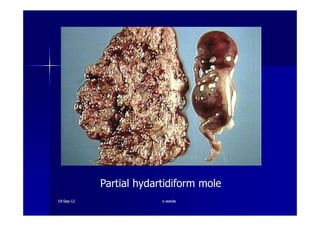
Partial hydartidiform mole
1919--SepSep--1212 o wardao warda
Microscopic image of partial molar pregnancy.
1919--SepSep--1212 o wardao warda
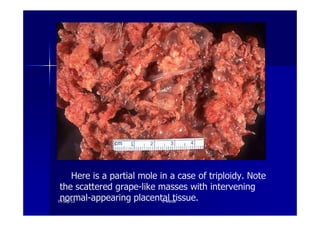
Here is a partial mole in a case of triploidy. Note
the scattered grape-like masses with intervening
normal-appearing placental tissue.1919--SepSep--1212 o wardao warda
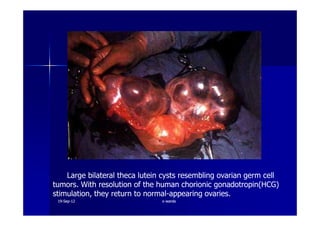
Large bilateral theca lutein cysts resembling ovarian germ cell
tumors. With resolution of the human chorionic gonadotropin(HCG)
stimulation, they return to normal-appearing ovaries.
1919--SepSep--1212 o wardao warda
Differential diagnosisDifferential diagnosis
•• AbortionAbortion
•• Multiple pregnancyMultiple pregnancy
•• PolyhydramniosPolyhydramnios•• PolyhydramniosPolyhydramnios
1919--SepSep--1212 o wardao warda
TreatmentTreatment
Suction dilation and curettageSuction dilation and curettage :to remove:to remove
benignbenign hydatidiformhydatidiform molesmoles
When the diagnosis ofWhen the diagnosis of hydatidiformhydatidiform mole ismole is
established, the molar pregnancy should beestablished, the molar pregnancy should beestablished, the molar pregnancy should beestablished, the molar pregnancy should be
evacuated.evacuated.
AnAn oxytocicoxytocic agent should be infusedagent should be infused
intravenouslyintravenously afterafter the start of evacuationthe start of evacuation
and continued for several hours to enhanceand continued for several hours to enhance
uterine contractilityuterine contractility
1919--SepSep--1212 o wardao warda
•• Removal of the uterus (hysterectomyRemoval of the uterus (hysterectomy)) ::
used rarely to treatused rarely to treat hydatidiformhydatidiform moles ifmoles if
future pregnancy is no longer desired.future pregnancy is no longer desired.
TreatmentTreatment
1919--SepSep--1212 o wardao warda
Chemotherapy with aChemotherapy with a
singlesingle--agent drugagent drug
Prophylactic (for prevention)Prophylactic (for prevention)
chemotherapy at the time ofchemotherapy at the time of
TreatmentTreatment
chemotherapy at the time ofchemotherapy at the time of
or immediately followingor immediately following
molar evacuation may bemolar evacuation may be
considered for the highconsidered for the high--riskrisk
patients( to prevent spreadpatients( to prevent spread
of disease )of disease )
1919--SepSep--1212 oo wardawarda
HighHigh--risk postmolarrisk postmolar
trophoblastic tumortrophoblastic tumor
1.1. PrePre--evacuation uterine size larger than expectedevacuation uterine size larger than expected
for gestational durationfor gestational duration
2.2. Bilateral ovarian enlargement (>Bilateral ovarian enlargement (> 99 cm thecacm theca
lutein cysts)lutein cysts)lutein cysts)lutein cysts)
3.3. Age greater thanAge greater than 4040 yearsyears
4.4. Very high hCG levels(>Very high hCG levels(>100100,,000000 m IU/ml)m IU/ml)
5.5. Medical complications of molar pregnancy such asMedical complications of molar pregnancy such as
toxemia, hyperthyrodism and trophoblastictoxemia, hyperthyrodism and trophoblastic
embolization (villi come out of placenta )embolization (villi come out of placenta )
6.6. repeat hydatidiform molerepeat hydatidiform mole
1919--SepSep--1212 o wardao warda
Patients with hudatidiform mole arePatients with hudatidiform mole are
curative overcurative over 8080% by treatment of% by treatment of
evacuation.evacuation.
FollowFollow--upup
evacuation.evacuation.
The followThe follow--up after evacuation is keyup after evacuation is key
necessarynecessary
uterine involution, ovarian cystuterine involution, ovarian cyst
regression and cessation of bleedingregression and cessation of bleeding
1919--SepSep--1212 o wardao warda
Quantitative serum hCG levels shouldQuantitative serum hCG levels should
be obtained everybe obtained every 11--22 weeks untilweeks until
negative for three consecutivenegative for three consecutive
determinations,determinations,
FollowFollow--upup
determinations,determinations,
Followed by everyFollowed by every 33 months formonths for 11
years.years.
Contraception should be practicedContraception should be practiced
during this followduring this follow--up periodup period
1919--SepSep--1212 o wardao warda
Invasive moleInvasive moleInvasive moleInvasive mole
1919--SepSep--1212 o wardao warda
DefinitionDefinition
This term is applied to a molarThis term is applied to a molar
pregnancy in which molar villi growpregnancy in which molar villi grow
into the myometrium or its bloodinto the myometrium or its bloodinto the myometrium or its bloodinto the myometrium or its blood
vessels, and may extend into thevessels, and may extend into the
broad ligament and metastasize to thebroad ligament and metastasize to the
lungs, the vagina or the vulva.lungs, the vagina or the vulva.
1919--SepSep--1212 o wardao warda
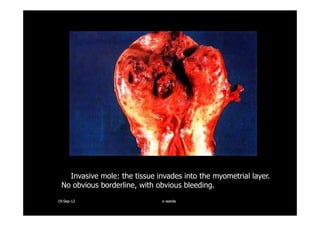
Invasive mole: the tissue invades into the myometrial layer.
No obvious borderline, with obvious bleeding.
1919--SepSep--1212 o wardao warda
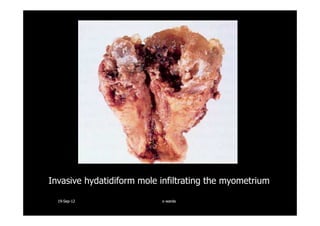
Invasive hydatidiform mole infiltrating the myometrium
1919--SepSep--1212 o wardao warda
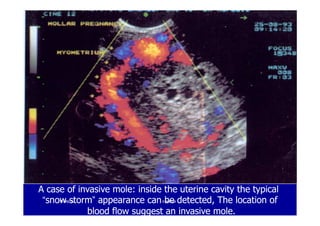
A case of invasive mole: inside the uterine cavity the typicalA case of invasive mole: inside the uterine cavity the typical
““snow stormsnow storm”” appearance can be detected, The location ofappearance can be detected, The location of
blood flow suggest an invasive mole.blood flow suggest an invasive mole.
1919--SepSep--1212 o wardao warda
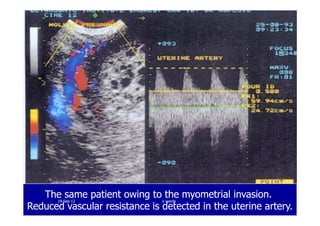
The same patient owing to the myometrial invasion.The same patient owing to the myometrial invasion.
Reduced vascular resistance is detected in the uterine artery.Reduced vascular resistance is detected in the uterine artery.
1919--SepSep--1212 o wardao warda
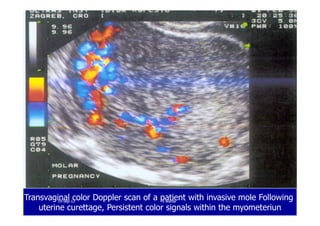
Transvaginal color Doppler scan of a patient with invasive mole Following
uterine curettage, Persistent color signals within the myometeriun
1919--SepSep--1212 o wardao warda
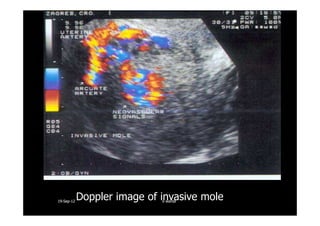
Doppler image of invasive mole1919--SepSep--1212 o wardao warda
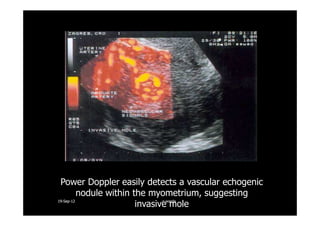
Power Doppler easily detects a vascular echogenic
nodule within the myometrium, suggesting
invasive mole1919--SepSep--1212 o wardao warda
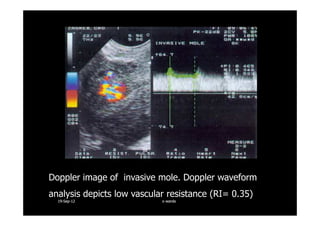
Doppler image of invasive mole. Doppler waveform
analysis depicts low vascular resistance (RI= 0.35)
1919--SepSep--1212 o wardao warda
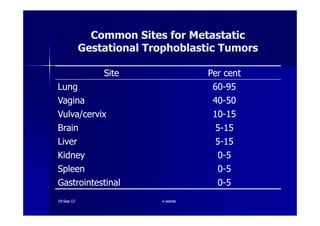
Common Sites for MetastaticCommon Sites for Metastatic
Gestational Trophoblastic TumorsGestational Trophoblastic Tumors
SiteSite Per centPer cent
LungLung 6060--9595
VaginaVagina 4040--5050
Vulva/cervixVulva/cervix 1010--1515Vulva/cervixVulva/cervix 1010--1515
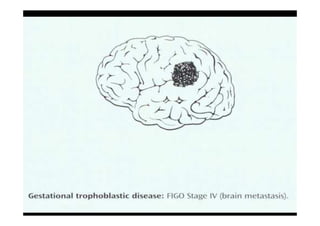
BrainBrain 55--1515
LiverLiver 55--1515
KidneyKidney 00--55
SpleenSpleen 00--55
GastrointestinalGastrointestinal 00--55
1919--SepSep--1212 o wardao warda
ChoriocarcinomaChoriocarcinomaChoriocarcinomaChoriocarcinoma
1919--SepSep--1212 o wardao warda
DefinitionDefinition
A malignant form of GTD whichA malignant form of GTD which
can develop from a hydatidiform molecan develop from a hydatidiform mole
or from placental trophoblast cellsor from placental trophoblast cellsor from placental trophoblast cellsor from placental trophoblast cells
associated with a healthy fetus ,anassociated with a healthy fetus ,an
abortion or an ectopic pregnancy.abortion or an ectopic pregnancy.
1919--SepSep--1212 o wardao warda
Characterized by abnormalCharacterized by abnormal
trophoblastic hyperplasia andtrophoblastic hyperplasia and
anaplasia , absence of chorionic villianaplasia , absence of chorionic villi
DefinitionDefinition
anaplasia , absence of chorionic villianaplasia , absence of chorionic villi
1919--SepSep--1212 o wardao warda
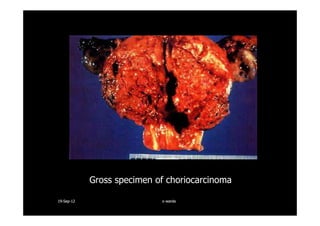
Gross specimen of choriocarcinoma
1919--SepSep--1212 o wardao warda
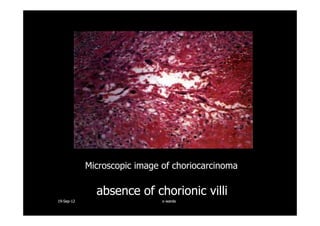
Microscopic image of choriocarcinoma
absence of chorionic villiabsence of chorionic villi
1919--SepSep--1212 o wardao warda
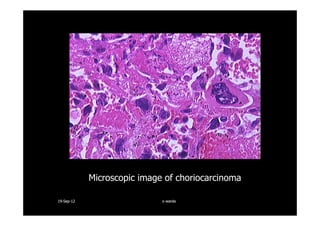
Microscopic image of choriocarcinoma
1919--SepSep--1212 o wardao warda
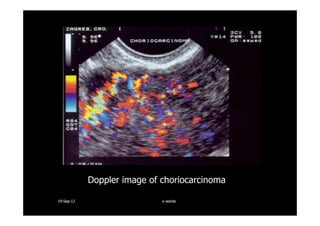
Doppler image of choriocarcinoma
1919--SepSep--1212 o wardao warda
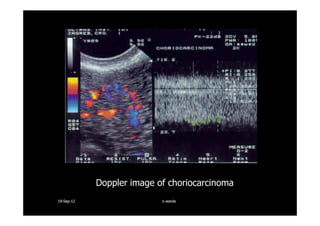
Doppler image of choriocarcinoma
1919--SepSep--1212 o wardao warda
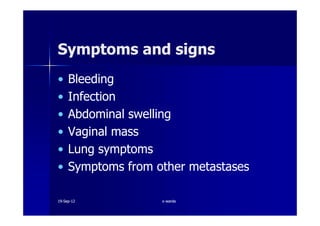
Symptoms and signsSymptoms and signs
•• BleedingBleeding
•• InfectionInfection
•• Abdominal swellingAbdominal swelling•• Abdominal swellingAbdominal swelling
•• Vaginal massVaginal mass
•• Lung symptomsLung symptoms
•• Symptoms from other metastasesSymptoms from other metastases
1919--SepSep--1212 o wardao warda
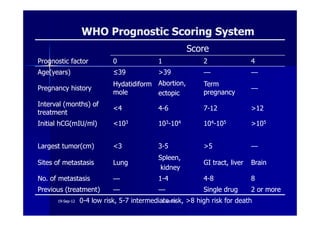
WHO Prognostic Scoring SystemWHO Prognostic Scoring System
ScoreScore
Prognostic factorPrognostic factor 00 11 22 44
Age(years)Age(years) ≤≤3939 >>3939 —— ——
Pregnancy historyPregnancy history
HydatidiformHydatidiform
molemole
Abortion,Abortion,
ectopicectopic
TermTerm
pregnancypregnancy
——
Interval (months) ofInterval (months) of
treatmenttreatment
<<44 44--66 77--1212 >>1212
treatmenttreatment
Initial hCG(mIU/ml)Initial hCG(mIU/ml) <<101033 101033--101044 101044--101055 >>101055
Largest tumor(cm)Largest tumor(cm) <<33 33--55 >>55 ——
Sites of metastasisSites of metastasis LungLung
Spleen,Spleen,
kidneykidney
GI tract, liverGI tract, liver BrainBrain
No. of metastasisNo. of metastasis —— 11--44 44--88 88
Previous (treatment)Previous (treatment) —— —— Single drugSingle drug 22 or moreor more
0-4 low risk, 5-7 intermediate risk, >8 high risk for death1919--SepSep--1212 o wardao warda
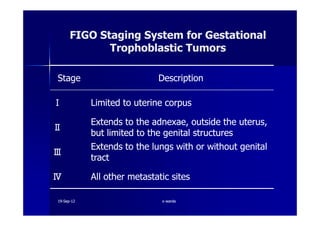
FIGO Staging System for GestationalFIGO Staging System for Gestational
Trophoblastic TumorsTrophoblastic Tumors
StageStage DescriptionDescription
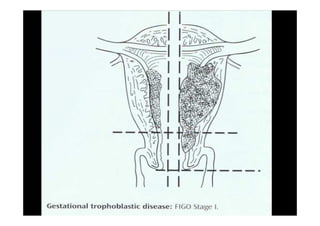
ⅠⅠ Limited to uterine corpusLimited to uterine corpus
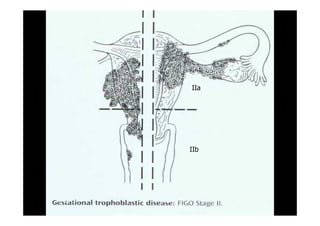
ⅡⅡ
Extends to the adnexae, outside the uterus,Extends to the adnexae, outside the uterus,
but limited to the genital structuresbut limited to the genital structures
ⅢⅢ
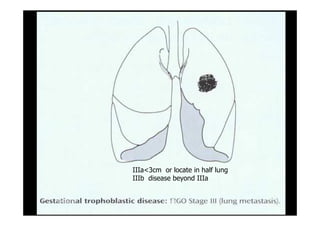
Extends to the lungs with or without genitalExtends to the lungs with or without genital
tracttract
ⅣⅣ All other metastatic sitesAll other metastatic sites
1919--SepSep--1212 o wardao warda
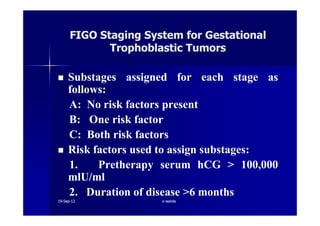
SubstagesSubstages assignedassigned forfor eacheach stagestage asas
followsfollows::
AA:: NoNo riskrisk factorsfactors presentpresent
BB:: OneOne riskrisk factorfactor
FIGO Staging System for GestationalFIGO Staging System for Gestational
Trophoblastic TumorsTrophoblastic Tumors
BB:: OneOne riskrisk factorfactor
CC:: BothBoth riskrisk factorsfactors
RiskRisk factorsfactors usedused toto assignassign substagessubstages::
11.. PretherapyPretherapy serumserum hCGhCG >> 100100,,000000
mlU/mlmlU/ml
22.. DurationDuration ofof diseasedisease >>66 monthsmonths
1919--SepSep--1212 o wardao warda
IIa
IIb
1919--SepSep--1212 o wardao warda
IIIa<3cm or locate in half lung
IIIb disease beyond IIIa
1919--SepSep--1212 o wardao warda
Diagnosis and evaluationDiagnosis and evaluation
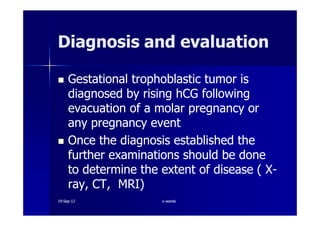
Gestational trophoblastic tumor isGestational trophoblastic tumor is
diagnosed by rising hCG followingdiagnosed by rising hCG following
evacuation of a molar pregnancy orevacuation of a molar pregnancy orevacuation of a molar pregnancy orevacuation of a molar pregnancy or
any pregnancy eventany pregnancy event
Once the diagnosis established theOnce the diagnosis established the
further examinations should be donefurther examinations should be done
to determine the extent of disease ( Xto determine the extent of disease ( X--
ray, CT, MRI)ray, CT, MRI)
1919--SepSep--1212 o wardao warda
TreatmentTreatment
Nonmetastatic GTDNonmetastatic GTD
LowLow--Risk Metastatic GTDRisk Metastatic GTD
HighHigh--Risk Metastatic GTDRisk Metastatic GTDHighHigh--Risk Metastatic GTDRisk Metastatic GTD
1919--SepSep--1212 o wardao warda
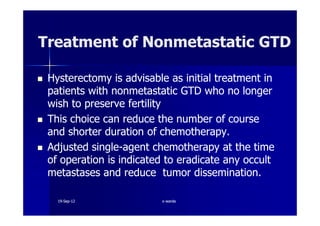
Treatment of Nonmetastatic GTDTreatment of Nonmetastatic GTD
Hysterectomy is advisable as initial treatment inHysterectomy is advisable as initial treatment in
patients with nonmetastatic GTD who no longerpatients with nonmetastatic GTD who no longer
wish to preserve fertilitywish to preserve fertility
This choice can reduce the number of courseThis choice can reduce the number of courseThis choice can reduce the number of courseThis choice can reduce the number of course
and shorter duration of chemotherapy.and shorter duration of chemotherapy.
Adjusted singleAdjusted single--agent chemotherapy at the timeagent chemotherapy at the time
of operation is indicated to eradicate any occultof operation is indicated to eradicate any occult
metastases and reduce tumor dissemination.metastases and reduce tumor dissemination.
1919--SepSep--1212 o wardao warda
SingleSingle--agent chemotherapy is the treatment ofagent chemotherapy is the treatment of
choice for patients wishing to preserve theirchoice for patients wishing to preserve their
fertility.fertility.
Methotrexate(MTX) and ActinomycinMethotrexate(MTX) and Actinomycin--D areD are
Treatment of Nonmetastatic GTDTreatment of Nonmetastatic GTD
Methotrexate(MTX) and ActinomycinMethotrexate(MTX) and Actinomycin--D areD are
generally chemotherapy agentsgenerally chemotherapy agents
Treatment is continued until three consecutiveTreatment is continued until three consecutive
normal hCG levels have been obtained and twonormal hCG levels have been obtained and two
courses have been given after the first normalcourses have been given after the first normal
hCG level.hCG level.
To prevent relapse or metastasisTo prevent relapse or metastasis1919--SepSep--1212 o wardao warda
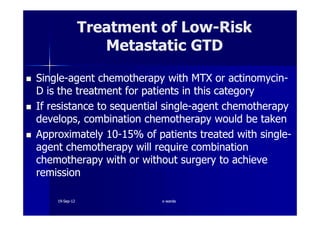
SingleSingle--agent chemotherapy with MTX or actinomycinagent chemotherapy with MTX or actinomycin--
D is the treatment for patients in this categoryD is the treatment for patients in this category
If resistance to sequential singleIf resistance to sequential single--agent chemotherapyagent chemotherapy
develops, combination chemotherapy would be takendevelops, combination chemotherapy would be taken
Treatment of LowTreatment of Low--RiskRisk
Metastatic GTDMetastatic GTD
develops, combination chemotherapy would be takendevelops, combination chemotherapy would be taken
ApproximatelyApproximately 1010--1515% of patients treated with single% of patients treated with single--
agent chemotherapy will require combinationagent chemotherapy will require combination
chemotherapy with or without surgery to achievechemotherapy with or without surgery to achieve
remissionremission
1919--SepSep--1212 o wardao warda
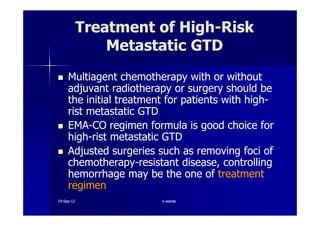
Multiagent chemotherapy with or withoutMultiagent chemotherapy with or without
adjuvant radiotherapy or surgery should beadjuvant radiotherapy or surgery should be
the initial treatment for patients with highthe initial treatment for patients with high--
rist metastatic GTDrist metastatic GTD
Treatment of HighTreatment of High--RiskRisk
Metastatic GTDMetastatic GTD
rist metastatic GTDrist metastatic GTD
EMAEMA--CO regimen formula is good choice forCO regimen formula is good choice for
highhigh--rist metastatic GTDrist metastatic GTD
Adjusted surgeries such as removing foci ofAdjusted surgeries such as removing foci of
chemotherapychemotherapy--resistant disease, controllingresistant disease, controlling
hemorrhage may be the one ofhemorrhage may be the one of treatmenttreatment
regimenregimen
1919--SepSep--1212 o wardao warda
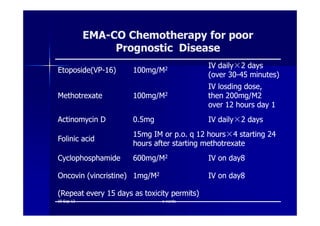
EMAEMA--CO Chemotherapy for poorCO Chemotherapy for poor
Prognostic DiseasePrognostic Disease
Etoposide(VPEtoposide(VP--1616)) 100100mg/Mmg/M22 IV dailyIV daily××22 daysdays
(over(over 3030--4545 minutes)minutes)
MethotrexateMethotrexate 100100mg/Mmg/M22
IV losding dose,IV losding dose,
thenthen 200200mg/Mmg/M22
overover 1212 hours dayhours day 11
Actinomycin DActinomycin D 00..55mgmg IV dailyIV daily××22 daysdays
Folinic acidFolinic acid
1515mg IM or p.o. qmg IM or p.o. q 1212 hourshours××44 startingstarting 2424
hours after starting methotrexatehours after starting methotrexate
CyclophosphamideCyclophosphamide 600600mg/Mmg/M22 IV on dayIV on day88
Oncovin (vincristine)Oncovin (vincristine) 11mg/Mmg/M22 IV on dayIV on day88
((Repeat everyRepeat every 1515 days as toxicity permits)days as toxicity permits)
1919--SepSep--1212 o wardao warda
PrognosisPrognosis
Cure rates should approachCure rates should approach 100100% in% in
nonmetastatic and lownonmetastatic and low--risk metastaticrisk metastatic
GTDGTDGTDGTD
Intensive multimodality therapy hasIntensive multimodality therapy has
resulted in cure rates ofresulted in cure rates of 8080--9090% in% in
patients with highpatients with high--risk metastatic GTDrisk metastatic GTD
1919--SepSep--1212 o wardao warda
FollowFollow--up After Successfulup After Successful
TreatmentTreatment
Quantitative serum hCG levels should beQuantitative serum hCG levels should be
obtained monthly forobtained monthly for 66 months, every twomonths, every two
months for remainder of the first year,months for remainder of the first year,months for remainder of the first year,months for remainder of the first year,
everyevery 33 months during the second yearmonths during the second year
Contraception should be maintained for atContraception should be maintained for at
leastleast 11 year after the completion ofyear after the completion of
chemotherapy. Condom is the choice.chemotherapy. Condom is the choice.
1919--SepSep--1212 o wardao warda
Placenta Site TrophoblasticPlacenta Site Trophoblastic
Tumor (PSTT)Tumor (PSTT)Tumor (PSTT)Tumor (PSTT)
1919--SepSep--1212 o wardao warda
Placenta Site Trophoblastic Tumor is anPlacenta Site Trophoblastic Tumor is an
extremely rare tumor that arised from theextremely rare tumor that arised from the
placental implantation siteplacental implantation site
Tumor cells infiltrate the myometrium andTumor cells infiltrate the myometrium and
DefinitionDefinition
Tumor cells infiltrate the myometrium andTumor cells infiltrate the myometrium and
grow between smoothgrow between smooth--muscle cellsmuscle cells
1919--SepSep--1212 o wardao warda
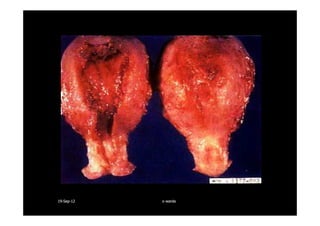
Surum hCG levels are relatively lowSurum hCG levels are relatively low
compared to those seen withcompared to those seen with
choriocarcinoma.choriocarcinoma.
Several reports have noted a benignSeveral reports have noted a benign
Dignosis and treatmentDignosis and treatment
Several reports have noted a benignSeveral reports have noted a benign
behavior of this disease. They are relativelybehavior of this disease. They are relatively
chemotherapychemotherapy--resistant, and deaths fromresistant, and deaths from
metastasis have occurred.metastasis have occurred.
Surgery has been the mainstay of treatmentSurgery has been the mainstay of treatment
1919--SepSep--1212 o wardao warda

gestational trophoblastic disease GTD

  • 1.
    GestationalGestational TrophoblasticTrophoblastic Disease (GTD)Disease(GTD)Disease (GTD)Disease (GTD) Osama M Warda, MD Obstetrics & Gynecology department Mansoura Faculty of Medicine
  • 2.
    Types of GTDTypesof GTD BenignBenign •• HydatidiformHydatidiform mole/molar pregnancymole/molar pregnancy (complete or incomplete)(complete or incomplete)(complete or incomplete)(complete or incomplete) malignantmalignant •• Invasive moleInvasive mole •• ChoriocarcinomaChoriocarcinoma ((chorioepitheliomachorioepithelioma)) •• Placental sitePlacental site trophoblastictrophoblastic tumortumor 1919--SepSep--1212 o wardao warda
  • 3.
    The termThe termGestationalGestational TrophoblasticTrophoblastic TumorsTumors has been applied the latterhas been applied the latter three conditionsthree conditions AriseArise from thefrom the trophoblastictrophoblastic elementselements Types of GTDTypes of GTD AriseArise from thefrom the trophoblastictrophoblastic elementselements RetainRetain the invasive tendencies of thethe invasive tendencies of the normal placenta or metastasisnormal placenta or metastasis Keep secretion of the human chorionicKeep secretion of the human chorionic gonadotropingonadotropin ((hCGhCG)) 1919--SepSep--1212 o wardao warda
  • 4.
    PATHOLOGICPATHOLOGIC CLASSIFICATIONCLASSIFICATION CLINICALCLINICAL CLASSIFICATIONCLASSIFICATION HydatidiformHydatidiform molemole *complete*complete *incomplete*incomplete Benign gestationalBenigngestational trophoblastic diseasetrophoblastic disease Pathologic and clinical classifications for gestational trophoblastic disease *incomplete*incomplete Invasive moleInvasive mole MalignantMalignant trophoblastic diseasetrophoblastic disease NonmetastaticNonmetastatic Placental sitePlacental site trophoblastic tumortrophoblastic tumor MetastaticMetastatic ChoriocarcinomaChoriocarcinoma High riskHigh risk Low riskLow risk 1919--SepSep--1212 o wardao warda
  • 5.
    HydatidiformHydatidiform MoleMole (=vesicular Mole)(=vesicularMole)(=vesicular Mole)(=vesicular Mole) (=molar pregnancy)(=molar pregnancy) 1919--SepSep--1212 o wardao warda
  • 6.
    Definition and EtiologyDefinitionand Etiology HydatidiformHydatidiform mole is a pregnancymole is a pregnancy characterized by vesicular swelling ofcharacterized by vesicular swelling of placentalplacental villivilli and usually the absence ofand usually the absence of an intact fetus.an intact fetus.an intact fetus.an intact fetus. The etiology ofThe etiology of hydatidiformhydatidiform molemole remains unclear, but it appears to be dueremains unclear, but it appears to be due to abnormalto abnormal gametogenesisgametogenesis andand fertilizationfertilization 1919--SepSep--1212 o wardao warda
  • 7.
    In aIn a‘‘complete molecomplete mole’’ the mass ofthe mass of tissue is completely made up oftissue is completely made up of abnormal cellsabnormal cells ThereThere is no fetusis no fetus and nothing canand nothing can Definition and EtiologyDefinition and Etiology ThereThere is no fetusis no fetus and nothing canand nothing can be found at the time of the firstbe found at the time of the first scan.scan. 1919--SepSep--1212 o wardao warda
  • 8.
    In aIn a‘‘partial molepartial mole’’,, the mass maythe mass may contain both these abnormal cellscontain both these abnormal cells and often a fetus that has severeand often a fetus that has severe defects.defects. Definition and EtiologyDefinition and Etiology defects.defects. In this case the fetus will beIn this case the fetus will be consumed ( destroyed) by theconsumed ( destroyed) by the growing abnormal mass verygrowing abnormal mass very quickly.quickly. (shrink)(shrink) 1919--SepSep--1212 o wardao warda
  • 9.
    IncidenceIncidence •• 11 outofout of 15001500--20002000 pregnancies in thepregnancies in the U.S. and EuropeU.S. and Europe •• 11 out ofout of 500500--600600 (another report(another report 11%%))•• 11 out ofout of 500500--600600 (another report(another report 11%%)) pregnancies in some Asian countries.pregnancies in some Asian countries. •• Complete >Complete > incompleteincomplete 1919--SepSep--1212 o wardao warda
  • 10.
    Repeat hydatidiform molesoccure inRepeat hydatidiform moles occure in 00..55--22..66% of patients, and these% of patients, and these patiens have a subsequent greater riskpatiens have a subsequent greater risk IncidenceIncidence patiens have a subsequent greater riskpatiens have a subsequent greater risk of developing invasive mole orof developing invasive mole or choriocarcinomachoriocarcinoma There is an increased risk of molarThere is an increased risk of molar pregnancy for women over the agepregnancy for women over the age 4040 1919--SepSep--1212 o wardao warda
  • 11.
    ApproximatelyApproximately 1010--1717% ofhydatidiform% of hydatidiform moles will result in invasive molemoles will result in invasive mole ApproximatelyApproximately 22--33% of hydatidiform% of hydatidiform IncidenceIncidence ApproximatelyApproximately 22--33% of hydatidiform% of hydatidiform moles progress to choriocarcinomamoles progress to choriocarcinoma ( most of them are curable)( most of them are curable) Not definitely benign disease ,Not definitely benign disease , has a tight relationship with GTThas a tight relationship with GTT 1919--SepSep--1212 o wardao warda
  • 12.
    Clinical risk factorsfor molar pregnancyClinical risk factors for molar pregnancy Age (extremes of reproductive years)Age (extremes of reproductive years) <<1515 >>4040 Reproductive historyReproductive historyReproductive historyReproductive history prior hydatidiform moleprior hydatidiform mole prior spontaneous abortionprior spontaneous abortion DietDiet Vitamin A deficiencyVitamin A deficiency 1919--SepSep--1212 o wardao warda
  • 13.
    CytogeneticsCytogenetics Complete molar pregnancyCompletemolar pregnancy Chromosomes are paternal , diploidChromosomes are paternal , diploid 4646,XX in,XX in 9090% cases% cases4646,XX in,XX in 9090% cases% cases 4646,XY in a small part,XY in a small part Partial molar pregnancyPartial molar pregnancy Chromosomes are paternal and maternal, triploid.Chromosomes are paternal and maternal, triploid. 6969,XXY,XXY 8080%% 6969,XXX or,XXX or 6969,XYY,XYY 1010--2020%% Wrong life message , so can not develop normally1919--SepSep--1212 o wardao warda
  • 14.
  • 15.
  • 16.
    Comparative Pathologic FeaturesofComparative Pathologic Features of Complete and Partial Hydatidiform MoleComplete and Partial Hydatidiform Mole FeatureFeature CompleteComplete MoleMole Partial MolePartial Mole KaryotypeKaryotype Usually diploidUsually diploid 4646XXXX Usually triploidyUsually triploidy 6969XXX mostXXX most common.common. VilliVilli All villi hydropin; noAll villi hydropin; no normal adjacent villinormal adjacent villi Normal adjacent villi may beNormal adjacent villi may be presentpresent vesselsvessels present they contain nopresent they contain no fetal blood cellsfetal blood cells blood cellsblood cells Fetal tissueFetal tissue None presentNone present Usually presentUsually present TrophoblastTrophoblast Hyperplasia usuallyHyperplasia usually present to variablepresent to variable degreesdegrees Hyperplasia mild and focalHyperplasia mild and focal 1919--SepSep--1212 o wardao warda
  • 17.
    Signs and Symptomsof CompleteSigns and Symptoms of Complete Hydatidiform MoleHydatidiform Mole •• Vaginal bleedingVaginal bleeding •• HyperemesisHyperemesis ( severe vomit)( severe vomit) •• Size inconsistent with gestationalSize inconsistent with gestational•• Size inconsistent with gestationalSize inconsistent with gestational age( with no fetal heart beating andage( with no fetal heart beating and fetal movement)fetal movement) •• PreeclampsiaPreeclampsia •• ThecaTheca luteinlutein ovarian cystsovarian cysts 1919--SepSep--1212 o wardao warda
  • 18.
    Signs and Symptomsof PartialSigns and Symptoms of Partial Hydatidiform MoleHydatidiform Mole •• Vaginal bleedingVaginal bleeding •• Absence of fetal heart tonesAbsence of fetal heart tones •• Uterine enlargement andUterine enlargement and•• Uterine enlargement andUterine enlargement and preeclampsia is reported in onlypreeclampsia is reported in only 33%% of patients.of patients. •• ThecaTheca luteinlutein cysts,cysts, hyperemesishyperemesis isis rarerare.. 1919--SepSep--1212 o wardao warda
  • 19.
    Diagnosis of hydatidiformmoleDiagnosis of hydatidiform mole Quantitative betaQuantitative beta--HCGHCG Ultrasound is the criterion standard forUltrasound is the criterion standard for identifying both complete and partialidentifying both complete and partialidentifying both complete and partialidentifying both complete and partial molar pregnancies. The classic imagemolar pregnancies. The classic image is of ais of a ““snowstormsnowstorm”” patternpattern 1919--SepSep--1212 o wardao warda
  • 20.
    The most commonsymptom of a mole isThe most common symptom of a mole is vaginal bleeding during the first trimestervaginal bleeding during the first trimester however very often no signs of a problemhowever very often no signs of a problem appear and the mole can only be diagnosed byappear and the mole can only be diagnosed by DiagnosisDiagnosis appear and the mole can only be diagnosed byappear and the mole can only be diagnosed by use of ultrasound scanning. (rutting check)use of ultrasound scanning. (rutting check) Occasionally, a uterus that is too large for theOccasionally, a uterus that is too large for the stage of the pregnancy can be an indication.stage of the pregnancy can be an indication. NOTE: Vaginal bleeding does not alwaysNOTE: Vaginal bleeding does not always indicate a problem!indicate a problem! 1919--SepSep--1212 o wardao warda
  • 21.
    Complete hydatidiform moledemonstrating enlarged villi of various size1919--SepSep--1212 o wardao warda
  • 22.
    Hydatidiform mole: specimenfrom suction curettage 1919--SepSep--1212 o wardao warda
  • 23.
    A large amountof villi in the uterus. 1919--SepSep--1212 o wardao warda
  • 24.
    The microscopic appearanceof hydatidiform mole: •Hyperplasia of trophobasitc cells •Hydropic swelling of all villi •Vessles are usually absent 1919--SepSep--1212 o wardao warda
  • 25.
    A sonographic findingsof a molar pregnancy. The characteristic “snowstorm” pattern is evident. 1919--SepSep--1212 o wardao warda
  • 26.
    Transvaginal sonogram demonstratingthe “ snow storm” appearance.1919--SepSep--1212 o wardao warda
  • 27.
    Color Dopplor facilitatesvisualization of the enlarged spiral arteriesclose proximity to the “ snow storm” appearance 1919--SepSep--1212 o wardao warda
  • 28.
    Color Doppler imageof a hydatidiform mole and surrounding vessels. The uterine artery is easily identified from its anatomical location.1919--SepSep--1212 o wardao warda
  • 29.
  • 30.
    Dopplor waveform analysisdemonstrates low vascular resistance(RI=0.29) in the spiral arteries, much lower than that obtained in normal early pregnancy 1919--SepSep--1212 o wardao warda
  • 31.
  • 32.
  • 33.
    Microscopic image ofpartial molar pregnancy. 1919--SepSep--1212 o wardao warda
  • 34.
    Here is apartial mole in a case of triploidy. Note the scattered grape-like masses with intervening normal-appearing placental tissue.1919--SepSep--1212 o wardao warda
  • 35.
    Large bilateral thecalutein cysts resembling ovarian germ cell tumors. With resolution of the human chorionic gonadotropin(HCG) stimulation, they return to normal-appearing ovaries. 1919--SepSep--1212 o wardao warda
  • 36.
    Differential diagnosisDifferential diagnosis ••AbortionAbortion •• Multiple pregnancyMultiple pregnancy •• PolyhydramniosPolyhydramnios•• PolyhydramniosPolyhydramnios 1919--SepSep--1212 o wardao warda
  • 37.
    TreatmentTreatment Suction dilation andcurettageSuction dilation and curettage :to remove:to remove benignbenign hydatidiformhydatidiform molesmoles When the diagnosis ofWhen the diagnosis of hydatidiformhydatidiform mole ismole is established, the molar pregnancy should beestablished, the molar pregnancy should beestablished, the molar pregnancy should beestablished, the molar pregnancy should be evacuated.evacuated. AnAn oxytocicoxytocic agent should be infusedagent should be infused intravenouslyintravenously afterafter the start of evacuationthe start of evacuation and continued for several hours to enhanceand continued for several hours to enhance uterine contractilityuterine contractility 1919--SepSep--1212 o wardao warda
  • 38.
    •• Removal ofthe uterus (hysterectomyRemoval of the uterus (hysterectomy)) :: used rarely to treatused rarely to treat hydatidiformhydatidiform moles ifmoles if future pregnancy is no longer desired.future pregnancy is no longer desired. TreatmentTreatment 1919--SepSep--1212 o wardao warda
  • 39.
    Chemotherapy with aChemotherapywith a singlesingle--agent drugagent drug Prophylactic (for prevention)Prophylactic (for prevention) chemotherapy at the time ofchemotherapy at the time of TreatmentTreatment chemotherapy at the time ofchemotherapy at the time of or immediately followingor immediately following molar evacuation may bemolar evacuation may be considered for the highconsidered for the high--riskrisk patients( to prevent spreadpatients( to prevent spread of disease )of disease ) 1919--SepSep--1212 oo wardawarda
  • 40.
    HighHigh--risk postmolarrisk postmolar trophoblastictumortrophoblastic tumor 1.1. PrePre--evacuation uterine size larger than expectedevacuation uterine size larger than expected for gestational durationfor gestational duration 2.2. Bilateral ovarian enlargement (>Bilateral ovarian enlargement (> 99 cm thecacm theca lutein cysts)lutein cysts)lutein cysts)lutein cysts) 3.3. Age greater thanAge greater than 4040 yearsyears 4.4. Very high hCG levels(>Very high hCG levels(>100100,,000000 m IU/ml)m IU/ml) 5.5. Medical complications of molar pregnancy such asMedical complications of molar pregnancy such as toxemia, hyperthyrodism and trophoblastictoxemia, hyperthyrodism and trophoblastic embolization (villi come out of placenta )embolization (villi come out of placenta ) 6.6. repeat hydatidiform molerepeat hydatidiform mole 1919--SepSep--1212 o wardao warda
  • 41.
    Patients with hudatidiformmole arePatients with hudatidiform mole are curative overcurative over 8080% by treatment of% by treatment of evacuation.evacuation. FollowFollow--upup evacuation.evacuation. The followThe follow--up after evacuation is keyup after evacuation is key necessarynecessary uterine involution, ovarian cystuterine involution, ovarian cyst regression and cessation of bleedingregression and cessation of bleeding 1919--SepSep--1212 o wardao warda
  • 42.
    Quantitative serum hCGlevels shouldQuantitative serum hCG levels should be obtained everybe obtained every 11--22 weeks untilweeks until negative for three consecutivenegative for three consecutive determinations,determinations, FollowFollow--upup determinations,determinations, Followed by everyFollowed by every 33 months formonths for 11 years.years. Contraception should be practicedContraception should be practiced during this followduring this follow--up periodup period 1919--SepSep--1212 o wardao warda
  • 43.
    Invasive moleInvasive moleInvasivemoleInvasive mole 1919--SepSep--1212 o wardao warda
  • 44.
    DefinitionDefinition This term isapplied to a molarThis term is applied to a molar pregnancy in which molar villi growpregnancy in which molar villi grow into the myometrium or its bloodinto the myometrium or its bloodinto the myometrium or its bloodinto the myometrium or its blood vessels, and may extend into thevessels, and may extend into the broad ligament and metastasize to thebroad ligament and metastasize to the lungs, the vagina or the vulva.lungs, the vagina or the vulva. 1919--SepSep--1212 o wardao warda
  • 45.
    Invasive mole: thetissue invades into the myometrial layer. No obvious borderline, with obvious bleeding. 1919--SepSep--1212 o wardao warda
  • 46.
    Invasive hydatidiform moleinfiltrating the myometrium 1919--SepSep--1212 o wardao warda
  • 47.
    A case ofinvasive mole: inside the uterine cavity the typicalA case of invasive mole: inside the uterine cavity the typical ““snow stormsnow storm”” appearance can be detected, The location ofappearance can be detected, The location of blood flow suggest an invasive mole.blood flow suggest an invasive mole. 1919--SepSep--1212 o wardao warda
  • 48.
    The same patientowing to the myometrial invasion.The same patient owing to the myometrial invasion. Reduced vascular resistance is detected in the uterine artery.Reduced vascular resistance is detected in the uterine artery. 1919--SepSep--1212 o wardao warda
  • 49.
    Transvaginal color Dopplerscan of a patient with invasive mole Following uterine curettage, Persistent color signals within the myometeriun 1919--SepSep--1212 o wardao warda
  • 50.
    Doppler image ofinvasive mole1919--SepSep--1212 o wardao warda
  • 51.
    Power Doppler easilydetects a vascular echogenic nodule within the myometrium, suggesting invasive mole1919--SepSep--1212 o wardao warda
  • 52.
    Doppler image ofinvasive mole. Doppler waveform analysis depicts low vascular resistance (RI= 0.35) 1919--SepSep--1212 o wardao warda
  • 53.
    Common Sites forMetastaticCommon Sites for Metastatic Gestational Trophoblastic TumorsGestational Trophoblastic Tumors SiteSite Per centPer cent LungLung 6060--9595 VaginaVagina 4040--5050 Vulva/cervixVulva/cervix 1010--1515Vulva/cervixVulva/cervix 1010--1515 BrainBrain 55--1515 LiverLiver 55--1515 KidneyKidney 00--55 SpleenSpleen 00--55 GastrointestinalGastrointestinal 00--55 1919--SepSep--1212 o wardao warda
  • 54.
  • 55.
    DefinitionDefinition A malignant formof GTD whichA malignant form of GTD which can develop from a hydatidiform molecan develop from a hydatidiform mole or from placental trophoblast cellsor from placental trophoblast cellsor from placental trophoblast cellsor from placental trophoblast cells associated with a healthy fetus ,anassociated with a healthy fetus ,an abortion or an ectopic pregnancy.abortion or an ectopic pregnancy. 1919--SepSep--1212 o wardao warda
  • 56.
    Characterized by abnormalCharacterizedby abnormal trophoblastic hyperplasia andtrophoblastic hyperplasia and anaplasia , absence of chorionic villianaplasia , absence of chorionic villi DefinitionDefinition anaplasia , absence of chorionic villianaplasia , absence of chorionic villi 1919--SepSep--1212 o wardao warda
  • 57.
    Gross specimen ofchoriocarcinoma 1919--SepSep--1212 o wardao warda
  • 58.
    Microscopic image ofchoriocarcinoma absence of chorionic villiabsence of chorionic villi 1919--SepSep--1212 o wardao warda
  • 59.
    Microscopic image ofchoriocarcinoma 1919--SepSep--1212 o wardao warda
  • 60.
    Doppler image ofchoriocarcinoma 1919--SepSep--1212 o wardao warda
  • 61.
    Doppler image ofchoriocarcinoma 1919--SepSep--1212 o wardao warda
  • 62.
    Symptoms and signsSymptomsand signs •• BleedingBleeding •• InfectionInfection •• Abdominal swellingAbdominal swelling•• Abdominal swellingAbdominal swelling •• Vaginal massVaginal mass •• Lung symptomsLung symptoms •• Symptoms from other metastasesSymptoms from other metastases 1919--SepSep--1212 o wardao warda
  • 63.
    WHO Prognostic ScoringSystemWHO Prognostic Scoring System ScoreScore Prognostic factorPrognostic factor 00 11 22 44 Age(years)Age(years) ≤≤3939 >>3939 —— —— Pregnancy historyPregnancy history HydatidiformHydatidiform molemole Abortion,Abortion, ectopicectopic TermTerm pregnancypregnancy —— Interval (months) ofInterval (months) of treatmenttreatment <<44 44--66 77--1212 >>1212 treatmenttreatment Initial hCG(mIU/ml)Initial hCG(mIU/ml) <<101033 101033--101044 101044--101055 >>101055 Largest tumor(cm)Largest tumor(cm) <<33 33--55 >>55 —— Sites of metastasisSites of metastasis LungLung Spleen,Spleen, kidneykidney GI tract, liverGI tract, liver BrainBrain No. of metastasisNo. of metastasis —— 11--44 44--88 88 Previous (treatment)Previous (treatment) —— —— Single drugSingle drug 22 or moreor more 0-4 low risk, 5-7 intermediate risk, >8 high risk for death1919--SepSep--1212 o wardao warda
  • 64.
    FIGO Staging Systemfor GestationalFIGO Staging System for Gestational Trophoblastic TumorsTrophoblastic Tumors StageStage DescriptionDescription ⅠⅠ Limited to uterine corpusLimited to uterine corpus ⅡⅡ Extends to the adnexae, outside the uterus,Extends to the adnexae, outside the uterus, but limited to the genital structuresbut limited to the genital structures ⅢⅢ Extends to the lungs with or without genitalExtends to the lungs with or without genital tracttract ⅣⅣ All other metastatic sitesAll other metastatic sites 1919--SepSep--1212 o wardao warda
  • 65.
    SubstagesSubstages assignedassigned forforeacheach stagestage asas followsfollows:: AA:: NoNo riskrisk factorsfactors presentpresent BB:: OneOne riskrisk factorfactor FIGO Staging System for GestationalFIGO Staging System for Gestational Trophoblastic TumorsTrophoblastic Tumors BB:: OneOne riskrisk factorfactor CC:: BothBoth riskrisk factorsfactors RiskRisk factorsfactors usedused toto assignassign substagessubstages:: 11.. PretherapyPretherapy serumserum hCGhCG >> 100100,,000000 mlU/mlmlU/ml 22.. DurationDuration ofof diseasedisease >>66 monthsmonths 1919--SepSep--1212 o wardao warda
  • 66.
  • 67.
  • 68.
    IIIa<3cm or locatein half lung IIIb disease beyond IIIa 1919--SepSep--1212 o wardao warda
  • 69.
  • 70.
    Diagnosis and evaluationDiagnosisand evaluation Gestational trophoblastic tumor isGestational trophoblastic tumor is diagnosed by rising hCG followingdiagnosed by rising hCG following evacuation of a molar pregnancy orevacuation of a molar pregnancy orevacuation of a molar pregnancy orevacuation of a molar pregnancy or any pregnancy eventany pregnancy event Once the diagnosis established theOnce the diagnosis established the further examinations should be donefurther examinations should be done to determine the extent of disease ( Xto determine the extent of disease ( X-- ray, CT, MRI)ray, CT, MRI) 1919--SepSep--1212 o wardao warda
  • 71.
    TreatmentTreatment Nonmetastatic GTDNonmetastatic GTD LowLow--RiskMetastatic GTDRisk Metastatic GTD HighHigh--Risk Metastatic GTDRisk Metastatic GTDHighHigh--Risk Metastatic GTDRisk Metastatic GTD 1919--SepSep--1212 o wardao warda
  • 72.
    Treatment of NonmetastaticGTDTreatment of Nonmetastatic GTD Hysterectomy is advisable as initial treatment inHysterectomy is advisable as initial treatment in patients with nonmetastatic GTD who no longerpatients with nonmetastatic GTD who no longer wish to preserve fertilitywish to preserve fertility This choice can reduce the number of courseThis choice can reduce the number of courseThis choice can reduce the number of courseThis choice can reduce the number of course and shorter duration of chemotherapy.and shorter duration of chemotherapy. Adjusted singleAdjusted single--agent chemotherapy at the timeagent chemotherapy at the time of operation is indicated to eradicate any occultof operation is indicated to eradicate any occult metastases and reduce tumor dissemination.metastases and reduce tumor dissemination. 1919--SepSep--1212 o wardao warda
  • 73.
    SingleSingle--agent chemotherapy isthe treatment ofagent chemotherapy is the treatment of choice for patients wishing to preserve theirchoice for patients wishing to preserve their fertility.fertility. Methotrexate(MTX) and ActinomycinMethotrexate(MTX) and Actinomycin--D areD are Treatment of Nonmetastatic GTDTreatment of Nonmetastatic GTD Methotrexate(MTX) and ActinomycinMethotrexate(MTX) and Actinomycin--D areD are generally chemotherapy agentsgenerally chemotherapy agents Treatment is continued until three consecutiveTreatment is continued until three consecutive normal hCG levels have been obtained and twonormal hCG levels have been obtained and two courses have been given after the first normalcourses have been given after the first normal hCG level.hCG level. To prevent relapse or metastasisTo prevent relapse or metastasis1919--SepSep--1212 o wardao warda
  • 74.
    SingleSingle--agent chemotherapy withMTX or actinomycinagent chemotherapy with MTX or actinomycin-- D is the treatment for patients in this categoryD is the treatment for patients in this category If resistance to sequential singleIf resistance to sequential single--agent chemotherapyagent chemotherapy develops, combination chemotherapy would be takendevelops, combination chemotherapy would be taken Treatment of LowTreatment of Low--RiskRisk Metastatic GTDMetastatic GTD develops, combination chemotherapy would be takendevelops, combination chemotherapy would be taken ApproximatelyApproximately 1010--1515% of patients treated with single% of patients treated with single-- agent chemotherapy will require combinationagent chemotherapy will require combination chemotherapy with or without surgery to achievechemotherapy with or without surgery to achieve remissionremission 1919--SepSep--1212 o wardao warda
  • 75.
    Multiagent chemotherapy withor withoutMultiagent chemotherapy with or without adjuvant radiotherapy or surgery should beadjuvant radiotherapy or surgery should be the initial treatment for patients with highthe initial treatment for patients with high-- rist metastatic GTDrist metastatic GTD Treatment of HighTreatment of High--RiskRisk Metastatic GTDMetastatic GTD rist metastatic GTDrist metastatic GTD EMAEMA--CO regimen formula is good choice forCO regimen formula is good choice for highhigh--rist metastatic GTDrist metastatic GTD Adjusted surgeries such as removing foci ofAdjusted surgeries such as removing foci of chemotherapychemotherapy--resistant disease, controllingresistant disease, controlling hemorrhage may be the one ofhemorrhage may be the one of treatmenttreatment regimenregimen 1919--SepSep--1212 o wardao warda
  • 76.
    EMAEMA--CO Chemotherapy forpoorCO Chemotherapy for poor Prognostic DiseasePrognostic Disease Etoposide(VPEtoposide(VP--1616)) 100100mg/Mmg/M22 IV dailyIV daily××22 daysdays (over(over 3030--4545 minutes)minutes) MethotrexateMethotrexate 100100mg/Mmg/M22 IV losding dose,IV losding dose, thenthen 200200mg/Mmg/M22 overover 1212 hours dayhours day 11 Actinomycin DActinomycin D 00..55mgmg IV dailyIV daily××22 daysdays Folinic acidFolinic acid 1515mg IM or p.o. qmg IM or p.o. q 1212 hourshours××44 startingstarting 2424 hours after starting methotrexatehours after starting methotrexate CyclophosphamideCyclophosphamide 600600mg/Mmg/M22 IV on dayIV on day88 Oncovin (vincristine)Oncovin (vincristine) 11mg/Mmg/M22 IV on dayIV on day88 ((Repeat everyRepeat every 1515 days as toxicity permits)days as toxicity permits) 1919--SepSep--1212 o wardao warda
  • 77.
    PrognosisPrognosis Cure rates shouldapproachCure rates should approach 100100% in% in nonmetastatic and lownonmetastatic and low--risk metastaticrisk metastatic GTDGTDGTDGTD Intensive multimodality therapy hasIntensive multimodality therapy has resulted in cure rates ofresulted in cure rates of 8080--9090% in% in patients with highpatients with high--risk metastatic GTDrisk metastatic GTD 1919--SepSep--1212 o wardao warda
  • 78.
    FollowFollow--up After SuccessfulupAfter Successful TreatmentTreatment Quantitative serum hCG levels should beQuantitative serum hCG levels should be obtained monthly forobtained monthly for 66 months, every twomonths, every two months for remainder of the first year,months for remainder of the first year,months for remainder of the first year,months for remainder of the first year, everyevery 33 months during the second yearmonths during the second year Contraception should be maintained for atContraception should be maintained for at leastleast 11 year after the completion ofyear after the completion of chemotherapy. Condom is the choice.chemotherapy. Condom is the choice. 1919--SepSep--1212 o wardao warda
  • 79.
    Placenta Site TrophoblasticPlacentaSite Trophoblastic Tumor (PSTT)Tumor (PSTT)Tumor (PSTT)Tumor (PSTT) 1919--SepSep--1212 o wardao warda
  • 80.
    Placenta Site TrophoblasticTumor is anPlacenta Site Trophoblastic Tumor is an extremely rare tumor that arised from theextremely rare tumor that arised from the placental implantation siteplacental implantation site Tumor cells infiltrate the myometrium andTumor cells infiltrate the myometrium and DefinitionDefinition Tumor cells infiltrate the myometrium andTumor cells infiltrate the myometrium and grow between smoothgrow between smooth--muscle cellsmuscle cells 1919--SepSep--1212 o wardao warda
  • 81.
  • 82.
    Surum hCG levelsare relatively lowSurum hCG levels are relatively low compared to those seen withcompared to those seen with choriocarcinoma.choriocarcinoma. Several reports have noted a benignSeveral reports have noted a benign Dignosis and treatmentDignosis and treatment Several reports have noted a benignSeveral reports have noted a benign behavior of this disease. They are relativelybehavior of this disease. They are relatively chemotherapychemotherapy--resistant, and deaths fromresistant, and deaths from metastasis have occurred.metastasis have occurred. Surgery has been the mainstay of treatmentSurgery has been the mainstay of treatment 1919--SepSep--1212 o wardao warda