BERGEY’S MANUAL & IT’S
CLASSIFICATION
Presented By- Bidisha Mandal
The History and Evolution of Bergey’s Manual
1. Bergey’s Manual of Determinative Bacteriology (1923-
1994)
 9 Editions (1 volume each )-These are mainly phenetic
 First edition-1923 (one volume)
 Seventh edition-1957 (one volume)
 8th edition-1975 (one volume)
 9th edition-1994 (one volume)
2. Bergey’s Manual of Systematic Bacteriology (1984-
2012)
 1st edition (4volumes);1984-1989; Mix Phylogenetic / Phenetic - 5
Kingdoms
 2nd Edition (5 volumes) (2001-2012);Phylogenetic-3 Domains
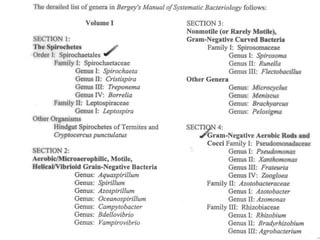
Bergey’s Manual of Systematic Bacteriology
 First edition -Published in 4 volumes:
 Volume 1 (1984) – Gram - negative Bacteria of
general, medical, or industrial importance
 Volume 2 (1986) – Gram - positive Bacteria other than
Actinomycetes
 Volume 3 (1989) – Archaeobacteria, Cyanobacteria,
and remaining Gram-negative Bacteria
 Volume 4 (1989) – Actinomycetes
Bergey’s Manual of Systematic Bacteriology
 Second Edition - published in 5 volumes:
 Vol 1 - (2001) The Archaea and the deeply branching and
phototrophic Bacteria
 Vol 2 - (2005) -The Proteobacteria
 Vol 3 - (2009) - The Firmicutes
 Vol 4 - (2011) - The Bacteroidetes, Spirochaetes, Tenericutes
(Mollicutes), Acidobacteria, Fibrobacteres, Fusobacteria,
Dictyoglomi, Gemmatimonadetes, Lentisphaerae,
Verrucomicrobia, Chlamydiae, and Planctomycetes
 Vol 5- (2012) - The Actinobacteria
VOLUME I
Domain: Archaea
Phylum Crenarchaeota
Class: Thermoprotei
• Originally containing thermophilic and hyperthermophilic
sulfur-metabolizing archaea
• Thermoproteales, Desulfurococclaes, Sulfolobales
• Recently discovered Crenarchaeota are inhibited by sulfur &
grow at lower temperatures
• Eg. Sulfolobus
Domain: Archaea
Phylum Euryarchaeota
 Differ in rRNA from other archaeans
 Eight classes and twelve orders
 Methanogenic archaea - Methanococcus
 Halophilic archaea -Halobacterium
 Thermophilic - Thermococcus
 Sulfur-reducing archaea - Archaeoglobus
 Domain Bacteria
The 2nd edition of Bergey’s Manual of Systematic
Bacteriology divides domain Bacteria into 23 phyla. Some
notable phyla are:
Phylum Aquificae
 The earliest branch of the Bacteria
 Contains genera Aquiflex and Hydrogenobacter that can
obtain energy from hydrogen via chemolithotrophic
pathways
 Also thermophilic
 Ether-linked lipids
 Domain Bacteria (cont.)
Phylum Thermotogae
 Anaerobic, thermophilic, fermentative, gram-negative
 Contains unusual fatty acids and ether linked lipids
 Also thermophilic
 E.g. Thermotoga
Phylum Deinococcus-Thermus
 Radiation resistant
 Stains Gram-positive
 High carotenoid contents
 Domain Bacteria (cont.)
 Phylum Chloroflexi
 Gram negative green nonsulfur bacteria
 Gliding motility
 Anoxygenic photosynthesis
 Unusual peptidoglycans and lack LPS
 Chloroflexus,
 Herpetosiphon (Nonphotosynthetic)
 Domain Bacteria (cont.)
 Phylum Cyanobacteria
 Oxygenic photosynthetic bacteria
 Chlorophyll a and phycobilins
 Unicellular or filamentous
 Some are Nitrogen fixers
 Nostoc, Spirulina
 Phylum Chlorobi
 The “green sulfur bacteria”
 Anoxygenic photosynthesis
 Includes genus Chlorobium
VOLUME II
Exclusive for Gram-negative bacteria
Phylum Proteobacteria
 The largest group of gram-negative bacteria
 Extremely complex group, with over 538 genera and
2000 species
 All major nutritional types are represented: phototrophy,
heterotrophy, and several types of chemolithotrophy
 Many species are important in medicine, industry and
biological research
 Five classes – (i) Alphaproteobacteria,
(ii) Betaproteobacteria,
(iii) Gammaproteobacteria,
(iv) Deltaproteobacteria,
(v) Epsilonproteobacteria
 Alphaproteobacteria:
o Metabolic resemblance with alphaproteobacteria
o Use Organically decomposed materials in anoxic zones
o Hydrogen (Alcaligenes)
o Ammonia (Nitrosomonas)
o Methane (Methylobacillus)
o Volatile fatty acids (Burkholderia)
o Pathogen -Neisseria
 Betaproteobacteria
o Largest class
o 14 orders and 28 families
o Many facultative anaerobes
o Enterobacteriaceae, Vibrionaceae and Pasteurellaceae
– Use EMP and HMP pathways
o The family Enterobacteriaceae, the “gram-negative
enteric bacteria,” include genera Escherichia, Proteus,
Enterobacter, Klebsiella, Salmonella, Shigella,
Serratia, and others
 Gammaproteobacteria:
o Pseudomonadaceae, Azotobacteraceae use ED and
HMP pathways
o The family Pseudomonadaceae, which includes genus
Pseudomonas and related genera
o Few are photosynthetic – Chromatium
o Methylotrophic - Methylococcus
 Deltaproteobacteria:
o Eight orders and 20 families
Predators
o Bdellovibrio
Myxococcales (Slime bacteria)
o Fruiting myxobacteria – Myxococcus, Polyangium
Anaerobic sulfate reducers
o Desulfovibrio
 Epsilonproteobacteria:
o Only one order – Campylobacterales
o Campylobacter, Helicobacter
o Many are microaerophilic
VOLUME III
 Phylum Firmicutes
 “Low G + C gram-positive” bacteria (less than 50%)
 Divided into 3 classes
Class I – Clostridia
o Includes genera Clostridium and Desulfotomaculum,
and others
o Anaerobic
o Forms endospores
Class II – Mollicutes
o Called as mycoplasmas
o Lack cell wall
o Cell membrane –sterols are present
o Pleomorphic
o Require sterols for growth
o Normally non motile, but some exhibit gliding
movement
o Most are Animal and plant pathogens
o E.g. Mycoplasma, Spiroplasma
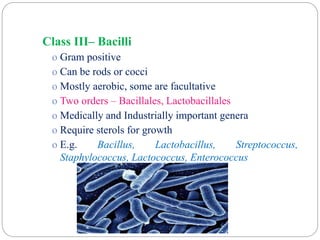
Class III– Bacilli
o Gram positive
o Can be rods or cocci
o Mostly aerobic, some are facultative
o Two orders – Bacillales, Lactobacillales
o Medically and Industrially important genera
o Require sterols for growth
o E.g. Bacillus, Lactobacillus, Streptococcus,
Staphylococcus, Lactococcus, Enterococcus
VOLUME IV
 Phylum Planctomycetes
o Aquatic habitats
o Coccoid, ovoid or pear shaped
o Some have membrane-enclosed nucleoid
o Most of them lack peptidoglycan
o Unicellular as well as chains
o Division by budding
o Stalks - non-prosthecate appendages
o Flagellar or giding motility
o E.g. Isophaera
 Phylum Chlamydiae
 Obligate intracellular parasites
 Coccoid
 Very small in size
 Two stages in life cycle – elementary bodies and
reticulate bodies
 Most of them lack peptidoglycan
Phylum Spirochaetes
 Characterized by flexible, helical cells with a modified
outer membrane (the outer sheath) and modified flagella
(axial filaments) located within the outer sheath
 Gram negative
 Chemoheterotrophs
 Free living, symbiotic or parasitic
 Important pathogenic genera include Treponema, Borrelia,
and Leptospira
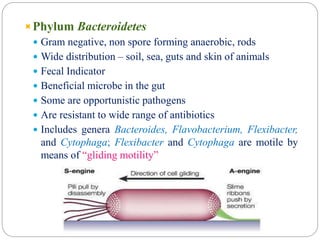
Phylum Bacteroidetes
 Gram negative, non spore forming anaerobic, rods
 Wide distribution – soil, sea, guts and skin of animals
 Fecal Indicator
 Beneficial microbe in the gut
 Some are opportunistic pathogens
 Are resistant to wide range of antibiotics
 Includes genera Bacteroides, Flavobacterium, Flexibacter,
and Cytophaga; Flexibacter and Cytophaga are motile by
means of “gliding motility”
VOLUME V
Phylum Actinobacteria
 “High G + C gram-positive” bacteria (50-55%)
 Terrestrial or aquatic
 Only one class, but 5 subclasses, six orders and 44
families
 Often form complex branching filaments called hyphae
 Even complex life cycles are found in some genera
 Forms asexual spores
Phylum Actinobacteria
 Secondary metabolite producers
 Geosmin production
 Varied difference in their cell walls, e.g. mycolic acid
 Largest genus Streptomyces – 150 species
 Includes genera Actinomyces, Streptomyces,
Corynebacterium, Micrococcus, Mycobacterium,
Propionibacterium
bergeysclassificationpresentation-171022145035.pdf

bergeysclassificationpresentation-171022145035.pdf

  • 1.
    BERGEY’S MANUAL &IT’S CLASSIFICATION Presented By- Bidisha Mandal
  • 2.
    The History andEvolution of Bergey’s Manual 1. Bergey’s Manual of Determinative Bacteriology (1923- 1994)  9 Editions (1 volume each )-These are mainly phenetic  First edition-1923 (one volume)  Seventh edition-1957 (one volume)  8th edition-1975 (one volume)  9th edition-1994 (one volume) 2. Bergey’s Manual of Systematic Bacteriology (1984- 2012)  1st edition (4volumes);1984-1989; Mix Phylogenetic / Phenetic - 5 Kingdoms  2nd Edition (5 volumes) (2001-2012);Phylogenetic-3 Domains
  • 4.
    Bergey’s Manual ofSystematic Bacteriology  First edition -Published in 4 volumes:  Volume 1 (1984) – Gram - negative Bacteria of general, medical, or industrial importance  Volume 2 (1986) – Gram - positive Bacteria other than Actinomycetes  Volume 3 (1989) – Archaeobacteria, Cyanobacteria, and remaining Gram-negative Bacteria  Volume 4 (1989) – Actinomycetes
  • 6.
    Bergey’s Manual ofSystematic Bacteriology  Second Edition - published in 5 volumes:  Vol 1 - (2001) The Archaea and the deeply branching and phototrophic Bacteria  Vol 2 - (2005) -The Proteobacteria  Vol 3 - (2009) - The Firmicutes  Vol 4 - (2011) - The Bacteroidetes, Spirochaetes, Tenericutes (Mollicutes), Acidobacteria, Fibrobacteres, Fusobacteria, Dictyoglomi, Gemmatimonadetes, Lentisphaerae, Verrucomicrobia, Chlamydiae, and Planctomycetes  Vol 5- (2012) - The Actinobacteria
  • 7.
    VOLUME I Domain: Archaea PhylumCrenarchaeota Class: Thermoprotei • Originally containing thermophilic and hyperthermophilic sulfur-metabolizing archaea • Thermoproteales, Desulfurococclaes, Sulfolobales • Recently discovered Crenarchaeota are inhibited by sulfur & grow at lower temperatures • Eg. Sulfolobus
  • 8.
    Domain: Archaea Phylum Euryarchaeota Differ in rRNA from other archaeans  Eight classes and twelve orders  Methanogenic archaea - Methanococcus  Halophilic archaea -Halobacterium  Thermophilic - Thermococcus  Sulfur-reducing archaea - Archaeoglobus
  • 9.
     Domain Bacteria The2nd edition of Bergey’s Manual of Systematic Bacteriology divides domain Bacteria into 23 phyla. Some notable phyla are: Phylum Aquificae  The earliest branch of the Bacteria  Contains genera Aquiflex and Hydrogenobacter that can obtain energy from hydrogen via chemolithotrophic pathways  Also thermophilic  Ether-linked lipids
  • 10.
     Domain Bacteria(cont.) Phylum Thermotogae  Anaerobic, thermophilic, fermentative, gram-negative  Contains unusual fatty acids and ether linked lipids  Also thermophilic  E.g. Thermotoga Phylum Deinococcus-Thermus  Radiation resistant  Stains Gram-positive  High carotenoid contents
  • 11.
     Domain Bacteria(cont.)  Phylum Chloroflexi  Gram negative green nonsulfur bacteria  Gliding motility  Anoxygenic photosynthesis  Unusual peptidoglycans and lack LPS  Chloroflexus,  Herpetosiphon (Nonphotosynthetic)
  • 12.
     Domain Bacteria(cont.)  Phylum Cyanobacteria  Oxygenic photosynthetic bacteria  Chlorophyll a and phycobilins  Unicellular or filamentous  Some are Nitrogen fixers  Nostoc, Spirulina  Phylum Chlorobi  The “green sulfur bacteria”  Anoxygenic photosynthesis  Includes genus Chlorobium
  • 13.
    VOLUME II Exclusive forGram-negative bacteria Phylum Proteobacteria  The largest group of gram-negative bacteria  Extremely complex group, with over 538 genera and 2000 species  All major nutritional types are represented: phototrophy, heterotrophy, and several types of chemolithotrophy  Many species are important in medicine, industry and biological research  Five classes – (i) Alphaproteobacteria, (ii) Betaproteobacteria, (iii) Gammaproteobacteria, (iv) Deltaproteobacteria, (v) Epsilonproteobacteria
  • 14.
     Alphaproteobacteria: o Metabolicresemblance with alphaproteobacteria o Use Organically decomposed materials in anoxic zones o Hydrogen (Alcaligenes) o Ammonia (Nitrosomonas) o Methane (Methylobacillus) o Volatile fatty acids (Burkholderia) o Pathogen -Neisseria
  • 15.
     Betaproteobacteria o Largestclass o 14 orders and 28 families o Many facultative anaerobes o Enterobacteriaceae, Vibrionaceae and Pasteurellaceae – Use EMP and HMP pathways o The family Enterobacteriaceae, the “gram-negative enteric bacteria,” include genera Escherichia, Proteus, Enterobacter, Klebsiella, Salmonella, Shigella, Serratia, and others
  • 16.
     Gammaproteobacteria: o Pseudomonadaceae,Azotobacteraceae use ED and HMP pathways o The family Pseudomonadaceae, which includes genus Pseudomonas and related genera o Few are photosynthetic – Chromatium o Methylotrophic - Methylococcus
  • 17.
     Deltaproteobacteria: o Eightorders and 20 families Predators o Bdellovibrio Myxococcales (Slime bacteria) o Fruiting myxobacteria – Myxococcus, Polyangium Anaerobic sulfate reducers o Desulfovibrio
  • 18.
     Epsilonproteobacteria: o Onlyone order – Campylobacterales o Campylobacter, Helicobacter o Many are microaerophilic
  • 19.
    VOLUME III  PhylumFirmicutes  “Low G + C gram-positive” bacteria (less than 50%)  Divided into 3 classes Class I – Clostridia o Includes genera Clostridium and Desulfotomaculum, and others o Anaerobic o Forms endospores
  • 20.
    Class II –Mollicutes o Called as mycoplasmas o Lack cell wall o Cell membrane –sterols are present o Pleomorphic o Require sterols for growth o Normally non motile, but some exhibit gliding movement o Most are Animal and plant pathogens o E.g. Mycoplasma, Spiroplasma
  • 21.
    Class III– Bacilli oGram positive o Can be rods or cocci o Mostly aerobic, some are facultative o Two orders – Bacillales, Lactobacillales o Medically and Industrially important genera o Require sterols for growth o E.g. Bacillus, Lactobacillus, Streptococcus, Staphylococcus, Lactococcus, Enterococcus
  • 22.
    VOLUME IV  PhylumPlanctomycetes o Aquatic habitats o Coccoid, ovoid or pear shaped o Some have membrane-enclosed nucleoid o Most of them lack peptidoglycan o Unicellular as well as chains o Division by budding o Stalks - non-prosthecate appendages o Flagellar or giding motility o E.g. Isophaera
  • 23.
     Phylum Chlamydiae Obligate intracellular parasites  Coccoid  Very small in size  Two stages in life cycle – elementary bodies and reticulate bodies  Most of them lack peptidoglycan
  • 24.
    Phylum Spirochaetes  Characterizedby flexible, helical cells with a modified outer membrane (the outer sheath) and modified flagella (axial filaments) located within the outer sheath  Gram negative  Chemoheterotrophs  Free living, symbiotic or parasitic  Important pathogenic genera include Treponema, Borrelia, and Leptospira
  • 25.
    Phylum Bacteroidetes  Gramnegative, non spore forming anaerobic, rods  Wide distribution – soil, sea, guts and skin of animals  Fecal Indicator  Beneficial microbe in the gut  Some are opportunistic pathogens  Are resistant to wide range of antibiotics  Includes genera Bacteroides, Flavobacterium, Flexibacter, and Cytophaga; Flexibacter and Cytophaga are motile by means of “gliding motility”
  • 26.
    VOLUME V Phylum Actinobacteria “High G + C gram-positive” bacteria (50-55%)  Terrestrial or aquatic  Only one class, but 5 subclasses, six orders and 44 families  Often form complex branching filaments called hyphae  Even complex life cycles are found in some genera  Forms asexual spores
  • 27.
    Phylum Actinobacteria  Secondarymetabolite producers  Geosmin production  Varied difference in their cell walls, e.g. mycolic acid  Largest genus Streptomyces – 150 species  Includes genera Actinomyces, Streptomyces, Corynebacterium, Micrococcus, Mycobacterium, Propionibacterium