NUTRITION IN MICROORGANISMS
Prepared By
ANUSMRITABARMAN
Roll. No 11
M.Sc. 3RD semester
Dept Of Botany
Under the guidance of-
Dr. Diganta Narzary
Nutrition is simply the process of taking in of food and its utilization for release of energy.
It is the part of microbial physiology that deals with the nutrients required for growth and metabolism
Why nutrition is necessary?
It is the vital process that felicitates the procurement of energy from various
sources and its utilization for growth and other metabolic processes of the
microorganism.
Modes of nutrition
 Absorption- process of diffusion of nutrients in the form of dissolved organic
matter through the body surface. This is the characteristic of bacteria and fungi.
 Photosynthesis- production of food inside the cell of the organism by using light,
atm. CO2 and water as the source of energy,carbon and electrons respectively.
Example-cyanobacteria
 Ingestion-characteristic of protozoa and slime moulds where food is engulfed by
phagocytosis through special openings on their body.
Nutritional source
 life on Earth is carbon-based. Thus all organisms must obtain carbon from their environments to
synthesize the organic molecules they need to survive
 all organisms require an energy source to maintain their order and complexity
 the importance of redox reactions in cellular metabolism dictates that organisms must also have
an electron source.
The central importance of energy, electrons, and carbon has led biologists to describe organisms
in terms of how these requirements are met. The terms devised can be combined to characterize
an organism's nutritional type.
 Carbon source
1. Autotrophs-CO2 is the sole or principle biosynthetic carbon source e.g-
photosynthesizing bacteria(green and purple bacteria and cyanobacteria)
2. Heterotrophs- reduced organic molecules from other organisms serves as the
carbon source. E.g fungi and other green nonsulfur bacteria, such as Chloroflexus and purple
nonsulfur bacteria.
 EnergySource
1. Phototrophs-light is the primary energy source
2.Chemotrophs-oxidation-reduction reactions of organic/inorganic compounds serves as
as the energy source.
 Electron Source
1.Lithotrophs-reduced inorganic compounds serves as the electron source
2.Organotrophs-reduces organic compounds serves as the electron source
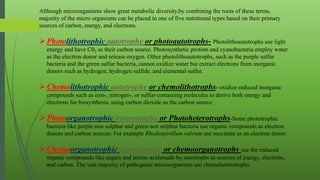
Although microorganisms show great metabolic diversity,by combining the roots of these terms,
majority of the micro organisms can be placed in one of five nutritional types based on their primary
sources of carbon, energy, and electrons.
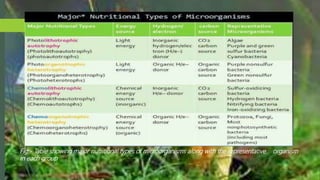
Photolithotrophic autotrophy or photoautotrophs- Photolithoautotrophs use light
energy and have C02 as their carbon source. Photosynthetic protists and cyanobacteria employ water
as the electron donor and release oxygen. Other photolithoautotrophs, such as the purple sulfur
bacteria and the green sulfur bacteria, cannot oxidize water but extract electrons from inorganic
donors such as hydrogen, hydrogen sulfide, and elemental sulfur.
Chemolithotrophic autotrophy or chemolithotrophs- oxidize reduced inorganic
compounds such as iron-, nitrogen-, or sulfur-containing molecules to derive both energy and
electrons for biosynthesis, using carbon dioxide as the carbon source.
Photoorganotrophic heterotrophy or Photoheterotrophs-Some phototrophic
bacteria like purple non sulphur and green non sulphur bacteria use organic compounds as electron
donors and carbon sources. For example Rhodospirillum rubrum use succinate as an electron donor.
Chemoorganotrophic heterotrophy or chemoorganotrophs use the reduced
organic compounds like sugars and amino acidsmade by autotrophs as sources of energy, electrons,
and carbon. The vast majority of pathogenic microorganisms are chemoheterotrophs.
Fig:- Table showing major nutritional types of microorganisms along with the representative organism
in each group
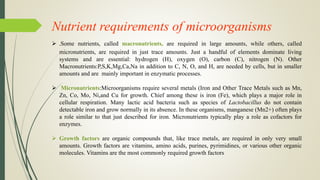
Nutrient requirements of microorganisms
 .Some nutrients, called macronutrients, are required in large amounts, while others, called
micronutrients, are required in just trace amounts. Just a handful of elements dominate living
systems and are essential: hydrogen (H), oxygen (O), carbon (C), nitrogen (N). Other
Macronutrients:P,S,K,Mg,Ca,Na in addition to C, N, O, and H, are needed by cells, but in smaller
amounts and are mainly important in enzymatic processes.
 Micronutrients:Microorganisms require several metals (Iron and Other Trace Metals such as Mn,
Zn, Co, Mo, Ni,and Cu for growth. Chief among these is iron (Fe), which plays a major role in
cellular respiration. Many lactic acid bacteria such as species of Lactobacillus do not contain
detectable iron and grow normally in its absence. In these organisms, manganese (Mn2+) often plays
a role similar to that just described for iron. Micronutrients typically play a role as cofactors for
enzymes.
 Growth factors are organic compounds that, like trace metals, are required in only very small
amounts. Growth factors are vitamins, amino acids, purines, pyrimidines, or various other organic
molecules. Vitamins are the most commonly required growth factors
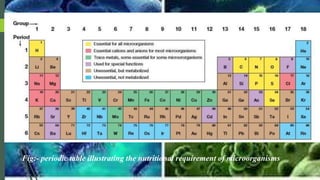
Fig:- periodic table illustrating the nutritional requirement of microorganisms
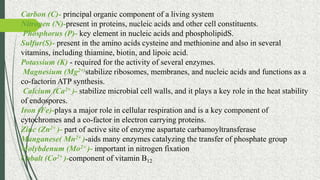
Carbon (C)- principal organic component of a living system
Nitrogen (N)-present in proteins, nucleic acids and other cell constituents.
Phosphorus (P)- key element in nucleic acids and phospholipidS.
Sulfur(S)- present in the amino acids cysteine and methionine and also in several
vitamins, including thiamine, biotin, and lipoic acid.
Potassium (K) - required for the activity of several enzymes.
Magnesium (Mg2+)stabilize ribosomes, membranes, and nucleic acids and functions as a
co-factorin ATP synthesis.
Calcium (Ca2+ )- stabilize microbial cell walls, and it plays a key role in the heat stability
of endospores.
Iron (Fe)-plays a major role in cellular respiration and is a key component of
cytochromes and a co-factor in electron carrying proteins.
Zinc (Zn2+ )- part of active site of enzyme aspartate carbamoyltransferase
Manganese( Mn2+ )-aids many enzymes catalyzing the transfer of phosphate group
Molybdenum (Mo2+ )- important in nitrogen fixation
Cobalt (Co2+ )-component of vitamin B12
Conclusion
Precisely, it can be concluded from the above discussion that nutrition in microorgannisms,like any other organism
mainly focuses on the procurement of energy in the form of nutrients for growth and other metabolic processes of
the microorganism . A carbon source, an energy source and a source of electrons is mandatory for the overall
nutrition machinery of the microorganism. Based on these three vital sources of nutrition, microorganisms are
divided into mainly four nutritional types with varied nutrient requirement, but all for the fundamental necessity of
nutrition for sustaining life of the microorganism.
References
 MICROBIOLOGY-an introduction
-Tortora,Funke,Case
 BROCK BIOLOGY OF MICROORGANISMS
-Madigan,Martinko,Stahl,Clark
 PRESCOTT’S MICROBIOLOGY
-Willey, Sherwood,Woolverton
 www.annualreviews.com
 www.courses.lumenlearning.com
 www.sciencing.com
 www.nature.com/nutritioninmicrobes
Nutrition in microorganisms

Nutrition in microorganisms

  • 1.
    NUTRITION IN MICROORGANISMS PreparedBy ANUSMRITABARMAN Roll. No 11 M.Sc. 3RD semester Dept Of Botany Under the guidance of- Dr. Diganta Narzary
  • 2.
    Nutrition is simplythe process of taking in of food and its utilization for release of energy. It is the part of microbial physiology that deals with the nutrients required for growth and metabolism Why nutrition is necessary? It is the vital process that felicitates the procurement of energy from various sources and its utilization for growth and other metabolic processes of the microorganism.
  • 3.
    Modes of nutrition Absorption- process of diffusion of nutrients in the form of dissolved organic matter through the body surface. This is the characteristic of bacteria and fungi.  Photosynthesis- production of food inside the cell of the organism by using light, atm. CO2 and water as the source of energy,carbon and electrons respectively. Example-cyanobacteria  Ingestion-characteristic of protozoa and slime moulds where food is engulfed by phagocytosis through special openings on their body.
  • 4.
    Nutritional source  lifeon Earth is carbon-based. Thus all organisms must obtain carbon from their environments to synthesize the organic molecules they need to survive  all organisms require an energy source to maintain their order and complexity  the importance of redox reactions in cellular metabolism dictates that organisms must also have an electron source. The central importance of energy, electrons, and carbon has led biologists to describe organisms in terms of how these requirements are met. The terms devised can be combined to characterize an organism's nutritional type.
  • 5.
     Carbon source 1.Autotrophs-CO2 is the sole or principle biosynthetic carbon source e.g- photosynthesizing bacteria(green and purple bacteria and cyanobacteria) 2. Heterotrophs- reduced organic molecules from other organisms serves as the carbon source. E.g fungi and other green nonsulfur bacteria, such as Chloroflexus and purple nonsulfur bacteria.  EnergySource 1. Phototrophs-light is the primary energy source 2.Chemotrophs-oxidation-reduction reactions of organic/inorganic compounds serves as as the energy source.  Electron Source 1.Lithotrophs-reduced inorganic compounds serves as the electron source 2.Organotrophs-reduces organic compounds serves as the electron source
  • 6.
    Although microorganisms showgreat metabolic diversity,by combining the roots of these terms, majority of the micro organisms can be placed in one of five nutritional types based on their primary sources of carbon, energy, and electrons. Photolithotrophic autotrophy or photoautotrophs- Photolithoautotrophs use light energy and have C02 as their carbon source. Photosynthetic protists and cyanobacteria employ water as the electron donor and release oxygen. Other photolithoautotrophs, such as the purple sulfur bacteria and the green sulfur bacteria, cannot oxidize water but extract electrons from inorganic donors such as hydrogen, hydrogen sulfide, and elemental sulfur. Chemolithotrophic autotrophy or chemolithotrophs- oxidize reduced inorganic compounds such as iron-, nitrogen-, or sulfur-containing molecules to derive both energy and electrons for biosynthesis, using carbon dioxide as the carbon source. Photoorganotrophic heterotrophy or Photoheterotrophs-Some phototrophic bacteria like purple non sulphur and green non sulphur bacteria use organic compounds as electron donors and carbon sources. For example Rhodospirillum rubrum use succinate as an electron donor. Chemoorganotrophic heterotrophy or chemoorganotrophs use the reduced organic compounds like sugars and amino acidsmade by autotrophs as sources of energy, electrons, and carbon. The vast majority of pathogenic microorganisms are chemoheterotrophs.
  • 7.
    Fig:- Table showingmajor nutritional types of microorganisms along with the representative organism in each group
  • 8.
    Nutrient requirements ofmicroorganisms  .Some nutrients, called macronutrients, are required in large amounts, while others, called micronutrients, are required in just trace amounts. Just a handful of elements dominate living systems and are essential: hydrogen (H), oxygen (O), carbon (C), nitrogen (N). Other Macronutrients:P,S,K,Mg,Ca,Na in addition to C, N, O, and H, are needed by cells, but in smaller amounts and are mainly important in enzymatic processes.  Micronutrients:Microorganisms require several metals (Iron and Other Trace Metals such as Mn, Zn, Co, Mo, Ni,and Cu for growth. Chief among these is iron (Fe), which plays a major role in cellular respiration. Many lactic acid bacteria such as species of Lactobacillus do not contain detectable iron and grow normally in its absence. In these organisms, manganese (Mn2+) often plays a role similar to that just described for iron. Micronutrients typically play a role as cofactors for enzymes.  Growth factors are organic compounds that, like trace metals, are required in only very small amounts. Growth factors are vitamins, amino acids, purines, pyrimidines, or various other organic molecules. Vitamins are the most commonly required growth factors
  • 9.
    Fig:- periodic tableillustrating the nutritional requirement of microorganisms
  • 10.
    Carbon (C)- principalorganic component of a living system Nitrogen (N)-present in proteins, nucleic acids and other cell constituents. Phosphorus (P)- key element in nucleic acids and phospholipidS. Sulfur(S)- present in the amino acids cysteine and methionine and also in several vitamins, including thiamine, biotin, and lipoic acid. Potassium (K) - required for the activity of several enzymes. Magnesium (Mg2+)stabilize ribosomes, membranes, and nucleic acids and functions as a co-factorin ATP synthesis. Calcium (Ca2+ )- stabilize microbial cell walls, and it plays a key role in the heat stability of endospores. Iron (Fe)-plays a major role in cellular respiration and is a key component of cytochromes and a co-factor in electron carrying proteins. Zinc (Zn2+ )- part of active site of enzyme aspartate carbamoyltransferase Manganese( Mn2+ )-aids many enzymes catalyzing the transfer of phosphate group Molybdenum (Mo2+ )- important in nitrogen fixation Cobalt (Co2+ )-component of vitamin B12
  • 11.
    Conclusion Precisely, it canbe concluded from the above discussion that nutrition in microorgannisms,like any other organism mainly focuses on the procurement of energy in the form of nutrients for growth and other metabolic processes of the microorganism . A carbon source, an energy source and a source of electrons is mandatory for the overall nutrition machinery of the microorganism. Based on these three vital sources of nutrition, microorganisms are divided into mainly four nutritional types with varied nutrient requirement, but all for the fundamental necessity of nutrition for sustaining life of the microorganism.
  • 12.
    References  MICROBIOLOGY-an introduction -Tortora,Funke,Case BROCK BIOLOGY OF MICROORGANISMS -Madigan,Martinko,Stahl,Clark  PRESCOTT’S MICROBIOLOGY -Willey, Sherwood,Woolverton  www.annualreviews.com  www.courses.lumenlearning.com  www.sciencing.com  www.nature.com/nutritioninmicrobes