Earth History 2
UNIT CHECKS
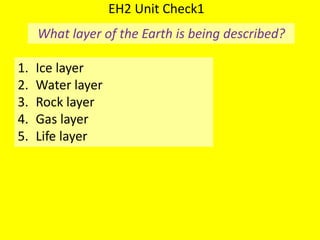
EH2 Unit Check1
1. Ice layer
2. Water layer
3. Rock layer
4. Gas layer
5. Life layer
What layer of the Earth is being described?
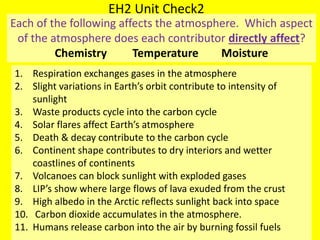
EH2 Unit Check2
1. Respiration exchanges gases in the atmosphere
2. Slight variations in Earth’s orbit contribute to intensity of
sunlight
3. Waste products cycle into the carbon cycle
4. Solar flares affect Earth’s atmosphere
5. Death & decay contribute to the carbon cycle
6. Continent shape contributes to dry interiors and wetter
coastlines of continents
7. Volcanoes can block sunlight with exploded gases
8. LIP’s show where large flows of lava exuded from the crust
9. High albedo in the Arctic reflects sunlight back into space
10. Carbon dioxide accumulates in the atmosphere.
11. Humans release carbon into the air by burning fossil fuels
Each of the following affects the atmosphere. Which aspect
of the atmosphere does each contributor directly affect?
Chemistry Temperature Moisture
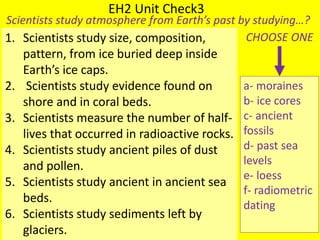
EH2 Unit Check3
Scientists study atmosphere from Earth’s past by studying…?
1. Scientists study size, composition,
pattern, from ice buried deep inside
Earth’s ice caps.
2. Scientists study evidence found on
shore and in coral beds.
3. Scientists measure the number of half-
lives that occurred in radioactive rocks.
4. Scientists study ancient piles of dust
and pollen.
5. Scientists study ancient in ancient sea
beds.
6. Scientists study sediments left by
glaciers.
a- moraines
b- ice cores
c- ancient
fossils
d- past sea
levels
e- loess
f- radiometric
dating
CHOOSE ONE
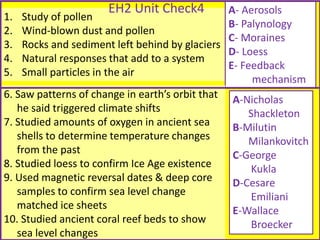
1. Study of pollen
2. Wind-blown dust and pollen
3. Rocks and sediment left behind by glaciers
4. Natural responses that add to a system
5. Small particles in the air
A- Aerosols
B- Palynology
C- Moraines
D- Loess
E- Feedback
mechanism
6. Saw patterns of change in earth’s orbit that
he said triggered climate shifts
7. Studied amounts of oxygen in ancient sea
shells to determine temperature changes
from the past
8. Studied loess to confirm Ice Age existence
9. Used magnetic reversal dates & deep core
samples to confirm sea level change
matched ice sheets
10. Studied ancient coral reef beds to show
sea level changes
A-Nicholas
Shackleton
B-Milutin
Milankovitch
C-George
Kukla
D-Cesare
Emiliani
E-Wallace
Broecker
EH2 Unit Check4

Eh2 unit checks questions

  • 1.
  • 2.
    EH2 Unit Check1 1.Ice layer 2. Water layer 3. Rock layer 4. Gas layer 5. Life layer What layer of the Earth is being described?
  • 3.
    EH2 Unit Check2 1.Respiration exchanges gases in the atmosphere 2. Slight variations in Earth’s orbit contribute to intensity of sunlight 3. Waste products cycle into the carbon cycle 4. Solar flares affect Earth’s atmosphere 5. Death & decay contribute to the carbon cycle 6. Continent shape contributes to dry interiors and wetter coastlines of continents 7. Volcanoes can block sunlight with exploded gases 8. LIP’s show where large flows of lava exuded from the crust 9. High albedo in the Arctic reflects sunlight back into space 10. Carbon dioxide accumulates in the atmosphere. 11. Humans release carbon into the air by burning fossil fuels Each of the following affects the atmosphere. Which aspect of the atmosphere does each contributor directly affect? Chemistry Temperature Moisture
  • 4.
    EH2 Unit Check3 Scientistsstudy atmosphere from Earth’s past by studying…? 1. Scientists study size, composition, pattern, from ice buried deep inside Earth’s ice caps. 2. Scientists study evidence found on shore and in coral beds. 3. Scientists measure the number of half- lives that occurred in radioactive rocks. 4. Scientists study ancient piles of dust and pollen. 5. Scientists study ancient in ancient sea beds. 6. Scientists study sediments left by glaciers. a- moraines b- ice cores c- ancient fossils d- past sea levels e- loess f- radiometric dating CHOOSE ONE
  • 5.
    1. Study ofpollen 2. Wind-blown dust and pollen 3. Rocks and sediment left behind by glaciers 4. Natural responses that add to a system 5. Small particles in the air A- Aerosols B- Palynology C- Moraines D- Loess E- Feedback mechanism 6. Saw patterns of change in earth’s orbit that he said triggered climate shifts 7. Studied amounts of oxygen in ancient sea shells to determine temperature changes from the past 8. Studied loess to confirm Ice Age existence 9. Used magnetic reversal dates & deep core samples to confirm sea level change matched ice sheets 10. Studied ancient coral reef beds to show sea level changes A-Nicholas Shackleton B-Milutin Milankovitch C-George Kukla D-Cesare Emiliani E-Wallace Broecker EH2 Unit Check4