GEOLOGIC TIME
SCALE
REPORTER
GROUP
1
Before we start for today's reporting let's
try to do a Energizer called "Arranging
Word". What you will do is simple, you will
only arrange the right letter to get the
correct word. Whoever get the correct
answer will receive a reward.
ECOGOLIG
GEOLOGIC
CLEAS
SCALE
MITE
TIME
OEN
EON
AER
ERA
RIOPDE
PERIOD
CHOEP
EPOCH
For today’s reporting/ lesson let's take a
closer look at the “ Geologic Time Scale”
and we are going to describe the
relationship between event's that have
occurred throughout the Earth's history.
Previously we learn about the method's
use by geologists in determining the age
of rocks and fossils which, led to the
creation of the geologic time scale.
A time line or calendar that illustrate
Earth's history based on geologic events
and life forms. This is a system that
chronologically relates geological strata(
stratigraphy) to time.
What is Geologic Time Scale?
The four (4) major division
of the Geologic Time Scale
● Eon
● Era
● Period
● Epoch
Stratigraphy
● Which the correlation and
classification of rock strata.
Eon
● The largest time span of the
geologic time scale
The two(2) Eons
A.Pre- Cambrian Eon
• refers to the earliest part of Earth's
history.
B. Phanerozoic Eon
• the current geologic eon in the geologic
time scale.
A. Pre- Cambrian Eon
Earliest part of the Earth’s
History is divided into three(3)
Eons.
The Hadean Eon, Archean Eon
and Proterozoic Eon.
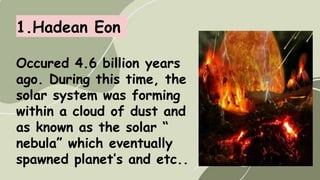
1.Hadean Eon
Occured 4.6 billion years
ago. During this time, the
solar system was forming
within a cloud of dust and
as known as the solar “
nebula” which eventually
spawned planet’s and etc..
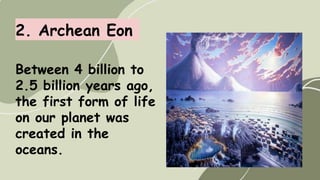
2.Archean Eon
Between 4 billion to
2.5 billion years ago,
the first form of life
on our planet was
created in the
oceans.
2. Archean Eon
Between 4 billion to
2.5 billion years ago,
the first form of life
on our planet was
created in the
oceans.
3. Proterozoic Eon
Also called the “Age of
hidden Life” started 2.5
billion years ago. In this
time, enough shield rock
had formed to start
recognizable geologic
process such as plate
tectonics.
B. Phanerozoic Eon
The time in which abundant animal and
plant life has existed. It covers 541
million years up to the present. The
Phanerozoic Eon is subdivided into three
(3) Era; we have the Paleozoic Era,
Mesozoic Era, and Cenozoic Era.
1.Paleozoic Era
The era ran from about 542 million
years ago to 251 million years ago.
Paleozoic Era be an with the break- up
of one supercontinent and the formation
of another. Because of this plants
became widespread.
The six (6) Peroliod of Paleozoic Era
We have;
● Cambrian Period
● Ordovician Period
● Silurian Period
● Devonian Period
● Carboniferous Period
● Permian Period
a) Cambrian Period
( 53 million years ago). Known for ushering
in an explosion of life on Earth. This “
Cambrian Explosion” included the evolution
of arthropods ( ancestor of today's insects
and crustaceans) and chordates (animals
with rudimentary spinal cords)
b) Ordovician Period
Which occurred 45 years ago. Ordovician
Period mark in the fossils record began
abundance of marine invertebrates. Perhaps
the famous of this invertebrates was the
trilobites, an armored arthropod that
scuttled around the seafloor for about 270
million years before going extinct.
c) Silurian Period
Which occurred 443 million to 416 million
years ago.This period show the spread of
jawless fish throughout the seas. Mollusks
and corals thrived in the oceans and land.
The first undisputed evidence of terrestrial
life.
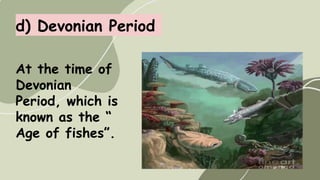
d) Devonian Period
At the time of
Devonian
Period, which is
known as the “
Age of fishes”.
e) Carboniferous Period
Which occurred 359 million to 299
million years ago. Long before birds
evolved, tetrapods began laying eggs on
land for the first time during this
period. Allowing them to break away
from an amphibious lifestyle.
f) Permian Period
Which occurred 299 million to 259 million
years ago. This period would end with the
largest mass extinction ever. The Permian
extinction, before the Permian mass
extinction though the warm seas teemed with
life. Coral reefs flourished, providing shelter
for fish and shelled creatures such as
nautiloids and ammonoid’s.
2. Mesozoic Era
Mesozoic Era is know as the” Middle life
Era”.
Mesozoic Era contains three(3) Periods. This
periods which span for from about 259 million
years ago to about 66 million years ago, was
also known as the “ Age of Reptiles” or “ The
Age of Dinosaurs” because of its famous
inhabitants.
The Three (3) Period of Mesozoic
Era.
● Triasic Period
● Jurassic Period
● Cretaceous Period
a) Triasic Period
Which occurred
252 million to 200
years ago. This
Period saw the rise
of reptiles and the
first dinosaurs.
b) Jurassic Period
Which occurred 200
million to 145 million
years ago. This Period
marked the resence of
Dinosaurs and the
first appearance of
birds.
c) Cretaceous Period
This Period is also
known for it's iconic
dinosaurs. Such as
Triceratops and
Pterosaur
(Pteranodon).
3. Cenozoic Era
This Era began about 65 million years ago
and continues into the present. This Era
also know as the “Age of Mammals” and the
third documented Era in the history of
Earth. This Era is divided into three (3)
Periods.
The Three(3) Period of Cenozoic Era
● Paleogene Period
● Neogene Period
● Quaternary Period
a) Paleogene Period
Which occurred 65 million to 23 million years
ago. The beginning of this Period was a time
for the mammals that survived from the
cretaceous period. Later in this period
rodents and small horses, such as
Hyracotherium, are common and Rhinoceroses
and Elephants appears.This period consists
Three (3) Epochs.
The Three (3) Epochs of Paleogene
Period
● Paleocene
● Eocene
● Oligocene
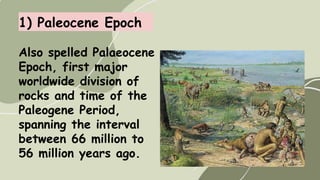
1) Paleocene Epoch
Also spelled Palaeocene
Epoch, first major
worldwide division of
rocks and time of the
Paleogene Period,
spanning the interval
between 66 million to
56 million years ago.
2) Eocene Epoch
Is a Geological Epoch that
lasted from about 56 million
to 33.9 million years ago. It
is the second of the
Paleogene Period in the
modern Cenozoic Era. Eocene
means “down” from modern
fauna a that appeared during
the epoch.
3) Oligocene Epoch
Is a geologic epoch of
the Paleogene Period
and extend from
about 33.9 million to
23 million years
before the present.
b) Neogene Period
Which occurred 23 million to 2.6 million
years ago. This period gave rise to early
primates, including early humans. Bovids,
including cattle,sheep, goats, antelope, and
gazelle, flourish this period.This consists
Two (2) Epochs.
The Two (2) Epochs of Neogene Period
● Miocene
● Pliocene
1) Miocene Epoch
Is the first geologic
epoch of the Neogene
Period and extend from
about 23.03 to million
to 5.333 million years
ago.
2) Pliocene Epoch
Is the epoch in the
geologic time scale that
extend from 5.333 million
to 2.58 million years ago.
It is the second and most
recent epoch of the
Neogene Period in the
Cenozoic Era.
c) Quaternary Period
Which occurred 2.6 million to the present
year. In this period,Cave lions, Sabre-
toothed cats, Cave bears, Giant deer, Wolly
Rhinoceroses and Wolly mommoths were
recalling species of Quaternary Period. This
period consists Two (2) Epochs.
The Two (2) Epochs of Quaternary
Period
● Pleistocene
● Holocene
1) Pleistocene
Earlier and major of the
two Epochs that constitute
the Quaternary Period of
Earth's history, an epoch
during which a successful
of glacial and interglacial
climate cycles secured.
2) Holocene Epoch
Is the name given to the last
11,700 years of the Earth's
history. The name since the
end of the last major glacial
epoch, or “ice age”. Since
then, the “ little Ice Age”
between about 1200 and 1700
A.D.( After Death).
Is the Geologic Time Scale is useful?
Yes, the Geologic Time Scale is an
important tool used to portray the history
of the Earth. A standard timeline used to
describe the age of rocks and fossils, and
the events that formed them. It is also
used to describe the timing relationship of
events that have occurred during Earth's
nearly five (5) billion years history. It's
contribute to human knowledge about the
discovery of Earth's history.
We are done now discussing
about the Geologic Time
Scale,And now let's test your
knowledge by answering the
Test 1 and Test 2 honestly.
Test 1 enumeration
Just choose the correct letter and write on
your paper and No erasure.
1. A time line or calendar that illustrates Earth's
history based on geologic events and life form.
a. Eon
b. Period
c. Stratigraphy
d. Geologic Time Scale
2. The correlation and the classification of rock
strata.
a. Era c. Stratigraphy
b. Epoch d. Period
3. The largest time span of the geologic time
scale.
a. Eon c. Period
b.Era d. Epoch
4. Refers to the earliest part of Earth's
history.
a. Pre-Cambrian Eon c. Phanerozoic Eon
b.Eon d. Hadean Eon
5. The current geologic eon in the Geologic
Time Scale
a. Eon c. Phanerozoic Eon
b.Pre-Cambrian Eon d. Archean Eon
6. Eon that started between 4 billion to 2.5
billion years ago. And the first form of life on
our planet was created in the oceans.
a. Archean Eon. c. Pre-Cambrian Eon
b.Proterozoic Eon d. Hadean Eon
7. During this time, the solar system was
forming within a cloud of dust known as the
solar “ nebula”.
a. Archean Eon c. Hadean Eon
b.Proterozoic Eon d. Pre-Cambrian Eon
8. Eon that called as the “ Age of hidden
Life".
a. Phanerozoic Eon c. Archean Eon
b. Proterozoic Eon d. Hadean Eon
9. Era that began with the break-up of one
supercontinent and the formation of another.
a. Cenozoic Era c. Cambrian Era
b.Mesozoic Era d. Paleozoic Era
10. Era that known as the “ Middle Life
Era”.
a. Mesozoic Era c. Cenozoic Era
b. Paleozoic Era d. Cambrian Era
Test 2: TRUE OR FALSE
write the correct answer on your paper. No
erasure and wrong spelling wrong.
1. EON, ERA, PERIOD, AND EPOCH are the
four (4) major division of Geologic Time Scale?
2. Devonian Period is known as the “ Age of
fishes”.
3. Cretaceous Period is also known for its iconic
dinosaurs.
4. Cenozoic Era is also known as the “ Age of
Mammals”.
5. Triasic Period marked the resence of
Dinosaurs and the first appearance of birds.
6. Jurassic Period saw the rise of reptiles and
the first dinosaurs.
7. Paleozoic Era has Six (6) Period
8. The Neogene Period gave rise to early
primates, including early humans.
9. Cenozoic Era has Three (3) Period
10. Geological Time Scale is useful.
Answers;
Test 1 Test 2
1.D 6. A 1. True 6. False
2.B. 7. C 2. True 7. True
3.A 8. B 3. True 8. True
4.A 9. D 4. True 9. True
5.C 10. A 5. False 10. True
These Report prepared by:
Noel Jane Balacano - leader/ Reporter/ make Quiz
Angelika Guerrero - Secretary/ Reporter
Mary Joy Besina- Researcher
Leonard Ben Bornales- Researcher/ give idea for
Energizer
John Earl Paragas - Researcher / give idea for
Energizer
Jemuel Begaso - Researcher
Ryan Dordas - Researcher
The Geologic Time Scale .pptx

The Geologic Time Scale .pptx

  • 1.
  • 2.
  • 3.
    Before we startfor today's reporting let's try to do a Energizer called "Arranging Word". What you will do is simple, you will only arrange the right letter to get the correct word. Whoever get the correct answer will receive a reward.
  • 4.
  • 5.
  • 6.
  • 7.
  • 8.
  • 9.
  • 10.
  • 11.
  • 12.
  • 13.
  • 14.
  • 15.
  • 16.
  • 17.
  • 18.
    For today’s reporting/lesson let's take a closer look at the “ Geologic Time Scale” and we are going to describe the relationship between event's that have occurred throughout the Earth's history. Previously we learn about the method's use by geologists in determining the age of rocks and fossils which, led to the creation of the geologic time scale.
  • 19.
    A time lineor calendar that illustrate Earth's history based on geologic events and life forms. This is a system that chronologically relates geological strata( stratigraphy) to time. What is Geologic Time Scale?
  • 21.
    The four (4)major division of the Geologic Time Scale ● Eon ● Era ● Period ● Epoch
  • 22.
    Stratigraphy ● Which thecorrelation and classification of rock strata. Eon ● The largest time span of the geologic time scale
  • 23.
    The two(2) Eons A.Pre-Cambrian Eon • refers to the earliest part of Earth's history. B. Phanerozoic Eon • the current geologic eon in the geologic time scale.
  • 24.
    A. Pre- CambrianEon Earliest part of the Earth’s History is divided into three(3) Eons. The Hadean Eon, Archean Eon and Proterozoic Eon.
  • 25.
    1.Hadean Eon Occured 4.6billion years ago. During this time, the solar system was forming within a cloud of dust and as known as the solar “ nebula” which eventually spawned planet’s and etc..
  • 26.
    2.Archean Eon Between 4billion to 2.5 billion years ago, the first form of life on our planet was created in the oceans. 2. Archean Eon Between 4 billion to 2.5 billion years ago, the first form of life on our planet was created in the oceans.
  • 27.
    3. Proterozoic Eon Alsocalled the “Age of hidden Life” started 2.5 billion years ago. In this time, enough shield rock had formed to start recognizable geologic process such as plate tectonics.
  • 28.
    B. Phanerozoic Eon Thetime in which abundant animal and plant life has existed. It covers 541 million years up to the present. The Phanerozoic Eon is subdivided into three (3) Era; we have the Paleozoic Era, Mesozoic Era, and Cenozoic Era.
  • 29.
    1.Paleozoic Era The eraran from about 542 million years ago to 251 million years ago. Paleozoic Era be an with the break- up of one supercontinent and the formation of another. Because of this plants became widespread.
  • 31.
    The six (6)Peroliod of Paleozoic Era We have; ● Cambrian Period ● Ordovician Period ● Silurian Period ● Devonian Period ● Carboniferous Period ● Permian Period
  • 32.
    a) Cambrian Period (53 million years ago). Known for ushering in an explosion of life on Earth. This “ Cambrian Explosion” included the evolution of arthropods ( ancestor of today's insects and crustaceans) and chordates (animals with rudimentary spinal cords)
  • 34.
    b) Ordovician Period Whichoccurred 45 years ago. Ordovician Period mark in the fossils record began abundance of marine invertebrates. Perhaps the famous of this invertebrates was the trilobites, an armored arthropod that scuttled around the seafloor for about 270 million years before going extinct.
  • 36.
    c) Silurian Period Whichoccurred 443 million to 416 million years ago.This period show the spread of jawless fish throughout the seas. Mollusks and corals thrived in the oceans and land. The first undisputed evidence of terrestrial life.
  • 38.
    d) Devonian Period Atthe time of Devonian Period, which is known as the “ Age of fishes”.
  • 39.
    e) Carboniferous Period Whichoccurred 359 million to 299 million years ago. Long before birds evolved, tetrapods began laying eggs on land for the first time during this period. Allowing them to break away from an amphibious lifestyle.
  • 41.
    f) Permian Period Whichoccurred 299 million to 259 million years ago. This period would end with the largest mass extinction ever. The Permian extinction, before the Permian mass extinction though the warm seas teemed with life. Coral reefs flourished, providing shelter for fish and shelled creatures such as nautiloids and ammonoid’s.
  • 43.
    2. Mesozoic Era MesozoicEra is know as the” Middle life Era”. Mesozoic Era contains three(3) Periods. This periods which span for from about 259 million years ago to about 66 million years ago, was also known as the “ Age of Reptiles” or “ The Age of Dinosaurs” because of its famous inhabitants.
  • 44.
    The Three (3)Period of Mesozoic Era. ● Triasic Period ● Jurassic Period ● Cretaceous Period
  • 45.
    a) Triasic Period Whichoccurred 252 million to 200 years ago. This Period saw the rise of reptiles and the first dinosaurs.
  • 46.
    b) Jurassic Period Whichoccurred 200 million to 145 million years ago. This Period marked the resence of Dinosaurs and the first appearance of birds.
  • 47.
    c) Cretaceous Period ThisPeriod is also known for it's iconic dinosaurs. Such as Triceratops and Pterosaur (Pteranodon).
  • 48.
    3. Cenozoic Era ThisEra began about 65 million years ago and continues into the present. This Era also know as the “Age of Mammals” and the third documented Era in the history of Earth. This Era is divided into three (3) Periods.
  • 49.
    The Three(3) Periodof Cenozoic Era ● Paleogene Period ● Neogene Period ● Quaternary Period
  • 50.
    a) Paleogene Period Whichoccurred 65 million to 23 million years ago. The beginning of this Period was a time for the mammals that survived from the cretaceous period. Later in this period rodents and small horses, such as Hyracotherium, are common and Rhinoceroses and Elephants appears.This period consists Three (3) Epochs.
  • 52.
    The Three (3)Epochs of Paleogene Period ● Paleocene ● Eocene ● Oligocene
  • 53.
    1) Paleocene Epoch Alsospelled Palaeocene Epoch, first major worldwide division of rocks and time of the Paleogene Period, spanning the interval between 66 million to 56 million years ago.
  • 54.
    2) Eocene Epoch Isa Geological Epoch that lasted from about 56 million to 33.9 million years ago. It is the second of the Paleogene Period in the modern Cenozoic Era. Eocene means “down” from modern fauna a that appeared during the epoch.
  • 55.
    3) Oligocene Epoch Isa geologic epoch of the Paleogene Period and extend from about 33.9 million to 23 million years before the present.
  • 56.
    b) Neogene Period Whichoccurred 23 million to 2.6 million years ago. This period gave rise to early primates, including early humans. Bovids, including cattle,sheep, goats, antelope, and gazelle, flourish this period.This consists Two (2) Epochs.
  • 58.
    The Two (2)Epochs of Neogene Period ● Miocene ● Pliocene
  • 59.
    1) Miocene Epoch Isthe first geologic epoch of the Neogene Period and extend from about 23.03 to million to 5.333 million years ago.
  • 60.
    2) Pliocene Epoch Isthe epoch in the geologic time scale that extend from 5.333 million to 2.58 million years ago. It is the second and most recent epoch of the Neogene Period in the Cenozoic Era.
  • 61.
    c) Quaternary Period Whichoccurred 2.6 million to the present year. In this period,Cave lions, Sabre- toothed cats, Cave bears, Giant deer, Wolly Rhinoceroses and Wolly mommoths were recalling species of Quaternary Period. This period consists Two (2) Epochs.
  • 63.
    The Two (2)Epochs of Quaternary Period ● Pleistocene ● Holocene
  • 64.
    1) Pleistocene Earlier andmajor of the two Epochs that constitute the Quaternary Period of Earth's history, an epoch during which a successful of glacial and interglacial climate cycles secured.
  • 65.
    2) Holocene Epoch Isthe name given to the last 11,700 years of the Earth's history. The name since the end of the last major glacial epoch, or “ice age”. Since then, the “ little Ice Age” between about 1200 and 1700 A.D.( After Death).
  • 66.
    Is the GeologicTime Scale is useful? Yes, the Geologic Time Scale is an important tool used to portray the history of the Earth. A standard timeline used to describe the age of rocks and fossils, and the events that formed them. It is also used to describe the timing relationship of events that have occurred during Earth's
  • 67.
    nearly five (5)billion years history. It's contribute to human knowledge about the discovery of Earth's history.
  • 68.
    We are donenow discussing about the Geologic Time Scale,And now let's test your knowledge by answering the Test 1 and Test 2 honestly.
  • 69.
    Test 1 enumeration Justchoose the correct letter and write on your paper and No erasure. 1. A time line or calendar that illustrates Earth's history based on geologic events and life form. a. Eon b. Period c. Stratigraphy d. Geologic Time Scale
  • 70.
    2. The correlationand the classification of rock strata. a. Era c. Stratigraphy b. Epoch d. Period 3. The largest time span of the geologic time scale. a. Eon c. Period b.Era d. Epoch
  • 71.
    4. Refers tothe earliest part of Earth's history. a. Pre-Cambrian Eon c. Phanerozoic Eon b.Eon d. Hadean Eon 5. The current geologic eon in the Geologic Time Scale a. Eon c. Phanerozoic Eon b.Pre-Cambrian Eon d. Archean Eon
  • 72.
    6. Eon thatstarted between 4 billion to 2.5 billion years ago. And the first form of life on our planet was created in the oceans. a. Archean Eon. c. Pre-Cambrian Eon b.Proterozoic Eon d. Hadean Eon 7. During this time, the solar system was forming within a cloud of dust known as the solar “ nebula”.
  • 73.
    a. Archean Eonc. Hadean Eon b.Proterozoic Eon d. Pre-Cambrian Eon 8. Eon that called as the “ Age of hidden Life". a. Phanerozoic Eon c. Archean Eon b. Proterozoic Eon d. Hadean Eon
  • 74.
    9. Era thatbegan with the break-up of one supercontinent and the formation of another. a. Cenozoic Era c. Cambrian Era b.Mesozoic Era d. Paleozoic Era 10. Era that known as the “ Middle Life Era”. a. Mesozoic Era c. Cenozoic Era b. Paleozoic Era d. Cambrian Era
  • 75.
    Test 2: TRUEOR FALSE write the correct answer on your paper. No erasure and wrong spelling wrong. 1. EON, ERA, PERIOD, AND EPOCH are the four (4) major division of Geologic Time Scale? 2. Devonian Period is known as the “ Age of fishes”.
  • 76.
    3. Cretaceous Periodis also known for its iconic dinosaurs. 4. Cenozoic Era is also known as the “ Age of Mammals”. 5. Triasic Period marked the resence of Dinosaurs and the first appearance of birds. 6. Jurassic Period saw the rise of reptiles and the first dinosaurs.
  • 77.
    7. Paleozoic Erahas Six (6) Period 8. The Neogene Period gave rise to early primates, including early humans. 9. Cenozoic Era has Three (3) Period 10. Geological Time Scale is useful.
  • 78.
    Answers; Test 1 Test2 1.D 6. A 1. True 6. False 2.B. 7. C 2. True 7. True 3.A 8. B 3. True 8. True 4.A 9. D 4. True 9. True 5.C 10. A 5. False 10. True
  • 79.
    These Report preparedby: Noel Jane Balacano - leader/ Reporter/ make Quiz Angelika Guerrero - Secretary/ Reporter Mary Joy Besina- Researcher Leonard Ben Bornales- Researcher/ give idea for Energizer John Earl Paragas - Researcher / give idea for Energizer Jemuel Begaso - Researcher Ryan Dordas - Researcher