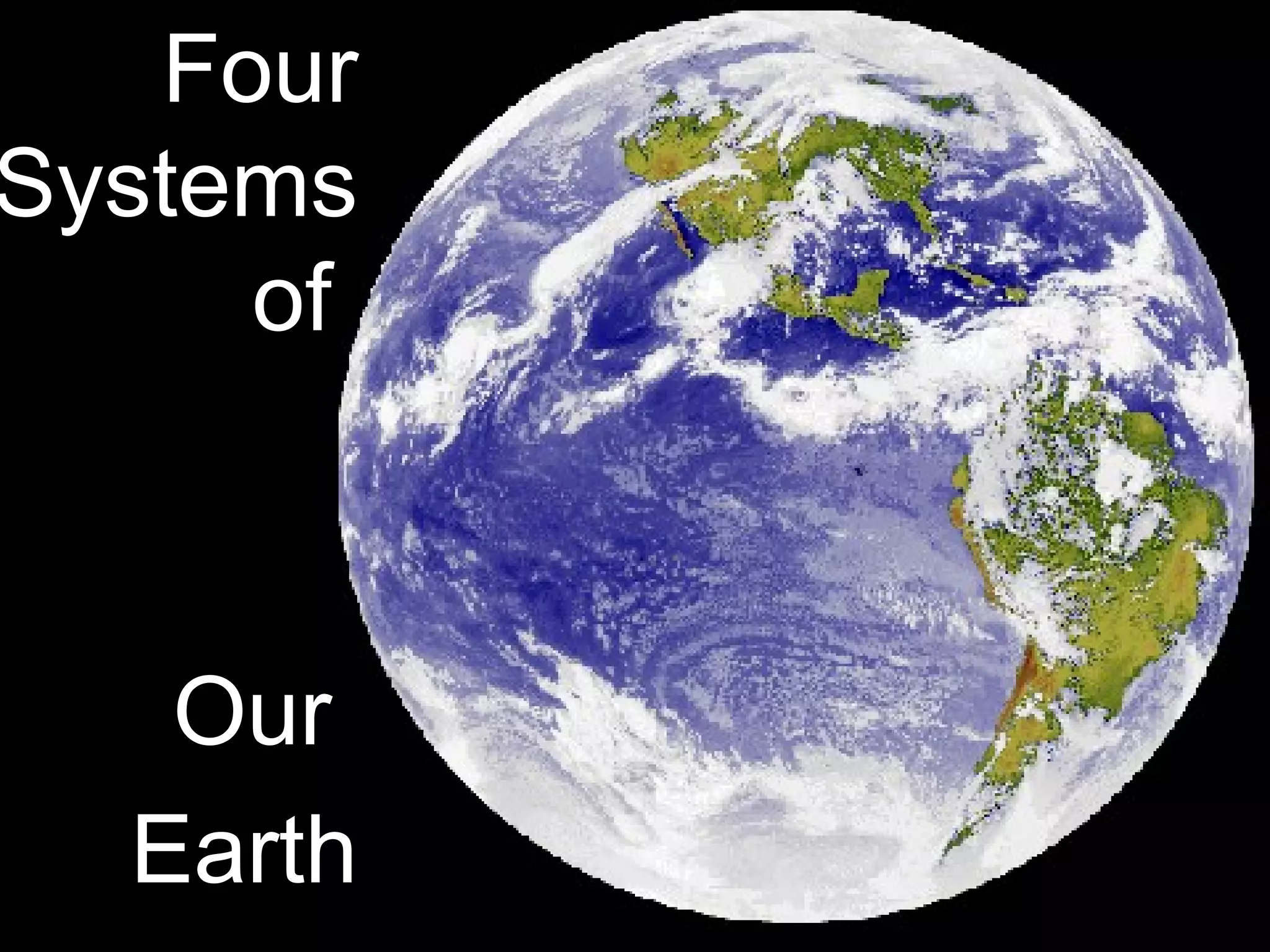
Four Systems of  Our  Earth
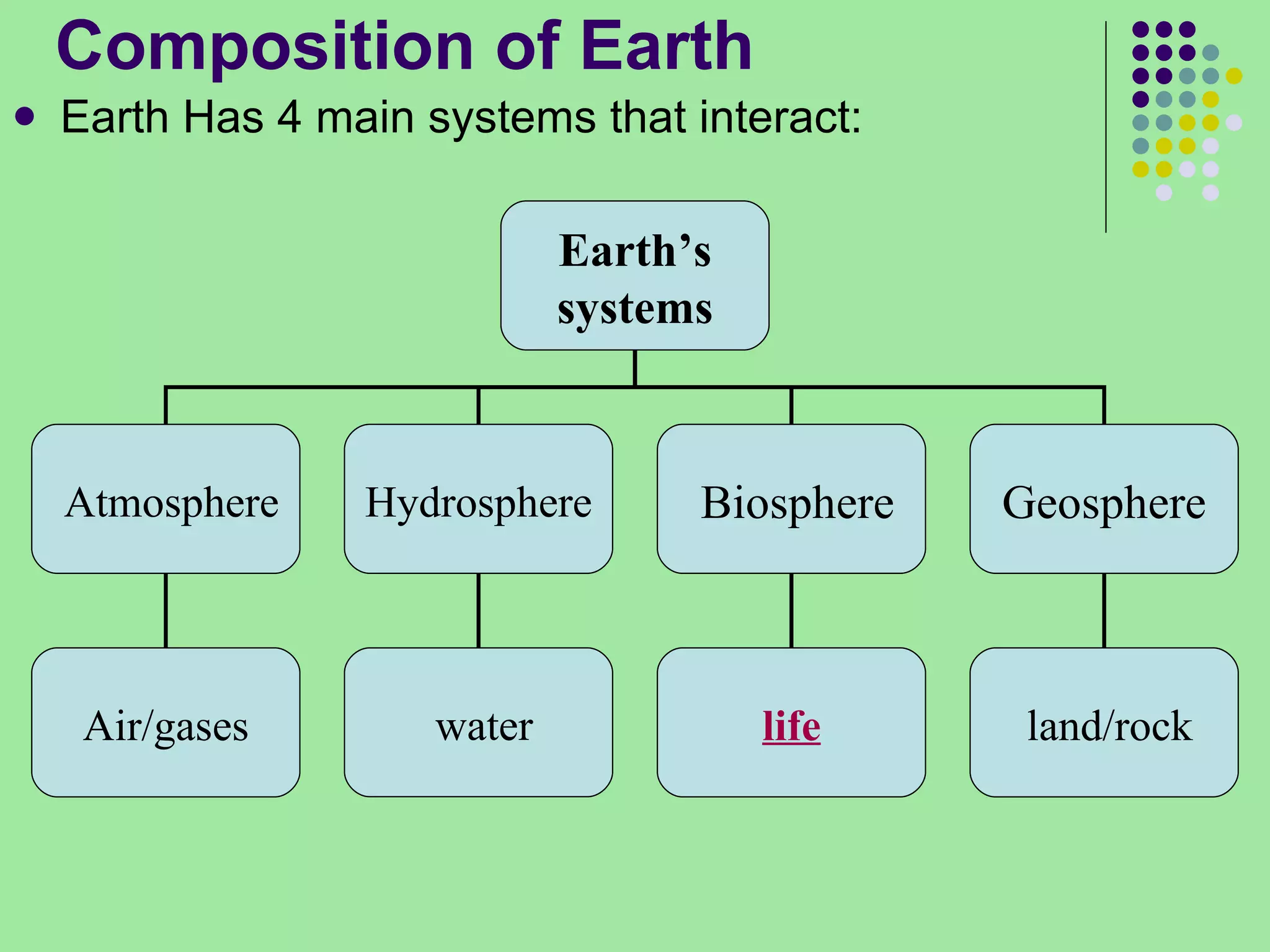
Composition of Earth Earth Has 4 main systems that interact: Earth’s systems Atmosphere Hydrosphere Biosphere Geosphere water life land/rock Air/gases
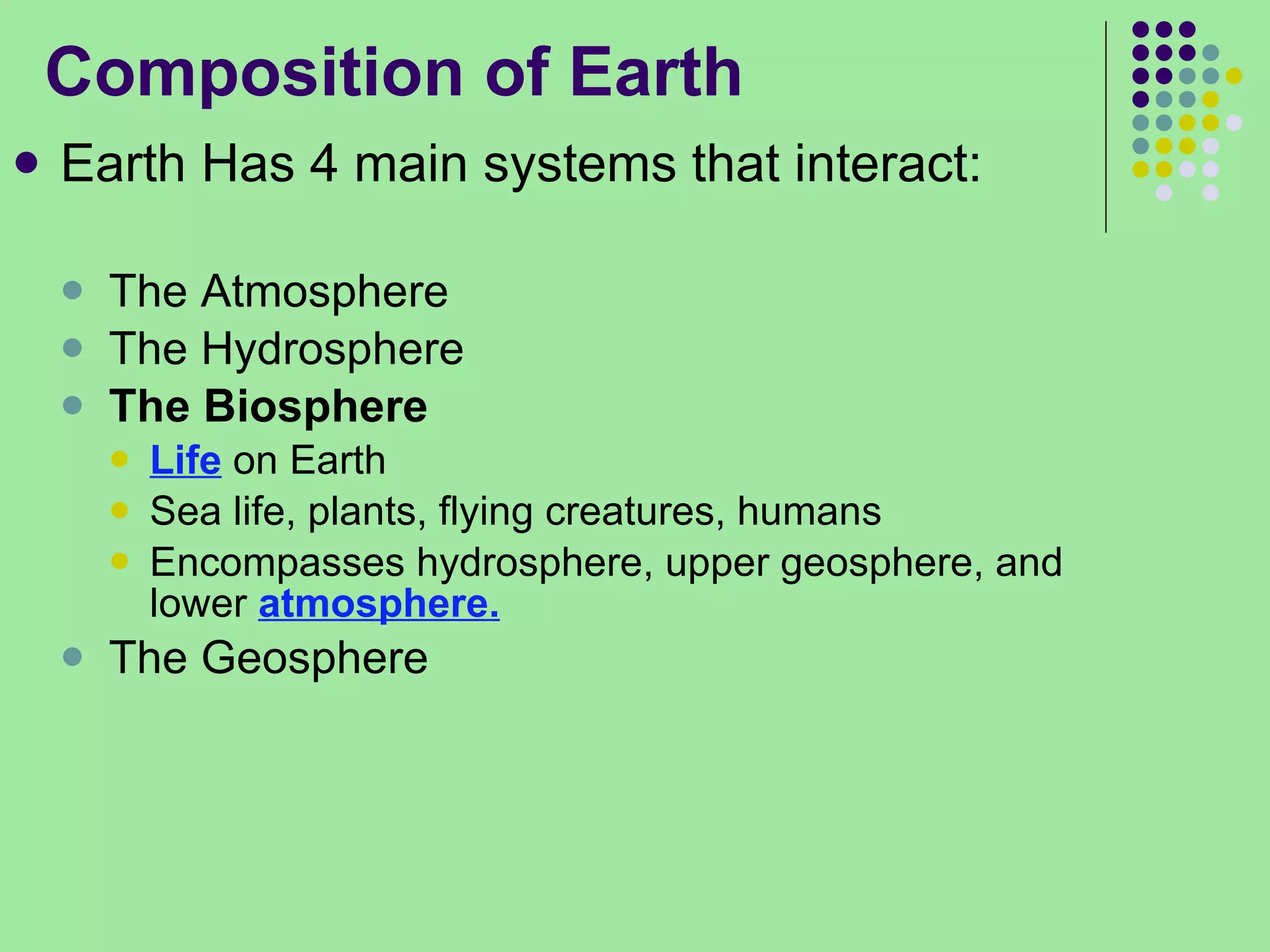
Composition of Earth Earth Has 4 main systems that interact: The Atmosphere The Hydrosphere The Biosphere Life  on Earth Sea life, plants, flying creatures, humans Encompasses hydrosphere, upper geosphere, and lower  atmosphere. The Geosphere
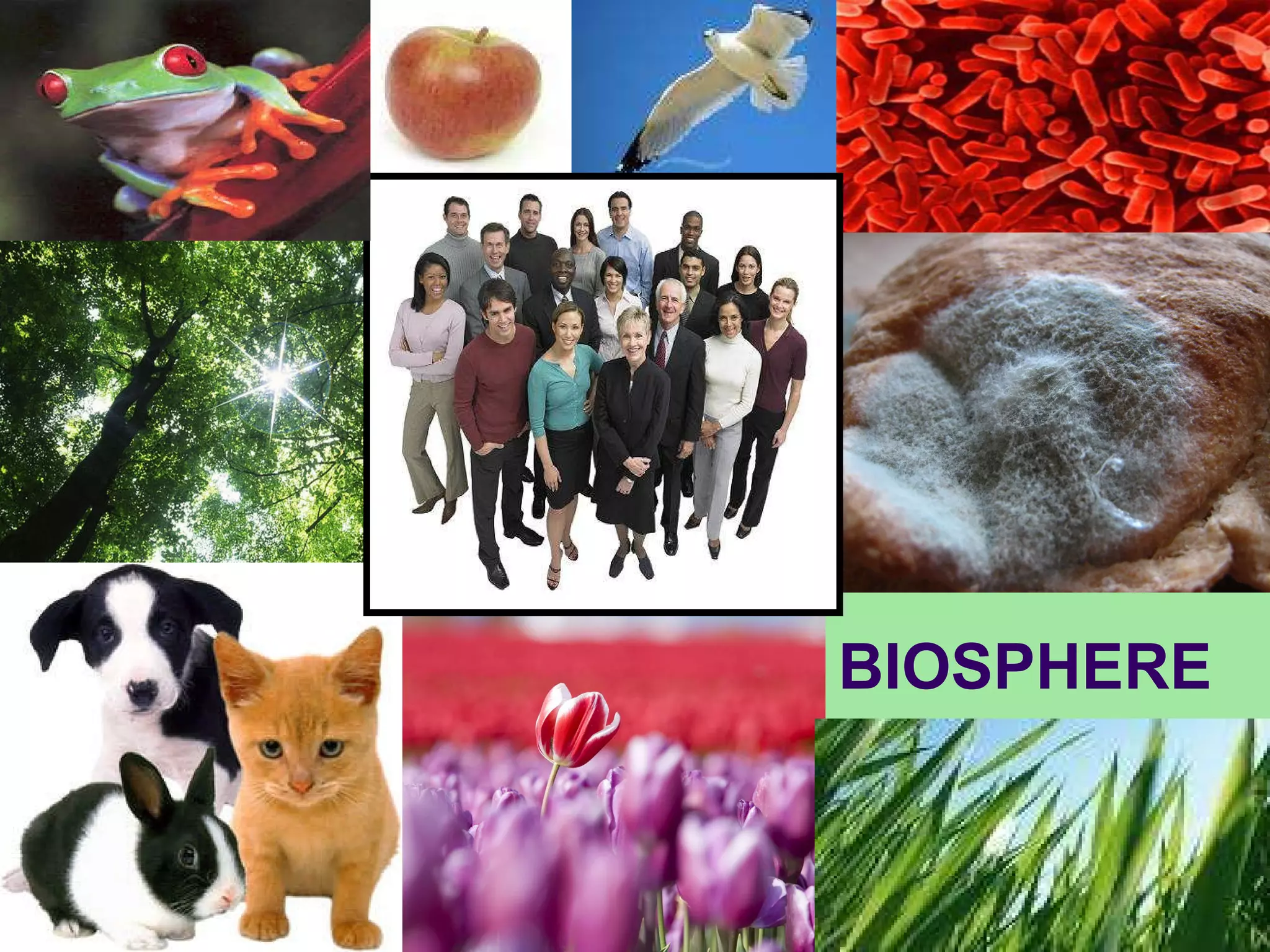
BIOSPHERE
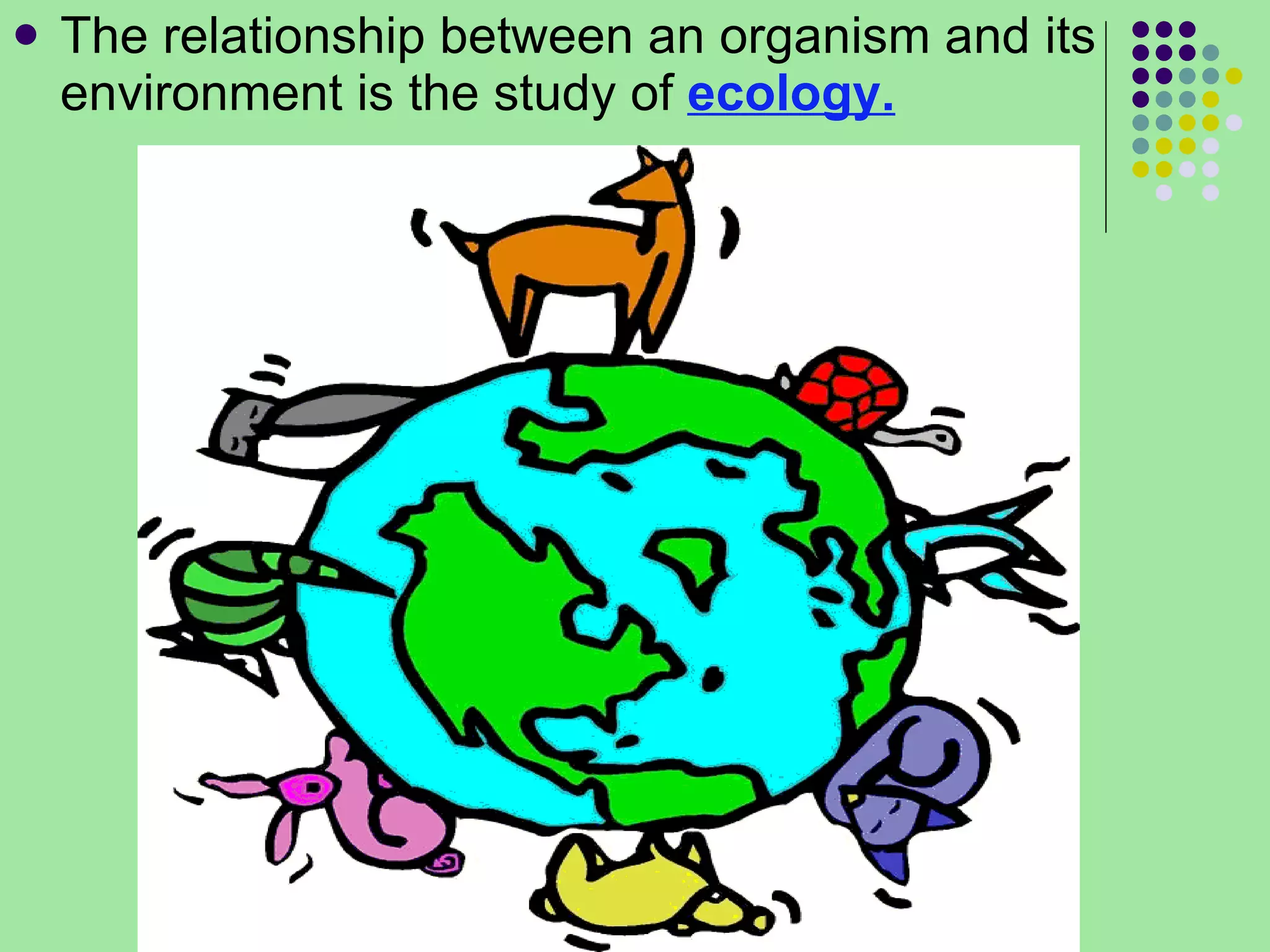
The relationship between an organism and its environment is the study of  ecology.
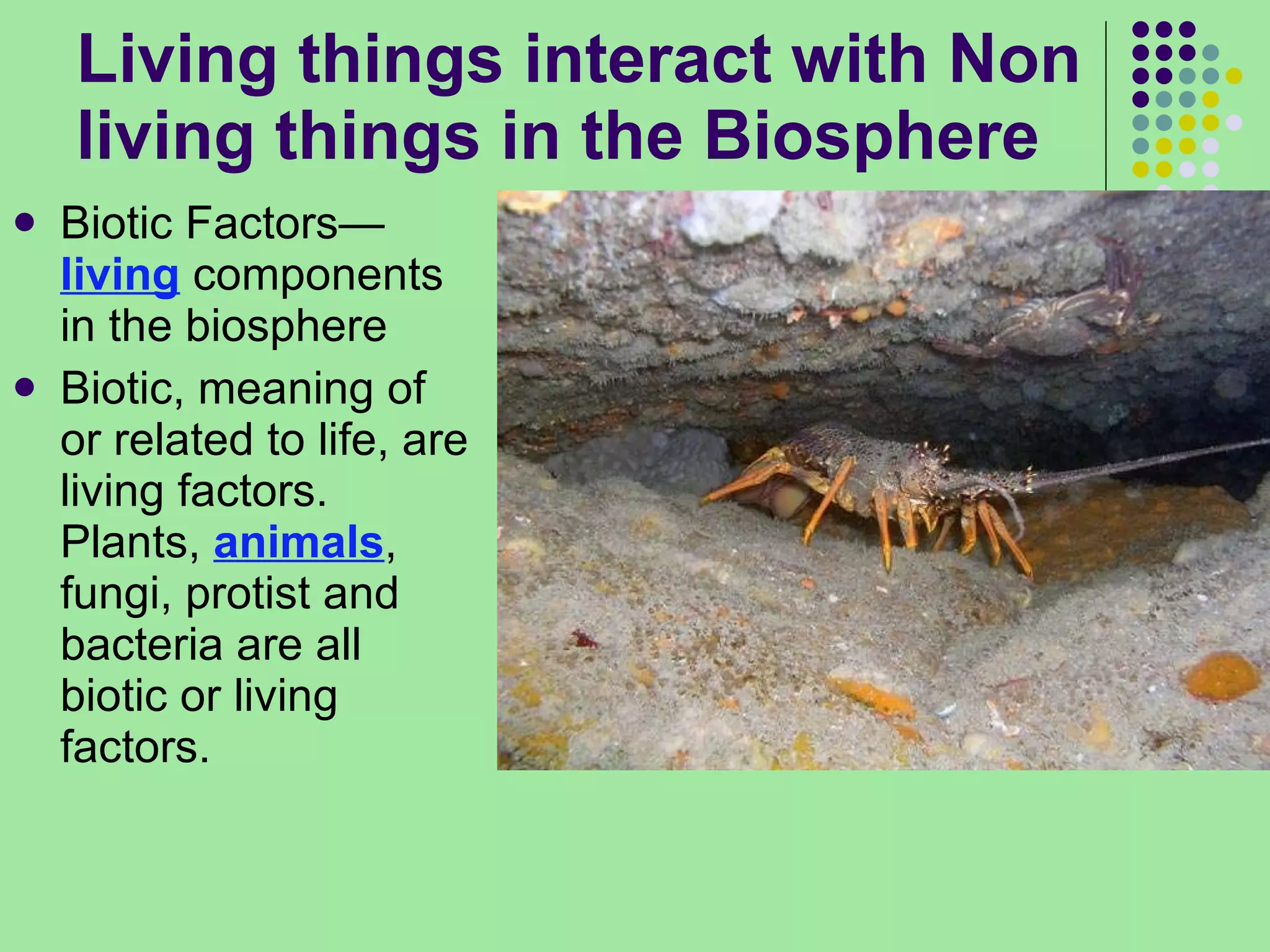
Living things interact with Non living things in the Biosphere Biotic Factors— living  components in the biosphere Biotic, meaning of or related to life, are living factors. Plants,  animals , fungi, protist and bacteria are all biotic or living factors.
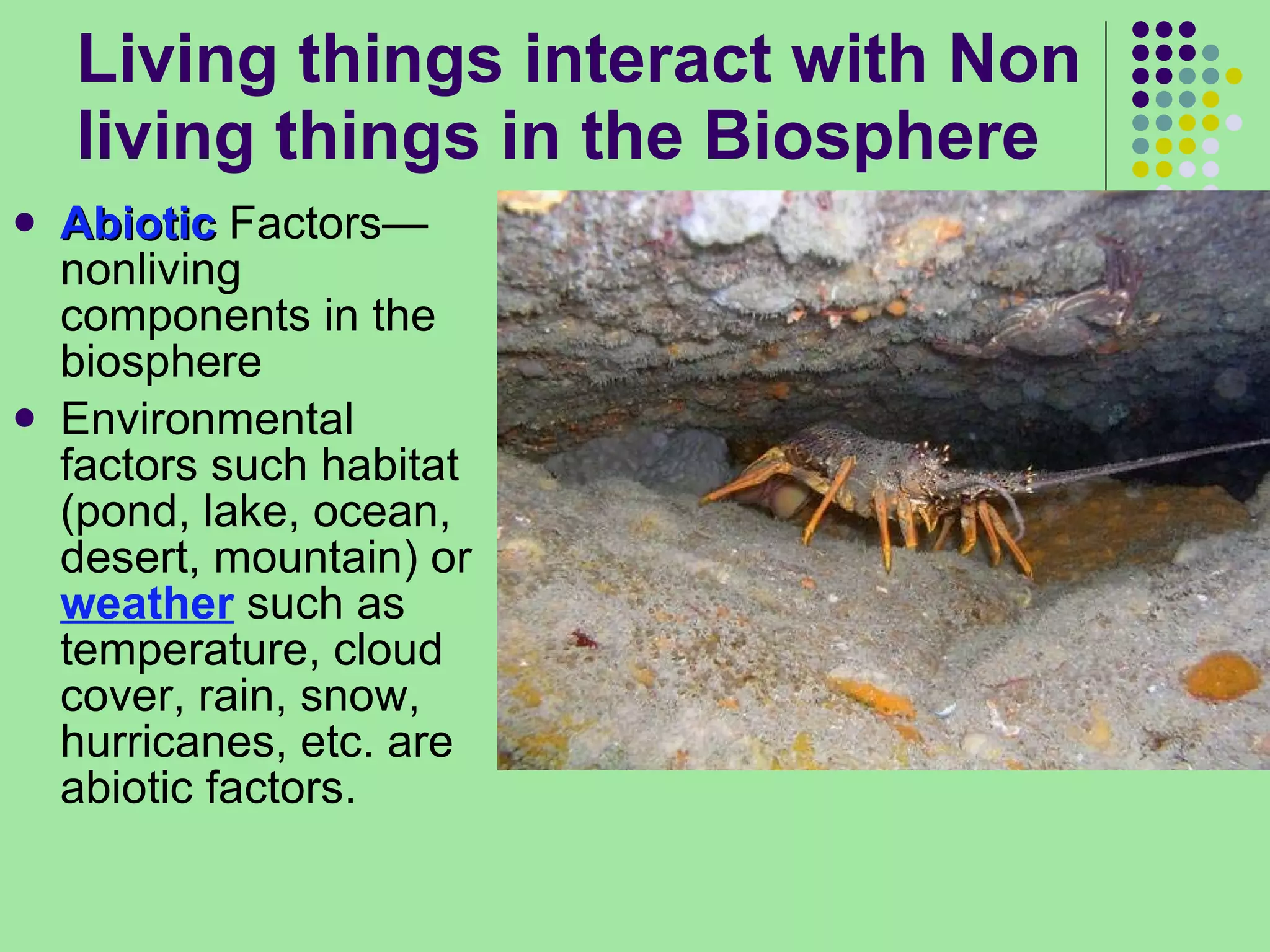
Living things interact with Non living things in the Biosphere Abiotic  Factors—nonliving components in the biosphere Environmental factors such habitat (pond, lake, ocean, desert, mountain) or  weather  such as temperature, cloud cover, rain, snow, hurricanes, etc. are abiotic factors.
Role of Water in the Biosphere Water is the universal solvent and the  basis of all  life  on our Planet. The hydrosphere is important to the Biosphere!
Role of the Sun for the biosphere The Sun provides the light and heat necessary to maintain life on Earth and is the ultimate source of  energy.
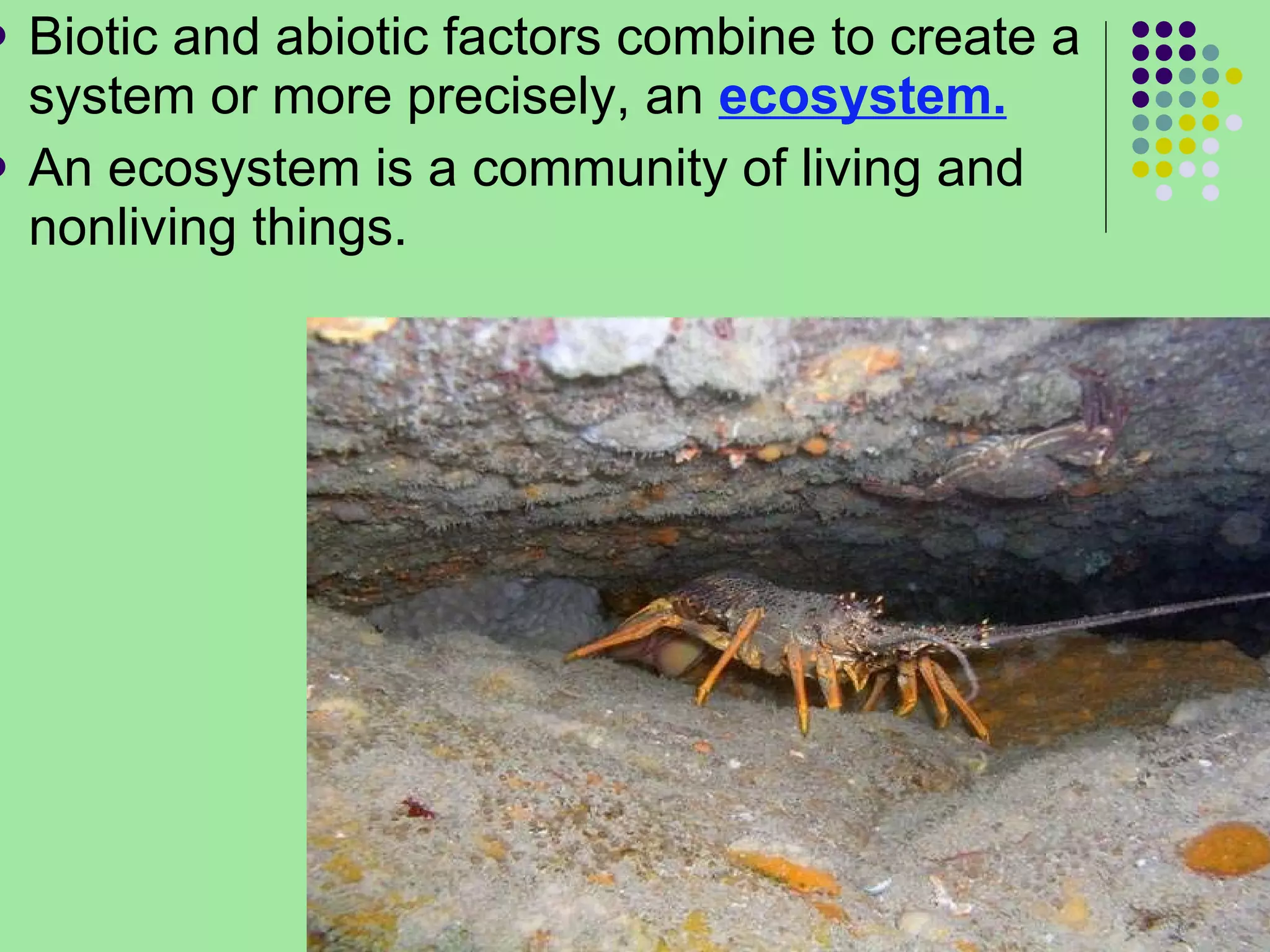
Biotic and abiotic factors combine to create a system or more precisely, an  ecosystem.   An ecosystem is a community of living and nonliving things.
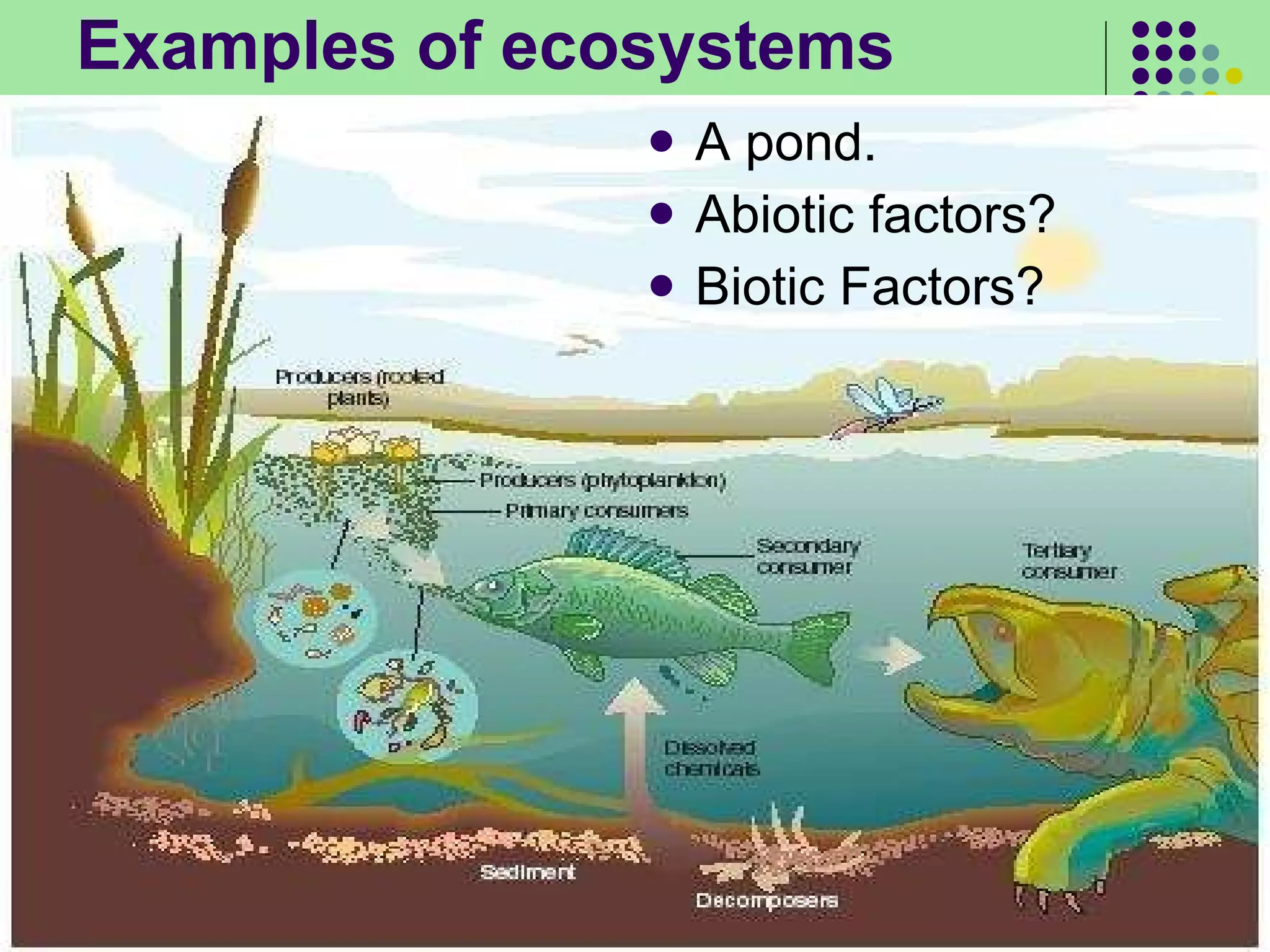
Examples of ecosystems A pond. Abiotic factors? Biotic Factors?
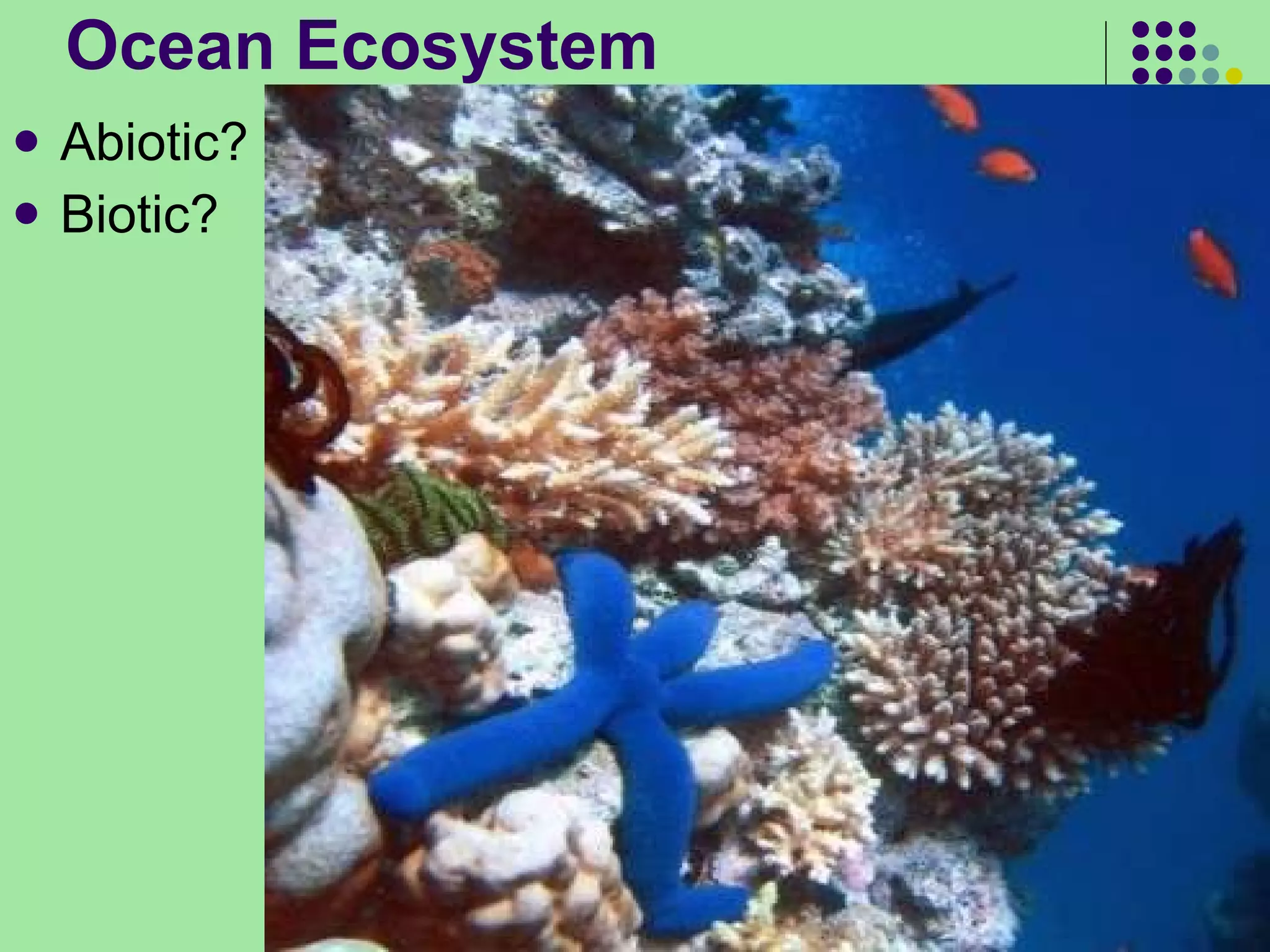
Ocean Ecosystem Abiotic? Biotic?
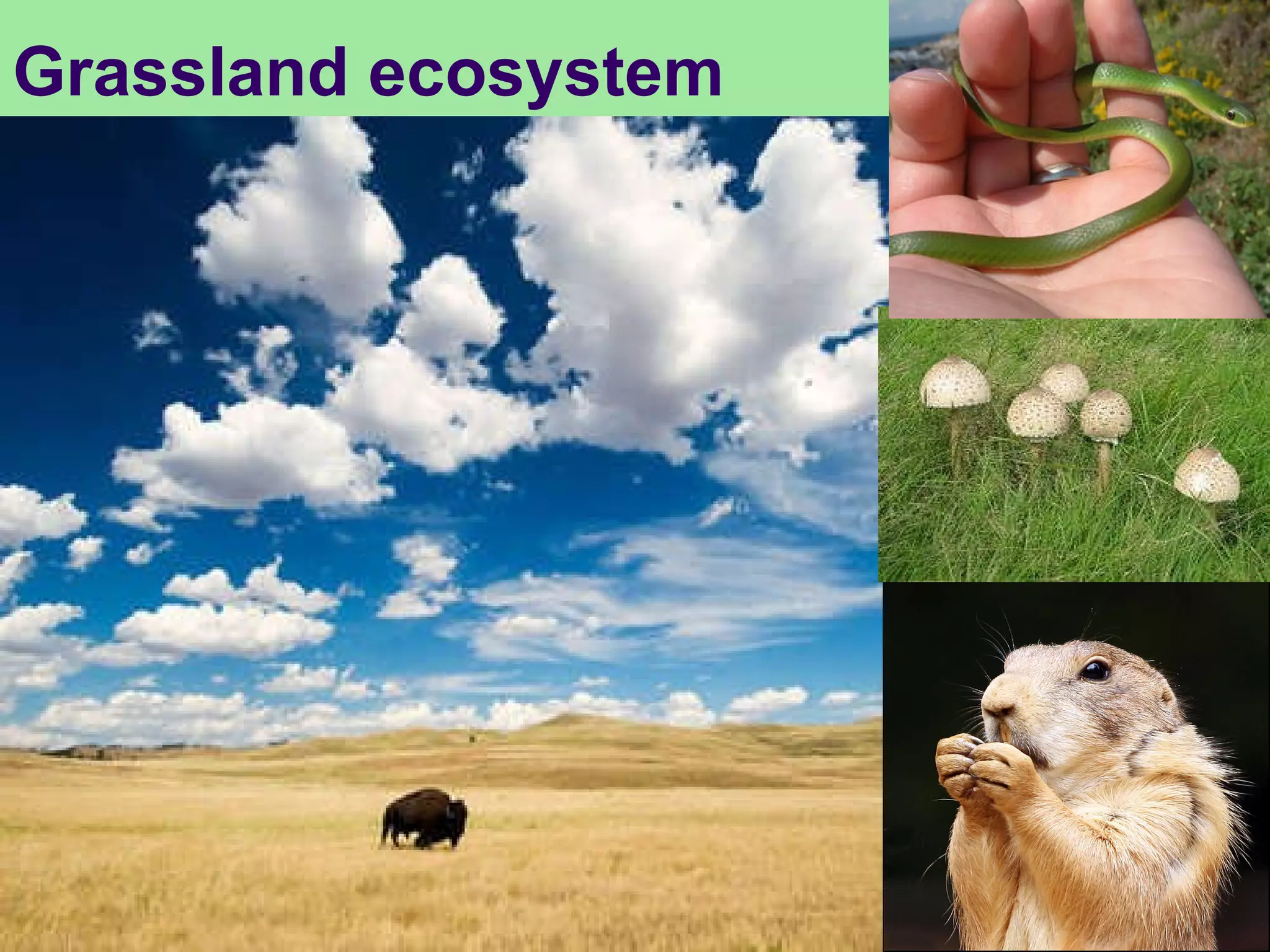
Grassland ecosystem
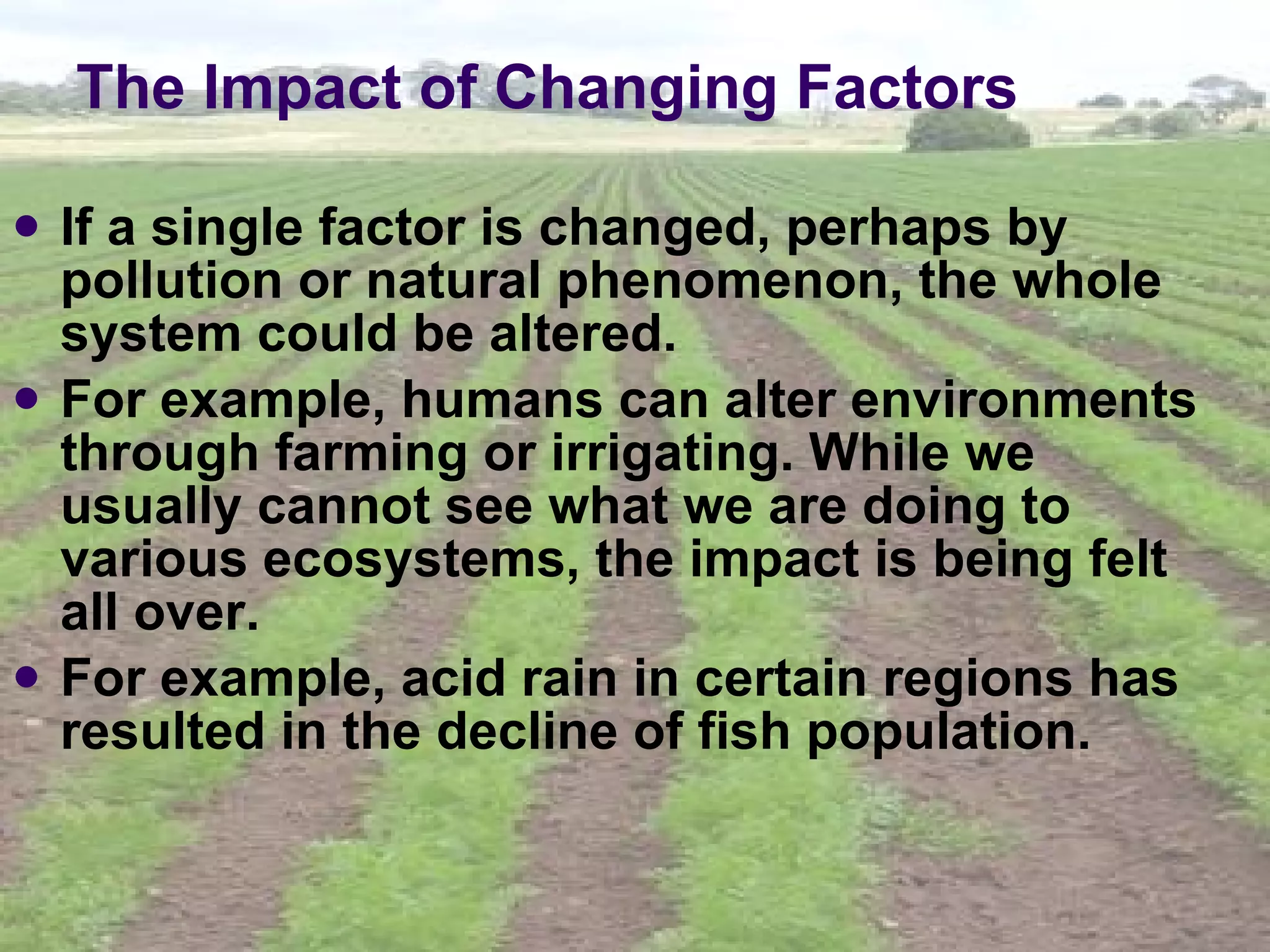
The Impact of Changing Factors If a single factor is changed, perhaps by pollution or natural phenomenon, the whole system could be altered.  For example, humans can alter environments through farming or irrigating. While we usually cannot see what we are doing to various ecosystems, the impact is being felt all over.  For example, acid rain in certain regions has resulted in the decline of fish population.
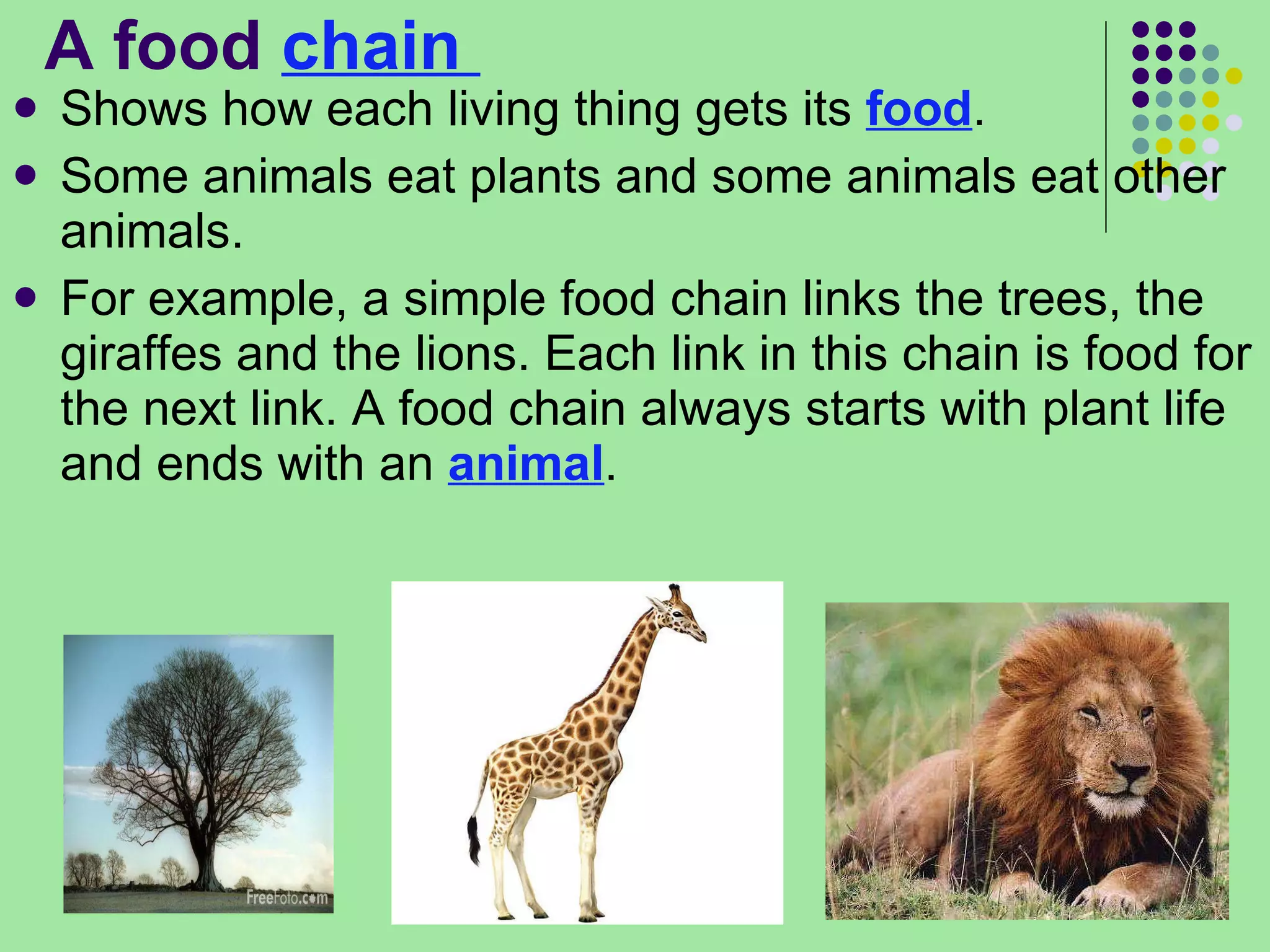
A food  chain  Shows how each living thing gets its  food .  Some animals eat plants and some animals eat other animals.  For example, a simple food chain links the trees, the giraffes and the lions. Each link in this chain is food for the next link. A food chain always starts with plant life and ends with an  animal .
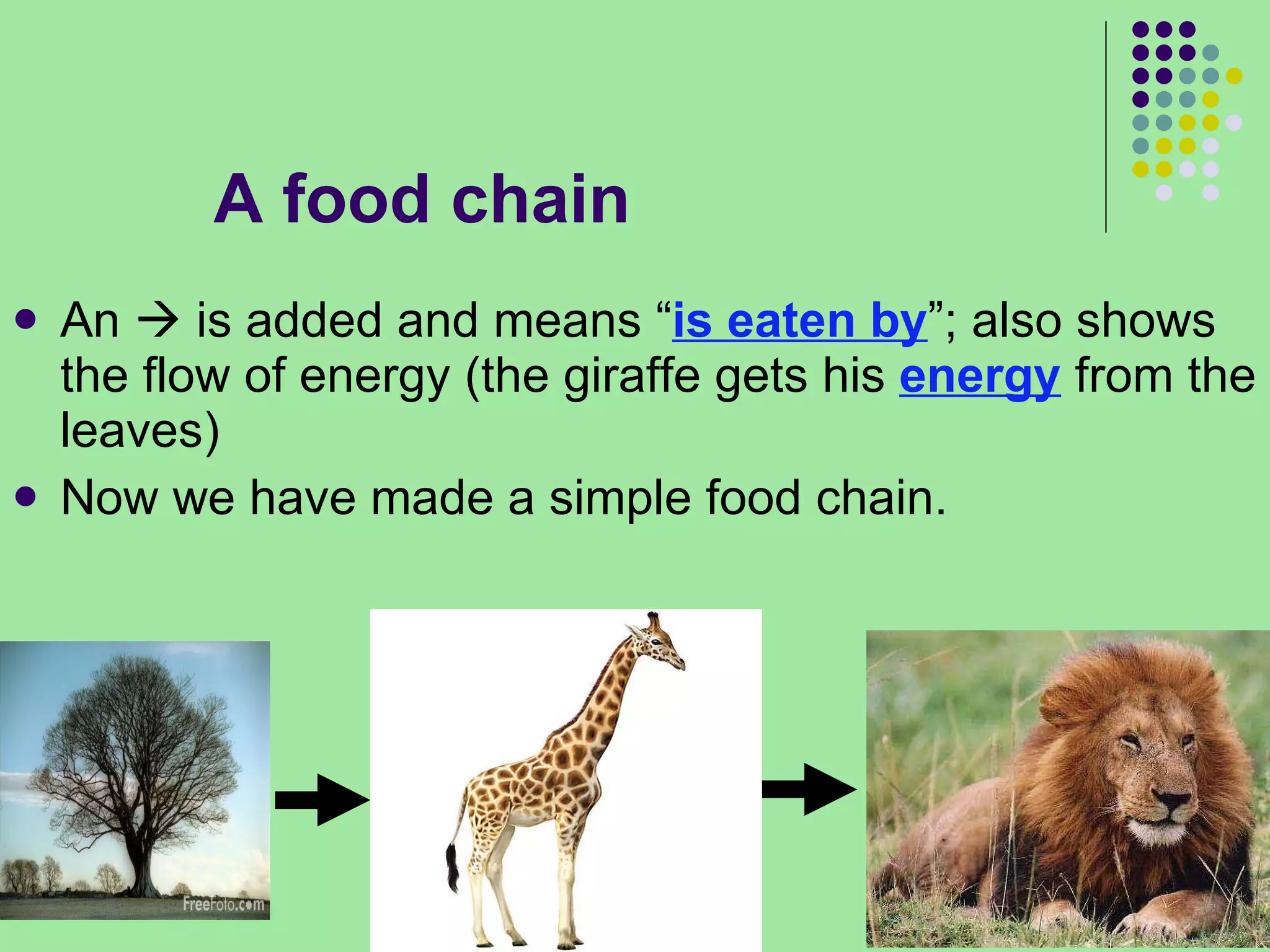
A food chain  An    is added and means “ is eaten by ”; also shows the flow of energy (the giraffe gets his  energy  from the leaves) Now we have made a simple food chain.
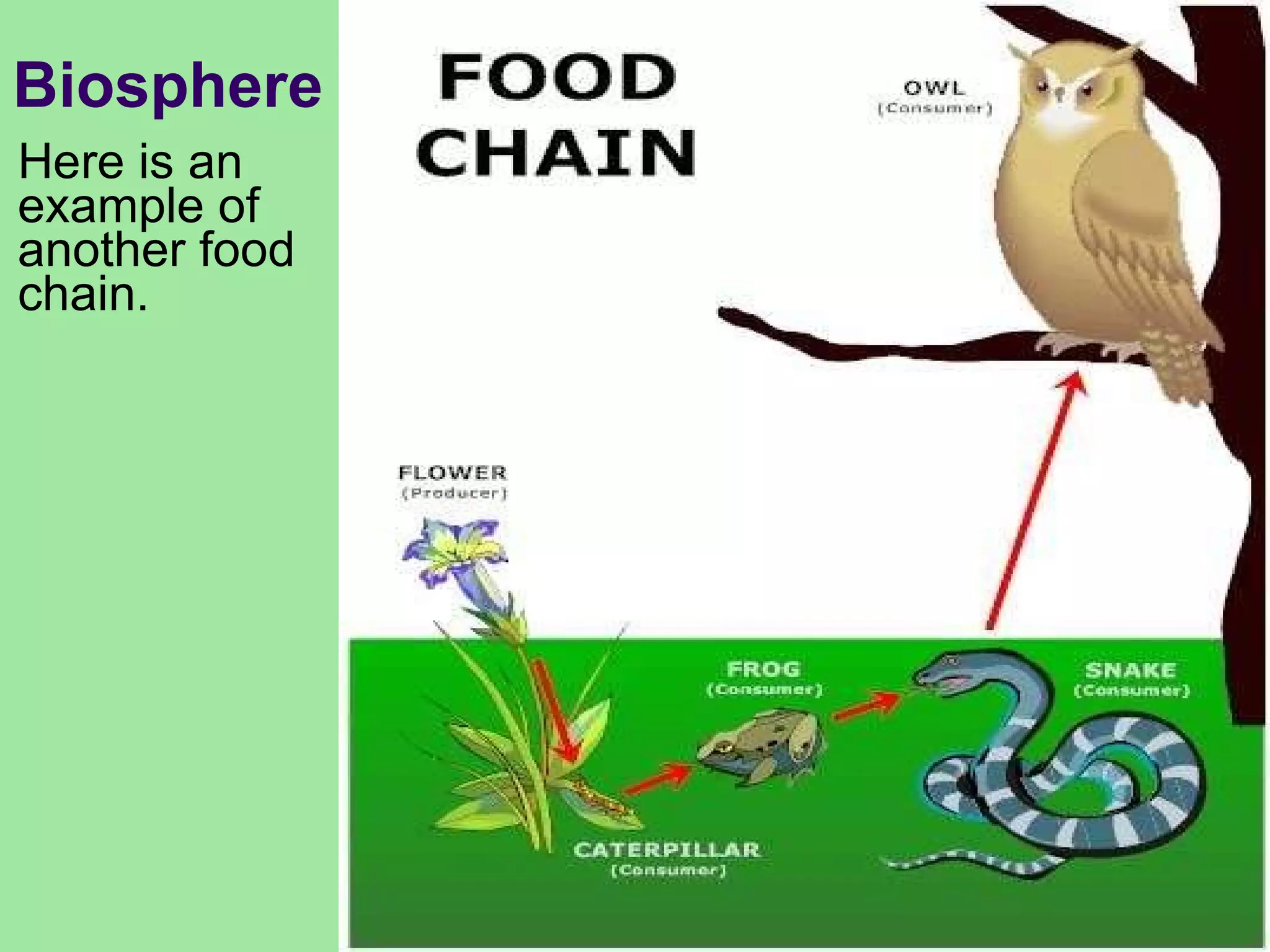
Biosphere Here is an example of another food chain.
 
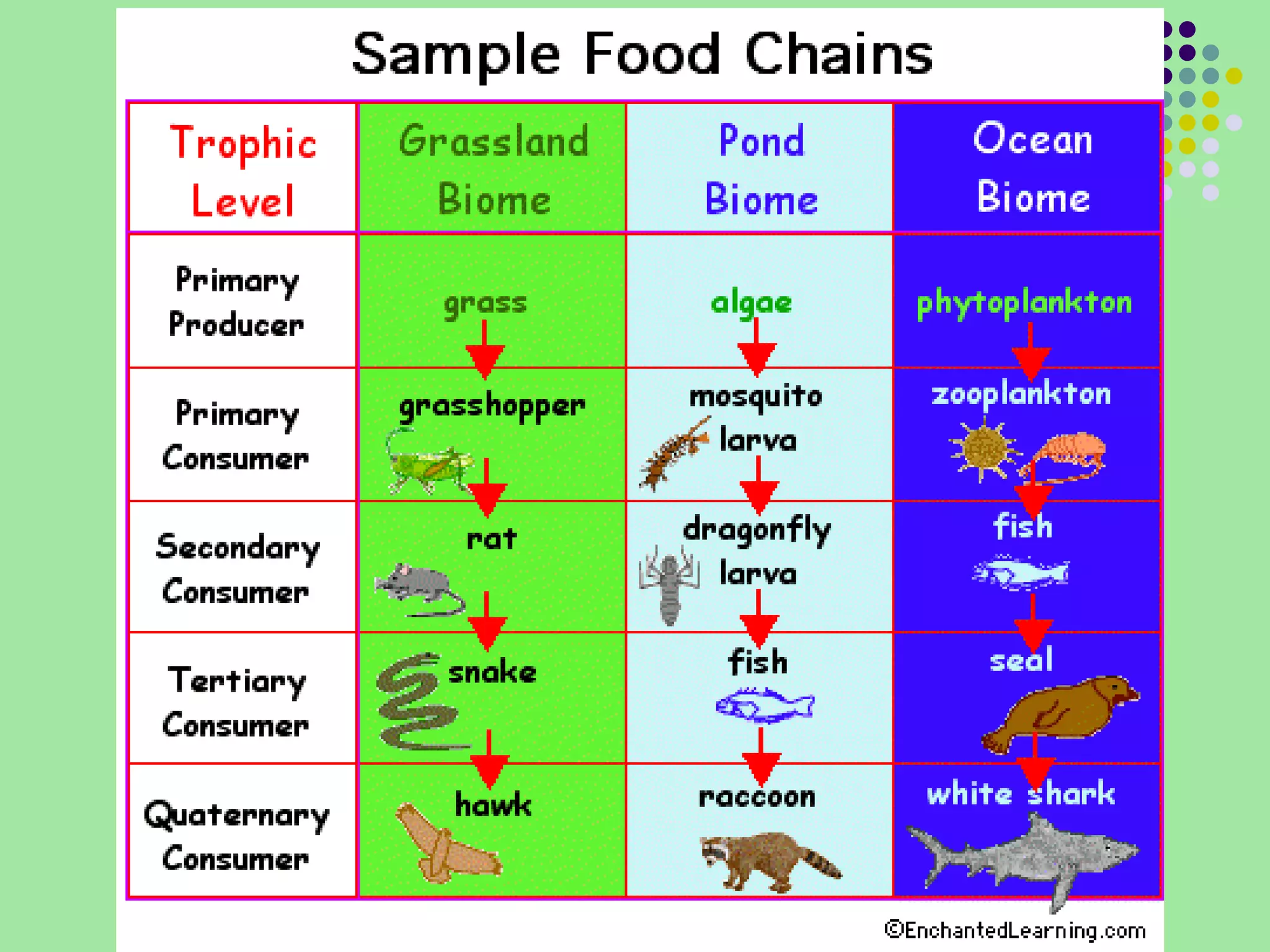
Plants are called  producers  or autotrophs because they are able to use light energy to make their own food.
 
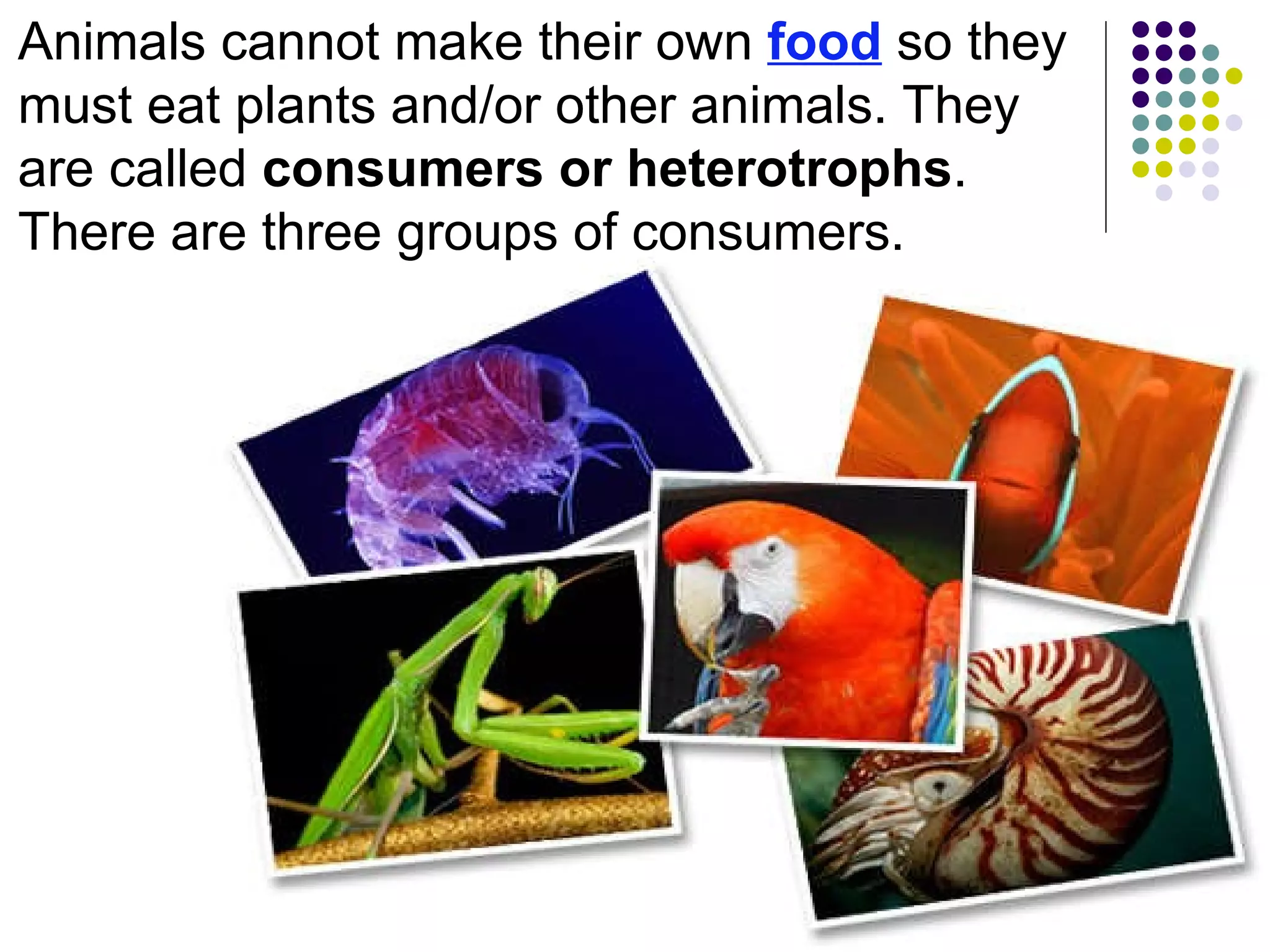
Animals cannot make their own  food  so they must eat plants and/or other animals. They are called  consumers or heterotrophs . There are three groups of consumers.
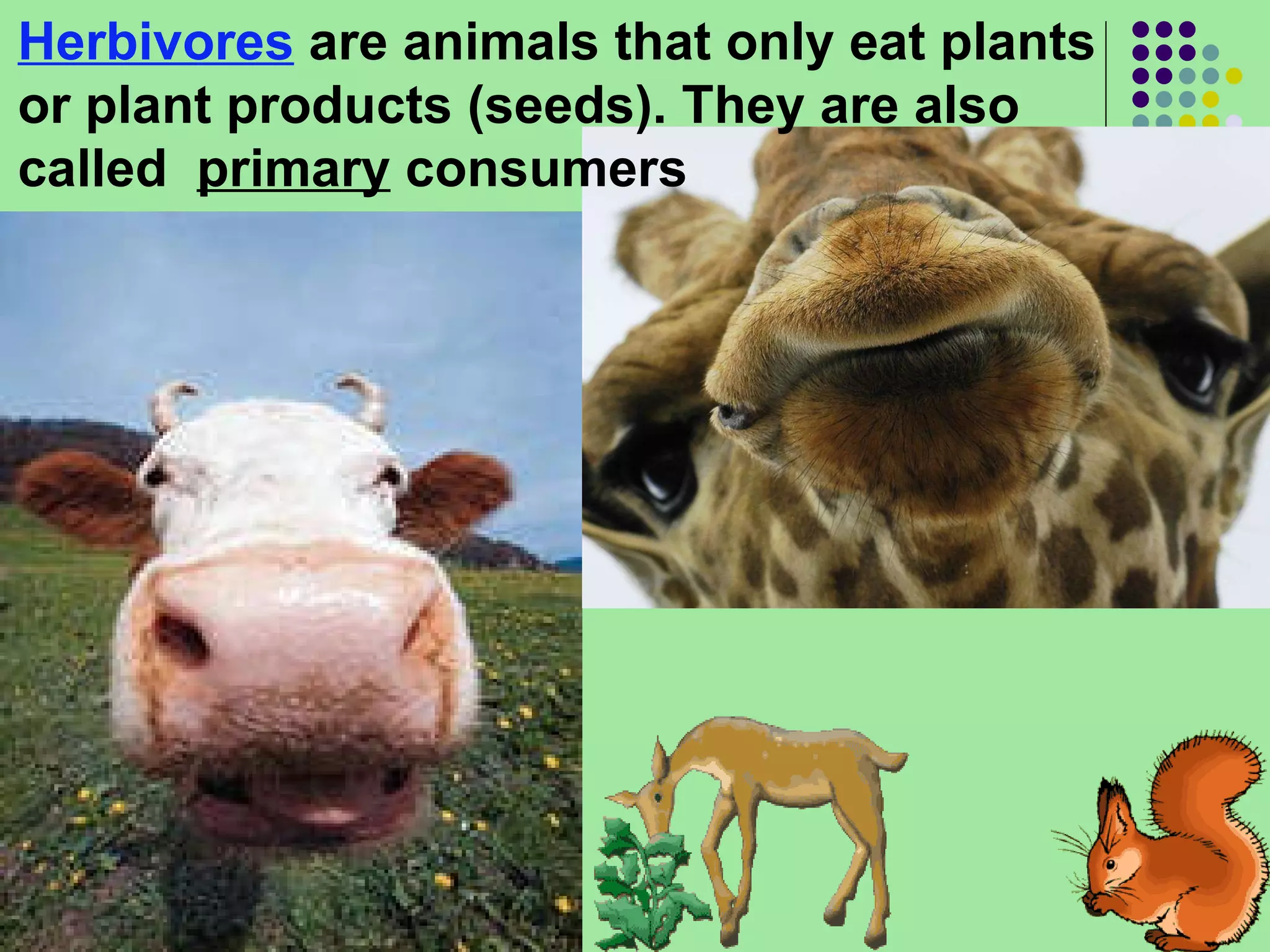
Herbivores  are animals that only eat plants or plant products (seeds). They are also called  primary  consumers
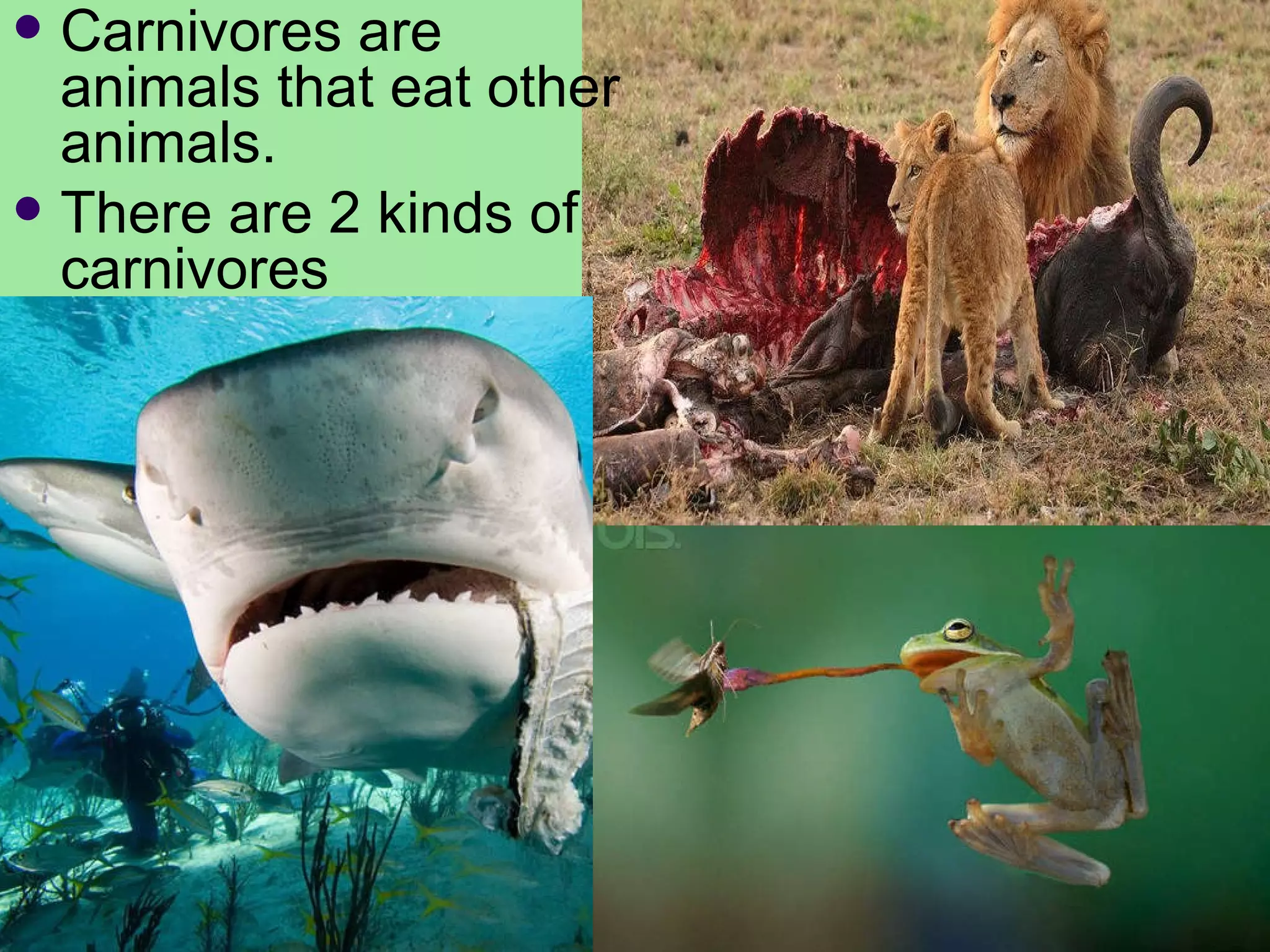
Carnivores are animals that eat other animals.  There are 2 kinds of carnivores
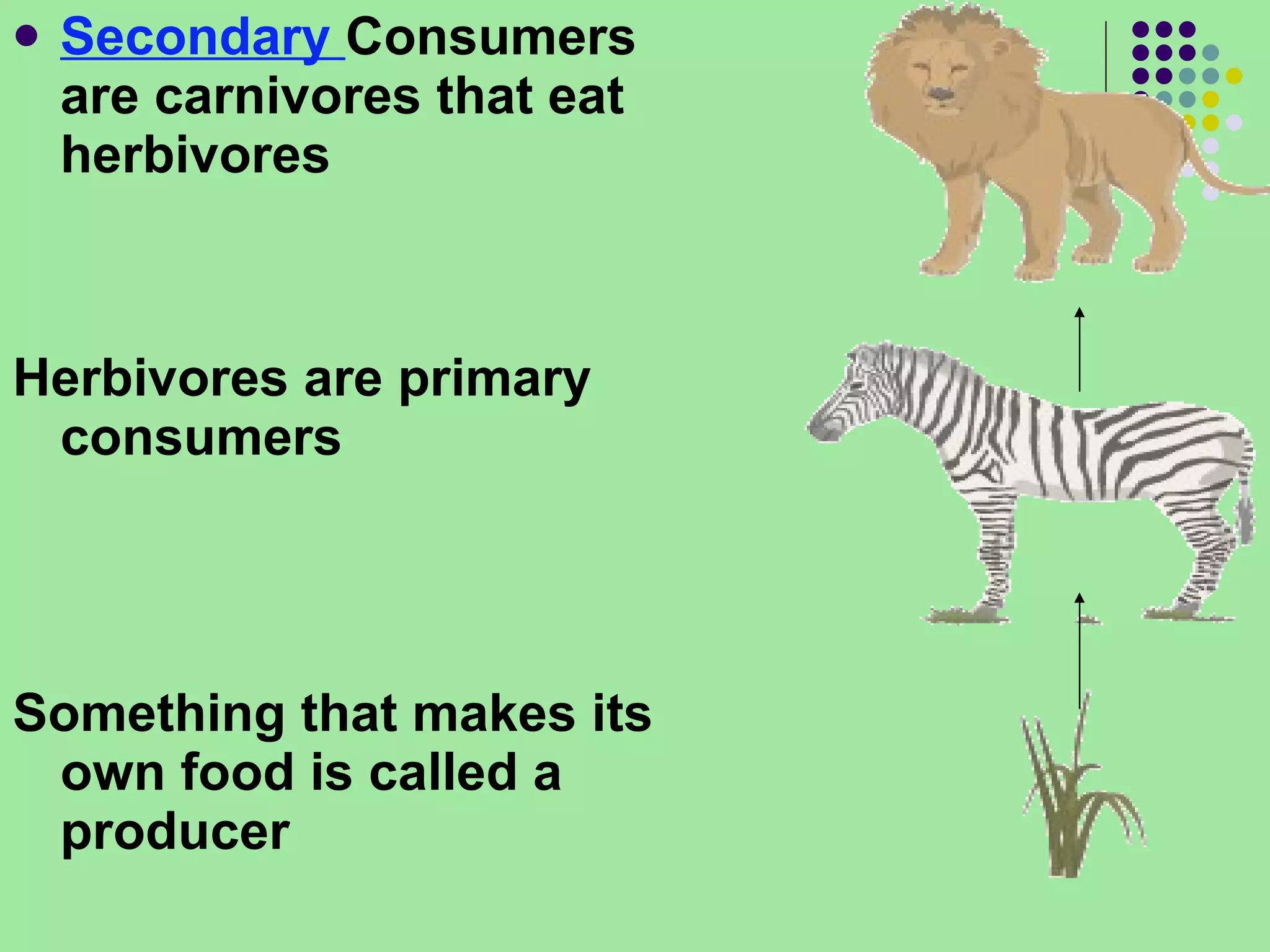
Secondary  Consumers are carnivores that eat herbivores  Herbivores are primary consumers Something that makes its own food is called a producer
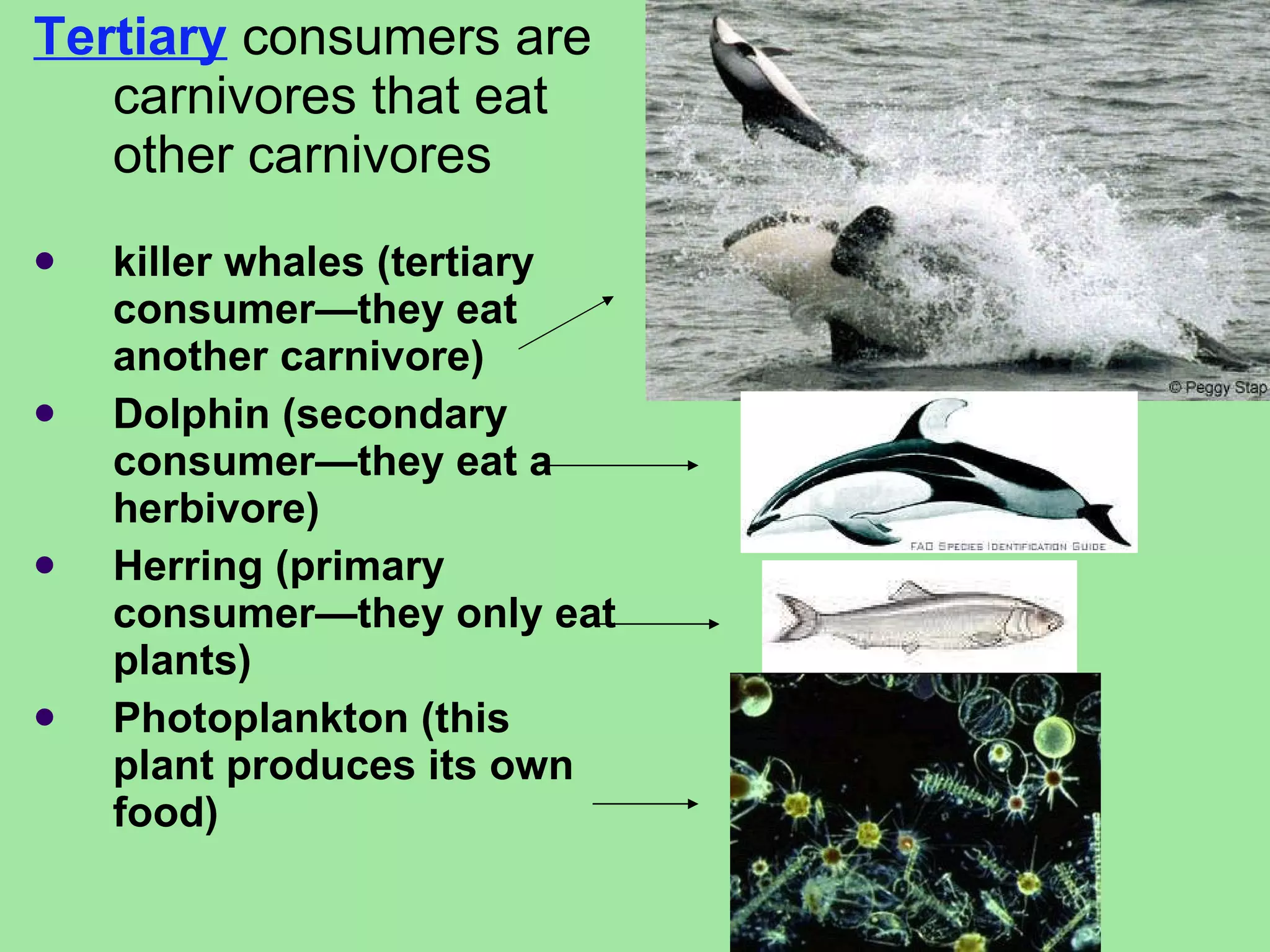
Tertiary  consumers are carnivores that eat other carnivores  killer whales (tertiary consumer—they eat another carnivore) Dolphin (secondary consumer—they eat a herbivore) Herring (primary consumer—they only eat plants) Photoplankton (this plant produces its own food)
Make your own food chain Find in your notes where it says to make your own food chain. Start with a plant on the very left side. The arrow means “is eaten by” so think of the next thing that might eat your plant…and so on.
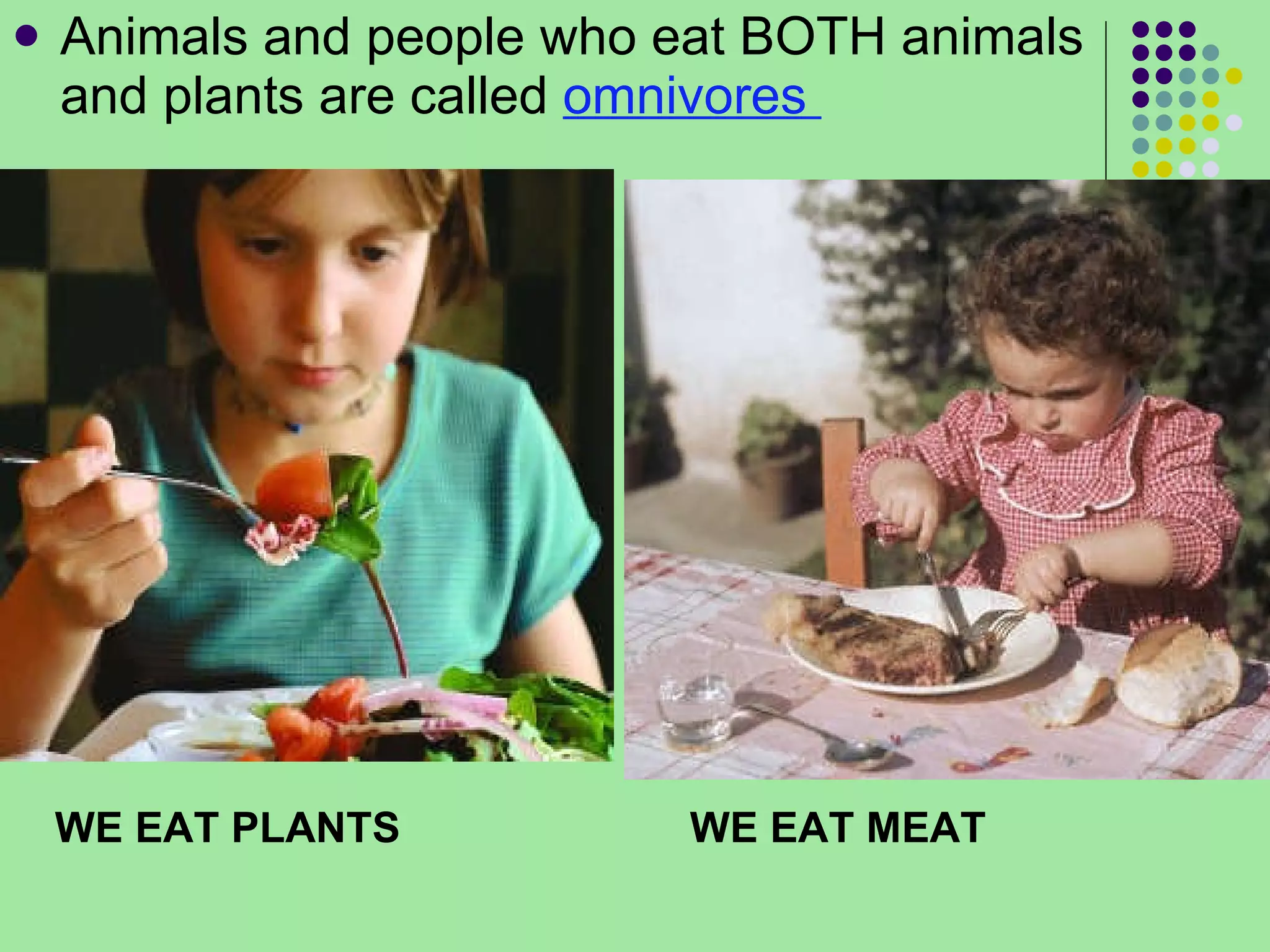
Animals and people who eat BOTH animals and plants are called  omnivores  WE EAT PLANTS WE EAT MEAT
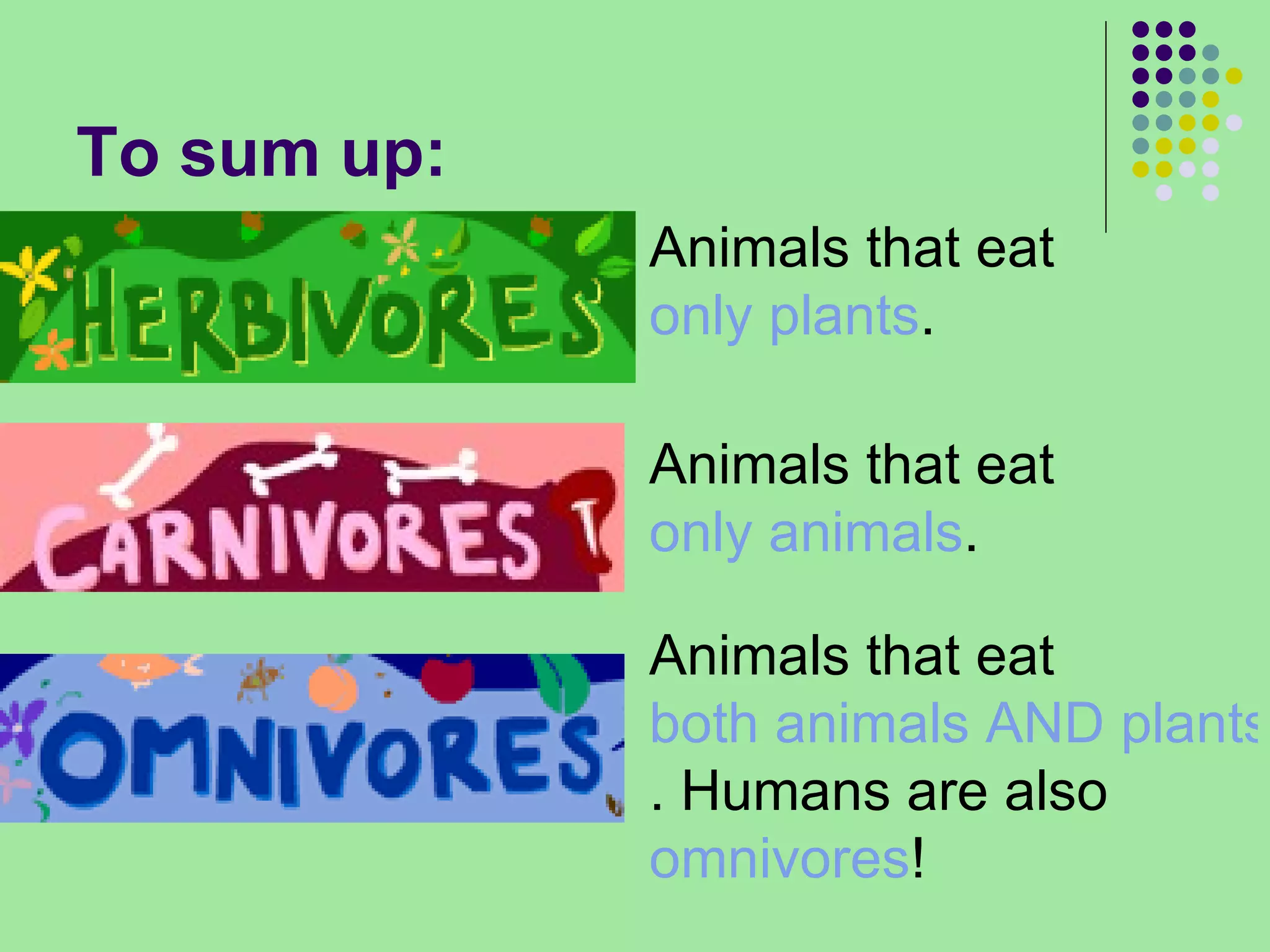
To sum up: Animals that eat  both animals AND plants . Humans are also  omnivores !       Animals that eat   only animals .       Animals that eat  only plants .                
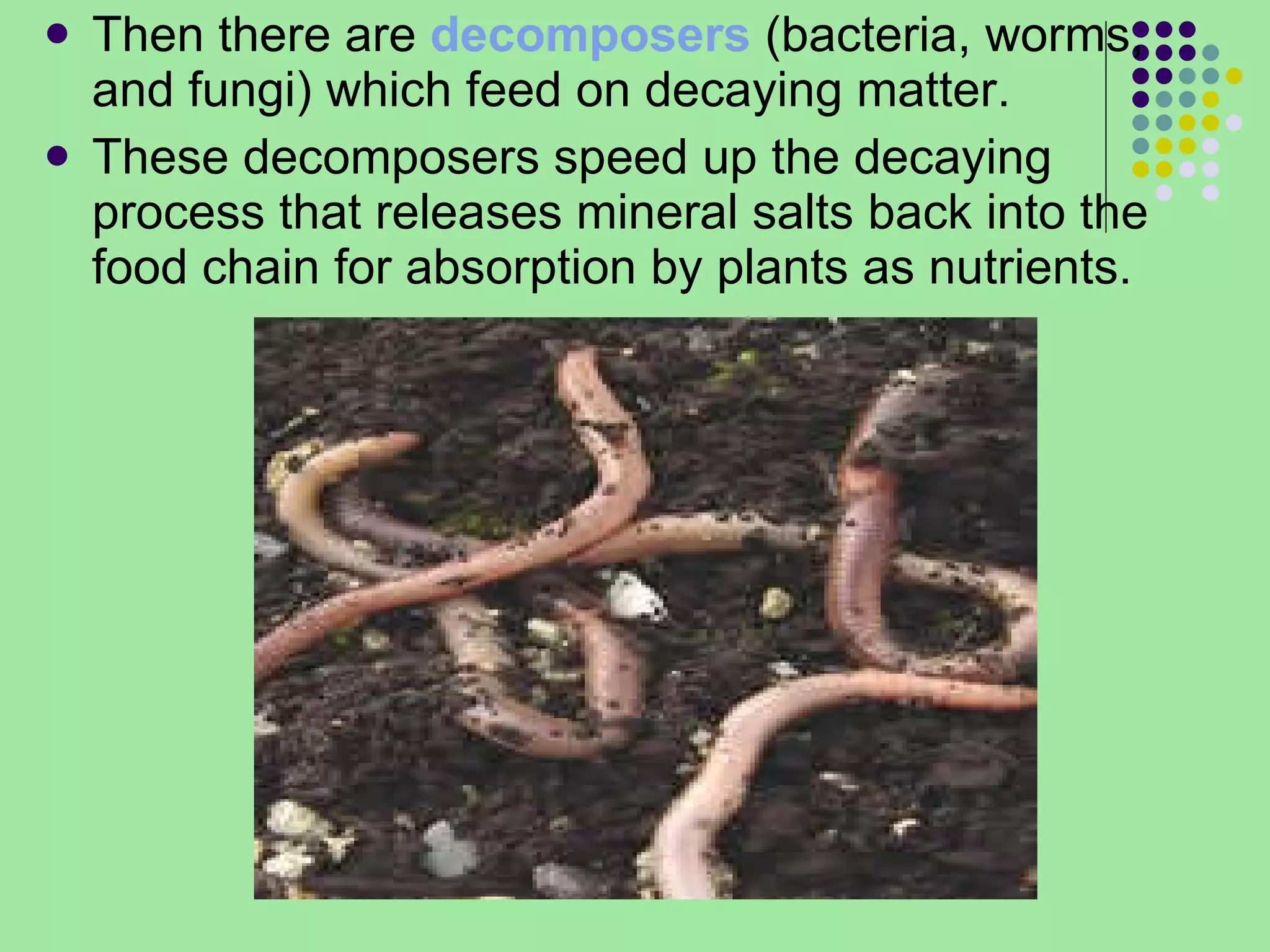
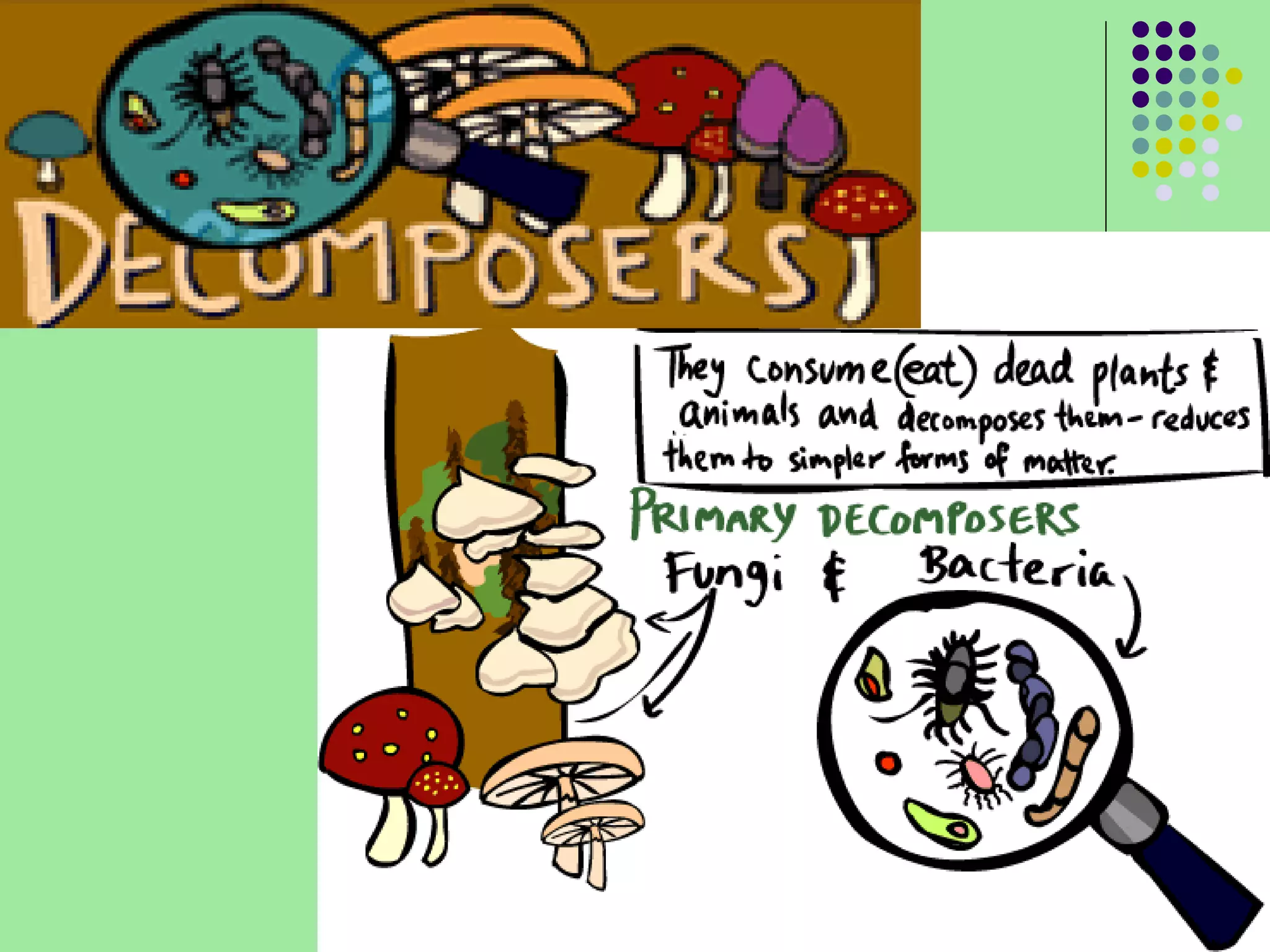
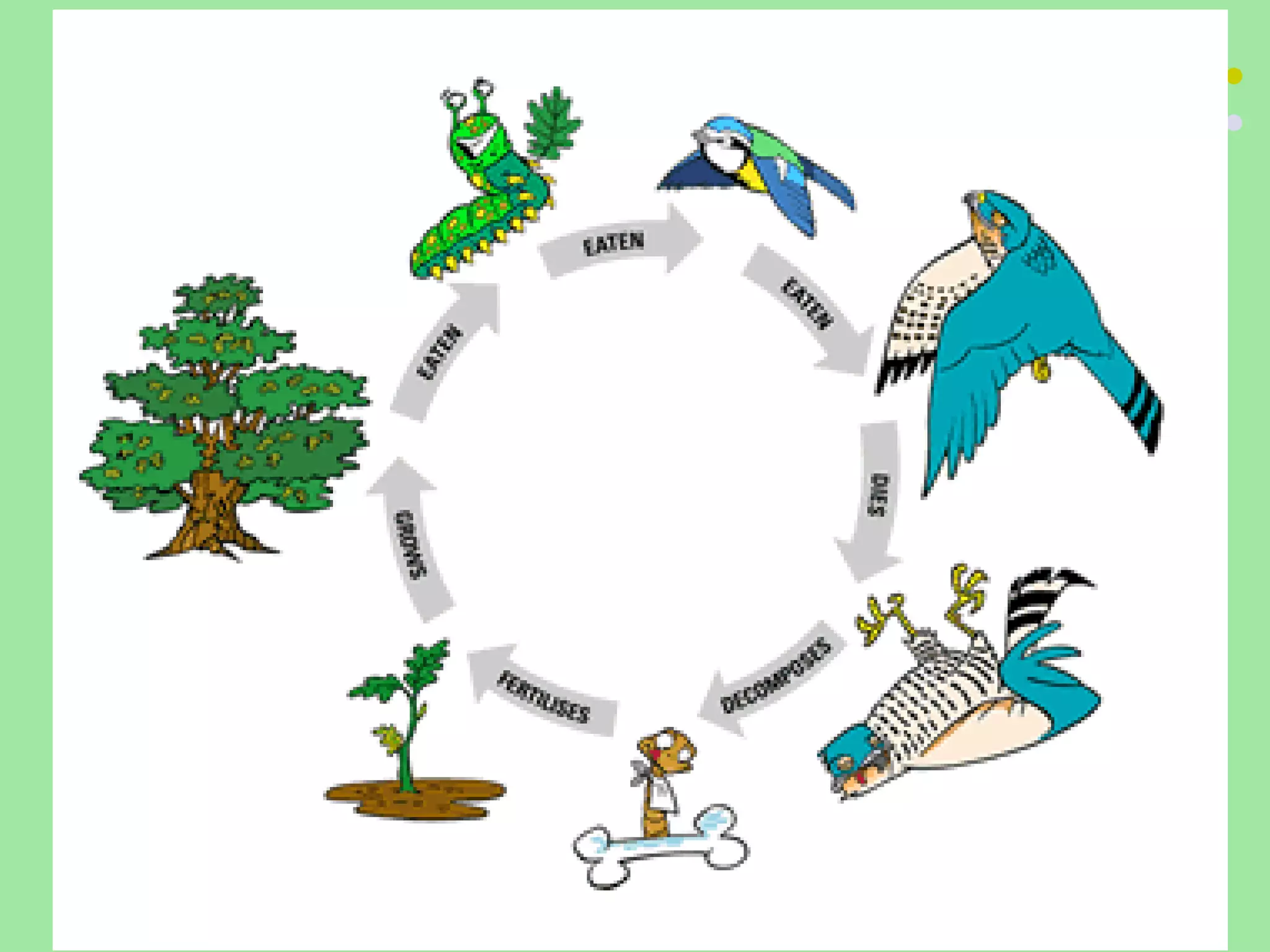
Then there are  decomposers  (bacteria, worms, and fungi) which feed on decaying matter.  These decomposers speed up the decaying process that releases mineral salts back into the food chain for absorption by plants as nutrients.
 
 
Games http://www.sheppardsoftware.com/content/animals/kidscorner/foodchain/foodchain.htm  producer consumer game (pic of cow) http://www.sheppardsoftware.com/content/animals/kidscorner/foodchain/foodchain.htm Omnivore, carnivore, herbivore game (pic of person,frog, lion and bear) http://www.sheppardsoftware.com/content/animals/kidscorner/matching/mcarnivores.htm   Matching game (herbivore, carnivore, omnivore)
Do you know why there are more herbivores than carnivores?
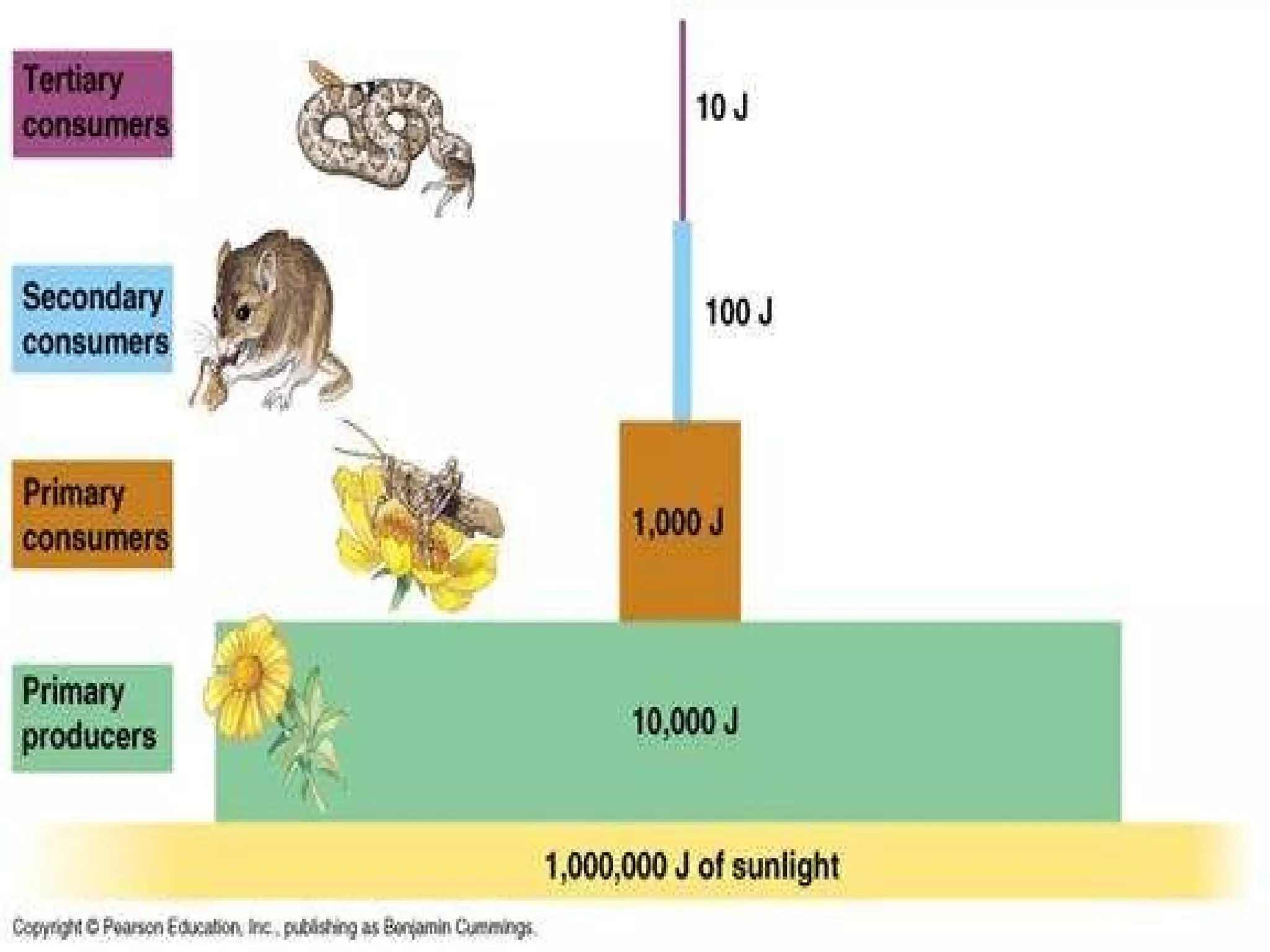
In a food chain, energy is passed from one link to another Lets say a plant has the # 100 to represent the energy it has made. When a herbivore eats, it does not get all the plant’s energy. It uses up some of the energy in everyday activities. The herbivore may only get 10% of that energy. A carnivore then eats this herbivore. The carnivore only gets 1% of that plants original energy. This is why the carnivore has to eat many herbivores to get enough energy to grow.
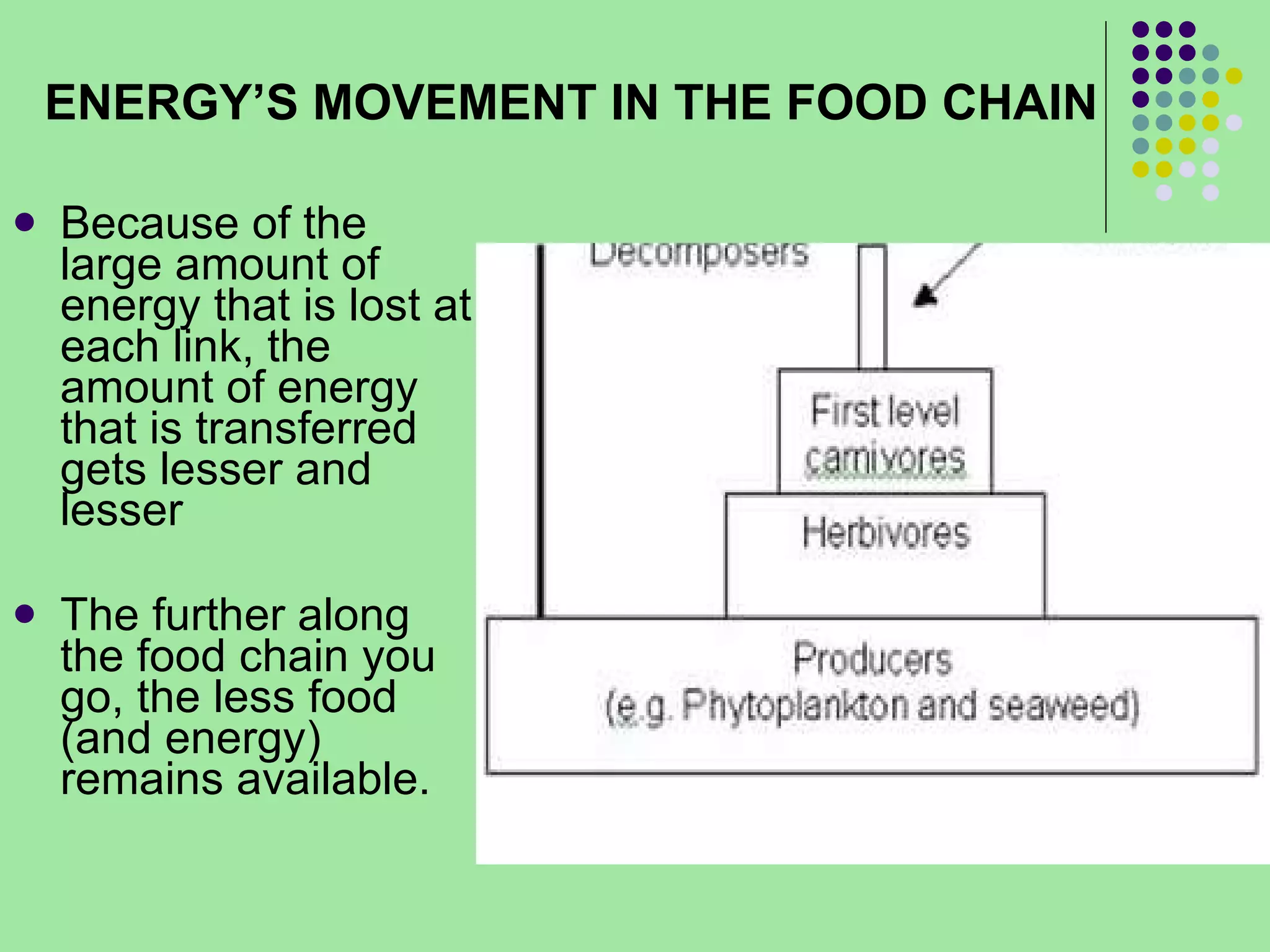
Energy and mass is transferred from one level of the food chain to the next with an efficiency of about  10 %.
Because of the large amount of energy that is lost at each link, the amount of energy that is transferred gets lesser and lesser  The further along the food chain you go, the less food (and energy) remains available.  ENERGY’S MOVEMENT IN THE FOOD CHAIN
 
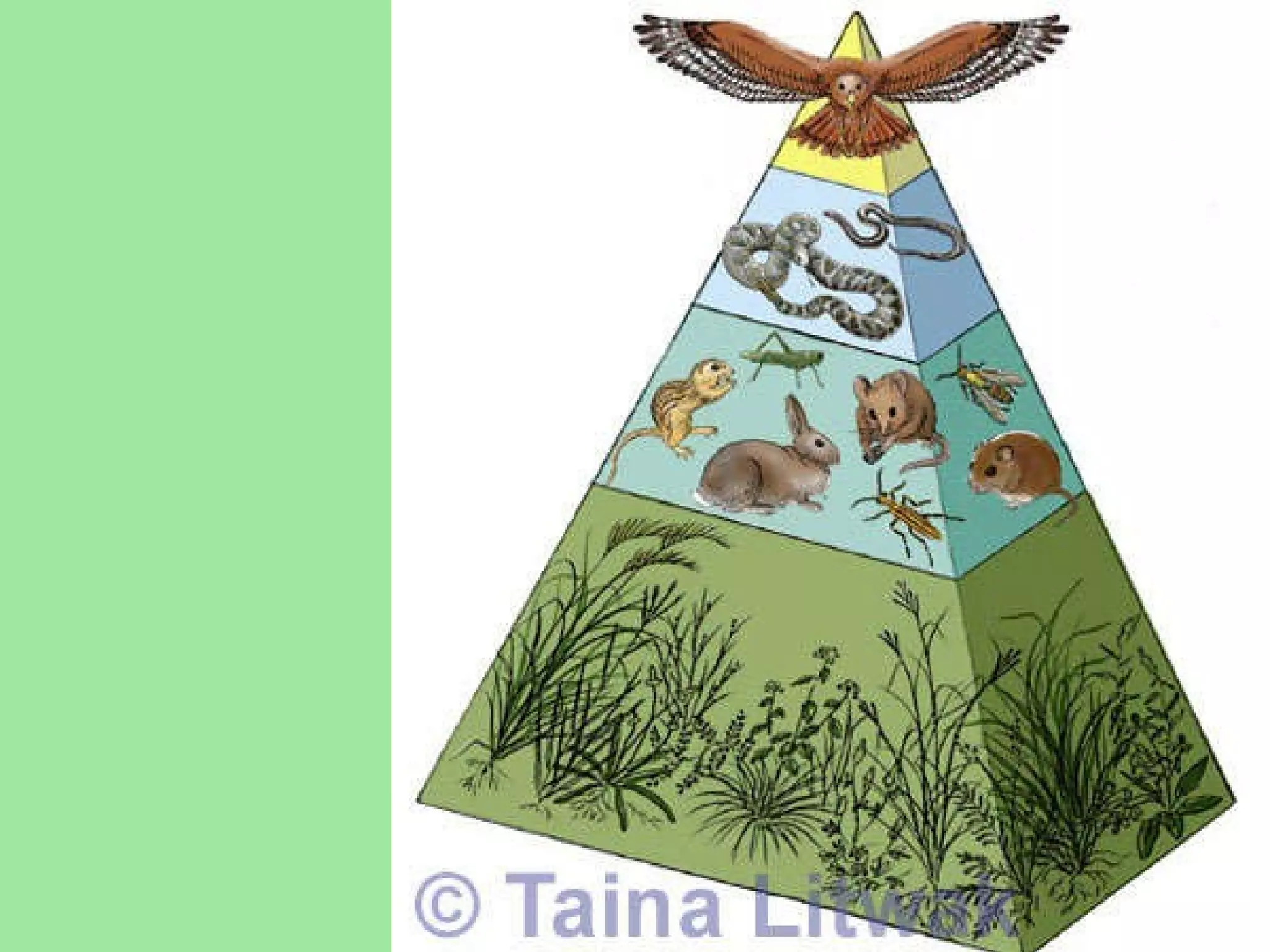
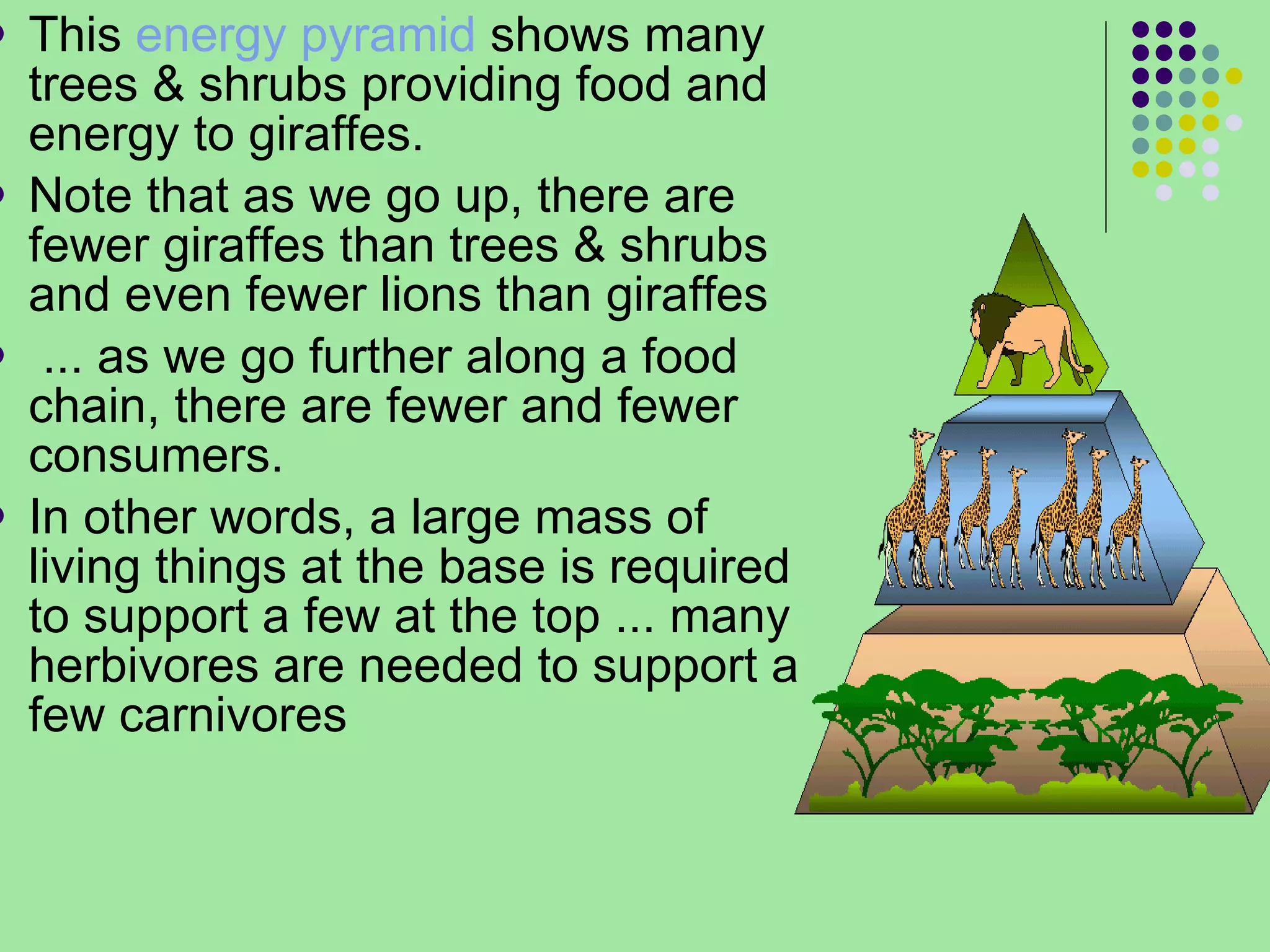
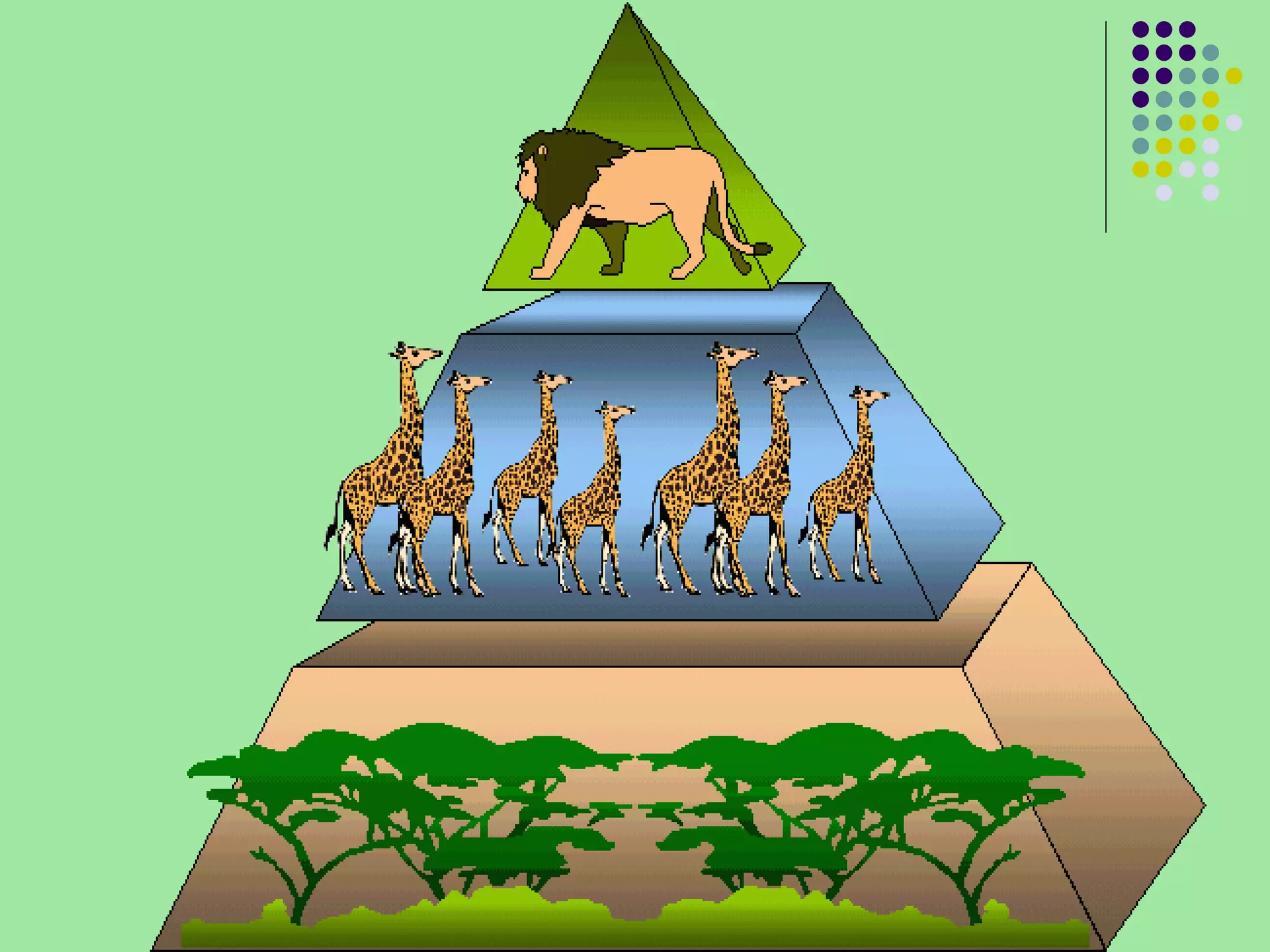
This  energy pyramid  shows many trees & shrubs providing food and energy to giraffes.  Note that as we go up, there are fewer giraffes than trees & shrubs and even fewer lions than giraffes ... as we go further along a food chain, there are fewer and fewer consumers.  In other words, a large mass of living things at the base is required to support a few at the top ... many herbivores are needed to support a few carnivores
 
 
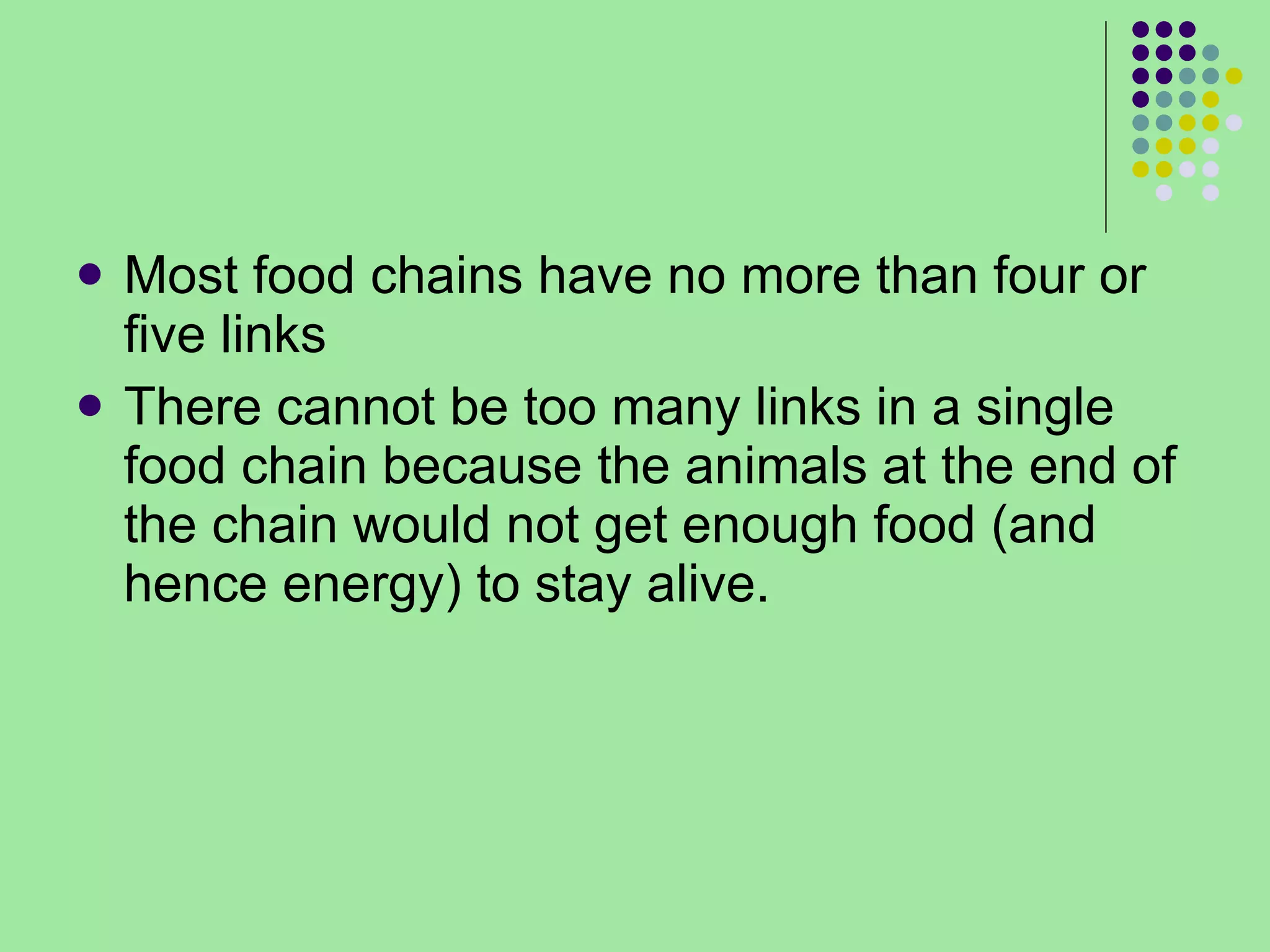
Most food chains have no more than four or five links  There cannot be too many links in a single food chain because the animals at the end of the chain would not get enough food (and hence energy) to stay alive.
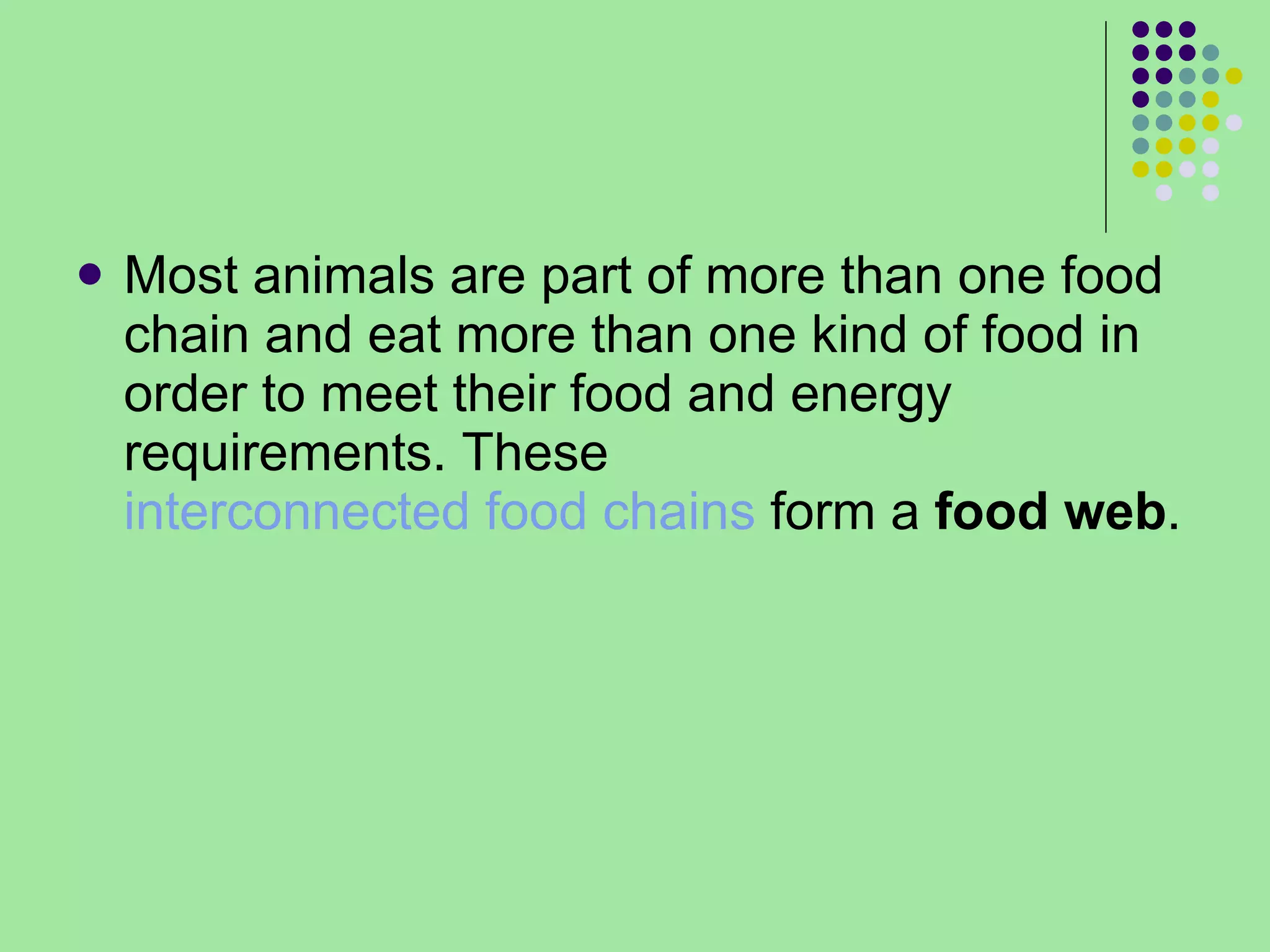
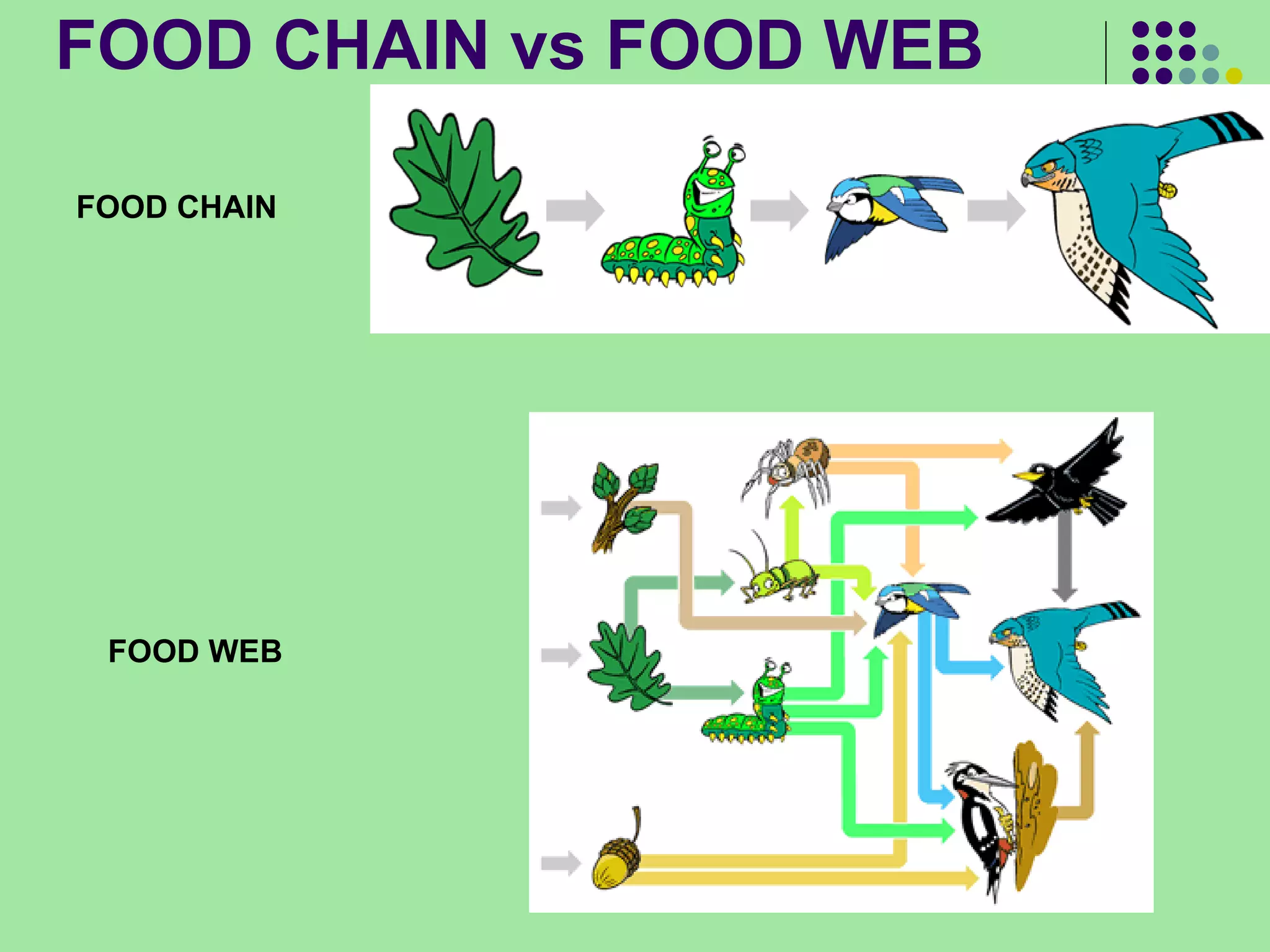
Most animals are part of more than one food chain and eat more than one kind of food in order to meet their food and energy requirements. These  interconnected food chains  form a  food web .
FOOD CHAIN vs FOOD WEB FOOD CHAIN FOOD WEB
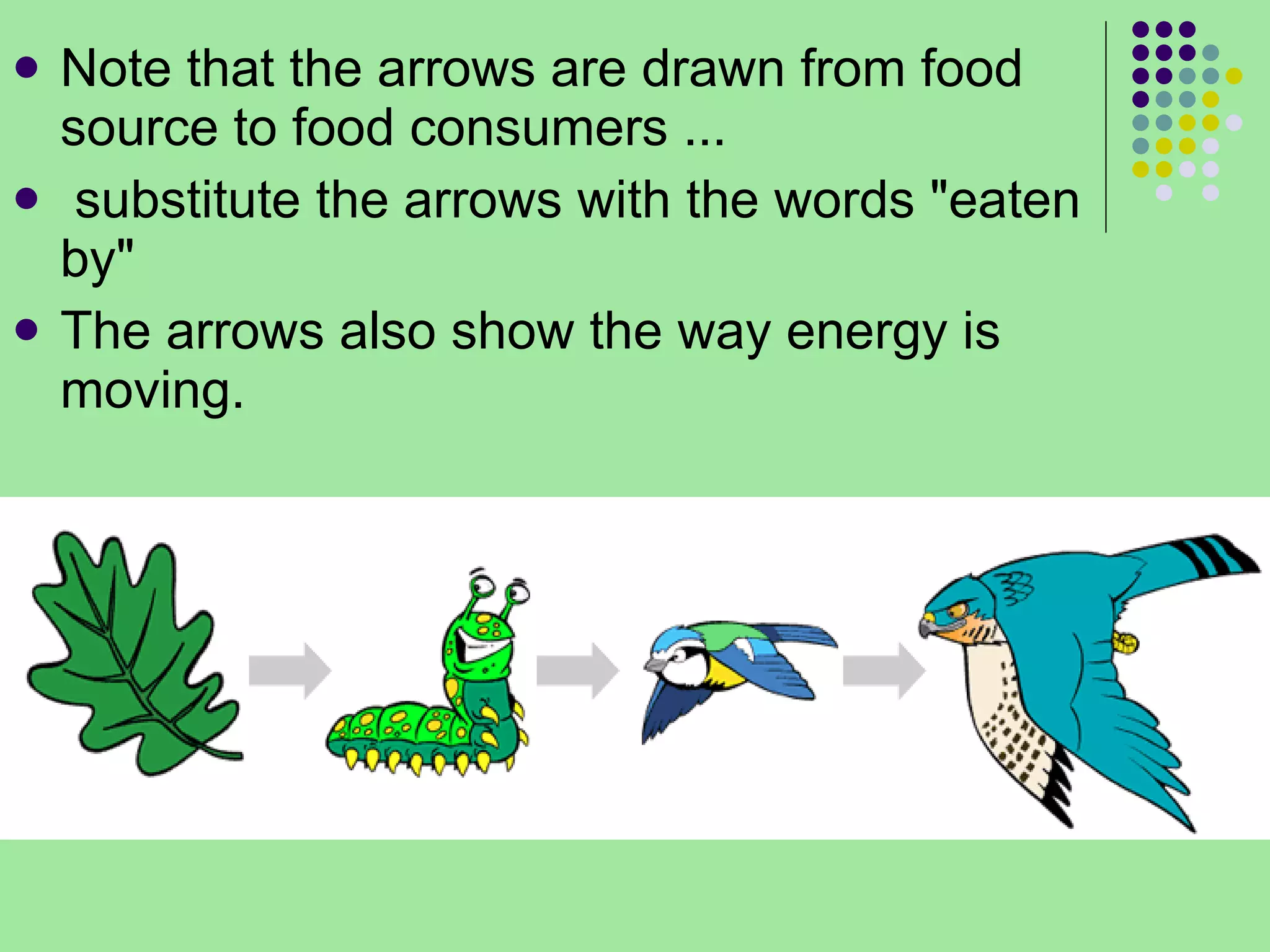
Note that the arrows are drawn from food source to food consumers ...  substitute the arrows with the words "eaten by"  The arrows also show the way energy is moving.
Recap The sun is the source of energy Water is the source of life on earth Water is in the hydrosphere, geosphere and atmosphere, and biosphere. The living things in the biosphere are dependent on many nonliving things. (abiotic and biotic) There are food chains and webs that show what animals eat. The higher up on the food chain, the less predators they have. Be able to describe who receives the most of the sun’s energy and how energy moves and is converted through the food chain. Be able to describe how the systems are connected (atmosphere, hydrosphere, and biosphere)
http://www.ecokids.ca/pub/eco_info/topics/frogs/chain_reaction/index.cfm  make a foodchain http://www.sheppardsoftware.com/content/animals/kidscorner/games/foodchaingame.htm  resource http://www.sheppardsoftware.com/content/animals/kidscorner/games/foodchaingame.htm  game food chain Fun with foodwebs  http://www.harcourtschool.com/activity/food/food_menu.html   Fill in foodwebs  http://www.gould.edu.au/foodwebs/kids_web.htm

Earth Science. Biosphere ppt

  • 1.
    Four Systems of Our Earth
  • 2.
    Composition of EarthEarth Has 4 main systems that interact: Earth’s systems Atmosphere Hydrosphere Biosphere Geosphere water life land/rock Air/gases
  • 3.
    Composition of EarthEarth Has 4 main systems that interact: The Atmosphere The Hydrosphere The Biosphere Life on Earth Sea life, plants, flying creatures, humans Encompasses hydrosphere, upper geosphere, and lower atmosphere. The Geosphere
  • 4.
  • 5.
    The relationship betweenan organism and its environment is the study of ecology.
  • 6.
    Living things interactwith Non living things in the Biosphere Biotic Factors— living components in the biosphere Biotic, meaning of or related to life, are living factors. Plants, animals , fungi, protist and bacteria are all biotic or living factors.
  • 7.
    Living things interactwith Non living things in the Biosphere Abiotic Factors—nonliving components in the biosphere Environmental factors such habitat (pond, lake, ocean, desert, mountain) or weather such as temperature, cloud cover, rain, snow, hurricanes, etc. are abiotic factors.
  • 8.
    Role of Waterin the Biosphere Water is the universal solvent and the basis of all life on our Planet. The hydrosphere is important to the Biosphere!
  • 9.
    Role of theSun for the biosphere The Sun provides the light and heat necessary to maintain life on Earth and is the ultimate source of energy.
  • 10.
    Biotic and abioticfactors combine to create a system or more precisely, an ecosystem. An ecosystem is a community of living and nonliving things.
  • 11.
    Examples of ecosystemsA pond. Abiotic factors? Biotic Factors?
  • 12.
  • 13.
  • 14.
    The Impact ofChanging Factors If a single factor is changed, perhaps by pollution or natural phenomenon, the whole system could be altered. For example, humans can alter environments through farming or irrigating. While we usually cannot see what we are doing to various ecosystems, the impact is being felt all over. For example, acid rain in certain regions has resulted in the decline of fish population.
  • 15.
    A food chain Shows how each living thing gets its food . Some animals eat plants and some animals eat other animals. For example, a simple food chain links the trees, the giraffes and the lions. Each link in this chain is food for the next link. A food chain always starts with plant life and ends with an animal .
  • 16.
    A food chain An  is added and means “ is eaten by ”; also shows the flow of energy (the giraffe gets his energy from the leaves) Now we have made a simple food chain.
  • 17.
    Biosphere Here isan example of another food chain.
  • 18.
  • 19.
    Plants are called producers or autotrophs because they are able to use light energy to make their own food.
  • 20.
  • 21.
    Animals cannot maketheir own food so they must eat plants and/or other animals. They are called consumers or heterotrophs . There are three groups of consumers.
  • 22.
    Herbivores areanimals that only eat plants or plant products (seeds). They are also called primary consumers
  • 23.
    Carnivores are animalsthat eat other animals. There are 2 kinds of carnivores
  • 24.
    Secondary Consumersare carnivores that eat herbivores Herbivores are primary consumers Something that makes its own food is called a producer
  • 25.
    Tertiary consumersare carnivores that eat other carnivores killer whales (tertiary consumer—they eat another carnivore) Dolphin (secondary consumer—they eat a herbivore) Herring (primary consumer—they only eat plants) Photoplankton (this plant produces its own food)
  • 26.
    Make your ownfood chain Find in your notes where it says to make your own food chain. Start with a plant on the very left side. The arrow means “is eaten by” so think of the next thing that might eat your plant…and so on.
  • 27.
    Animals and peoplewho eat BOTH animals and plants are called omnivores WE EAT PLANTS WE EAT MEAT
  • 28.
    To sum up:Animals that eat both animals AND plants . Humans are also omnivores !      Animals that eat only animals .      Animals that eat only plants .               
  • 29.
    Then there are decomposers (bacteria, worms, and fungi) which feed on decaying matter. These decomposers speed up the decaying process that releases mineral salts back into the food chain for absorption by plants as nutrients.
  • 30.
  • 31.
  • 32.
    Games http://www.sheppardsoftware.com/content/animals/kidscorner/foodchain/foodchain.htm producer consumer game (pic of cow) http://www.sheppardsoftware.com/content/animals/kidscorner/foodchain/foodchain.htm Omnivore, carnivore, herbivore game (pic of person,frog, lion and bear) http://www.sheppardsoftware.com/content/animals/kidscorner/matching/mcarnivores.htm Matching game (herbivore, carnivore, omnivore)
  • 33.
    Do you knowwhy there are more herbivores than carnivores?
  • 34.
    In a foodchain, energy is passed from one link to another Lets say a plant has the # 100 to represent the energy it has made. When a herbivore eats, it does not get all the plant’s energy. It uses up some of the energy in everyday activities. The herbivore may only get 10% of that energy. A carnivore then eats this herbivore. The carnivore only gets 1% of that plants original energy. This is why the carnivore has to eat many herbivores to get enough energy to grow.
  • 35.
    Energy and massis transferred from one level of the food chain to the next with an efficiency of about 10 %.
  • 36.
    Because of thelarge amount of energy that is lost at each link, the amount of energy that is transferred gets lesser and lesser The further along the food chain you go, the less food (and energy) remains available. ENERGY’S MOVEMENT IN THE FOOD CHAIN
  • 37.
  • 38.
    This energypyramid shows many trees & shrubs providing food and energy to giraffes. Note that as we go up, there are fewer giraffes than trees & shrubs and even fewer lions than giraffes ... as we go further along a food chain, there are fewer and fewer consumers. In other words, a large mass of living things at the base is required to support a few at the top ... many herbivores are needed to support a few carnivores
  • 39.
  • 40.
  • 41.
    Most food chainshave no more than four or five links There cannot be too many links in a single food chain because the animals at the end of the chain would not get enough food (and hence energy) to stay alive.
  • 42.
    Most animals arepart of more than one food chain and eat more than one kind of food in order to meet their food and energy requirements. These interconnected food chains form a food web .
  • 43.
    FOOD CHAIN vsFOOD WEB FOOD CHAIN FOOD WEB
  • 44.
    Note that thearrows are drawn from food source to food consumers ... substitute the arrows with the words "eaten by" The arrows also show the way energy is moving.
  • 45.
    Recap The sunis the source of energy Water is the source of life on earth Water is in the hydrosphere, geosphere and atmosphere, and biosphere. The living things in the biosphere are dependent on many nonliving things. (abiotic and biotic) There are food chains and webs that show what animals eat. The higher up on the food chain, the less predators they have. Be able to describe who receives the most of the sun’s energy and how energy moves and is converted through the food chain. Be able to describe how the systems are connected (atmosphere, hydrosphere, and biosphere)
  • 46.
    http://www.ecokids.ca/pub/eco_info/topics/frogs/chain_reaction/index.cfm makea foodchain http://www.sheppardsoftware.com/content/animals/kidscorner/games/foodchaingame.htm resource http://www.sheppardsoftware.com/content/animals/kidscorner/games/foodchaingame.htm game food chain Fun with foodwebs http://www.harcourtschool.com/activity/food/food_menu.html Fill in foodwebs http://www.gould.edu.au/foodwebs/kids_web.htm