
PROCESSOR
ORGANIZATION
Mohammad Asif Iqbal
Assistant Professor,
Deptt of ECE,
JETGI, Barabanki
HAVE YOU EVER THING IT??
HOW THE PROCESSOR IS ORGANIZE??
LET ME TELL YOU. BUT BEFORE THAT REMEMBER…
 The processor needs to store some data
temporally.
 It must remember the location of the last
instruction so that it can know where to get
the next instruction.
 It needs to store instructions and data
temporally while an instruction is being
executed.
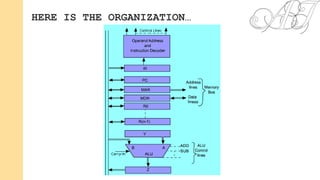
HERE IS THE ORGANIZATION…
INSTRUCTION CYCLE
•It is the time in which a single instruction is
fetched from memory, decoded, and executed
•An Instruction Cycle requires the following
subcycle:
INSTRUCTION CYCLE
• Fetch
Read next instruction from memory into the
processor
• Execute
Interpret the opcode and perform the indicated
operation
HOW AN OPERATION IS PERFORMED?
Most of the operation of a CPU can be carried
out by performing one or more of the following
function in some prespecified sequence ..
• Fetch the contents of a given memory location
and load them into a CPU register.
• Store a word of data from a CPU register into a
given memory location.
• Transfer a word of data from one CPU register
to another or to the ALU.
• Perform an arithmetic or logic operation, and
store the result in a CPU register.
FETCHING A WORD FROM MEMORY:
•The CPU transfers the address of the required memory location to the
Memory Address Register (MAR).
•The MAR is connected to the memory address line of the memory bus,
hence the address of the required word is transferred to the main memory.
•Next, CPU uses the control lines of the memory bus to indicate that a Read
operation is initiated. After issuing this request, the CPU waits until it
receives an answer from the memory, indicating that the requested
operation has been completed.
•This is accomplished by another control signal of memory bus known as
Memory-Function-Complete (MFC).
•The memory set this signal to 1 to indicate that the contents of the specified
memory location are available in memory data bus.
•As soon as MFC signal is set to 1, the information available in the data bus is
loaded into the Memory Data Register (MDR) and this is available for use
inside the CPU.
FETCHING A WORD FROM MEMORY:
As an example, assume that the address of the memory
location to be accessed is kept in register R2 and that the
memory contents to be loaded into register R1. This is
done by the following sequence of operations:
1. MAR [R2] 2. Read
3. Wait for MFC signal 4. R1 [MDR]
The time required for step 3 depends on the speed of the
memory unit. In general, the time required to access a
word from the memory is longer than the time required
to perform any operation within the CPU.
STORING A WORD INTO MEMORY:
•The procedure of writing a word into memory location is similar to that for reading
one from memory. The only difference is that the data word to be written is first
loaded into the MDR, the write command is issued.
•As an example, assumes that the data word to be stored in the memory is in register
R1 and that the memory address is in register R2. The memory write operation
requires the following sequence:
1. MAR [R2]
2. MDR [R1]
3. Write
4. Wait for MFC
•In this case step 1 and step 2 are independent and so they can be carried out in any
order. In fact, step 1 and 2 can be carried out simultaneously, if this is allowed by the
architecture, that is, if these two data transfers (memory address and data) do not use
the same data path.
•In case of both memory read and memory write operation, the total time duration
depends on wait for the MFC signal, which depends on the speed of the memory
module.
REGISTER TRANSFER OPERATION
Register transfer operations enable data transfer between various blocks connected to
the common bus of CPU. We have several registers inside CPU and it is needed to
transfer information from one register another. As for example during memory write
operation data from appropriate register must be moved to MDR.
Since the input output lines of all the register are connected to the common internal
bus, we need appropriate input output gating. The input and output gates for register
Ri are controlled by the signal Riin and Riout respectively.
Thus, when Riin set to 1 the data available in the common bus is loaded into Ri .
Similarly when, Riout is set to 1, the contents of the register Ri are placed on the bus.
To transfer data from one register to other register, we need to generate the
appropriate register gating signal.
For example, to transfer the contents of register R1 to register R2, the following
actions are needed:
Enable the output gate of register R1 by setting R1out to 1.
-- This places the contents of R1 on the CPU bus.
Enable the input gate of register R2 by setting R2 in to 1.
-- This loads data from the CPU bus into the register R2.
PERFORMING THE ARITHMETIC OR LOGIC OPERATION
Performing the arithmetic or logic operation:
Generally ALU is used inside CPU to perform arithmetic and logic operation. ALU is a
combinational logic circuit which does not have any internal storage.
Therefore, to perform any arithmetic or logic operation (say binary operation) both
the input should be made available at the two inputs of the ALU simultaneously. Once
both the inputs are available then appropriate signal is generated to perform the
required operation. We may have to use temporary storage (register) to carry out the
operation in ALU .
The sequence of operations that have to carried out to perform one ALU operation
depends on the organization of the CPU.
Consider an organization in which one of the operand of ALU is stored in some
temporary register Y and other operand is directly taken from CPU internal bus. The
result of the ALU operation is stored in another temporary register Z. This
organization is shown in the Figure 5.7.
PERFORMING THE ARITHMETIC OR LOGIC OPERATION
Therefore, the sequence of operations to add the contents of
register R1 to register R2 and store the result in
register R3 should be as follows:
R1out, Yin
R2out, Add, Zin
Zout, R3in
In step 2 of this sequence, the contents of register R2 are gated
to the bus, hence to input –B of the ALU which is directly
connected to the bus. The contents of register Y are always
available at input A of ALU. The function performed by the
ALU depends on the signal applied to the ALU control lines.
In this example, the Add control line of ALU is set to 1, which
indicate the addition operation and the output of ALU is the
sum of the two numbers at input A and B. The sum is loaded
into register Z, since the input gate is enabled (Zin ). In step 3,
the contents of register Z are transferred to the destination
register R3.
THANK YOU

Precessor organization

  • 1.
    PROCESSOR ORGANIZATION Mohammad Asif Iqbal AssistantProfessor, Deptt of ECE, JETGI, Barabanki
  • 2.
    HAVE YOU EVERTHING IT?? HOW THE PROCESSOR IS ORGANIZE??
  • 3.
    LET ME TELLYOU. BUT BEFORE THAT REMEMBER…  The processor needs to store some data temporally.  It must remember the location of the last instruction so that it can know where to get the next instruction.  It needs to store instructions and data temporally while an instruction is being executed.
  • 4.
    HERE IS THEORGANIZATION…
  • 5.
    INSTRUCTION CYCLE •It isthe time in which a single instruction is fetched from memory, decoded, and executed •An Instruction Cycle requires the following subcycle:
  • 6.
    INSTRUCTION CYCLE • Fetch Readnext instruction from memory into the processor • Execute Interpret the opcode and perform the indicated operation
  • 7.
    HOW AN OPERATIONIS PERFORMED? Most of the operation of a CPU can be carried out by performing one or more of the following function in some prespecified sequence .. • Fetch the contents of a given memory location and load them into a CPU register. • Store a word of data from a CPU register into a given memory location. • Transfer a word of data from one CPU register to another or to the ALU. • Perform an arithmetic or logic operation, and store the result in a CPU register.
  • 8.
    FETCHING A WORDFROM MEMORY: •The CPU transfers the address of the required memory location to the Memory Address Register (MAR). •The MAR is connected to the memory address line of the memory bus, hence the address of the required word is transferred to the main memory. •Next, CPU uses the control lines of the memory bus to indicate that a Read operation is initiated. After issuing this request, the CPU waits until it receives an answer from the memory, indicating that the requested operation has been completed. •This is accomplished by another control signal of memory bus known as Memory-Function-Complete (MFC). •The memory set this signal to 1 to indicate that the contents of the specified memory location are available in memory data bus. •As soon as MFC signal is set to 1, the information available in the data bus is loaded into the Memory Data Register (MDR) and this is available for use inside the CPU.
  • 9.
    FETCHING A WORDFROM MEMORY: As an example, assume that the address of the memory location to be accessed is kept in register R2 and that the memory contents to be loaded into register R1. This is done by the following sequence of operations: 1. MAR [R2] 2. Read 3. Wait for MFC signal 4. R1 [MDR] The time required for step 3 depends on the speed of the memory unit. In general, the time required to access a word from the memory is longer than the time required to perform any operation within the CPU.
  • 10.
    STORING A WORDINTO MEMORY: •The procedure of writing a word into memory location is similar to that for reading one from memory. The only difference is that the data word to be written is first loaded into the MDR, the write command is issued. •As an example, assumes that the data word to be stored in the memory is in register R1 and that the memory address is in register R2. The memory write operation requires the following sequence: 1. MAR [R2] 2. MDR [R1] 3. Write 4. Wait for MFC •In this case step 1 and step 2 are independent and so they can be carried out in any order. In fact, step 1 and 2 can be carried out simultaneously, if this is allowed by the architecture, that is, if these two data transfers (memory address and data) do not use the same data path. •In case of both memory read and memory write operation, the total time duration depends on wait for the MFC signal, which depends on the speed of the memory module.
  • 11.
  • 12.
    REGISTER TRANSFER OPERATION Registertransfer operations enable data transfer between various blocks connected to the common bus of CPU. We have several registers inside CPU and it is needed to transfer information from one register another. As for example during memory write operation data from appropriate register must be moved to MDR. Since the input output lines of all the register are connected to the common internal bus, we need appropriate input output gating. The input and output gates for register Ri are controlled by the signal Riin and Riout respectively. Thus, when Riin set to 1 the data available in the common bus is loaded into Ri . Similarly when, Riout is set to 1, the contents of the register Ri are placed on the bus. To transfer data from one register to other register, we need to generate the appropriate register gating signal. For example, to transfer the contents of register R1 to register R2, the following actions are needed: Enable the output gate of register R1 by setting R1out to 1. -- This places the contents of R1 on the CPU bus. Enable the input gate of register R2 by setting R2 in to 1. -- This loads data from the CPU bus into the register R2.
  • 13.
    PERFORMING THE ARITHMETICOR LOGIC OPERATION Performing the arithmetic or logic operation: Generally ALU is used inside CPU to perform arithmetic and logic operation. ALU is a combinational logic circuit which does not have any internal storage. Therefore, to perform any arithmetic or logic operation (say binary operation) both the input should be made available at the two inputs of the ALU simultaneously. Once both the inputs are available then appropriate signal is generated to perform the required operation. We may have to use temporary storage (register) to carry out the operation in ALU . The sequence of operations that have to carried out to perform one ALU operation depends on the organization of the CPU. Consider an organization in which one of the operand of ALU is stored in some temporary register Y and other operand is directly taken from CPU internal bus. The result of the ALU operation is stored in another temporary register Z. This organization is shown in the Figure 5.7.
  • 14.
    PERFORMING THE ARITHMETICOR LOGIC OPERATION Therefore, the sequence of operations to add the contents of register R1 to register R2 and store the result in register R3 should be as follows: R1out, Yin R2out, Add, Zin Zout, R3in In step 2 of this sequence, the contents of register R2 are gated to the bus, hence to input –B of the ALU which is directly connected to the bus. The contents of register Y are always available at input A of ALU. The function performed by the ALU depends on the signal applied to the ALU control lines. In this example, the Add control line of ALU is set to 1, which indicate the addition operation and the output of ALU is the sum of the two numbers at input A and B. The sum is loaded into register Z, since the input gate is enabled (Zin ). In step 3, the contents of register Z are transferred to the destination register R3.
  • 15.