CHANDRAYAAN 3
A Mission Of Hope For The Future Of Space Exploration.
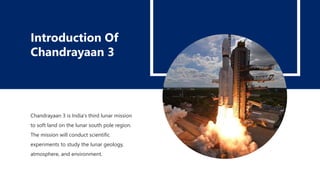
Chandrayaan 3 is India's third lunar mission
to soft land on the lunar south pole region.
The mission will conduct scientific
experiments to study the lunar geology,
atmosphere, and environment.
Introduction Of
Chandrayaan 3
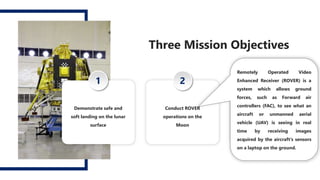
Three Mission Objectives
Demonstrate safe and
soft landing on the lunar
surface
Conduct ROVER
operations on the
Moon
Conduct on-site
experiments on the
lunar surface
1 2 3
Remotely Operated Video
Enhanced Receiver (ROVER) is a
system which allows ground
forces, such as Forward air
controllers (FAC), to see what an
aircraft or unmanned aerial
vehicle (UAV) is seeing in real
time by receiving images
acquired by the aircraft's sensors
on a laptop on the ground.
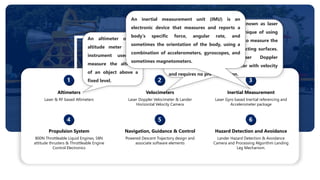
Key Technologies
Hazard Detection and Avoidance
Lander Hazard Detection & Avoidance
Camera and Processing Algorithm Landing
Leg Mechanism.
Inertial Measurement
Laser Gyro based Inertial referencing and
Accelerometer package
Altimeters
Laser & RF based Altimeters
Propulsion System
800N Throttleable Liquid Engines, 58N
attitude thrusters & Throttleable Engine
Control Electronics
Velocimeters
Laser Doppler Velocimeter & Lander
Horizontal Velocity Camera
Navigation, Guidance & Control
Powered Descent Trajectory design and
associate software elements
1 2 3
4 5 6
An altimeter or an
altitude meter is an
instrument used to
measure the altitude
of an object above a
fixed level.
Laser Doppler velocimetry, also known as laser
Doppler anemometry, is the technique of using
the Doppler shift in a laser beam to measure the
vibratory motion of opaque, reflecting surfaces.
The measurement with laser Doppler
anemometry is absolute and linear with velocity
and requires no pre-calibration.
An inertial measurement unit (IMU) is an
electronic device that measures and reports a
body's specific force, angular rate, and
sometimes the orientation of the body, using a
combination of accelerometers, gyroscopes, and
sometimes magnetometers.
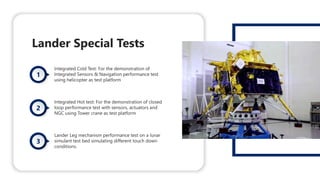
Lander Special Tests
Integrated Cold Test: For the demonstration of
Integrated Sensors & Navigation performance test
using helicopter as test platform
Integrated Hot test: For the demonstration of closed
loop performance test with sensors, actuators and
NGC using Tower crane as test platform
Lander Leg mechanism performance test on a lunar
simulant test bed simulating different touch down
conditions.
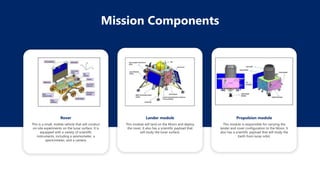
Mission Components
Propulsion module
This module is responsible for carrying the
lander and rover configuration to the Moon. It
also has a scientific payload that will study the
Earth from lunar orbit.
Lander module
This module will land on the Moon and deploy
the rover. It also has a scientific payload that
will study the lunar surface.
Rover
This is a small, mobile vehicle that will conduct
on-site experiments on the lunar surface. It is
equipped with a variety of scientific
instruments, including a seismometer, a
spectrometer, and a camera.
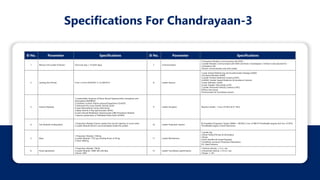
Specifications For Chandrayaan-3
Sl No. Parameter Specifications Sl No. Parameter Specifications
1. Mission Life (Lander & Rover) One lunar day (~14 Earth days) 7. Communication
1.Propulsion Module: Communicates with IDSN
2.Lander Module: Communicates with IDSN and Rover. Chandrayaan-2 Orbiter is also planned for
contingency link.
3.Rover: Communicates only with Lander.
2. Landing Site (Prime) 4 km x 2.4 km 69.367621 S, 32.348126 E 8. Lander Sensors
1.Laser Inertial Referencing and Accelerometer Package (LIRAP)
2.Ka-Band Altimeter (KaRA)
3.Lander Position Detection Camera (LPDC)
4.LHDAC (Lander Hazard Detection & Avoidance Camera)
5.Laser Altimeter (LASA)
6.Laser Doppler Velocimeter (LDV)
7.Lander Horizontal Velocity Camera (LHVC)
8.Micro Star sensor
9.Inclinometer & Touchdown sensors
3. Science Payloads
1.Lander:Radio Anatomy of Moon Bound Hypersensitive ionosphere and
Atmosphere (RAMBHA)
2.Chandra’s Surface Thermo physical Experiment (ChaSTE)
3.Instrument for Lunar Seismic Activity (ILSA)
4.Laser Retroreflector Array (LRA) Rover:
5.Alpha Particle X-Ray Spectrometer (APXS)
6.Laser Induced Breakdown Spectroscope (LIBS) Propulsion Module:
7.Spectro-polarimetry of HAbitable Planet Earth (SHAPE)
9. Lander Actuators Reaction wheels – 4 nos (10 Nms & 0.1 Nm)
4. Two Module Configuration
1.Propulsion Module (Carries Lander from launch injection to Lunar orbit)
2.Lander Module (Rover is accommodated inside the Lander)
10. Lander Propulsion System
Bi-Propellant Propulsion System (MMH + MON3), 4 nos. of 800 N Throttleable engines & 8 nos. of 58 N;
Throttleable Engine Control Electronics
5. Mass
1.Propulsion Module: 2148 kg
2.Lander Module: 1752 kg including Rover of 26 kg
3.Total: 3900 kg
11. Lander Mechanisms
1.Lander leg
2.Rover Ramp (Primary & Secondary)
3.Rover
4.ILSA, Rambha & Chaste Payloads
5.Umbilical connector Protection Mechanism,
6.X- Band Antenna
6. Power generation
1.Propulsion Module: 758 W
2.Lander Module: 738W, WS with Bias
3.Rover: 50W
12. Lander Touchdown specifications
1.Vertical velocity: ≤ 2 m / sec
2.Horizontal velocity: ≤ 0.5 m / sec
3.Slope: ≤ 120
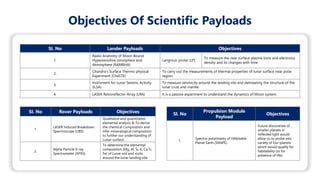
Objectives Of Scientific Payloads
SI. No Lander Payloads Objectives
1.
Radio Anatomy of Moon Bound
Hypersensitive ionosphere and
Atmosphere (RAMBHA)
Langmuir probe (LP)
To measure the near surface plasma (ions and electrons)
density and its changes with time
2.
Chandra’s Surface Thermo physical
Experiment (ChaSTE)
To carry out the measurements of thermal properties of lunar surface near polar
region.
3.
Instrument for Lunar Seismic Activity
(ILSA)
To measure seismicity around the landing site and delineating the structure of the
lunar crust and mantle.
4. LASER Retroreflector Array (LRA) It is a passive experiment to understand the dynamics of Moon system.
SI. No Rover Payloads Objectives
1.
LASER Induced Breakdown
Spectroscope (LIBS)
Qualitative and quantitative
elemental analysis & To derive
the chemical Composition and
infer mineralogical composition
to further our understanding of
Lunar-surface.
2.
Alpha Particle X-ray
Spectrometer (APXS)
To determine the elemental
composition (Mg, Al, Si, K, Ca,Ti,
Fe) of Lunar soil and rocks
around the lunar landing site.
Sl. No
Propulsion Module
Payload
Objectives
1.
Spectro-polarimetry of HAbitable
Planet Earth (SHAPE)
Future discoveries of
smaller planets in
reflected light would
allow us to probe into
variety of Exo-planets
which would qualify for
habitability (or for
presence of life).
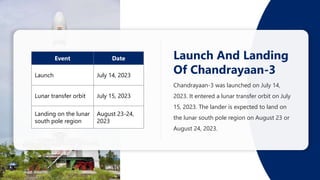
Launch And Landing
Of Chandrayaan-3
Chandrayaan-3 was launched on July 14,
2023. It entered a lunar transfer orbit on July
15, 2023. The lander is expected to land on
the lunar south pole region on August 23 or
August 24, 2023.
Event Date
Launch July 14, 2023
Lunar transfer orbit July 15, 2023
Landing on the lunar
south pole region
August 23-24,
2023
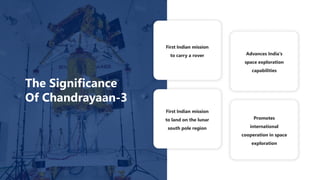
First Indian mission
to land on the lunar
south pole region
First Indian mission
to carry a rover Advances India's
space exploration
capabilities
Promotes
international
cooperation in space
exploration
The Significance
Of Chandrayaan-3
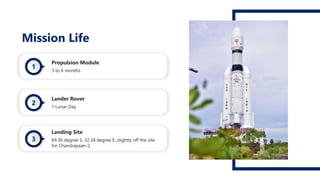
Mission Life
Propulsion Module
3 to 6 months
Lander Rover
1 Lunar Day
Landing Site
69.36 degree S, 32.34 degree E; slightly off the site
for Chandrayaan-2
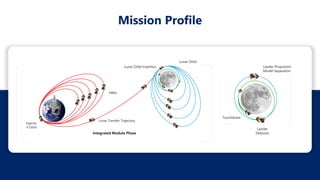
Integrated Module Phase
Lunar Transfer Trajectory
Injectio
n Orbit
EBNs
Lunar Orbit Insertion
Lunar Orbit
Lander
Deboost
Lander Propulsion
Model Separation
Touchdown
Mission Profile
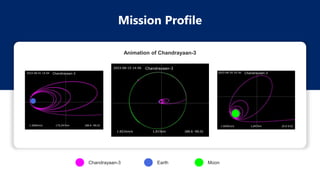
Mission Profile
Animation of Chandrayaan-3
Chandrayaan-3 Earth Moon
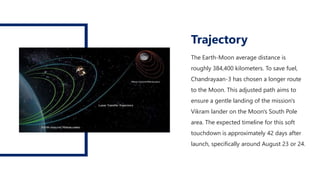
The Earth-Moon average distance is
roughly 384,400 kilometers. To save fuel,
Chandrayaan-3 has chosen a longer route
to the Moon. This adjusted path aims to
ensure a gentle landing of the mission's
Vikram lander on the Moon's South Pole
area. The expected timeline for this soft
touchdown is approximately 42 days after
launch, specifically around August 23 or 24.
Trajectory
01
02
03
04
05
06 07
Nominal Flight
Sequence
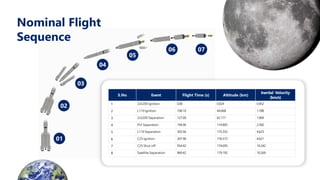
S.No Event Flight Time (s) Altitude (km)
Inertial Velocity
(km/s)
1 2xS200 Ignition 0.00 0.024 0.452
2 L110 Ignition 108.10 44.668 1.788
3 2xS200 Separation 127.00 62.171 1.969
4 PLF Separation 194.96 114.805 2.560
5 L110 Separation 305.56 175.352 4.623
6 C25 Ignition 307.96 176.573 4.621
7 C25 Shut-off 954.42 174.695 10.242
8 Satellite Separation 969.42 179.192 10.269
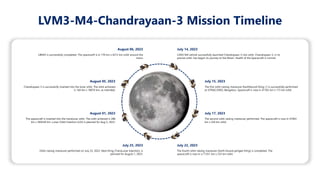
LVM3-M4-Chandrayaan-3 Mission Timeline
July 14, 2023
LVM3 M4 vehicle successfully launched Chandrayaan-3 into orbit. Chandrayaan-3, in its
precise orbit, has begun its journey to the Moon. Health of the Spacecraft is normal.
July 22, 2023
The fourth orbit-raising maneuver (Earth-bound perigee firing) is completed. The
spacecraft is now in a 71351 km x 233 km orbit.
August 06, 2023
LBN#2 is successfully completed. The spacecarft is in 170 km x 4313 km orbit around the
moon
July 25, 2023
Orbit-raising maneuver performed on July 25, 2023. Next firing (TransLunar Injection), is
planned for August 1, 2023.
July 15, 2023
The first orbit-raising maneuver (Earthbound firing-1) is successfully performed
at ISTRAC/ISRO, Bengaluru. Spacecraft is now in 41762 km x 173 km orbit.
July 17, 2023
The second orbit-raising maneuver performed. The spacecraft is now in 41603
km x 226 km orbit.
August 05, 2023
Chandrayaan-3 is successfully inserted into the lunar orbit. The orbit achieved
is 164 km x 18074 km, as intended.
August 01, 2023
The spacecraft is inserted into the translunar orbit. The orbit achieved is 288
km x 369328 km. Lunar-Orbit Insertion (LOI) is planned for Aug 5, 2023.
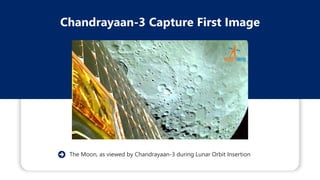
Chandrayaan-3 Capture First Image
The Moon, as viewed by Chandrayaan-3 during Lunar Orbit Insertion
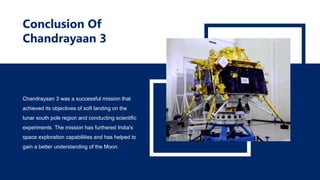
Conclusion Of
Chandrayaan 3
Chandrayaan 3 was a successful mission that
achieved its objectives of soft landing on the
lunar south pole region and conducting scientific
experiments. The mission has furthered India's
space exploration capabilities and has helped to
gain a better understanding of the Moon.
Our Hero
Mohana Kumar, Mission
director
S Mohana Kumar, a senior
scientists from the Vikram
Sarabhai Space Centre, is the
mission director for Chandrayaan-
3. Kumar has worked as the
director for the successful
commercial launch of the One Web
India 2 satellites on board the
LVM3-M3 mission.
P Veeramuthuvel,
Chandrayaan-3 project
director
The project director for India’s
latest lunar touch-down mission
is P Veeramuthuvel. In 2019, he
took charge for the mission.
Veeramuthuvel was serving as a
deputy director in the Space
Infrastructure Programme Office at
the ISRO headquarters before the
Moon mission started. He is known
for his technical skills.
S Somanath, ISRO Chairman
The brain behind India’s ambitious
Moon mission is ISRO chief S
Somanath. Somanath has also been
given the credits for accelerating
ISRO’s other missions
including Gaganyaan and Sun-mision
Aditya-L1.
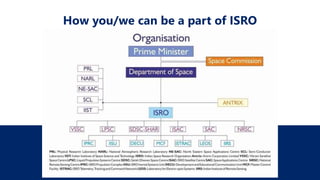
How you/we can be a part of ISRO
•There are people designing all sorts of electronic packages required in a launch vehicle
which includes control electronics packages, various sensors and it’s interface units,
packages used for base band communication, packages for radio frequency communication,
antennas for different communication requirements, processors used in launch vehicles,
packages required for testing, batteries and power modules for powering all these packages
during flight etc… the list goes on and on. The design philosophy is different from the
commercial package manufacturing and it has to qualify winder range of environmental
specifications like temperature, vibration, shock etc. Here main focus is on reliability and
safety due to high cost of launch vehicle and satellites.
•As an EC engineer your job can be designing or testing any of these kinds of packages. It
can be making PCBs or writing FPGA codes.
•It can be related to designing large motors or designing a small inertial sensor or image
processing and data compression algorithm development.
•Or may be selection of suitable MIL grade components from the market, procuring it, flight
qualifying it. End to end everything you may need to handle including the paper work.
•There are even boring and mostly paper work jobs related to outsourced production of
packages etc.
•You may be involved in various phases of testing. Or analysing test data and identifying
failures in packages or components. Sometimes, it can be automation of certain tests. If you
have read ‘The Martian’ novel, you will understand the importance of testing. Some of Launch
vehicle testing teams have to travel to other centres occasionally (mainly LPSC, IPRC and
SDSC).
Vikram Sarabhai Space Centre(VSSC)
•There will be cases where your job may be to support some mechanical engineer's work. May
be you will have to work on miniaturized package development of an already existing package.
•If you are in launch vehicle project, your work will be coordinating work between various
agencies, preparing schedules and getting work done before deadlines. There can be even some
junk work like arranging food or vehicles if necessary.
•Sometimes your work can be even analysing data from a payload in Mangalyaan or developing
payload for Chandrayaan-II (usually most payloads for satellites will be developed by SAC,
LEOS, ISAC etc but for scientific mission at least one payload will be developed by Space
Physics Laboratory in VSSC)
•Your work can be freezing Electrical configuration of next generation launch vehicles or
accommodating changes in coming flights of PSLV or may be technology transfer to some
industries. Here, I want add one more thing that each PSLV is electrically more or less the
same (except at times when major architectural changes are undertaken), at the same time
there will be always some changes for each flight.
•At present there is a renewed emphasis on developing a modern and advanced architecture for
launch vehicles to reduce mass and turn around time. So coming five to ten years will
decisive in this development. The last time major changes in avionics architecture happened
more than 10 years ago (with work on it started around 2000). Usually incremental changes
are only done due to reliability issues and schedule.
•Here, in ISRO many times the work can be multi-disciplinary and you may need to work as a
team with people with different backgrounds. Also your job may not be properly defined
(especially if it is a new work), you may have to do whatever is required to get the final
product.
If u want to be a part of ISRO
• Through all the semester in Engineering minimum marks should be 65% .
• Must have a 4 years full time B.tech degree in your specified Engineering stream
• Age should be between 18 - 42 years.
• ISRO conducts its own paper and it is almost like GATE.
• Some tips on what to do to qualify the test :-
1. You need to be good at fundamentals. test will be fairly easy.
2.there are 80 questions you need to plan.
3.Try to solve the problems of old ISRO Questions papers.
4.prepare well and strive hard .
5.make sure your basics are good in 2 to 3 subjects of your domain.
www.slideegg.com
Thank You!
We respect your valuable time with SlideEgg!
If you have any questions, please reach us
CREDIT: SlideEgg created this PowerPoint template.
Let this slide be kept for attribution.
Do you have a design request, please visit our redesign page.

Chandrayaan 3.pptx

  • 1.
    CHANDRAYAAN 3 A MissionOf Hope For The Future Of Space Exploration.
  • 2.
    Chandrayaan 3 isIndia's third lunar mission to soft land on the lunar south pole region. The mission will conduct scientific experiments to study the lunar geology, atmosphere, and environment. Introduction Of Chandrayaan 3
  • 3.
    Three Mission Objectives Demonstratesafe and soft landing on the lunar surface Conduct ROVER operations on the Moon Conduct on-site experiments on the lunar surface 1 2 3 Remotely Operated Video Enhanced Receiver (ROVER) is a system which allows ground forces, such as Forward air controllers (FAC), to see what an aircraft or unmanned aerial vehicle (UAV) is seeing in real time by receiving images acquired by the aircraft's sensors on a laptop on the ground.
  • 4.
    Key Technologies Hazard Detectionand Avoidance Lander Hazard Detection & Avoidance Camera and Processing Algorithm Landing Leg Mechanism. Inertial Measurement Laser Gyro based Inertial referencing and Accelerometer package Altimeters Laser & RF based Altimeters Propulsion System 800N Throttleable Liquid Engines, 58N attitude thrusters & Throttleable Engine Control Electronics Velocimeters Laser Doppler Velocimeter & Lander Horizontal Velocity Camera Navigation, Guidance & Control Powered Descent Trajectory design and associate software elements 1 2 3 4 5 6 An altimeter or an altitude meter is an instrument used to measure the altitude of an object above a fixed level. Laser Doppler velocimetry, also known as laser Doppler anemometry, is the technique of using the Doppler shift in a laser beam to measure the vibratory motion of opaque, reflecting surfaces. The measurement with laser Doppler anemometry is absolute and linear with velocity and requires no pre-calibration. An inertial measurement unit (IMU) is an electronic device that measures and reports a body's specific force, angular rate, and sometimes the orientation of the body, using a combination of accelerometers, gyroscopes, and sometimes magnetometers.
  • 5.
    Lander Special Tests IntegratedCold Test: For the demonstration of Integrated Sensors & Navigation performance test using helicopter as test platform Integrated Hot test: For the demonstration of closed loop performance test with sensors, actuators and NGC using Tower crane as test platform Lander Leg mechanism performance test on a lunar simulant test bed simulating different touch down conditions.
  • 6.
    Mission Components Propulsion module Thismodule is responsible for carrying the lander and rover configuration to the Moon. It also has a scientific payload that will study the Earth from lunar orbit. Lander module This module will land on the Moon and deploy the rover. It also has a scientific payload that will study the lunar surface. Rover This is a small, mobile vehicle that will conduct on-site experiments on the lunar surface. It is equipped with a variety of scientific instruments, including a seismometer, a spectrometer, and a camera.
  • 7.
    Specifications For Chandrayaan-3 SlNo. Parameter Specifications Sl No. Parameter Specifications 1. Mission Life (Lander & Rover) One lunar day (~14 Earth days) 7. Communication 1.Propulsion Module: Communicates with IDSN 2.Lander Module: Communicates with IDSN and Rover. Chandrayaan-2 Orbiter is also planned for contingency link. 3.Rover: Communicates only with Lander. 2. Landing Site (Prime) 4 km x 2.4 km 69.367621 S, 32.348126 E 8. Lander Sensors 1.Laser Inertial Referencing and Accelerometer Package (LIRAP) 2.Ka-Band Altimeter (KaRA) 3.Lander Position Detection Camera (LPDC) 4.LHDAC (Lander Hazard Detection & Avoidance Camera) 5.Laser Altimeter (LASA) 6.Laser Doppler Velocimeter (LDV) 7.Lander Horizontal Velocity Camera (LHVC) 8.Micro Star sensor 9.Inclinometer & Touchdown sensors 3. Science Payloads 1.Lander:Radio Anatomy of Moon Bound Hypersensitive ionosphere and Atmosphere (RAMBHA) 2.Chandra’s Surface Thermo physical Experiment (ChaSTE) 3.Instrument for Lunar Seismic Activity (ILSA) 4.Laser Retroreflector Array (LRA) Rover: 5.Alpha Particle X-Ray Spectrometer (APXS) 6.Laser Induced Breakdown Spectroscope (LIBS) Propulsion Module: 7.Spectro-polarimetry of HAbitable Planet Earth (SHAPE) 9. Lander Actuators Reaction wheels – 4 nos (10 Nms & 0.1 Nm) 4. Two Module Configuration 1.Propulsion Module (Carries Lander from launch injection to Lunar orbit) 2.Lander Module (Rover is accommodated inside the Lander) 10. Lander Propulsion System Bi-Propellant Propulsion System (MMH + MON3), 4 nos. of 800 N Throttleable engines & 8 nos. of 58 N; Throttleable Engine Control Electronics 5. Mass 1.Propulsion Module: 2148 kg 2.Lander Module: 1752 kg including Rover of 26 kg 3.Total: 3900 kg 11. Lander Mechanisms 1.Lander leg 2.Rover Ramp (Primary & Secondary) 3.Rover 4.ILSA, Rambha & Chaste Payloads 5.Umbilical connector Protection Mechanism, 6.X- Band Antenna 6. Power generation 1.Propulsion Module: 758 W 2.Lander Module: 738W, WS with Bias 3.Rover: 50W 12. Lander Touchdown specifications 1.Vertical velocity: ≤ 2 m / sec 2.Horizontal velocity: ≤ 0.5 m / sec 3.Slope: ≤ 120
  • 8.
    Objectives Of ScientificPayloads SI. No Lander Payloads Objectives 1. Radio Anatomy of Moon Bound Hypersensitive ionosphere and Atmosphere (RAMBHA) Langmuir probe (LP) To measure the near surface plasma (ions and electrons) density and its changes with time 2. Chandra’s Surface Thermo physical Experiment (ChaSTE) To carry out the measurements of thermal properties of lunar surface near polar region. 3. Instrument for Lunar Seismic Activity (ILSA) To measure seismicity around the landing site and delineating the structure of the lunar crust and mantle. 4. LASER Retroreflector Array (LRA) It is a passive experiment to understand the dynamics of Moon system. SI. No Rover Payloads Objectives 1. LASER Induced Breakdown Spectroscope (LIBS) Qualitative and quantitative elemental analysis & To derive the chemical Composition and infer mineralogical composition to further our understanding of Lunar-surface. 2. Alpha Particle X-ray Spectrometer (APXS) To determine the elemental composition (Mg, Al, Si, K, Ca,Ti, Fe) of Lunar soil and rocks around the lunar landing site. Sl. No Propulsion Module Payload Objectives 1. Spectro-polarimetry of HAbitable Planet Earth (SHAPE) Future discoveries of smaller planets in reflected light would allow us to probe into variety of Exo-planets which would qualify for habitability (or for presence of life).
  • 9.
    Launch And Landing OfChandrayaan-3 Chandrayaan-3 was launched on July 14, 2023. It entered a lunar transfer orbit on July 15, 2023. The lander is expected to land on the lunar south pole region on August 23 or August 24, 2023. Event Date Launch July 14, 2023 Lunar transfer orbit July 15, 2023 Landing on the lunar south pole region August 23-24, 2023
  • 10.
    First Indian mission toland on the lunar south pole region First Indian mission to carry a rover Advances India's space exploration capabilities Promotes international cooperation in space exploration The Significance Of Chandrayaan-3
  • 11.
    Mission Life Propulsion Module 3to 6 months Lander Rover 1 Lunar Day Landing Site 69.36 degree S, 32.34 degree E; slightly off the site for Chandrayaan-2
  • 12.
    Integrated Module Phase LunarTransfer Trajectory Injectio n Orbit EBNs Lunar Orbit Insertion Lunar Orbit Lander Deboost Lander Propulsion Model Separation Touchdown Mission Profile
  • 13.
    Mission Profile Animation ofChandrayaan-3 Chandrayaan-3 Earth Moon
  • 14.
    The Earth-Moon averagedistance is roughly 384,400 kilometers. To save fuel, Chandrayaan-3 has chosen a longer route to the Moon. This adjusted path aims to ensure a gentle landing of the mission's Vikram lander on the Moon's South Pole area. The expected timeline for this soft touchdown is approximately 42 days after launch, specifically around August 23 or 24. Trajectory
  • 15.
    01 02 03 04 05 06 07 Nominal Flight Sequence S.NoEvent Flight Time (s) Altitude (km) Inertial Velocity (km/s) 1 2xS200 Ignition 0.00 0.024 0.452 2 L110 Ignition 108.10 44.668 1.788 3 2xS200 Separation 127.00 62.171 1.969 4 PLF Separation 194.96 114.805 2.560 5 L110 Separation 305.56 175.352 4.623 6 C25 Ignition 307.96 176.573 4.621 7 C25 Shut-off 954.42 174.695 10.242 8 Satellite Separation 969.42 179.192 10.269
  • 16.
    LVM3-M4-Chandrayaan-3 Mission Timeline July14, 2023 LVM3 M4 vehicle successfully launched Chandrayaan-3 into orbit. Chandrayaan-3, in its precise orbit, has begun its journey to the Moon. Health of the Spacecraft is normal. July 22, 2023 The fourth orbit-raising maneuver (Earth-bound perigee firing) is completed. The spacecraft is now in a 71351 km x 233 km orbit. August 06, 2023 LBN#2 is successfully completed. The spacecarft is in 170 km x 4313 km orbit around the moon July 25, 2023 Orbit-raising maneuver performed on July 25, 2023. Next firing (TransLunar Injection), is planned for August 1, 2023. July 15, 2023 The first orbit-raising maneuver (Earthbound firing-1) is successfully performed at ISTRAC/ISRO, Bengaluru. Spacecraft is now in 41762 km x 173 km orbit. July 17, 2023 The second orbit-raising maneuver performed. The spacecraft is now in 41603 km x 226 km orbit. August 05, 2023 Chandrayaan-3 is successfully inserted into the lunar orbit. The orbit achieved is 164 km x 18074 km, as intended. August 01, 2023 The spacecraft is inserted into the translunar orbit. The orbit achieved is 288 km x 369328 km. Lunar-Orbit Insertion (LOI) is planned for Aug 5, 2023.
  • 17.
    Chandrayaan-3 Capture FirstImage The Moon, as viewed by Chandrayaan-3 during Lunar Orbit Insertion
  • 18.
    Conclusion Of Chandrayaan 3 Chandrayaan3 was a successful mission that achieved its objectives of soft landing on the lunar south pole region and conducting scientific experiments. The mission has furthered India's space exploration capabilities and has helped to gain a better understanding of the Moon.
  • 19.
    Our Hero Mohana Kumar,Mission director S Mohana Kumar, a senior scientists from the Vikram Sarabhai Space Centre, is the mission director for Chandrayaan- 3. Kumar has worked as the director for the successful commercial launch of the One Web India 2 satellites on board the LVM3-M3 mission. P Veeramuthuvel, Chandrayaan-3 project director The project director for India’s latest lunar touch-down mission is P Veeramuthuvel. In 2019, he took charge for the mission. Veeramuthuvel was serving as a deputy director in the Space Infrastructure Programme Office at the ISRO headquarters before the Moon mission started. He is known for his technical skills. S Somanath, ISRO Chairman The brain behind India’s ambitious Moon mission is ISRO chief S Somanath. Somanath has also been given the credits for accelerating ISRO’s other missions including Gaganyaan and Sun-mision Aditya-L1.
  • 20.
    How you/we canbe a part of ISRO
  • 21.
    •There are peopledesigning all sorts of electronic packages required in a launch vehicle which includes control electronics packages, various sensors and it’s interface units, packages used for base band communication, packages for radio frequency communication, antennas for different communication requirements, processors used in launch vehicles, packages required for testing, batteries and power modules for powering all these packages during flight etc… the list goes on and on. The design philosophy is different from the commercial package manufacturing and it has to qualify winder range of environmental specifications like temperature, vibration, shock etc. Here main focus is on reliability and safety due to high cost of launch vehicle and satellites. •As an EC engineer your job can be designing or testing any of these kinds of packages. It can be making PCBs or writing FPGA codes. •It can be related to designing large motors or designing a small inertial sensor or image processing and data compression algorithm development. •Or may be selection of suitable MIL grade components from the market, procuring it, flight qualifying it. End to end everything you may need to handle including the paper work. •There are even boring and mostly paper work jobs related to outsourced production of packages etc. •You may be involved in various phases of testing. Or analysing test data and identifying failures in packages or components. Sometimes, it can be automation of certain tests. If you have read ‘The Martian’ novel, you will understand the importance of testing. Some of Launch vehicle testing teams have to travel to other centres occasionally (mainly LPSC, IPRC and SDSC). Vikram Sarabhai Space Centre(VSSC)
  • 22.
    •There will becases where your job may be to support some mechanical engineer's work. May be you will have to work on miniaturized package development of an already existing package. •If you are in launch vehicle project, your work will be coordinating work between various agencies, preparing schedules and getting work done before deadlines. There can be even some junk work like arranging food or vehicles if necessary. •Sometimes your work can be even analysing data from a payload in Mangalyaan or developing payload for Chandrayaan-II (usually most payloads for satellites will be developed by SAC, LEOS, ISAC etc but for scientific mission at least one payload will be developed by Space Physics Laboratory in VSSC) •Your work can be freezing Electrical configuration of next generation launch vehicles or accommodating changes in coming flights of PSLV or may be technology transfer to some industries. Here, I want add one more thing that each PSLV is electrically more or less the same (except at times when major architectural changes are undertaken), at the same time there will be always some changes for each flight. •At present there is a renewed emphasis on developing a modern and advanced architecture for launch vehicles to reduce mass and turn around time. So coming five to ten years will decisive in this development. The last time major changes in avionics architecture happened more than 10 years ago (with work on it started around 2000). Usually incremental changes are only done due to reliability issues and schedule. •Here, in ISRO many times the work can be multi-disciplinary and you may need to work as a team with people with different backgrounds. Also your job may not be properly defined (especially if it is a new work), you may have to do whatever is required to get the final product.
  • 23.
    If u wantto be a part of ISRO • Through all the semester in Engineering minimum marks should be 65% . • Must have a 4 years full time B.tech degree in your specified Engineering stream • Age should be between 18 - 42 years. • ISRO conducts its own paper and it is almost like GATE. • Some tips on what to do to qualify the test :- 1. You need to be good at fundamentals. test will be fairly easy. 2.there are 80 questions you need to plan. 3.Try to solve the problems of old ISRO Questions papers. 4.prepare well and strive hard . 5.make sure your basics are good in 2 to 3 subjects of your domain.
  • 24.
    www.slideegg.com Thank You! We respectyour valuable time with SlideEgg! If you have any questions, please reach us CREDIT: SlideEgg created this PowerPoint template. Let this slide be kept for attribution. Do you have a design request, please visit our redesign page.