Design of small directive antennas for IoT
E4 Final Project
Prepared by:
Habib Mariam
Luvuezo Holldry
Submitted for:
Prof. Alves Thierry
July, 2017
Design of small directive antennas for IoT
Outlines
• Introduction
• WSN and IoT
• Antenna theory
• Practical work
• Conclusion
• Knowledge gained
Design of small directive antennas for IoT
3
Introduction
Design of small directive antennas for IoT
Internet of Things
(IoT)
4
Internet of Things (IoT)
Design of small directive antennas for IoT
• IoT is the term used to
describe any kind of
applications that are
connected and made
“things” interact
through the internet.
SENSORS
5
Wireless Sensor Networks (WSN)
Design of small directive antennas for IoT
• WSN is a group of small devices
that are connected to the internet
through the gateway
• It’s called Sensor Nodes
• These small devices have sensing,
data processing and wireless
communication capabilities
6
Wireless Sensor Networks (WSN)
Design of small directive antennas for IoT
At the moment, Small directive antennas are not used in the IoT.
o Advantages of using directive antennas in IoT:
• Create new channels
• Reduce the interference between the nodes operating at the same
frequency
7
Antenna Theory
What is antenna?
• Antenna is defined as a metallic device for
radiating/ receiving radio waves.
Design of small directive antennas for IoT
• Thus, antenna is considered as the transitional
structure between free space and a guiding device.
9
Antenna Parameters
o The performance of an antenna is defined by
a set of parameters:
Design of small directive antennas for IoT
• Radiation pattern
• Radiation intensity
• Radiation power density
• Input impedance
• Efficiency
• Gain
• Bandwidth
10
Half wave dipole antenna
• It’s formed from a half wavelength long conducting
element with a feeder connected in the center.
Design of small directive antennas for IoT
Dipole antenna structure and radiation pattern
• Half wave dipole characteristics:
• Maximum directivity of 2.15 dB
• Radiation resistance of 73 Ω
• Linear current with amplitude varies as
one half of a sine wave, maximum at the
center.
• It’s the basic unit of Yagi- Uda antenna.
11
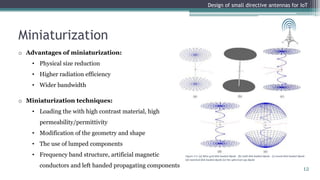
Miniaturization
Design of small directive antennas for IoT
o Advantages of miniaturization:
• Physical size reduction
• Higher radiation efficiency
• Wider bandwidth
o Miniaturization techniques:
• Loading the with high contrast material, high
permeability/permittivity
• Modification of the geometry and shape
• The use of lumped components
• Frequency band structure, artificial magnetic
conductors and left handed propagating components
12
Antenna Array
Design of small directive antennas for IoT
• Antenna array:
A group of identical (conventionally) antennas interconnected and arranged in a regular
structure to form an array.
• It’s built to control the radiation intensity, field strength, directivity, polarization,
radiation pattern and the gain depending on the application
• One of the most successful RF antenna design for directive antennas is Yagi Uda antenna
13
Yagi Uda antenna
Design of small directive antennas for IoT
o Structure
• Driven element: half wave dipole antenna
• Reflector (backward gain)
• Director (forward gain)
o Design considerations
• Reflector is 5% longer than the driven element
• Director is 5% smaller than the driven element
• Optimum directors separation ranges from 0.3𝜆 to 0.4𝜆
• Optimum reflectors- driven element separation is 0.25𝜆
14
Yagi antenna structure and radiation pattern
Design of small directive antennas for IoT
Practical Work
Design Requirements
Design of small directive antennas for IoT
o Design small directive antennas operating at 868 and 2400 MHz
with the following parameters
• SWR ≤ 2
• Overall gain ≥ 5 𝑑𝐵𝑖
• Front to back ratio ≥ 10 𝑑𝐵
• Reflection coefficient ≤ −10 𝑑𝐵
• Matched to a 50 Ω transmission line.
16
Design Procedures
Design of small directive antennas for IoT
1. Design of simple 2 elements half wave directive antenna
operating at 2400 MHz
2. Design of small directive antennas operating at 868 and
2400 MHz by applying the meandered lines miniaturization
approach.
17
1. Design of simple 2 elements Yagi antenna operating at 2400 MHz.
Design of small directive antennas for IoT
• The spacing between the driven element and the reflector
was set to its theoretical value 0.15𝜆
• The length of the driven element was set to 𝜆/2 (Half wave
dipole)
• The reflector length was optimized till the design
requirements were satisfied
o The optimum reflector length is 0.11𝝀
• Outcomes:
o SWR= 1.958
o F/B= 10.3 dB
o Gain= 6.54 dBi
18
2. Design of 2 elements small directive antennas
Design of small directive antennas for IoT
• Design Procedures:
1. 1 element dipole of length 𝜆/10 was designed to have a resonance at the desired
frequency using a meandered line approach.
2. Once the antenna is resonated at the desired frequency, the spacing between the
two elements was adjusted to satisfy the F/B condition
3. The second step resulted in a mismatched antenna, thus a short circuit was used
as a matching approach.
19
Design of a small directive antenna operating at 868 MHz[1]
Design of small directive antennas for IoT
3D geometry of 868 MHz small directive antenna
20
Design of a small directive antenna operating at 868 MHz[2]
Design of small directive antennas for IoT
1. Simulation results
2. Total gain (dBi)
3. SWR
4. Reflection
coefficient
1 2
3 4
21
Design of a small directive antenna operating at 868 MHz[3]
Design of small directive antennas for IoT
1. F/B
2. Impedance
3. Radiation pattern
1 3
2
22
Design of a small directive antenna operating at 2400 MHz[1]
Design of small directive antennas for IoT
3D geometry of 2400 MHz small directive antenna
23
Design of a small directive antenna operating at 2400 MHz[2]
Design of small directive antennas for IoT
1. Simulation results
2. Total gain (dBi)
3. SWR
4. Reflection coefficient
1 2
3 4
24
Design of a small directive antenna operating at 2400 MHz[3]
Design of small directive antennas for IoT
1. F/B
2. Impedance
3. Radiation pattern
1 3
2
25
Results and Comments
Design of small directive antennas for IoT
1. Standing Wave Ratio (SWR) 2. Reflection coefficient
o Minimum SWR at
the operating
frequency ≈ 1;
∴ matched
o The bandwidth
is:
• 11 MHz at 868
MHz design
• 50 MHz at
2400 MHz
design
o SWR is minimum,
∴ 𝑆11 is minimum
26
Results and Comments
Design of small directive antennas for IoT
3. Gain (dBi)
4. Front to back ratio (dB)
• Positive gain
but higher value for
2400 MHz design
∴ More directive. i.e.
all the transmitted
power is directed into
the area where it’s
required.
• Less gain in other
directions so
transmits/receives
less signal in other
directions thereby
interference
reduction
• Front to back ratio is
the ratio of the signal
level in the forward
direction to the reverse
direction.
• ↑ Forward signal
strength → ↓ backward
strength.
• Both designs satisfy the
requirements (higher
than 10 dB), but with a
bit higher value in case
of 868 MHz. 27
Results and Comments
Design of small directive antennas for IoT
5. Radiation efficiency 6. Radiation pattern
• More efficient (higher
radiation efficiency) in
case of 2400 MHz
i.e. for the same radiated
power:
↑ power delivered →
↓ losses within the antenna
or reflected away, which is
a result of better
matching
𝑍 2400 𝑀𝐻𝑧 = 49.025 − 𝑗0.0254 Ω
𝑍 868 𝑀𝐻𝑧 = 45.0793 − 𝑗4.1279 Ω
o Radiation pattern of
Yagi antenna has:
• Main lobe (wide on
the x- axis)
• Back lobe
• 2 side lobes.
28
Results and Comments
Design of small directive antennas for IoT
7. Comparison of the radiation pattern of simple 2 elements Yagi antenna and
the miniaturized design
o More efficient
o Higher gain
o Higher front to back ratio
29
Results and Comments
Design of small directive antennas for IoT
8. Comments on the antenna array parameters:
• The reflector size and spacing have negligible effects on the forward gain but significant
effects on the backward gain and input impedance.
• The size and spacing of the director has a large effect on the forward gain, backward
gain and input impedance.
• The impedance of the driven element is greatly affected by the parasitic elements
• The Yagi antenna gain is governed by the number of elements in the array and the spacing in
between them
• The most obvious factor that affects the Yagi antenna gain is the number of elements. In
one of the trial, another reflector was added, in this case a significant improvement on the
gain and directivity of the antenna was provided
30
Design of small directive antennas for IoT
Conclusion and Knowledge gained
Knowledge gained
Design of small directive antennas for IoT
• The first and the most important is the antenna theory
Two months ago, the antenna field was something obscure, we did not know about it anything except its
name. Now and after two months of working in this field between theory and design, we can say that we
have some knowledge about antenna and how does it work, so many thanks to you doctor and your efforts
are really appreciated.
• A good knowledge in IoT and WSN which are one of the edge of technology fields
• A good experience in 4NEC2 as an antenna modeller and optimizer software
• A good knowledge in the antenna array design and parameters optimization
32
Conclusion
Design of small directive antennas for IoT
• This project demonstrates the possibility to use small directive antennas in
IoT technology.
• The work done was divided into 3 parts:
1. Theoretical study of IoT and WSN
2. Minutely study of antenna theory
3. Applying the theoretical knowledge that was gained through the last two parts in the
design of the small directive antenna based on the requirements using 4nec2.
33

11815939.ppt

  • 1.
    Design of smalldirective antennas for IoT E4 Final Project Prepared by: Habib Mariam Luvuezo Holldry Submitted for: Prof. Alves Thierry July, 2017
  • 2.
    Design of smalldirective antennas for IoT
  • 3.
    Outlines • Introduction • WSNand IoT • Antenna theory • Practical work • Conclusion • Knowledge gained Design of small directive antennas for IoT 3
  • 4.
    Introduction Design of smalldirective antennas for IoT Internet of Things (IoT) 4
  • 5.
    Internet of Things(IoT) Design of small directive antennas for IoT • IoT is the term used to describe any kind of applications that are connected and made “things” interact through the internet. SENSORS 5
  • 6.
    Wireless Sensor Networks(WSN) Design of small directive antennas for IoT • WSN is a group of small devices that are connected to the internet through the gateway • It’s called Sensor Nodes • These small devices have sensing, data processing and wireless communication capabilities 6
  • 7.
    Wireless Sensor Networks(WSN) Design of small directive antennas for IoT At the moment, Small directive antennas are not used in the IoT. o Advantages of using directive antennas in IoT: • Create new channels • Reduce the interference between the nodes operating at the same frequency 7
  • 8.
  • 9.
    What is antenna? •Antenna is defined as a metallic device for radiating/ receiving radio waves. Design of small directive antennas for IoT • Thus, antenna is considered as the transitional structure between free space and a guiding device. 9
  • 10.
    Antenna Parameters o Theperformance of an antenna is defined by a set of parameters: Design of small directive antennas for IoT • Radiation pattern • Radiation intensity • Radiation power density • Input impedance • Efficiency • Gain • Bandwidth 10
  • 11.
    Half wave dipoleantenna • It’s formed from a half wavelength long conducting element with a feeder connected in the center. Design of small directive antennas for IoT Dipole antenna structure and radiation pattern • Half wave dipole characteristics: • Maximum directivity of 2.15 dB • Radiation resistance of 73 Ω • Linear current with amplitude varies as one half of a sine wave, maximum at the center. • It’s the basic unit of Yagi- Uda antenna. 11
  • 12.
    Miniaturization Design of smalldirective antennas for IoT o Advantages of miniaturization: • Physical size reduction • Higher radiation efficiency • Wider bandwidth o Miniaturization techniques: • Loading the with high contrast material, high permeability/permittivity • Modification of the geometry and shape • The use of lumped components • Frequency band structure, artificial magnetic conductors and left handed propagating components 12
  • 13.
    Antenna Array Design ofsmall directive antennas for IoT • Antenna array: A group of identical (conventionally) antennas interconnected and arranged in a regular structure to form an array. • It’s built to control the radiation intensity, field strength, directivity, polarization, radiation pattern and the gain depending on the application • One of the most successful RF antenna design for directive antennas is Yagi Uda antenna 13
  • 14.
    Yagi Uda antenna Designof small directive antennas for IoT o Structure • Driven element: half wave dipole antenna • Reflector (backward gain) • Director (forward gain) o Design considerations • Reflector is 5% longer than the driven element • Director is 5% smaller than the driven element • Optimum directors separation ranges from 0.3𝜆 to 0.4𝜆 • Optimum reflectors- driven element separation is 0.25𝜆 14 Yagi antenna structure and radiation pattern
  • 15.
    Design of smalldirective antennas for IoT Practical Work
  • 16.
    Design Requirements Design ofsmall directive antennas for IoT o Design small directive antennas operating at 868 and 2400 MHz with the following parameters • SWR ≤ 2 • Overall gain ≥ 5 𝑑𝐵𝑖 • Front to back ratio ≥ 10 𝑑𝐵 • Reflection coefficient ≤ −10 𝑑𝐵 • Matched to a 50 Ω transmission line. 16
  • 17.
    Design Procedures Design ofsmall directive antennas for IoT 1. Design of simple 2 elements half wave directive antenna operating at 2400 MHz 2. Design of small directive antennas operating at 868 and 2400 MHz by applying the meandered lines miniaturization approach. 17
  • 18.
    1. Design ofsimple 2 elements Yagi antenna operating at 2400 MHz. Design of small directive antennas for IoT • The spacing between the driven element and the reflector was set to its theoretical value 0.15𝜆 • The length of the driven element was set to 𝜆/2 (Half wave dipole) • The reflector length was optimized till the design requirements were satisfied o The optimum reflector length is 0.11𝝀 • Outcomes: o SWR= 1.958 o F/B= 10.3 dB o Gain= 6.54 dBi 18
  • 19.
    2. Design of2 elements small directive antennas Design of small directive antennas for IoT • Design Procedures: 1. 1 element dipole of length 𝜆/10 was designed to have a resonance at the desired frequency using a meandered line approach. 2. Once the antenna is resonated at the desired frequency, the spacing between the two elements was adjusted to satisfy the F/B condition 3. The second step resulted in a mismatched antenna, thus a short circuit was used as a matching approach. 19
  • 20.
    Design of asmall directive antenna operating at 868 MHz[1] Design of small directive antennas for IoT 3D geometry of 868 MHz small directive antenna 20
  • 21.
    Design of asmall directive antenna operating at 868 MHz[2] Design of small directive antennas for IoT 1. Simulation results 2. Total gain (dBi) 3. SWR 4. Reflection coefficient 1 2 3 4 21
  • 22.
    Design of asmall directive antenna operating at 868 MHz[3] Design of small directive antennas for IoT 1. F/B 2. Impedance 3. Radiation pattern 1 3 2 22
  • 23.
    Design of asmall directive antenna operating at 2400 MHz[1] Design of small directive antennas for IoT 3D geometry of 2400 MHz small directive antenna 23
  • 24.
    Design of asmall directive antenna operating at 2400 MHz[2] Design of small directive antennas for IoT 1. Simulation results 2. Total gain (dBi) 3. SWR 4. Reflection coefficient 1 2 3 4 24
  • 25.
    Design of asmall directive antenna operating at 2400 MHz[3] Design of small directive antennas for IoT 1. F/B 2. Impedance 3. Radiation pattern 1 3 2 25
  • 26.
    Results and Comments Designof small directive antennas for IoT 1. Standing Wave Ratio (SWR) 2. Reflection coefficient o Minimum SWR at the operating frequency ≈ 1; ∴ matched o The bandwidth is: • 11 MHz at 868 MHz design • 50 MHz at 2400 MHz design o SWR is minimum, ∴ 𝑆11 is minimum 26
  • 27.
    Results and Comments Designof small directive antennas for IoT 3. Gain (dBi) 4. Front to back ratio (dB) • Positive gain but higher value for 2400 MHz design ∴ More directive. i.e. all the transmitted power is directed into the area where it’s required. • Less gain in other directions so transmits/receives less signal in other directions thereby interference reduction • Front to back ratio is the ratio of the signal level in the forward direction to the reverse direction. • ↑ Forward signal strength → ↓ backward strength. • Both designs satisfy the requirements (higher than 10 dB), but with a bit higher value in case of 868 MHz. 27
  • 28.
    Results and Comments Designof small directive antennas for IoT 5. Radiation efficiency 6. Radiation pattern • More efficient (higher radiation efficiency) in case of 2400 MHz i.e. for the same radiated power: ↑ power delivered → ↓ losses within the antenna or reflected away, which is a result of better matching 𝑍 2400 𝑀𝐻𝑧 = 49.025 − 𝑗0.0254 Ω 𝑍 868 𝑀𝐻𝑧 = 45.0793 − 𝑗4.1279 Ω o Radiation pattern of Yagi antenna has: • Main lobe (wide on the x- axis) • Back lobe • 2 side lobes. 28
  • 29.
    Results and Comments Designof small directive antennas for IoT 7. Comparison of the radiation pattern of simple 2 elements Yagi antenna and the miniaturized design o More efficient o Higher gain o Higher front to back ratio 29
  • 30.
    Results and Comments Designof small directive antennas for IoT 8. Comments on the antenna array parameters: • The reflector size and spacing have negligible effects on the forward gain but significant effects on the backward gain and input impedance. • The size and spacing of the director has a large effect on the forward gain, backward gain and input impedance. • The impedance of the driven element is greatly affected by the parasitic elements • The Yagi antenna gain is governed by the number of elements in the array and the spacing in between them • The most obvious factor that affects the Yagi antenna gain is the number of elements. In one of the trial, another reflector was added, in this case a significant improvement on the gain and directivity of the antenna was provided 30
  • 31.
    Design of smalldirective antennas for IoT Conclusion and Knowledge gained
  • 32.
    Knowledge gained Design ofsmall directive antennas for IoT • The first and the most important is the antenna theory Two months ago, the antenna field was something obscure, we did not know about it anything except its name. Now and after two months of working in this field between theory and design, we can say that we have some knowledge about antenna and how does it work, so many thanks to you doctor and your efforts are really appreciated. • A good knowledge in IoT and WSN which are one of the edge of technology fields • A good experience in 4NEC2 as an antenna modeller and optimizer software • A good knowledge in the antenna array design and parameters optimization 32
  • 33.
    Conclusion Design of smalldirective antennas for IoT • This project demonstrates the possibility to use small directive antennas in IoT technology. • The work done was divided into 3 parts: 1. Theoretical study of IoT and WSN 2. Minutely study of antenna theory 3. Applying the theoretical knowledge that was gained through the last two parts in the design of the small directive antenna based on the requirements using 4nec2. 33