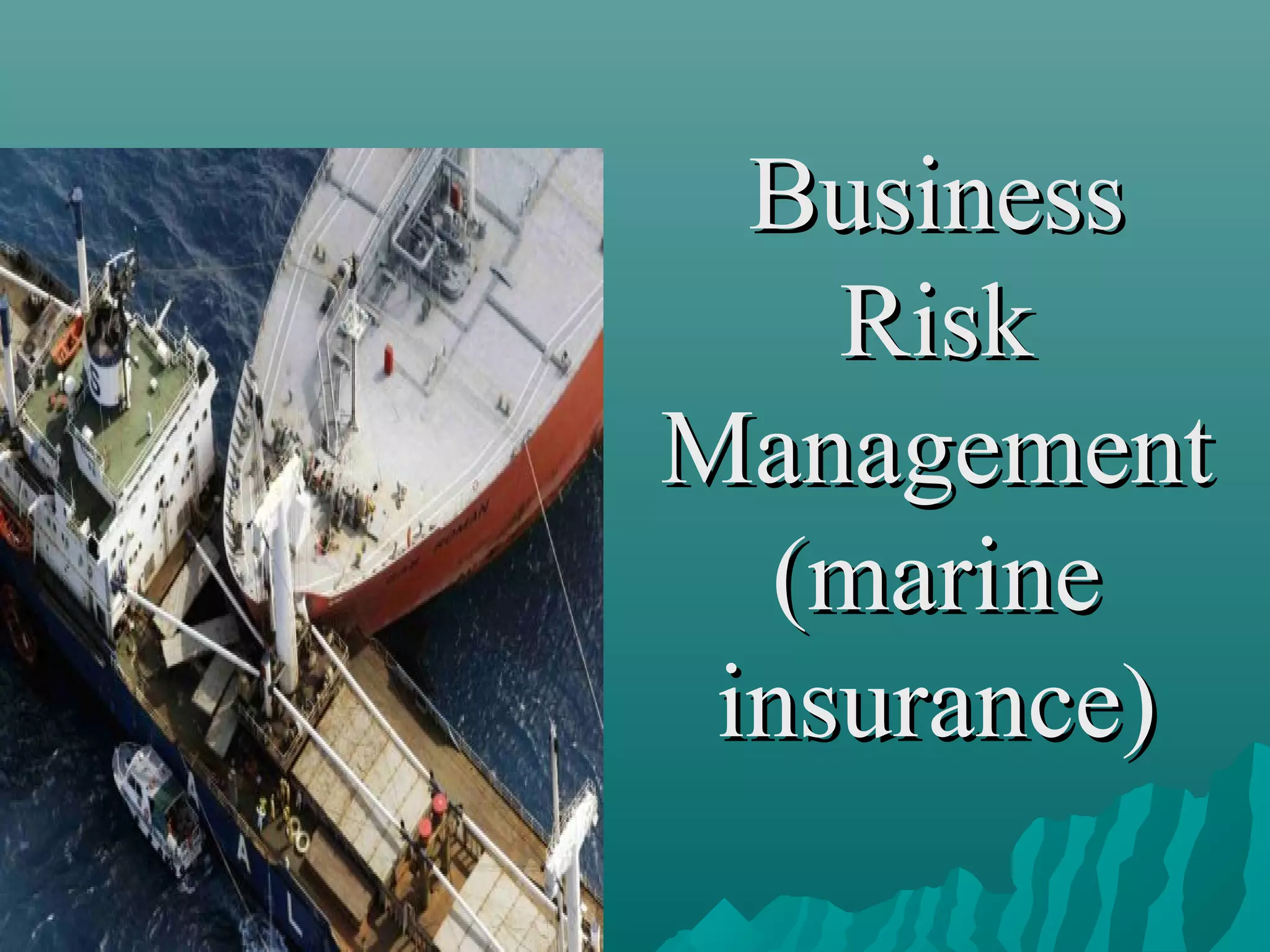
Business
    Risk
Management
   (marine
 insurance)
Meaning of marine insurance


 Marineinsurance is a contract
 whereby the insurer undertakes to
 indemnify the assured, in manner
 and to the extent thereby by agreed,
 against marine losses, i.e. the losses
 incident to marine adventure
 Contract  of Insurance
 Insurer & Insured

 Premium

 Policy

 Perils Insured Against

 Insurance against Wagering
Why Marine Insurance should be done?

Once the goods are moved out from the warehouse of the seller, they are no
more in the custody of the seller or the buyer. They are rather in the hands of a
third party called the carrier. During the transit loss can arise from:

Fire, explosion
Contact with water
Breakage
Accident
Derailment of conveyance
Theft
Pilferage
Non-delivery
Exposure to these risks and the fact that the goods are in possession of a
third party enhances the chances of loss.


                                                                               4
Principles governing the
      contract of insurance
 Principle of utmost good faith
 Principle of insurable interest

 Principle of indemnity

 Causa proxima
Marine Policy
   Meaning :-
 The terms and conditions on which a
contract of marine insurance is entered
into between the assured and the
insurer are incorporated in a document.
 It must be signed by or on behalf of
the insurer [Sec.26(1)].
 It must be duly stamped under the
Stamp Act, 1899.
    It must specify -
1.    the name of the assured, or of some person who
     effects the insurance on his behalf
2.    the subject-matter insured and the risk insured
     against
3.    the voyage, or period of time, or both, as the
     case may be, covered by the insurance
4.    the sum or sums insured
5.    the name or names of the insurer or insurers
Types of Marine Policies
Some important types of policies are:
I. Voyage Policy :-
   Where the contract is to insure the subject-
    matter at and from or from one place to
    another or others [Sec.27(1)].

II. Time Policy :-
   Where the contract is to insure the subject-
    matter for a definite period of time
    [Sec.27(1)].
   It can’t be for a period more than a year
    [Sec.27(2)].
   It may, however, contain a ‘continuation
    clause’.
iii. Floating Policy :-
   It only mentions the amount for which
    the insurance is taken out, and leaves
    the name of the ship or ships and
    other particulars to be defined by
    subsequent declarations, which will be
    declared by the assured by
    endorsement on the policy or in other
    customary manner.
WARRANTIES IN A CONTRACT OF
      MARINE INSURANCE

 The term warranty in case of
 MARINE INSURANCE ACT means
 that the assured undertakes that
 some particular thing shall or shall
 not be done , or that some
 stipulation shall be fulfilled , or that
 a particular state of facts does or
 does not exist.
Types of warranty
   Expressed warranty
    – Date on which the ship will sail
    – Place and manner of loading
    – Statement that the cargo is lawful
      merchandise
   Implied Warranty
    – Seaworthiness of the ship
    – Legality of the voyage
    – Proper documentation
    – Clauses of marine insurance act
LOSSES
Unless the policy otherwise provides, the
insurer is liable for any losses
proximately caused by a peril insured
against.
Further unless the policy otherwise
provides, the insurer is not liable :-
1.If the loss is not caused by a peril
insured against.
2. If the loss is caused by delay, which is
caused by a peril insured against.
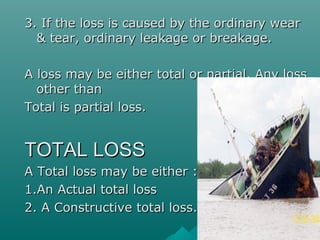
3. If the loss is caused by the ordinary wear
  & tear, ordinary leakage or breakage.

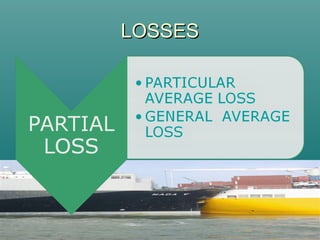
A loss may be either total or partial. Any loss
  other than
Total is partial loss.


TOTAL LOSS
A Total loss may be either :-
1.An Actual total loss
2. A Constructive total loss.
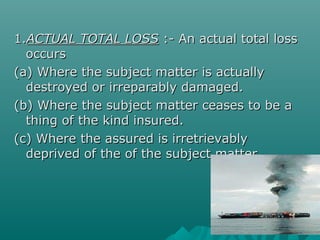
1.ACTUAL TOTAL LOSS :- An actual total loss
  occurs
(a) Where the subject matter is actually
  destroyed or irreparably damaged.
(b) Where the subject matter ceases to be a
  thing of the kind insured.
(c) Where the assured is irretrievably
  deprived of the of the subject matter.
2. CONSTRUCTIVE TOTAL LOSS :- A constructive total
  loss
occurs where the subject matter insured is reasonably
abandoned because its actual total loss appears to be
unavoidable.
In particular there is a constructive total loss :- In the
  case of damage to goods, the cost of repairing the
  goods will exceed their value after arrival.
LOSSES
Partial Loss
 Sec 56 of Marine Insurance Act 1963
 provides that any loss other than
 total loss is a partial loss.
Particular Average Loss
 Defines  it as partial loss of the
  subject matter insured, caused by a
  peril insured against, and which is
  not a general average loss.
 Ex- damage to the ship by running
  aground, damage to the cargo by fire
  etc.,
Particular average loss
    The three things under risk
     during the course of voyage
     are:-
1.   Ship.
2.   Cargo
3.   The freight( compensation paid
     for the transportation of goods)
Cont……………
 As a general rule ,any loss to these interest
  sustained must be borne by that interest
  alone.
 It gives no right of contribution from the
  other parties interested in the adventure.
 So, particular average losses are those in
  which damage is caused by accident in the
  marine adventure by the peril of sea.
General average loss
Where extraordinary sacrifices are
made at the time of peril for the
benefit of the whole adventure.
    Voluntary  and accidental
    Adventure must be imperiled, sacrifice in
     anticipation not recognized
    Objective must be the preservation of
     adventure
    Loss of market is indirect loss hence not
     allowed in GAL.
Extent of Cover
 SinceJanuary 1982, the British
 Insurance Market adopted new forms
 of cover for all cargo insurance, and
 these forms known as Institute
 Cargo Clauses (A), (B), (C) were
 adopted in India from 1st April 1983.
Marine Policy For Overseas
           Shipments
Institute Cargo Clause
 Basic Cover - ICC (C)

 Inter Mediate Cover - ICC (B)

 All Risk Cover - ICC (A)


                                  23
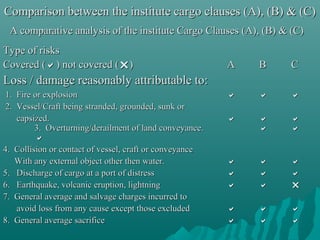
Comparison between the institute cargo clauses (A), (B) & (C)
 A comparative analysis of the institute Cargo Clauses (A), (B) & (C)
Type of risks
Covered () not covered ()                              A   B   C
Loss / damage reasonably attributable to:
1. Fire or explosion                                           
2. Vessel/Craft being stranded, grounded, sunk or
   capsized.                                                   
         3. Overturning/derailment of land conveyance.          
         
4. Collision or contact of vessel, craft or conveyance
   With any external object other then water.                  
5. Discharge of cargo at a port of distress                    
6. Earthquake, volcanic eruption, lightning                    
7. General average and salvage charges incurred to
   avoid loss from any cause except those excluded             
8. General average sacrifice                                   
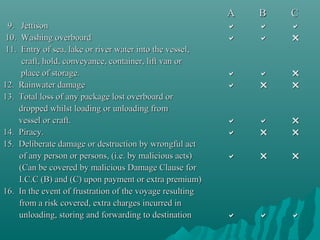
A   B   C
 9. Jettison                                                    
10. Washing overboard                                           
11. Entry of sea, lake or river water into the vessel,
     craft, hold, conveyance, container, lift van or
     place of storage.                                          
12. Rainwater damage                                            
13. Total loss of any package lost overboard or
    dropped whilst loading or unloading from
    vessel or craft.                                            
14. Piracy.                                                     
15. Deliberate damage or destruction by wrongful act
    of any person or persons, (i.e. by malicious acts)          
    (Can be covered by malicious Damage Clause for
    I.C.C (B) and (C) upon payment or extra premium)
16. In the event of frustration of the voyage resulting
    from a risk covered, extra charges incurred in
    unloading, storing and forwarding to destination            
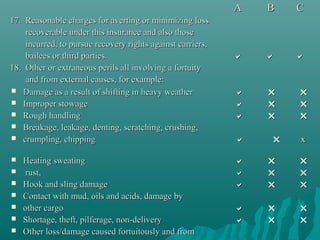
A   B   C
17. Reasonable charges for averting or minimizing loss
    recoverable under this insurance and also those
    incurred, to pursue recovery rights against carriers,
    bailees or third parties.                                     
18. Other or extraneous perils all involving a fortuity
    and from external causes, for example:
 Damage as a result of shifting in heavy weather                 
 Improper stowage                                                
 Rough handling                                                  
 Breakage, leakage, denting, scratching, crushing,
 crumpling, chipping                                             x

   Heating sweating                                              
    rust,                                                        
   Hook and sling damage                                         
   Contact with mud, oils and acids, damage by
   other cargo                                                   
   Shortage, theft, pilferage, non-delivery                      
   Other loss/damage caused fortuitously and from
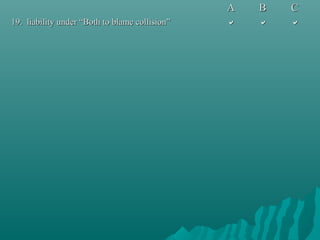
A   B   C
19. liability under “Both to blame collision”         
COMMON EXCLUSIONS
   Loss, damage or expenses attributable to willful misconduct of
    the assured
   Ordinary or inevitable losses
   Loss, damage or expense caused by inherent vice or nature of
    the subject matter insured
   Loss/damage due to insufficient, unsuitable or defective packing
    (including stowage)
   Loss/damage or expenses proximately caused by delay even if
    the delay is caused by a peril insured against
   Loss damage or expenses arising from insolvency .
   Loss damage due to un seaworthiness of the vessel or craft,
    container, lift van employed for carrying the insured matter.
   Wars, strikes and civil commotions unless covered under
    separate endorsements.
Thank You…!

Marine ins ppt

  • 1.
    Business Risk Management (marine insurance)
  • 2.
    Meaning of marineinsurance  Marineinsurance is a contract whereby the insurer undertakes to indemnify the assured, in manner and to the extent thereby by agreed, against marine losses, i.e. the losses incident to marine adventure
  • 3.
     Contract of Insurance  Insurer & Insured  Premium  Policy  Perils Insured Against  Insurance against Wagering
  • 4.
    Why Marine Insuranceshould be done? Once the goods are moved out from the warehouse of the seller, they are no more in the custody of the seller or the buyer. They are rather in the hands of a third party called the carrier. During the transit loss can arise from: Fire, explosion Contact with water Breakage Accident Derailment of conveyance Theft Pilferage Non-delivery Exposure to these risks and the fact that the goods are in possession of a third party enhances the chances of loss. 4
  • 5.
    Principles governing the contract of insurance  Principle of utmost good faith  Principle of insurable interest  Principle of indemnity  Causa proxima
  • 6.
    Marine Policy  Meaning :-  The terms and conditions on which a contract of marine insurance is entered into between the assured and the insurer are incorporated in a document.  It must be signed by or on behalf of the insurer [Sec.26(1)].  It must be duly stamped under the Stamp Act, 1899.
  • 7.
    It must specify - 1. the name of the assured, or of some person who effects the insurance on his behalf 2. the subject-matter insured and the risk insured against 3. the voyage, or period of time, or both, as the case may be, covered by the insurance 4. the sum or sums insured 5. the name or names of the insurer or insurers
  • 8.
    Types of MarinePolicies Some important types of policies are: I. Voyage Policy :-  Where the contract is to insure the subject- matter at and from or from one place to another or others [Sec.27(1)]. II. Time Policy :-  Where the contract is to insure the subject- matter for a definite period of time [Sec.27(1)].  It can’t be for a period more than a year [Sec.27(2)].  It may, however, contain a ‘continuation clause’.
  • 9.
    iii. Floating Policy:-  It only mentions the amount for which the insurance is taken out, and leaves the name of the ship or ships and other particulars to be defined by subsequent declarations, which will be declared by the assured by endorsement on the policy or in other customary manner.
  • 10.
    WARRANTIES IN ACONTRACT OF MARINE INSURANCE  The term warranty in case of MARINE INSURANCE ACT means that the assured undertakes that some particular thing shall or shall not be done , or that some stipulation shall be fulfilled , or that a particular state of facts does or does not exist.
  • 11.
    Types of warranty  Expressed warranty – Date on which the ship will sail – Place and manner of loading – Statement that the cargo is lawful merchandise  Implied Warranty – Seaworthiness of the ship – Legality of the voyage – Proper documentation – Clauses of marine insurance act
  • 12.
    LOSSES Unless the policyotherwise provides, the insurer is liable for any losses proximately caused by a peril insured against. Further unless the policy otherwise provides, the insurer is not liable :- 1.If the loss is not caused by a peril insured against. 2. If the loss is caused by delay, which is caused by a peril insured against.
  • 13.
    3. If theloss is caused by the ordinary wear & tear, ordinary leakage or breakage. A loss may be either total or partial. Any loss other than Total is partial loss. TOTAL LOSS A Total loss may be either :- 1.An Actual total loss 2. A Constructive total loss.
  • 14.
    1.ACTUAL TOTAL LOSS:- An actual total loss occurs (a) Where the subject matter is actually destroyed or irreparably damaged. (b) Where the subject matter ceases to be a thing of the kind insured. (c) Where the assured is irretrievably deprived of the of the subject matter.
  • 15.
    2. CONSTRUCTIVE TOTALLOSS :- A constructive total loss occurs where the subject matter insured is reasonably abandoned because its actual total loss appears to be unavoidable. In particular there is a constructive total loss :- In the case of damage to goods, the cost of repairing the goods will exceed their value after arrival.
  • 16.
  • 17.
    Partial Loss  Sec56 of Marine Insurance Act 1963 provides that any loss other than total loss is a partial loss.
  • 18.
    Particular Average Loss Defines it as partial loss of the subject matter insured, caused by a peril insured against, and which is not a general average loss.  Ex- damage to the ship by running aground, damage to the cargo by fire etc.,
  • 19.
    Particular average loss  The three things under risk during the course of voyage are:- 1. Ship. 2. Cargo 3. The freight( compensation paid for the transportation of goods)
  • 20.
    Cont……………  As ageneral rule ,any loss to these interest sustained must be borne by that interest alone.  It gives no right of contribution from the other parties interested in the adventure.  So, particular average losses are those in which damage is caused by accident in the marine adventure by the peril of sea.
  • 21.
    General average loss Whereextraordinary sacrifices are made at the time of peril for the benefit of the whole adventure.  Voluntary and accidental  Adventure must be imperiled, sacrifice in anticipation not recognized  Objective must be the preservation of adventure  Loss of market is indirect loss hence not allowed in GAL.
  • 22.
    Extent of Cover SinceJanuary 1982, the British Insurance Market adopted new forms of cover for all cargo insurance, and these forms known as Institute Cargo Clauses (A), (B), (C) were adopted in India from 1st April 1983.
  • 23.
    Marine Policy ForOverseas Shipments Institute Cargo Clause  Basic Cover - ICC (C)  Inter Mediate Cover - ICC (B)  All Risk Cover - ICC (A) 23
  • 24.
    Comparison between theinstitute cargo clauses (A), (B) & (C) A comparative analysis of the institute Cargo Clauses (A), (B) & (C) Type of risks Covered () not covered () A B C Loss / damage reasonably attributable to: 1. Fire or explosion    2. Vessel/Craft being stranded, grounded, sunk or capsized.    3. Overturning/derailment of land conveyance.    4. Collision or contact of vessel, craft or conveyance With any external object other then water.    5. Discharge of cargo at a port of distress    6. Earthquake, volcanic eruption, lightning    7. General average and salvage charges incurred to avoid loss from any cause except those excluded    8. General average sacrifice   
  • 25.
    A B C 9. Jettison    10. Washing overboard    11. Entry of sea, lake or river water into the vessel, craft, hold, conveyance, container, lift van or place of storage.    12. Rainwater damage    13. Total loss of any package lost overboard or dropped whilst loading or unloading from vessel or craft.    14. Piracy.    15. Deliberate damage or destruction by wrongful act of any person or persons, (i.e. by malicious acts)    (Can be covered by malicious Damage Clause for I.C.C (B) and (C) upon payment or extra premium) 16. In the event of frustration of the voyage resulting from a risk covered, extra charges incurred in unloading, storing and forwarding to destination   
  • 26.
    A B C 17. Reasonable charges for averting or minimizing loss recoverable under this insurance and also those incurred, to pursue recovery rights against carriers, bailees or third parties.    18. Other or extraneous perils all involving a fortuity and from external causes, for example:  Damage as a result of shifting in heavy weather     Improper stowage     Rough handling     Breakage, leakage, denting, scratching, crushing,  crumpling, chipping   x  Heating sweating     rust,     Hook and sling damage     Contact with mud, oils and acids, damage by  other cargo     Shortage, theft, pilferage, non-delivery     Other loss/damage caused fortuitously and from
  • 27.
    A B C 19. liability under “Both to blame collision”   
  • 28.
    COMMON EXCLUSIONS  Loss, damage or expenses attributable to willful misconduct of the assured  Ordinary or inevitable losses  Loss, damage or expense caused by inherent vice or nature of the subject matter insured  Loss/damage due to insufficient, unsuitable or defective packing (including stowage)  Loss/damage or expenses proximately caused by delay even if the delay is caused by a peril insured against  Loss damage or expenses arising from insolvency .  Loss damage due to un seaworthiness of the vessel or craft, container, lift van employed for carrying the insured matter.  Wars, strikes and civil commotions unless covered under separate endorsements.
  • 29.