Import & Export
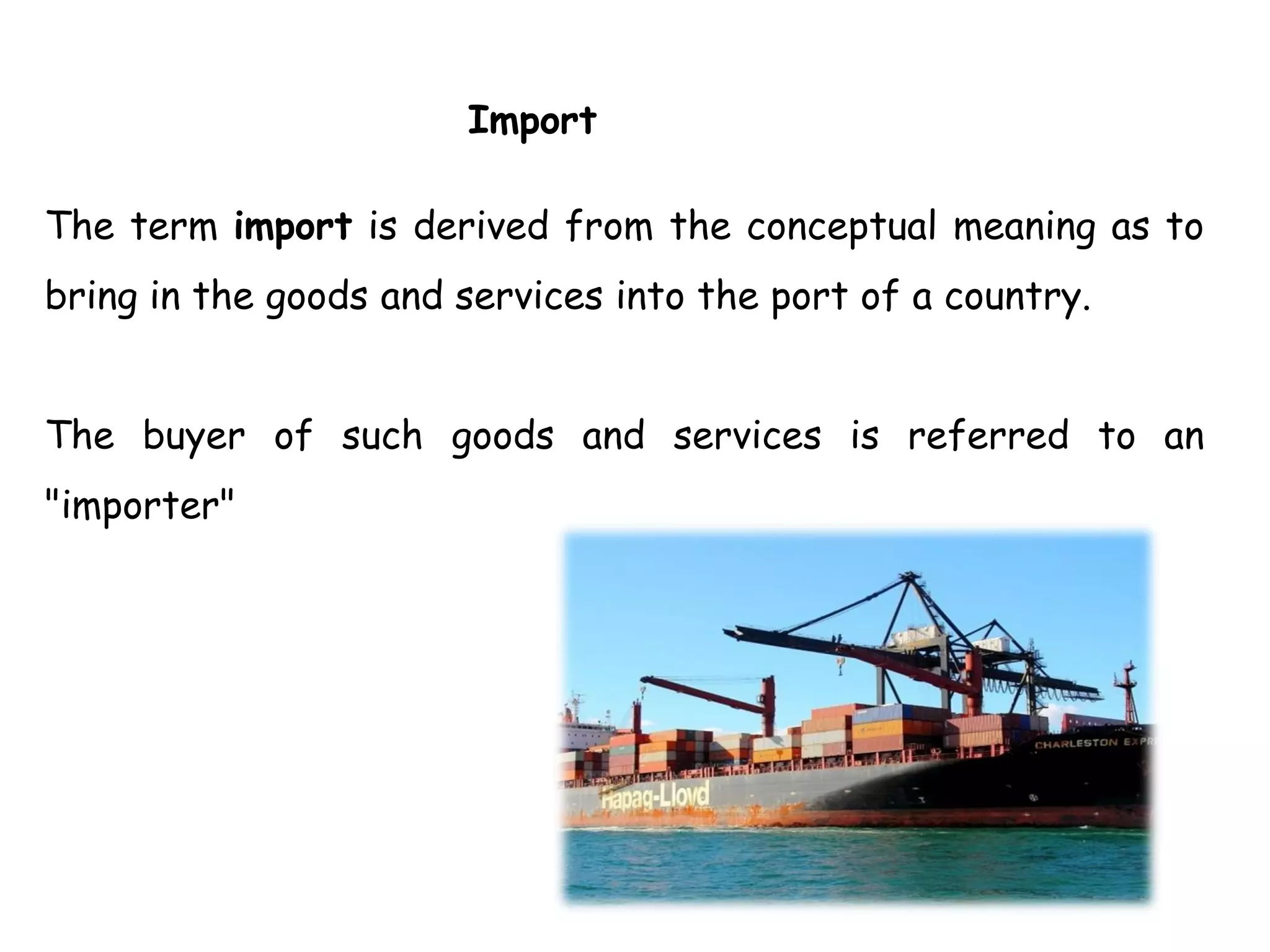
The term import is derived from the conceptual meaning as to
bring in the goods and services into the port of a country.
The buyer of such goods and services is referred to an
"importer"
Import
This term export is derived from the conceptual meaning as to
ship the goods and services out of the port of a country.
The seller of such goods and services is referred to as an
"exporter"
Export
Balance Of Trade
Balance of trade represents a difference in value for import
and export for a country.
A trade deficit occurs when imports are large relative to
exports.
 Imports are impacted principally by a country's income and
its productive resources.
Types of Import
There are two basic types of import:
Industrial and consumer goods
Intermediate goods and services
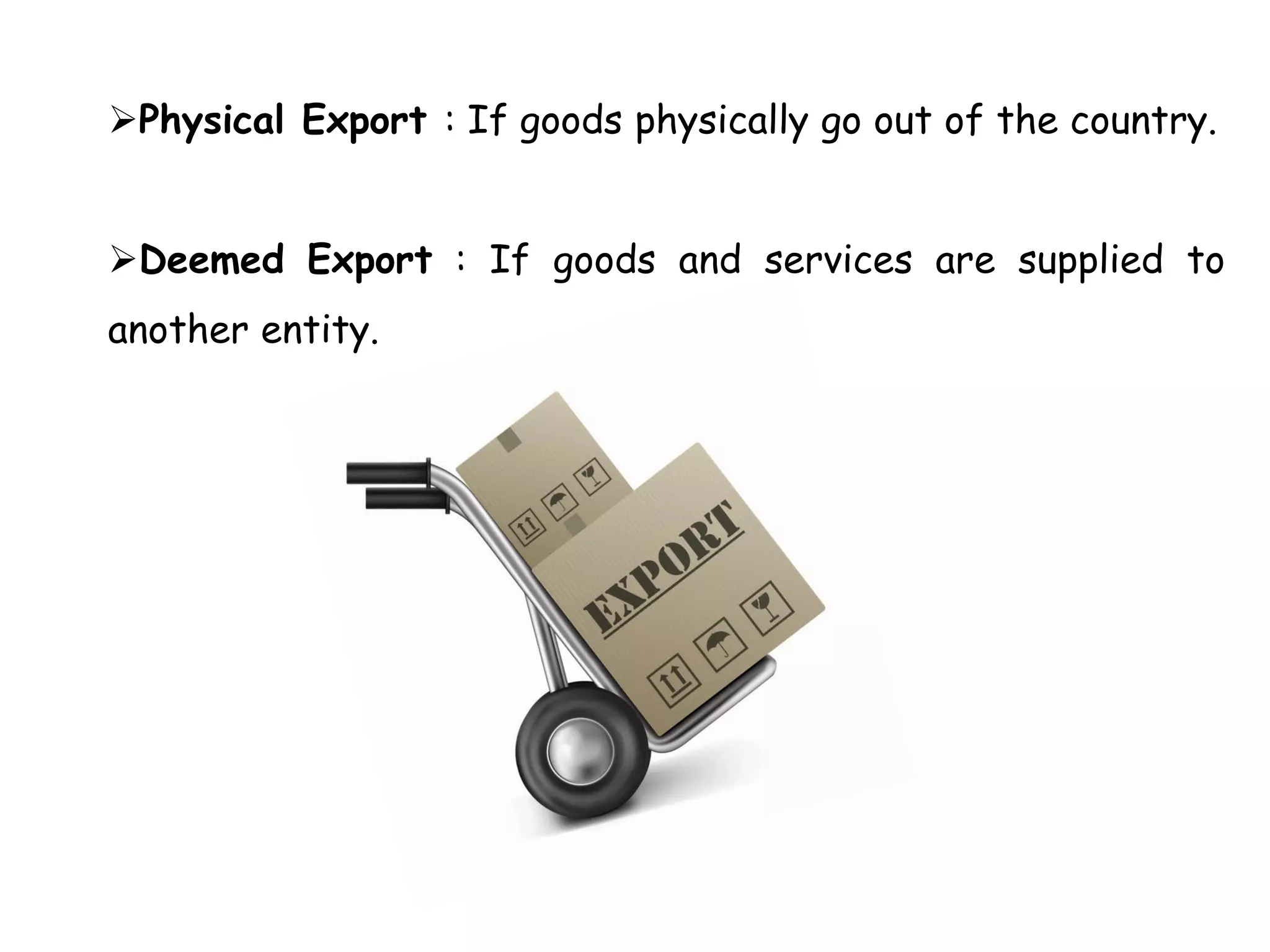
Physical Export : If goods physically go out of the country.
Deemed Export : If goods and services are supplied to
another entity.
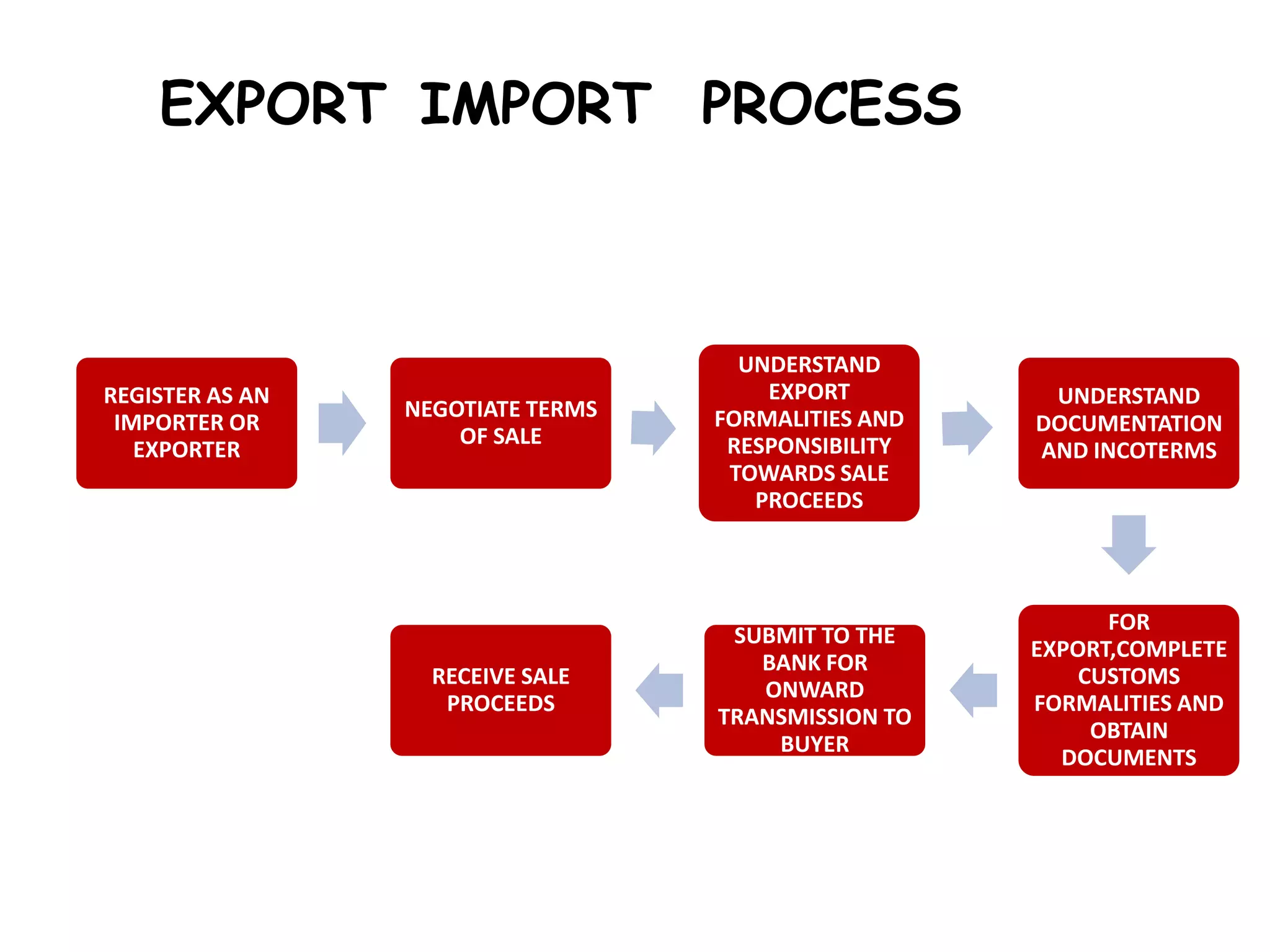
REGISTER AS AN
IMPORTER OR
EXPORTER
NEGOTIATE TERMS
OF SALE
UNDERSTAND
EXPORT
FORMALITIES AND
RESPONSIBILITY
TOWARDS SALE
PROCEEDS
UNDERSTAND
DOCUMENTATION
AND INCOTERMS
FOR
EXPORT,COMPLETE
CUSTOMS
FORMALITIES AND
OBTAIN
DOCUMENTS
SUBMIT TO THE
BANK FOR
ONWARD
TRANSMISSION TO
BUYER
RECEIVE SALE
PROCEEDS
EXPORT IMPORT PROCESS
Reduce dependence on existing markets
Exploit international trade technology
Extend sales potential of existing products
Maintain cost competitiveness in your domestic market
Advantages of Import
Disadvantages Of Import
Importation of items from other countries can increase
the risk of getting them which is no more common in the
warm weather.
 it leads to excessive competition
 It also increases risks of other diseases from which the
country is exporting the goods.
Advantages Of Export
Exporting is one way of increasing
your sales potential
Increasing sale& profits
Reducing risk and balancing growth
Sell Excess Production Capacity.
Gain New Knowledge and
Experience
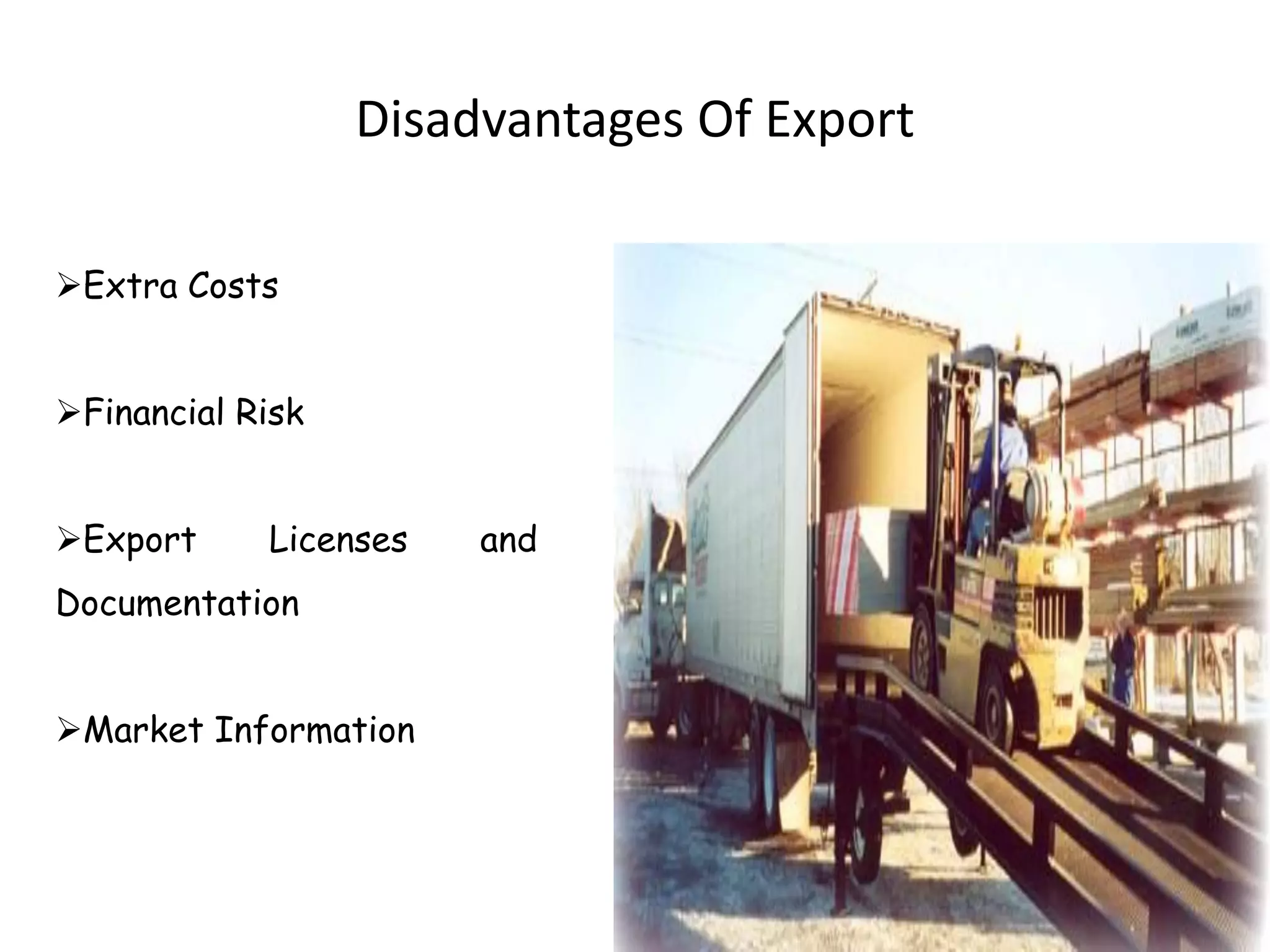
Disadvantages Of Export
Extra Costs
Financial Risk
Export Licenses and
Documentation
Market Information
MODES OF PAYMENT
In order to complete the export process, the payment of
the exported goods has to be received by the exporters.
An exporter can receive the export proceeds as
advance payment
payment against documentary bills
payment against documentary bills under letter of credit
EXIM Bank
EXIM Bank
Export-Import Bank of India is the premier export finance
institution of the country, established in 1982 under the
Export-Import Bank of India Act 1981
Government of India launched the institution with a mandate, not just
to enhance exports from India, but to integrate the country’s foreign
trade and investment with the overall economic growth.
like other Export Credit Agencies in the world, Exim Bank of India
has, over the period, evolved into an institution that plays a major role
in partnering Indian industries, particularly the Small and Medium
Enterprises, in their globalization efforts, through a wide range of
products and services offered at all stages of the business cycle,
starting from import of technology and export product development
to export production, export marketing, pre-shipment and post-
shipment and overseas investment.
EXIM Bank
Exim Bank of India has been the prime mover in encouraging
project exports from India.
The Bank extends lines of credit to overseas financial
institutions, foreign governments and their agencies, enabling
them to finance imports of goods and services from India on
deferred credit terms.
The Bank provides financial assistance by way of term loans in Indian
rupees/foreign currencies for setting up new production facility,
expansion/modernization/upgradation of existing facilities and for
acquisition of production equipment/technology.
Such facilities Such facilities particularly help export oriented Small
and Medium Enterprises for creation of export capabilities and
enhancement of international competitiveness.
The Bank has launched the Rural Initiatives Program with the
objective of linking Indian rural industry to the global market.
The program is intended to benefit rural poor through creation of
export capability in rural enterprises.
EXIM Bank
Exim Bank supplements its financing programs with a
wide range of value-added information, advisory and
support services, which enable exporters to evaluate
international risks, exploit export opportunities and
improve competitiveness, thereby helping them in their
globalization efforts.
Support Institutions to Facilitate Exports
Some of these institutions are:
Export Credit Guarantee Corporation (ECGC)
Exim Bank of India
India Trade Promotion Organisation (ITPO)
Export Inspection council (EIC)
Indian Institute of Packaging (IIP) contd
OCTROI
The state government
levies the octroi charges
when the product enters
the state. This charge is
applicable to certain
states and fluctuates as
per the Government
regulations and we are
unable to confirm the
amount.
ECGC
The Export Credit Guarantee Corporation of India
Limited(ECGC) is a company wholly owned by the Government
of India based in Mumbai, Maharashtra.
It provides export credit insurance support to Indian
exporters and is controlled by the Ministry of Commerce.
Government of India had initially set up Export Risks
Insurance Corporation (ERIC) in July 1957.
ECGC LOGO
ECGC
What does ECGC do?
Provides a range of credit risk insurance covers to
exporters against loss in export of goods and services.
Offers guarantees to banks and financial institutions to
enable exporters to obtain better facilities from them.
Provides Overseas Investment Insurance to Indian companies
investing in joint ventures abroad in the form of equity or loan.
Information on different countries with its own credit rating.
Assists the exporters in recovering bad debts.
Exports & Import – General Provisions in
Foreign Trade Policy
 The interpretation of Policy: DGFT is the final authority. Any
exemption from policy or procedure also to be referred to
DGFT
 Freedom to export & import except to the extent of provisions
in the Foreign Trade Policy or any other law in force
 Every exporter/importer must comply with the provisions of
the Foreign Trade (Development & Regulation) Act 1992
 No agency shall withhold consignments allowed for exports.
Free movement of export goods is allowed. Authority can take
undertaking from exporter in case of any doubt
Specific Provisions
 Free exports
 All exports in freely convertible currency except in specific
situations
 Realization of export proceeds within a specified time
 Deemed exports
Excise Duty
An excise or excise tax (sometimes called a duty of excise
special tax) is an inland tax on the sale, or production for sale,
of specific goods or a tax on a good produced for sale, or sold,
within a country or licenses for specific activities. Excises are
distinguished from customs duties, which are taxes on
importation.
Custom Duty
.
Customs duty is a kind of indirect tax which is realized on goods
of international trade.
In economic sense, it is also a kind of consumption tax.
Duties levied by the government in relation to imported items is
referred to as import duty.
In the same vein, duties realized on export consignments is
called export duty.
Tariff, which is actually a list of commodities along with the
leviable rate (amount) of Customs duty, is popularly understood
as Customs duty.
INCOTERMS
The Incoterms rules or International Commercial terms are a
series of pre-defined commercial terms published by
the International Chamber of Commerce (ICC) widely used in
international commercial transactions.
It defines the trade contract ,responsibilities and liabilities
between the buyer and the seller
These terms make international trade easier and help traders
in different countries to understand the responsibilities and
rights of the buyers and sellers.
SOME OF THE TERMS ARE-
EXW – Ex Works (named place of delivery)
FCA – Free Carrier (named place of delivery)
CPT - Carriage Paid To (named place of destination)
CIP – Carriage and Insurance Paid to (named place of
destination)
DAT – Delivered at Terminal (named terminal at port or place
of destination)
DAP – Delivered at Place (named place of destination)
DDP – Delivered Duty Paid (named place of destination)

Export & import

  • 1.
  • 2.
    The term importis derived from the conceptual meaning as to bring in the goods and services into the port of a country. The buyer of such goods and services is referred to an "importer" Import
  • 3.
    This term exportis derived from the conceptual meaning as to ship the goods and services out of the port of a country. The seller of such goods and services is referred to as an "exporter" Export
  • 4.
    Balance Of Trade Balanceof trade represents a difference in value for import and export for a country. A trade deficit occurs when imports are large relative to exports.  Imports are impacted principally by a country's income and its productive resources.
  • 5.
    Types of Import Thereare two basic types of import: Industrial and consumer goods Intermediate goods and services
  • 6.
    Physical Export :If goods physically go out of the country. Deemed Export : If goods and services are supplied to another entity.
  • 7.
    REGISTER AS AN IMPORTEROR EXPORTER NEGOTIATE TERMS OF SALE UNDERSTAND EXPORT FORMALITIES AND RESPONSIBILITY TOWARDS SALE PROCEEDS UNDERSTAND DOCUMENTATION AND INCOTERMS FOR EXPORT,COMPLETE CUSTOMS FORMALITIES AND OBTAIN DOCUMENTS SUBMIT TO THE BANK FOR ONWARD TRANSMISSION TO BUYER RECEIVE SALE PROCEEDS EXPORT IMPORT PROCESS
  • 8.
    Reduce dependence onexisting markets Exploit international trade technology Extend sales potential of existing products Maintain cost competitiveness in your domestic market Advantages of Import
  • 9.
    Disadvantages Of Import Importationof items from other countries can increase the risk of getting them which is no more common in the warm weather.  it leads to excessive competition  It also increases risks of other diseases from which the country is exporting the goods.
  • 10.
    Advantages Of Export Exportingis one way of increasing your sales potential Increasing sale& profits Reducing risk and balancing growth Sell Excess Production Capacity. Gain New Knowledge and Experience
  • 11.
    Disadvantages Of Export ExtraCosts Financial Risk Export Licenses and Documentation Market Information
  • 12.
    MODES OF PAYMENT Inorder to complete the export process, the payment of the exported goods has to be received by the exporters. An exporter can receive the export proceeds as advance payment payment against documentary bills payment against documentary bills under letter of credit
  • 13.
  • 14.
    EXIM Bank Export-Import Bankof India is the premier export finance institution of the country, established in 1982 under the Export-Import Bank of India Act 1981
  • 15.
    Government of Indialaunched the institution with a mandate, not just to enhance exports from India, but to integrate the country’s foreign trade and investment with the overall economic growth. like other Export Credit Agencies in the world, Exim Bank of India has, over the period, evolved into an institution that plays a major role in partnering Indian industries, particularly the Small and Medium Enterprises, in their globalization efforts, through a wide range of products and services offered at all stages of the business cycle, starting from import of technology and export product development to export production, export marketing, pre-shipment and post- shipment and overseas investment.
  • 16.
    EXIM Bank Exim Bankof India has been the prime mover in encouraging project exports from India. The Bank extends lines of credit to overseas financial institutions, foreign governments and their agencies, enabling them to finance imports of goods and services from India on deferred credit terms.
  • 17.
    The Bank providesfinancial assistance by way of term loans in Indian rupees/foreign currencies for setting up new production facility, expansion/modernization/upgradation of existing facilities and for acquisition of production equipment/technology. Such facilities Such facilities particularly help export oriented Small and Medium Enterprises for creation of export capabilities and enhancement of international competitiveness. The Bank has launched the Rural Initiatives Program with the objective of linking Indian rural industry to the global market. The program is intended to benefit rural poor through creation of export capability in rural enterprises.
  • 18.
    EXIM Bank Exim Banksupplements its financing programs with a wide range of value-added information, advisory and support services, which enable exporters to evaluate international risks, exploit export opportunities and improve competitiveness, thereby helping them in their globalization efforts.
  • 19.
    Support Institutions toFacilitate Exports Some of these institutions are: Export Credit Guarantee Corporation (ECGC) Exim Bank of India India Trade Promotion Organisation (ITPO) Export Inspection council (EIC) Indian Institute of Packaging (IIP) contd
  • 20.
    OCTROI The state government leviesthe octroi charges when the product enters the state. This charge is applicable to certain states and fluctuates as per the Government regulations and we are unable to confirm the amount.
  • 21.
    ECGC The Export CreditGuarantee Corporation of India Limited(ECGC) is a company wholly owned by the Government of India based in Mumbai, Maharashtra. It provides export credit insurance support to Indian exporters and is controlled by the Ministry of Commerce. Government of India had initially set up Export Risks Insurance Corporation (ERIC) in July 1957.
  • 22.
  • 23.
    ECGC What does ECGCdo? Provides a range of credit risk insurance covers to exporters against loss in export of goods and services. Offers guarantees to banks and financial institutions to enable exporters to obtain better facilities from them.
  • 24.
    Provides Overseas InvestmentInsurance to Indian companies investing in joint ventures abroad in the form of equity or loan. Information on different countries with its own credit rating. Assists the exporters in recovering bad debts.
  • 25.
    Exports & Import– General Provisions in Foreign Trade Policy  The interpretation of Policy: DGFT is the final authority. Any exemption from policy or procedure also to be referred to DGFT  Freedom to export & import except to the extent of provisions in the Foreign Trade Policy or any other law in force  Every exporter/importer must comply with the provisions of the Foreign Trade (Development & Regulation) Act 1992  No agency shall withhold consignments allowed for exports. Free movement of export goods is allowed. Authority can take undertaking from exporter in case of any doubt
  • 26.
    Specific Provisions  Freeexports  All exports in freely convertible currency except in specific situations  Realization of export proceeds within a specified time  Deemed exports
  • 27.
    Excise Duty An exciseor excise tax (sometimes called a duty of excise special tax) is an inland tax on the sale, or production for sale, of specific goods or a tax on a good produced for sale, or sold, within a country or licenses for specific activities. Excises are distinguished from customs duties, which are taxes on importation.
  • 28.
    Custom Duty . Customs dutyis a kind of indirect tax which is realized on goods of international trade. In economic sense, it is also a kind of consumption tax. Duties levied by the government in relation to imported items is referred to as import duty. In the same vein, duties realized on export consignments is called export duty. Tariff, which is actually a list of commodities along with the leviable rate (amount) of Customs duty, is popularly understood as Customs duty.
  • 29.
    INCOTERMS The Incoterms rulesor International Commercial terms are a series of pre-defined commercial terms published by the International Chamber of Commerce (ICC) widely used in international commercial transactions. It defines the trade contract ,responsibilities and liabilities between the buyer and the seller These terms make international trade easier and help traders in different countries to understand the responsibilities and rights of the buyers and sellers.
  • 30.
    SOME OF THETERMS ARE- EXW – Ex Works (named place of delivery) FCA – Free Carrier (named place of delivery) CPT - Carriage Paid To (named place of destination) CIP – Carriage and Insurance Paid to (named place of destination) DAT – Delivered at Terminal (named terminal at port or place of destination) DAP – Delivered at Place (named place of destination) DDP – Delivered Duty Paid (named place of destination)