By:
Eny Wanti 0813042003
Devina Adinda 0813042026
Hesti Prasetianingtias 0813042031
Myra Desmayeni 0813042038
Nisa Fitriyani 0813042040
Olla Refildha 0613042044
SPEECH ACT AND PRAGMATICS
Definition of Discourse Analysis
 It’s a way of looking at language. Grammarians
look at with grammar as the unit of analysis.
Discourse analysis is concerned with the
relationship between language and the contexts
it’s used in.
There may be a case for arguing some pieces of
language are a hybrid of the two.
 Spoken discourse may cover telephone calls,
transactions in shops, interviews, etc..
 Written discourse may cover newspapers,
poems, letters and so forth.
1. SPOKEN DISCOURSE
1.1 FORM and FUNCTION
 Look at extract 1. Taken from the British comedy show
Morecombe and Wise.
ERNIE: Tell ‘em about the show.
ERIC: (to the audience) Have we got a show for you tonight folks!
Have we got a show for you!
(aside to Ernie) Have we got a show for them?
 “Have we got a show for you” changes meaning or function
during the exchange. The important thing is how we recognize
this change. Interpretation is based essentially on context, the
relationship of the people, intonation, may be pitch, conventions
of speech.
 In a nutshell this is what discourse analysis is about. How we
interpret language, what makes sentences coherent, what we
are doing with the language.
 A more accurate knowledge of this can help us when evaluating
materials, creating materials and using language in the
2. WRITTEN DISCOURSE
 Apart from recognizing markers (past tense, gerund,
etc.) and cohesive devices (and, etc.) how did you
interpret the text?
 What you do when you read is bring your knowledge
of the world and of writing to the text.
 When you read there is a continual internal
conversation happening between you and the text.
You read “The broken house” and ask “Whose is the
house? Why is it broken? Is this an advert?” etc. and
this goes on until you satisfactorily interpret the text.
 So how can we help students read? One way is
increasing world knowledge (by no means an easy
task!) and increasing knowledge of text patterns for
different text types.
TEXT PATTERNS
 Phenomenon –reason: Cause – consequence:
Instrument – achievement: Problem – solution
 These are some common patterns found in writing.
 The phrase “Feeling ill, he went home”.
 Could be cause – consequence or even, problem -
solution.
 The problem – solution pattern is typically used in
adverts.
 As teachers we can point out the vocabulary
that signals a pattern and then students
identify patterns in texts, (bottom-up) or we
indicate the patterns and let students find the
signaling vocabulary (top-down). Vocabulary
TEXT COHERENCE
 The result is…
 The reason is….
 The fact is that…
 This contrasts with…
 *Here is another exercise to help raise awareness and use of coherence in texts.
 Give the first and last sentence of a text to all the students in a small group.
 E.G. “Young people today are exposed to a lot of violence on TV”
 “This suggests some sort of censorship may be necessary to solve the problem”
 Then each student has to write individually a sentence from his cue E.G. “The result is”
“This contrast with” etc.
 They then put all their sentences together and discuss how well the text gels and what
needs to change to make it work.
 All of the ideas on Writing discourse of course are equally applicable to reading.
Speech act
Definition: A speech act is a technical term in
linguistics and the philosophy of language. It is an
act that a speaker performs when making an
utterance.
According to John L. Austin (1962) speech acts can
be analysed on three levels:
 Locutionary act
 Illocutionary act
 Perlocutionary act
Locutionary act
Locutionary act is simply the speech act that has
taken place the performance of an utterance. A
locutionary act is the act of using a referring
expression and a predicating expression to
express a proposition.
For example:
 A warning: “I warn you to stop smoking”
It constitutes an expressed locutionary act because
its propositional content predicates a future act
(to stop smoking) of the hearer (you).
Illocutionary act
Illocutionary act is the real action which is
performed by the utterance. It is the semantic
'illocutionary force' of the utterance, thus the real,
intended meaning.
In performing a illocutionary act, it can be
performed such an act as:
 Warning
In saying, "Watch out, the ground is slippery",
Mary performs the speech act of warning
Peter to be careful.
Perlocutionary act
Perlocutionary act is the actual effect, an action or
state of mind brought about by, or as a
consequence of, saying something.
Perlocutionary effect is in some sense external to
the performance, it may be thought of, in a sense,
as the effect of the illocutionary act. Therefore,
when examining perlocutionary acts, the effect on
the hearer or reader is emphasized.
Pragmatics
Pragmatics is a systematic way of explaining
language use in context to explain aspects of
meaning which cannot be found in the plain
sense of words or structures.
We can illustrate how pragmatics works by an
example from association football. It sometimes
happens that a team-mate will shout at me: “Man
on!”
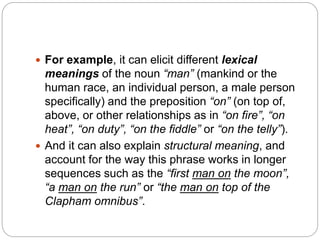
 For example, it can elicit different lexical
meanings of the noun “man” (mankind or the
human race, an individual person, a male person
specifically) and the preposition “on” (on top of,
above, or other relationships as in “on fire”, “on
heat”, “on duty”, “on the fiddle” or “on the telly”).
 And it can also explain structural meaning, and
account for the way this phrase works in longer
sequences such as the “first man on the moon”,
“a man on the run” or “the man on top of the
Clapham omnibus”.
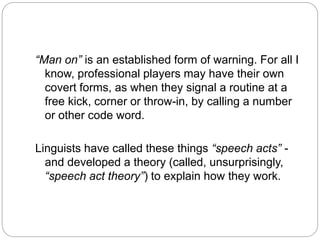
“Man on” is an established form of warning. For all I
know, professional players may have their own
covert forms, as when they signal a routine at a
free kick, corner or throw-in, by calling a number
or other code word.
Linguists have called these things “speech acts” -
and developed a theory (called, unsurprisingly,
“speech act theory”) to explain how they work.

Pragmatic and Speech act.ppt

  • 1.
    By: Eny Wanti 0813042003 DevinaAdinda 0813042026 Hesti Prasetianingtias 0813042031 Myra Desmayeni 0813042038 Nisa Fitriyani 0813042040 Olla Refildha 0613042044 SPEECH ACT AND PRAGMATICS
  • 2.
    Definition of DiscourseAnalysis  It’s a way of looking at language. Grammarians look at with grammar as the unit of analysis. Discourse analysis is concerned with the relationship between language and the contexts it’s used in. There may be a case for arguing some pieces of language are a hybrid of the two.  Spoken discourse may cover telephone calls, transactions in shops, interviews, etc..  Written discourse may cover newspapers, poems, letters and so forth.
  • 3.
    1. SPOKEN DISCOURSE 1.1FORM and FUNCTION  Look at extract 1. Taken from the British comedy show Morecombe and Wise. ERNIE: Tell ‘em about the show. ERIC: (to the audience) Have we got a show for you tonight folks! Have we got a show for you! (aside to Ernie) Have we got a show for them?  “Have we got a show for you” changes meaning or function during the exchange. The important thing is how we recognize this change. Interpretation is based essentially on context, the relationship of the people, intonation, may be pitch, conventions of speech.  In a nutshell this is what discourse analysis is about. How we interpret language, what makes sentences coherent, what we are doing with the language.  A more accurate knowledge of this can help us when evaluating materials, creating materials and using language in the
  • 4.
    2. WRITTEN DISCOURSE Apart from recognizing markers (past tense, gerund, etc.) and cohesive devices (and, etc.) how did you interpret the text?  What you do when you read is bring your knowledge of the world and of writing to the text.  When you read there is a continual internal conversation happening between you and the text. You read “The broken house” and ask “Whose is the house? Why is it broken? Is this an advert?” etc. and this goes on until you satisfactorily interpret the text.  So how can we help students read? One way is increasing world knowledge (by no means an easy task!) and increasing knowledge of text patterns for different text types.
  • 5.
    TEXT PATTERNS  Phenomenon–reason: Cause – consequence: Instrument – achievement: Problem – solution  These are some common patterns found in writing.  The phrase “Feeling ill, he went home”.  Could be cause – consequence or even, problem - solution.  The problem – solution pattern is typically used in adverts.  As teachers we can point out the vocabulary that signals a pattern and then students identify patterns in texts, (bottom-up) or we indicate the patterns and let students find the signaling vocabulary (top-down). Vocabulary
  • 6.
    TEXT COHERENCE  Theresult is…  The reason is….  The fact is that…  This contrasts with…  *Here is another exercise to help raise awareness and use of coherence in texts.  Give the first and last sentence of a text to all the students in a small group.  E.G. “Young people today are exposed to a lot of violence on TV”  “This suggests some sort of censorship may be necessary to solve the problem”  Then each student has to write individually a sentence from his cue E.G. “The result is” “This contrast with” etc.  They then put all their sentences together and discuss how well the text gels and what needs to change to make it work.  All of the ideas on Writing discourse of course are equally applicable to reading.
  • 7.
    Speech act Definition: Aspeech act is a technical term in linguistics and the philosophy of language. It is an act that a speaker performs when making an utterance. According to John L. Austin (1962) speech acts can be analysed on three levels:  Locutionary act  Illocutionary act  Perlocutionary act
  • 8.
    Locutionary act Locutionary actis simply the speech act that has taken place the performance of an utterance. A locutionary act is the act of using a referring expression and a predicating expression to express a proposition. For example:  A warning: “I warn you to stop smoking” It constitutes an expressed locutionary act because its propositional content predicates a future act (to stop smoking) of the hearer (you).
  • 9.
    Illocutionary act Illocutionary actis the real action which is performed by the utterance. It is the semantic 'illocutionary force' of the utterance, thus the real, intended meaning. In performing a illocutionary act, it can be performed such an act as:  Warning In saying, "Watch out, the ground is slippery", Mary performs the speech act of warning Peter to be careful.
  • 10.
    Perlocutionary act Perlocutionary actis the actual effect, an action or state of mind brought about by, or as a consequence of, saying something. Perlocutionary effect is in some sense external to the performance, it may be thought of, in a sense, as the effect of the illocutionary act. Therefore, when examining perlocutionary acts, the effect on the hearer or reader is emphasized.
  • 11.
    Pragmatics Pragmatics is asystematic way of explaining language use in context to explain aspects of meaning which cannot be found in the plain sense of words or structures. We can illustrate how pragmatics works by an example from association football. It sometimes happens that a team-mate will shout at me: “Man on!”
  • 12.
     For example,it can elicit different lexical meanings of the noun “man” (mankind or the human race, an individual person, a male person specifically) and the preposition “on” (on top of, above, or other relationships as in “on fire”, “on heat”, “on duty”, “on the fiddle” or “on the telly”).  And it can also explain structural meaning, and account for the way this phrase works in longer sequences such as the “first man on the moon”, “a man on the run” or “the man on top of the Clapham omnibus”.
  • 13.
    “Man on” isan established form of warning. For all I know, professional players may have their own covert forms, as when they signal a routine at a free kick, corner or throw-in, by calling a number or other code word. Linguists have called these things “speech acts” - and developed a theory (called, unsurprisingly, “speech act theory”) to explain how they work.