Language in Context Pragmatics, Metaphor and Framing
Meaning Semantics –meaning derived from linguistic knowledge ( from the words themselves) Pragmatics – aspects of meaning that cannot be predicted by linguistic knowledge alone, relies on  social and contextual cues.
What do we mean by context? All features of a situation that are relevant to how an utterance is produced an understood.
Context guides meaning A: What’s your stepmother like? B: she’s a woman and she’s married to  my father.
Pragmatic meaning
Pragmatic meaning depends  on Inference Entailments  are directly retrievable from the linguistic form of the utterance Pre-suppositions  are closely linked to the words and grammatical structures  + our knowledge of the way language is conventionally interpreted.
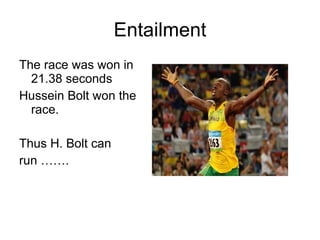
Entailment The race was won in 21.38 seconds Hussein Bolt won the race. Thus H. Bolt can  run …….
Pre-supposition Anti-oxidants help to fight cancer. Tea contains 10% anti-oxidants Thus tea…
Pre-supposition Ayla managed to stop in time. Also presupposes : Ayla tried to stop in time Ayla intended to stop in time Ayla had the ability to stop in time Ian forgot to buy the pizza Also presupposes Ian intended to buy pizza  Ian ought to have bought pizza Ian had the ability (money) to buy pizza
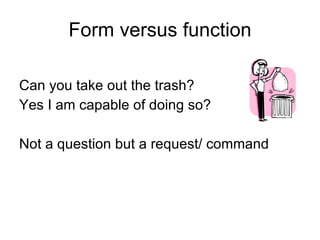
Form versus function Can you take out the trash? Yes I am capable of doing so? Not a question but a request/ command
‘ its cold in here’ Semantic meaning  = The temperature is below a comfortable level e.g. 75 degrees Pragmatic meanings = Turn the heat up Get me a sweater Shut the window
Children & meaning. There’s a breeze in my mouth (sucking a mint) I can’t die this spider (stomping on spider) Daddy (when seeing postman)
Literalness SLP:  so you like ice-cream what are your favorite flavours? Child: Hamburger…fish…and chips
Literalness A father is trying to get his 3 year old daughter to stop lifting her dress up and showing her new underwear to the guests Father:  we don’t DO that Girl:  I KNOW Daddy you don’t wear a dress.
Literalness A 3 year old comes in the front door Mom:  wipe your feet please He removes his shoes and socks and carefully wipes his feet on the doormat.
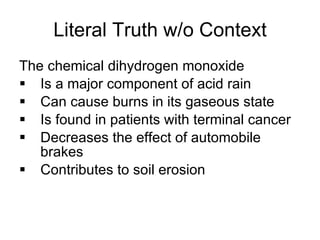
Literal Truth w/o Context The chemical dihydrogen monoxide Is a major component of acid rain Can cause burns in its gaseous state Is found in patients with terminal cancer Decreases the effect of automobile brakes Contributes to soil erosion
Language as social action Pragmatics “ Study of understanding  intentional   human action” (Green, 1989) Intentions Wishes beliefs
Dennet: Mindreading Take the intentional stance. Adopt a theory of mind. Concepts include: Knowledge, beliefs, desires, intentions.
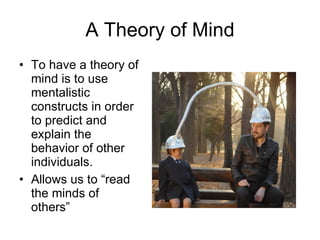
A Theory of Mind To have a theory of mind is to use mentalistic constructs in order to predict and explain the behavior of other individuals. Allows us to “read the minds of others”
Prediction and Explanation Prediction: Knowing someone’s desires makes it easy to anticipate his/her emotions. Explanation: Knowing someone’s intentions is central to properly interpreting his/her behavior.
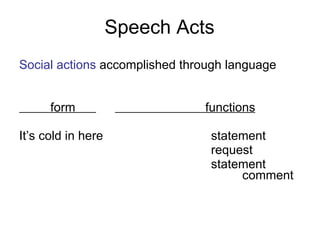
Speech Acts   Social actions  accomplished through language    form    functions   It’s cold in here  statement  request statement   comment
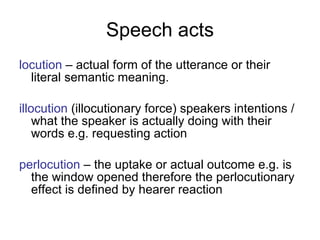
Speech acts locution   – actual form of the utterance or their literal semantic meaning. illocution   (illocutionary force) speakers intentions /what the speaker is actually doing with their words e.g. requesting action perlocution   – the uptake or actual outcome e.g. is the window opened therefore the perlocutionary effect is defined by hearer reaction
Speech Acts How we do things with words (Searle, 1971 Austin, 1975) Social actions accomplished through use of language. Language as  appropriate  behavior. Appropriateness dependent on  context .
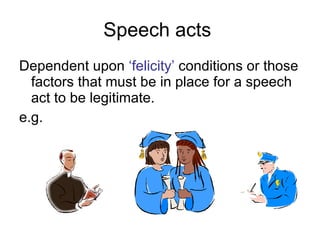
Speech acts  Dependent upon  ‘felicity’  conditions or those factors that must be in place for a speech act to be legitimate. e.g.
Felicity conditions (appropriacy conditions) I’ll buy you an ice-cream tomorrow (for this speech act to be a promise) The speaker has said they will carry out an action at some future date. The speaker intends to do the action. The speaker believes he can do the action. The speaker would not have done the action in the normal course of events.  The speaker believes the hearer wants him to do the action. The speaker intends to be placed under an obligation to do an action. If these felicity conditions are not true then the speech act is not a promise but a “lie”.
Communication requires: An  intention  to communicate some information/ or emotion to another person. An  understanding  that,  the other person should be able to  recognize  that intention. that while the other person may understand the intention they may also have  goals  and  beliefs  that are different to the speaker (theory of mind)
Features of context. Roles and status of participants. Time and place of utterance Environmental conditions Social setting    formal / informal) Subject matter     serious, casual Purpose [goals]     interpersonal   instrumental    identity
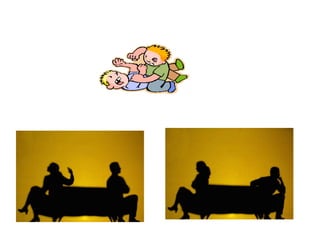
Dichotomy between  words & actions Actions speak louder than words! Sticks and stones may break your bones but words will never hurt you
 
Easier said than done!
While we can study the meaning and structure of language independently we need to look at  pragmatic  meanings in relation to their context and the speaker’s intentions  J:  I just  love  your new hair cut M: ???{does she mean it}
Meaning  Emergent feature of interaction and also dependent on internal context i.e. what happens in the conversation.
Grice Cooperation Principle  = All things being equal there is a basic framework that conversations appear to follow  We can describe this in terms of  Grice’s Maxims
Conversational Implicature Grice suggested that if you analyze conversations there is an implicit formula of participant cooperativity.
Conversational implicature Grice talks about  conversational implicature   –  an inference that unlike  entailments  and  presuppositions  cannot be made from the utterance alone, not linked to actual words
Conversational implicature Conversational  implicature   is dependent on both the context of the utterance and the  shared knowledge  between speaker and hearer.
Grice’s Maxims RELEVANCE  [relation]  Make sure that whatever you say is relevant to the conversation at hand. QUALITY Do not say what you believe to be false. Do not say something for which you do not have adequate evidence.
Grice’s Maxims QUANTITY Make your contribution as informative as is required for the current purposes of the conversation.  Do not make your contribution more informative than necessary. MANNER [CLARITY] Do not make your contribution obscure, ambiguous or difficult to understand. Be brief, be orderly
Speakers regularly  flout  Grice’s maxims to generate  implicatures  (implied meanings) Speakers in our culture are typically less than direct in their interactions Why ?
Violating maxims Violating   – not necessarily deliberate that the speaker has not given enough information or been ambiguous.  e.g. intercultural conversations Flouting  –openly flouting a maxim leads to a deliberately generated conversational implicature. e.g.  To be sarcastic, diplomatic, covering your back
Recap- Pragmatics Study of language use in its social & cultural context. Types of inference Entailment  – directly in the words Pre-supposition  – linked to language Implicature  –implied meaning Speakers  intentions Listeners  interpretations.   (interlocutor = participants in a conversation)

Semantics and pragmatics

  • 1.
    Language in ContextPragmatics, Metaphor and Framing
  • 2.
    Meaning Semantics –meaningderived from linguistic knowledge ( from the words themselves) Pragmatics – aspects of meaning that cannot be predicted by linguistic knowledge alone, relies on social and contextual cues.
  • 3.
    What do wemean by context? All features of a situation that are relevant to how an utterance is produced an understood.
  • 4.
    Context guides meaningA: What’s your stepmother like? B: she’s a woman and she’s married to my father.
  • 5.
  • 6.
    Pragmatic meaning depends on Inference Entailments are directly retrievable from the linguistic form of the utterance Pre-suppositions are closely linked to the words and grammatical structures + our knowledge of the way language is conventionally interpreted.
  • 7.
    Entailment The racewas won in 21.38 seconds Hussein Bolt won the race. Thus H. Bolt can run …….
  • 8.
    Pre-supposition Anti-oxidants helpto fight cancer. Tea contains 10% anti-oxidants Thus tea…
  • 9.
    Pre-supposition Ayla managedto stop in time. Also presupposes : Ayla tried to stop in time Ayla intended to stop in time Ayla had the ability to stop in time Ian forgot to buy the pizza Also presupposes Ian intended to buy pizza Ian ought to have bought pizza Ian had the ability (money) to buy pizza
  • 10.
    Form versus functionCan you take out the trash? Yes I am capable of doing so? Not a question but a request/ command
  • 11.
    ‘ its coldin here’ Semantic meaning = The temperature is below a comfortable level e.g. 75 degrees Pragmatic meanings = Turn the heat up Get me a sweater Shut the window
  • 12.
    Children & meaning.There’s a breeze in my mouth (sucking a mint) I can’t die this spider (stomping on spider) Daddy (when seeing postman)
  • 13.
    Literalness SLP: so you like ice-cream what are your favorite flavours? Child: Hamburger…fish…and chips
  • 14.
    Literalness A fatheris trying to get his 3 year old daughter to stop lifting her dress up and showing her new underwear to the guests Father: we don’t DO that Girl: I KNOW Daddy you don’t wear a dress.
  • 15.
    Literalness A 3year old comes in the front door Mom: wipe your feet please He removes his shoes and socks and carefully wipes his feet on the doormat.
  • 16.
    Literal Truth w/oContext The chemical dihydrogen monoxide Is a major component of acid rain Can cause burns in its gaseous state Is found in patients with terminal cancer Decreases the effect of automobile brakes Contributes to soil erosion
  • 17.
    Language as socialaction Pragmatics “ Study of understanding intentional human action” (Green, 1989) Intentions Wishes beliefs
  • 18.
    Dennet: Mindreading Takethe intentional stance. Adopt a theory of mind. Concepts include: Knowledge, beliefs, desires, intentions.
  • 19.
    A Theory ofMind To have a theory of mind is to use mentalistic constructs in order to predict and explain the behavior of other individuals. Allows us to “read the minds of others”
  • 20.
    Prediction and ExplanationPrediction: Knowing someone’s desires makes it easy to anticipate his/her emotions. Explanation: Knowing someone’s intentions is central to properly interpreting his/her behavior.
  • 21.
    Speech Acts Social actions accomplished through language form functions It’s cold in here statement request statement comment
  • 22.
    Speech acts locution – actual form of the utterance or their literal semantic meaning. illocution (illocutionary force) speakers intentions /what the speaker is actually doing with their words e.g. requesting action perlocution – the uptake or actual outcome e.g. is the window opened therefore the perlocutionary effect is defined by hearer reaction
  • 23.
    Speech Acts Howwe do things with words (Searle, 1971 Austin, 1975) Social actions accomplished through use of language. Language as appropriate behavior. Appropriateness dependent on context .
  • 24.
    Speech acts Dependent upon ‘felicity’ conditions or those factors that must be in place for a speech act to be legitimate. e.g.
  • 25.
    Felicity conditions (appropriacyconditions) I’ll buy you an ice-cream tomorrow (for this speech act to be a promise) The speaker has said they will carry out an action at some future date. The speaker intends to do the action. The speaker believes he can do the action. The speaker would not have done the action in the normal course of events. The speaker believes the hearer wants him to do the action. The speaker intends to be placed under an obligation to do an action. If these felicity conditions are not true then the speech act is not a promise but a “lie”.
  • 26.
    Communication requires: An intention to communicate some information/ or emotion to another person. An understanding that, the other person should be able to recognize that intention. that while the other person may understand the intention they may also have goals and beliefs that are different to the speaker (theory of mind)
  • 27.
    Features of context.Roles and status of participants. Time and place of utterance Environmental conditions Social setting  formal / informal) Subject matter  serious, casual Purpose [goals]  interpersonal instrumental identity
  • 28.
    Dichotomy between words & actions Actions speak louder than words! Sticks and stones may break your bones but words will never hurt you
  • 29.
  • 30.
  • 31.
    While we canstudy the meaning and structure of language independently we need to look at pragmatic meanings in relation to their context and the speaker’s intentions J: I just love your new hair cut M: ???{does she mean it}
  • 32.
    Meaning Emergentfeature of interaction and also dependent on internal context i.e. what happens in the conversation.
  • 33.
    Grice Cooperation Principle = All things being equal there is a basic framework that conversations appear to follow We can describe this in terms of Grice’s Maxims
  • 34.
    Conversational Implicature Gricesuggested that if you analyze conversations there is an implicit formula of participant cooperativity.
  • 35.
    Conversational implicature Gricetalks about conversational implicature – an inference that unlike entailments and presuppositions cannot be made from the utterance alone, not linked to actual words
  • 36.
    Conversational implicature Conversational implicature is dependent on both the context of the utterance and the shared knowledge between speaker and hearer.
  • 37.
    Grice’s Maxims RELEVANCE [relation] Make sure that whatever you say is relevant to the conversation at hand. QUALITY Do not say what you believe to be false. Do not say something for which you do not have adequate evidence.
  • 38.
    Grice’s Maxims QUANTITYMake your contribution as informative as is required for the current purposes of the conversation. Do not make your contribution more informative than necessary. MANNER [CLARITY] Do not make your contribution obscure, ambiguous or difficult to understand. Be brief, be orderly
  • 39.
    Speakers regularly flout Grice’s maxims to generate implicatures (implied meanings) Speakers in our culture are typically less than direct in their interactions Why ?
  • 40.
    Violating maxims Violating – not necessarily deliberate that the speaker has not given enough information or been ambiguous. e.g. intercultural conversations Flouting –openly flouting a maxim leads to a deliberately generated conversational implicature. e.g. To be sarcastic, diplomatic, covering your back
  • 41.
    Recap- Pragmatics Studyof language use in its social & cultural context. Types of inference Entailment – directly in the words Pre-supposition – linked to language Implicature –implied meaning Speakers intentions Listeners interpretations. (interlocutor = participants in a conversation)