Pragmatic 
Submitted To: Dr. Iqbal Butt 
Submitted By: Kosar Parveen 
& Muhammad Sajjad Raja 
NCBA & E Gujrat Campus
What is pragmatics? 
• "We human beings are odd compared with our 
nearest animal relatives. Unlike them, we can say 
what we 
• want, when we want. All normal humans can 
produce and understand any number of new words 
and 
• sentences. Humans use the multiple options of 
language often without thinking. But blindly, they 
sometimes 
• fall into its traps. They are like spiders who exploit 
their webs, but themselves get caught in the sticky 
• strands"
Definition 
Jean Aitchison: 
• Pragmatics studies the factors that govern our 
choice of language in social interaction and the 
effects of our choice on others. 
• Systematic study of meaning by virtue of the use of 
language. 
• Central topics are implicature, presupposition, 
speech acts, deixis.
A brief history of pragmatics 
• Origin goes back to the philosophy of language 
around the 1930’s : Charles Morris, Rudolph 
Carnap, Charles Peirce. 
• Peirce divided semiotics into syntax (study of 
formal relation of signs to each other) semantics 
(relation of signs to what they denote) and 
pragmatics (relation of signs to their users and 
interpreters). Carnap arranges them by their level of 
abstractness; he says syntax is the most abstract 
followed by semantics and pragmatics at the end.
Conti……. 
• In the 1950s the school of ideal language 
philosophy was concerned with the study of logical 
systems of artificial/formal language which resulted 
in the development of nowadays formal semantics. 
Another school of thought was the ordinary 
language school. It argued to concentrate on the 
natural language, for example Austin’s theory of 
speech acts or Grice’s conversational implicature 
was set in this environment.
Conti……. 
• about 20 years later, the late 1960s and early 
1970’s, Noam Chomsky’s followers spoke up 
against an abstract language view and achieved with 
their campaign the emptying of the“pragmatic 
wastebasket” as Yeoshua Bar-Hillel put it. 
Concretely this meant that a lot of research was 
done in the 1970s by linguists to get order into the 
linguistic theories.
Why pragmatics? 
• Just taking a sentence in a literally way won’t give 
us all the facts of meaning it has, the proposition 
which is made by uttering a sentence is to be seen 
in context with for example physical behavior, 
background assumptions, real-world knowledge 
and other factors. Pragmatics wants to fill up the 
gap between a sentence and its entire meaning.
The scope of pragmatics 
Morris (1938) divides linguistics into three provinces: 
• –syntax or the study of the relation between signs and 
other signs 
• –semantics or the study of signs to their referents 
• –pragmatics or the study of the relations of signs to 
interpreters. 
• the investigation of speech acts, 
• Investigating meaning entails three fundamental ways of 
viewing the relationship between language and reality: 
• Truth-conditional semantics focuses on sentence 
meaning, and its purpose is to analyze sentence meaning 
in the light of formal rigour and logical plausibility by 
assigning truth conditions to sentence meaning in 
compliance with ongoing states-of-affairs.
Conti……. 
• Nevertheless, the analysis of the structure of the 
sentence and the encoded lexical content in terms 
of truth-conditions, needs supplementing by 
inferring information about meaning supplied by 
other sources (Chapman 2000). 
• As Capone (2005) points out, language is both ‘an 
instrument of thought’ and ‘an instrument of 
social action’
The utterance 
• The utterance is the real, physically graspable unit of 
meaning that carries some informative contribution 
through 
• the words used, 
• the structure, 
• Its location in the conversation setting, 
• The additional senses it triggers with in that 
particular context. 
• The immersion in the overall system of gestures and 
other ways of conveying meaning.
Conti……. 
• The most important of these sources is the context 
of utterance (the background knowledge of the 
interlocutors, information conveyed in other parts of 
the conversation or written text, as well as the 
baggage of world experience of interlocutors).
Grice 
• In analyzing meaning in actual communicative situations, 
the key notions to be looked into are speaker’s 
meaning and intention and recovery of speaker’s 
meaning and intentions by the addressee. 
• Grice defines this meaning by resorting to speaker’s 
intentions and the reflexive nature of those intentions, 
namely their need to be recognized as such by the 
addressee. Speaker’s REFLEXIVE INTENTION toward 
Hearer is the intention to have the Hearer recognize that 
when making an utterance in a specific context, 
Speaker intends their utterance to have a certain 
effect on the Hearer
Conti……. 
• In his definition of non-natural or conventional 
meaning, Grice insists on the crucial role played by 
intentionality: “A meant something by x’ is 
roughly equivalent to <A uttered x with the 
intention of inducing a belief by means of the 
recognition of this intention
Speech Acts 
• The use-centred, social-interactionist view on 
language discusses linguistic phenomena in terms 
of Speech Acts 
• As social actions, Speech Acts involve acts of 
speaking or writing when someone (the Speaker) 
says (or writes) something to someone else (the 
Hearer) at a specific time in a specific place. 
• Engaging in any SA is underlain by the assumption 
that the Speaker intends to communicate with the 
Hearer.
Intensions 
• There are numberless effects that speakers might 
attempt to produce, e.g. 
• Persuading the Hearer, intimidating the Hearer, 
warning the Hearer of danger, getting the Hearer to 
do something by means of a suggestion, a hint, a 
request, or a command. 
• The Speaker adjusts his/her utterance to suit the 
Hearer, taking into account the context, the 
assumed shared background knowledge and whats 
he knows or supposes about the Hearer’s ability to 
understand the messages he wants to convey.
Direct addressee 
• A distinction needs to be made between Hearer as 
‘direct addressee’, and Hearer as ‘ratified 
participant’ (Goffman 1981: 131). 
• An Addressee is someone who cannot reject the role of 
Hearer without serious affront to Speaker. 
• Direct address is determined contextually - by direction 
of gaze, pointing a finger, touching an arm, using a 
name, In the first example below, there is a change of 
addressee, while in example 2 there is a non-specific 
addressee. 
• (1) ‘Boss, I can’t tell you how much effort Mark has 
put into this project, haven’t you, Mark?’ 
• (2) ‘Congratulations to whoever is going to be the 
lucky winner of this contest!’
Ratified participant 
• A ratified participant can more easily reject the 
Hearer role than an addressee and with less 
potential affront to the Speaker. 
When the Speaker is speaking, all those who can 
reasonably consider themselves ratified participants 
are expected to cooperate in the unfolding of the 
conversation and appropriately have their own say. 
• Typical examples might include round tables, chat-rooms 
or workshops
Over hearer 
• An over hearer may be any other person hearing an 
utterance, be they a bystander or an eavesdropper. 
• An Eavesdropper can only admit to listening at the 
risk of putting themselves in an unfavorable light 
and potentially affronting the Speaker. People in 
earshot are expected to overhear, though not 
necessarily to listen; only hearers are properly 
expected to listen.
Conti……. 
• The Speaker has a reflexive intention towards the 
Hearer but not towards an over hearer. 
• An over hearer may understand the message the 
same way the Hearer does because they share some 
background knowledge; but for want of appropriate 
contextual information relevant to the correct 
interpretation of the utterance's ,he may 
misinterpret it.
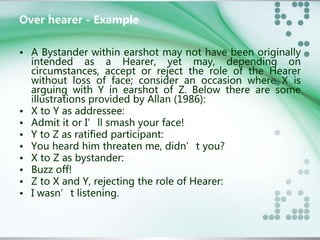
Over hearer - Example 
• A Bystander within earshot may not have been originally 
intended as a Hearer, yet may, depending on 
circumstances, accept or reject the role of the Hearer 
without loss of face; consider an occasion where X is 
arguing with Y in earshot of Z. Below there are some 
illustrations provided by Allan (1986): 
• X to Y as addressee: 
• Admit it or I’ll smash your face! 
• Y to Z as ratified participant: 
• You heard him threaten me, didn’t you? 
• X to Z as bystander: 
• Buzz off! 
• Z to X and Y, rejecting the role of Hearer: 
• I wasn’t listening.
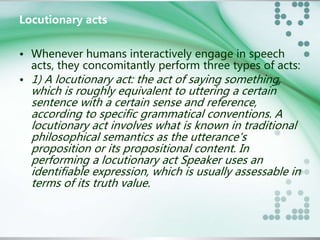
Locutionary acts 
• Whenever humans interactively engage in speech 
acts, they concomitantly perform three types of acts: 
• 1) A locutionary act: the act of saying something, 
which is roughly equivalent to uttering a certain 
sentence with a certain sense and reference, 
according to specific grammatical conventions. A 
locutionary act involves what is known in traditional 
philosophical semantics as the utterance's 
proposition or its propositional content. In 
performing a locutionary act Speaker uses an 
identifiable expression, which is usually assessable in 
terms of its truth value.
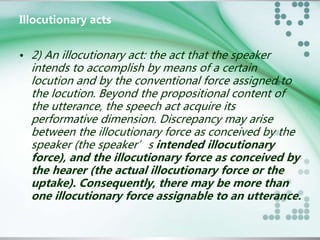
Illocutionary acts 
• 2) An illocutionary act: the act that the speaker 
intends to accomplish by means of a certain 
locution and by the conventional force assigned to 
the locution. Beyond the propositional content of 
the utterance, the speech act acquire its 
performative dimension. Discrepancy may arise 
between the illocutionary force as conceived by the 
speaker (the speaker’s intended illocutionary 
force), and the illocutionary force as conceived by 
the hearer (the actual illocutionary force or the 
uptake). Consequently, there may be more than 
one illocutionary force assignable to an utterance.
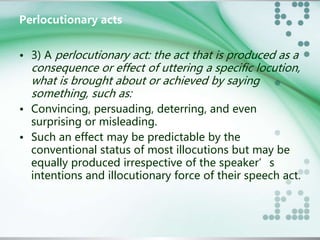
Perlocutionary acts 
• 3) A perlocutionary act: the act that is produced as a 
consequence or effect of uttering a specific locution, 
what is brought about or achieved by saying 
something, such as: 
• Convincing, persuading, deterring, and even 
surprising or misleading. 
• Such an effect may be predictable by the 
conventional status of most illocutions but may be 
equally produced irrespective of the speaker’s 
intentions and illocutionary force of their speech act.
Illocutionary act - examples 
• The most significant constituent of a speech act is, 
undeniably, the illocutionary act. (Austin 1962), 
because the illocution signals what the Speaker 
DOES in uttering that particular utterance to the 
Hearer in a specific context, namely: 
• States a fact or an opinion 
• (3) ‘IQ tests can be tricky’ 
• •confirms or denies something 
• (4) ‘It’s not true that Michael Jackson is a 
paedophiliac’
Illocutionary act - examples 
• makes a prediction 
• (5) ‘It’ll be a stormy week’ 
• a promise 
• (6) ‘I’ll join you at the country club’ 
• a request 
• (7) ‘Could I use your phone, please?’ 
• offers thanks 
• (8) ‘Thank you all for being here tonight on this very 
special occasion’
Illocutionary act - examples 
• makes an invitation 
• (9) ‘Can we do lunch sometime next week?’ 
• issues an order 
• (10) ‘Get out of my face!’ 
• gives advice or permission 
• (11) ‘You may be excused’ 
• christens a child 
• (12) ‘I baptize this child James’ 
• names a ship 
• (13) ‘I name this ship Hibernia’ 
• swears an oath 
• (14) ‘I swear loyalty to my master and commander
Illocutionary act - examples 
• In producing utterance a specific utterance, the 
Speaker performs an illocutionary act whenever that 
utterance has the illocutionary force of a statement, 
a confirmation, a denial, a prediction, a promise, a 
request, and so forth. Thus, 
• (15) ‘I’ll make some coffee’ 
• May have the illocutionary force of a statement 
about a future act but it usually counts as a promise. 
If this is the recognized intention of the Speaker, 
then that promise is the illocutionary point of the 
utterance.
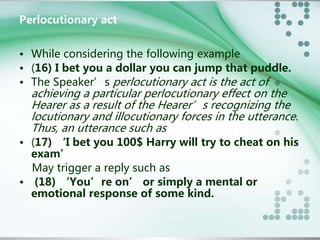
Perlocutionary act 
• While considering the following example 
• (16) I bet you a dollar you can jump that puddle. 
• The Speaker’s perlocutionary act is the act of 
achieving a particular perlocutionary effect on the 
Hearer as a result of the Hearer’s recognizing the 
locutionary and illocutionary forces in the utterance. 
Thus, an utterance such as 
• (17) ‘I bet you 100$ Harry will try to cheat on his 
exam’ 
May trigger a reply such as 
• (18) ‘You’re on’ or simply a mental or 
emotional response of some kind.
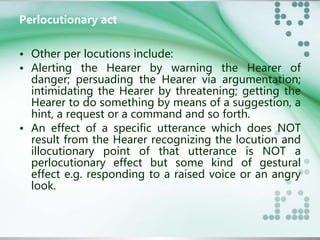
Perlocutionary act 
• Other per locutions include: 
• Alerting the Hearer by warning the Hearer of 
danger; persuading the Hearer via argumentation; 
intimidating the Hearer by threatening; getting the 
Hearer to do something by means of a suggestion, a 
hint, a request or a command and so forth. 
• An effect of a specific utterance which does NOT 
result from the Hearer recognizing the locution and 
illocutionary point of that utterance is NOT a 
perlocutionary effect but some kind of gestural 
effect e.g. responding to a raised voice or an angry 
look.
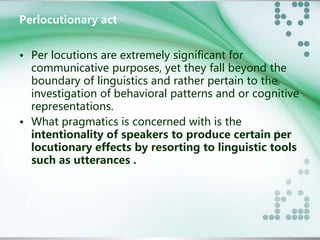
Perlocutionary act 
• Per locutions are extremely significant for 
communicative purposes, yet they fall beyond the 
boundary of linguistics and rather pertain to the 
investigation of behavioral patterns and or cognitive 
representations. 
• What pragmatics is concerned with is the 
intentionality of speakers to produce certain per 
locutionary effects by resorting to linguistic tools 
such as utterances .
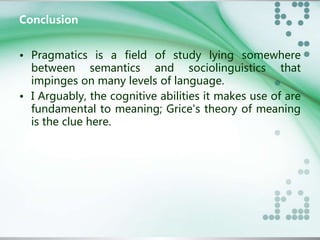
Conclusion 
• Pragmatics is a field of study lying somewhere 
between semantics and sociolinguistics that 
impinges on many levels of language. 
• I Arguably, the cognitive abilities it makes use of are 
fundamental to meaning; Grice's theory of meaning 
is the clue here.
What is pragmatics ppt final

What is pragmatics ppt final

  • 1.
    Pragmatic Submitted To:Dr. Iqbal Butt Submitted By: Kosar Parveen & Muhammad Sajjad Raja NCBA & E Gujrat Campus
  • 2.
    What is pragmatics? • "We human beings are odd compared with our nearest animal relatives. Unlike them, we can say what we • want, when we want. All normal humans can produce and understand any number of new words and • sentences. Humans use the multiple options of language often without thinking. But blindly, they sometimes • fall into its traps. They are like spiders who exploit their webs, but themselves get caught in the sticky • strands"
  • 3.
    Definition Jean Aitchison: • Pragmatics studies the factors that govern our choice of language in social interaction and the effects of our choice on others. • Systematic study of meaning by virtue of the use of language. • Central topics are implicature, presupposition, speech acts, deixis.
  • 4.
    A brief historyof pragmatics • Origin goes back to the philosophy of language around the 1930’s : Charles Morris, Rudolph Carnap, Charles Peirce. • Peirce divided semiotics into syntax (study of formal relation of signs to each other) semantics (relation of signs to what they denote) and pragmatics (relation of signs to their users and interpreters). Carnap arranges them by their level of abstractness; he says syntax is the most abstract followed by semantics and pragmatics at the end.
  • 5.
    Conti……. • Inthe 1950s the school of ideal language philosophy was concerned with the study of logical systems of artificial/formal language which resulted in the development of nowadays formal semantics. Another school of thought was the ordinary language school. It argued to concentrate on the natural language, for example Austin’s theory of speech acts or Grice’s conversational implicature was set in this environment.
  • 6.
    Conti……. • about20 years later, the late 1960s and early 1970’s, Noam Chomsky’s followers spoke up against an abstract language view and achieved with their campaign the emptying of the“pragmatic wastebasket” as Yeoshua Bar-Hillel put it. Concretely this meant that a lot of research was done in the 1970s by linguists to get order into the linguistic theories.
  • 7.
    Why pragmatics? •Just taking a sentence in a literally way won’t give us all the facts of meaning it has, the proposition which is made by uttering a sentence is to be seen in context with for example physical behavior, background assumptions, real-world knowledge and other factors. Pragmatics wants to fill up the gap between a sentence and its entire meaning.
  • 8.
    The scope ofpragmatics Morris (1938) divides linguistics into three provinces: • –syntax or the study of the relation between signs and other signs • –semantics or the study of signs to their referents • –pragmatics or the study of the relations of signs to interpreters. • the investigation of speech acts, • Investigating meaning entails three fundamental ways of viewing the relationship between language and reality: • Truth-conditional semantics focuses on sentence meaning, and its purpose is to analyze sentence meaning in the light of formal rigour and logical plausibility by assigning truth conditions to sentence meaning in compliance with ongoing states-of-affairs.
  • 9.
    Conti……. • Nevertheless,the analysis of the structure of the sentence and the encoded lexical content in terms of truth-conditions, needs supplementing by inferring information about meaning supplied by other sources (Chapman 2000). • As Capone (2005) points out, language is both ‘an instrument of thought’ and ‘an instrument of social action’
  • 10.
    The utterance •The utterance is the real, physically graspable unit of meaning that carries some informative contribution through • the words used, • the structure, • Its location in the conversation setting, • The additional senses it triggers with in that particular context. • The immersion in the overall system of gestures and other ways of conveying meaning.
  • 11.
    Conti……. • Themost important of these sources is the context of utterance (the background knowledge of the interlocutors, information conveyed in other parts of the conversation or written text, as well as the baggage of world experience of interlocutors).
  • 12.
    Grice • Inanalyzing meaning in actual communicative situations, the key notions to be looked into are speaker’s meaning and intention and recovery of speaker’s meaning and intentions by the addressee. • Grice defines this meaning by resorting to speaker’s intentions and the reflexive nature of those intentions, namely their need to be recognized as such by the addressee. Speaker’s REFLEXIVE INTENTION toward Hearer is the intention to have the Hearer recognize that when making an utterance in a specific context, Speaker intends their utterance to have a certain effect on the Hearer
  • 13.
    Conti……. • Inhis definition of non-natural or conventional meaning, Grice insists on the crucial role played by intentionality: “A meant something by x’ is roughly equivalent to <A uttered x with the intention of inducing a belief by means of the recognition of this intention
  • 14.
    Speech Acts •The use-centred, social-interactionist view on language discusses linguistic phenomena in terms of Speech Acts • As social actions, Speech Acts involve acts of speaking or writing when someone (the Speaker) says (or writes) something to someone else (the Hearer) at a specific time in a specific place. • Engaging in any SA is underlain by the assumption that the Speaker intends to communicate with the Hearer.
  • 15.
    Intensions • Thereare numberless effects that speakers might attempt to produce, e.g. • Persuading the Hearer, intimidating the Hearer, warning the Hearer of danger, getting the Hearer to do something by means of a suggestion, a hint, a request, or a command. • The Speaker adjusts his/her utterance to suit the Hearer, taking into account the context, the assumed shared background knowledge and whats he knows or supposes about the Hearer’s ability to understand the messages he wants to convey.
  • 16.
    Direct addressee •A distinction needs to be made between Hearer as ‘direct addressee’, and Hearer as ‘ratified participant’ (Goffman 1981: 131). • An Addressee is someone who cannot reject the role of Hearer without serious affront to Speaker. • Direct address is determined contextually - by direction of gaze, pointing a finger, touching an arm, using a name, In the first example below, there is a change of addressee, while in example 2 there is a non-specific addressee. • (1) ‘Boss, I can’t tell you how much effort Mark has put into this project, haven’t you, Mark?’ • (2) ‘Congratulations to whoever is going to be the lucky winner of this contest!’
  • 17.
    Ratified participant •A ratified participant can more easily reject the Hearer role than an addressee and with less potential affront to the Speaker. When the Speaker is speaking, all those who can reasonably consider themselves ratified participants are expected to cooperate in the unfolding of the conversation and appropriately have their own say. • Typical examples might include round tables, chat-rooms or workshops
  • 18.
    Over hearer •An over hearer may be any other person hearing an utterance, be they a bystander or an eavesdropper. • An Eavesdropper can only admit to listening at the risk of putting themselves in an unfavorable light and potentially affronting the Speaker. People in earshot are expected to overhear, though not necessarily to listen; only hearers are properly expected to listen.
  • 19.
    Conti……. • TheSpeaker has a reflexive intention towards the Hearer but not towards an over hearer. • An over hearer may understand the message the same way the Hearer does because they share some background knowledge; but for want of appropriate contextual information relevant to the correct interpretation of the utterance's ,he may misinterpret it.
  • 20.
    Over hearer -Example • A Bystander within earshot may not have been originally intended as a Hearer, yet may, depending on circumstances, accept or reject the role of the Hearer without loss of face; consider an occasion where X is arguing with Y in earshot of Z. Below there are some illustrations provided by Allan (1986): • X to Y as addressee: • Admit it or I’ll smash your face! • Y to Z as ratified participant: • You heard him threaten me, didn’t you? • X to Z as bystander: • Buzz off! • Z to X and Y, rejecting the role of Hearer: • I wasn’t listening.
  • 21.
    Locutionary acts •Whenever humans interactively engage in speech acts, they concomitantly perform three types of acts: • 1) A locutionary act: the act of saying something, which is roughly equivalent to uttering a certain sentence with a certain sense and reference, according to specific grammatical conventions. A locutionary act involves what is known in traditional philosophical semantics as the utterance's proposition or its propositional content. In performing a locutionary act Speaker uses an identifiable expression, which is usually assessable in terms of its truth value.
  • 22.
    Illocutionary acts •2) An illocutionary act: the act that the speaker intends to accomplish by means of a certain locution and by the conventional force assigned to the locution. Beyond the propositional content of the utterance, the speech act acquire its performative dimension. Discrepancy may arise between the illocutionary force as conceived by the speaker (the speaker’s intended illocutionary force), and the illocutionary force as conceived by the hearer (the actual illocutionary force or the uptake). Consequently, there may be more than one illocutionary force assignable to an utterance.
  • 23.
    Perlocutionary acts •3) A perlocutionary act: the act that is produced as a consequence or effect of uttering a specific locution, what is brought about or achieved by saying something, such as: • Convincing, persuading, deterring, and even surprising or misleading. • Such an effect may be predictable by the conventional status of most illocutions but may be equally produced irrespective of the speaker’s intentions and illocutionary force of their speech act.
  • 24.
    Illocutionary act -examples • The most significant constituent of a speech act is, undeniably, the illocutionary act. (Austin 1962), because the illocution signals what the Speaker DOES in uttering that particular utterance to the Hearer in a specific context, namely: • States a fact or an opinion • (3) ‘IQ tests can be tricky’ • •confirms or denies something • (4) ‘It’s not true that Michael Jackson is a paedophiliac’
  • 25.
    Illocutionary act -examples • makes a prediction • (5) ‘It’ll be a stormy week’ • a promise • (6) ‘I’ll join you at the country club’ • a request • (7) ‘Could I use your phone, please?’ • offers thanks • (8) ‘Thank you all for being here tonight on this very special occasion’
  • 26.
    Illocutionary act -examples • makes an invitation • (9) ‘Can we do lunch sometime next week?’ • issues an order • (10) ‘Get out of my face!’ • gives advice or permission • (11) ‘You may be excused’ • christens a child • (12) ‘I baptize this child James’ • names a ship • (13) ‘I name this ship Hibernia’ • swears an oath • (14) ‘I swear loyalty to my master and commander
  • 27.
    Illocutionary act -examples • In producing utterance a specific utterance, the Speaker performs an illocutionary act whenever that utterance has the illocutionary force of a statement, a confirmation, a denial, a prediction, a promise, a request, and so forth. Thus, • (15) ‘I’ll make some coffee’ • May have the illocutionary force of a statement about a future act but it usually counts as a promise. If this is the recognized intention of the Speaker, then that promise is the illocutionary point of the utterance.
  • 28.
    Perlocutionary act •While considering the following example • (16) I bet you a dollar you can jump that puddle. • The Speaker’s perlocutionary act is the act of achieving a particular perlocutionary effect on the Hearer as a result of the Hearer’s recognizing the locutionary and illocutionary forces in the utterance. Thus, an utterance such as • (17) ‘I bet you 100$ Harry will try to cheat on his exam’ May trigger a reply such as • (18) ‘You’re on’ or simply a mental or emotional response of some kind.
  • 29.
    Perlocutionary act •Other per locutions include: • Alerting the Hearer by warning the Hearer of danger; persuading the Hearer via argumentation; intimidating the Hearer by threatening; getting the Hearer to do something by means of a suggestion, a hint, a request or a command and so forth. • An effect of a specific utterance which does NOT result from the Hearer recognizing the locution and illocutionary point of that utterance is NOT a perlocutionary effect but some kind of gestural effect e.g. responding to a raised voice or an angry look.
  • 30.
    Perlocutionary act •Per locutions are extremely significant for communicative purposes, yet they fall beyond the boundary of linguistics and rather pertain to the investigation of behavioral patterns and or cognitive representations. • What pragmatics is concerned with is the intentionality of speakers to produce certain per locutionary effects by resorting to linguistic tools such as utterances .
  • 31.
    Conclusion • Pragmaticsis a field of study lying somewhere between semantics and sociolinguistics that impinges on many levels of language. • I Arguably, the cognitive abilities it makes use of are fundamental to meaning; Grice's theory of meaning is the clue here.