NAWAB SHAH ALAM KHAN COLLEGE OF
ENGINEERING AND TECHNOLOGY
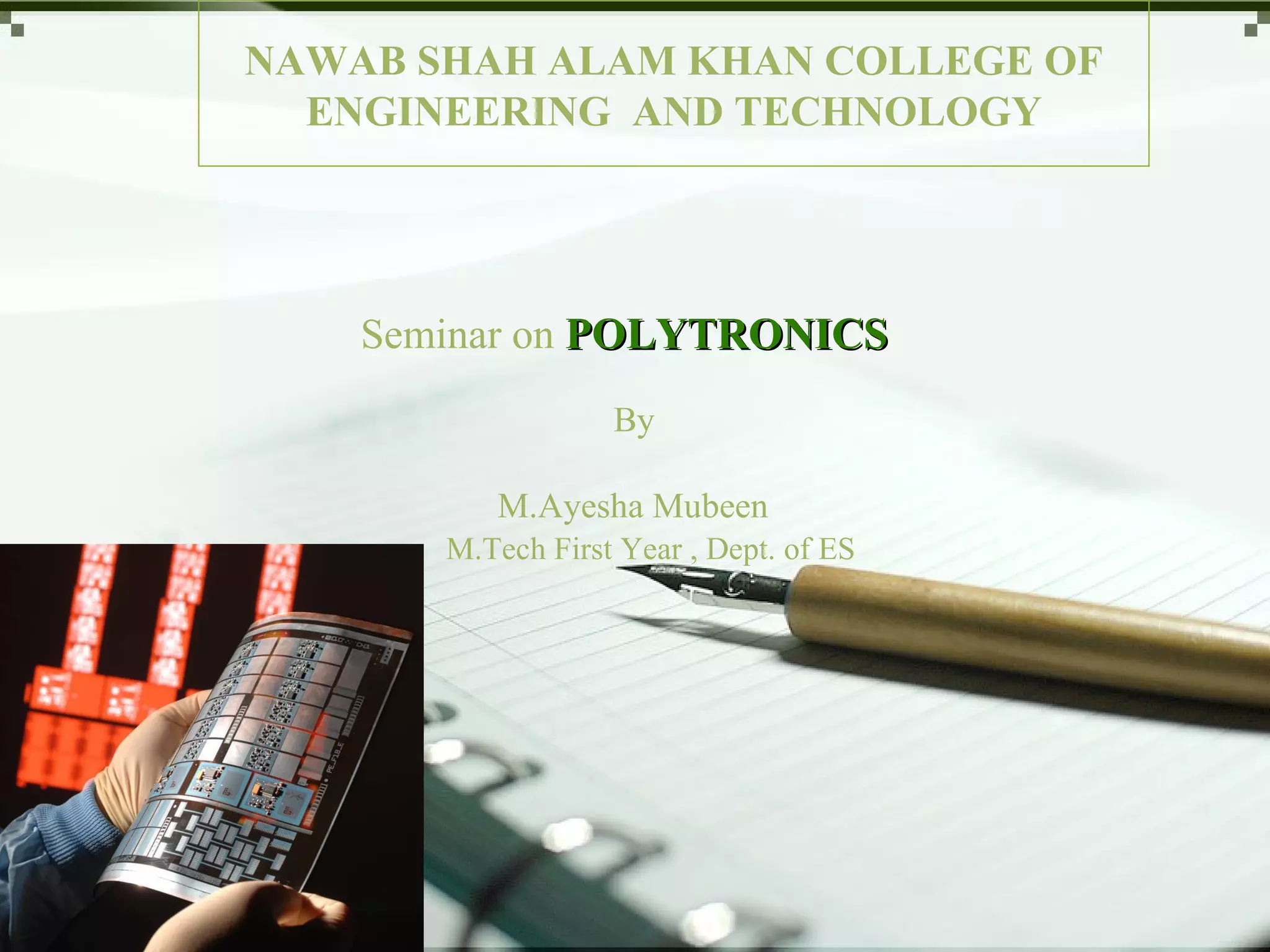
Seminar on POLYTRONICSPOLYTRONICS
By
M.Ayesha Mubeen
M.Tech First Year , Dept. of ES
CONTENTSCONTENTS
 Introduction…
 What is polytronics…..
 Need of polytronics…
 What is a polymer…..
 History of polytronics….
 How does a polymer conducts ….
 Applications….
 Example…
 Advantages….
 Conclusion….
 References…….
 With the invention…transistors …early half of the nineteenth century,
the field of electronics…innumerable changes…tremendous impact on
the life of the common man. Be it education, entertainment or
healthcare, there is possibly no field where electronics has not made an
impact.
 The entire concept of electronics is based…study of materials called
semi-conductors.
 Silicon is one such material…widely used…manufacture of electronic
circuits.
 However the use of silicon has various disadvantages…led researchers
and scientists all over the world…look for other alternatives.
 For long, it was believed plastics were materials with poor
conductivity.
 Researchers…proved that when plastics are combined with other
substances in proper chemical compositions they can behave as good
conductors of electricity.
INTRODUCTIONINTRODUCTION
WHAT IS POLYTRONICSWHAT IS POLYTRONICS ??
Polymer electronics
Influence of plastic in electronics
 All-new field in which plastics or ‘conjugated polymers’ are
exclusively used in the manufacture of electronic products.
 Emerging technology…focuses…development of electronic devices
incorporating ..electrically conductive and semi conductive organic
materials, especially organic polymers.
 Offers the prospect…advanced electronics platform using new
materials, processes & electronic devices.
NEED OF POLYTRONICS…NEED OF POLYTRONICS…
The widespread use of silicon…electronic goods…large number of
disadvantages some are,
 Production of silicon embedded circuits involves a huge investment.
 These circuits also consume more power.
 Moreover since silicon chips are not flexible, the products,
which..use, are not easily portable.
By using polytronics these limitations can overcome.
 Polytronic devices…manufactured at a fraction of the cost involved in
making conventional chips.
 Also Polytronics seems to be the best answer to the growing menace of
electronic wastes.
WhyWhy
WhenWhen
HowHow
WHAT IS A POLYMERWHAT IS A POLYMER
 (poly- ’many’) + (mer- ’parts’)
 Large molecule/macromolecule, composed…many repeated subunits.
 Because…broad range of properties both synthetic & natural polymers
play an essential and ubiquitous role…everyday life.
 Formed because…double and triple bonds between monomer to form a
rigid structure and unique chemical & physical characteristics.
 Organic polymers…chains of carbon atoms combined with hydrogen
atoms.
 It is a conjugated chain comprise…alternating single and double bonds
between the carbon atoms.
HISTORYHISTORY
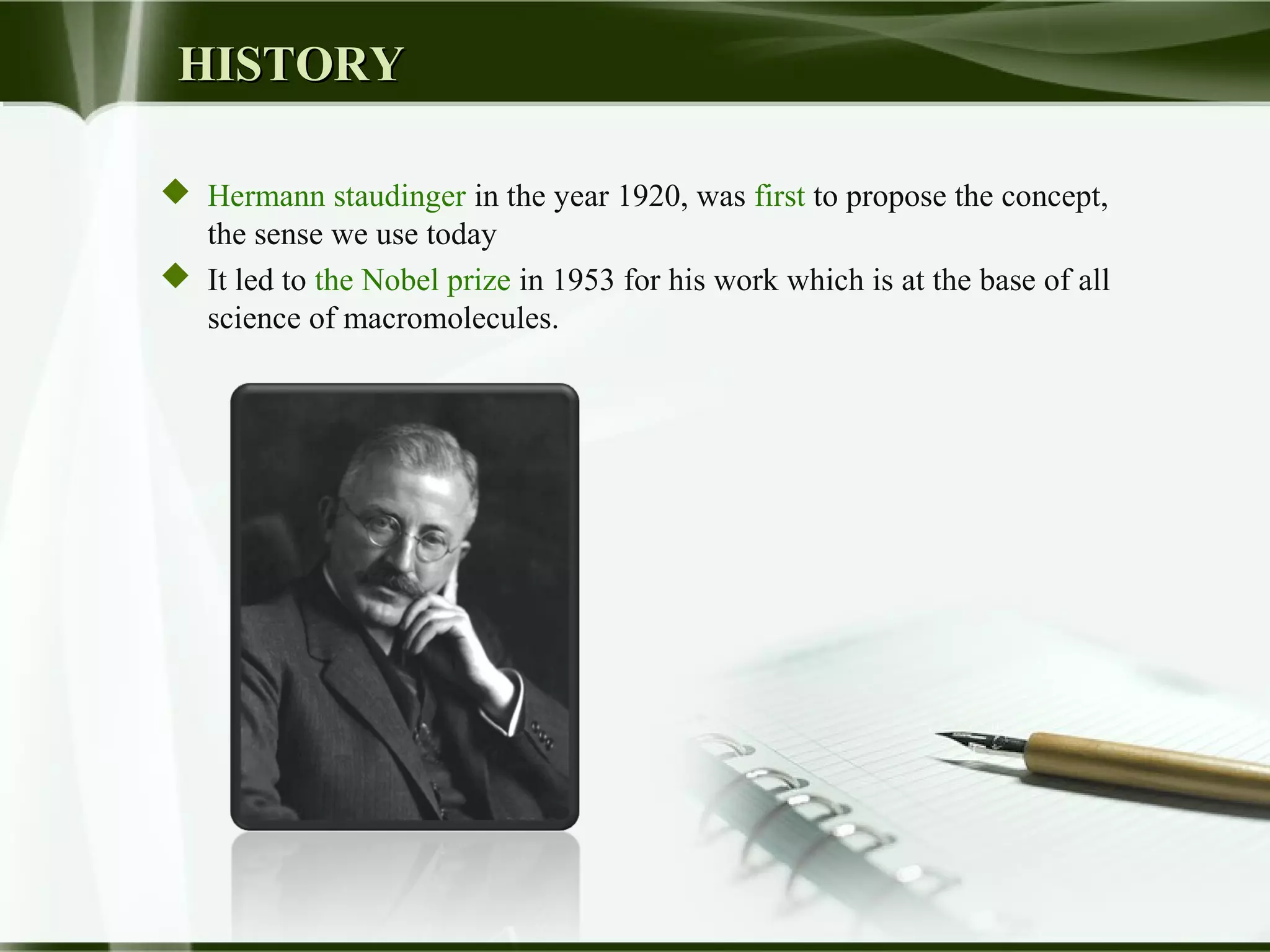
 Hermann staudinger in the year 1920, was first to propose the concept,
the sense we use today
 It led to the Nobel prize in 1953 for his work which is at the base of all
science of macromolecules.
HOW DOES A POLYMER CONDUCTHOW DOES A POLYMER CONDUCT
 By simply obeying ohm’s law.
 Ohm’s law define conductivity in polymers & ceramics as Free flow of ions/e-s
.
……WorkingWorking
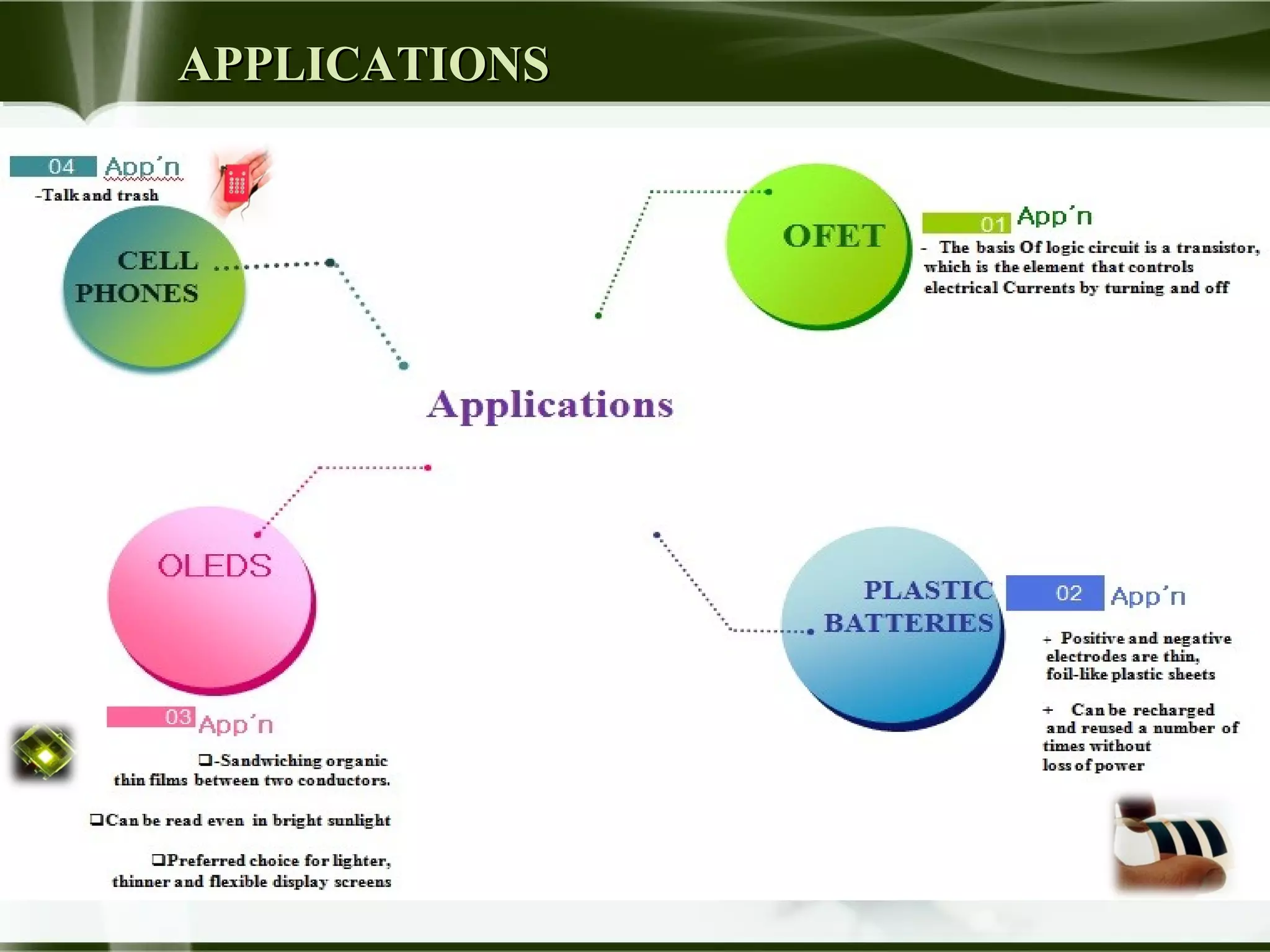
APPLICATIONSAPPLICATIONS
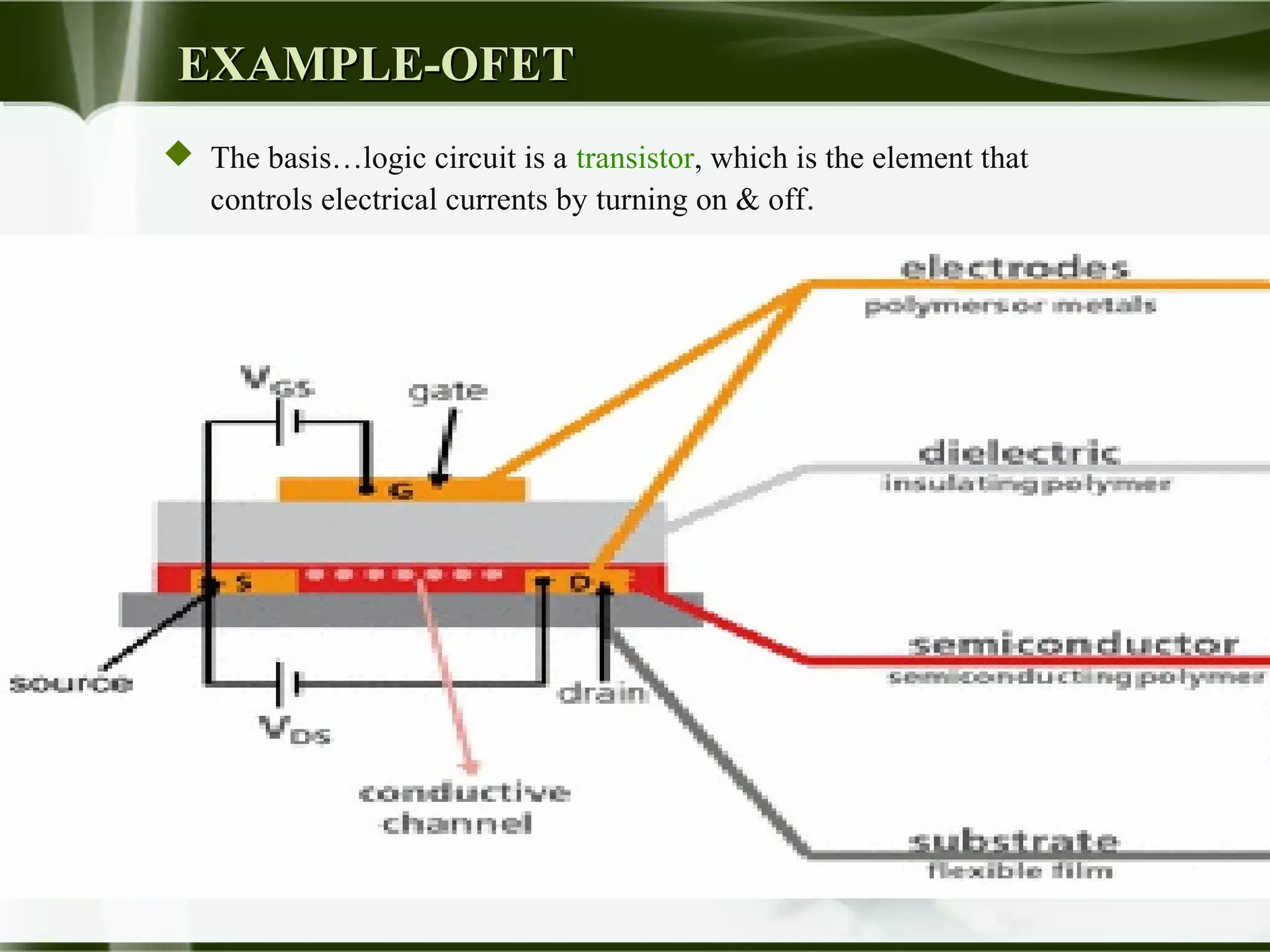
EXAMPLE-OFETEXAMPLE-OFET
 The basis…logic circuit is a transistor, which is the element that
controls electrical currents by turning on & off.
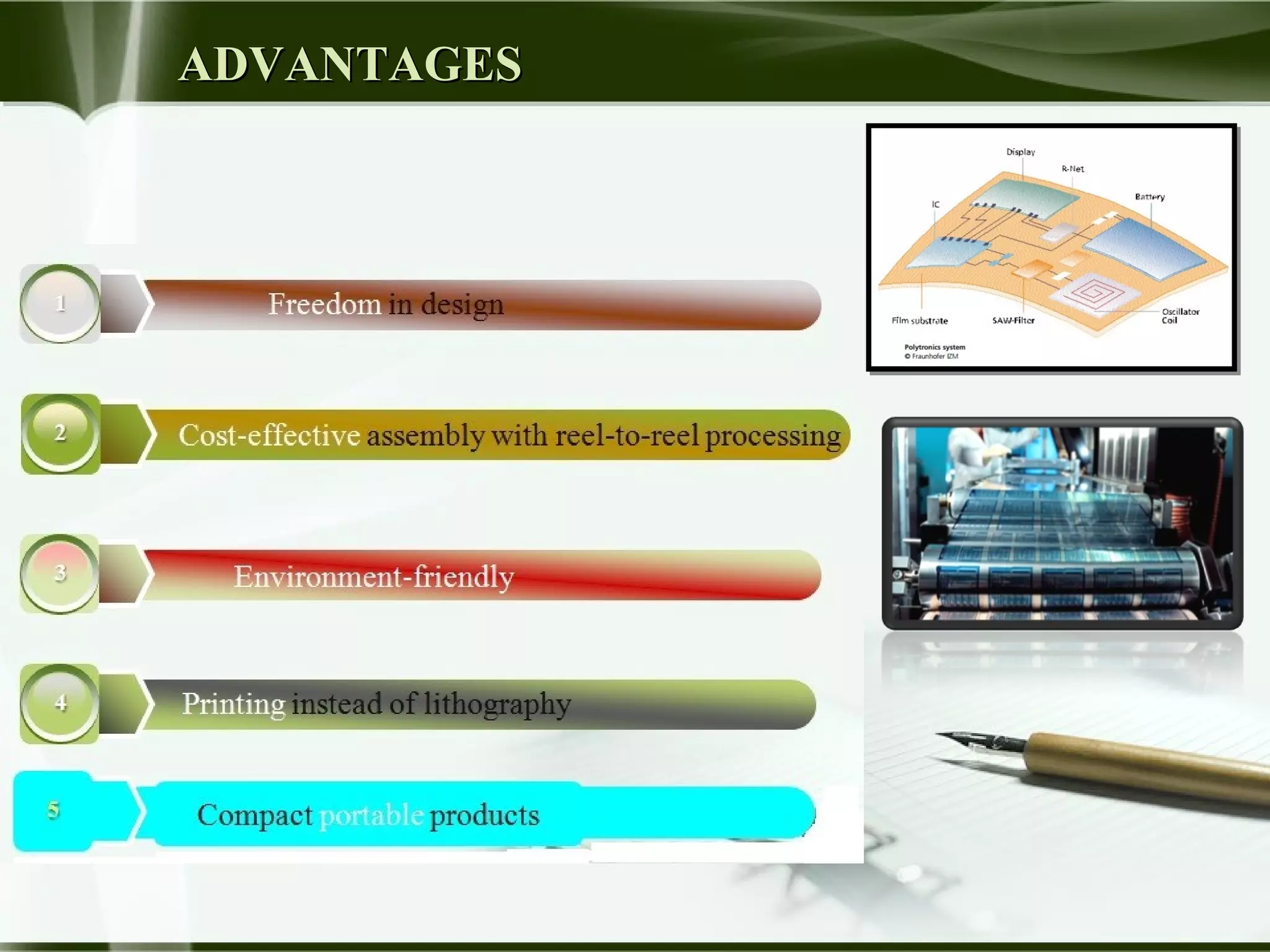
ADVANTAGESADVANTAGES
 With efficient use and reuse…electronic waste.
 Products are built…sub stream of the society, to build a better society
in which each and every individual has access to the features that it has
to offer.
 In short…field that offers tremendous opportunities for young and
budding engineers, field that is going to revolutionize the way in which
we live.
 I would again like to emphasize the fact that Polytronics is the next
BIG THING.
CONCLUSIONCONCLUSION
REFERENCES…….REFERENCES…….

http://www.nptel.ac.in/courses/112108150/pdf/We
b_Pages/WEBP_M14.pdf
http://www.theage.com/au-technology
www.plastics.org
http://www.AmericanPlasticsCouncil.org
http://ieeexplore.ieee.org/xpl/mostRecentIssue.js
p?punumber=10642
Polytronics

Polytronics

  • 1.
    NAWAB SHAH ALAMKHAN COLLEGE OF ENGINEERING AND TECHNOLOGY Seminar on POLYTRONICSPOLYTRONICS By M.Ayesha Mubeen M.Tech First Year , Dept. of ES
  • 2.
    CONTENTSCONTENTS  Introduction…  Whatis polytronics…..  Need of polytronics…  What is a polymer…..  History of polytronics….  How does a polymer conducts ….  Applications….  Example…  Advantages….  Conclusion….  References…….
  • 3.
     With theinvention…transistors …early half of the nineteenth century, the field of electronics…innumerable changes…tremendous impact on the life of the common man. Be it education, entertainment or healthcare, there is possibly no field where electronics has not made an impact.  The entire concept of electronics is based…study of materials called semi-conductors.  Silicon is one such material…widely used…manufacture of electronic circuits.  However the use of silicon has various disadvantages…led researchers and scientists all over the world…look for other alternatives.  For long, it was believed plastics were materials with poor conductivity.  Researchers…proved that when plastics are combined with other substances in proper chemical compositions they can behave as good conductors of electricity. INTRODUCTIONINTRODUCTION
  • 4.
    WHAT IS POLYTRONICSWHATIS POLYTRONICS ?? Polymer electronics Influence of plastic in electronics  All-new field in which plastics or ‘conjugated polymers’ are exclusively used in the manufacture of electronic products.  Emerging technology…focuses…development of electronic devices incorporating ..electrically conductive and semi conductive organic materials, especially organic polymers.  Offers the prospect…advanced electronics platform using new materials, processes & electronic devices.
  • 5.
    NEED OF POLYTRONICS…NEEDOF POLYTRONICS… The widespread use of silicon…electronic goods…large number of disadvantages some are,  Production of silicon embedded circuits involves a huge investment.  These circuits also consume more power.  Moreover since silicon chips are not flexible, the products, which..use, are not easily portable. By using polytronics these limitations can overcome.  Polytronic devices…manufactured at a fraction of the cost involved in making conventional chips.  Also Polytronics seems to be the best answer to the growing menace of electronic wastes. WhyWhy WhenWhen HowHow
  • 6.
    WHAT IS APOLYMERWHAT IS A POLYMER  (poly- ’many’) + (mer- ’parts’)  Large molecule/macromolecule, composed…many repeated subunits.  Because…broad range of properties both synthetic & natural polymers play an essential and ubiquitous role…everyday life.  Formed because…double and triple bonds between monomer to form a rigid structure and unique chemical & physical characteristics.  Organic polymers…chains of carbon atoms combined with hydrogen atoms.  It is a conjugated chain comprise…alternating single and double bonds between the carbon atoms.
  • 7.
    HISTORYHISTORY  Hermann staudingerin the year 1920, was first to propose the concept, the sense we use today  It led to the Nobel prize in 1953 for his work which is at the base of all science of macromolecules.
  • 8.
    HOW DOES APOLYMER CONDUCTHOW DOES A POLYMER CONDUCT  By simply obeying ohm’s law.  Ohm’s law define conductivity in polymers & ceramics as Free flow of ions/e-s . ……WorkingWorking
  • 9.
  • 10.
    EXAMPLE-OFETEXAMPLE-OFET  The basis…logiccircuit is a transistor, which is the element that controls electrical currents by turning on & off.
  • 11.
  • 12.
     With efficientuse and reuse…electronic waste.  Products are built…sub stream of the society, to build a better society in which each and every individual has access to the features that it has to offer.  In short…field that offers tremendous opportunities for young and budding engineers, field that is going to revolutionize the way in which we live.  I would again like to emphasize the fact that Polytronics is the next BIG THING. CONCLUSIONCONCLUSION
  • 13.