A
SEMINAR ON
Presented by
manoj Kumar Nayak
Roll no-L1100207002
Introduction
Brief history
What is bluetooth
What disadvantage it overcome
Aim of bluetooth
How bluetooth technology works
Bluetooth technology benefits
Competing technologies
Conclusion
introduction
Bluetooth is the name of a new technology
that is now becoming commercially
available .it promise to change significantly
the way we use machines. Bluetooth is a
global defact standard for wireless
connectivity. Based on a low- cost, short-
range radio link, Bluetooth cuts the cords
that used to tie up digital devices.bluetooh
technology allows for replacement of the
many proprietarycables that connect one
device to another with one universal short-
range radio link.
Bluetooth History
• Began as a private development effort at
Ericssion in 1994
• 5 companies joined to form the Bluetooth Special
interest Group (SIG) in 1998
• First Specification released in july 1999
• Current specification is version 1.1
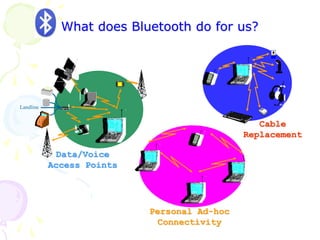
What does Bluetooth do for us?
Personal Ad-hoc
Connectivity
Cable
Replacement
Landline
Data/Voice
Access Points
Bluetooth is the name of a wireless technology
standard for connecting devices, set to replace
cables. It uses radio frequencies in the 2.45 GHz
range to transmit information over short
distances of generally 33 feet (10 meters) or
less. By embedding a Bluetooth chip and
receiver into products, cables that would
normally carry the signal can be eliminated
WHAT IS BLUETOOTH
WHAT DISADVANTAGE IT OVERCOME:-
One wireless standard that is already familiar to many
is IrDA or infrared. Infrared uses pulses of non-visible
light to communicate between two devices, such as a
remote control to a television or DVD player
One drawback of IrDA is that there must be a clear line
of sight between the two devices, and the other
disadvantage is that IrDA normally only operates
between two devices at a time. An infrared remote
control unit cannot communicate with the DVD player
while it is signaling the TV
Bluetooth overcomes these limitations by using radio
waves to send information in packet bursts. The bursts
can be sent to any device within ‘earshot’ allowing
communication with several devices at once.
• Bluetooth devices in the house are always
communicating with one another as long as they are
powered on. Each device sends out a signal, received
by the other devices that are sending out their own
signals. The devices scan all signals to see if any are
addressing it. In this way, Bluetooth creates a
personal-area network (PAN) in the home and the
user is not required to do anything special to get the
devices to speak to one another. They operate in a
perpetual interactive mode by default.
•For example, let’s assume you are using your cell phone
and headset while you copy a DVD from your
entertainment center to your desktop -- meanwhile your
digital camera is offloading its contents to your laptop.
The Bluetooth devices that have business with one
another will initiate their own separate PAN (also called a
piconet) and synchronize a random hopping scheme to
create interference-free communications. Known as
spread-spectrum frequency hopping
• The devices will jump among 79 random frequencies
within a specified range, changing about 1,600 times
per second in perfect unison. The likelihood that a
device in another PAN will be using the same frequency
at the same time is minute. Hence several individual
PANs or piconets can operate in the house without
interfering with one another. Each piconet can have 1
master and up to 7 slave devices. Future versions may
allow linked piconets called scatter nets.
The maximum bandwidth for any single channel or
frequency is 1 megabyte per second (1Mbps), while
individual packets range up to 2,745 bits. There are
currently three flavors or classifications of Bluetooth
devices, relative to transmitting range. As the range is
increased the signal used in the respective
classification is also stronger. Note that Class 3devices
are comparatively rare.
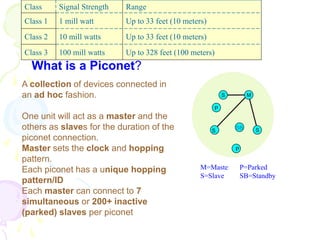
A collection of devices connected in
an ad hoc fashion.
One unit will act as a master and the
others as slaves for the duration of the
piconet connection.
Master sets the clock and hopping
pattern.
Each piconet has a unique hopping
pattern/ID
Each master can connect to 7
simultaneous or 200+ inactive
(parked) slaves per piconet
M
S
S
S
SB
P
P
M=Master
S=Slave
P=Parked
SB=Standby
What is a Piconet?
Class Signal Strength Range
Class 1 1 mill watt Up to 33 feet (10 meters)
Class 2 10 mill watts Up to 33 feet (10 meters)
Class 3 100 mill watts Up to 328 feet (100 meters)
Characteristics
Operates in the 2.4 GHz band at a data rate of 720Kb/s.
Uses Frequency Hopping (FH) spread spectrum, which
divides the frequency band into a number of channels
(2.402 - 2.480 GHz yielding 79 channels).
Radio transceivers hop from one channel to another in a
pseudo-random fashion, determined by the master.
Supports up to 8 devices in a piconet (1 master and 7
slaves).
Piconets can combine to form scatternets.
• Optimizes the usage model of all mobile computing and
communications devices, and provides:
• Global usage
• Voice and data handling
• Withstand interference from other sources
• Low power consumption
• Competitively low cost of units
• Very small in size and Ergonomic design
Aim of Bluetooth
 􀁺 Open Specification
 􀁺 Voice and Data Capability
 􀁺 Worldwide Usability
 􀁺 Short-Range Wireless Solutions
Bluetooth Goals
Bluetooth Technology Benefits
Globally Accepted Specification
Range of Devices
Ease of Use
Globally Accepted Specification
Secure Connections
How Bluetooth Technology Works
Bluetooth is a high-speed, low-power microwave
wireless link technology, designed to connect
phones, laptops, PDAs and other portable
equipment together with little or no work by the
user .
Unlike infra-red, Bluetooth does not require line-
of-sight positioning of connected units.
The technology uses modifications of existing
wireless LAN techniques but is most notable for its
small size and low cost.
The current prototype circuits are contained on a
circuit board 0.9cm square, with a much smaller
single chip version in development. The cost of
the device is expected to fall very fast, from $20
initially to $5 in a year or two
When one Bluetooth product comes within range of
another, (this can be set to between 10cm and 100m)
they automatically exchange address and capability
details.The protocols will handle both voice and data,
with a very flexible network topography
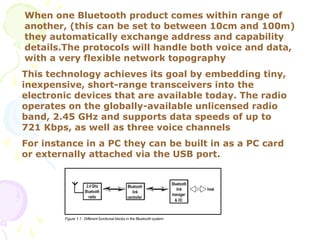
This technology achieves its goal by embedding tiny,
inexpensive, short-range transceivers into the
electronic devices that are available today. The radio
operates on the globally-available unlicensed radio
band, 2.45 GHz and supports data speeds of up to
721 Kbps, as well as three voice channels
For instance in a PC they can be built in as a PC card
or externally attached via the USB port.
Each device has a unique 48-bit address from the
IEEE 802 standard. Connections can be point-to-
point or multipoint. The maximum range is 10
meters but can be extended to 100 meters by
increasing the power. Bluetooth devices are
protected from radio interference by changing their
frequencies arbitrarily upto a maximum of 1600
times a second,
The Bluetooth specification targets power
consumption of the device from a "hold" mode
consuming 30 micro amps to the active transmitting
range of 8-30 milliamps (or less than 1/10th of a
watt). The radio chip consumers only 0.3mA in
standby mode, which is less than 3 % of the power
used by a standard mobile phone. The chips also have
excellent power-saving features, as they will
automatically shift to a low-power mode as soon as
traffic volume lessens or stops.Bluetooth devices are
classified according to three different power classes,
as shown in the following table.
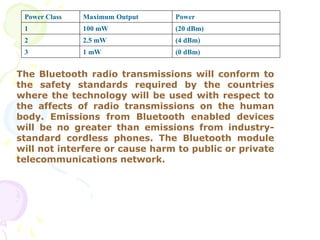
Power Class Maximum Output Power
1 100 mW (20 dBm)
2 2.5 mW (4 dBm)
3 1 mW (0 dBm)
The Bluetooth radio transmissions will conform to
the safety standards required by the countries
where the technology will be used with respect to
the affects of radio transmissions on the human
body. Emissions from Bluetooth enabled devices
will be no greater than emissions from industry-
standard cordless phones. The Bluetooth module
will not interfere or cause harm to public or private
telecommunications network.
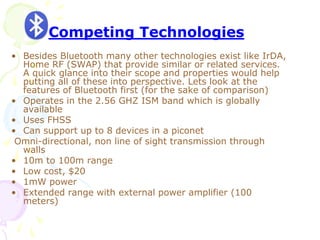
• Besides Bluetooth many other technologies exist like IrDA,
Home RF (SWAP) that provide similar or related services.
A quick glance into their scope and properties would help
putting all of these into perspective. Lets look at the
features of Bluetooth first (for the sake of comparison)
• Operates in the 2.56 GHZ ISM band which is globally
available
• Uses FHSS
• Can support up to 8 devices in a piconet
Omni-directional, non line of sight transmission through
walls
• 10m to 100m range
• Low cost, $20
• 1mW power
• Extended range with external power amplifier (100
meters)
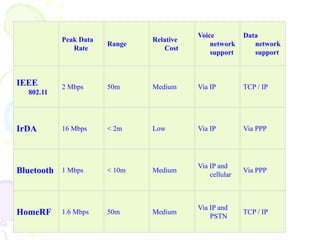
Competing Technologies
Peak Data
Rate
Range
Relative
Cost
Voice
network
support
Data
network
support
IEEE
802.11
2 Mbps 50m Medium Via IP TCP / IP
IrDA 16 Mbps < 2m Low Via IP Via PPP
Bluetooth 1 Mbps < 10m Medium
Via IP and
cellular
Via PPP
HomeRF 1.6 Mbps 50m Medium
Via IP and
PSTN
TCP / IP
CONCLUSION
As you can see, the Bluetooth specification is
definitely real and is being widely adopted by
industry leaders. The possibilities for new
applications is very exciting with this versatile
technology
Bluetooth.ppt

Bluetooth.ppt

  • 1.
    A SEMINAR ON Presented by manojKumar Nayak Roll no-L1100207002
  • 2.
    Introduction Brief history What isbluetooth What disadvantage it overcome Aim of bluetooth How bluetooth technology works Bluetooth technology benefits Competing technologies Conclusion
  • 3.
    introduction Bluetooth is thename of a new technology that is now becoming commercially available .it promise to change significantly the way we use machines. Bluetooth is a global defact standard for wireless connectivity. Based on a low- cost, short- range radio link, Bluetooth cuts the cords that used to tie up digital devices.bluetooh technology allows for replacement of the many proprietarycables that connect one device to another with one universal short- range radio link.
  • 4.
    Bluetooth History • Beganas a private development effort at Ericssion in 1994 • 5 companies joined to form the Bluetooth Special interest Group (SIG) in 1998 • First Specification released in july 1999 • Current specification is version 1.1
  • 5.
    What does Bluetoothdo for us? Personal Ad-hoc Connectivity Cable Replacement Landline Data/Voice Access Points
  • 6.
    Bluetooth is thename of a wireless technology standard for connecting devices, set to replace cables. It uses radio frequencies in the 2.45 GHz range to transmit information over short distances of generally 33 feet (10 meters) or less. By embedding a Bluetooth chip and receiver into products, cables that would normally carry the signal can be eliminated WHAT IS BLUETOOTH
  • 7.
    WHAT DISADVANTAGE ITOVERCOME:- One wireless standard that is already familiar to many is IrDA or infrared. Infrared uses pulses of non-visible light to communicate between two devices, such as a remote control to a television or DVD player One drawback of IrDA is that there must be a clear line of sight between the two devices, and the other disadvantage is that IrDA normally only operates between two devices at a time. An infrared remote control unit cannot communicate with the DVD player while it is signaling the TV Bluetooth overcomes these limitations by using radio waves to send information in packet bursts. The bursts can be sent to any device within ‘earshot’ allowing communication with several devices at once.
  • 8.
    • Bluetooth devicesin the house are always communicating with one another as long as they are powered on. Each device sends out a signal, received by the other devices that are sending out their own signals. The devices scan all signals to see if any are addressing it. In this way, Bluetooth creates a personal-area network (PAN) in the home and the user is not required to do anything special to get the devices to speak to one another. They operate in a perpetual interactive mode by default. •For example, let’s assume you are using your cell phone and headset while you copy a DVD from your entertainment center to your desktop -- meanwhile your digital camera is offloading its contents to your laptop. The Bluetooth devices that have business with one another will initiate their own separate PAN (also called a piconet) and synchronize a random hopping scheme to create interference-free communications. Known as spread-spectrum frequency hopping
  • 9.
    • The deviceswill jump among 79 random frequencies within a specified range, changing about 1,600 times per second in perfect unison. The likelihood that a device in another PAN will be using the same frequency at the same time is minute. Hence several individual PANs or piconets can operate in the house without interfering with one another. Each piconet can have 1 master and up to 7 slave devices. Future versions may allow linked piconets called scatter nets. The maximum bandwidth for any single channel or frequency is 1 megabyte per second (1Mbps), while individual packets range up to 2,745 bits. There are currently three flavors or classifications of Bluetooth devices, relative to transmitting range. As the range is increased the signal used in the respective classification is also stronger. Note that Class 3devices are comparatively rare.
  • 10.
    A collection ofdevices connected in an ad hoc fashion. One unit will act as a master and the others as slaves for the duration of the piconet connection. Master sets the clock and hopping pattern. Each piconet has a unique hopping pattern/ID Each master can connect to 7 simultaneous or 200+ inactive (parked) slaves per piconet M S S S SB P P M=Master S=Slave P=Parked SB=Standby What is a Piconet? Class Signal Strength Range Class 1 1 mill watt Up to 33 feet (10 meters) Class 2 10 mill watts Up to 33 feet (10 meters) Class 3 100 mill watts Up to 328 feet (100 meters)
  • 11.
    Characteristics Operates in the2.4 GHz band at a data rate of 720Kb/s. Uses Frequency Hopping (FH) spread spectrum, which divides the frequency band into a number of channels (2.402 - 2.480 GHz yielding 79 channels). Radio transceivers hop from one channel to another in a pseudo-random fashion, determined by the master. Supports up to 8 devices in a piconet (1 master and 7 slaves). Piconets can combine to form scatternets.
  • 12.
    • Optimizes theusage model of all mobile computing and communications devices, and provides: • Global usage • Voice and data handling • Withstand interference from other sources • Low power consumption • Competitively low cost of units • Very small in size and Ergonomic design Aim of Bluetooth
  • 13.
     􀁺 OpenSpecification  􀁺 Voice and Data Capability  􀁺 Worldwide Usability  􀁺 Short-Range Wireless Solutions Bluetooth Goals
  • 14.
    Bluetooth Technology Benefits GloballyAccepted Specification Range of Devices Ease of Use Globally Accepted Specification Secure Connections
  • 15.
    How Bluetooth TechnologyWorks Bluetooth is a high-speed, low-power microwave wireless link technology, designed to connect phones, laptops, PDAs and other portable equipment together with little or no work by the user . Unlike infra-red, Bluetooth does not require line- of-sight positioning of connected units. The technology uses modifications of existing wireless LAN techniques but is most notable for its small size and low cost. The current prototype circuits are contained on a circuit board 0.9cm square, with a much smaller single chip version in development. The cost of the device is expected to fall very fast, from $20 initially to $5 in a year or two
  • 16.
    When one Bluetoothproduct comes within range of another, (this can be set to between 10cm and 100m) they automatically exchange address and capability details.The protocols will handle both voice and data, with a very flexible network topography This technology achieves its goal by embedding tiny, inexpensive, short-range transceivers into the electronic devices that are available today. The radio operates on the globally-available unlicensed radio band, 2.45 GHz and supports data speeds of up to 721 Kbps, as well as three voice channels For instance in a PC they can be built in as a PC card or externally attached via the USB port.
  • 17.
    Each device hasa unique 48-bit address from the IEEE 802 standard. Connections can be point-to- point or multipoint. The maximum range is 10 meters but can be extended to 100 meters by increasing the power. Bluetooth devices are protected from radio interference by changing their frequencies arbitrarily upto a maximum of 1600 times a second, The Bluetooth specification targets power consumption of the device from a "hold" mode consuming 30 micro amps to the active transmitting range of 8-30 milliamps (or less than 1/10th of a watt). The radio chip consumers only 0.3mA in standby mode, which is less than 3 % of the power used by a standard mobile phone. The chips also have excellent power-saving features, as they will automatically shift to a low-power mode as soon as traffic volume lessens or stops.Bluetooth devices are classified according to three different power classes, as shown in the following table.
  • 18.
    Power Class MaximumOutput Power 1 100 mW (20 dBm) 2 2.5 mW (4 dBm) 3 1 mW (0 dBm) The Bluetooth radio transmissions will conform to the safety standards required by the countries where the technology will be used with respect to the affects of radio transmissions on the human body. Emissions from Bluetooth enabled devices will be no greater than emissions from industry- standard cordless phones. The Bluetooth module will not interfere or cause harm to public or private telecommunications network.
  • 19.
    • Besides Bluetoothmany other technologies exist like IrDA, Home RF (SWAP) that provide similar or related services. A quick glance into their scope and properties would help putting all of these into perspective. Lets look at the features of Bluetooth first (for the sake of comparison) • Operates in the 2.56 GHZ ISM band which is globally available • Uses FHSS • Can support up to 8 devices in a piconet Omni-directional, non line of sight transmission through walls • 10m to 100m range • Low cost, $20 • 1mW power • Extended range with external power amplifier (100 meters) Competing Technologies
  • 20.
    Peak Data Rate Range Relative Cost Voice network support Data network support IEEE 802.11 2 Mbps50m Medium Via IP TCP / IP IrDA 16 Mbps < 2m Low Via IP Via PPP Bluetooth 1 Mbps < 10m Medium Via IP and cellular Via PPP HomeRF 1.6 Mbps 50m Medium Via IP and PSTN TCP / IP
  • 21.
    CONCLUSION As you cansee, the Bluetooth specification is definitely real and is being widely adopted by industry leaders. The possibilities for new applications is very exciting with this versatile technology

Editor's Notes