Seminar 
on 
BLUETOOTH TECHNOLOGY 
Submitted To: 
Abhinav Bansal 
Assistant Proffesor 
ECE Department 
Submitted By: 
Anusha Srivastava 
ECE-3rd year 
Roll No-1103331037
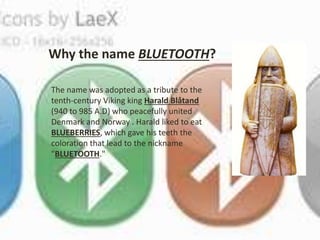
Why the name BLUETOOTH? 
The name was adopted as a tribute to the 
tenth-century Viking king Harald Blåtand 
(940 to 985 A.D) who peacefully united 
Denmark and Norway . Harald liked to eat 
BLUEBERRIES, which gave his teeth the 
coloration that lead to the nickname 
"BLUETOOTH."
Q. What is Bluetooth??? 
Ans. Bluetooth is a method for data communication 
that uses short range radio links to replace cables 
between computers and their connected units.
Introduction 
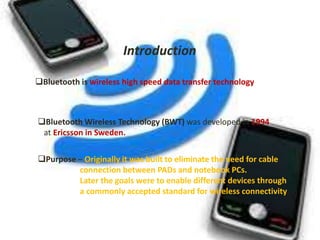
Bluetooth is wireless high speed data transfer technology 
Bluetooth Wireless Technology (BWT) was developed in 1994 
at Ericsson in Sweden. 
Purpose – Originally it was built to eliminate the need for cable 
connection between PADs and notebook PCs. 
Later the goals were to enable different devices through 
a commonly accepted standard for wireless connectivity.
Introduction(contd…) : 
Ericsson on the advent of BWT conceptualized a Radio 
Technology through a Wireless Personal Area Network (WPAN). 
Group called Bluetooth Special Interest Group (SIG) was 
formed in 1998 to develop the standard of IEEE 802.15 
This specification standarized the Bluetooth technology 
world wide.
Bluetooth Specifications 
Developed by : J.Haarsten and S.Mattisson in Sweden 
Standard : IEEE 802.15 
ISM band frequency : 2.4 GHz 
Range : 10 – 100 meters. 
Channel Band width : 1 Mbps
Bluetooth Topology 
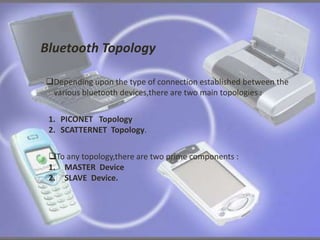
Depending upon the type of connection established between the 
various bluetooth devices,there are two main topologies : 
1. PICONET Topology 
2. SCATTERNET Topology. 
To any topology,there are two prime components : 
1. MASTER Device 
2. SLAVE Device.
PICONET Topology : 
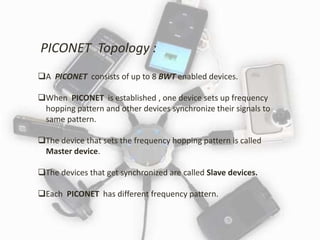
A PICONET consists of up to 8 BWT enabled devices. 
When PICONET is established , one device sets up frequency 
hopping pattern and other devices synchronize their signals to 
same pattern. 
The device that sets the frequency hopping pattern is called 
Master device. 
The devices that get synchronized are called Slave devices. 
Each PICONET has different frequency pattern.
PICONET Topology (contd…): 
Each PICONET has 1 Master for establishment of PICONET and 
up to 7 Slave devices. 
Master’s Bluetooth address is used for defining frequency hopping 
sequence. 
Slave devices use Master’s clock to synchronize their clocks so as 
to hop simultaneously. 
For establishing PICONET , other bluetooth devices are discovered 
by an inquiry procrdure.
SCATTERNET Topology 
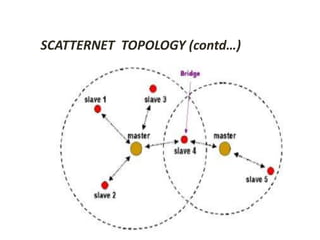
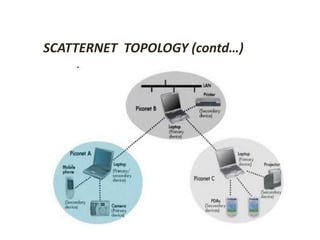
SCATTERNET consists of several PICONETs connected by 
devices participating in multiple PICONETs. 
Here ,devices can be Slaves in all PICONETs or Master in one 
PICONET and Slave in other PICONETs. 
There is a ‘BRIDGE’ connecting two PICONETs which is also a 
Slave in other PICONET. 
The major advantage of SCATTERNET is the multiple hop-route 
and higher throughput.
SCATTERNET TOPOLOGY (contd…)
HARDWARE ARCHITECTURE (contd…) : 
CPU Core – Helps Bluetooth Module to handle Inquiries and 
filter page request (not involving host device). 
Link Manager – LM software runs on CPU core.LM discovers 
other remote LMs and communicates to them 
via LMP (Link Manager Protocol). 
Bluetooth module also incoperates higher level software protocols, 
governing the functionality with other modules.
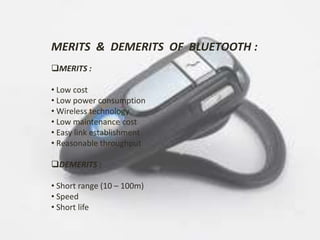
MERITS & DEMERITS OF BLUETOOTH : 
MERITS : 
• Low cost 
• Low power consumption 
• Wireless technology 
• Low maintenance cost 
• Easy link establishment 
• Reasonable throughput 
DEMERITS : 
• Short range (10 – 100m) 
• Speed 
• Short life
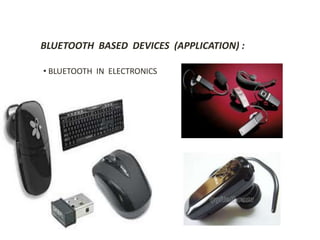
BLUETOOTH BASED DEVICES (APPLICATION) : 
• BLUETOOTH IN ELECTRONICS
APPLICATION (contd…) 
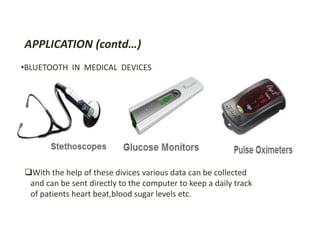
•BLUETOOTH IN MEDICAL DEVICES 
With the help of these divices various data can be collected 
and can be sent directly to the computer to keep a daily track 
of patients heart beat,blood sugar levels etc.
REFERENCES 
1. www.bluetooth.com 
2. www.slideshare.net 
3. www.en.wikipedia.org/wiki/buetooth 
4. How Bluetooth Technology Works“Bluetooth SIG.Archived 
from the original on 17January 2008. Retrieved 2008-02-01. 
5. www.bluetooth.org
ANY QUESTIONS??

Bluetooth.ppt

  • 1.
    Seminar on BLUETOOTHTECHNOLOGY Submitted To: Abhinav Bansal Assistant Proffesor ECE Department Submitted By: Anusha Srivastava ECE-3rd year Roll No-1103331037
  • 2.
    Why the nameBLUETOOTH? The name was adopted as a tribute to the tenth-century Viking king Harald Blåtand (940 to 985 A.D) who peacefully united Denmark and Norway . Harald liked to eat BLUEBERRIES, which gave his teeth the coloration that lead to the nickname "BLUETOOTH."
  • 3.
    Q. What isBluetooth??? Ans. Bluetooth is a method for data communication that uses short range radio links to replace cables between computers and their connected units.
  • 4.
    Introduction Bluetooth iswireless high speed data transfer technology Bluetooth Wireless Technology (BWT) was developed in 1994 at Ericsson in Sweden. Purpose – Originally it was built to eliminate the need for cable connection between PADs and notebook PCs. Later the goals were to enable different devices through a commonly accepted standard for wireless connectivity.
  • 5.
    Introduction(contd…) : Ericssonon the advent of BWT conceptualized a Radio Technology through a Wireless Personal Area Network (WPAN). Group called Bluetooth Special Interest Group (SIG) was formed in 1998 to develop the standard of IEEE 802.15 This specification standarized the Bluetooth technology world wide.
  • 6.
    Bluetooth Specifications Developedby : J.Haarsten and S.Mattisson in Sweden Standard : IEEE 802.15 ISM band frequency : 2.4 GHz Range : 10 – 100 meters. Channel Band width : 1 Mbps
  • 7.
    Bluetooth Topology Dependingupon the type of connection established between the various bluetooth devices,there are two main topologies : 1. PICONET Topology 2. SCATTERNET Topology. To any topology,there are two prime components : 1. MASTER Device 2. SLAVE Device.
  • 8.
    PICONET Topology : A PICONET consists of up to 8 BWT enabled devices. When PICONET is established , one device sets up frequency hopping pattern and other devices synchronize their signals to same pattern. The device that sets the frequency hopping pattern is called Master device. The devices that get synchronized are called Slave devices. Each PICONET has different frequency pattern.
  • 9.
    PICONET Topology (contd…): Each PICONET has 1 Master for establishment of PICONET and up to 7 Slave devices. Master’s Bluetooth address is used for defining frequency hopping sequence. Slave devices use Master’s clock to synchronize their clocks so as to hop simultaneously. For establishing PICONET , other bluetooth devices are discovered by an inquiry procrdure.
  • 10.
    SCATTERNET Topology SCATTERNETconsists of several PICONETs connected by devices participating in multiple PICONETs. Here ,devices can be Slaves in all PICONETs or Master in one PICONET and Slave in other PICONETs. There is a ‘BRIDGE’ connecting two PICONETs which is also a Slave in other PICONET. The major advantage of SCATTERNET is the multiple hop-route and higher throughput.
  • 11.
  • 12.
  • 13.
    HARDWARE ARCHITECTURE (contd…): CPU Core – Helps Bluetooth Module to handle Inquiries and filter page request (not involving host device). Link Manager – LM software runs on CPU core.LM discovers other remote LMs and communicates to them via LMP (Link Manager Protocol). Bluetooth module also incoperates higher level software protocols, governing the functionality with other modules.
  • 14.
    MERITS & DEMERITSOF BLUETOOTH : MERITS : • Low cost • Low power consumption • Wireless technology • Low maintenance cost • Easy link establishment • Reasonable throughput DEMERITS : • Short range (10 – 100m) • Speed • Short life
  • 15.
    BLUETOOTH BASED DEVICES(APPLICATION) : • BLUETOOTH IN ELECTRONICS
  • 16.
    APPLICATION (contd…) •BLUETOOTHIN MEDICAL DEVICES With the help of these divices various data can be collected and can be sent directly to the computer to keep a daily track of patients heart beat,blood sugar levels etc.
  • 17.
    REFERENCES 1. www.bluetooth.com 2. www.slideshare.net 3. www.en.wikipedia.org/wiki/buetooth 4. How Bluetooth Technology Works“Bluetooth SIG.Archived from the original on 17January 2008. Retrieved 2008-02-01. 5. www.bluetooth.org
  • 19.