Bluetooth Based Smart
Sensor Network
Presented by,

Maulik Patel
131060753011(WiMC)
What Is Wireless Sensor Network ?


Networks of small devices equipped with sensors, microprocessor and wireless
Communication interfaces and power sources.



It can be deployed in an ad-hoc manner.



Automatically collected and presented in structured way using xml.



No limits in sensor type and number of sensor.



Various simple RF, Bluetooth, UWB or infrared might be used for
communication between sensors.
Operation Performed by WSN


QUERING – Queries are used when user requires only the current value of the
observation.



TASKING – More Complex operation Used when a phenomenon has to be
observed over a large period of time.
Application



Military applications



Monitoring friendly forces, equipment and ammunition



Nuclear, biological and chemical attack detection



Environmental applications



Forest fire detection



Flood detection and Precision agriculture



Health applications



Tracking and monitoring patients and doctors inside a hospital



Drug administration in hospitals
And much more…
Why to use Bluetooth in WSN?


Bluetooth is already well developed and experienced



Large range of Bluetooth devices available today.



Relatively low cost.



Many protocols are already developed.



Automatic node discovery synchronization and connection set up.
Bluetooth Specification


Standard: IEEE 802.15



ISM Band Frequency: 2.4 GHz



Range: 10 – 100 meters



Channel Bandwidth: 1 Mbps



Maximum Asymmetric Data Transfer Rate: 721 Kbps



Power saving mode(sniff , park and stand by)



piconet & scatternet
Smart Sensor Networks


Challenge : It is to ensure interoperability among various Bluetooth
manufactures’ devices and to provide numerous applications.



Important features of WSN: Collaboration of network nodes during
execution and Data Centric nature.



Many smart sensor nodes scattered in the field collect data and send it to
users via ‘gateway’ using multi-hop routes.
Smart Sensor Network (cont.)

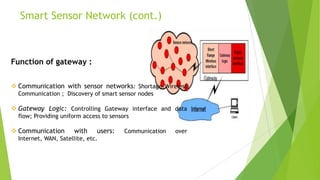
Function of gateway :
 Communication with sensor networks: Shortage Wireless
Communication ; Discovery of smart sensor nodes

 Gateway Logic: Controlling Gateway interface and data
flow; Providing uniform access to sensors

 Communication

with

users:

Internet, WAN, Satellite, etc.

Communication

over
Sensor Network Implementation


Main goal is to develop hardware and software for test based for researcher.



automatically collected and presented in a structured way using XML.



new protocols can be added easily without affecting current functionality.
Smart sensor node implementation
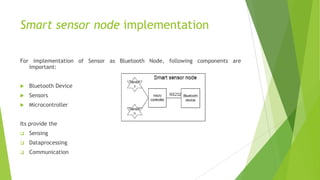
For implementation of Sensor as Bluetooth Node, following components are
important:


Bluetooth Device



Sensors



Microcontroller

Its provide the


Sensing



Dataprocessing



Communication
Sensor network gateway implementation


Gateway is implemented in Pentium laptop with linux OS.



Complete software functionality developed in java so it is possioble to
change in operation system.



It can be implemented by the use of either bluetooth ,PCMCIA CARD.



Java community undertook the first effort towards bluetooth stack API
application



Ex-JSR-82 JABWT
Bluetooth Hardware Architecture
Bluetooth hardware architecture (contd.)

Bluetooth Hardware consists of 3 main functional modules:
 2.4 GHz Bluetooth RF Transceiver Unit
 Link Management Unit
 Host Controller Interface

HOST CONTROLLER– Consists of a Digital Signal Processing part,having Link
Controller(LC) & CPU Core. It interfaces to the Host environment.
LINK CONTROLLER - Consists of Hardware & Software parts to perform Base-Band
Processing, and PhysicalLayer Protocols.Also performs low-level digital signal
processing to form connections.
Discovery Of Smart Sensor Nodes


After installation, the primary step during execution is
to discover the smart sensor nodes in the area.



The is to prepare a list of sensor’s characteristics and
network topology.



Next in execution process, provision is to have addition
of new or removal of existing sensors.
Communication with smart sensor nodes


Initialization of gateway and Bluetooth Inquiry Procedure.



Discovery of Bluetooth device and Checking of major and
minor devices.



Setting of parameters and assigning type of devices and
sensors.



Description by Service-Class Field.



Discarding of non-smart nodes.



Exchange the service profile of each other.



Lastly, Bluetooth link is established and data exchange with
smart node starts.
Abstraction layers


Gateway’s abstraction layer uses sensor profiles to
create list of objects that represent each sensor in the
network.



Each object provides methods that enable sending and
receiving data to and from sensor. Specifics of actual
data transmission are hidden from users.
Research Issues


There are mainly two research issues for bluetooth based
smart sensor network:-

1.

Hardware development issues,

2.

Software development issues.
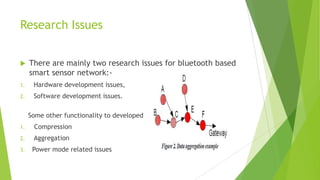
Some other functionality to developed

1.

Compression

2.

Aggregation

3.

Power mode related issues
Conclusion


Interesting research area with many possible solution



They are based on many collaborative effort of small devices



Many open issue related to physical layer , MAC layer , routing layer and
application layer
References


Bluetooth Based Wireless Sensor Networks –Implementation Issues and
Solutions -Srdjan Krco - Applied Research Lab, Ericsson Ireland



I.F. Akyildiz, W. Su, Y. Sankarasubramaniam, E.Cayirci, “Wireless sensor
networks: a survey”,Computer Networks 38, Elsevier, 2002



C. Shen, C. Srisathapornphat, C. Jaikeeo, “Sensorinformation networking
architecture and applications”,IEEE Personal Communications, August 2001



K. Sohrabi, J. Gao, V. Ailawadhi, G.J. Pottie, “Protocols for self-organization
of a wireless sensor network”,IEEE Personal Communications, October 2000
blutooth based smart sensor network

blutooth based smart sensor network

  • 1.
    Bluetooth Based Smart SensorNetwork Presented by, Maulik Patel 131060753011(WiMC)
  • 2.
    What Is WirelessSensor Network ?  Networks of small devices equipped with sensors, microprocessor and wireless Communication interfaces and power sources.  It can be deployed in an ad-hoc manner.  Automatically collected and presented in structured way using xml.  No limits in sensor type and number of sensor.  Various simple RF, Bluetooth, UWB or infrared might be used for communication between sensors.
  • 3.
    Operation Performed byWSN  QUERING – Queries are used when user requires only the current value of the observation.  TASKING – More Complex operation Used when a phenomenon has to be observed over a large period of time.
  • 4.
    Application  Military applications  Monitoring friendlyforces, equipment and ammunition  Nuclear, biological and chemical attack detection  Environmental applications  Forest fire detection  Flood detection and Precision agriculture  Health applications  Tracking and monitoring patients and doctors inside a hospital  Drug administration in hospitals And much more…
  • 5.
    Why to useBluetooth in WSN?  Bluetooth is already well developed and experienced  Large range of Bluetooth devices available today.  Relatively low cost.  Many protocols are already developed.  Automatic node discovery synchronization and connection set up.
  • 6.
    Bluetooth Specification  Standard: IEEE802.15  ISM Band Frequency: 2.4 GHz  Range: 10 – 100 meters  Channel Bandwidth: 1 Mbps  Maximum Asymmetric Data Transfer Rate: 721 Kbps  Power saving mode(sniff , park and stand by)  piconet & scatternet
  • 7.
    Smart Sensor Networks  Challenge: It is to ensure interoperability among various Bluetooth manufactures’ devices and to provide numerous applications.  Important features of WSN: Collaboration of network nodes during execution and Data Centric nature.  Many smart sensor nodes scattered in the field collect data and send it to users via ‘gateway’ using multi-hop routes.
  • 8.
    Smart Sensor Network(cont.) Function of gateway :  Communication with sensor networks: Shortage Wireless Communication ; Discovery of smart sensor nodes  Gateway Logic: Controlling Gateway interface and data flow; Providing uniform access to sensors  Communication with users: Internet, WAN, Satellite, etc. Communication over
  • 9.
    Sensor Network Implementation  Maingoal is to develop hardware and software for test based for researcher.  automatically collected and presented in a structured way using XML.  new protocols can be added easily without affecting current functionality.
  • 10.
    Smart sensor nodeimplementation For implementation of Sensor as Bluetooth Node, following components are important:  Bluetooth Device  Sensors  Microcontroller Its provide the  Sensing  Dataprocessing  Communication
  • 11.
    Sensor network gatewayimplementation  Gateway is implemented in Pentium laptop with linux OS.  Complete software functionality developed in java so it is possioble to change in operation system.  It can be implemented by the use of either bluetooth ,PCMCIA CARD.  Java community undertook the first effort towards bluetooth stack API application  Ex-JSR-82 JABWT
  • 12.
  • 13.
    Bluetooth hardware architecture(contd.) Bluetooth Hardware consists of 3 main functional modules:  2.4 GHz Bluetooth RF Transceiver Unit  Link Management Unit  Host Controller Interface HOST CONTROLLER– Consists of a Digital Signal Processing part,having Link Controller(LC) & CPU Core. It interfaces to the Host environment. LINK CONTROLLER - Consists of Hardware & Software parts to perform Base-Band Processing, and PhysicalLayer Protocols.Also performs low-level digital signal processing to form connections.
  • 14.
    Discovery Of SmartSensor Nodes  After installation, the primary step during execution is to discover the smart sensor nodes in the area.  The is to prepare a list of sensor’s characteristics and network topology.  Next in execution process, provision is to have addition of new or removal of existing sensors.
  • 15.
    Communication with smartsensor nodes  Initialization of gateway and Bluetooth Inquiry Procedure.  Discovery of Bluetooth device and Checking of major and minor devices.  Setting of parameters and assigning type of devices and sensors.  Description by Service-Class Field.  Discarding of non-smart nodes.  Exchange the service profile of each other.  Lastly, Bluetooth link is established and data exchange with smart node starts.
  • 16.
    Abstraction layers  Gateway’s abstractionlayer uses sensor profiles to create list of objects that represent each sensor in the network.  Each object provides methods that enable sending and receiving data to and from sensor. Specifics of actual data transmission are hidden from users.
  • 17.
    Research Issues  There aremainly two research issues for bluetooth based smart sensor network:- 1. Hardware development issues, 2. Software development issues. Some other functionality to developed 1. Compression 2. Aggregation 3. Power mode related issues
  • 18.
    Conclusion  Interesting research areawith many possible solution  They are based on many collaborative effort of small devices  Many open issue related to physical layer , MAC layer , routing layer and application layer
  • 19.
    References  Bluetooth Based WirelessSensor Networks –Implementation Issues and Solutions -Srdjan Krco - Applied Research Lab, Ericsson Ireland  I.F. Akyildiz, W. Su, Y. Sankarasubramaniam, E.Cayirci, “Wireless sensor networks: a survey”,Computer Networks 38, Elsevier, 2002  C. Shen, C. Srisathapornphat, C. Jaikeeo, “Sensorinformation networking architecture and applications”,IEEE Personal Communications, August 2001  K. Sohrabi, J. Gao, V. Ailawadhi, G.J. Pottie, “Protocols for self-organization of a wireless sensor network”,IEEE Personal Communications, October 2000

Editor's Notes

  • #9 generic methods for sending and receivingdata to and from sensors, routing, etc.;and abstraction level apiprovides function for uniform access to sensor
  • #14 Csma cd ,rs232,dsl
  • #18 1> no way for slave to demand a park theat can only request. So no guranteeEach time a device switch between piconets it mightlose up to two slots for communication due to differencein piconet’s clocks;Scheduling switches between piconets in such a way tomaintain communication links with devicesuninterrupted is very difficult,