

Presented
By:
Anamika
Contents
 Introduction
 History
 What is Bluetooth?
 Bluetooth Devices
 Bluetooth Specifications
 Bluetooth Networks
 Bluetooth layers
 Goals Of Bluetooth
 Bluetooth Sensor Network
 Applications
 Bluetooth Issues
 Advantages
 Research Work
 Conclusion
 Future scope
 References
Introduction
Bluetooth is a radio frequency specification for short range,
point to point and point to multipoint voice and data transfer.
In spite of facilitating the replacement of cables, bluetooth
technology works as an universal medium to bridge the existing
data networks, a peripheral interface for existing devices and
provide a mechanism to form short ad hoc network of connected
devices away form fixed network infrastructures.
History
 The Bluetooth name comes from the Danish Viking Harald Blåtand.
 By Ericsson, Intel, IBM, Nokia, Toshiba.
 1998 - Bluetooth technology is officially introduced and the
BLUETOOTH Special Interest Group (SIG) is formed.
 1999 - Bluetooth 1.0 Specification is introduced.
 In June of 2010, the Bluetooth SIG Board of Directors adopted the
Bluetooth Core specification v4.0, which can be found inside the
iPhone 4S .
WHAT IS BLUETOOTH?
 It is wireless protocol utilizing short range communication
technology.
 Facilitates data transmission from fixed and/or mobile devices
creating personal area network(PAN).
 PAN is used to link to the NIC card of the system.
 Low cost device with small power consumption and reasonable
throughput.
 Suitable for small battery driven devices.
Bluetooth (contd.)
 Eliminate wires and cables between both stationary and mobile
devices.
 In Bluetooth,Connection can be initiated without user interaction.
 Devices can be connected to multiple devices at the same time.
 One complete Bluetooth data packet can be transmitted within each
625 msec hop slot.
Bluetooth Devices
 Telephones
 Headsets
 Computers
 Cameras
 Printers
 Cars
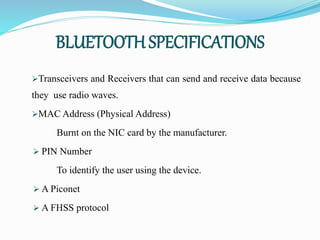
BLUETOOTH SPECIFICATIONS
Transceivers and Receivers that can send and receive data because
they use radio waves.
MAC Address (Physical Address)
Burnt on the NIC card by the manufacturer.
 PIN Number
To identify the user using the device.
 A Piconet
 A FHSS protocol
BLUETOOTH NETWORKS…
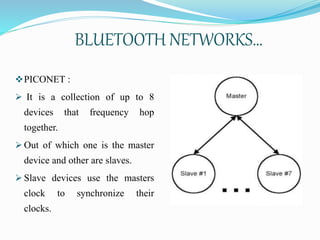
PICONET :
 It is a collection of up to 8
devices that frequency hop
together.
 Out of which one is the master
device and other are slaves.
 Slave devices use the masters
clock to synchronize their
clocks.
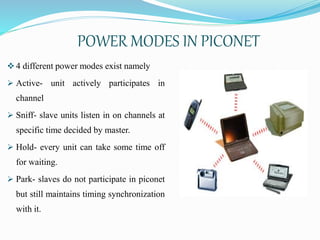
POWER MODES IN PICONET
 4 different power modes exist namely
 Active- unit actively participates in
channel
 Sniff- slave units listen in on channels at
specific time decided by master.
 Hold- every unit can take some time off
for waiting.
 Park- slaves do not participate in piconet
but still maintains timing synchronization
with it.
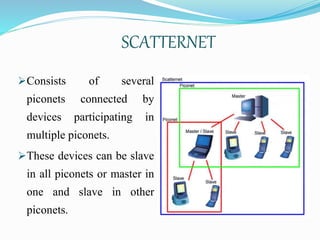
SCATTERNET
Consists of several
piconets connected by
devices participating in
multiple piconets.
These devices can be slave
in all piconets or master in
one and slave in other
piconets.
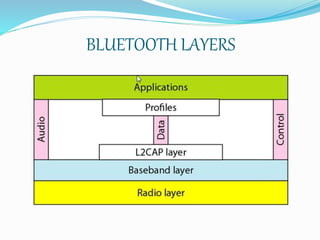
BLUETOOTH LAYERS
BLUETOOTH LAYERS
 Bluetooth Radio layer :
• This layer is roughly equivalent to the physical layer of the Internet model.
• It specifics details of the air interface, including frequency, frequency hopping,
modulation scheme, and transmission power.
• The Bluetooth Radio (layer) is the lowest defined layer of the Bluetooth
specification.
• Modulation:
To transform bits to signal , sophisticated version of FSK is used called
GFSK. Bit 1 is represented by frequency deviation above the carrier.
 Bluetooth Baseband Layer:
• It is equivalent to MAC sub layer in LANs.
• The access method is TDMA.
• The primary and secondary communicate with each other using time slots. The
time that one frequency is used ,a sender sends frame to secondary or secondary
sends frame to primary.
• It is concerned with connection establishment within a piconet, addressing, packet
format, timing and power control.
• TDMA
It uses a form of TDMA called TDD-TDMA(time division duplex TDMA).It is
a kind of half –duplex communication in which secondary and receiver send
and receive data but not at same time. Communication for each direction uses
different hops.
• Frame format: A frame in the baseband can be of three types:
1. One-slot
In a one-slot frame exchange 259microseconds is needed for hopping
and control mechanisms.
2. Three-slot
It occupies three slots. Length of frame is 1616 micro seconds.
3. Five –slot
It uses 259 bits for hopping i.e. length of frame is 2866bits.
Logical link control and adaptation protocol (L2CAP)
It adapts upper layer protocols to the baseband layer and provides both
connectionless and connection-oriented services. Multiplexing can also
be done.
FHSS
 Bluetooth devices use a protocol called (FHSS) Frequency-Hopping Spread
Spectrum to avoid interference from other devices or networks .
 Uses packet-switching to send data.
 Bluetooth sends packets of data on a range of frequencies.
 In each session one device is a master and the others are slaves.
 The master device decides at which frequency data will travel.
 Bluetooth hops 1600 Times per second
 This technique allows devices to communicate with each other more
securely.
GOALS OF BLUETOOTH
 Goals of Bluetooth are unification and harmony as well,
specifically enabling different devices to communicate
through a commonly accepted Standard.
 Bluetooth operates in the unlicensed ISM band at 2.4 GHZ
frequency band and use frequency hopping spread spectrum
technique.
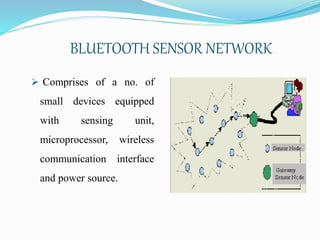
BLUETOOTH SENSOR NETWORK
 Comprises of a no. of
small devices equipped
with sensing unit,
microprocessor, wireless
communication interface
and power source.
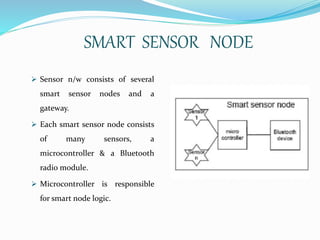
SMART SENSOR NODE
 Sensor n/w consists of several
smart sensor nodes and a
gateway.
 Each smart sensor node consists
of many sensors, a
microcontroller & a Bluetooth
radio module.
 Microcontroller is responsible
for smart node logic.
APPLICATIONS OF BLUETOOTH BASED
SENSOR NETWORKS
HEALTH MONITORING: Various sensors are attached to a
patients body to collect physiological data then stored or
forwarded i.e. in CT Scan, Ultrasound, ECG etc.
ENVIRONMENTAL MONITORING: Fire detection, water
pollution monitoring etc.
MILITARY And SECURITY: Monitoring soldiers in the field,
tracking enemy movements.
BLUETOOTH ISSUES
Scalability Issues: Only 8 nodes can be connected at a time so
dense n/w not possible. Slave to Slave direct communication not
possible.
Establishing a scatternet is very difficult due to frequency
interference problem.
Low Throughput: It is1mbps but with overheads it is 722 kbps
only.
Advantages
 Very easy to use.
 Connection is fast and simple.
 More devices are Bluetooth capable.
 Auto recognition.
 Wireless (No Cables).
 No Setup Needed.
 Industry Wide Support.
 Inexpensive Technique.
Research Work
Currently a protocol is being researched that would
support large ad hoc networks.
Ultra wide band has been chosen by the Bluetooth Special
Interest Group as the future of Bluetooth Technology.
Many companies are designing impressive bluetooth
applications in demand.
CONCLUSION
Bluetooth is a new standard developed by a group of electronics
manufacturers, that will allow any sort of electronic equipment to
make it's own connections without wires, cables or any direct
action from user. It is a rapid growing technology that makes man
easy to transfer his electronic equipments from one place to
another. It is a technology that not yet completely developed.
Hope this will be achieved very soon.
Future Scope
Bluetooth has a good future ahead because it meets a basic
need of connectivity.
Latest version of bluetooth are improving both its security
and capabilities.
New versions of bluetooth technology will meet the high-
speed and large range.
References
http://www.bluetooth.com/Pages/Bluetooth-Home.aspx
http://en.wikipedia.org/wiki/Bluetooth
http://electronics.howstuffworks.com/bluetooth.htm
file:///C:/Users/w-
7/Downloads/09e4150ead3fb08e16000000.pdf
http://www.slideshare.net
Bluetooth
Bluetooth

Bluetooth

  • 1.
  • 2.
    Contents  Introduction  History What is Bluetooth?  Bluetooth Devices  Bluetooth Specifications  Bluetooth Networks  Bluetooth layers  Goals Of Bluetooth  Bluetooth Sensor Network  Applications  Bluetooth Issues  Advantages  Research Work  Conclusion  Future scope  References
  • 3.
    Introduction Bluetooth is aradio frequency specification for short range, point to point and point to multipoint voice and data transfer. In spite of facilitating the replacement of cables, bluetooth technology works as an universal medium to bridge the existing data networks, a peripheral interface for existing devices and provide a mechanism to form short ad hoc network of connected devices away form fixed network infrastructures.
  • 4.
    History  The Bluetoothname comes from the Danish Viking Harald Blåtand.  By Ericsson, Intel, IBM, Nokia, Toshiba.  1998 - Bluetooth technology is officially introduced and the BLUETOOTH Special Interest Group (SIG) is formed.  1999 - Bluetooth 1.0 Specification is introduced.  In June of 2010, the Bluetooth SIG Board of Directors adopted the Bluetooth Core specification v4.0, which can be found inside the iPhone 4S .
  • 5.
    WHAT IS BLUETOOTH? It is wireless protocol utilizing short range communication technology.  Facilitates data transmission from fixed and/or mobile devices creating personal area network(PAN).  PAN is used to link to the NIC card of the system.  Low cost device with small power consumption and reasonable throughput.  Suitable for small battery driven devices.
  • 6.
    Bluetooth (contd.)  Eliminatewires and cables between both stationary and mobile devices.  In Bluetooth,Connection can be initiated without user interaction.  Devices can be connected to multiple devices at the same time.  One complete Bluetooth data packet can be transmitted within each 625 msec hop slot.
  • 7.
    Bluetooth Devices  Telephones Headsets  Computers  Cameras  Printers  Cars
  • 8.
    BLUETOOTH SPECIFICATIONS Transceivers andReceivers that can send and receive data because they use radio waves. MAC Address (Physical Address) Burnt on the NIC card by the manufacturer.  PIN Number To identify the user using the device.  A Piconet  A FHSS protocol
  • 9.
    BLUETOOTH NETWORKS… PICONET : It is a collection of up to 8 devices that frequency hop together.  Out of which one is the master device and other are slaves.  Slave devices use the masters clock to synchronize their clocks.
  • 10.
    POWER MODES INPICONET  4 different power modes exist namely  Active- unit actively participates in channel  Sniff- slave units listen in on channels at specific time decided by master.  Hold- every unit can take some time off for waiting.  Park- slaves do not participate in piconet but still maintains timing synchronization with it.
  • 11.
    SCATTERNET Consists of several piconetsconnected by devices participating in multiple piconets. These devices can be slave in all piconets or master in one and slave in other piconets.
  • 12.
  • 13.
    BLUETOOTH LAYERS  BluetoothRadio layer : • This layer is roughly equivalent to the physical layer of the Internet model. • It specifics details of the air interface, including frequency, frequency hopping, modulation scheme, and transmission power. • The Bluetooth Radio (layer) is the lowest defined layer of the Bluetooth specification. • Modulation: To transform bits to signal , sophisticated version of FSK is used called GFSK. Bit 1 is represented by frequency deviation above the carrier.
  • 14.
     Bluetooth BasebandLayer: • It is equivalent to MAC sub layer in LANs. • The access method is TDMA. • The primary and secondary communicate with each other using time slots. The time that one frequency is used ,a sender sends frame to secondary or secondary sends frame to primary. • It is concerned with connection establishment within a piconet, addressing, packet format, timing and power control. • TDMA It uses a form of TDMA called TDD-TDMA(time division duplex TDMA).It is a kind of half –duplex communication in which secondary and receiver send and receive data but not at same time. Communication for each direction uses different hops.
  • 15.
    • Frame format:A frame in the baseband can be of three types: 1. One-slot In a one-slot frame exchange 259microseconds is needed for hopping and control mechanisms. 2. Three-slot It occupies three slots. Length of frame is 1616 micro seconds. 3. Five –slot It uses 259 bits for hopping i.e. length of frame is 2866bits. Logical link control and adaptation protocol (L2CAP) It adapts upper layer protocols to the baseband layer and provides both connectionless and connection-oriented services. Multiplexing can also be done.
  • 16.
    FHSS  Bluetooth devicesuse a protocol called (FHSS) Frequency-Hopping Spread Spectrum to avoid interference from other devices or networks .  Uses packet-switching to send data.  Bluetooth sends packets of data on a range of frequencies.  In each session one device is a master and the others are slaves.  The master device decides at which frequency data will travel.  Bluetooth hops 1600 Times per second  This technique allows devices to communicate with each other more securely.
  • 17.
    GOALS OF BLUETOOTH Goals of Bluetooth are unification and harmony as well, specifically enabling different devices to communicate through a commonly accepted Standard.  Bluetooth operates in the unlicensed ISM band at 2.4 GHZ frequency band and use frequency hopping spread spectrum technique.
  • 18.
    BLUETOOTH SENSOR NETWORK Comprises of a no. of small devices equipped with sensing unit, microprocessor, wireless communication interface and power source.
  • 19.
    SMART SENSOR NODE Sensor n/w consists of several smart sensor nodes and a gateway.  Each smart sensor node consists of many sensors, a microcontroller & a Bluetooth radio module.  Microcontroller is responsible for smart node logic.
  • 20.
    APPLICATIONS OF BLUETOOTHBASED SENSOR NETWORKS HEALTH MONITORING: Various sensors are attached to a patients body to collect physiological data then stored or forwarded i.e. in CT Scan, Ultrasound, ECG etc. ENVIRONMENTAL MONITORING: Fire detection, water pollution monitoring etc. MILITARY And SECURITY: Monitoring soldiers in the field, tracking enemy movements.
  • 21.
    BLUETOOTH ISSUES Scalability Issues:Only 8 nodes can be connected at a time so dense n/w not possible. Slave to Slave direct communication not possible. Establishing a scatternet is very difficult due to frequency interference problem. Low Throughput: It is1mbps but with overheads it is 722 kbps only.
  • 22.
    Advantages  Very easyto use.  Connection is fast and simple.  More devices are Bluetooth capable.  Auto recognition.  Wireless (No Cables).  No Setup Needed.  Industry Wide Support.  Inexpensive Technique.
  • 23.
    Research Work Currently aprotocol is being researched that would support large ad hoc networks. Ultra wide band has been chosen by the Bluetooth Special Interest Group as the future of Bluetooth Technology. Many companies are designing impressive bluetooth applications in demand.
  • 24.
    CONCLUSION Bluetooth is anew standard developed by a group of electronics manufacturers, that will allow any sort of electronic equipment to make it's own connections without wires, cables or any direct action from user. It is a rapid growing technology that makes man easy to transfer his electronic equipments from one place to another. It is a technology that not yet completely developed. Hope this will be achieved very soon.
  • 25.
    Future Scope Bluetooth hasa good future ahead because it meets a basic need of connectivity. Latest version of bluetooth are improving both its security and capabilities. New versions of bluetooth technology will meet the high- speed and large range.
  • 26.