By: Raginee Ranjan Sinha Roll: 06ESBEC071 BLUETOOTH
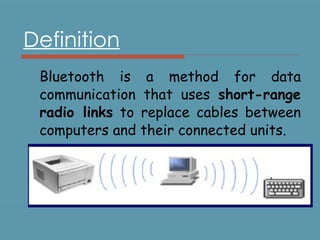
Definition Bluetooth is a method for data communication that uses  short-range radio links  to replace cables between computers and their connected units.
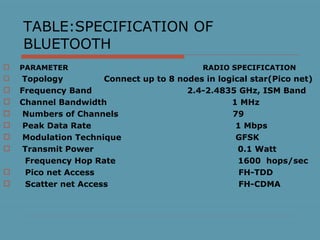
TABLE:SPECIFICATION OF BLUETOOTH PARAMETER  RADIO SPECIFICATION Topology  Connect up to 8 nodes in logical star(Pico net) Frequency Band  2.4-2.4835 GHz, ISM Band Channel Bandwidth  1 MHz Numbers of Channels  79 Peak Data Rate  1 Mbps Modulation Technique  GFSK Transmit Power  0.1 Watt Frequency Hop Rate  1600  hops/sec Pico net Access  FH-TDD Scatter net Access  FH-CDMA
ORIGINATION OF “BLUETOOTH” In 10 th  century  Harald Bluetooth  the king of Denmark  united Norway and Denmark into a single kingdom. Apparently he got that name from his penchant for blueberries.
HISTORY OF BLUETOOTH In 1994, Ericsson Mobile Communication Ltd. Started project named “Bluetooth”. In 1998, Bluetooth SIG was formed and it officially adopts the project name “Bluetooth” as the name of technology. Frequency Hopping  Spread Spectrum Technology  was used for data transformation .
In 1999, Bluetooth 1.0 & Bluetooth 1.0B Specification was released In 2000, Bluetooth headset and phone adaptor from Ericsson; the first consumer product. In 2003, Bluetooth 1.2 was released. Improved resistance to radio  frequency interference.  Ratified as IEEE 802.15.1-2005
In 2004, Bluetooth 2.0 with enhanced data rate (EDR) is released. In Jun 2007, Nokia and Bluetooth SIG announced that Wibree will be a part of Bluetooth Specification as an ultra low power Bluetooth technology.
In July 2007, Bluetooth 2.1 Core Specification is released. Extended Inquiry Response. Sniff Sub-rating. Secure Simple Pairing. Near field Communication (NFC)  Cooperation .
Comparison with other wireless  technologies 802.11 Has higher bit rate compared to Bluetooth . But  has higher power consumption. Basic a LAN technology so not a direct competitor  for Bluetooth IrDA (Infrared Data Association) Low cost but require Line of sight. Only point to point Home RF Competing technology. But current Bluetooth is better positioned in market
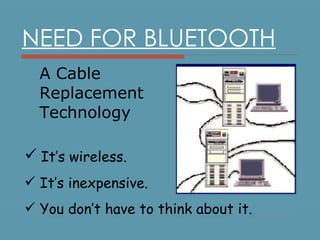
NEED FOR BLUETOOTH A Cable Replacement Technology It’s wireless. It’s inexpensive. You don’t have to think about it.
 
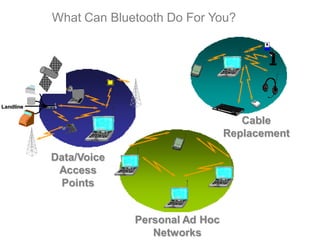
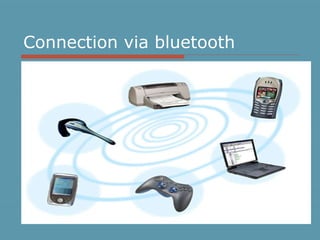
Connection via bluetooth
APPLICATION EXAMPLES: A Bluetooth–mouse A Bluetooth-keyboard  Cable-less connection to printers Use e-mail while your portable PC is still in the briefcase!
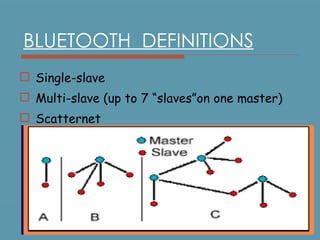
BLUETOOTH  DEFINITIONS Single-slave Multi-slave (up to 7 “slaves”on one master) Scatternet
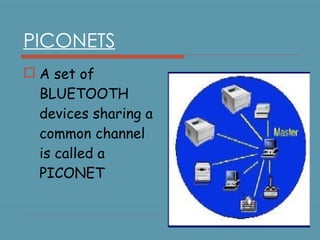
PICONETS A set of BLUETOOTH devices sharing a common channel is called a PICONET
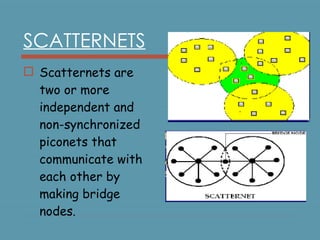
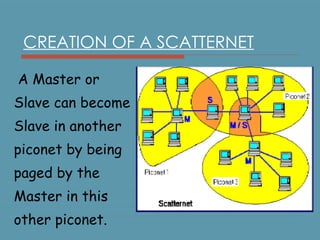
SCATTERNETS Scatternets are two or more independent and non-synchronized piconets that communicate with each other by making bridge nodes .
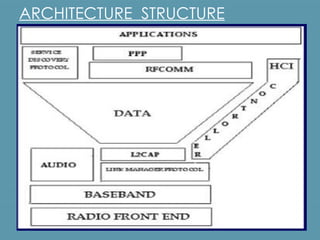
ARCHITECTURE  STRUCTURE
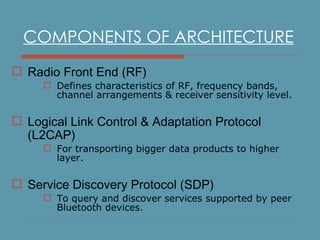
COMPONENTS OF ARCHITECTURE Radio Front End (RF) Defines characteristics of RF, frequency bands, channel arrangements & receiver sensitivity level. Logical Link Control & Adaptation Protocol (L2CAP) For transporting bigger data products to higher layer. Service Discovery Protocol (SDP) T o query and discover services supported by peer Bluetooth devices.
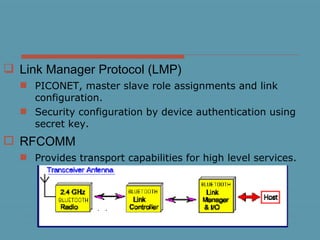
Link Manager Protocol (LMP) PICONET, master slave role assignments and link configuration. Security configuration by device authentication using secret key. RFCOMM Provides transport capabilities for high level services.
CREATION OF A SCATTERNET A Master or Slave can become Slave in another piconet by being paged by the Master in this other piconet.
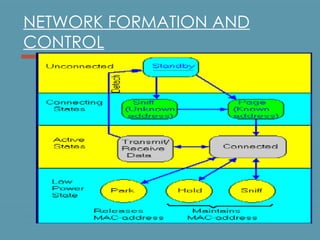
NETWORK FORMATION AND CONTROL
ADVANTAGES OF BLUETOOTH Bluetooth is used widely across countries and almost by everyone. It has simple features. It is free of charge and not added to our budget. It allow us to stay cord free. It has the ability to keep our information private. Bluetooth isn't requires a line of sight.
Advantages (contd.) It provides ranges of up to 100 meters. Bluetooth is also low power and low  processing with an overhead protocol. To put it short, the applications with Bluetooth are virtually endless.
DISADVANTAGES OF BLUETOOTH More battery power when Bluetooth is enable on the phone all day. Throughout all device, when using Bluetooth internet, the connection sometimes may run very slow so Bluetooth internet is not highly suggested for all cases. The only real downside s are the data rate and security.  Infrared can have data rates of up to 4 M Bps, which provides very fast rates for data transfer, while Bluetooth only offers 1 M Bps
CONCLUSION Bluetooth is a short range radio link wireless technology used to connect various device by a invisible link getting rid of wires. Last but not the least, WHENEVER THINK OF WIRELESS,”THINK BLUETOOTH”, this is the best way of communication.
BIBLIOGRAPHY WIKIPEDIA www.bluetooth.com E-book on Wireless Lan Techniques-RF, Wi-Fi, Bluetooth. E-book on Introduction of Bluetooth. Wireless Technology By-INTEL. E-book on Bluetooth Security.
 

Bluetooth

  • 1.
    By: Raginee RanjanSinha Roll: 06ESBEC071 BLUETOOTH
  • 2.
    Definition Bluetooth isa method for data communication that uses short-range radio links to replace cables between computers and their connected units.
  • 3.
    TABLE:SPECIFICATION OF BLUETOOTHPARAMETER RADIO SPECIFICATION Topology Connect up to 8 nodes in logical star(Pico net) Frequency Band 2.4-2.4835 GHz, ISM Band Channel Bandwidth 1 MHz Numbers of Channels 79 Peak Data Rate 1 Mbps Modulation Technique GFSK Transmit Power 0.1 Watt Frequency Hop Rate 1600 hops/sec Pico net Access FH-TDD Scatter net Access FH-CDMA
  • 4.
    ORIGINATION OF “BLUETOOTH”In 10 th century Harald Bluetooth the king of Denmark united Norway and Denmark into a single kingdom. Apparently he got that name from his penchant for blueberries.
  • 5.
    HISTORY OF BLUETOOTHIn 1994, Ericsson Mobile Communication Ltd. Started project named “Bluetooth”. In 1998, Bluetooth SIG was formed and it officially adopts the project name “Bluetooth” as the name of technology. Frequency Hopping Spread Spectrum Technology was used for data transformation .
  • 6.
    In 1999, Bluetooth1.0 & Bluetooth 1.0B Specification was released In 2000, Bluetooth headset and phone adaptor from Ericsson; the first consumer product. In 2003, Bluetooth 1.2 was released. Improved resistance to radio frequency interference. Ratified as IEEE 802.15.1-2005
  • 7.
    In 2004, Bluetooth2.0 with enhanced data rate (EDR) is released. In Jun 2007, Nokia and Bluetooth SIG announced that Wibree will be a part of Bluetooth Specification as an ultra low power Bluetooth technology.
  • 8.
    In July 2007,Bluetooth 2.1 Core Specification is released. Extended Inquiry Response. Sniff Sub-rating. Secure Simple Pairing. Near field Communication (NFC) Cooperation .
  • 9.
    Comparison with otherwireless technologies 802.11 Has higher bit rate compared to Bluetooth . But has higher power consumption. Basic a LAN technology so not a direct competitor for Bluetooth IrDA (Infrared Data Association) Low cost but require Line of sight. Only point to point Home RF Competing technology. But current Bluetooth is better positioned in market
  • 10.
    NEED FOR BLUETOOTHA Cable Replacement Technology It’s wireless. It’s inexpensive. You don’t have to think about it.
  • 11.
  • 12.
  • 13.
    APPLICATION EXAMPLES: ABluetooth–mouse A Bluetooth-keyboard Cable-less connection to printers Use e-mail while your portable PC is still in the briefcase!
  • 14.
    BLUETOOTH DEFINITIONSSingle-slave Multi-slave (up to 7 “slaves”on one master) Scatternet
  • 15.
    PICONETS A setof BLUETOOTH devices sharing a common channel is called a PICONET
  • 16.
    SCATTERNETS Scatternets aretwo or more independent and non-synchronized piconets that communicate with each other by making bridge nodes .
  • 17.
  • 18.
    COMPONENTS OF ARCHITECTURERadio Front End (RF) Defines characteristics of RF, frequency bands, channel arrangements & receiver sensitivity level. Logical Link Control & Adaptation Protocol (L2CAP) For transporting bigger data products to higher layer. Service Discovery Protocol (SDP) T o query and discover services supported by peer Bluetooth devices.
  • 19.
    Link Manager Protocol(LMP) PICONET, master slave role assignments and link configuration. Security configuration by device authentication using secret key. RFCOMM Provides transport capabilities for high level services.
  • 20.
    CREATION OF ASCATTERNET A Master or Slave can become Slave in another piconet by being paged by the Master in this other piconet.
  • 21.
  • 22.
    ADVANTAGES OF BLUETOOTHBluetooth is used widely across countries and almost by everyone. It has simple features. It is free of charge and not added to our budget. It allow us to stay cord free. It has the ability to keep our information private. Bluetooth isn't requires a line of sight.
  • 23.
    Advantages (contd.) Itprovides ranges of up to 100 meters. Bluetooth is also low power and low processing with an overhead protocol. To put it short, the applications with Bluetooth are virtually endless.
  • 24.
    DISADVANTAGES OF BLUETOOTHMore battery power when Bluetooth is enable on the phone all day. Throughout all device, when using Bluetooth internet, the connection sometimes may run very slow so Bluetooth internet is not highly suggested for all cases. The only real downside s are the data rate and security. Infrared can have data rates of up to 4 M Bps, which provides very fast rates for data transfer, while Bluetooth only offers 1 M Bps
  • 25.
    CONCLUSION Bluetooth isa short range radio link wireless technology used to connect various device by a invisible link getting rid of wires. Last but not the least, WHENEVER THINK OF WIRELESS,”THINK BLUETOOTH”, this is the best way of communication.
  • 26.
    BIBLIOGRAPHY WIKIPEDIA www.bluetooth.comE-book on Wireless Lan Techniques-RF, Wi-Fi, Bluetooth. E-book on Introduction of Bluetooth. Wireless Technology By-INTEL. E-book on Bluetooth Security.
  • 27.