Huffman Coding Vida Movahedi October 2006
Contents A simple example Definitions Huffman Coding Algorithm Image Compression
A simple example Suppose we have a message consisting of 5 symbols, e.g. [ ►♣♣♠☻►♣☼►☻] How can we code this message using 0/1 so the coded message will have minimum length (for transmission or saving!) 5 symbols    at least 3 bits  For a simple encoding, length of code is 10*3=30 bits
A simple example – cont. Intuition: Those symbols that are more frequent should have smaller codes, yet since their length is not the same, there must be a way of distinguishing each code For Huffman code, length of encoded message  will be  ►♣♣♠☻►♣☼►☻ =3*2 +3*2+2*2+3+3=24bits
Definitions An  ensemble  X is a triple (x, A x , P x ) x: value of a random variable A x : set of possible values for x , A x ={a 1 , a 2 , …, a I } P x : probability for each value , P x ={p 1 , p 2 , …, p I } where P(x)=P(x=a i )=p i , p i > 0,  Shannon information content  of x h(x) = log 2 (1/P(x)) Entropy  of x i a i p i h(p i ) 1 a .0575 4.1 2 b .0128 6.3 3 c .0263 5.2 .. .. .. 26 z .0007 10.4
Source Coding Theorem There exists a variable-length encoding C of an ensemble X such that the average length of an encoded symbol,  L(C,X),  satisfies  L(C,X)  [H(X), H(X)+1) The Huffman coding algorithm produces optimal symbol codes
Symbol Codes Notations: A N : all strings of length N A + : all strings of finite length {0,1} 3 ={000,001,010,…,111} {0,1} + ={0,1,00,01,10,11,000,001,…} A symbol code C for an ensemble X is a mapping from A x  (range of x values) to {0,1} + c(x): codeword for x, l(x): length of codeword
Example Ensemble X: A x = {  a  ,  b ,  c  ,  d  } P x = { 1/2  , 1/4 , 1/8 ,  1/8 } c(a)= 1000 c + (acd)= 100000100001 (called the  extended  code) 4 0001 d 4 0010 c 4 0100 b 4 1000 a l i c(a i ) a i C 0 :
Any encoded string must have a  unique  decoding A code C(X) is  uniquely decodable  if, under the extended code C + , no two distinct strings have the same encoding, i.e.
The symbol code must be easy to decode If possible to identify end of a codeword as soon as it arrives  no codeword can be a prefix of another codeword A symbol code is called a  prefix code  if no code word is a prefix of any other codeword (also called  prefix-free  code,  instantaneous  code or  self-punctuating  code)
The code should achieve  as much compression as possible The  expected length  L(C,X) of symbol code C for X is
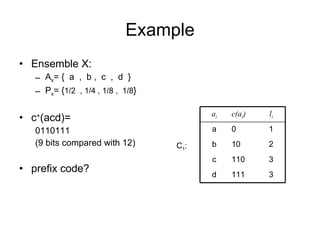
Example Ensemble X: A x = {  a  ,  b ,  c  ,  d  } P x = { 1/2  , 1/4 , 1/8 ,  1/8 } c + (acd)= 0110111 (9 bits compared with 12) prefix code? 3 111 d 3 110 c 2 10 b 1 0 a l i c(a i ) a i C 1 :
The Huffman Coding algorithm- History In 1951, David Huffman and his MIT information theory classmates given the choice of a term paper or a final exam Huffman hit upon the idea of using a frequency-sorted binary tree and quickly proved this method the most efficient. In doing so, the student outdid his professor, who had worked with information theory inventor Claude Shannon to develop a similar code.  Huffman built the tree from the bottom up instead of from the top down
Huffman Coding Algorithm Take the two least probable symbols in the alphabet (longest codewords, equal length, differing in last digit) Combine these two symbols into a single symbol, and repeat.
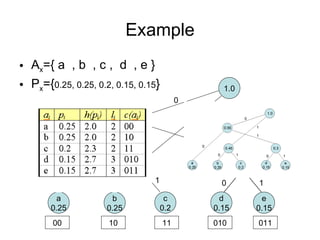
Example A x ={ a  , b  , c ,  d  , e } P x ={ 0.25, 0.25, 0.2, 0.15, 0.15 } d 0.15 e 0.15 b 0.25 c 0.2 a 0.25 00 10 11 010 011 0.3 0 1 0.45 0 1 0.55 0 1 1.0 0 1
Statements Lower bound on expected length is H(X) There is no better symbol code for a source than the Huffman code Constructing a binary tree top-down is suboptimal
Disadvantages of the Huffman Code Changing ensemble If the ensemble changes   the frequencies and probabilities change    the optimal coding changes e.g. in text compression symbol frequencies vary with context Re-computing the Huffman code by running through the entire file in advance?! Saving/ transmitting the code too?! Does not consider ‘blocks of symbols’ ‘ strings_of_ch’   the next nine symbols are predictable ‘aracters_’ , but bits are used without conveying any new information
Variations n -ary Huffman coding Uses {0, 1, .., n-1} (not just {0,1}) Adaptive Huffman coding Calculates frequencies dynamically based on recent actual frequencies Huffman template algorithm Generalizing  probabilities    any weight Combining methods (addition)    any function Can solve other min. problems e.g.  max [w i +length(c i )]
Image Compression 2-stage Coding technique A linear predictor such as DPCM, or some linear predicting function    Decorrelate the raw image data A standard coding technique, such as Huffman coding, arithmetic coding, … Lossless JPEG: - version 1: DPCM with arithmetic coding - version 2: DPCM with Huffman coding
DPCM Differential Pulse Code Modulation DPCM is an efficient way to encode highly correlated analog signals into binary form suitable for digital transmission, storage, or input to a digital computer Patent by Cutler (1952)
DPCM
Huffman Coding Algorithm  for Image Compression Step 1. Build a Huffman tree by sorting the histogram and successively combine the two bins of the lowest value until only one bin remains. Step 2. Encode the Huffman tree and save the Huffman tree with the coded value. Step 3. Encode the residual image.
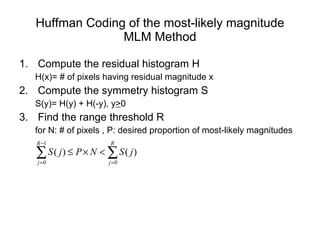
Huffman Coding of the most-likely magnitude MLM Method Compute the residual histogram H H(x)= # of pixels having residual magnitude x Compute the symmetry histogram S S(y)= H(y) + H(-y), y > 0 Find the range threshold R  for N: # of pixels , P: desired proportion of most-likely magnitudes
References MacKay, D.J.C. , Information Theory, Inference, and Learning Algorithms, Cambridge University Press, 2003. Wikipedia,  http://en.wikipedia.org/wiki/Huffman_coding Hu, Y.C. and Chang, C.C., “A new losseless compression scheme based on Huffman coding scheme for image compression”,  O’Neal

Huffman Coding

  • 1.
    Huffman Coding VidaMovahedi October 2006
  • 2.
    Contents A simpleexample Definitions Huffman Coding Algorithm Image Compression
  • 3.
    A simple exampleSuppose we have a message consisting of 5 symbols, e.g. [ ►♣♣♠☻►♣☼►☻] How can we code this message using 0/1 so the coded message will have minimum length (for transmission or saving!) 5 symbols  at least 3 bits For a simple encoding, length of code is 10*3=30 bits
  • 4.
    A simple example– cont. Intuition: Those symbols that are more frequent should have smaller codes, yet since their length is not the same, there must be a way of distinguishing each code For Huffman code, length of encoded message will be ►♣♣♠☻►♣☼►☻ =3*2 +3*2+2*2+3+3=24bits
  • 5.
    Definitions An ensemble X is a triple (x, A x , P x ) x: value of a random variable A x : set of possible values for x , A x ={a 1 , a 2 , …, a I } P x : probability for each value , P x ={p 1 , p 2 , …, p I } where P(x)=P(x=a i )=p i , p i > 0, Shannon information content of x h(x) = log 2 (1/P(x)) Entropy of x i a i p i h(p i ) 1 a .0575 4.1 2 b .0128 6.3 3 c .0263 5.2 .. .. .. 26 z .0007 10.4
  • 6.
    Source Coding TheoremThere exists a variable-length encoding C of an ensemble X such that the average length of an encoded symbol, L(C,X), satisfies L(C,X)  [H(X), H(X)+1) The Huffman coding algorithm produces optimal symbol codes
  • 7.
    Symbol Codes Notations:A N : all strings of length N A + : all strings of finite length {0,1} 3 ={000,001,010,…,111} {0,1} + ={0,1,00,01,10,11,000,001,…} A symbol code C for an ensemble X is a mapping from A x (range of x values) to {0,1} + c(x): codeword for x, l(x): length of codeword
  • 8.
    Example Ensemble X:A x = { a , b , c , d } P x = { 1/2 , 1/4 , 1/8 , 1/8 } c(a)= 1000 c + (acd)= 100000100001 (called the extended code) 4 0001 d 4 0010 c 4 0100 b 4 1000 a l i c(a i ) a i C 0 :
  • 9.
    Any encoded stringmust have a unique decoding A code C(X) is uniquely decodable if, under the extended code C + , no two distinct strings have the same encoding, i.e.
  • 10.
    The symbol codemust be easy to decode If possible to identify end of a codeword as soon as it arrives  no codeword can be a prefix of another codeword A symbol code is called a prefix code if no code word is a prefix of any other codeword (also called prefix-free code, instantaneous code or self-punctuating code)
  • 11.
    The code shouldachieve as much compression as possible The expected length L(C,X) of symbol code C for X is
  • 12.
    Example Ensemble X:A x = { a , b , c , d } P x = { 1/2 , 1/4 , 1/8 , 1/8 } c + (acd)= 0110111 (9 bits compared with 12) prefix code? 3 111 d 3 110 c 2 10 b 1 0 a l i c(a i ) a i C 1 :
  • 13.
    The Huffman Codingalgorithm- History In 1951, David Huffman and his MIT information theory classmates given the choice of a term paper or a final exam Huffman hit upon the idea of using a frequency-sorted binary tree and quickly proved this method the most efficient. In doing so, the student outdid his professor, who had worked with information theory inventor Claude Shannon to develop a similar code. Huffman built the tree from the bottom up instead of from the top down
  • 14.
    Huffman Coding AlgorithmTake the two least probable symbols in the alphabet (longest codewords, equal length, differing in last digit) Combine these two symbols into a single symbol, and repeat.
  • 15.
    Example A x={ a , b , c , d , e } P x ={ 0.25, 0.25, 0.2, 0.15, 0.15 } d 0.15 e 0.15 b 0.25 c 0.2 a 0.25 00 10 11 010 011 0.3 0 1 0.45 0 1 0.55 0 1 1.0 0 1
  • 16.
    Statements Lower boundon expected length is H(X) There is no better symbol code for a source than the Huffman code Constructing a binary tree top-down is suboptimal
  • 17.
    Disadvantages of theHuffman Code Changing ensemble If the ensemble changes  the frequencies and probabilities change  the optimal coding changes e.g. in text compression symbol frequencies vary with context Re-computing the Huffman code by running through the entire file in advance?! Saving/ transmitting the code too?! Does not consider ‘blocks of symbols’ ‘ strings_of_ch’  the next nine symbols are predictable ‘aracters_’ , but bits are used without conveying any new information
  • 18.
    Variations n -aryHuffman coding Uses {0, 1, .., n-1} (not just {0,1}) Adaptive Huffman coding Calculates frequencies dynamically based on recent actual frequencies Huffman template algorithm Generalizing probabilities  any weight Combining methods (addition)  any function Can solve other min. problems e.g. max [w i +length(c i )]
  • 19.
    Image Compression 2-stageCoding technique A linear predictor such as DPCM, or some linear predicting function  Decorrelate the raw image data A standard coding technique, such as Huffman coding, arithmetic coding, … Lossless JPEG: - version 1: DPCM with arithmetic coding - version 2: DPCM with Huffman coding
  • 20.
    DPCM Differential PulseCode Modulation DPCM is an efficient way to encode highly correlated analog signals into binary form suitable for digital transmission, storage, or input to a digital computer Patent by Cutler (1952)
  • 21.
  • 22.
    Huffman Coding Algorithm for Image Compression Step 1. Build a Huffman tree by sorting the histogram and successively combine the two bins of the lowest value until only one bin remains. Step 2. Encode the Huffman tree and save the Huffman tree with the coded value. Step 3. Encode the residual image.
  • 23.
    Huffman Coding ofthe most-likely magnitude MLM Method Compute the residual histogram H H(x)= # of pixels having residual magnitude x Compute the symmetry histogram S S(y)= H(y) + H(-y), y > 0 Find the range threshold R for N: # of pixels , P: desired proportion of most-likely magnitudes
  • 24.
    References MacKay, D.J.C., Information Theory, Inference, and Learning Algorithms, Cambridge University Press, 2003. Wikipedia, http://en.wikipedia.org/wiki/Huffman_coding Hu, Y.C. and Chang, C.C., “A new losseless compression scheme based on Huffman coding scheme for image compression”, O’Neal