COLOR FUNDAMENTALS
AND
COLOR MODELS
INTRODUCTION
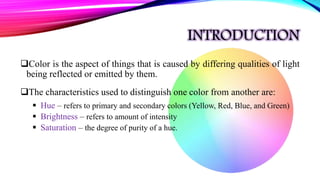
Color is the aspect of things that is caused by differing qualities of light
being reflected or emitted by them.
The characteristics used to distinguish one color from another are:
 Hue – refers to primary and secondary colors (Yellow, Red, Blue, and Green)
 Brightness – refers to amount of intensity
 Saturation – the degree of purity of a hue.
COLOR IN IMAGE PROCESSING
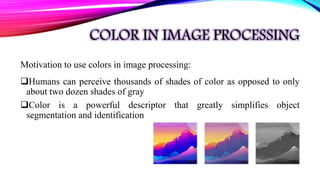
Motivation to use colors in image processing:
Humans can perceive thousands of shades of color as opposed to only
about two dozen shades of gray
Color is a powerful descriptor that greatly simplifies object
segmentation and identification
COLOR IN IMAGE PROCESSING
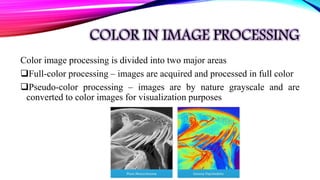
Color image processing is divided into two major areas
Full-color processing – images are acquired and processed in full color
Pseudo-color processing – images are by nature grayscale and are
converted to color images for visualization purposes
COLOR FUNDAMENTALS
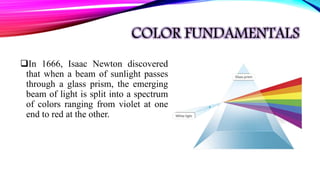
In 1666, Isaac Newton discovered
that when a beam of sunlight passes
through a glass prism, the emerging
beam of light is split into a spectrum
of colors ranging from violet at one
end to red at the other.
COLOR FUNDAMENTALS
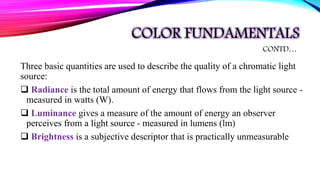
Three basic quantities are used to describe the quality of a chromatic light
source:
 Radiance is the total amount of energy that flows from the light source -
measured in watts (W).
 Luminance gives a measure of the amount of energy an observer
perceives from a light source - measured in lumens (lm)
 Brightness is a subjective descriptor that is practically unmeasurable
CONTD…
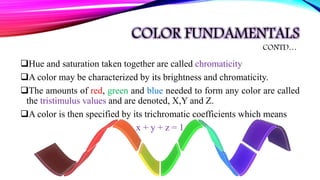
Hue and saturation taken together are called chromaticity
A color may be characterized by its brightness and chromaticity.
The amounts of red, green and blue needed to form any color are called
the tristimulus values and are denoted, X,Y and Z.
A color is then specified by its trichromatic coefficients which means
x + y + z = 1
COLOR FUNDAMENTALS
CONTD…
COLOR FUNDAMENTALS
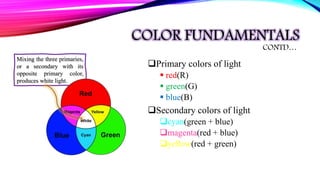
Primary colors of light
 red(R)
 green(G)
 blue(B)
Secondary colors of light
cyan(green + blue)
magenta(red + blue)
yellow(red + green)
CONTD…
Mixing the three primaries,
or a secondary with its
opposite primary color,
produces white light.
COLOR FUNDAMENTALS
CONTD…
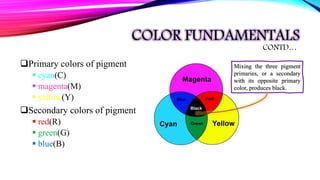
Primary colors of pigment
 cyan(C)
 magenta(M)
 yellow(Y)
Secondary colors of pigment
 red(R)
 green(G)
 blue(B)
Mixing the three pigment
primaries, or a secondary
with its opposite primary
color, produces black.
COLOR MODELS
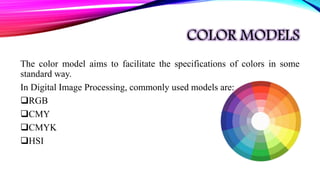
The color model aims to facilitate the specifications of colors in some
standard way.
In Digital Image Processing, commonly used models are:
RGB
CMY
CMYK
HSI
COLOR MODELS
RGB
Each color appears in its primary colors red,
green, and blue
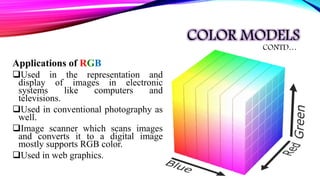
Based on Cartesian coordinate system
All color values R, G and B have been
normalized in the range [0, 1]
We can represent each of R, G and B from 0
to 255
CONTD…
COLOR MODELS
RGB
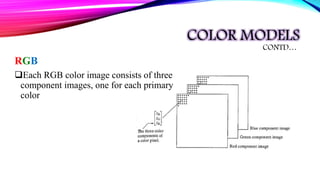
Each RGB color image consists of three
component images, one for each primary
color
CONTD…
COLOR MODELS
RGB
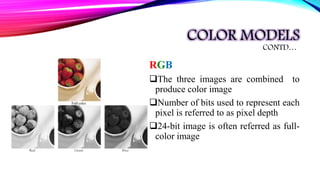
The three images are combined to
produce color image
Number of bits used to represent each
pixel is referred to as pixel depth
24-bit image is often referred as full-
color image
CONTD…
COLOR MODELS
Applications of RGB
Used in the representation and
display of images in electronic
systems like computers and
televisions.
Used in conventional photography as
well.
Image scanner which scans images
and converts it to a digital image
mostly supports RGB color.
Used in web graphics.
CONTD…
CMY
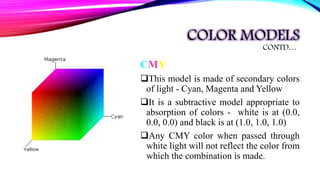
This model is made of secondary colors
of light - Cyan, Magenta and Yellow
It is a subtractive model appropriate to
absorption of colors - white is at (0.0,
0.0, 0.0) and black is at (1.0, 1.0, 1.0)
Any CMY color when passed through
white light will not reflect the color from
which the combination is made.
COLOR MODELS
CONTD…
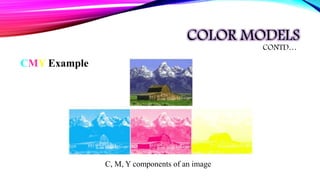
CMY Example
COLOR MODELS
CONTD…
C, M, Y components of an image
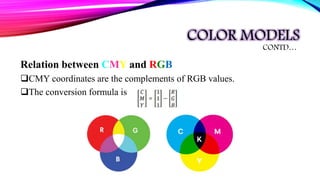
Relation between CMY and RGB
CMY coordinates are the complements of RGB values.
The conversion formula is
COLOR MODELS
CONTD…
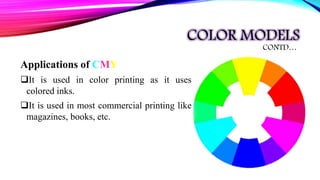
Applications of CMY
It is used in color printing as it uses
colored inks.
It is used in most commercial printing like
magazines, books, etc.
COLOR MODELS
CONTD…
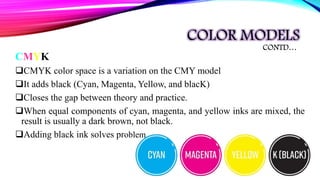
CMYK
CMYK color space is a variation on the CMY model
It adds black (Cyan, Magenta, Yellow, and blacK)
Closes the gap between theory and practice.
When equal components of cyan, magenta, and yellow inks are mixed, the
result is usually a dark brown, not black.
Adding black ink solves problem.
COLOR MODELS
CONTD…
CONTD…
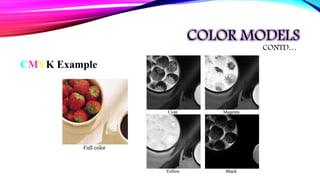
CMYK Example
COLOR MODELS
CONTD…
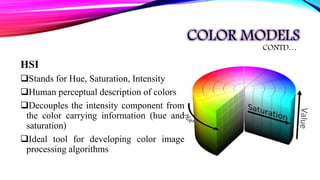
HSI
Stands for Hue, Saturation, Intensity
Human perceptual description of colors
Decouples the intensity component from
the color carrying information (hue and
saturation)
Ideal tool for developing color image
processing algorithms
COLOR MODELS
CONTD…
COLOR MODELS
CONTD…
HUE SATURATION INTENSITY
Component that
describes a pure color
(pure yellow, orange or
red)
Component represents the
measure of the degree to
which color is mixed with
white color.
0 degree – Red
120 degree – Green
240 degree – Blue
60 degree – Yellow
300 degree – Magenta
Component refers
to grey level.
Range is [0, 1]
 0 means white
 1 means black
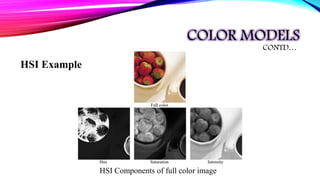
HSI Example
COLOR MODELS
CONTD…
HSI Components of full color image
HSI AND RGB
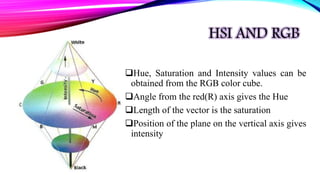
Hue, Saturation and Intensity values can be
obtained from the RGB color cube.
Angle from the red(R) axis gives the Hue
Length of the vector is the saturation
Position of the plane on the vertical axis gives
intensity
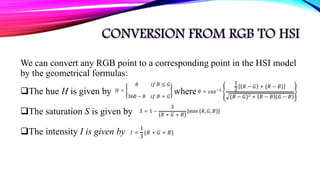
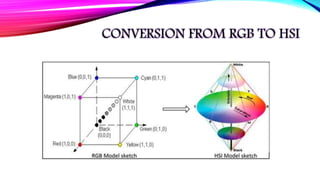
CONVERSION FROM RGB TO HSI
We can convert any RGB point to a corresponding point in the HSI model
by the geometrical formulas:
The hue H is given by where
The saturation S is given by
The intensity I is given by
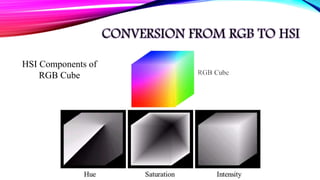
CONVERSION FROM RGB TO HSI
HSI Components of
RGB Cube
CONVERSION FROM HSI TO RGB
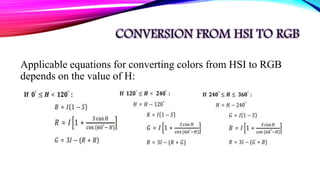
Applicable equations for converting colors from HSI to RGB
depends on the value of H:
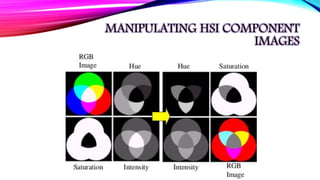
MANIPULATING HSI COMPONENT
IMAGES
Thank you!

Color fundamentals and color models - Digital Image Processing

  • 1.
  • 2.
    INTRODUCTION Color is theaspect of things that is caused by differing qualities of light being reflected or emitted by them. The characteristics used to distinguish one color from another are:  Hue – refers to primary and secondary colors (Yellow, Red, Blue, and Green)  Brightness – refers to amount of intensity  Saturation – the degree of purity of a hue.
  • 3.
    COLOR IN IMAGEPROCESSING Motivation to use colors in image processing: Humans can perceive thousands of shades of color as opposed to only about two dozen shades of gray Color is a powerful descriptor that greatly simplifies object segmentation and identification
  • 4.
    COLOR IN IMAGEPROCESSING Color image processing is divided into two major areas Full-color processing – images are acquired and processed in full color Pseudo-color processing – images are by nature grayscale and are converted to color images for visualization purposes
  • 5.
    COLOR FUNDAMENTALS In 1666,Isaac Newton discovered that when a beam of sunlight passes through a glass prism, the emerging beam of light is split into a spectrum of colors ranging from violet at one end to red at the other.
  • 6.
    COLOR FUNDAMENTALS Three basicquantities are used to describe the quality of a chromatic light source:  Radiance is the total amount of energy that flows from the light source - measured in watts (W).  Luminance gives a measure of the amount of energy an observer perceives from a light source - measured in lumens (lm)  Brightness is a subjective descriptor that is practically unmeasurable CONTD…
  • 7.
    Hue and saturationtaken together are called chromaticity A color may be characterized by its brightness and chromaticity. The amounts of red, green and blue needed to form any color are called the tristimulus values and are denoted, X,Y and Z. A color is then specified by its trichromatic coefficients which means x + y + z = 1 COLOR FUNDAMENTALS CONTD…
  • 8.
    COLOR FUNDAMENTALS Primary colorsof light  red(R)  green(G)  blue(B) Secondary colors of light cyan(green + blue) magenta(red + blue) yellow(red + green) CONTD… Mixing the three primaries, or a secondary with its opposite primary color, produces white light.
  • 9.
    COLOR FUNDAMENTALS CONTD… Primary colorsof pigment  cyan(C)  magenta(M)  yellow(Y) Secondary colors of pigment  red(R)  green(G)  blue(B) Mixing the three pigment primaries, or a secondary with its opposite primary color, produces black.
  • 10.
    COLOR MODELS The colormodel aims to facilitate the specifications of colors in some standard way. In Digital Image Processing, commonly used models are: RGB CMY CMYK HSI
  • 11.
    COLOR MODELS RGB Each colorappears in its primary colors red, green, and blue Based on Cartesian coordinate system All color values R, G and B have been normalized in the range [0, 1] We can represent each of R, G and B from 0 to 255 CONTD…
  • 12.
    COLOR MODELS RGB Each RGBcolor image consists of three component images, one for each primary color CONTD…
  • 13.
    COLOR MODELS RGB The threeimages are combined to produce color image Number of bits used to represent each pixel is referred to as pixel depth 24-bit image is often referred as full- color image CONTD…
  • 14.
    COLOR MODELS Applications ofRGB Used in the representation and display of images in electronic systems like computers and televisions. Used in conventional photography as well. Image scanner which scans images and converts it to a digital image mostly supports RGB color. Used in web graphics. CONTD…
  • 15.
    CMY This model ismade of secondary colors of light - Cyan, Magenta and Yellow It is a subtractive model appropriate to absorption of colors - white is at (0.0, 0.0, 0.0) and black is at (1.0, 1.0, 1.0) Any CMY color when passed through white light will not reflect the color from which the combination is made. COLOR MODELS CONTD…
  • 16.
    CMY Example COLOR MODELS CONTD… C,M, Y components of an image
  • 17.
    Relation between CMYand RGB CMY coordinates are the complements of RGB values. The conversion formula is COLOR MODELS CONTD…
  • 18.
    Applications of CMY Itis used in color printing as it uses colored inks. It is used in most commercial printing like magazines, books, etc. COLOR MODELS CONTD…
  • 19.
    CMYK CMYK color spaceis a variation on the CMY model It adds black (Cyan, Magenta, Yellow, and blacK) Closes the gap between theory and practice. When equal components of cyan, magenta, and yellow inks are mixed, the result is usually a dark brown, not black. Adding black ink solves problem. COLOR MODELS CONTD… CONTD…
  • 20.
  • 21.
    HSI Stands for Hue,Saturation, Intensity Human perceptual description of colors Decouples the intensity component from the color carrying information (hue and saturation) Ideal tool for developing color image processing algorithms COLOR MODELS CONTD…
  • 22.
    COLOR MODELS CONTD… HUE SATURATIONINTENSITY Component that describes a pure color (pure yellow, orange or red) Component represents the measure of the degree to which color is mixed with white color. 0 degree – Red 120 degree – Green 240 degree – Blue 60 degree – Yellow 300 degree – Magenta Component refers to grey level. Range is [0, 1]  0 means white  1 means black
  • 23.
    HSI Example COLOR MODELS CONTD… HSIComponents of full color image
  • 24.
    HSI AND RGB Hue,Saturation and Intensity values can be obtained from the RGB color cube. Angle from the red(R) axis gives the Hue Length of the vector is the saturation Position of the plane on the vertical axis gives intensity
  • 25.
    CONVERSION FROM RGBTO HSI We can convert any RGB point to a corresponding point in the HSI model by the geometrical formulas: The hue H is given by where The saturation S is given by The intensity I is given by
  • 26.
  • 27.
    CONVERSION FROM RGBTO HSI HSI Components of RGB Cube
  • 28.
    CONVERSION FROM HSITO RGB Applicable equations for converting colors from HSI to RGB depends on the value of H:
  • 29.
  • 30.