Presented By:
M.Divya Sushma
 (08PA1A0433)
Digital image processing is a rapidly evolving field with growing
applications in science and engineering . Image processing holds the
probability of developing the ultimate machine that could perform
the visual function of all living beings.

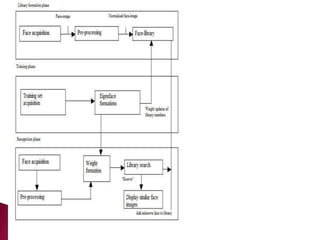
            Here an approach is made to detect and identify a human
face and describe the algorithm for software implementation of face
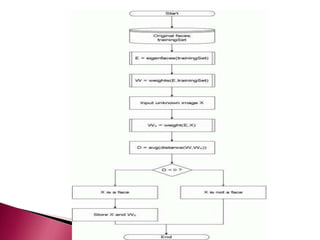
recognition system using eigenface. In eigenface method, training
set is prepared first and then the person is recognized by comparing
characteristics of the face to those of known individuals.
Face is our primary focous of interaction with society, face

communicates identify, Emotion, race and age. It is also quite

useful for judging gender, size and perhaps even character Of

the person.
The major approaches used for face recognition are


1.Featured based approach


2.Eiganface based approach
1.Feature based approach:
           First order features values

           Second order features values

2. Eigen Face Based Approach:
HISTORY:


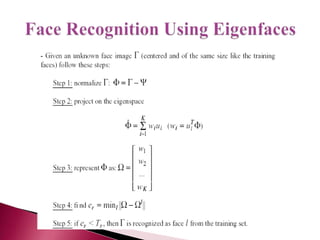
HOW EIGEN FACES WILL GENERATED:
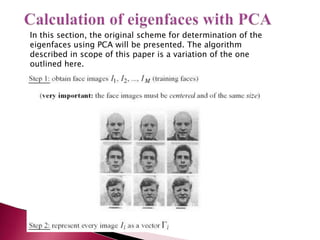
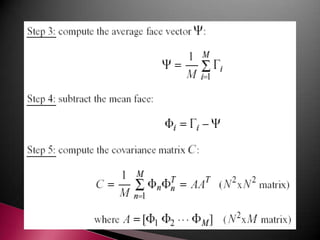
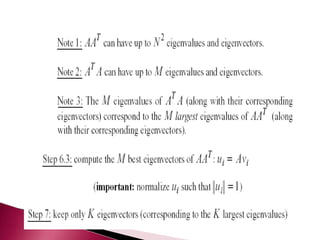
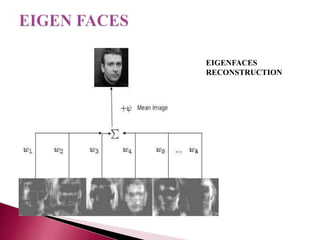
In this section, the original scheme for determination of the
eigenfaces using PCA will be presented. The algorithm
described in scope of this paper is a variation of the one
outlined here.
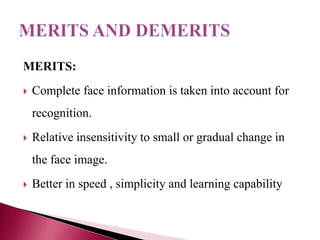
MERITS:
   Complete face information is taken into account for
    recognition.
   Relative insensitivity to small or gradual change in
    the face image.
   Better in speed , simplicity and learning capability
DEMERITS:
   If lighting effects and the position of the face with respect to
    the camera is varied Greately then accuracy will effect.
   Only gray scale images can be detected
   A noisy image or partially occluded face causes recognition
    performance to degrade gracefully.
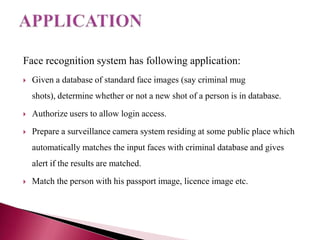
Face recognition system has following application:
   Given a database of standard face images (say criminal mug
    shots), determine whether or not a new shot of a person is in database.
   Authorize users to allow login access.
   Prepare a surveillance camera system residing at some public place which
    automatically matches the input faces with criminal database and gives
    alert if the results are matched.
   Match the person with his passport image, licence image etc.
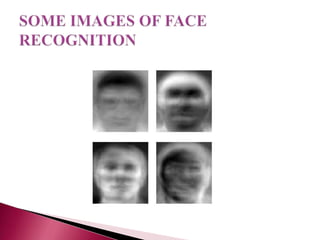
EIGENFACES
RECONSTRUCTION
   Face Recognition has been successfully implemented
    using eigenface approach. Eigenface approach of face
    recognition has been found to be a robust technique
    that can be used in security systems
   T. M. Mitchell. Machine Learning. McGraw-Hill International Editions, 1997.

    D. Pissarenko. Neural networks for financial time series prediction: Overview over recent research. BSc
    thesis, 2002.

    L. I. Smith. A tutorial on principal components analysis, February 2002.
    URL http://www.cs.otago.ac.nz/cosc453/student_tutorials/principal_components.pdf. (URL accessed on
    November 27, 2002).

    M. Turk and A. Pentland. Eigenfaces for recognition. Journal of Cognitive Neuroscience, 3 (1), 1991a.
    URL http://www.cs.ucsb.edu/ mturk/Papers/jcn.pdf. (URL accessed on November 27, 2002).

    M. A. Turk and A. P. Pentland. Face recognition using eigenfaces. In Proc. of Computer Vision and
    Pattern Recognition, pages 586-591. IEEE, June 1991b.
    URLhttp://www.cs.wisc.edu/ dyer/cs540/handouts/mturk-CVPR91.pdf. (URL accessed on November
    27, 2002).
Facial recognition system

Facial recognition system

  • 1.
  • 2.
    Digital image processingis a rapidly evolving field with growing applications in science and engineering . Image processing holds the probability of developing the ultimate machine that could perform the visual function of all living beings. Here an approach is made to detect and identify a human face and describe the algorithm for software implementation of face recognition system using eigenface. In eigenface method, training set is prepared first and then the person is recognized by comparing characteristics of the face to those of known individuals.
  • 3.
    Face is ourprimary focous of interaction with society, face communicates identify, Emotion, race and age. It is also quite useful for judging gender, size and perhaps even character Of the person.
  • 4.
    The major approachesused for face recognition are 1.Featured based approach 2.Eiganface based approach
  • 5.
    1.Feature based approach: First order features values Second order features values 2. Eigen Face Based Approach:
  • 8.
    HISTORY: HOW EIGEN FACESWILL GENERATED:
  • 11.
    In this section,the original scheme for determination of the eigenfaces using PCA will be presented. The algorithm described in scope of this paper is a variation of the one outlined here.
  • 16.
    MERITS:  Complete face information is taken into account for recognition.  Relative insensitivity to small or gradual change in the face image.  Better in speed , simplicity and learning capability
  • 17.
    DEMERITS:  If lighting effects and the position of the face with respect to the camera is varied Greately then accuracy will effect.  Only gray scale images can be detected  A noisy image or partially occluded face causes recognition performance to degrade gracefully.
  • 18.
    Face recognition systemhas following application:  Given a database of standard face images (say criminal mug shots), determine whether or not a new shot of a person is in database.  Authorize users to allow login access.  Prepare a surveillance camera system residing at some public place which automatically matches the input faces with criminal database and gives alert if the results are matched.  Match the person with his passport image, licence image etc.
  • 20.
  • 21.
    Face Recognition has been successfully implemented using eigenface approach. Eigenface approach of face recognition has been found to be a robust technique that can be used in security systems
  • 22.
    T. M. Mitchell. Machine Learning. McGraw-Hill International Editions, 1997.  D. Pissarenko. Neural networks for financial time series prediction: Overview over recent research. BSc thesis, 2002.  L. I. Smith. A tutorial on principal components analysis, February 2002. URL http://www.cs.otago.ac.nz/cosc453/student_tutorials/principal_components.pdf. (URL accessed on November 27, 2002).  M. Turk and A. Pentland. Eigenfaces for recognition. Journal of Cognitive Neuroscience, 3 (1), 1991a. URL http://www.cs.ucsb.edu/ mturk/Papers/jcn.pdf. (URL accessed on November 27, 2002).  M. A. Turk and A. P. Pentland. Face recognition using eigenfaces. In Proc. of Computer Vision and Pattern Recognition, pages 586-591. IEEE, June 1991b. URLhttp://www.cs.wisc.edu/ dyer/cs540/handouts/mturk-CVPR91.pdf. (URL accessed on November 27, 2002).