PRODUCT PLANNING AND PRODUCT
CONTROL
UNIT - III
PRODUCT PLANNING
 Evaluation of range
 Pricing of existing and new products
 Pricing based on future market requirements
 Pricing to satisfy company objectives
 Specify the design and development support
PRODUCT PLANNING
 Product development not only for new
products
 It is also for existing products
NEED FOR PRODUCT
PLANNING
1. Need determined from current deficiencies
1. Wanted occurring in present condition
2. Need determined from anticipated
deficiencies
1. Need through prediction of social, technology etc.
PRODUCT PLANNING
PROCESS (8mark)
 Everyone wants a new product
 And every one make the product successful
STEPS:
1. Marketing and marketing analysis
2. Performance and feasibility studies
3. Advanced product planning
1. Marketing and marketing analysis
 Marketing does not require the engineering
involvement
 Technical details for promotion
 Technical support for answering the customer
queries
 Product planned – to satisfy customer needs or not?
 Availability of proper technology to satisfy needs
2. Performance and feasibility studies
 It is to extend the market analysis
 Arriving at the preferred system configuration
 Firm will offer the product.
 ELEMENTS OF FESIBILITY:
 A detailed need analysis
 System operation requirments
 Maintenance support requirments
 Identification of alternate configuration
 Screening and evaluating of available resources’
3. Advanced product planning
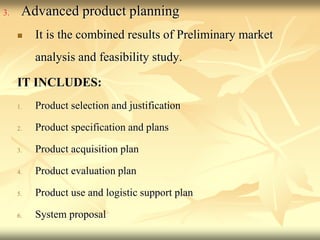
 It is the combined results of Preliminary market
analysis and feasibility study.
IT INCLUDES:
1. Product selection and justification
2. Product specification and plans
3. Product acquisition plan
4. Product evaluation plan
5. Product use and logistic support plan
6. System proposal
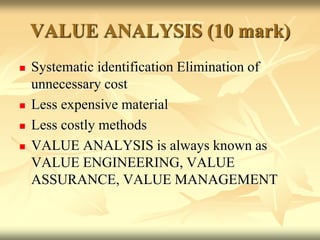
VALUE ANALYSIS (10 mark)
 Systematic identification Elimination of
unnecessary cost
 Less expensive material
 Less costly methods
 VALUE ANALYSIS is always known as
VALUE ENGINEERING, VALUE
ASSURANCE, VALUE MANAGEMENT
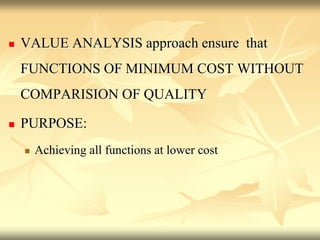
 VALUE ANALYSIS approach ensure that
FUNCTIONS OF MINIMUM COST WITHOUT
COMPARISION OF QUALITY
 PURPOSE:
 Achieving all functions at lower cost
CONCEPT OF VALUE AND FUNCTION
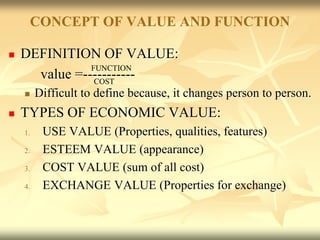
 DEFINITION OF VALUE:
value =-----------
 Difficult to define because, it changes person to person.
 TYPES OF ECONOMIC VALUE:
1. USE VALUE (Properties, qualities, features)
2. ESTEEM VALUE (appearance)
3. COST VALUE (sum of all cost)
4. EXCHANGE VALUE (Properties for exchange)
COST
FUNCTION
FUNCTION
 Working function of a product
TYPES OF FUNCTION:
 PRIMARY FUNCTION (Designed product function,
call function in phone)
 SECONDARY FUNCTION ( other than primary
function , mp3 player)
 TERITARY FUNCTION ( Esteem nature, torch in
mobile)
VALUE ANALYSIS vs VALUE
ENGINEERING
 Value analysis is a remedial process
 Value engineering is a preventive process
USES OF VALUE ANALYSIS:
 Reduce cost
 Better fashion
 New ideas and concepts
 employees with new innovative ideas
 Fulfill customer needs
REASON FOR UNNECESSARY
COST
1. Poor Design
2. Lack of ideas
3. Lack of standardisation
4. Un avoidable delivery constrains
5. Poor production planning
STEPS IN VALUE ANALYSIS (16 mark)
1. BLAST
1. Identify the product (product for study)
2. Collect relevant information(information in
manufacturing, engineering, economics)
3. Define different functions ( Functions setting)
2. CREATE
1. Create different alternatives
2. Critically evaluate alternatives
3. REFINE
1. Develop the best alternative
2. Implement the alternative
PHASES OF VALUE ANALYSIS (16 mark)
1. ORIENTATION PHASE (data collection)
2. INFORMATION PHASE(Identify facts)
3. FUNCTIONAL ANALYSIS(basic function)
4. CREATIVE PHASE( rearrange the information)
5. EVALUATION PHASE(create various alternatives)
6. DEVELOPMENT PHASE (alternatives for
technical requirement)
1. RECOMMENDATION PHASE(decision making)
2. IMPLEMENTATION PHASE(approval)
3. FOLLOW UP PHASE(compare with expectation)
PROCESS PLANNING (16 mark)
 Convert the product design in to manufacturing
plan
 Manufacture the products and parts
 Raw material in to finished state
 It is otherwise called as operations planning
PROCESS PLANNING vs PRODUCTION
PLANNING:
How to make the product (Process Planning)
To order raw materials obtaining resources to
require to make insufficient and demand to it
(production planning)
DETAILS OF PROCESS PLAN (8MARK)
 It contains:
 Route sheet
 Process
 Process parameters
 Machine and tools
1. Assembly and component drawings and boll of
materials
2. Machine and equipment details
3. Set up time for job
4. Availability of machine and equipment
Factors affecting process
planning
1. Volume of production
2. Skill and man power
3. Delivery dates for parts
4. Material specification
5. Accuracy requirements for parts
PROCESS PLANNING
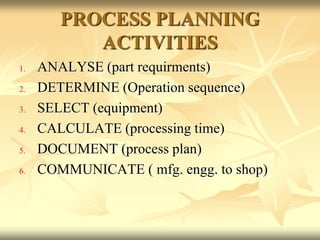
ACTIVITIES
1. ANALYSE (part requirments)
2. DETERMINE (Operation sequence)
3. SELECT (equipment)
4. CALCULATE (processing time)
5. DOCUMENT (process plan)
6. COMMUNICATE ( mfg. engg. to shop)
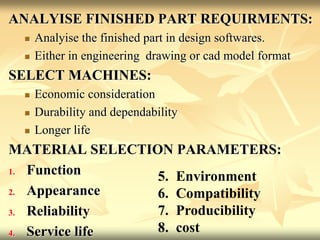
ANALYISE FINISHED PART REQUIRMENTS:
 Analyise the finished part in design softwares.
 Either in engineering drawing or cad model format
SELECT MACHINES:
 Economic consideration
 Durability and dependability
 Longer life
MATERIAL SELECTION PARAMETERS:
1. Function
2. Appearance
3. Reliability
4. Service life
5. Environment
6. Compatibility
7. Producibility
8. cost
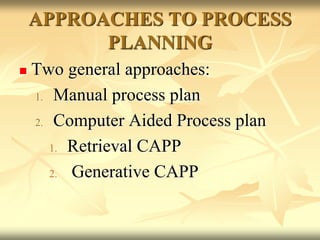
APPROACHES TO PROCESS
PLANNING
 Two general approaches:
1. Manual process plan
2. Computer Aided Process plan
1. Retrieval CAPP
2. Generative CAPP
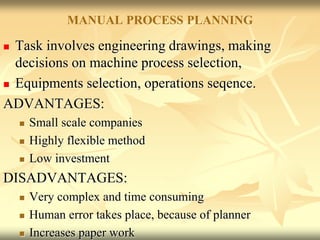
MANUAL PROCESS PLANNING
 Task involves engineering drawings, making
decisions on machine process selection,
 Equipments selection, operations seqence.
ADVANTAGES:
 Small scale companies
 Highly flexible method
 Low investment
DISADVANTAGES:
 Very complex and time consuming
 Human error takes place, because of planner
 Increases paper work
COMPUTER AIDED PROCESS PLANNING
 To overcome the manual process planning.
 CADD provides interface between CAD & CAM
BENEFITS OF CAPP:
1. Process standardisation
2. Productivity improvement
3. Product cost reduction
4. Elimination of human error
5. Reduce in time
6. Reduce paper work
7. Improved legibility ( computer based route sheets prepared)
8. Faster response to engineering changes
9. Incorporate of other application programs
QUANTITY DETERMINATION IN BATCH
PRODUCTION
 Batch production required when variety of
products needed.
 Products made by volume of products needed.
PLANNING FOR BATCH PRODUCTION:
 Determination of batch size ( production lot)
 Determination of batch scheduling.
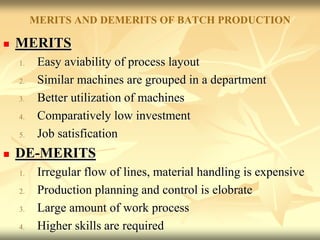
MERITS AND DEMERITS OF BATCH PRODUCTION
 MERITS
1. Easy aviability of process layout
2. Similar machines are grouped in a department
3. Better utilization of machines
4. Comparatively low investment
5. Job satisfication
 DE-MERITS
1. Irregular flow of lines, material handling is expensive
2. Production planning and control is elobrate
3. Large amount of work process
4. Higher skills are required
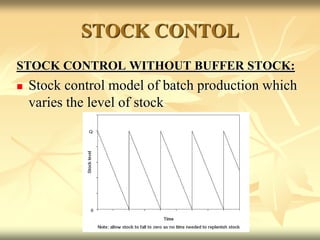
STOCK CONTOL
STOCK CONTROL WITHOUT BUFFER STOCK:
 Stock control model of batch production which
varies the level of stock
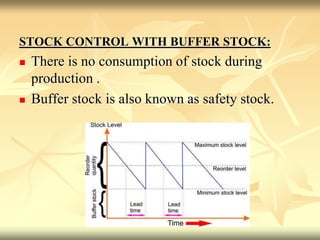
STOCK CONTROL WITH BUFFER STOCK:
 There is no consumption of stock during
production .
 Buffer stock is also known as safety stock.
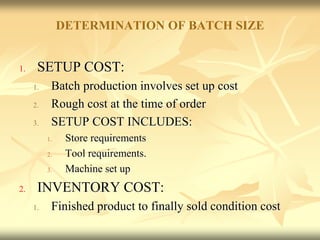
DETERMINATION OF BATCH SIZE
1. SETUP COST:
1. Batch production involves set up cost
2. Rough cost at the time of order
3. SETUP COST INCLUDES:
1. Store requirements
2. Tool requirements.
3. Machine set up
2. INVENTORY COST:
1. Finished product to finally sold condition cost
DETERMINATION OF MINIMUM
COST BATCH SIZE
1. CONSTANT COST PER PIECE
2. SETUP COST PER BATCH
3. CARRYING COST
4. STORAGE CARRYING COST
MACHINE CAPACITY
 Batch size calculations, for batch production.
 Focus on machine loading and unloading.
MACHINE LOADING:
1. It is process of assigning a specific job for
machines
2. Smooth workflow can be ensured
3. Machine loading should ensure maximum
utilization
INFORMATION REQUIRED FOR
MACHINE LOADING
1. Number and identification of work order
2. Symbol or identification of part
3. Number of parts
4. List of operations to be performed
5. Necessary tooling's
METHODS TO REDUCE
CYCLE TIME
1. Methods-i- To reduce cycle time
2. Methods-ii- Reduce the independent activity
time (workmen don’t wait for
another workmen for interval)
3. Methods-iii- Reduce the concurrent activity
time (Working by several
parteners)
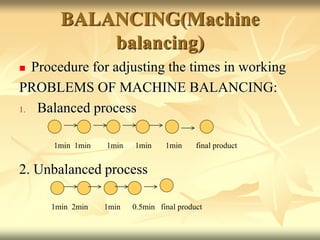
BALANCING(Machine
balancing)
 Procedure for adjusting the times in working
PROBLEMS OF MACHINE BALANCING:
1. Balanced process
2. Unbalanced process
1min 1min 1min 1min 1min final product
1min 2min 1min 0.5min final product
ANALYSIS OF PROCESS
CAPACITIES IN A MULTI
PRODUCT SYSTEM
(16MARK,10 MARK, 8 MARK)
 REFER NOTES

PPC-Unit III- PRODUCT PLANNING AND PRODUCT CONTROL

  • 1.
    PRODUCT PLANNING ANDPRODUCT CONTROL UNIT - III
  • 2.
    PRODUCT PLANNING  Evaluationof range  Pricing of existing and new products  Pricing based on future market requirements  Pricing to satisfy company objectives  Specify the design and development support
  • 3.
    PRODUCT PLANNING  Productdevelopment not only for new products  It is also for existing products
  • 4.
    NEED FOR PRODUCT PLANNING 1.Need determined from current deficiencies 1. Wanted occurring in present condition 2. Need determined from anticipated deficiencies 1. Need through prediction of social, technology etc.
  • 5.
    PRODUCT PLANNING PROCESS (8mark) Everyone wants a new product  And every one make the product successful STEPS: 1. Marketing and marketing analysis 2. Performance and feasibility studies 3. Advanced product planning
  • 6.
    1. Marketing andmarketing analysis  Marketing does not require the engineering involvement  Technical details for promotion  Technical support for answering the customer queries  Product planned – to satisfy customer needs or not?  Availability of proper technology to satisfy needs
  • 7.
    2. Performance andfeasibility studies  It is to extend the market analysis  Arriving at the preferred system configuration  Firm will offer the product.  ELEMENTS OF FESIBILITY:  A detailed need analysis  System operation requirments  Maintenance support requirments  Identification of alternate configuration  Screening and evaluating of available resources’
  • 8.
    3. Advanced productplanning  It is the combined results of Preliminary market analysis and feasibility study. IT INCLUDES: 1. Product selection and justification 2. Product specification and plans 3. Product acquisition plan 4. Product evaluation plan 5. Product use and logistic support plan 6. System proposal
  • 9.
    VALUE ANALYSIS (10mark)  Systematic identification Elimination of unnecessary cost  Less expensive material  Less costly methods  VALUE ANALYSIS is always known as VALUE ENGINEERING, VALUE ASSURANCE, VALUE MANAGEMENT
  • 10.
     VALUE ANALYSISapproach ensure that FUNCTIONS OF MINIMUM COST WITHOUT COMPARISION OF QUALITY  PURPOSE:  Achieving all functions at lower cost
  • 11.
    CONCEPT OF VALUEAND FUNCTION  DEFINITION OF VALUE: value =-----------  Difficult to define because, it changes person to person.  TYPES OF ECONOMIC VALUE: 1. USE VALUE (Properties, qualities, features) 2. ESTEEM VALUE (appearance) 3. COST VALUE (sum of all cost) 4. EXCHANGE VALUE (Properties for exchange) COST FUNCTION
  • 12.
    FUNCTION  Working functionof a product TYPES OF FUNCTION:  PRIMARY FUNCTION (Designed product function, call function in phone)  SECONDARY FUNCTION ( other than primary function , mp3 player)  TERITARY FUNCTION ( Esteem nature, torch in mobile)
  • 13.
    VALUE ANALYSIS vsVALUE ENGINEERING  Value analysis is a remedial process  Value engineering is a preventive process USES OF VALUE ANALYSIS:  Reduce cost  Better fashion  New ideas and concepts  employees with new innovative ideas  Fulfill customer needs
  • 14.
    REASON FOR UNNECESSARY COST 1.Poor Design 2. Lack of ideas 3. Lack of standardisation 4. Un avoidable delivery constrains 5. Poor production planning
  • 15.
    STEPS IN VALUEANALYSIS (16 mark) 1. BLAST 1. Identify the product (product for study) 2. Collect relevant information(information in manufacturing, engineering, economics) 3. Define different functions ( Functions setting) 2. CREATE 1. Create different alternatives 2. Critically evaluate alternatives 3. REFINE 1. Develop the best alternative 2. Implement the alternative
  • 16.
    PHASES OF VALUEANALYSIS (16 mark) 1. ORIENTATION PHASE (data collection) 2. INFORMATION PHASE(Identify facts) 3. FUNCTIONAL ANALYSIS(basic function) 4. CREATIVE PHASE( rearrange the information) 5. EVALUATION PHASE(create various alternatives) 6. DEVELOPMENT PHASE (alternatives for technical requirement) 1. RECOMMENDATION PHASE(decision making) 2. IMPLEMENTATION PHASE(approval) 3. FOLLOW UP PHASE(compare with expectation)
  • 17.
    PROCESS PLANNING (16mark)  Convert the product design in to manufacturing plan  Manufacture the products and parts  Raw material in to finished state  It is otherwise called as operations planning PROCESS PLANNING vs PRODUCTION PLANNING: How to make the product (Process Planning) To order raw materials obtaining resources to require to make insufficient and demand to it (production planning)
  • 18.
    DETAILS OF PROCESSPLAN (8MARK)  It contains:  Route sheet  Process  Process parameters  Machine and tools 1. Assembly and component drawings and boll of materials 2. Machine and equipment details 3. Set up time for job 4. Availability of machine and equipment
  • 19.
    Factors affecting process planning 1.Volume of production 2. Skill and man power 3. Delivery dates for parts 4. Material specification 5. Accuracy requirements for parts
  • 20.
    PROCESS PLANNING ACTIVITIES 1. ANALYSE(part requirments) 2. DETERMINE (Operation sequence) 3. SELECT (equipment) 4. CALCULATE (processing time) 5. DOCUMENT (process plan) 6. COMMUNICATE ( mfg. engg. to shop)
  • 21.
    ANALYISE FINISHED PARTREQUIRMENTS:  Analyise the finished part in design softwares.  Either in engineering drawing or cad model format SELECT MACHINES:  Economic consideration  Durability and dependability  Longer life MATERIAL SELECTION PARAMETERS: 1. Function 2. Appearance 3. Reliability 4. Service life 5. Environment 6. Compatibility 7. Producibility 8. cost
  • 22.
    APPROACHES TO PROCESS PLANNING Two general approaches: 1. Manual process plan 2. Computer Aided Process plan 1. Retrieval CAPP 2. Generative CAPP
  • 23.
    MANUAL PROCESS PLANNING Task involves engineering drawings, making decisions on machine process selection,  Equipments selection, operations seqence. ADVANTAGES:  Small scale companies  Highly flexible method  Low investment DISADVANTAGES:  Very complex and time consuming  Human error takes place, because of planner  Increases paper work
  • 24.
    COMPUTER AIDED PROCESSPLANNING  To overcome the manual process planning.  CADD provides interface between CAD & CAM BENEFITS OF CAPP: 1. Process standardisation 2. Productivity improvement 3. Product cost reduction 4. Elimination of human error 5. Reduce in time 6. Reduce paper work 7. Improved legibility ( computer based route sheets prepared) 8. Faster response to engineering changes 9. Incorporate of other application programs
  • 25.
    QUANTITY DETERMINATION INBATCH PRODUCTION  Batch production required when variety of products needed.  Products made by volume of products needed. PLANNING FOR BATCH PRODUCTION:  Determination of batch size ( production lot)  Determination of batch scheduling.
  • 26.
    MERITS AND DEMERITSOF BATCH PRODUCTION  MERITS 1. Easy aviability of process layout 2. Similar machines are grouped in a department 3. Better utilization of machines 4. Comparatively low investment 5. Job satisfication  DE-MERITS 1. Irregular flow of lines, material handling is expensive 2. Production planning and control is elobrate 3. Large amount of work process 4. Higher skills are required
  • 27.
    STOCK CONTOL STOCK CONTROLWITHOUT BUFFER STOCK:  Stock control model of batch production which varies the level of stock
  • 28.
    STOCK CONTROL WITHBUFFER STOCK:  There is no consumption of stock during production .  Buffer stock is also known as safety stock.
  • 29.
    DETERMINATION OF BATCHSIZE 1. SETUP COST: 1. Batch production involves set up cost 2. Rough cost at the time of order 3. SETUP COST INCLUDES: 1. Store requirements 2. Tool requirements. 3. Machine set up 2. INVENTORY COST: 1. Finished product to finally sold condition cost
  • 30.
    DETERMINATION OF MINIMUM COSTBATCH SIZE 1. CONSTANT COST PER PIECE 2. SETUP COST PER BATCH 3. CARRYING COST 4. STORAGE CARRYING COST
  • 31.
    MACHINE CAPACITY  Batchsize calculations, for batch production.  Focus on machine loading and unloading. MACHINE LOADING: 1. It is process of assigning a specific job for machines 2. Smooth workflow can be ensured 3. Machine loading should ensure maximum utilization
  • 32.
    INFORMATION REQUIRED FOR MACHINELOADING 1. Number and identification of work order 2. Symbol or identification of part 3. Number of parts 4. List of operations to be performed 5. Necessary tooling's
  • 33.
    METHODS TO REDUCE CYCLETIME 1. Methods-i- To reduce cycle time 2. Methods-ii- Reduce the independent activity time (workmen don’t wait for another workmen for interval) 3. Methods-iii- Reduce the concurrent activity time (Working by several parteners)
  • 34.
    BALANCING(Machine balancing)  Procedure foradjusting the times in working PROBLEMS OF MACHINE BALANCING: 1. Balanced process 2. Unbalanced process 1min 1min 1min 1min 1min final product 1min 2min 1min 0.5min final product
  • 35.
    ANALYSIS OF PROCESS CAPACITIESIN A MULTI PRODUCT SYSTEM (16MARK,10 MARK, 8 MARK)  REFER NOTES