STRENGTH OF MATERIALS
SYLLABUS
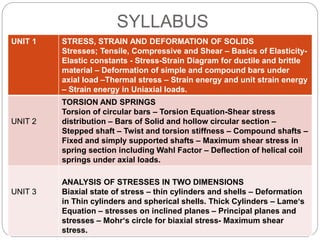
UNIT 1 STRESS, STRAIN AND DEFORMATION OF SOLIDS
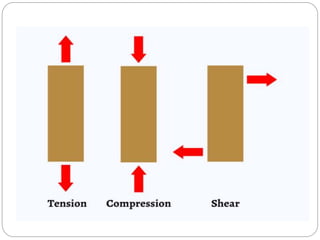
Stresses; Tensile, Compressive and Shear – Basics of Elasticity-
Elastic constants - Stress-Strain Diagram for ductile and brittle
material – Deformation of simple and compound bars under
axial load –Thermal stress – Strain energy and unit strain energy
– Strain energy in Uniaxial loads.
UNIT 2
TORSION AND SPRINGS
Torsion of circular bars – Torsion Equation-Shear stress
distribution – Bars of Solid and hollow circular section –
Stepped shaft – Twist and torsion stiffness – Compound shafts –
Fixed and simply supported shafts – Maximum shear stress in
spring section including Wahl Factor – Deflection of helical coil
springs under axial loads.
UNIT 3
ANALYSIS OF STRESSES IN TWO DIMENSIONS
Biaxial state of stress – thin cylinders and shells – Deformation
in Thin cylinders and spherical shells. Thick Cylinders – Lame‘s
Equation – stresses on inclined planes – Principal planes and
stresses – Mohr‘s circle for biaxial stress- Maximum shear
stress.
SYLLABUS
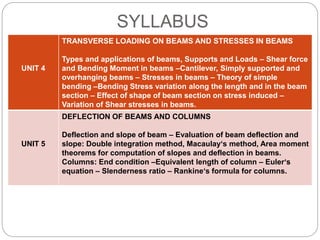
UNIT 4
TRANSVERSE LOADING ON BEAMS AND STRESSES IN BEAMS
Types and applications of beams, Supports and Loads – Shear force
and Bending Moment in beams –Cantilever, Simply supported and
overhanging beams – Stresses in beams – Theory of simple
bending –Bending Stress variation along the length and in the beam
section – Effect of shape of beam section on stress induced –
Variation of Shear stresses in beams.
UNIT 5
DEFLECTION OF BEAMS AND COLUMNS
Deflection and slope of beam – Evaluation of beam deflection and
slope: Double integration method, Macaulay‘s method, Area moment
theorems for computation of slopes and deflection in beams.
Columns: End condition –Equivalent length of column – Euler‘s
equation – Slenderness ratio – Rankine‘s formula for columns.
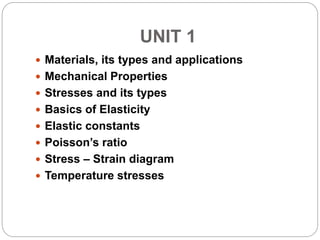
UNIT 1
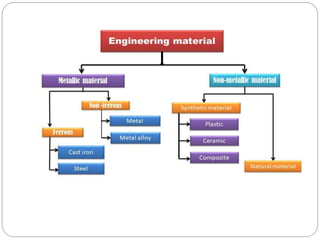
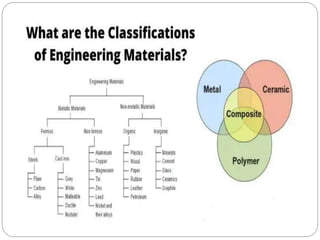
 Materials, its types and applications
 Mechanical Properties
 Stresses and its types
 Basics of Elasticity
 Elastic constants
 Poisson’s ratio
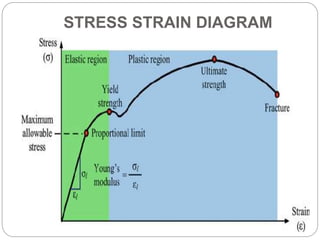
 Stress – Strain diagram
 Temperature stresses
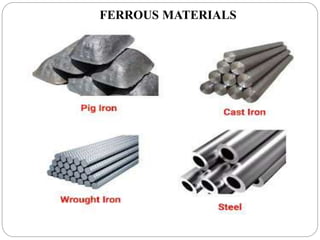
FERROUS MATERIALS
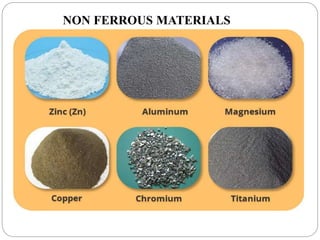
NON FERROUS MATERIALS
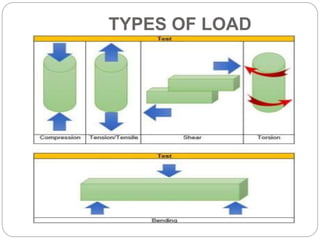
TYPES OF LOAD
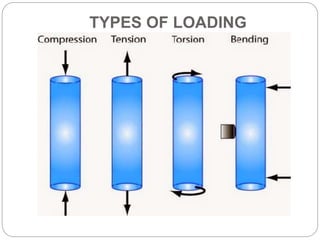
TYPES OF LOADING
STRESS STRAIN DIAGRAM

UNIT 1.ppt

  • 1.
  • 2.
    SYLLABUS UNIT 1 STRESS,STRAIN AND DEFORMATION OF SOLIDS Stresses; Tensile, Compressive and Shear – Basics of Elasticity- Elastic constants - Stress-Strain Diagram for ductile and brittle material – Deformation of simple and compound bars under axial load –Thermal stress – Strain energy and unit strain energy – Strain energy in Uniaxial loads. UNIT 2 TORSION AND SPRINGS Torsion of circular bars – Torsion Equation-Shear stress distribution – Bars of Solid and hollow circular section – Stepped shaft – Twist and torsion stiffness – Compound shafts – Fixed and simply supported shafts – Maximum shear stress in spring section including Wahl Factor – Deflection of helical coil springs under axial loads. UNIT 3 ANALYSIS OF STRESSES IN TWO DIMENSIONS Biaxial state of stress – thin cylinders and shells – Deformation in Thin cylinders and spherical shells. Thick Cylinders – Lame‘s Equation – stresses on inclined planes – Principal planes and stresses – Mohr‘s circle for biaxial stress- Maximum shear stress.
  • 3.
    SYLLABUS UNIT 4 TRANSVERSE LOADINGON BEAMS AND STRESSES IN BEAMS Types and applications of beams, Supports and Loads – Shear force and Bending Moment in beams –Cantilever, Simply supported and overhanging beams – Stresses in beams – Theory of simple bending –Bending Stress variation along the length and in the beam section – Effect of shape of beam section on stress induced – Variation of Shear stresses in beams. UNIT 5 DEFLECTION OF BEAMS AND COLUMNS Deflection and slope of beam – Evaluation of beam deflection and slope: Double integration method, Macaulay‘s method, Area moment theorems for computation of slopes and deflection in beams. Columns: End condition –Equivalent length of column – Euler‘s equation – Slenderness ratio – Rankine‘s formula for columns.
  • 4.
    UNIT 1  Materials,its types and applications  Mechanical Properties  Stresses and its types  Basics of Elasticity  Elastic constants  Poisson’s ratio  Stress – Strain diagram  Temperature stresses
  • 7.
  • 9.
  • 11.
  • 12.
  • 14.

Editor's Notes

  • #8 FERROUS MATERIALS
  • #10 NON FERROUS MATERIALS