UNIT I - SPARK IGNITION ENGINES
UNIT I - SPARK IGNITION ENGINES 9
Mixture requirements – Fuel injection systems –
Mono point, Multipoint & Direct injection -
Stages of combustion – Normal and Abnormal
combustion – Knock - Factors affecting knock –
Combustion chambers.
26 December 2017 ME6016 ADVANCED I.C ENGINES 2
FUEL SUPPLY SYSTEMS
 The fuel passes through a number of stages before reaching the combustion
chamber.
 It includes the filtration and atomization of fuel into fine particles.
 It is necessary to atomize the fuel before entering into the combustion
chamber so that complete combustion of fuel can take place.
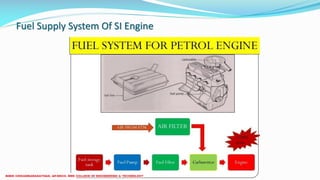
Fuel Supply System Of SI Engine
 In petrol engine the combustible mixture of fuel is prepared outside the
combustion chamber.
 Proper air-fuel ratio is maintained with the help of a device known as
carburetor and this mixture is inducted into the combustion chamber.
 The air fuel ratio depends upon the various conditions. The engine needs a
richer mixture while starting and leaner mixture at normal running conditions.
 Such conditions must be fulfilled before entering the combustion chamber.
 The fuel from the tank is delivered to the float chamber attached to the
carburetor with the help of fuel pump.
 The fuel pump maintains the constant pressure. In carburetor fuel is mixed
with air in required proportion.
 After that the mixture of fuel and air is inducted into the combustion chamber.
Air-fuel Requirement in SI Engines
 The spark-ignition automobile engines run on a mixture of gasoline and air.
The amount of mixture the engine can take in depends upon following major
factors:
(i) Engine displacement.
(ii) Maximum revolution per minute (rpm) of engine.
 (iii) Carburetor air flow capacity.
(iv) Volumetric efficiency of engine.
There is a direct relationship between an engine’s air flow and it’s fuel
requirement. This relationship is called the air-fuel ratio.
26 December 2017 ME6016 ADVANCED I.C ENGINES 6
Air-fuel Ratios
 The air-fuel ratio is the proportions by weight of air and gasoline mixed
by the carburetor as required for combustion by the engine. This ratio is
extremely important for an engine because there are limits to how rich
(with more fuel) or how lean (with less fuel) it can be, and still remain
fully combustible for efficient firing. The mixtures with which the engine
can operate range from 8:1 to 18.5:1 i.e. from 8 kg of air/kg of fuel to
18.5 kg of air/kg of fuel. Richer or leaner air-fuel ratio limit causes the
engine to misfire, or simply refuse to run at all.
26 December 2017 ME6016 ADVANCED I.C ENGINES 7
Stoichiometric Air-Fuel Ratio
 The ideal mixture or ratio at which all the fuels blend with all of the oxygen in
the air and be completely burned is called the stoichiometric ratio, a
chemically perfect combination. In theory, an air fuel ratio of about 14.7:1 i.e.
14.7 kg of air/kg of gasoline produce this ratio, but the exact ratio at which
perfect mixture and complete combustion take place depends on the
molecular structure of gasoline, which can vary somewhat.
26 December 2017 ME6016 ADVANCED I.C ENGINES 8
Engine Air-fuel Ratios
 An automobile SI engine, as indicated above, works with the air-fuel mixture
ranging from 8:1 to 18.5:1. But the ideal ratio would be one that provides
both the maximum power and the best economy, while producing the least
emissions. But such a ratio does not exist because the fuel requirements of an
engine vary widely depending upon temperature, load, and speed conditions.
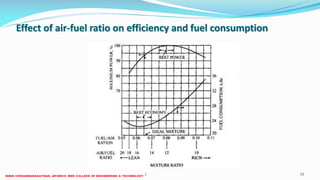
The best fuel economy is obtained with a 15:1 to 16:1 ratio, while maximum
power output is achieved with a 12.5:1 to 13.5:1 ratio. A rich mixture in the
order of 11:1 is required for idle heavy load, and high-speed conditions. A lean
mixture is required for normal cruising and light load conditions. Figure 9.36
represents the characteristic curves showing the effect of mixture ratio on
efficiency and fuel consumption.
26 December 2017 ME6016 ADVANCED I.C ENGINES 9
Effect of air-fuel ratio on efficiency and fuel consumption
26 December 2017 ME6016 ADVANCED I.C ENGINES 10
 Practically for complete combustion, through mixing of the fuel in excess air (to a limited
extent above that of the ideal condition) is needed. Lean mixtures are used to obtain best
economy through minimum fuel consumption whereas rich mixtures used to suppress
combustion knock and to obtain maximum power from the engine. However, improper
distribution of mixture to each cylinder and imperfect/incomplete vaporization of fuel in air
necessitates the use of rich mixture to obtain maximum power output. A rich mixture is also
required to overcome the effect of dilution of incoming mixture due to entrapped exhaust
gases in the cylinder and of air leakage because of the high vacuum in the manifold, under
idling or no-load condition. Maximum power is desired at full load while best economy is
expected at part throttle conditions. Thus required air fuel ratios result from maximum
economy to maximum power. The carburettor must be able to vary the air-fuel ratio quickly
to provide the best possible mixture for the engine’s requirements at a given moment.
26 December 2017 ME6016 ADVANCED I.C ENGINES 11
 The best air-fuel ratio for one engine may not be the best ratio for another, even
when the two engines are of the same size and design. To accurately determine the
best mixture, the engine should be run on a dynamometer to measure speed, load
and power requirements for all types of driving conditions.
 With a slightly rich mixture, the combustion flame travels faster and conversely with
a slightly weak mixture, the flame travel becomes slower. If a very rich mixture is
used then some “neat” petrol enters cylinder, washes away lubricant from cylinder
walls and gets past piston to contaminate engine oil. A very sooty deposit occurs in
the combustion chamber. On the other hand, if an engine runs on an excessively
weak mixture, then overheating particularly of such parts as valves, pistons and
spark plugs occurs. This causes detonation and pre-ignition together or separately.
26 December 2017 ME6016 ADVANCED I.C ENGINES 12
The approximate proportions of air to petrol (by weight) suitable
for the different operating conditions are indicated below:
 Starting 9 :1
 Idling 12 : 1
 Acceleration 12 : 1
 Economy 16:1
 Full power 12 : 1
 It makes no difference if an engine is carbureted or fuel injected, the engine
still needs the same air-fuel mixture ratios.
26 December 2017 ME6016 ADVANCED I.C ENGINES 13
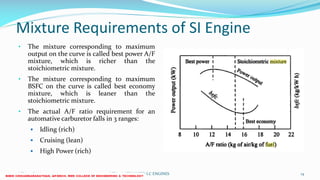
Mixture Requirements of SI Engine
• The mixture corresponding to maximum
output on the curve is called best power A/F
mixture, which is richer than the
stoichiometric mixture.
• The mixture corresponding to maximum
BSFC on the curve is called best economy
mixture, which is leaner than the
stoichiometric mixture.
• The actual A/F ratio requirement for an
automative carburetor falls in 3 ranges:
 Idling (rich)
 Cruising (lean)
 High Power (rich)
26 December 2017 ME6016 ADVANCED I.C ENGINES 14
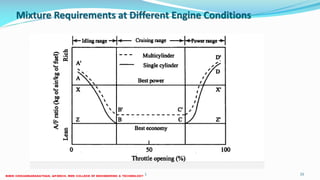
Mixture Requirements at Different Engine Conditions
26 December 2017 ME6016 ADVANCED I.C ENGINES 15
Mixture Requirements at Different Engine Conditions (Contd.)
 Idling Range (1-2)
• During idling, engine operates at no load and closed throttle.
• The engine requires rich mixture for starting at idling.
• Rich mixture is required to compensate for the charge dilution due to exhaust gases from the
combustion chamber.
• Also, the amount of fresh charge admitted is less due to smaller throttle opening.
• Exhaust gas dilution prevents efficient combustion by reducing the contact between the fuel and
air particles.
• Rich mixture improves the contact of fuel and air by providing efficient combustion at idling
conditions.
• As the throttle is opened further, the exhaust gas dilution reduces and the mixture requirement
shifts to the leaner side.
26 December 2017 ME6016 ADVANCED I.C ENGINES 16
Mixture Requirements at Different Engine Conditions (Contd.)
 Cruising Range (2-3)
• Focus is on fuel economy.
• No exhaust gas dilution.
• Carburetor has to give best economy mixture i.e.. Lean mixture.
 High Power Range (3-4)
• As high power is required, additional fuel has to be supplied to achieve rich
mixture in this range.
• Rich mixture also prevents overheating by reducing the flame temperature and
cylinder temperature.
26 December 2017 ME6016 ADVANCED I.C ENGINES 17
Mixture Requirements at Different Engine Conditions (Contd.)
An SI engine works with the Air-fuel mixture ranging from 8:1 to 18.5:1. But the
Ideal ratio would be one that provides both maximum power and best economy, while
producing the least emissions.
But such a ratio does not exist because fuel requirements of an engine vary widely
depending upon temperature, load, and speed conditions .
For complete combustion , thorough mixing of fuel in excess air is needed.
Lean mixtures are needed for best economy and rich mixtures are needed to suppress
combustion knock.
A rich mixture is required for High load and high speed and idling conditions.
Best economy is expected at part throttle.
A carburettor should supply the mixture ratio according to the engine requirements
26 December 2017 ME6016 ADVANCED I.C ENGINES 18
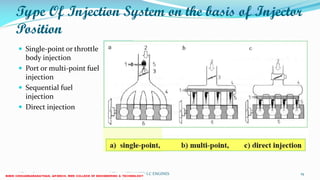
Type Of Injection System on the basis of Injector
Position
 Single-point or throttle
body injection
 Port or multi-point fuel
injection
 Sequential fuel
injection
 Direct injection
26 December 2017 ME6016 ADVANCED I.C ENGINES 19
Single-point or throttle body injection
 The earliest and simplest type of fuel injection, single-point simply replaces
the carburetor with one or two fuel-injector nozzles in the throttle body,
which is the throat of the engine’s air intake manifold. For some automakers,
single-point injection was a stepping stone to the more complex multi-point
system. Though not as precise as the systems that have followed, TBI meters
fuel better than a carburetor and is less expensive and easier to service.
26 December 2017 ME6016 ADVANCED I.C ENGINES 20
Port or multi-point fuel injection
 Multi-point fuel injection devotes a separate injector nozzle to each cylinder, right
outside its intake port, which is why the system is sometimes called port injection.
Shooting the fuel vapor this close to the intake port almost ensures that it will be
drawn completely into the cylinder. The main advantage is that MPFI meters fuel
more precisely than do TBI designs, better achieving the desired air/fuel ratio and
improving all related aspects. Also, it virtually eliminates the possibility that fuel
will condense or collect in the intake manifold. With TBI and carburetors, the
intake manifold must be designed to conduct the engine’s heat, a measure to
vaporize liquid fuel. This is unnecessary on engines equipped with MPFI, so the
intake manifold can be formed from lighter-weight material, even plastic.
Incremental fuel economy improvements result. Also, where conventional metal
intake manifolds must be located atop the engine to conduct heat, those used in
MPFI can be placed more creatively, granting engineers design flexibility.
26 December 2017 ME6016 ADVANCED I.C ENGINES 21
Sequential fuel injection
 Sequential fuel injection, also called sequential port fuel injection (SPFI) or
timed injection, is a type of multi-port injection. Though basic MPFI employs
multiple injectors, they all spray their fuel at the same time or in groups. As a
result, the fuel may “hang around” a port for as long as 150 milliseconds when
the engine is idling. This may not seem like much, but it’s enough of a
shortcoming that engineers addressed it: Sequential fuel injection triggers
each injector nozzle independently. Timed like spark plugs, they spray the fuel
immediately before or as their intake valve opens. It seems a minor step, but
efficiency and emissions improvements come in very small doses.
26 December 2017 ME6016 ADVANCED I.C ENGINES 22
Direct injection
 Direct injection takes the fuel injection concept about as far as it can go, injecting
fuel directly into the combustion chambers, past the valves. More common in
diesel engines, direct injection is starting to pop up in gasoline engine designs,
sometimes called DIG for direct injection gasoline. Again, fuel metering is even
more precise than in the other injection schemes, and the direct injection gives
engineers yet another variable to influence precisely how combustion occurs in the
cylinders. The science of engine design scrutinizes how the fuel/air mixture swirls
around in the cylinders and how the explosion travels from the ignition point.
Things such as the shape of cylinders and pistons; port and spark plug locations;
timing, duration and intensity of the spark; and number of spark plugs per cylinder
(more than one is possible) all affect how evenly and completely fuel combusts in a
gasoline engine. Direct injection is another tool in that discipline, one that can be
used in low-emissions lean-burn engines.
26 December 2017 ME6016 ADVANCED I.C ENGINES 23
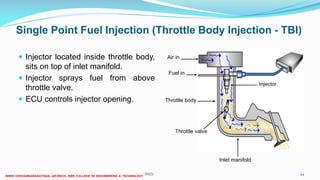
Single Point Fuel Injection (Throttle Body Injection - TBI)
 Injector located inside throttle body,
sits on top of inlet manifold.
 Injector sprays fuel from above
throttle valve.
 ECU controls injector opening.
26 December 2017 ME6016 ADVANCED I.C ENGINES 24
Fuel in
Air in
Throttle valve
Injector
Inlet manifold
Throttle body
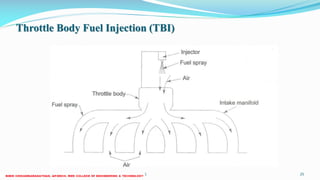
Throttle Body Fuel Injection (TBI)
26 December 2017 ME6016 ADVANCED I.C ENGINES 25
Throttle Body Fuel Injection (TBI)
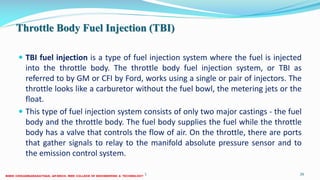
 TBI fuel injection is a type of fuel injection system where the fuel is injected
into the throttle body. The throttle body fuel injection system, or TBI as
referred to by GM or CFI by Ford, works using a single or pair of injectors. The
throttle looks like a carburetor without the fuel bowl, the metering jets or the
float.
 This type of fuel injection system consists of only two major castings - the fuel
body and the throttle body. The fuel body supplies the fuel while the throttle
body has a valve that controls the flow of air. On the throttle, there are ports
that gather signals to relay to the manifold absolute pressure sensor and to
the emission control system.
26 December 2017 ME6016 ADVANCED I.C ENGINES 26
TBI Fuel Injection Advantages
 It is less expensive than using other types of fuel injection systems.
 It is easier to clean, maintain and service because there are fewer parts.
 It is cheaper to manufacture than a port injection system and simpler to
diagnose. It also does not have the same level of injector balance problems
that a port injection system might have when the injectors are clogged.
 It greatly improves the fuel metering compared to a carburetor.
 You do not have to make any changes to the TBI intake manifold. You also do
not have to change the throttle linkage. Instead, use the existing linkage, air
cleaners and carbs to install the system.
 It is also capable of logging data and can be programmed for ignition and fuel.
The TBI system is that it learns and understands your habits when driving so it
can easily map out your actions and the performance of the engine.
26 December 2017 ME6016 ADVANCED I.C ENGINES 27
TBI Fuel Injection Disadvantages
 It is almost the same as a TBI carburetor wherein the fuel is not equally
distributed to all the cylinders. This means that the air/fuel mixture injected
differs for each cylinder.
 It can cool the manifold much faster causing the fuel to puddle and condense
in the manifold. The possibility of condensation is much higher since the fuel
travels longer from the throttle body to the combustion chamber.
 Since the system needs to be mounted on top of the combustion chamber,
you're prevented from modifying the manifold design to improve your car's
performance.
 It is a wet system and the mixture of fuel is still based per cylinder.
26 December 2017 ME6016 ADVANCED I.C ENGINES 28
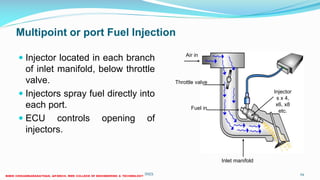
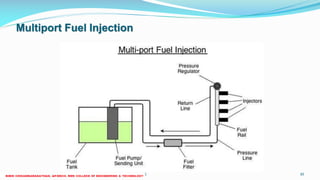
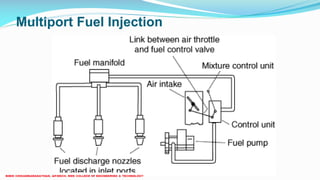
Multipoint or port Fuel Injection
 Injector located in each branch
of inlet manifold, below throttle
valve.
 Injectors spray fuel directly into
each port.
 ECU controls opening of
injectors.
26 December 2017 ME6016 ADVANCED I.C ENGINES 29
Injector
s x 4,
x6, x8
etc.
Inlet manifold
Throttle valve
Fuel in
Air in
Multiport Fuel Injection
26 December 2017 ME6016 ADVANCED I.C ENGINES 30
Multiport Fuel Injection
Multiport Fuel Injection (Contd.)
 MPFi is a fuel injection technique used in gasoline engines. Multi port fuel injection injects fuel into
the intake ports of each cylinder's intake valve, rather than at a central point within an intake
manifold like in spark plugs. It can be sequential, in which injection is timed to coincide with each
cylinder's intake stroke.
 A separate injector supplies the correct quantity of fuel to each of the engine cylinders by a fuel-rail
according to the firing order or in a ‘particular sequence’. This system provides further precision by
varying the fuel quantity and injection timing by governing the each injector separately and thereby
improving the performance and controlling the emissions.
 The return valve returns fuel in case the fuel is oversupplied. Also the pressure regulator regulates the
pressure of the intake fuel. Fuel filter contains small sized membranes which filters and absorbs
the undesirable matters of size 30 to 40 microns.
 The fuel and air are mixed in intake manifold and each manifold is controlled by an ECU(Electronic
Control Unit). fuel pressure runs between 3 to 5 bars.
26 December 2017 ME6016 ADVANCED I.C ENGINES 32
MAIN COMPONENTS OF MPFI SYSTEM
This system has four major components they are:
a) Air intake system
i. Throttle body
ii. Idle air control valve
b) Fuel delivery system
i. Fuel pump
ii. Pressure regulator system
iii. Injector
c) Electronic control system
i. Engine Control Module (ECM)
ii. On-Board diagnostic system
d) Emission control system
AIR INTAKE SYSTEM
The air (corresponding to the throttle valve opening) is filtered by the air
cleaner, passes through the throttle body, and is distributed by the intake
manifold and finally drawn into each combustion chamber , opening and
closing of throttle valve is controlled by ECU according to demand &
necessity with proper calculation with input system
1. Throttle Body -Throttle valve, which is interlocked with the accelerator
pedal and controls the amount of the intake air . TP sensor which
detects the throttle valve opening and sends a signal to ECM
2. Idle Air Control Valve -The lAC valve controls opening of the bypass air
passage. The air bypasses the throttle valve through bypass passage
and is finally drawn into the intake manifold.
FUEL DELIVERY SYSTEM
The fuel in the fuel tank is pumped up by the fuel pump, filtered by fuel filter and fed
under pressure to each injector through the delivery 'pipe. The fuel is injected into
the intake port of the cylinder head when the injector opens according to the
injection signal form ECM.
1. Fuel Pump- It is an electric fuel pump and its operation is controlled by ECM. The
fuel is drawn through the inlet port with high pressure, It is discharged through
the outlet port, the fuel pump also has a check valve to keep some pressure in the
fuel feed line even when the fuel pump is stopped.
2. Pressure Regulator System-The fuel pressure regulator is diaphragm operated
relief valve consisting of diaphragm, spring and valve. It keeps the fuel pressure
applied to the injector 2.9Kglcm higher than intake manifold at all times
3. Injector-Each cylinder has one injector, which is installed between the intake
manifold delivery pipes. It is an electromagnetic type injection nozzle, which
injects fuel into the intake port of the cylinder head according to the signal from
ECM.
ELECTRONIC CONTROL SYSTEM
The electronic control system consist of various sensors which detect the
state of engine and driving conditions, ECM which controls various devices
according to the signals from the sensors and Various controlled devices.
The systems are -
 Fuel Injection Control System
 Idle Speed Control System
 Fuel Pump Control System
 Ignition Control System
 Radiator Fan Control System
ADVANTAGES OF MULTI POINT FUEL INJECTION SYSTEM
 More uniform air-fuel mixture will be supplied to each cylinder, hence the
difference in power developed in each cylinder is minimum.
 The vibrations produced in MPFI engines is very less, due to this life of the
engine component is increased.
 No need to crank the engine twice or thrice in case of cold starting as happen
in the carburetor system.
 Immediate response, in case of sudden acceleration and deceleration.
 The mileage of the vehicle is improved.
 More accurate amount of air-fuel mixture will be supplied in these injection
system. As a result complete combustion will take place. This leads to effective
utilization of fuel supplied and hence low emission level.
26 December 2017 ME6016 ADVANCED I.C ENGINES 37
OTHER BENEFITS OF MULTI POINT FUEL INJECTION SYSTEM
 Smooth operations and drivability
 Reliability
 Competent to accommodate alternative fuels
 Easy engine tuning
 Diagnostic capability
 Initial and maintenance cost
26 December 2017 ME6016 ADVANCED I.C ENGINES 38
Height of the Car is High.
Manifold Heat control System OR Valve is Required.
Intake Manifold control only air not Fuel.
DISADVANTAGES OF MULTI POINT FUEL INJECTION
SYSTEM
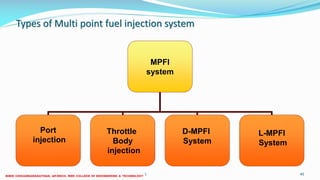
Types of Multi point fuel injection system
26 December 2017 ME6016 ADVANCED I.C ENGINES 40
MPFI
system
Port
injection
Throttle
Body
injection
L-MPFI
System
D-MPFI
System
PORT FUEL INJECTION
 The advantages of port fuel-injection design also are related to characteristics
of intake manifolds:
 Fuel distribution is equal to all cylinders because each cylinder has its own
injector.
 The fuel is injected almost directly into the combustion chamber, so there is no
chance for it to condense on the walls of a cold intake manifold.
 Because the manifold does not have to carry fuel to properly position a TBI unit, it
can be shaped and sized to tune the intake airflow to achieve specific engine
performance characteristics.
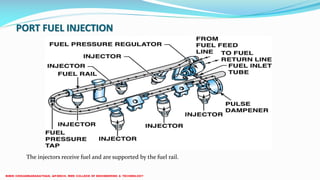
PORT FUEL INJECTION
The injectors receive fuel and are supported by the fuel rail.
PORT FUEL INJECTION
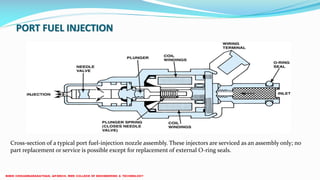
Cross-section of a typical port fuel-injection nozzle assembly. These injectors are serviced as an assembly only; no
part replacement or service is possible except for replacement of external O-ring seals.
PORT FUEL INJECTION
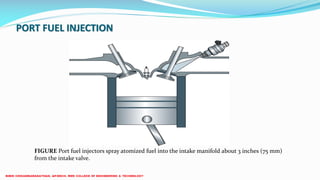
FIGURE Port fuel injectors spray atomized fuel into the intake manifold about 3 inches (75 mm)
from the intake valve.
PORT FUEL INJECTION
 Port systems have an injector for each cylinder, but they do not all fire the
injectors in the same way.
 Domestic systems use one of three ways to trigger the injectors:
 Grouped double-fire
 Simultaneous double-fire
 Sequential
PORT FUEL INJECTION
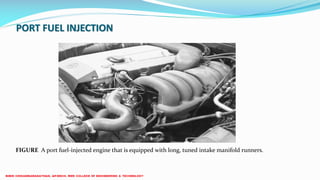
FIGURE A port fuel-injected engine that is equipped with long, tuned intake manifold runners.
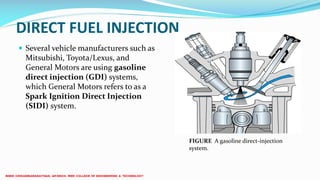
DIRECT FUEL INJECTION
 Several vehicle manufacturers such as
Mitsubishi, Toyota/Lexus, and
General Motors are using gasoline
direct injection (GDI) systems,
which General Motors refers to as a
Spark Ignition Direct Injection
(SIDI) system.
FIGURE A gasoline direct-injection
system.
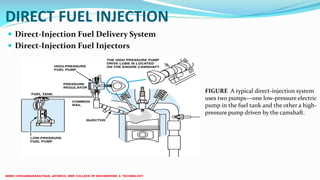
DIRECT FUEL INJECTION
 Direct-Injection Fuel Delivery System
 Direct-Injection Fuel Injectors
FIGURE A typical direct-injection system
uses two pumps—one low-pressure electric
pump in the fuel tank and the other a high-
pressure pump driven by the camshaft.
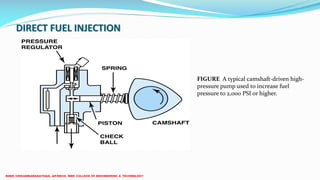
DIRECT FUEL INJECTION
FIGURE A typical camshaft-driven high-
pressure pump used to increase fuel
pressure to 2,000 PSI or higher.
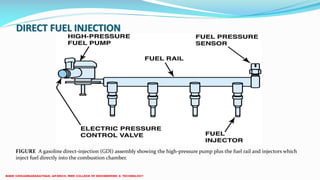
DIRECT FUEL INJECTION
FIGURE A gasoline direct-injection (GDI) assembly showing the high-pressure pump plus the fuel rail and injectors which
inject fuel directly into the combustion chamber.
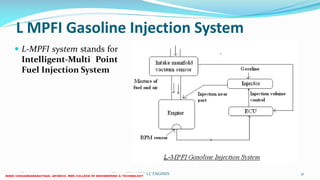
L MPFI Gasoline Injection System
 L-MPFI system stands for
Intelligent-Multi Point
Fuel Injection System
26 December 2017 ME6016 ADVANCED I.C ENGINES 51
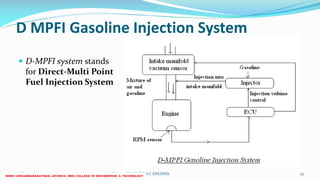
D MPFI Gasoline Injection System
 D-MPFI system stands
for Direct-Multi Point
Fuel Injection System
26 December 2017 ME6016 ADVANCED I.C ENGINES 52
D-MPFI Gasoline Injection System
 The D-MPFI system is the manifold fuel injection system . In this type , the
vacuum in the intake manifold is first sensed .In addition the volume of air is
sensed by its density . As air enters into the intake manifold ,the manifold
pressure sensor detects the intake manifold vacuum and sends the
information to the ECU . The speed sensor also sends the information about
the rpm of the engine to the ECU . The ECU in turn sends command to the
injector to regulate the amount of gasoline supply for injection . When the
injectors spray fuel in the intake manifold the gasoline mixes with the air and
the mixture enters the cylinder.
ELECTRONIC FUEL INJECTION
 The process of supplying air-fuel mixture to the engine cylinder(s), whereby a
carburetor is replaced by fuel injector(s) and fuel is metered proportionally to air
flow with the help of microprocessor is called electronic fuel injection (EFI). In fuel
injection system the fuel speed at the point of delivery is greater than the air
speed. Unlike a carburetor, however, pressure, and not engine vacuum is used to
feed fuel into the engine. An EFI system functions by the rapid and accurate
assessment of data received by various sensors and by responding automatically to
the slightest pedal movement. Microprocessor (ECU) controlled fuel injector(s)
supply the engine with the optimum amount of fuel under all driving conditions.
Information concerning, manifold air pressure, engine speed, crankshaft angle,
water temperature etc. are collected by sensors and relayed to ECU. By using this
data, ECU calculates the required opening time of fuel injectors and sends the
pulse.
26 December 2017 ME6016 ADVANCED I.C ENGINES 54
Advantages of Electronic Fuel Injection
 Improved atomization (fuel is forced into intake manifold under pressure
which helps break fuel droplets into a fine mist); smoother idle (lean fuel
mixture can be used without rough idle because of better fuel distribution and
low speed atomization); improved fuel economy (high efficiency because of
more precise fuel metering, atomization and distribution; lower emissions
(more accurate and efficient air-fuel mixture reduces exhaust pollution);
better fuel distribution; better cold weather drivability (injection provides
better control of mixture enrichment than a carburetor choke); increased
engine power (precise metering of fuel to each cylinder and increased air flow
can result in more power); elimination of carburetor plate icing.
26 December 2017 ME6016 ADVANCED I.C ENGINES 55
Classification of EFI
 With respect to number of injection point
 Single-Point or Throttle-Body Injection (SPI or TBI)
 Multipoint Injection (MPFI)
 With respect to place of injection
 Direct Injection
 Indirect Injection
 With respect to injection control
 Electronic Fuel Injection
 Hydraulic Fuel Injection
 Mechanical Fuel Injection
 With respect to Injection Timing
 Intermittent Injection
 Timed Injection
 Continues Injection
 Injector Opening Relationship
 Simultaneous Injection
 Sequential injection
 Group Injection
26 December 2017 ME6016 ADVANCED I.C ENGINES 56
Combustion in SI engines
 In a conventional spark-ignition engine a homogeneous mixture of fuel and air is supplied. The combustion in a
gaseous fuel-air mixture ignited by a spark is characterized by a rapid development of a flame that starts from
the point of ignition and spreads outwards in a continuous manner.
 When the flame spread continues to the end of the combustion chamber without any abrupt change in its speed
and shape, combustion is called normal.
 The combustion of fuel-air mixture depends on chain reactions. First only a few highly active constituents
surrounding the ignition point cause reactions. These in tum generate additional active constituents to cause
reactions. Soon a point is reached where the chain breaking reactions dominate the chain forming reactions. In
the flame front, the chain forming reactions can only reach a certain distance into a relatively cool, unburned
charge before they are broken and thus a definite flame boundary is established. However, if the unburned gases
become hot enough to sustain chain reactions, the remaining gas will suddenly auto-ignite.
 When the unburned mixture ahead of the flame ignites and bums before the flame reaches it, the
phenomenon is called autoignition. When there is a sudden increase in the reaction rate, accompanied by a
sudden pressure rise forming pressure waves, the phenomenon is called detonation which causes engine knock.
 When combustion is initiated by a spark, it is called controlled combustion and when combustion is initiated by
a hot spot, it is called uncontrolled combustion. Under normal combustion conditions, the combustion is
controlled and this is a designer's objective. Uncontrolled combustion is associated with preignition and running-
on.
 Autoignition and detonation come under the category of abnormal combustion. In this case the fuel-air mixture
ignites spontaneously without an ignition source.
26 December 2017 ME6016 ADVANCED I.C ENGINES 57
Combustion in SI engines
 Towards the end of the compression stroke the cylinder contains more or less a
homogeneous mixture of vaporized fuel, air and residual gases. A single intense and
high temperature spark is produced between the spark plug electrodes and as it
passes from one electrode to the other it leaves a thin thread of flame.
 Combustion spreads to the envelope of the mixture containing the thread at a rate
depending primarily on the temperature of the flame front and secondarily on the
temperature and density of the surrounding envelope.
 Thus a small hollow nucleus of flame at first grows up gradually and as the flame
front expands with steadily increasing speed it travels across chamber until finally
the whole of the mixture is engulfed.
 Depending on the degree of turbulence in the cylinder, the flame front wrinkles, thus
presenting a greater surface area from which heat is radiated; hence the flame speed
is increased enormously, and this speeds up the combustion process.
26 December 2017 ME6016 ADVANCED I.C ENGINES 58
Theoretical Combustion in SI engines
26 December 2017 ME6016 ADVANCED I.C ENGINES 59
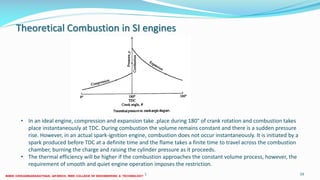
• In an ideal engine, compression and expansion take .place during 180° of crank rotation and combustion takes
place instantaneously at TDC. During combustion the volume remains constant and there is a sudden pressure
rise. However, in an actual spark-ignition engine, combustion does not occur instantaneously. It is initiated by a
spark produced before TDC at a definite time and the flame takes a finite time to travel across the combustion
chamber, burning the charge and raising the cylinder pressure as it proceeds.
• The thermal efficiency will be higher if the combustion approaches the constant volume process, however, the
requirement of smooth and quiet engine operation imposes the restriction.
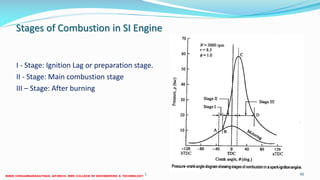
Stages of Combustion in SI Engine
I - Stage: Ignition Lag or preparation stage.
II - Stage: Main combustion stage
III – Stage: After burning
26 December 2017 ME6016 ADVANCED I.C ENGINES 60
I - Stage: Ignition Lag or preparation stage.
 This stage is called ignition lag or preparation phase. It corresponds to the time for the
growth and development of a self-propagating nucleus of the flame. The starting point of
the first stage is the point A, where the spark is produced and the end of the stage is marked
with point B, where the first measurable pressure rise against the motoring curve is
observed.
 The first stage is mainly a chemical process and depends on the nature of the fuel,
temperature and pressure of the fuel-air mixture, the concentration of the residual from the
previous cycle present in the cylinder and the chemical reaction rate. It is also influenced by
local turbulence .
 though the first stage of combustion is called the ignition lag, as it is analogous to the delay
period of CI engine. The the nucleus of combustion appears instantaneously near the spark
plug electrodes; initially the flame spreads very slowly.
 The fraction of the burned mixture is very little, so there is no appreciable pressure rise
against the motoring curve.
26 December 2017 ME6016 ADVANCED I.C ENGINES 61
II - Stage: Main combustion stage
 This stage is called the main stage. It corresponds to the propagation of the flame
practically at a constant speed.
 The starting point of the second stage is taken as point B, where the first measurable
pressure rise against the motoring curve is observed. The end of the second stage is
marked with point C, where the maximum pressure is attained.
 This stage is both a physical and a chemical process. The heat release depends on the
chemical composition and on the prevailing temperatures and pressures and the
degree of turbulence in the cylinder.
 During this stage heat transfer to the cylinder wall is low, since the burning mixture
comes in contact with a small part of the cylinder wall. The rate of pressure rise is
almost proportional to the heat release because during this stage, the combustion
chamber volume does not change much.
26 December 2017 ME6016 ADVANCED I.C ENGINES 62
III – Stage: After burning
 This stage is called afterburning. Although the point C indicates the completion of the flame
travel, it does not follow that the whole of the heat of the fuel has been liberated at this
point.
 Even after the passage of the flame, during expansion some of the constituents re-associate
and liberate heat.
 The starting point of this stage is usually taken at the instant when maximum pressure is
reached on the indicator diagram (Point C). The end of this stage is marked at point D.
 This point corresponds to the point where equilibrium is reached and after which the
products of combustion are assumed to be frozen.
 During this stage, the flame speed decreases and the rate of combustion is slow. Since the
expansion stroke starts before this stage with the piston moving away from TDC, there will
be pressure fall during this stage.
26 December 2017 ME6016 ADVANCED I.C ENGINES 63
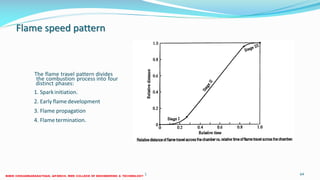
Flame speed pattern
26 December 2017 ME6016 ADVANCED I.C ENGINES 64
The flame travel pattern divides
the combustion process into four
distinct phases:
1. Sparkinitiation.
2. Early flame development
3. Flame propagation
4. Flame termination.
26 December 2017 ME6016 ADVANCED I.C ENGINES 65
Factors Affecting the Flame speed.
1. Inlet pressure & Temp conditions
2. Turbulence prevailing
3. Engine speed
4. Residual gas content
5. Compression ratio
6. Spark timing
7. Mixture strength
8. Physical and chemical characteristics of fuel
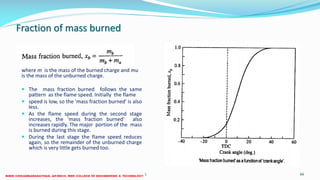
Fraction of mass burned
where m is the mass of the burned charge and mu
is the mass of the unburned charge.
 The mass fraction burned follows the same
pattern as the flame speed. Initially the flame
 speed is low, so the 'mass fraction burned' is also
less.
 As the flame speed during the second stage
increases, the 'mass fraction burned' also
increases rapidly. The major portion of the mass
is burned during this stage.
 During the last stage the flame speed reduces
again, so the remainder of the unburned charge
which is very little gets burned too.
26 December 2017 ME6016 ADVANCED I.C ENGINES 66
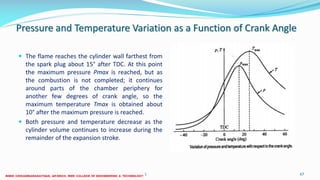
Pressure and Temperature Variation as a Function of Crank Angle
 The flame reaches the cylinder wall farthest from
the spark plug about 15° after TDC. At this point
the maximum pressure Pmax is reached, but as
the combustion is not completed; it continues
around parts of the chamber periphery for
another few degrees of crank angle, so the
maximum temperature Tmax is obtained about
10° after the maximum pressure is reached.
 Both pressure and temperature decrease as the
cylinder volume continues to increase during the
remainder of the expansion stroke.
26 December 2017 ME6016 ADVANCED I.C ENGINES 67
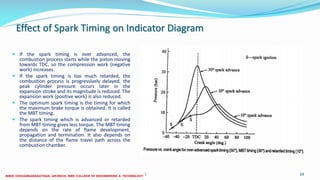
Effect of Spark Timing on Indicator Diagram
 If the spark timing is over advanced, the
combustion process starts while the piston moving
towards TDC, so the compression work (negative
work) increases.
 If the spark timing is too much retarded, the
combustion process is progressively delayed, the
peak cylinder pressure occurs later in the
expansion stroke and its magnitude is reduced. The
expansion work (positive work) is also reduced.
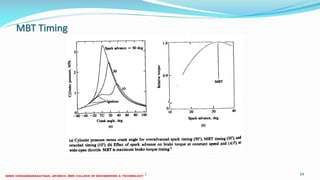
 The optimum spark timing is the timing for which
the maximum brake torque is obtained. It is called
the MBT timing.
 The spark timing which is advanced or retarded
from MBT timing gives less torque. The MBT timing
depends on the rate of flame development,
propagation and termination. It also depends on
the distance of the flame travel path across the
combustion chamber.
26 December 2017 ME6016 ADVANCED I.C ENGINES 68
MBT Timing
26 December 2017 ME6016 ADVANCED I.C ENGINES 69
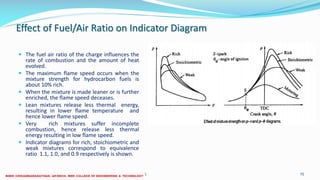
Effect of Fuel/Air Ratio on Indicator Diagram
 The fuel air ratio of the charge influences the
rate of combustion and the amount of heat
evolved.
 The maximum flame speed occurs when the
mixture strength for hydrocarbon fuels is
about 10% rich.
 When the mixture is made leaner or is further
enriched, the flame speed deceases.
 Lean mixtures release less thermal energy,
resulting in lower flame temperature and
hence lower flame speed.
 Very rich mixtures suffer incomplete
combustion, hence release less thermal
energy resulting in low flame speed.
 Indicator diagrams for rich, stoichiometric and
weak mixtures correspond to equivalence
ratio 1.1, 1.0, and 0.9 respectively is shown.
26 December 2017 ME6016 ADVANCED I.C ENGINES 70
Factors affecting ignition lag
 Nature of Fuel and Air/Fuel Ratio – Min lag for slightly richer mixture
 Initial Temperature and Pressure – Increased Pressure & temp reduces the lag
 Compression Ratio – higher CR reduces the lag
 Spark Timing – Retarding reduces the lag (temp high at the time of ignition)
and Advancing increases.
 Turbulence and Engine Speed – Not much affected by turbulence and engine
speed.
 Electrode Gap of Spark Plug – suitable custom made gap is required for each
engine.
26 December 2017 ME6016 ADVANCED I.C ENGINES 71
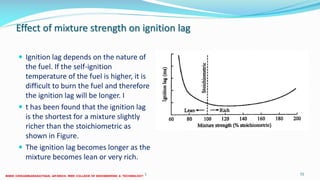
Effect of mixture strength on ignition lag
 Ignition lag depends on the nature of
the fuel. If the self-ignition
temperature of the fuel is higher, it is
difficult to burn the fuel and therefore
the ignition lag will be longer. I
 t has been found that the ignition lag
is the shortest for a mixture slightly
richer than the stoichiometric as
shown in Figure.
 The ignition lag becomes longer as the
mixture becomes lean or very rich.
26 December 2017 ME6016 ADVANCED I.C ENGINES 72
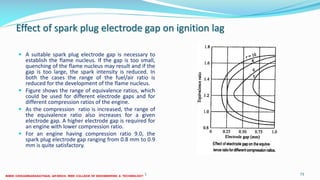
Effect of spark plug electrode gap on ignition lag
 A suitable spark plug electrode gap is necessary to
establish the flame nucleus. If the gap is too small,
quenching of the flame nucleus may result and if the
gap is too large, the spark intensity is reduced. In
both the cases the range of the fuel/air ratio is
reduced for the development of the flame nucleus.
 Figure shows the range of equivalence ratios, which
could be used for different electrode gaps and for
different compression ratios of the engine.
 As the compression ratio is increased, the range of
the equivalence ratio also increases for a given
electrode gap. A higher electrode gap is required for
an engine with lower compression ratio.
 For an engine having compression ratio 9.0, the
spark plug electrode gap ranging from 0.8 mm to 0.9
mm is quite satisfactory.
26 December 2017 ME6016 ADVANCED I.C ENGINES 73
Factors affecting combustion in spark-ignition engines
 Composition of the Mixture
 Load
 Compression Ratio
 Speed
 Turbulence and Shape of Combustion Chamber
 Spark Plug Position
26 December 2017 ME6016 ADVANCED I.C ENGINES 74
Factors affecting combustion in spark-ignition engines
 Composition of the Mixture
 For a rich mixture with the equivalence ratio between 1.1 and 1.2, the duration of
the first stage of combustion, the ignition lag and the duration of the main phase are
all minimum, resulting in the maximum rate of pressure rise (dp/dϴ).
 The flame speed, the heat liberation and consequently the power developed by the
engine are the maximum. When the equivalence ratio is less than 1.1, the energy
content is reduced, hence the duration of the first phase of combustion increases.
 The duration of the main phase of combustion in the second stage changes slightly,
resulting in reduction in maximum pressure and also reduction in the rate of
pressure rise (dp/dϴ). These could be improved by slightly advancing the spark
timing.
 For a lean mixture with the equivalence ratio between 0.85 and 0.9, the power
output is reduced but this range of equivalence ratio corresponds to the minimum
brake specific fuel consumption and represents the most economical range.
26 December 2017 ME6016 ADVANCED I.C ENGINES 75
Factors affecting combustion in spark-ignition engines
Load
 When the load is reduced, the power of an engine is reduced by throttling. The initial pressure and
the pressure at the point of ignition decrease and the residual gases in the mixture increase.
 The first phase of combustion prolongs and the combustion process loses its stability and frequently
cannot be resumed in some cycles, causing cyclic variations. To overcome this difficulty to some
extent, a rich mixture is used which may ensure proper combustion, but the combustion process may
continue during a substantial portion of the expansion stroke.
 This is because of interrupted ignition at large advance angles when the compression pressures are
still very low.
 At part load, the combustion of fuel in the spark-ignition engine is poor, causing a large amount of
products of incomplete combustion in the exhaust including carbon monoxide, oxides of nitrogen
and hydrocarbons which are responsible for air pollution.
 Part load combustion is improved by using a rich mixture but it causes wastage of fuel. These are the
main shortcomings of spark-ignition engines.
26 December 2017 ME6016 ADVANCED I.C ENGINES 76
Factors affecting combustion in spark-ignition engines
Compression Ratio
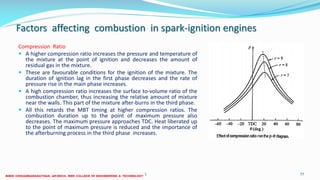
 A higher compression ratio increases the pressure and temperature of
the mixture at the point of ignition and decreases the amount of
residual gas in the mixture.
 These are favourable conditions for the ignition of the mixture. The
duration of ignition lag in the first phase decreases and the rate of
pressure rise in the main phase increases.
 A high compression ratio increases the surface to-volume ratio of the
combustion chamber, thus increasing the relative amount of mixture
near the walls. This part of the mixture after-burns in the third phase.
 All this retards the MBT timing at higher compression ratios. The
combustion duration up to the point of maximum pressure also
decreases. The maximum pressure approaches TDC. Heat liberated up
to the point of maximum pressure is reduced and the importance of
the afterburning process in the third phase increases.
26 December 2017 ME6016 ADVANCED I.C ENGINES 77
Factors affecting combustion in spark-ignition engines
Speed
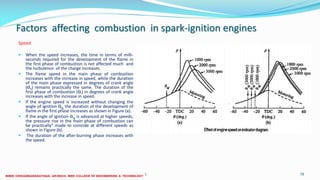
 When the speed increases, the time in terms of milli-
seconds required for the development of the flame in
the first phase of combustion is not affected much and
the turbulence of the charge increases.
 The flame speed in the main phase of combustion
increases with the increase in speed, while the duration
of the main phase expressed in degrees of crank angle
(ϴII) remains practically the same. The duration of the
first phase of combustion (ϴI) in degrees of crank angle
increases with the increase in speed.
 If the engine speed is increased without changing the
angle of ignition ϴIg the duration of the development of
flame in the first phase increases as shown in Figure (a).
 If the angle of ignition ϴIg is advanced at higher speeds,
the pressure rise in the main phase of combustion can
be practically" made to coincide at different speeds as
shown in Figure (b).
 The duration of the after-burning phase increases with
the speed.
26 December 2017 ME6016 ADVANCED I.C ENGINES 78
Factors affecting combustion in spark-ignition engines
Turbulence and Shape of Combustion Chamber
 Turbulence of the charge starts as it enters into the cylinder through narrow sections of inlet pipes
and intake valve.
 Turbulence can be intensified by using a properly shaped combustion chamber and recesses in the
form of gaps between the lower surface of the cylinder head and the piston crown.
 These recesses are so arranged as to create an additional swirling motion in those parts of the charge
which burn during the after-burning phase and thus cause rapid afterburning.
26 December 2017 ME6016 ADVANCED I.C ENGINES 79
Factors affecting combustion in spark-ignition engines
Spark Plug Position
 When the spark plug is mounted at the centre of the cylinder head, the distance travelled by the flame front to
the most distant part is the shortest. The central position of the spark plug also ensures the maximum flame
front surface.
 As a result, the rate of heat evolution and the rate of pressure rise are higher than those with a side-mounted
spark plug.
 The flame speed is increased if the spark plug is located more towards the hotter exhaust valve than in the
direction of the cooler inlet valve. As the spark plug is moved away from the central position, the combustion
period is increased and the ignition requires to be advanced accordingly, in order to obtain the best results for
the new plug location.
 The two spark plugs suitably located reduce the flame travel paths and give a higher rate of pressure rise. This
requires that ignition advance be reduced.
 The use of two spark plugs with synchronized sparks is standard on aircraft engines. It provides reliability and
improved performance. The thermal efficiency is increased and the specific fuel consumption is reduced.
 With large diameter cylinders the use of two plugs gives better performance results, whereas in small cylinders a
single plug will give satisfactory results, owing to the reduced flame travel path.
26 December 2017 ME6016 ADVANCED I.C ENGINES 80
Cyclic variations
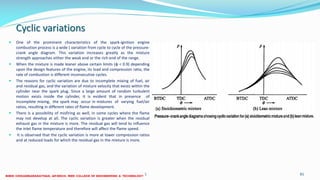
 One of the prominent characteristics of the spark-ignition engine
combustion process is a wide ( variation from cycle to cycle of the pressure-
crank angle diagram. This variation increases greatly as the mixture
strength approaches either the weak end or the rich end of the range.
 When the mixture is made leaner above certain limits (φ < 0.9) depending
upon the design features of the engine, its load and compression ratio, the
rate of combustion is different inconsecutive cycles.
 The reasons for cyclic variation are due to incomplete mixing of fuel, air
and residual gas, and the variation of mixture velocity that exists within the
cylinder near the spark plug. Since a large amount of random turbulent
motion exists inside the cylinder, it is evident that in presence of
incomplete mixing, the spark may occur in mixtures of varying fuel/air
ratios, resulting in different rates of flame development.
 There is a possibility of misfiring as well, in some cycles where the flame
may not develop at all. The cyclic variation is greater when the residual
exhaust gas in the mixture is more. The residual gas will tend to influence
the inlet flame temperature and therefore will affect the flame speed.
 It is observed that the cyclic variation is more at lower compression ratios
and at reduced loads for which the residual gas in the mixture is more.
26 December 2017 ME6016 ADVANCED I.C ENGINES 81
Rate of pressure rise
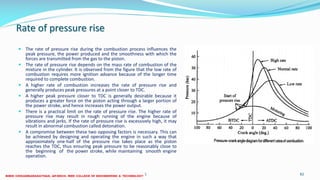
 The rate of pressure rise during the combustion process influences the
peak pressure, the power produced and the smoothness with which the
forces are transmitted from the gas to the piston.
 The rate of pressure rise depends on the mass rate of combustion of the
mixture in the cylinder. It is observed from the figure that the low rate of
combustion requires more ignition advance because of the longer time
required to complete combustion.
 A higher rate of combustion increases the rate of pressure rise and
generally produces peak pressures at a point closer to TDC.
 A higher peak pressure closer to TDC is generally desirable because it
produces a greater force on the piston acting through a larger portion of
the power stroke, and hence increases the power output.
 There is a practical limit on the rate of pressure rise. The higher rate of
pressure rise may result in rough running of the engine because of
vibrations and jerks. If the rate of pressure rise is excessively high, it may
result in abnormal combustion called detonation.
 A compromise between these two opposing factors is necessary. This can
be achieved by designing and operating the engine in such a way that
approximately one-half of the pressure rise takes place as the piston
reaches the TDC, thus ensuring peak pressure to be reasonably close to
the beginning of the power stroke, while maintaining smooth engine
operation.
26 December 2017 ME6016 ADVANCED I.C ENGINES 82
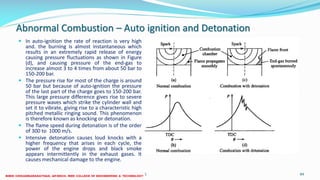
Abnormal Combustion – Auto ignition and Detonation
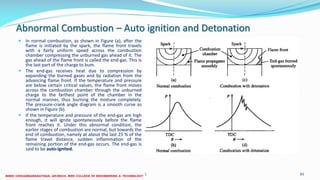
 In normal combustion, as shown in Figure (a), after the
flame is initiated by the spark, the flame front travels
with a fairly uniform speed across the combustion
chamber compressing the unburned gas ahead of it. The
gas ahead of the flame front is called the end-gas. This is
the last part of the charge to bum.
 The end-gas receives heat due to compression by
expanding the burned gases and by radiation from the
advancing flame front. If the temperature and pressure
are below certain critical values, the flame front moves
across the combustion chamber through the unburned
charge to the farthest point of the chamber in the
normal manner, thus burning the mixture completely.
The pressure-crank angle diagram is a smooth curve as
shown in Figure (b).
 If the temperature and pressure of the end-gas are high
enough, it will ignite spontaneously before the flame
front reaches it. Under this abnormal condition, the
earlier stages of combustion are normal, but towards the
end of combustion, namely at about the last 25 % of the
flame travel distance, sudden inflammation of the
remaining portion of the end-gas occurs. The end-gas is
said to be auto-ignited.
26 December 2017 ME6016 ADVANCED I.C ENGINES 83
Abnormal Combustion – Auto ignition and Detonation
 In auto-ignition the rate of reaction is very high
and. the burning is almost instantaneous which
results in an extremely rapid release of energy
causing pressure fluctuations as shown in Figure
(d), and causing pressure of the end-gas to
increase almost 3 to 4 times from about 50 bar to
150-200 bar.
 The pressure rise for most of the charge is around
50 bar but because of auto-ignition the pressure
of the last part of the charge goes to 150-200 bar.
This large pressure difference gives rise to severe
pressure waves which strike the cylinder wall and
set it to vibrate, giving rise to a characteristic high
pitched metallic ringing sound. This phenomenon
is therefore known as knocking or detonation.
 The flame speed during detonation is of the order
of 300 to 1000 m/s.
 Intensive detonation causes loud knocks with a
higher frequency that arises in each cycle, the
power of the engine drops and black smoke
appears intermittently in the exhaust gases. It
causes mechanical damage to the engine.
26 December 2017 ME6016 ADVANCED I.C ENGINES 84
Detrimental effects of detonation
 Noise and vibration
 Increase in heat transfer
 Mechanical damage
 Pre-ignition
 Power and efficiency
 Carbon in the exhaust
 Thermal stress
 Increased friction
26 December 2017 ME6016 ADVANCED I.C ENGINES 85
Theories of detonation
Auto-ignition theory
 According to this theory when the fuel-air mixture in the end-gas region is compressed to
sufficiently high pressures and above the self-ignition temperatures of the fuel before the
flame front reaches it, the pre-flame reactions take place in the parts or all of the end gas.
 During the pre-flame reactions, extensive decomposition of the mixture takes place
producing aldehydes, nitrogen peroxide, hydrogen peroxide and free radicals. The energy
released by these reactions and the presence of active chemical species and free radicals
greatly accelerate the chemical reaction, producing a very high pressure locally in the end-
gas region and leading to auto-ignition.
 Strong pressure waves propagate across the combustion chamber, and also knocking sound
due to the acoustic vibration of the gases at the appropriate resonant frequency is
transmitted through the engine structure.
 In auto-ignition theory it is assumed that the flame front propagates with a normal speed
before the start of auto-ignition.
26 December 2017 ME6016 ADVANCED I.C ENGINES 86
Theories of detonation
Detonation theory
 According to this theory, under the knocking conditions, the advancing flame front,
called detonating waves, accelerates to sonic velocity, and consumes the end-gas at a
rate much faster than would occur with normal flame speeds. Here also, there is a
rapid release of chemical energy in the end-gas which creates a high pressure in the
end-gas region, propagates strong pressure waves and produces knocking.
 There is much less evidence to support the detonation theory compared to the
evidence to support the auto-ignition theory as the knock initiating process.
 Most recent evidence indicates that the knock originates with the auto-ignition of
one or more local regions within the end-gas. The rest of the regions then ignite
until the end-gas is completely reacted.
 This sequence of operations occurs extremely rapidly. Thus, the auto-ignition theory
is most widely accepted. Therefore, the more general term 'knock' is preferred to
detonation to describe this phenomenon.
26 December 2017 ME6016 ADVANCED I.C ENGINES 87
Effect of engine variables on knock
 Temperature, Pressure and Density Factors
 Time Factors
 Composition Factors
 Effect of Design
26 December 2017 ME6016 ADVANCED I.C ENGINES 88
Effect of engine variables on knock
 Temperature, Pressure and Density Factors
 As the temperature of the charge is increased, the flame speed increases and
the possibility of the end-gas to reach its critical temperature for auto-
ignition also increases. This increases the tendency to knock.
 An increase in pressure reduces the delay period of the last part of the charge
as this part of the charge is subjected to a high pressure.
 Increase in density of the charge tends to increase the possibility of knocking
by increasing the pre-flame reactions in the end-gas, thus releasing higher
energy.
26 December 2017 ME6016 ADVANCED I.C ENGINES 89
Effect of engine variables on knock
 Temperature, Pressure and Density Factors
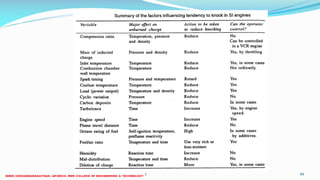
 The compression ratio - an increase in compression ratio increases the knocking tendency. For a given engine setting and a fuel, there is a
critical compression ratio above which knock would occur. This compression ratio is called the highest useful compression ratio (HUCR).
 The mass of inducted charge – By supercharging or WOT, knock tendency increase and reach a maximum at full throttle position.
 The inlet temperature of the mixture – increase will shorten the delay period and greatly increasing the tendency to knock.
 The temperature of the combustion chamber walls - an increase in the temperature of the combustion chamber walls increases the
tendency to knock.
 Spark timing - An increase in spark advance from the optimized timing increases the peak pressure of the cycle and therefore increases the
pressure and temperature to which the last part of the charge is subjected.
 The coolant temperature - An increase in the coolant temperature increases the temperature of the end-gas.
 Power output - An increase in the power output of the engine increases the temperatures of the cylinder and combustion chamber walls
and also increases the temperature and pressure of the end-gas, thus, reducing the delay period.
 Exhaust back pressure – Increasing the exhaust back pressure, increases the compression temperature, increases the residual fraction and
lowers the maximum pressure. The first effect tends to increase the knocking, while the others tend to reduce it.
 Cycle-to-cycle variation - Due to cyclic variation, the cycles with lower peak pressure may not knock, while the cycles with higher peak
pressure will knock.
 Carbon deposits - due to the relatively poor thermal conductivity of deposits, the heat is transferred back to the fresh charge which is
relatively cool. Thus the temperature of the fresh charge is increased and the tendency to knock increases. Apart from this, the reduced
clearance volume, the compression ratio is increased, causing an increase in the knocking tendency.
26 December 2017 ME6016 ADVANCED I.C ENGINES 90
Effect of engine variables on knock
Time Factors
In general, any action which tends to decrease the normal flame speed or shortens the ignition delay period, will tend to increase knocking.
Such an action will auto-ignite the end-gas before the flame front reaches it.
 Turbulence: Turbulence depends on the engine speed and the design of the combustion chamber. Decreasing turbulence decreases
the flame speed and increases the time available for the end-gas to attain auto-ignition conditions easily. Thus, knocking increases with
the decrease in turbulence.
 Engine speed: A decrease in engine speed decreases the turbulence within the cylinder and therefore decreases the flame speed and
increases the time available for pre-flame reactions. The length of the delay period is not greatly affected by engine speed. Therefore,
the knocking increases with the decrease in engine speed.
 Flame travel distance: The flame travel distance can be increased by increasing the size of the engine and the combustion chamber. It
can also be increased by locating the spark plug away from the centre. This gives more time for the end-gas to auto-ignite and,
therefore, knocking increases.
 Combustion chamber shape: In a compact-combustion chamber, the normal flame can be made to reach the last part of the charge
more quickly, so the combustion time will be shorter. Thus a compact combustion chamber reduces knocking.
 Engine size: Large engines operate at low rpm, while the small engines operate at high rpm. Thus the piston speed, turbulence and the
flame speed are almost the same in similar engines, regardless of the size. Therefore, the time required for the flame to travel across
the combustion space would be longer in the larger engines. The delay period is not much affected by size. The larger cylinders will
therefore be more likely to knock.
 Location of spark plug: A spark plug which is centrally located in the head of the combustion chamber has the minimum tendency to
knock, since the flame travel distance is minimum. The flame travel distance can further be reduced by using two or more spark plugs.
 Location of exhaust valve: The exhaust valve should be located close to the spark plug. The flame starts from the spark plug, therefore
the end-gas is far away from it. Locating the exhaust valve near the spark plug means that the exhaust valve is also not situated near
the end-gas region.
26 December 2017 ME6016 ADVANCED I.C ENGINES 91
Effect of engine variables on knock
Composition Factors
Once the compression ratio and the engine dimensions are selected, the fuel/air ratio and the properties of the fuel play an important role
in controlling the engine knock.
 Octane rating of the fuel: A lower self-ignition temperature of the fuel and a high pre-flame reactivity would increase the tendency of
knocking. The octane number is the measure of resistance to knock.
 Fuel/air ratio: For a slightly rich fuel-air mixture for which the best power is obtained, the flame temperature is maximum resulting in
maximum flame speed and minimum delay period.
 Humidity of air: Increasing the' humidity of the entering air tends to reduce knocking by reducing the reaction time the time between
the end of the compression stroke and the end of the appreciable pressure rise due to reaction.
 Stratifying the mixture: The probability pf knock is decreased by stratifying the mixture, which makes the end-gas less reactive.
 Mal-distribution: The unequal distribution of air and fuel between the various cylinders in a multi-cylinder engine is called mal-
distribution, which may result in different knocking tendencies in different cylinders because of change in the air/fuel ratio locally.
 Dilution of the charge: The dilution of the charge with the inert gases increases the reaction time and reduces the flame speed.
Therefore, by introducing cooled exhaust gas with the inlet air, the tendency to knock can be reduced.
 Water or water-alcohol injection: Injection of water or water-alcohol mixtures into the inlet system of the engine reduces knocking by
reducing the reaction time and increasing the flame speed.
 Fuel additives: Several substances have been found which have a pronounced anti-knock effect and increase. the octane ratings when
added to petrol in a very small proportion, called dope. Typical examples of these include benzole, ethanol, methanol, acetone,
nitrobenzene and tetra ethyl lead, etc. In recent years, the use of leaded fuel has been restricted, since it pollutes the atmosphere and
destroys the effectiveness of the noble metal catalysts of catalytic converters. The other drawbacks, associated with the prolonged use
of leaded fuels, are the deposition of lead salts upon the spark plugs, exhaust valves and combustion chambers.
26 December 2017 ME6016 ADVANCED I.C ENGINES 92
Effect of engine variables on knock
Effect of Design
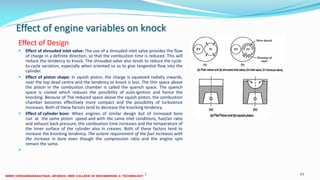
 Effect of shrouded inlet valve: The use of a shrouded inlet valve provides the flow
of charge in a definite direction, so that the combustion time is reduced. This will
reduce the tendency to knock. The shrouded valve also tends to reduce the cycle-
to-cycle variation, especially when oriented so as to give tangential flow into the
cylinder.
 Effect of piston shape: In squish piston, the charge is squeezed radially inwards,
near the top dead centre and the tendency to knock is less. The thin space above
the piston in the combustion chamber is called the quench space. The quench
space is cooled which reduces the possibility of auto-ignition and hence the
knocking. Because of The reduced space above the squish piston, the combustion
chamber becomes effectively more compact and the possibility of turbulence
increases. Both of these factors tend to decrease the knocking tendency.
 Effect of cylinder bore: When engines of similar design but of increased bore
run at the same piston speed and with the same inlet conditions, fuel/air ratio
and exhaust back pressure, the combustion time increases and the temperature of
the inner surface of the cylinder also in creases. Both of these factors tend to
increase the knocking tendency. The octane requirement of the fuel increases with
the increase in bore even though the compression ratio and the engine rpm
remain the same.

26 December 2017 ME6016 ADVANCED I.C ENGINES 93
26 December 2017 ME6016 ADVANCED I.C ENGINES 94
Detection of knocking
 Knocking sound can be heard in engines fitted with the silencer in the exhaust pipe. Under loud exhaust or
propeller noise, it is often impossible to detect knocking.
 The temperature measurement of a spark-plug gasket by a thermocouple embedded in it can indicate the
knocking. A sudden or abnormal temperature rise under steady operating conditions shows the presence of
possible knock. Steady operating conditions are necessary since the spark plug gasket temperature may also be
affected by changing the air/fuel ratio, the engine speed, the manifold pressure, and the rate of cooling, etc.
 Knock intensity can be detected by a pressure transducer which is flush mounted in the combustion chamber. It
is a pressure sensitive unit in which the diaphragm is exposed to the gases in the cylinder and the pressure
signals are converted to electrical signals. This electrical signal is amplified and recorded on a knock meter. With
increasing amplitude of the signal, the scale reading of the knock meter increases and a relative measure of
knock intensity is obtained. This unit can be used to apply knocking control measures automatically.
 It is often possible to detect knocking by the presence of intermittent puffs of gray smoke in the exhaust, which
appear bright yellow flashes when the test is carried out in dark.
26 December 2017 ME6016 ADVANCED I.C ENGINES 95
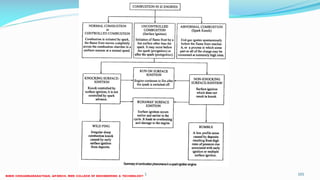
Uncontrolled combustion
 Surface ignition (Run-on, Run-away, wild ping & Rumble)
 Pre-ignition
 Post ignition
 Under certain conditions, the fuel-air mixture is ignited by a hot spot in the cylinder. Initiation of a
flame front by a hot surface other than the spark is called surface ignition. It comes under the
category of uncontrolled combustion.
 The hot surface might be the spark plug insulator or electrode. the exhaust valve head, the carbon
deposits on the combustion chamber surfaces, etc.
 Surface ignition occurring before the spark is called pre-ignition and that occurring after the spark
is called post ignition. Run-on, run-away, wild ping and rumble are caused by surface ignition, which
are harmful.
26 December 2017 ME6016 ADVANCED I.C ENGINES 96
Uncontrolled combustion
 Pre-ignition
 Under severe operating conditions, the cylinder wall temperature may be hot enough to ignite (nearly
11000C) to ignite the charge before the spark plug does so.
 This is equivalent to advancing the ignition, but since the hot spot surface is larger than
 Knock and pre-ignition are different phenomena. Knock is due to the rapid combustion of the last
part of the mixture following the initiation of flame by the spark, whereas pre-ignition is the ignition
of the charge by a hot body before the spark occurs.
 Pre-ignition causes higher temperature and pressure in the end gas than those caused leads to auto-
ignition and hence knock, and auto-ignition encourages pre-ignition.
 The results of pre-ignition are to increase the work of the compression stroke, decrease the net work
of the cycle, increase the engine pressures, increase the heat loss from the engine and decrease the
efficiency. Pre-ignition if not checked gets progressively worse, culminating in severe engine damage.
 Pre-ignition can be detected by switching off the ignition when irregular firing might occur for a few
strokes before the engine speed drops. The sudden loss of power with no evidence of mechanical
malfunctioning may also indicate pre-ignition.
26 December 2017 ME6016 ADVANCED I.C ENGINES 97
Uncontrolled combustion
 Run-on - Surface ignition
 When the ignition is switched off and the throttle is closed (fuel-air mixture is
supplied through the idling jet), the condition in which the engine continues to fire is
called run-on. It might be due to a hot surface in the cylinder, but the major cause is
spontaneous ignition of the fuel-air mixture.
 The physical factors influencing spontaneous ignition are (a) an elevated
temperature of the inlet mixture, (b) poor cooling of the combustion chamber
surface, (c) duration of the valve overlap, and (d) a high compression ratio.
 The inlet temperature is elevated at the low speed condition by the low rate of
air flow through the induction system, often in close proximity to the hot exhaust.
 At idling speed, the combustion chamber surface is not properly cooled due to poor
coolant circulation.
26 December 2017 ME6016 ADVANCED I.C ENGINES 98
Uncontrolled combustion
 Run-away Surface Ignition
 In severe cases of surface ignition, the run-away surface ignition develops.
Surface ignition in one cycle heats the surface ignition source to still higher
temperatures in consecutive cycles and a series of earlier pre-ignitions is set
up.
 The run-away surface ignition is caused by an overheated spark plug, exhaust
valve or piston head.
 The run-away surface ignition results in considerable damage to pistons and
other engine parts. Engine may catch fire as the pre-ignition advances to the
time when the intake valve is open and fuel-air mixture is entering.
26 December 2017 ME6016 ADVANCED I.C ENGINES 99
Uncontrolled combustion
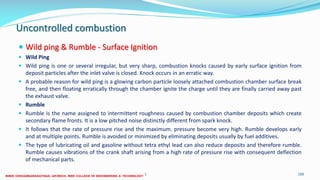
 Wild ping & Rumble - Surface Ignition
 Wild Ping
 Wild ping is one or several irregular, but very sharp, combustion knocks caused by early surface ignition from
deposit particles after the inlet valve is closed. Knock occurs in an erratic way.
 A probable reason for wild ping is a glowing carbon particle loosely attached combustion chamber surface break
free, and then floating erratically through the chamber ignite the charge until they are finally carried away past
the exhaust valve.
 Rumble
 Rumble is the name assigned to intermittent roughness caused by combustion chamber deposits which create
secondary flame fronts. It is a low pitched noise distinctly different from spark knock.
 It follows that the rate of pressure rise and the maximum. pressure become very high. Rumble develops early
and at multiple points. Rumble is avoided or minimized by eliminating deposits usually by fuel additives.
 The type of lubricating oil and gasoline without tetra ethyl lead can also reduce deposits and therefore rumble.
Rumble causes vibrations of the crank shaft arising from a high rate of pressure rise with consequent deflection
of mechanical parts.
26 December 2017 ME6016 ADVANCED I.C ENGINES 100
26 December 2017 ME6016 ADVANCED I.C ENGINES 101
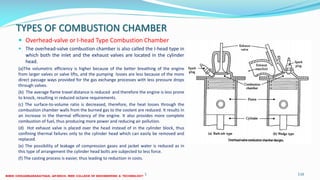
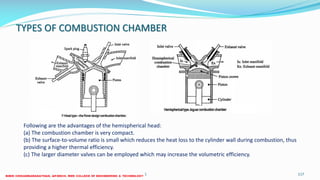
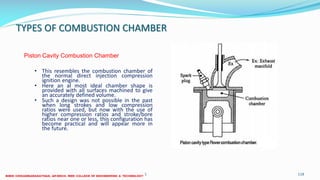
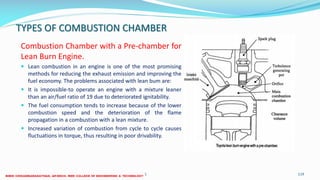
Combustion chambers for spark-ignition engines
 A proper design of the combustion chamber for the spark-ignition engine is
important as it affects the engine performance, its knocking tendencies and exhaust
pollutants.
 The design involves the shape of the cylinder head and piston crown, the location of
the spark plug, and location, size and number of inlet and exhaust valves.
 The design of the intake port also influences the turbulence and flow pattern of the
charge in the combustion chamber. The optimum design of a combustion chamber is
a subject of research and development.
 During the days of development of the engine, the compression ratio used was only
4 and now it is possible to raise the compression ratio to above 10 without knock.
26 December 2017 ME6016 ADVANCED I.C ENGINES 102
Basic Requirements of a Good Combustion Chamber
 The basic requirements of a good combustion chamber are to provide:
1. High power output
2. High thermal efficiency and low specific fuel consumption
3. Smooth engine operation
4. Reduced exhaust pollutants.
26 December 2017 ME6016 ADVANCED I.C ENGINES 103
Basic Requirements of a Good Combustion Chamber
High power output
For producing a high power output, a combustion chamber requires the following:
(a) A high compression ratio
(b) A little rich mixture
(c) Good turbulence
(d) Large inlet valve to obtain a higher volumetric efficiency
(e) Streamline flow in order to reduce the pressure drop and to increase further volumetric
efficiency.
26 December 2017 ME6016 ADVANCED I.C ENGINES 104
Basic Requirements of a Good Combustion Chamber
High thermal efficiency and low specific fuel consumption
In order to achieve high thermal efficiency and low specific fuel consumption, the
following are the requirements:
(a) A high compression ratio
(b) A small heat loss during combustion, which means a small surface-to-volume
ratio and a compact shape.
(c) Faster fuel burning process
(d) A little lean mixture.
26 December 2017 ME6016 ADVANCED I.C ENGINES 105
Basic Requirements of a Good Combustion Chamber
Smooth engine operation
Smooth engine operation, with the selection of the highest compression ratio to use
for a fuel of given octane rating, requires the following:
(a) A moderate rate of pressure rise during combustion.
(b) Absence of knock, which in tum means:
(i) A compact combustion chamber to reduce the flame travel distance.
(ii) Proper location of spark plug and exhaust valve, and their cooling.
26 December 2017 ME6016 ADVANCED I.C ENGINES 106
Basic Requirements of a Good Combustion Chamber
Reduced exhaust pollutants.
 Exhaust pollutants can be reduced by designing a combustion chamber that produces a faster
burning rate of fuel.
 A faster burning chamber with its shorter burning time permits operation with substantially
higher amounts of Exhaust Gas Recirculation (EGR), which reduces the oxides of nitrogen (NOx) in
the exhaust gas without substantial in crease in the hydrocarbon emissions.
 It can also burn very lean mixtures within the normal constraints of engine smoothness and
response. A faster burning chamber exhibits much less cyclic variations, permitting the normal
combustion at part load to have greater dilution of the charge.
Methods of using a 'fast burn' combustion chamber include the following:
(a) Locating the spark plug to a more central position within a compact combustion chamber.
(b) Using two spark plugs.
(c) Increasing the in-cylinder gas motion by creating swirl during the induction process or during
the latter stages of compression.
26 December 2017 ME6016 ADVANCED I.C ENGINES 107
Combustion chamber design principles
1. High volumetric efficiency - Effective valve open area, which depends on valve diameter and lift, directly affects the
volumetric efficiency.
2. Minimum path of flame travel - determined by the location of the spark plug and by the compact shape of the
combustion chamber. SI engines cylinder bore are limited up to 100 mm for short flame travel distance.
3. Provision of minimum heat loss zone around the spark plug - The spark plug is placed near the exhaust valve to
prevent heat loss in the first phase of combustion. The surface-to-volume ratio should be minimum.
4. Reduced rate of pressure rise – The second phase of the combustion zone or shock zone should be designed to give a
reduced rate of pressure rise to avoid knocking and to avoid excessive shocks on the crankshaft.
5. Provision of a suitable quench region - provided at the farthest distance of the flame travel.
6. Maximum thermal efficiency – using HUCR
7. Short combustion time or fast burn - results from properly creating turbulence, improves the 'lean burn'
8. Exhaust valve location - placed near to spark plug, exhaust valve head diameter is kept small and to avoid flow
restrictions, a high lift is employed.
9. Maximum output - two inlet and two exhaust valves are used per cylinder. Domed shape reduces llength of flame travel
and the combustion rate is high.
10. Scavenging of the exhaust gas - good scavenging of the exhaust gas is required.
11. Materials for cylinder head - materials of high heat conductivity conduct heat away from the hot spots. Al alloys, Cu.
26 December 2017 ME6016 ADVANCED I.C ENGINES 108
COMBUSTION CHAMBER OPTIMIZATION PROCEDURE
The sequence of steps described in the following subsections constitutes the
process of development of a good combustion chamber.
 Geometric Considerations
 Considerations for Cyclic Variations
 Consideration for Proper Turbulence
26 December 2017 ME6016 ADVANCED I.C ENGINES 109
COMBUSTION CHAMBER OPTIMIZATION PROCEDURE
 Geometric Considerations
 These involve the considerations of the shape of cylinder head and piston crown, the
spark plug location, and the inlet and exhaust valves location and size.
 Open chambers, such as the hemi spherical with almost central spark plug location,
give close to the maximum flame front surface area ensuring faster burn and provide
the lowest chamber surface area in contact with the burned gases ensuring the
lowest heat transfer.
 More compact combustion chamber shapes other than the open chambers, such as
the bowl-in-piston, do produce a somewhat faster bum but suffer from lower
volumetric efficiency and higher heat losses.
 With almost central positioning of the spark plug and providing some squish area the
bum rate is improved.
26 December 2017 ME6016 ADVANCED I.C ENGINES 110
COMBUSTION CHAMBER OPTIMIZATION PROCEDURE
 Considerations for Cyclic Variations
 Improving the uniformity of the flow of air, fuel and residual gases mixture during
the intake process.
 Delivery of equal amounts of constituents to each cylinder to avoid mal- distribution.
 Provision for good mixing between constituents in the intake manifold.
 Accurate control of mixture composition during engine transients.
 Achieving nearly similar flow patterns within each engine cylinder to obtain equal
burn rates in all cylinders.
26 December 2017 ME6016 ADVANCED I.C ENGINES 111
COMBUSTION CHAMBER OPTIMIZATION PROCEDURE
Consideration for Proper Turbulence
 The higher turbulence levels during combustion are required
which can usually be best done by creating swirl during the
induction process.
 Higher than necessary gas velocities within the cylinder result
in excessive heat losses and low volumetric efficiency.
26 December 2017 ME6016 ADVANCED I.C ENGINES 112
TYPES OF COMBUSTION CHAMBER
 T-head Type Combustion Chamber
 T-head type of combustion chamber. This was the earliest type
used by Ford Motor Corporation during early stages of engine
development in 1908. The T-head design suffers from the
following disadvantages:
 The distance across the combustion chamber is very long.
The spark plug is located near the exhaust valve, so the
flame travel distance from the spark plug to the end-gas
(near the inlet valve) increases. Therefore, knocking
tendency is increased.
 The configuration provides two valves on either side of the
combustion chamber, requiring two camshafts.
 There was a violent knocking even at compression ratio 4: 1.This
was also because of the low octane number of petrol available at
that time, which varied from 45 to 50.
26 December 2017 ME6016 ADVANCED I.C ENGINES 113
TYPES OF COMBUSTION CHAMBER
L-head Type Combustion Chamber
 In this, the combustion chamber is in the form of a more or less flat slab,
extending over the piston. The disadvantages of the T-head type of
combustion chamber forced the development of L-head, in which the two
valves are placed on the same side of the combustion chamber, thus
reducing the flame travel distance, and the valves are operated by a single
camshaft.
 The valve mechanism can easily be enclosed and lubricated. The detachable
head can easily be removed for de-carbonising without disturbing either the
valve gear or the main pipe work.
 In its original form, this type of engine gave poor performance because of the
following limitations:
1. Lack of turbulence as the charge had to take two right angle turns to enter into the
cylinder and in doing so the initial velocity of the charge got reduced.
2. Extremely prone to knock due to lack of turbulence, resulting in a low flame speed. The
3. flame travel distance was also large, and it therefore caused knock.
4. Extremely sensitive to ignition timing due to lower rate of burning and slow
combustion.
26 December 2017 ME6016 ADVANCED I.C ENGINES 114
TYPES OF COMBUSTION CHAMBER
Ricardo Turbulent Head Side Valve Combustion Chamber (1919)
The main objective of this design was to increase turbulence in order to obtain a higher
flame speed and to reduce the knocking tendency of the engine.
 A greater volume of the space of combustion chamber was available over the valves
and was called the main body of the combustion chamber.
 A slightly restricted passage-way was provided over the cylinder. During the
compression stroke the gases were forced back to the main body through the
restricted passage-way that created additional turbulence
 By varying the throat area of the restricted passage it was possible to achieve any
desired degree of turbulence within the main body of the combustion chamber.
 In order to reduce the knocking tendency to a minimum, the distance of effective
flame travel was shortened by forming a very thin layer of entrapped gas between
the piston crown and the portion of combustion chamber at the end-gas region,
when the piston was at TDC.
 The surface to-volume ratio in this region was high, which helped in rejecting
enough heat from the end-gas to prevent knocking. The flame travel distance was
further reduced by placing the spark plug in the centre of the effective combustion
space with a slight shift towards the exhaust valve.
26 December 2017 ME6016 ADVANCED I.C ENGINES 115
TYPES OF COMBUSTION CHAMBER
 Overhead-valve or I-head Type Combustion Chamber
 The overhead-valve combustion chamber is also called the I-head type in
which both the inlet and the exhaust valves are located in the cylinder
head.
(a)The volumetric efficiency is higher because of the better breathing of the engine
from larger valves or valve lifts, and the pumping losses are less because of the more
direct passage ways provided for the gas exchange processes with less pressure drops
through valves.
(b) The average flame travel distance is reduced and therefore the engine is less prone
to knock, resulting in reduced octane requirements.
(c) The surface-to-volume ratio is decreased, therefore, the heat losses through the
combustion chamber walls from the burned gas to the coolant are reduced. It results in
an increase in the thermal efficiency of the engine. It also provides more complete
combustion of fuel, thus producing more power and reducing air pollution.
(d) Hot exhaust valve is placed over the head instead of in the cylinder block, thus
confining thermal failures only to the cylinder head which can easily be removed and
replaced.
(e) The possibility of leakage of compression gases and jacket water is reduced as in
this type of arrangement the cylinder head bolts are subjected to less force.
(f) The casting process is easier, thus leading to reduction in costs.
26 December 2017 ME6016 ADVANCED I.C ENGINES 116
TYPES OF COMBUSTION CHAMBER
26 December 2017 ME6016 ADVANCED I.C ENGINES 117
Following are the advantages of the hemispherical head:
(a) The combustion chamber is very compact.
(b) The surface-to-volume ratio is small which reduces the heat loss to the cylinder wall during combustion, thus
providing a higher thermal efficiency.
(c) The larger diameter valves can be employed which may increase the volumetric efficiency.
TYPES OF COMBUSTION CHAMBER
26 December 2017 ME6016 ADVANCED I.C ENGINES 118
• This resembles the combustion chamber of
the normal direct injection compression
ignition engine.
• Here an al most ideal chamber shape is
provided with all surfaces machined to give
an accurately defined volume.
• Such a design was not possible in the past
when long strokes and low compression
ratios were used, but now with the use of
higher compression ratios and stroke/bore
ratios near one or less, this configuration has
become practical and will appear more in
the future.
Piston Cavity Combustion Chamber
TYPES OF COMBUSTION CHAMBER
Combustion Chamber with a Pre-chamber for
Lean Burn Engine.
 Lean combustion in an engine is one of the most promising
methods for reducing the exhaust emission and improving the
fuel economy. The problems associated with lean bum are:
 It is impossible-to operate an engine with a mixture leaner
than an air/fuel ratio of 19 due to deteriorated ignitability.
 The fuel consumption tends to increase because of the lower
combustion speed and the deterioration of the flame
propagation in a combustion with a lean mixture.
 Increased variation of combustion from cycle to cycle causes
fluctuations in torque, thus resulting in poor drivability.
26 December 2017 ME6016 ADVANCED I.C ENGINES 119

ME6016 ADVANCED I.C ENGINES UNIT I

  • 1.
    UNIT I -SPARK IGNITION ENGINES
  • 2.
    UNIT I -SPARK IGNITION ENGINES 9 Mixture requirements – Fuel injection systems – Mono point, Multipoint & Direct injection - Stages of combustion – Normal and Abnormal combustion – Knock - Factors affecting knock – Combustion chambers. 26 December 2017 ME6016 ADVANCED I.C ENGINES 2
  • 3.
    FUEL SUPPLY SYSTEMS The fuel passes through a number of stages before reaching the combustion chamber.  It includes the filtration and atomization of fuel into fine particles.  It is necessary to atomize the fuel before entering into the combustion chamber so that complete combustion of fuel can take place.
  • 4.
    Fuel Supply SystemOf SI Engine
  • 5.
     In petrolengine the combustible mixture of fuel is prepared outside the combustion chamber.  Proper air-fuel ratio is maintained with the help of a device known as carburetor and this mixture is inducted into the combustion chamber.  The air fuel ratio depends upon the various conditions. The engine needs a richer mixture while starting and leaner mixture at normal running conditions.  Such conditions must be fulfilled before entering the combustion chamber.  The fuel from the tank is delivered to the float chamber attached to the carburetor with the help of fuel pump.  The fuel pump maintains the constant pressure. In carburetor fuel is mixed with air in required proportion.  After that the mixture of fuel and air is inducted into the combustion chamber.
  • 6.
    Air-fuel Requirement inSI Engines  The spark-ignition automobile engines run on a mixture of gasoline and air. The amount of mixture the engine can take in depends upon following major factors: (i) Engine displacement. (ii) Maximum revolution per minute (rpm) of engine.  (iii) Carburetor air flow capacity. (iv) Volumetric efficiency of engine. There is a direct relationship between an engine’s air flow and it’s fuel requirement. This relationship is called the air-fuel ratio. 26 December 2017 ME6016 ADVANCED I.C ENGINES 6
  • 7.
    Air-fuel Ratios  Theair-fuel ratio is the proportions by weight of air and gasoline mixed by the carburetor as required for combustion by the engine. This ratio is extremely important for an engine because there are limits to how rich (with more fuel) or how lean (with less fuel) it can be, and still remain fully combustible for efficient firing. The mixtures with which the engine can operate range from 8:1 to 18.5:1 i.e. from 8 kg of air/kg of fuel to 18.5 kg of air/kg of fuel. Richer or leaner air-fuel ratio limit causes the engine to misfire, or simply refuse to run at all. 26 December 2017 ME6016 ADVANCED I.C ENGINES 7
  • 8.
    Stoichiometric Air-Fuel Ratio The ideal mixture or ratio at which all the fuels blend with all of the oxygen in the air and be completely burned is called the stoichiometric ratio, a chemically perfect combination. In theory, an air fuel ratio of about 14.7:1 i.e. 14.7 kg of air/kg of gasoline produce this ratio, but the exact ratio at which perfect mixture and complete combustion take place depends on the molecular structure of gasoline, which can vary somewhat. 26 December 2017 ME6016 ADVANCED I.C ENGINES 8
  • 9.
    Engine Air-fuel Ratios An automobile SI engine, as indicated above, works with the air-fuel mixture ranging from 8:1 to 18.5:1. But the ideal ratio would be one that provides both the maximum power and the best economy, while producing the least emissions. But such a ratio does not exist because the fuel requirements of an engine vary widely depending upon temperature, load, and speed conditions. The best fuel economy is obtained with a 15:1 to 16:1 ratio, while maximum power output is achieved with a 12.5:1 to 13.5:1 ratio. A rich mixture in the order of 11:1 is required for idle heavy load, and high-speed conditions. A lean mixture is required for normal cruising and light load conditions. Figure 9.36 represents the characteristic curves showing the effect of mixture ratio on efficiency and fuel consumption. 26 December 2017 ME6016 ADVANCED I.C ENGINES 9
  • 10.
    Effect of air-fuelratio on efficiency and fuel consumption 26 December 2017 ME6016 ADVANCED I.C ENGINES 10
  • 11.
     Practically forcomplete combustion, through mixing of the fuel in excess air (to a limited extent above that of the ideal condition) is needed. Lean mixtures are used to obtain best economy through minimum fuel consumption whereas rich mixtures used to suppress combustion knock and to obtain maximum power from the engine. However, improper distribution of mixture to each cylinder and imperfect/incomplete vaporization of fuel in air necessitates the use of rich mixture to obtain maximum power output. A rich mixture is also required to overcome the effect of dilution of incoming mixture due to entrapped exhaust gases in the cylinder and of air leakage because of the high vacuum in the manifold, under idling or no-load condition. Maximum power is desired at full load while best economy is expected at part throttle conditions. Thus required air fuel ratios result from maximum economy to maximum power. The carburettor must be able to vary the air-fuel ratio quickly to provide the best possible mixture for the engine’s requirements at a given moment. 26 December 2017 ME6016 ADVANCED I.C ENGINES 11
  • 12.
     The bestair-fuel ratio for one engine may not be the best ratio for another, even when the two engines are of the same size and design. To accurately determine the best mixture, the engine should be run on a dynamometer to measure speed, load and power requirements for all types of driving conditions.  With a slightly rich mixture, the combustion flame travels faster and conversely with a slightly weak mixture, the flame travel becomes slower. If a very rich mixture is used then some “neat” petrol enters cylinder, washes away lubricant from cylinder walls and gets past piston to contaminate engine oil. A very sooty deposit occurs in the combustion chamber. On the other hand, if an engine runs on an excessively weak mixture, then overheating particularly of such parts as valves, pistons and spark plugs occurs. This causes detonation and pre-ignition together or separately. 26 December 2017 ME6016 ADVANCED I.C ENGINES 12
  • 13.
    The approximate proportionsof air to petrol (by weight) suitable for the different operating conditions are indicated below:  Starting 9 :1  Idling 12 : 1  Acceleration 12 : 1  Economy 16:1  Full power 12 : 1  It makes no difference if an engine is carbureted or fuel injected, the engine still needs the same air-fuel mixture ratios. 26 December 2017 ME6016 ADVANCED I.C ENGINES 13
  • 14.
    Mixture Requirements ofSI Engine • The mixture corresponding to maximum output on the curve is called best power A/F mixture, which is richer than the stoichiometric mixture. • The mixture corresponding to maximum BSFC on the curve is called best economy mixture, which is leaner than the stoichiometric mixture. • The actual A/F ratio requirement for an automative carburetor falls in 3 ranges:  Idling (rich)  Cruising (lean)  High Power (rich) 26 December 2017 ME6016 ADVANCED I.C ENGINES 14
  • 15.
    Mixture Requirements atDifferent Engine Conditions 26 December 2017 ME6016 ADVANCED I.C ENGINES 15
  • 16.
    Mixture Requirements atDifferent Engine Conditions (Contd.)  Idling Range (1-2) • During idling, engine operates at no load and closed throttle. • The engine requires rich mixture for starting at idling. • Rich mixture is required to compensate for the charge dilution due to exhaust gases from the combustion chamber. • Also, the amount of fresh charge admitted is less due to smaller throttle opening. • Exhaust gas dilution prevents efficient combustion by reducing the contact between the fuel and air particles. • Rich mixture improves the contact of fuel and air by providing efficient combustion at idling conditions. • As the throttle is opened further, the exhaust gas dilution reduces and the mixture requirement shifts to the leaner side. 26 December 2017 ME6016 ADVANCED I.C ENGINES 16
  • 17.
    Mixture Requirements atDifferent Engine Conditions (Contd.)  Cruising Range (2-3) • Focus is on fuel economy. • No exhaust gas dilution. • Carburetor has to give best economy mixture i.e.. Lean mixture.  High Power Range (3-4) • As high power is required, additional fuel has to be supplied to achieve rich mixture in this range. • Rich mixture also prevents overheating by reducing the flame temperature and cylinder temperature. 26 December 2017 ME6016 ADVANCED I.C ENGINES 17
  • 18.
    Mixture Requirements atDifferent Engine Conditions (Contd.) An SI engine works with the Air-fuel mixture ranging from 8:1 to 18.5:1. But the Ideal ratio would be one that provides both maximum power and best economy, while producing the least emissions. But such a ratio does not exist because fuel requirements of an engine vary widely depending upon temperature, load, and speed conditions . For complete combustion , thorough mixing of fuel in excess air is needed. Lean mixtures are needed for best economy and rich mixtures are needed to suppress combustion knock. A rich mixture is required for High load and high speed and idling conditions. Best economy is expected at part throttle. A carburettor should supply the mixture ratio according to the engine requirements 26 December 2017 ME6016 ADVANCED I.C ENGINES 18
  • 19.
    Type Of InjectionSystem on the basis of Injector Position  Single-point or throttle body injection  Port or multi-point fuel injection  Sequential fuel injection  Direct injection 26 December 2017 ME6016 ADVANCED I.C ENGINES 19
  • 20.
    Single-point or throttlebody injection  The earliest and simplest type of fuel injection, single-point simply replaces the carburetor with one or two fuel-injector nozzles in the throttle body, which is the throat of the engine’s air intake manifold. For some automakers, single-point injection was a stepping stone to the more complex multi-point system. Though not as precise as the systems that have followed, TBI meters fuel better than a carburetor and is less expensive and easier to service. 26 December 2017 ME6016 ADVANCED I.C ENGINES 20
  • 21.
    Port or multi-pointfuel injection  Multi-point fuel injection devotes a separate injector nozzle to each cylinder, right outside its intake port, which is why the system is sometimes called port injection. Shooting the fuel vapor this close to the intake port almost ensures that it will be drawn completely into the cylinder. The main advantage is that MPFI meters fuel more precisely than do TBI designs, better achieving the desired air/fuel ratio and improving all related aspects. Also, it virtually eliminates the possibility that fuel will condense or collect in the intake manifold. With TBI and carburetors, the intake manifold must be designed to conduct the engine’s heat, a measure to vaporize liquid fuel. This is unnecessary on engines equipped with MPFI, so the intake manifold can be formed from lighter-weight material, even plastic. Incremental fuel economy improvements result. Also, where conventional metal intake manifolds must be located atop the engine to conduct heat, those used in MPFI can be placed more creatively, granting engineers design flexibility. 26 December 2017 ME6016 ADVANCED I.C ENGINES 21
  • 22.
    Sequential fuel injection Sequential fuel injection, also called sequential port fuel injection (SPFI) or timed injection, is a type of multi-port injection. Though basic MPFI employs multiple injectors, they all spray their fuel at the same time or in groups. As a result, the fuel may “hang around” a port for as long as 150 milliseconds when the engine is idling. This may not seem like much, but it’s enough of a shortcoming that engineers addressed it: Sequential fuel injection triggers each injector nozzle independently. Timed like spark plugs, they spray the fuel immediately before or as their intake valve opens. It seems a minor step, but efficiency and emissions improvements come in very small doses. 26 December 2017 ME6016 ADVANCED I.C ENGINES 22
  • 23.
    Direct injection  Directinjection takes the fuel injection concept about as far as it can go, injecting fuel directly into the combustion chambers, past the valves. More common in diesel engines, direct injection is starting to pop up in gasoline engine designs, sometimes called DIG for direct injection gasoline. Again, fuel metering is even more precise than in the other injection schemes, and the direct injection gives engineers yet another variable to influence precisely how combustion occurs in the cylinders. The science of engine design scrutinizes how the fuel/air mixture swirls around in the cylinders and how the explosion travels from the ignition point. Things such as the shape of cylinders and pistons; port and spark plug locations; timing, duration and intensity of the spark; and number of spark plugs per cylinder (more than one is possible) all affect how evenly and completely fuel combusts in a gasoline engine. Direct injection is another tool in that discipline, one that can be used in low-emissions lean-burn engines. 26 December 2017 ME6016 ADVANCED I.C ENGINES 23
  • 24.
    Single Point FuelInjection (Throttle Body Injection - TBI)  Injector located inside throttle body, sits on top of inlet manifold.  Injector sprays fuel from above throttle valve.  ECU controls injector opening. 26 December 2017 ME6016 ADVANCED I.C ENGINES 24 Fuel in Air in Throttle valve Injector Inlet manifold Throttle body
  • 25.
    Throttle Body FuelInjection (TBI) 26 December 2017 ME6016 ADVANCED I.C ENGINES 25
  • 26.
    Throttle Body FuelInjection (TBI)  TBI fuel injection is a type of fuel injection system where the fuel is injected into the throttle body. The throttle body fuel injection system, or TBI as referred to by GM or CFI by Ford, works using a single or pair of injectors. The throttle looks like a carburetor without the fuel bowl, the metering jets or the float.  This type of fuel injection system consists of only two major castings - the fuel body and the throttle body. The fuel body supplies the fuel while the throttle body has a valve that controls the flow of air. On the throttle, there are ports that gather signals to relay to the manifold absolute pressure sensor and to the emission control system. 26 December 2017 ME6016 ADVANCED I.C ENGINES 26
  • 27.
    TBI Fuel InjectionAdvantages  It is less expensive than using other types of fuel injection systems.  It is easier to clean, maintain and service because there are fewer parts.  It is cheaper to manufacture than a port injection system and simpler to diagnose. It also does not have the same level of injector balance problems that a port injection system might have when the injectors are clogged.  It greatly improves the fuel metering compared to a carburetor.  You do not have to make any changes to the TBI intake manifold. You also do not have to change the throttle linkage. Instead, use the existing linkage, air cleaners and carbs to install the system.  It is also capable of logging data and can be programmed for ignition and fuel. The TBI system is that it learns and understands your habits when driving so it can easily map out your actions and the performance of the engine. 26 December 2017 ME6016 ADVANCED I.C ENGINES 27
  • 28.
    TBI Fuel InjectionDisadvantages  It is almost the same as a TBI carburetor wherein the fuel is not equally distributed to all the cylinders. This means that the air/fuel mixture injected differs for each cylinder.  It can cool the manifold much faster causing the fuel to puddle and condense in the manifold. The possibility of condensation is much higher since the fuel travels longer from the throttle body to the combustion chamber.  Since the system needs to be mounted on top of the combustion chamber, you're prevented from modifying the manifold design to improve your car's performance.  It is a wet system and the mixture of fuel is still based per cylinder. 26 December 2017 ME6016 ADVANCED I.C ENGINES 28
  • 29.
    Multipoint or portFuel Injection  Injector located in each branch of inlet manifold, below throttle valve.  Injectors spray fuel directly into each port.  ECU controls opening of injectors. 26 December 2017 ME6016 ADVANCED I.C ENGINES 29 Injector s x 4, x6, x8 etc. Inlet manifold Throttle valve Fuel in Air in
  • 30.
    Multiport Fuel Injection 26December 2017 ME6016 ADVANCED I.C ENGINES 30
  • 31.
  • 32.
    Multiport Fuel Injection(Contd.)  MPFi is a fuel injection technique used in gasoline engines. Multi port fuel injection injects fuel into the intake ports of each cylinder's intake valve, rather than at a central point within an intake manifold like in spark plugs. It can be sequential, in which injection is timed to coincide with each cylinder's intake stroke.  A separate injector supplies the correct quantity of fuel to each of the engine cylinders by a fuel-rail according to the firing order or in a ‘particular sequence’. This system provides further precision by varying the fuel quantity and injection timing by governing the each injector separately and thereby improving the performance and controlling the emissions.  The return valve returns fuel in case the fuel is oversupplied. Also the pressure regulator regulates the pressure of the intake fuel. Fuel filter contains small sized membranes which filters and absorbs the undesirable matters of size 30 to 40 microns.  The fuel and air are mixed in intake manifold and each manifold is controlled by an ECU(Electronic Control Unit). fuel pressure runs between 3 to 5 bars. 26 December 2017 ME6016 ADVANCED I.C ENGINES 32
  • 33.
    MAIN COMPONENTS OFMPFI SYSTEM This system has four major components they are: a) Air intake system i. Throttle body ii. Idle air control valve b) Fuel delivery system i. Fuel pump ii. Pressure regulator system iii. Injector c) Electronic control system i. Engine Control Module (ECM) ii. On-Board diagnostic system d) Emission control system
  • 34.
    AIR INTAKE SYSTEM Theair (corresponding to the throttle valve opening) is filtered by the air cleaner, passes through the throttle body, and is distributed by the intake manifold and finally drawn into each combustion chamber , opening and closing of throttle valve is controlled by ECU according to demand & necessity with proper calculation with input system 1. Throttle Body -Throttle valve, which is interlocked with the accelerator pedal and controls the amount of the intake air . TP sensor which detects the throttle valve opening and sends a signal to ECM 2. Idle Air Control Valve -The lAC valve controls opening of the bypass air passage. The air bypasses the throttle valve through bypass passage and is finally drawn into the intake manifold.
  • 35.
    FUEL DELIVERY SYSTEM Thefuel in the fuel tank is pumped up by the fuel pump, filtered by fuel filter and fed under pressure to each injector through the delivery 'pipe. The fuel is injected into the intake port of the cylinder head when the injector opens according to the injection signal form ECM. 1. Fuel Pump- It is an electric fuel pump and its operation is controlled by ECM. The fuel is drawn through the inlet port with high pressure, It is discharged through the outlet port, the fuel pump also has a check valve to keep some pressure in the fuel feed line even when the fuel pump is stopped. 2. Pressure Regulator System-The fuel pressure regulator is diaphragm operated relief valve consisting of diaphragm, spring and valve. It keeps the fuel pressure applied to the injector 2.9Kglcm higher than intake manifold at all times 3. Injector-Each cylinder has one injector, which is installed between the intake manifold delivery pipes. It is an electromagnetic type injection nozzle, which injects fuel into the intake port of the cylinder head according to the signal from ECM.
  • 36.
    ELECTRONIC CONTROL SYSTEM Theelectronic control system consist of various sensors which detect the state of engine and driving conditions, ECM which controls various devices according to the signals from the sensors and Various controlled devices. The systems are -  Fuel Injection Control System  Idle Speed Control System  Fuel Pump Control System  Ignition Control System  Radiator Fan Control System
  • 37.
    ADVANTAGES OF MULTIPOINT FUEL INJECTION SYSTEM  More uniform air-fuel mixture will be supplied to each cylinder, hence the difference in power developed in each cylinder is minimum.  The vibrations produced in MPFI engines is very less, due to this life of the engine component is increased.  No need to crank the engine twice or thrice in case of cold starting as happen in the carburetor system.  Immediate response, in case of sudden acceleration and deceleration.  The mileage of the vehicle is improved.  More accurate amount of air-fuel mixture will be supplied in these injection system. As a result complete combustion will take place. This leads to effective utilization of fuel supplied and hence low emission level. 26 December 2017 ME6016 ADVANCED I.C ENGINES 37
  • 38.
    OTHER BENEFITS OFMULTI POINT FUEL INJECTION SYSTEM  Smooth operations and drivability  Reliability  Competent to accommodate alternative fuels  Easy engine tuning  Diagnostic capability  Initial and maintenance cost 26 December 2017 ME6016 ADVANCED I.C ENGINES 38
  • 39.
    Height of theCar is High. Manifold Heat control System OR Valve is Required. Intake Manifold control only air not Fuel. DISADVANTAGES OF MULTI POINT FUEL INJECTION SYSTEM
  • 40.
    Types of Multipoint fuel injection system 26 December 2017 ME6016 ADVANCED I.C ENGINES 40 MPFI system Port injection Throttle Body injection L-MPFI System D-MPFI System
  • 41.
    PORT FUEL INJECTION The advantages of port fuel-injection design also are related to characteristics of intake manifolds:  Fuel distribution is equal to all cylinders because each cylinder has its own injector.  The fuel is injected almost directly into the combustion chamber, so there is no chance for it to condense on the walls of a cold intake manifold.  Because the manifold does not have to carry fuel to properly position a TBI unit, it can be shaped and sized to tune the intake airflow to achieve specific engine performance characteristics.
  • 42.
    PORT FUEL INJECTION Theinjectors receive fuel and are supported by the fuel rail.
  • 43.
    PORT FUEL INJECTION Cross-sectionof a typical port fuel-injection nozzle assembly. These injectors are serviced as an assembly only; no part replacement or service is possible except for replacement of external O-ring seals.
  • 44.
    PORT FUEL INJECTION FIGUREPort fuel injectors spray atomized fuel into the intake manifold about 3 inches (75 mm) from the intake valve.
  • 45.
    PORT FUEL INJECTION Port systems have an injector for each cylinder, but they do not all fire the injectors in the same way.  Domestic systems use one of three ways to trigger the injectors:  Grouped double-fire  Simultaneous double-fire  Sequential
  • 46.
    PORT FUEL INJECTION FIGUREA port fuel-injected engine that is equipped with long, tuned intake manifold runners.
  • 47.
    DIRECT FUEL INJECTION Several vehicle manufacturers such as Mitsubishi, Toyota/Lexus, and General Motors are using gasoline direct injection (GDI) systems, which General Motors refers to as a Spark Ignition Direct Injection (SIDI) system. FIGURE A gasoline direct-injection system.
  • 48.
    DIRECT FUEL INJECTION Direct-Injection Fuel Delivery System  Direct-Injection Fuel Injectors FIGURE A typical direct-injection system uses two pumps—one low-pressure electric pump in the fuel tank and the other a high- pressure pump driven by the camshaft.
  • 49.
    DIRECT FUEL INJECTION FIGUREA typical camshaft-driven high- pressure pump used to increase fuel pressure to 2,000 PSI or higher.
  • 50.
    DIRECT FUEL INJECTION FIGUREA gasoline direct-injection (GDI) assembly showing the high-pressure pump plus the fuel rail and injectors which inject fuel directly into the combustion chamber.
  • 51.
    L MPFI GasolineInjection System  L-MPFI system stands for Intelligent-Multi Point Fuel Injection System 26 December 2017 ME6016 ADVANCED I.C ENGINES 51
  • 52.
    D MPFI GasolineInjection System  D-MPFI system stands for Direct-Multi Point Fuel Injection System 26 December 2017 ME6016 ADVANCED I.C ENGINES 52
  • 53.
    D-MPFI Gasoline InjectionSystem  The D-MPFI system is the manifold fuel injection system . In this type , the vacuum in the intake manifold is first sensed .In addition the volume of air is sensed by its density . As air enters into the intake manifold ,the manifold pressure sensor detects the intake manifold vacuum and sends the information to the ECU . The speed sensor also sends the information about the rpm of the engine to the ECU . The ECU in turn sends command to the injector to regulate the amount of gasoline supply for injection . When the injectors spray fuel in the intake manifold the gasoline mixes with the air and the mixture enters the cylinder.
  • 54.
    ELECTRONIC FUEL INJECTION The process of supplying air-fuel mixture to the engine cylinder(s), whereby a carburetor is replaced by fuel injector(s) and fuel is metered proportionally to air flow with the help of microprocessor is called electronic fuel injection (EFI). In fuel injection system the fuel speed at the point of delivery is greater than the air speed. Unlike a carburetor, however, pressure, and not engine vacuum is used to feed fuel into the engine. An EFI system functions by the rapid and accurate assessment of data received by various sensors and by responding automatically to the slightest pedal movement. Microprocessor (ECU) controlled fuel injector(s) supply the engine with the optimum amount of fuel under all driving conditions. Information concerning, manifold air pressure, engine speed, crankshaft angle, water temperature etc. are collected by sensors and relayed to ECU. By using this data, ECU calculates the required opening time of fuel injectors and sends the pulse. 26 December 2017 ME6016 ADVANCED I.C ENGINES 54
  • 55.
    Advantages of ElectronicFuel Injection  Improved atomization (fuel is forced into intake manifold under pressure which helps break fuel droplets into a fine mist); smoother idle (lean fuel mixture can be used without rough idle because of better fuel distribution and low speed atomization); improved fuel economy (high efficiency because of more precise fuel metering, atomization and distribution; lower emissions (more accurate and efficient air-fuel mixture reduces exhaust pollution); better fuel distribution; better cold weather drivability (injection provides better control of mixture enrichment than a carburetor choke); increased engine power (precise metering of fuel to each cylinder and increased air flow can result in more power); elimination of carburetor plate icing. 26 December 2017 ME6016 ADVANCED I.C ENGINES 55
  • 56.
    Classification of EFI With respect to number of injection point  Single-Point or Throttle-Body Injection (SPI or TBI)  Multipoint Injection (MPFI)  With respect to place of injection  Direct Injection  Indirect Injection  With respect to injection control  Electronic Fuel Injection  Hydraulic Fuel Injection  Mechanical Fuel Injection  With respect to Injection Timing  Intermittent Injection  Timed Injection  Continues Injection  Injector Opening Relationship  Simultaneous Injection  Sequential injection  Group Injection 26 December 2017 ME6016 ADVANCED I.C ENGINES 56
  • 57.
    Combustion in SIengines  In a conventional spark-ignition engine a homogeneous mixture of fuel and air is supplied. The combustion in a gaseous fuel-air mixture ignited by a spark is characterized by a rapid development of a flame that starts from the point of ignition and spreads outwards in a continuous manner.  When the flame spread continues to the end of the combustion chamber without any abrupt change in its speed and shape, combustion is called normal.  The combustion of fuel-air mixture depends on chain reactions. First only a few highly active constituents surrounding the ignition point cause reactions. These in tum generate additional active constituents to cause reactions. Soon a point is reached where the chain breaking reactions dominate the chain forming reactions. In the flame front, the chain forming reactions can only reach a certain distance into a relatively cool, unburned charge before they are broken and thus a definite flame boundary is established. However, if the unburned gases become hot enough to sustain chain reactions, the remaining gas will suddenly auto-ignite.  When the unburned mixture ahead of the flame ignites and bums before the flame reaches it, the phenomenon is called autoignition. When there is a sudden increase in the reaction rate, accompanied by a sudden pressure rise forming pressure waves, the phenomenon is called detonation which causes engine knock.  When combustion is initiated by a spark, it is called controlled combustion and when combustion is initiated by a hot spot, it is called uncontrolled combustion. Under normal combustion conditions, the combustion is controlled and this is a designer's objective. Uncontrolled combustion is associated with preignition and running- on.  Autoignition and detonation come under the category of abnormal combustion. In this case the fuel-air mixture ignites spontaneously without an ignition source. 26 December 2017 ME6016 ADVANCED I.C ENGINES 57
  • 58.
    Combustion in SIengines  Towards the end of the compression stroke the cylinder contains more or less a homogeneous mixture of vaporized fuel, air and residual gases. A single intense and high temperature spark is produced between the spark plug electrodes and as it passes from one electrode to the other it leaves a thin thread of flame.  Combustion spreads to the envelope of the mixture containing the thread at a rate depending primarily on the temperature of the flame front and secondarily on the temperature and density of the surrounding envelope.  Thus a small hollow nucleus of flame at first grows up gradually and as the flame front expands with steadily increasing speed it travels across chamber until finally the whole of the mixture is engulfed.  Depending on the degree of turbulence in the cylinder, the flame front wrinkles, thus presenting a greater surface area from which heat is radiated; hence the flame speed is increased enormously, and this speeds up the combustion process. 26 December 2017 ME6016 ADVANCED I.C ENGINES 58
  • 59.
    Theoretical Combustion inSI engines 26 December 2017 ME6016 ADVANCED I.C ENGINES 59 • In an ideal engine, compression and expansion take .place during 180° of crank rotation and combustion takes place instantaneously at TDC. During combustion the volume remains constant and there is a sudden pressure rise. However, in an actual spark-ignition engine, combustion does not occur instantaneously. It is initiated by a spark produced before TDC at a definite time and the flame takes a finite time to travel across the combustion chamber, burning the charge and raising the cylinder pressure as it proceeds. • The thermal efficiency will be higher if the combustion approaches the constant volume process, however, the requirement of smooth and quiet engine operation imposes the restriction.
  • 60.
    Stages of Combustionin SI Engine I - Stage: Ignition Lag or preparation stage. II - Stage: Main combustion stage III – Stage: After burning 26 December 2017 ME6016 ADVANCED I.C ENGINES 60
  • 61.
    I - Stage:Ignition Lag or preparation stage.  This stage is called ignition lag or preparation phase. It corresponds to the time for the growth and development of a self-propagating nucleus of the flame. The starting point of the first stage is the point A, where the spark is produced and the end of the stage is marked with point B, where the first measurable pressure rise against the motoring curve is observed.  The first stage is mainly a chemical process and depends on the nature of the fuel, temperature and pressure of the fuel-air mixture, the concentration of the residual from the previous cycle present in the cylinder and the chemical reaction rate. It is also influenced by local turbulence .  though the first stage of combustion is called the ignition lag, as it is analogous to the delay period of CI engine. The the nucleus of combustion appears instantaneously near the spark plug electrodes; initially the flame spreads very slowly.  The fraction of the burned mixture is very little, so there is no appreciable pressure rise against the motoring curve. 26 December 2017 ME6016 ADVANCED I.C ENGINES 61
  • 62.
    II - Stage:Main combustion stage  This stage is called the main stage. It corresponds to the propagation of the flame practically at a constant speed.  The starting point of the second stage is taken as point B, where the first measurable pressure rise against the motoring curve is observed. The end of the second stage is marked with point C, where the maximum pressure is attained.  This stage is both a physical and a chemical process. The heat release depends on the chemical composition and on the prevailing temperatures and pressures and the degree of turbulence in the cylinder.  During this stage heat transfer to the cylinder wall is low, since the burning mixture comes in contact with a small part of the cylinder wall. The rate of pressure rise is almost proportional to the heat release because during this stage, the combustion chamber volume does not change much. 26 December 2017 ME6016 ADVANCED I.C ENGINES 62
  • 63.
    III – Stage:After burning  This stage is called afterburning. Although the point C indicates the completion of the flame travel, it does not follow that the whole of the heat of the fuel has been liberated at this point.  Even after the passage of the flame, during expansion some of the constituents re-associate and liberate heat.  The starting point of this stage is usually taken at the instant when maximum pressure is reached on the indicator diagram (Point C). The end of this stage is marked at point D.  This point corresponds to the point where equilibrium is reached and after which the products of combustion are assumed to be frozen.  During this stage, the flame speed decreases and the rate of combustion is slow. Since the expansion stroke starts before this stage with the piston moving away from TDC, there will be pressure fall during this stage. 26 December 2017 ME6016 ADVANCED I.C ENGINES 63
  • 64.
    Flame speed pattern 26December 2017 ME6016 ADVANCED I.C ENGINES 64 The flame travel pattern divides the combustion process into four distinct phases: 1. Sparkinitiation. 2. Early flame development 3. Flame propagation 4. Flame termination.
  • 65.
    26 December 2017ME6016 ADVANCED I.C ENGINES 65 Factors Affecting the Flame speed. 1. Inlet pressure & Temp conditions 2. Turbulence prevailing 3. Engine speed 4. Residual gas content 5. Compression ratio 6. Spark timing 7. Mixture strength 8. Physical and chemical characteristics of fuel
  • 66.
    Fraction of massburned where m is the mass of the burned charge and mu is the mass of the unburned charge.  The mass fraction burned follows the same pattern as the flame speed. Initially the flame  speed is low, so the 'mass fraction burned' is also less.  As the flame speed during the second stage increases, the 'mass fraction burned' also increases rapidly. The major portion of the mass is burned during this stage.  During the last stage the flame speed reduces again, so the remainder of the unburned charge which is very little gets burned too. 26 December 2017 ME6016 ADVANCED I.C ENGINES 66
  • 67.
    Pressure and TemperatureVariation as a Function of Crank Angle  The flame reaches the cylinder wall farthest from the spark plug about 15° after TDC. At this point the maximum pressure Pmax is reached, but as the combustion is not completed; it continues around parts of the chamber periphery for another few degrees of crank angle, so the maximum temperature Tmax is obtained about 10° after the maximum pressure is reached.  Both pressure and temperature decrease as the cylinder volume continues to increase during the remainder of the expansion stroke. 26 December 2017 ME6016 ADVANCED I.C ENGINES 67
  • 68.
    Effect of SparkTiming on Indicator Diagram  If the spark timing is over advanced, the combustion process starts while the piston moving towards TDC, so the compression work (negative work) increases.  If the spark timing is too much retarded, the combustion process is progressively delayed, the peak cylinder pressure occurs later in the expansion stroke and its magnitude is reduced. The expansion work (positive work) is also reduced.  The optimum spark timing is the timing for which the maximum brake torque is obtained. It is called the MBT timing.  The spark timing which is advanced or retarded from MBT timing gives less torque. The MBT timing depends on the rate of flame development, propagation and termination. It also depends on the distance of the flame travel path across the combustion chamber. 26 December 2017 ME6016 ADVANCED I.C ENGINES 68
  • 69.
    MBT Timing 26 December2017 ME6016 ADVANCED I.C ENGINES 69
  • 70.
    Effect of Fuel/AirRatio on Indicator Diagram  The fuel air ratio of the charge influences the rate of combustion and the amount of heat evolved.  The maximum flame speed occurs when the mixture strength for hydrocarbon fuels is about 10% rich.  When the mixture is made leaner or is further enriched, the flame speed deceases.  Lean mixtures release less thermal energy, resulting in lower flame temperature and hence lower flame speed.  Very rich mixtures suffer incomplete combustion, hence release less thermal energy resulting in low flame speed.  Indicator diagrams for rich, stoichiometric and weak mixtures correspond to equivalence ratio 1.1, 1.0, and 0.9 respectively is shown. 26 December 2017 ME6016 ADVANCED I.C ENGINES 70
  • 71.
    Factors affecting ignitionlag  Nature of Fuel and Air/Fuel Ratio – Min lag for slightly richer mixture  Initial Temperature and Pressure – Increased Pressure & temp reduces the lag  Compression Ratio – higher CR reduces the lag  Spark Timing – Retarding reduces the lag (temp high at the time of ignition) and Advancing increases.  Turbulence and Engine Speed – Not much affected by turbulence and engine speed.  Electrode Gap of Spark Plug – suitable custom made gap is required for each engine. 26 December 2017 ME6016 ADVANCED I.C ENGINES 71
  • 72.
    Effect of mixturestrength on ignition lag  Ignition lag depends on the nature of the fuel. If the self-ignition temperature of the fuel is higher, it is difficult to burn the fuel and therefore the ignition lag will be longer. I  t has been found that the ignition lag is the shortest for a mixture slightly richer than the stoichiometric as shown in Figure.  The ignition lag becomes longer as the mixture becomes lean or very rich. 26 December 2017 ME6016 ADVANCED I.C ENGINES 72
  • 73.
    Effect of sparkplug electrode gap on ignition lag  A suitable spark plug electrode gap is necessary to establish the flame nucleus. If the gap is too small, quenching of the flame nucleus may result and if the gap is too large, the spark intensity is reduced. In both the cases the range of the fuel/air ratio is reduced for the development of the flame nucleus.  Figure shows the range of equivalence ratios, which could be used for different electrode gaps and for different compression ratios of the engine.  As the compression ratio is increased, the range of the equivalence ratio also increases for a given electrode gap. A higher electrode gap is required for an engine with lower compression ratio.  For an engine having compression ratio 9.0, the spark plug electrode gap ranging from 0.8 mm to 0.9 mm is quite satisfactory. 26 December 2017 ME6016 ADVANCED I.C ENGINES 73
  • 74.
    Factors affecting combustionin spark-ignition engines  Composition of the Mixture  Load  Compression Ratio  Speed  Turbulence and Shape of Combustion Chamber  Spark Plug Position 26 December 2017 ME6016 ADVANCED I.C ENGINES 74
  • 75.
    Factors affecting combustionin spark-ignition engines  Composition of the Mixture  For a rich mixture with the equivalence ratio between 1.1 and 1.2, the duration of the first stage of combustion, the ignition lag and the duration of the main phase are all minimum, resulting in the maximum rate of pressure rise (dp/dϴ).  The flame speed, the heat liberation and consequently the power developed by the engine are the maximum. When the equivalence ratio is less than 1.1, the energy content is reduced, hence the duration of the first phase of combustion increases.  The duration of the main phase of combustion in the second stage changes slightly, resulting in reduction in maximum pressure and also reduction in the rate of pressure rise (dp/dϴ). These could be improved by slightly advancing the spark timing.  For a lean mixture with the equivalence ratio between 0.85 and 0.9, the power output is reduced but this range of equivalence ratio corresponds to the minimum brake specific fuel consumption and represents the most economical range. 26 December 2017 ME6016 ADVANCED I.C ENGINES 75
  • 76.
    Factors affecting combustionin spark-ignition engines Load  When the load is reduced, the power of an engine is reduced by throttling. The initial pressure and the pressure at the point of ignition decrease and the residual gases in the mixture increase.  The first phase of combustion prolongs and the combustion process loses its stability and frequently cannot be resumed in some cycles, causing cyclic variations. To overcome this difficulty to some extent, a rich mixture is used which may ensure proper combustion, but the combustion process may continue during a substantial portion of the expansion stroke.  This is because of interrupted ignition at large advance angles when the compression pressures are still very low.  At part load, the combustion of fuel in the spark-ignition engine is poor, causing a large amount of products of incomplete combustion in the exhaust including carbon monoxide, oxides of nitrogen and hydrocarbons which are responsible for air pollution.  Part load combustion is improved by using a rich mixture but it causes wastage of fuel. These are the main shortcomings of spark-ignition engines. 26 December 2017 ME6016 ADVANCED I.C ENGINES 76
  • 77.
    Factors affecting combustionin spark-ignition engines Compression Ratio  A higher compression ratio increases the pressure and temperature of the mixture at the point of ignition and decreases the amount of residual gas in the mixture.  These are favourable conditions for the ignition of the mixture. The duration of ignition lag in the first phase decreases and the rate of pressure rise in the main phase increases.  A high compression ratio increases the surface to-volume ratio of the combustion chamber, thus increasing the relative amount of mixture near the walls. This part of the mixture after-burns in the third phase.  All this retards the MBT timing at higher compression ratios. The combustion duration up to the point of maximum pressure also decreases. The maximum pressure approaches TDC. Heat liberated up to the point of maximum pressure is reduced and the importance of the afterburning process in the third phase increases. 26 December 2017 ME6016 ADVANCED I.C ENGINES 77
  • 78.
    Factors affecting combustionin spark-ignition engines Speed  When the speed increases, the time in terms of milli- seconds required for the development of the flame in the first phase of combustion is not affected much and the turbulence of the charge increases.  The flame speed in the main phase of combustion increases with the increase in speed, while the duration of the main phase expressed in degrees of crank angle (ϴII) remains practically the same. The duration of the first phase of combustion (ϴI) in degrees of crank angle increases with the increase in speed.  If the engine speed is increased without changing the angle of ignition ϴIg the duration of the development of flame in the first phase increases as shown in Figure (a).  If the angle of ignition ϴIg is advanced at higher speeds, the pressure rise in the main phase of combustion can be practically" made to coincide at different speeds as shown in Figure (b).  The duration of the after-burning phase increases with the speed. 26 December 2017 ME6016 ADVANCED I.C ENGINES 78
  • 79.
    Factors affecting combustionin spark-ignition engines Turbulence and Shape of Combustion Chamber  Turbulence of the charge starts as it enters into the cylinder through narrow sections of inlet pipes and intake valve.  Turbulence can be intensified by using a properly shaped combustion chamber and recesses in the form of gaps between the lower surface of the cylinder head and the piston crown.  These recesses are so arranged as to create an additional swirling motion in those parts of the charge which burn during the after-burning phase and thus cause rapid afterburning. 26 December 2017 ME6016 ADVANCED I.C ENGINES 79
  • 80.
    Factors affecting combustionin spark-ignition engines Spark Plug Position  When the spark plug is mounted at the centre of the cylinder head, the distance travelled by the flame front to the most distant part is the shortest. The central position of the spark plug also ensures the maximum flame front surface.  As a result, the rate of heat evolution and the rate of pressure rise are higher than those with a side-mounted spark plug.  The flame speed is increased if the spark plug is located more towards the hotter exhaust valve than in the direction of the cooler inlet valve. As the spark plug is moved away from the central position, the combustion period is increased and the ignition requires to be advanced accordingly, in order to obtain the best results for the new plug location.  The two spark plugs suitably located reduce the flame travel paths and give a higher rate of pressure rise. This requires that ignition advance be reduced.  The use of two spark plugs with synchronized sparks is standard on aircraft engines. It provides reliability and improved performance. The thermal efficiency is increased and the specific fuel consumption is reduced.  With large diameter cylinders the use of two plugs gives better performance results, whereas in small cylinders a single plug will give satisfactory results, owing to the reduced flame travel path. 26 December 2017 ME6016 ADVANCED I.C ENGINES 80
  • 81.
    Cyclic variations  Oneof the prominent characteristics of the spark-ignition engine combustion process is a wide ( variation from cycle to cycle of the pressure- crank angle diagram. This variation increases greatly as the mixture strength approaches either the weak end or the rich end of the range.  When the mixture is made leaner above certain limits (φ < 0.9) depending upon the design features of the engine, its load and compression ratio, the rate of combustion is different inconsecutive cycles.  The reasons for cyclic variation are due to incomplete mixing of fuel, air and residual gas, and the variation of mixture velocity that exists within the cylinder near the spark plug. Since a large amount of random turbulent motion exists inside the cylinder, it is evident that in presence of incomplete mixing, the spark may occur in mixtures of varying fuel/air ratios, resulting in different rates of flame development.  There is a possibility of misfiring as well, in some cycles where the flame may not develop at all. The cyclic variation is greater when the residual exhaust gas in the mixture is more. The residual gas will tend to influence the inlet flame temperature and therefore will affect the flame speed.  It is observed that the cyclic variation is more at lower compression ratios and at reduced loads for which the residual gas in the mixture is more. 26 December 2017 ME6016 ADVANCED I.C ENGINES 81
  • 82.
    Rate of pressurerise  The rate of pressure rise during the combustion process influences the peak pressure, the power produced and the smoothness with which the forces are transmitted from the gas to the piston.  The rate of pressure rise depends on the mass rate of combustion of the mixture in the cylinder. It is observed from the figure that the low rate of combustion requires more ignition advance because of the longer time required to complete combustion.  A higher rate of combustion increases the rate of pressure rise and generally produces peak pressures at a point closer to TDC.  A higher peak pressure closer to TDC is generally desirable because it produces a greater force on the piston acting through a larger portion of the power stroke, and hence increases the power output.  There is a practical limit on the rate of pressure rise. The higher rate of pressure rise may result in rough running of the engine because of vibrations and jerks. If the rate of pressure rise is excessively high, it may result in abnormal combustion called detonation.  A compromise between these two opposing factors is necessary. This can be achieved by designing and operating the engine in such a way that approximately one-half of the pressure rise takes place as the piston reaches the TDC, thus ensuring peak pressure to be reasonably close to the beginning of the power stroke, while maintaining smooth engine operation. 26 December 2017 ME6016 ADVANCED I.C ENGINES 82
  • 83.
    Abnormal Combustion –Auto ignition and Detonation  In normal combustion, as shown in Figure (a), after the flame is initiated by the spark, the flame front travels with a fairly uniform speed across the combustion chamber compressing the unburned gas ahead of it. The gas ahead of the flame front is called the end-gas. This is the last part of the charge to bum.  The end-gas receives heat due to compression by expanding the burned gases and by radiation from the advancing flame front. If the temperature and pressure are below certain critical values, the flame front moves across the combustion chamber through the unburned charge to the farthest point of the chamber in the normal manner, thus burning the mixture completely. The pressure-crank angle diagram is a smooth curve as shown in Figure (b).  If the temperature and pressure of the end-gas are high enough, it will ignite spontaneously before the flame front reaches it. Under this abnormal condition, the earlier stages of combustion are normal, but towards the end of combustion, namely at about the last 25 % of the flame travel distance, sudden inflammation of the remaining portion of the end-gas occurs. The end-gas is said to be auto-ignited. 26 December 2017 ME6016 ADVANCED I.C ENGINES 83
  • 84.
    Abnormal Combustion –Auto ignition and Detonation  In auto-ignition the rate of reaction is very high and. the burning is almost instantaneous which results in an extremely rapid release of energy causing pressure fluctuations as shown in Figure (d), and causing pressure of the end-gas to increase almost 3 to 4 times from about 50 bar to 150-200 bar.  The pressure rise for most of the charge is around 50 bar but because of auto-ignition the pressure of the last part of the charge goes to 150-200 bar. This large pressure difference gives rise to severe pressure waves which strike the cylinder wall and set it to vibrate, giving rise to a characteristic high pitched metallic ringing sound. This phenomenon is therefore known as knocking or detonation.  The flame speed during detonation is of the order of 300 to 1000 m/s.  Intensive detonation causes loud knocks with a higher frequency that arises in each cycle, the power of the engine drops and black smoke appears intermittently in the exhaust gases. It causes mechanical damage to the engine. 26 December 2017 ME6016 ADVANCED I.C ENGINES 84
  • 85.
    Detrimental effects ofdetonation  Noise and vibration  Increase in heat transfer  Mechanical damage  Pre-ignition  Power and efficiency  Carbon in the exhaust  Thermal stress  Increased friction 26 December 2017 ME6016 ADVANCED I.C ENGINES 85
  • 86.
    Theories of detonation Auto-ignitiontheory  According to this theory when the fuel-air mixture in the end-gas region is compressed to sufficiently high pressures and above the self-ignition temperatures of the fuel before the flame front reaches it, the pre-flame reactions take place in the parts or all of the end gas.  During the pre-flame reactions, extensive decomposition of the mixture takes place producing aldehydes, nitrogen peroxide, hydrogen peroxide and free radicals. The energy released by these reactions and the presence of active chemical species and free radicals greatly accelerate the chemical reaction, producing a very high pressure locally in the end- gas region and leading to auto-ignition.  Strong pressure waves propagate across the combustion chamber, and also knocking sound due to the acoustic vibration of the gases at the appropriate resonant frequency is transmitted through the engine structure.  In auto-ignition theory it is assumed that the flame front propagates with a normal speed before the start of auto-ignition. 26 December 2017 ME6016 ADVANCED I.C ENGINES 86
  • 87.
    Theories of detonation Detonationtheory  According to this theory, under the knocking conditions, the advancing flame front, called detonating waves, accelerates to sonic velocity, and consumes the end-gas at a rate much faster than would occur with normal flame speeds. Here also, there is a rapid release of chemical energy in the end-gas which creates a high pressure in the end-gas region, propagates strong pressure waves and produces knocking.  There is much less evidence to support the detonation theory compared to the evidence to support the auto-ignition theory as the knock initiating process.  Most recent evidence indicates that the knock originates with the auto-ignition of one or more local regions within the end-gas. The rest of the regions then ignite until the end-gas is completely reacted.  This sequence of operations occurs extremely rapidly. Thus, the auto-ignition theory is most widely accepted. Therefore, the more general term 'knock' is preferred to detonation to describe this phenomenon. 26 December 2017 ME6016 ADVANCED I.C ENGINES 87
  • 88.
    Effect of enginevariables on knock  Temperature, Pressure and Density Factors  Time Factors  Composition Factors  Effect of Design 26 December 2017 ME6016 ADVANCED I.C ENGINES 88
  • 89.
    Effect of enginevariables on knock  Temperature, Pressure and Density Factors  As the temperature of the charge is increased, the flame speed increases and the possibility of the end-gas to reach its critical temperature for auto- ignition also increases. This increases the tendency to knock.  An increase in pressure reduces the delay period of the last part of the charge as this part of the charge is subjected to a high pressure.  Increase in density of the charge tends to increase the possibility of knocking by increasing the pre-flame reactions in the end-gas, thus releasing higher energy. 26 December 2017 ME6016 ADVANCED I.C ENGINES 89
  • 90.
    Effect of enginevariables on knock  Temperature, Pressure and Density Factors  The compression ratio - an increase in compression ratio increases the knocking tendency. For a given engine setting and a fuel, there is a critical compression ratio above which knock would occur. This compression ratio is called the highest useful compression ratio (HUCR).  The mass of inducted charge – By supercharging or WOT, knock tendency increase and reach a maximum at full throttle position.  The inlet temperature of the mixture – increase will shorten the delay period and greatly increasing the tendency to knock.  The temperature of the combustion chamber walls - an increase in the temperature of the combustion chamber walls increases the tendency to knock.  Spark timing - An increase in spark advance from the optimized timing increases the peak pressure of the cycle and therefore increases the pressure and temperature to which the last part of the charge is subjected.  The coolant temperature - An increase in the coolant temperature increases the temperature of the end-gas.  Power output - An increase in the power output of the engine increases the temperatures of the cylinder and combustion chamber walls and also increases the temperature and pressure of the end-gas, thus, reducing the delay period.  Exhaust back pressure – Increasing the exhaust back pressure, increases the compression temperature, increases the residual fraction and lowers the maximum pressure. The first effect tends to increase the knocking, while the others tend to reduce it.  Cycle-to-cycle variation - Due to cyclic variation, the cycles with lower peak pressure may not knock, while the cycles with higher peak pressure will knock.  Carbon deposits - due to the relatively poor thermal conductivity of deposits, the heat is transferred back to the fresh charge which is relatively cool. Thus the temperature of the fresh charge is increased and the tendency to knock increases. Apart from this, the reduced clearance volume, the compression ratio is increased, causing an increase in the knocking tendency. 26 December 2017 ME6016 ADVANCED I.C ENGINES 90
  • 91.
    Effect of enginevariables on knock Time Factors In general, any action which tends to decrease the normal flame speed or shortens the ignition delay period, will tend to increase knocking. Such an action will auto-ignite the end-gas before the flame front reaches it.  Turbulence: Turbulence depends on the engine speed and the design of the combustion chamber. Decreasing turbulence decreases the flame speed and increases the time available for the end-gas to attain auto-ignition conditions easily. Thus, knocking increases with the decrease in turbulence.  Engine speed: A decrease in engine speed decreases the turbulence within the cylinder and therefore decreases the flame speed and increases the time available for pre-flame reactions. The length of the delay period is not greatly affected by engine speed. Therefore, the knocking increases with the decrease in engine speed.  Flame travel distance: The flame travel distance can be increased by increasing the size of the engine and the combustion chamber. It can also be increased by locating the spark plug away from the centre. This gives more time for the end-gas to auto-ignite and, therefore, knocking increases.  Combustion chamber shape: In a compact-combustion chamber, the normal flame can be made to reach the last part of the charge more quickly, so the combustion time will be shorter. Thus a compact combustion chamber reduces knocking.  Engine size: Large engines operate at low rpm, while the small engines operate at high rpm. Thus the piston speed, turbulence and the flame speed are almost the same in similar engines, regardless of the size. Therefore, the time required for the flame to travel across the combustion space would be longer in the larger engines. The delay period is not much affected by size. The larger cylinders will therefore be more likely to knock.  Location of spark plug: A spark plug which is centrally located in the head of the combustion chamber has the minimum tendency to knock, since the flame travel distance is minimum. The flame travel distance can further be reduced by using two or more spark plugs.  Location of exhaust valve: The exhaust valve should be located close to the spark plug. The flame starts from the spark plug, therefore the end-gas is far away from it. Locating the exhaust valve near the spark plug means that the exhaust valve is also not situated near the end-gas region. 26 December 2017 ME6016 ADVANCED I.C ENGINES 91
  • 92.
    Effect of enginevariables on knock Composition Factors Once the compression ratio and the engine dimensions are selected, the fuel/air ratio and the properties of the fuel play an important role in controlling the engine knock.  Octane rating of the fuel: A lower self-ignition temperature of the fuel and a high pre-flame reactivity would increase the tendency of knocking. The octane number is the measure of resistance to knock.  Fuel/air ratio: For a slightly rich fuel-air mixture for which the best power is obtained, the flame temperature is maximum resulting in maximum flame speed and minimum delay period.  Humidity of air: Increasing the' humidity of the entering air tends to reduce knocking by reducing the reaction time the time between the end of the compression stroke and the end of the appreciable pressure rise due to reaction.  Stratifying the mixture: The probability pf knock is decreased by stratifying the mixture, which makes the end-gas less reactive.  Mal-distribution: The unequal distribution of air and fuel between the various cylinders in a multi-cylinder engine is called mal- distribution, which may result in different knocking tendencies in different cylinders because of change in the air/fuel ratio locally.  Dilution of the charge: The dilution of the charge with the inert gases increases the reaction time and reduces the flame speed. Therefore, by introducing cooled exhaust gas with the inlet air, the tendency to knock can be reduced.  Water or water-alcohol injection: Injection of water or water-alcohol mixtures into the inlet system of the engine reduces knocking by reducing the reaction time and increasing the flame speed.  Fuel additives: Several substances have been found which have a pronounced anti-knock effect and increase. the octane ratings when added to petrol in a very small proportion, called dope. Typical examples of these include benzole, ethanol, methanol, acetone, nitrobenzene and tetra ethyl lead, etc. In recent years, the use of leaded fuel has been restricted, since it pollutes the atmosphere and destroys the effectiveness of the noble metal catalysts of catalytic converters. The other drawbacks, associated with the prolonged use of leaded fuels, are the deposition of lead salts upon the spark plugs, exhaust valves and combustion chambers. 26 December 2017 ME6016 ADVANCED I.C ENGINES 92
  • 93.
    Effect of enginevariables on knock Effect of Design  Effect of shrouded inlet valve: The use of a shrouded inlet valve provides the flow of charge in a definite direction, so that the combustion time is reduced. This will reduce the tendency to knock. The shrouded valve also tends to reduce the cycle- to-cycle variation, especially when oriented so as to give tangential flow into the cylinder.  Effect of piston shape: In squish piston, the charge is squeezed radially inwards, near the top dead centre and the tendency to knock is less. The thin space above the piston in the combustion chamber is called the quench space. The quench space is cooled which reduces the possibility of auto-ignition and hence the knocking. Because of The reduced space above the squish piston, the combustion chamber becomes effectively more compact and the possibility of turbulence increases. Both of these factors tend to decrease the knocking tendency.  Effect of cylinder bore: When engines of similar design but of increased bore run at the same piston speed and with the same inlet conditions, fuel/air ratio and exhaust back pressure, the combustion time increases and the temperature of the inner surface of the cylinder also in creases. Both of these factors tend to increase the knocking tendency. The octane requirement of the fuel increases with the increase in bore even though the compression ratio and the engine rpm remain the same.  26 December 2017 ME6016 ADVANCED I.C ENGINES 93
  • 94.
    26 December 2017ME6016 ADVANCED I.C ENGINES 94
  • 95.
    Detection of knocking Knocking sound can be heard in engines fitted with the silencer in the exhaust pipe. Under loud exhaust or propeller noise, it is often impossible to detect knocking.  The temperature measurement of a spark-plug gasket by a thermocouple embedded in it can indicate the knocking. A sudden or abnormal temperature rise under steady operating conditions shows the presence of possible knock. Steady operating conditions are necessary since the spark plug gasket temperature may also be affected by changing the air/fuel ratio, the engine speed, the manifold pressure, and the rate of cooling, etc.  Knock intensity can be detected by a pressure transducer which is flush mounted in the combustion chamber. It is a pressure sensitive unit in which the diaphragm is exposed to the gases in the cylinder and the pressure signals are converted to electrical signals. This electrical signal is amplified and recorded on a knock meter. With increasing amplitude of the signal, the scale reading of the knock meter increases and a relative measure of knock intensity is obtained. This unit can be used to apply knocking control measures automatically.  It is often possible to detect knocking by the presence of intermittent puffs of gray smoke in the exhaust, which appear bright yellow flashes when the test is carried out in dark. 26 December 2017 ME6016 ADVANCED I.C ENGINES 95
  • 96.
    Uncontrolled combustion  Surfaceignition (Run-on, Run-away, wild ping & Rumble)  Pre-ignition  Post ignition  Under certain conditions, the fuel-air mixture is ignited by a hot spot in the cylinder. Initiation of a flame front by a hot surface other than the spark is called surface ignition. It comes under the category of uncontrolled combustion.  The hot surface might be the spark plug insulator or electrode. the exhaust valve head, the carbon deposits on the combustion chamber surfaces, etc.  Surface ignition occurring before the spark is called pre-ignition and that occurring after the spark is called post ignition. Run-on, run-away, wild ping and rumble are caused by surface ignition, which are harmful. 26 December 2017 ME6016 ADVANCED I.C ENGINES 96
  • 97.
    Uncontrolled combustion  Pre-ignition Under severe operating conditions, the cylinder wall temperature may be hot enough to ignite (nearly 11000C) to ignite the charge before the spark plug does so.  This is equivalent to advancing the ignition, but since the hot spot surface is larger than  Knock and pre-ignition are different phenomena. Knock is due to the rapid combustion of the last part of the mixture following the initiation of flame by the spark, whereas pre-ignition is the ignition of the charge by a hot body before the spark occurs.  Pre-ignition causes higher temperature and pressure in the end gas than those caused leads to auto- ignition and hence knock, and auto-ignition encourages pre-ignition.  The results of pre-ignition are to increase the work of the compression stroke, decrease the net work of the cycle, increase the engine pressures, increase the heat loss from the engine and decrease the efficiency. Pre-ignition if not checked gets progressively worse, culminating in severe engine damage.  Pre-ignition can be detected by switching off the ignition when irregular firing might occur for a few strokes before the engine speed drops. The sudden loss of power with no evidence of mechanical malfunctioning may also indicate pre-ignition. 26 December 2017 ME6016 ADVANCED I.C ENGINES 97
  • 98.
    Uncontrolled combustion  Run-on- Surface ignition  When the ignition is switched off and the throttle is closed (fuel-air mixture is supplied through the idling jet), the condition in which the engine continues to fire is called run-on. It might be due to a hot surface in the cylinder, but the major cause is spontaneous ignition of the fuel-air mixture.  The physical factors influencing spontaneous ignition are (a) an elevated temperature of the inlet mixture, (b) poor cooling of the combustion chamber surface, (c) duration of the valve overlap, and (d) a high compression ratio.  The inlet temperature is elevated at the low speed condition by the low rate of air flow through the induction system, often in close proximity to the hot exhaust.  At idling speed, the combustion chamber surface is not properly cooled due to poor coolant circulation. 26 December 2017 ME6016 ADVANCED I.C ENGINES 98
  • 99.
    Uncontrolled combustion  Run-awaySurface Ignition  In severe cases of surface ignition, the run-away surface ignition develops. Surface ignition in one cycle heats the surface ignition source to still higher temperatures in consecutive cycles and a series of earlier pre-ignitions is set up.  The run-away surface ignition is caused by an overheated spark plug, exhaust valve or piston head.  The run-away surface ignition results in considerable damage to pistons and other engine parts. Engine may catch fire as the pre-ignition advances to the time when the intake valve is open and fuel-air mixture is entering. 26 December 2017 ME6016 ADVANCED I.C ENGINES 99
  • 100.
    Uncontrolled combustion  Wildping & Rumble - Surface Ignition  Wild Ping  Wild ping is one or several irregular, but very sharp, combustion knocks caused by early surface ignition from deposit particles after the inlet valve is closed. Knock occurs in an erratic way.  A probable reason for wild ping is a glowing carbon particle loosely attached combustion chamber surface break free, and then floating erratically through the chamber ignite the charge until they are finally carried away past the exhaust valve.  Rumble  Rumble is the name assigned to intermittent roughness caused by combustion chamber deposits which create secondary flame fronts. It is a low pitched noise distinctly different from spark knock.  It follows that the rate of pressure rise and the maximum. pressure become very high. Rumble develops early and at multiple points. Rumble is avoided or minimized by eliminating deposits usually by fuel additives.  The type of lubricating oil and gasoline without tetra ethyl lead can also reduce deposits and therefore rumble. Rumble causes vibrations of the crank shaft arising from a high rate of pressure rise with consequent deflection of mechanical parts. 26 December 2017 ME6016 ADVANCED I.C ENGINES 100
  • 101.
    26 December 2017ME6016 ADVANCED I.C ENGINES 101
  • 102.
    Combustion chambers forspark-ignition engines  A proper design of the combustion chamber for the spark-ignition engine is important as it affects the engine performance, its knocking tendencies and exhaust pollutants.  The design involves the shape of the cylinder head and piston crown, the location of the spark plug, and location, size and number of inlet and exhaust valves.  The design of the intake port also influences the turbulence and flow pattern of the charge in the combustion chamber. The optimum design of a combustion chamber is a subject of research and development.  During the days of development of the engine, the compression ratio used was only 4 and now it is possible to raise the compression ratio to above 10 without knock. 26 December 2017 ME6016 ADVANCED I.C ENGINES 102
  • 103.
    Basic Requirements ofa Good Combustion Chamber  The basic requirements of a good combustion chamber are to provide: 1. High power output 2. High thermal efficiency and low specific fuel consumption 3. Smooth engine operation 4. Reduced exhaust pollutants. 26 December 2017 ME6016 ADVANCED I.C ENGINES 103
  • 104.
    Basic Requirements ofa Good Combustion Chamber High power output For producing a high power output, a combustion chamber requires the following: (a) A high compression ratio (b) A little rich mixture (c) Good turbulence (d) Large inlet valve to obtain a higher volumetric efficiency (e) Streamline flow in order to reduce the pressure drop and to increase further volumetric efficiency. 26 December 2017 ME6016 ADVANCED I.C ENGINES 104
  • 105.
    Basic Requirements ofa Good Combustion Chamber High thermal efficiency and low specific fuel consumption In order to achieve high thermal efficiency and low specific fuel consumption, the following are the requirements: (a) A high compression ratio (b) A small heat loss during combustion, which means a small surface-to-volume ratio and a compact shape. (c) Faster fuel burning process (d) A little lean mixture. 26 December 2017 ME6016 ADVANCED I.C ENGINES 105
  • 106.
    Basic Requirements ofa Good Combustion Chamber Smooth engine operation Smooth engine operation, with the selection of the highest compression ratio to use for a fuel of given octane rating, requires the following: (a) A moderate rate of pressure rise during combustion. (b) Absence of knock, which in tum means: (i) A compact combustion chamber to reduce the flame travel distance. (ii) Proper location of spark plug and exhaust valve, and their cooling. 26 December 2017 ME6016 ADVANCED I.C ENGINES 106
  • 107.
    Basic Requirements ofa Good Combustion Chamber Reduced exhaust pollutants.  Exhaust pollutants can be reduced by designing a combustion chamber that produces a faster burning rate of fuel.  A faster burning chamber with its shorter burning time permits operation with substantially higher amounts of Exhaust Gas Recirculation (EGR), which reduces the oxides of nitrogen (NOx) in the exhaust gas without substantial in crease in the hydrocarbon emissions.  It can also burn very lean mixtures within the normal constraints of engine smoothness and response. A faster burning chamber exhibits much less cyclic variations, permitting the normal combustion at part load to have greater dilution of the charge. Methods of using a 'fast burn' combustion chamber include the following: (a) Locating the spark plug to a more central position within a compact combustion chamber. (b) Using two spark plugs. (c) Increasing the in-cylinder gas motion by creating swirl during the induction process or during the latter stages of compression. 26 December 2017 ME6016 ADVANCED I.C ENGINES 107
  • 108.
    Combustion chamber designprinciples 1. High volumetric efficiency - Effective valve open area, which depends on valve diameter and lift, directly affects the volumetric efficiency. 2. Minimum path of flame travel - determined by the location of the spark plug and by the compact shape of the combustion chamber. SI engines cylinder bore are limited up to 100 mm for short flame travel distance. 3. Provision of minimum heat loss zone around the spark plug - The spark plug is placed near the exhaust valve to prevent heat loss in the first phase of combustion. The surface-to-volume ratio should be minimum. 4. Reduced rate of pressure rise – The second phase of the combustion zone or shock zone should be designed to give a reduced rate of pressure rise to avoid knocking and to avoid excessive shocks on the crankshaft. 5. Provision of a suitable quench region - provided at the farthest distance of the flame travel. 6. Maximum thermal efficiency – using HUCR 7. Short combustion time or fast burn - results from properly creating turbulence, improves the 'lean burn' 8. Exhaust valve location - placed near to spark plug, exhaust valve head diameter is kept small and to avoid flow restrictions, a high lift is employed. 9. Maximum output - two inlet and two exhaust valves are used per cylinder. Domed shape reduces llength of flame travel and the combustion rate is high. 10. Scavenging of the exhaust gas - good scavenging of the exhaust gas is required. 11. Materials for cylinder head - materials of high heat conductivity conduct heat away from the hot spots. Al alloys, Cu. 26 December 2017 ME6016 ADVANCED I.C ENGINES 108
  • 109.
    COMBUSTION CHAMBER OPTIMIZATIONPROCEDURE The sequence of steps described in the following subsections constitutes the process of development of a good combustion chamber.  Geometric Considerations  Considerations for Cyclic Variations  Consideration for Proper Turbulence 26 December 2017 ME6016 ADVANCED I.C ENGINES 109
  • 110.
    COMBUSTION CHAMBER OPTIMIZATIONPROCEDURE  Geometric Considerations  These involve the considerations of the shape of cylinder head and piston crown, the spark plug location, and the inlet and exhaust valves location and size.  Open chambers, such as the hemi spherical with almost central spark plug location, give close to the maximum flame front surface area ensuring faster burn and provide the lowest chamber surface area in contact with the burned gases ensuring the lowest heat transfer.  More compact combustion chamber shapes other than the open chambers, such as the bowl-in-piston, do produce a somewhat faster bum but suffer from lower volumetric efficiency and higher heat losses.  With almost central positioning of the spark plug and providing some squish area the bum rate is improved. 26 December 2017 ME6016 ADVANCED I.C ENGINES 110
  • 111.
    COMBUSTION CHAMBER OPTIMIZATIONPROCEDURE  Considerations for Cyclic Variations  Improving the uniformity of the flow of air, fuel and residual gases mixture during the intake process.  Delivery of equal amounts of constituents to each cylinder to avoid mal- distribution.  Provision for good mixing between constituents in the intake manifold.  Accurate control of mixture composition during engine transients.  Achieving nearly similar flow patterns within each engine cylinder to obtain equal burn rates in all cylinders. 26 December 2017 ME6016 ADVANCED I.C ENGINES 111
  • 112.
    COMBUSTION CHAMBER OPTIMIZATIONPROCEDURE Consideration for Proper Turbulence  The higher turbulence levels during combustion are required which can usually be best done by creating swirl during the induction process.  Higher than necessary gas velocities within the cylinder result in excessive heat losses and low volumetric efficiency. 26 December 2017 ME6016 ADVANCED I.C ENGINES 112
  • 113.
    TYPES OF COMBUSTIONCHAMBER  T-head Type Combustion Chamber  T-head type of combustion chamber. This was the earliest type used by Ford Motor Corporation during early stages of engine development in 1908. The T-head design suffers from the following disadvantages:  The distance across the combustion chamber is very long. The spark plug is located near the exhaust valve, so the flame travel distance from the spark plug to the end-gas (near the inlet valve) increases. Therefore, knocking tendency is increased.  The configuration provides two valves on either side of the combustion chamber, requiring two camshafts.  There was a violent knocking even at compression ratio 4: 1.This was also because of the low octane number of petrol available at that time, which varied from 45 to 50. 26 December 2017 ME6016 ADVANCED I.C ENGINES 113
  • 114.
    TYPES OF COMBUSTIONCHAMBER L-head Type Combustion Chamber  In this, the combustion chamber is in the form of a more or less flat slab, extending over the piston. The disadvantages of the T-head type of combustion chamber forced the development of L-head, in which the two valves are placed on the same side of the combustion chamber, thus reducing the flame travel distance, and the valves are operated by a single camshaft.  The valve mechanism can easily be enclosed and lubricated. The detachable head can easily be removed for de-carbonising without disturbing either the valve gear or the main pipe work.  In its original form, this type of engine gave poor performance because of the following limitations: 1. Lack of turbulence as the charge had to take two right angle turns to enter into the cylinder and in doing so the initial velocity of the charge got reduced. 2. Extremely prone to knock due to lack of turbulence, resulting in a low flame speed. The 3. flame travel distance was also large, and it therefore caused knock. 4. Extremely sensitive to ignition timing due to lower rate of burning and slow combustion. 26 December 2017 ME6016 ADVANCED I.C ENGINES 114
  • 115.
    TYPES OF COMBUSTIONCHAMBER Ricardo Turbulent Head Side Valve Combustion Chamber (1919) The main objective of this design was to increase turbulence in order to obtain a higher flame speed and to reduce the knocking tendency of the engine.  A greater volume of the space of combustion chamber was available over the valves and was called the main body of the combustion chamber.  A slightly restricted passage-way was provided over the cylinder. During the compression stroke the gases were forced back to the main body through the restricted passage-way that created additional turbulence  By varying the throat area of the restricted passage it was possible to achieve any desired degree of turbulence within the main body of the combustion chamber.  In order to reduce the knocking tendency to a minimum, the distance of effective flame travel was shortened by forming a very thin layer of entrapped gas between the piston crown and the portion of combustion chamber at the end-gas region, when the piston was at TDC.  The surface to-volume ratio in this region was high, which helped in rejecting enough heat from the end-gas to prevent knocking. The flame travel distance was further reduced by placing the spark plug in the centre of the effective combustion space with a slight shift towards the exhaust valve. 26 December 2017 ME6016 ADVANCED I.C ENGINES 115
  • 116.
    TYPES OF COMBUSTIONCHAMBER  Overhead-valve or I-head Type Combustion Chamber  The overhead-valve combustion chamber is also called the I-head type in which both the inlet and the exhaust valves are located in the cylinder head. (a)The volumetric efficiency is higher because of the better breathing of the engine from larger valves or valve lifts, and the pumping losses are less because of the more direct passage ways provided for the gas exchange processes with less pressure drops through valves. (b) The average flame travel distance is reduced and therefore the engine is less prone to knock, resulting in reduced octane requirements. (c) The surface-to-volume ratio is decreased, therefore, the heat losses through the combustion chamber walls from the burned gas to the coolant are reduced. It results in an increase in the thermal efficiency of the engine. It also provides more complete combustion of fuel, thus producing more power and reducing air pollution. (d) Hot exhaust valve is placed over the head instead of in the cylinder block, thus confining thermal failures only to the cylinder head which can easily be removed and replaced. (e) The possibility of leakage of compression gases and jacket water is reduced as in this type of arrangement the cylinder head bolts are subjected to less force. (f) The casting process is easier, thus leading to reduction in costs. 26 December 2017 ME6016 ADVANCED I.C ENGINES 116
  • 117.
    TYPES OF COMBUSTIONCHAMBER 26 December 2017 ME6016 ADVANCED I.C ENGINES 117 Following are the advantages of the hemispherical head: (a) The combustion chamber is very compact. (b) The surface-to-volume ratio is small which reduces the heat loss to the cylinder wall during combustion, thus providing a higher thermal efficiency. (c) The larger diameter valves can be employed which may increase the volumetric efficiency.
  • 118.
    TYPES OF COMBUSTIONCHAMBER 26 December 2017 ME6016 ADVANCED I.C ENGINES 118 • This resembles the combustion chamber of the normal direct injection compression ignition engine. • Here an al most ideal chamber shape is provided with all surfaces machined to give an accurately defined volume. • Such a design was not possible in the past when long strokes and low compression ratios were used, but now with the use of higher compression ratios and stroke/bore ratios near one or less, this configuration has become practical and will appear more in the future. Piston Cavity Combustion Chamber
  • 119.
    TYPES OF COMBUSTIONCHAMBER Combustion Chamber with a Pre-chamber for Lean Burn Engine.  Lean combustion in an engine is one of the most promising methods for reducing the exhaust emission and improving the fuel economy. The problems associated with lean bum are:  It is impossible-to operate an engine with a mixture leaner than an air/fuel ratio of 19 due to deteriorated ignitability.  The fuel consumption tends to increase because of the lower combustion speed and the deterioration of the flame propagation in a combustion with a lean mixture.  Increased variation of combustion from cycle to cycle causes fluctuations in torque, thus resulting in poor drivability. 26 December 2017 ME6016 ADVANCED I.C ENGINES 119