Leadership Definition
Leadership is the process of influencing (power) the activities
of an individual or a group towards the achievement of a goal
in a given situation
Leader
 Show the direction and guide the group members
towards the accomplishment of the company’s goal
Leadership is defined as personal quality of an individual
that influence the behavior of followers
It is very important function of management
“ A good leader thus does not stand behind a group to push
But he places himself before the group & inspires the group
to accomplish organizational goals “
Knowledge  What to do & the why
Skill  How to do
Desire  Want to do or Motivation
T
C
SFO
h
CU
a
S.C
rO
a
M cteristics of Quality Leaders
Q
TSFO
u
CU
a
S.C
lO
iM
ty characteristics of Leadership
Working
Relationship
Acceptance of
leadership
Assumptions
of
Responsibility
Understanding
Feelings &
problems
Exemplary
Conduct
Community
of interest
Spoke Person
Qualities
Physical & Mental Strength
Emotional Stability
Communication Skill
Sociability
Technical competence
Ability to coordinate
Self confidence & Will power
Building Morale
Functions
Initiative
Voice of the institution
Encouragement & inspiration
Integrator
Planner
Communicator
Arbitrator (Judge)
Proper use of Power
To develop Team Spirit
Characteristics of Quality Leaders
(12 Behaviors )
 Priority Attention to External & Internal Customers & theirneeds
Continually evaluate the customers changing requirements
 Empower rather then control, subordinates
 Leaders have trust & confidence in the performance of
subordinates
 Provide the resources, training & good work environment
to help subordinates do their jobs
 Improvement rather than maintenance
 “ If it isn’t perfect, improve it “ rather then “ If it ain’t
broke, don’t fix it”
 Continuous process improvement on a positive track
 Prevention than Cure
”An ounce of prevention is worth a pound of cure”
 Preventing problems & developing better
 Encourage Coordination than Competition among Department
 Must be collaboration among & within units
 Training & Guide than Directing & supervise
 As coaches, they help their subordinates learn to do a betterjob
 Learn from problems
 When a problem exists, it is treated as an Opportunity
 What caused it ? How can we prevent it in the future?
 To improve Communications
 Communications is two way-ideas will be generated by people
when leaders encourage them & act upon them
 Demonstrate involvement / Commitment to Quality
 Leader walk their talk- their actions rather thanwords
 Choose Suppliers Based Quality not Price
 Suppliers are encouraged to participate on project teams & involved
 Organization Structure –Quality
 Encourage Team Work
 Provide rewards & recognition individuals & teams
Leadership Concepts
To become successful ,leadership requires to understand human
natures-Basic needs, wants and abilities of people.
To effective a leader understand the following
1. People need, Gives Security & independence
2. People are sensitive to Rewards & punishments, yet are
also strongly self motivated
3.People like to hear a Kind word of praise. Catch People
doing something right, so you can pat them on the back
4. People can process only a few facts at time , a leader
needs to keep things Simple
5. People trust their gut (burn) reaction more than statistical data
6.People distrust a leader’s expression if the words are
inconsistent with the leaders actions
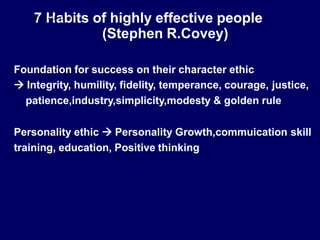
Foundation for success on their character ethic
 Integrity, humility, fidelity, temperance, courage, justice,
patience,industry,simplicity,modesty & golden rule
Personality ethic  Personality Growth,commuication skill
training, education, Positive thinking
N
7
TSFO
H
CUS
a
.CO
b
M
its of highly effective people
(Stephen R.Covey)
Interdependence – Team work,
cooperation, communication
Independence –
Character Growth
Renewal
Begin with the end in mind
Put first things first
Think win-win
Seek first to understand, then to
be understood
Synergy
Sharpen the saw
Be p
S
r
TU
o
D
a
EN
c
TS
t
F
i
O
v
CU
e
S.
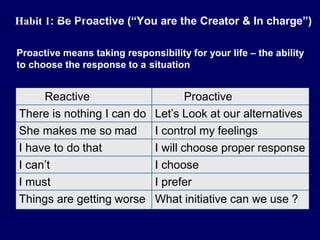
Reactive Proactive
There is nothing I can do Let’s Look at our alternatives
She makes me so mad I control my feelings
I have to do that I will choose proper response
I can’t I choose
I must I prefer
Things are getting worse What initiative can we use ?
Proactive means taking responsibility for your life – the ability
to choose the response to a situation
Hab
ST
iU
tD
1
EN
:
TS
B
FOC
e
US
P
.CO
r
M
oactive (“You are the Creator & In charge”)
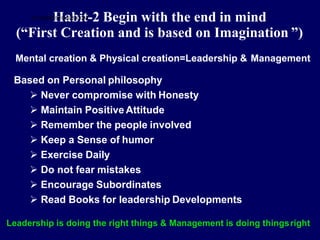
Mental creation & Physical creation=Leadership & Management
Based on Personal philosophy
 Never compromise with Honesty
 Maintain Positive Attitude
 Remember the people involved
 Keep a Sense of humor
 Exercise Daily
 Do not fear mistakes
 Encourage Subordinates
 Read Books for leadership Developments
Leadership is doing the right things & Management is doing thingsright
STUDENT
H
SFOa
CUb
S.C
i
Ot
M-2 Begin with the end in mind
(“First Creation and is based on Imagination ”)
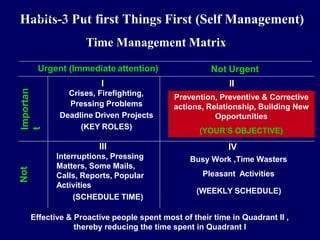
Time Management Matrix
Important
Urgent (Immediate attention) Not Urgent
Importan
t
I
Crises, Firefighting,
Pressing Problems
Deadline Driven Projects
(KEY ROLES)
II
Prevention, Preventive & Corrective
actions, Relationship, Building New
Opportunities
(YOUR’S OBJECTIVE)
Not
III
Interruptions, Pressing
Matters, Some Mails,
Calls, Reports, Popular
Activities
(SCHEDULE TIME)
IV
Busy Work ,Time Wasters
Pleasant Activities
(WEEKLY SCHEDULE)
Effective & Proactive people spent most of their time in Quadrant II ,
thereby reducing the time spent in Quadrant I
Ha
ST
b
UD
i
E
t
NT
s
S
-
FO
3
CUS
P
.CO
u
M
t first Things First (Self Management)
Habit-4 Think Win Win
(Benefit all Human Interactions)
Win Win based
 character, relationships, agreements, systems, processes
Obtain Win Win , Four step process
See the Problem From Others Viewpoint
Identify Key Issues
Determine & Analyze Acceptable Results
Seek New Options to Achieve Results
STUDENTSFOCUS.COM
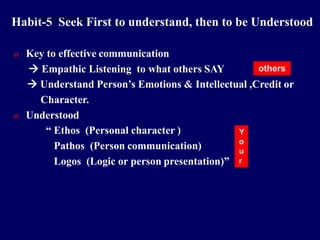
o Key to effective communication
 Empathic Listening to what others SAY
 Understand Person’s Emotions & Intellectual ,Credit or
Character.
o Understood
“ Ethos (Personal character )
Pathos (Person communication)
Logos (Logic or person presentation)”
Y
o
u
r
others
HabS
i
T
t
UD
-E
5
NTSF
S
OC
e
U
e
S.
k
COM
First to understand, then to be Understood
Habit-6 Synergy (Whole >Parts)
 Team Achieves More Than Individual Efforts
 First 5 Habits towards Habit 6
 Coordination & Understanding Reaches Better Solutions.
Habit-7 Sharpen the Saw (Renewal)
Four Dimensions personal Nature
 Physical –Good nutrition, Rest & Relaxation
 Spiritual- Prayer, Meditation &Spiritual Reading
 Mental – Reading, seminars, & Writings
 Social/Emotional –Our Relationship with others.
STUDENTSFOCUS.COM
Externally
Focused
Stability
Flexibility
Internally
Focused
1
2
8
7
4
3
5
6
1. Mentor
2. Stimulator
3. Checker
4. Coordinator
5. Director
6. Producer
7. Negotiator
8. Innovator
STUDENTSFOCUS.COM
Role of TQM leaders
STUDENTSFOCUS.COM
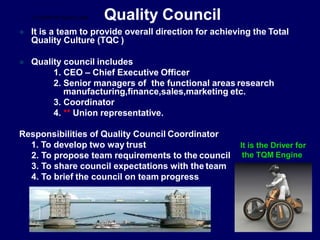
Quality Council
 It is a team to provide overall direction for achieving the Total
Quality Culture (TQC )
 Quality council includes
1. CEO – Chief Executive Officer
2. Senior managers of the functional areas research
manufacturing,finance,sales,marketing etc.
3. Coordinator
4. ** Union representative.
Responsibilities of Quality Council Coordinator
1. To develop two way trust
2. To propose team requirements to the council
3. To share council expectations with the team
4. To brief the council on team progress
It is the Driver for
the TQM Engine
STUDENTSFOCUS.COM
 To develop the Quality statements eg. Vision, Mission, Quality
policy statements, Core values etc.
 To develop strategic long-term plans and annual quality
improvement programme.
 Make a quality training programme
 Monitor the costs of poor quality.
 Determine the performance measures for the organization
 Always find projects that improve the processes and produce
customer satisfaction.
 Establish work-group teams and measure their progress.
 Establish and review the recognition and reward system for
the TQM system
Dut
S
i
TU
e
DE
s
NTS
o
FOC
fUS
t.C
h
OM
e Quality Council
 Vision statement – a short declaration of
what the organization hopes to be tomorrow.
“ To be world class enterprise in professional electronics “
BHARAT ELECTRONICS
 Mission statement – a statement of purpose
–who we are, who are our customers, what
we do , and how we do it.
“ Our mission is to help our customers achieve their
business goals through excellence in global product
realization. We will enable this through solutions based
on innovative technologies, efficient processes & world
class competencies in our people “
GEOMETRIC SOFTWARE
STUDENTSFOCUS.COM Quality statements
“Xerox is a quality company. Quality is the basic business
principle for Xerox. Quality means providing our external &
internal customers with innovative products & services
that fully satisfy their requirements. Quality is the job of
every employee”
XEROX CORPORATION
 Q
STU
u
DE
a
NT
lS
iF
t
O
y
CUS
P
.CO
o
M
licy – is a guide for everyone in the
organization ,how they should provide
products and services to the customers.
Quality Policy is a important requirements
of ISO 9000 Quality system
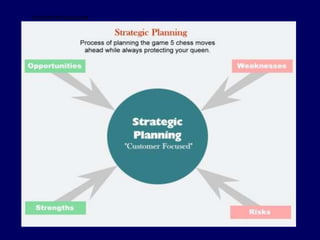
Strategic Planning
It sets the long term direction of the organization
in which it wants to proceed in future
 Goals must be focused, Goals must be concrete
 Goals must be based on statistical evidence
 Goals must be specific, understandable
 Goals must have plan or method with resources
 Goals must have a time-frame & measurable
 Goals must be challenging yet achievable
Present Strategic Plan
Vision of
future
Goals Long term planning : Objective  Short term Planning
Goal is to win the war ; Objective is to capture the bridge
1.Growth rate in
sales
2.Business into
new lines
3.Type of products
to be offered
STUDENTSFOCUS.COM
STUDENTSFOCUS.COM
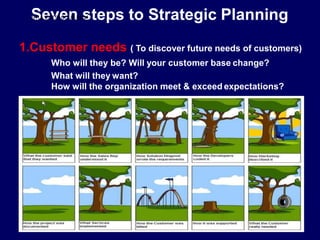
teps to Strategic Planning
1.Customer needs ( To discover future needs of customers)
Who will they be? Will your customer base change?
What will they want?
How will the organization meet & exceed expectations?
S
STUD
e
EN
v
TSF
e
OCn
US.CO
s
M
2.Customer position
 Organizations wants to be in relation to the customer
Do they want to retain, reduce or expand the
customer base
3.Predict the future
Must look into their crystal ball to predict future
conditions that will affect their product or service
Depends on economic, technology etc.
STUDENTSFOCUS.COM
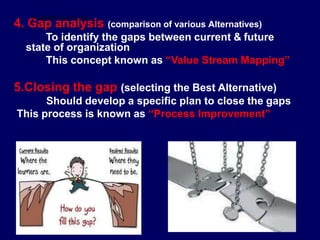
4. Gap analysis (comparison of various Alternatives)
To identify the gaps between current & future
state of organization
This concept known as “Value Stream Mapping”
5.Closing the gap (selecting the Best Alternative)
Should develop a specific plan to close the gaps
This process is known as “Process Improvement”
STUDENTSFOCUS.COM
The plan is developed, must be aligned with the
mission,vision,concepts of the organizations
7.Implementation
Resources must be allocated, collecting data,
corrective action, designing changes
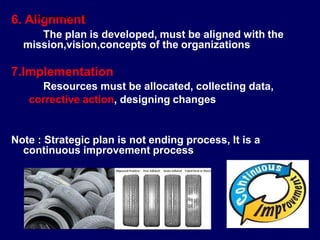
Note : Strategic plan is not ending process, It is a
continuous improvement process
6. AS
lT
i
U
g
DEN
n
TS
m
FOC
e
US
n
.CO
tM
ustomer satisfaction
 Customer is the Boss or' King’
 Customer dictates the market trends and direction
 Satisfied customers will buy more, and buy more
frequently, and pay their bill quickly
 Understanding the customer's needs & expectations
is essential to winning new business
What is customer satisfaction?
Is it due to Product quality?
Is it due to pricing?
Is it due to good customer service?
Is it due to company reputation?
Is it something more?
Answer : It is difficult to measure
STUDENTSFOCUS.CO
C
M
Norman’s Customer satisfaction model
Customer
Quality C,Q
Teboul’s Model of Customer Satisfaction
Customer needs
Company
Product/Service offer
Customer Satisfaction
STUDENTSFOCUS.COM
Customer Satisfaction Organizational
Diagram
CUSTOMERS
Front-line Staff
Functional
Department Staff
Senior
Managers
CEO
STUDENTSFOCUS.COM
Who is Customer ?
STUDENTSFOCUS.COM
Customer types
Customers  Most important people
 not dependent on the origination.
The organization depends on them
 Life Blood of Business
External Customers
 current, prospective & lost customers
 one who uses the product or service, the one who purchase
the product, or the who influences the sale of the product
Internal Customers
Every person in a process is a customer of the previous
operation (applies to design, manufacturing,sales,supplies etc)
 Exchange, providers a product or service
TQM is focus on both internal and external customers
STUDENTSFOCUS.COM
Inputs from
external customers
Outputs to external
customers
Internal
customers/Suppliers
Internal customer/Supplier relationships
Questions asked by people to their internal customers
What do you need from me?
What do you do with my output?
Are there any gaps between what you need and what
you get?
Good team-work and inter-Departmental harmony is required.
Also the leaders role in supervising the internal customer-
supplier chain
STUDENTSFOC
C
US.
u
COM
stomer/supplier chain
Customer perception of Quality
 Performance Features Service
 Warranty Price Reputation
Others
Availability Reliability Maintainability
STUDENTSFOCUS.COM
 Customer feedback must be continually solicited and
monitored - not one-time only
Why Customer feedback ?
To discover customer Dissatisfaction
To identify customer needs
To discover relative priorities of quality
To compare performance with the competition
To determine opportunities for improvement
STUDENTSFOCUS.COM
CUSTOMER COMPLAINTS
Customer satisfaction/Dissatisfaction feedback
STUDENTSFOCUS.COM
Customer feedback methods
 Comment cards enclosed with warranty card
when product is purchased.
 Customer survey and questionnaire
 Customer visits
 Customer focus groups
 Quarterly reports
 Toll-free phones
 E-mail, Internet newsgroups, discussion forums
 Employee feedback
 Mass customization
STUDENTSFOCUS.COM
1.Investigaste customer's experiences by actively receiving
the customer feedback and then acting promptly
2.Develop procedures for complaint resolution that include
empowering front-line employee
3. Analyze complaints, try to put them in a category for
speedy response
4. Work to identify process and material variations and then
eliminate the root cause
5. After receiving the response, a senior manager should
contact the customer and strive top resolve the concern
6. Establish customer satisfaction measures and constantly
monitor them
Han
S
d
TU
lD
iE
n
NT
g
SFO
tC
h
US
e
.CO
c
Mustomer complaints
7
. C
ST
o
UD
m
EN
m
TSF
u
OC
n
US
ic
.CO
a
M
te complaint information, as well as the
results of all inquiries and solutions, to all people in the
organization
8. provide a monthly complaint report to the quality council
for their evolution and if needed, the assignment of
process improvement teams
9. Identify customer's expectations in advance rather than
afterward through complaint analysis
Service Quality
Organization
 Identify each market segment
 Write down the requirements
 Communicate the requirements
 Organize processes & Organize physical spaces
Customer Care
 Meet the customer’s expectations
 Get the customer’s point of view
 Deliver what is promised
 Make the customer feel valued
 Respond to all complaints
 Over-respond to the customer
 Provide a clean and comfortable customer reception area
STUDENTSFOCUS.COM
 Optimize the trade-off between time & personal attention
 Minimize the number of contact points
 Provide pleasant,knowledgable & enthusiastic employees
 Write documents in customer-friendly language.
Front-line people
 Challenge them to develop better methods
 Give them the authority to solve problems
 Serve them as internal customers
 Be sure they are sufficiently trained
 Recognize and reward performance
Leadership
 Lead by example
 Listen to the front-line people
 Strive for continuous process improvement
Com
STU
m
DEN
u
TS
n
FO
iC
c
Ua
S.C
tO
iM
on
Customer Retention
 Customer retention is more powerful than customer
Satisfaction
 Customer retention represents the activities that
produce the necessary customer scarification that
creates customer loyalty
 Over 60% of an organization’s future revenue will
come from existing customers
 Upto 96% of unhappy customers do not infact complain.
But they are 3 times more likely to communicate a bad
experience to other customers than a good one
STUDENTSFOCUS.COM
Foundations of
individual behavior
STUDENTSFOCUS.COM
Attitudes
• Evaluative statements–either favorable
or unfavorable- concerning objects,
people or events
• We are interested in attitudes about
the work…
– “I like my job”
STUDENTSFOCUS.COM
Attitudes: Job satisfaction
Job
Dissatisfaction
Positive
Attitudes
Job
Satisfaction
Negative
Attitudes
STUDENTSFOCUS.COM
objectives
None A lot
Frustration
A
STU
t
DEN
t
TSF
i
OC
t
US
u
.COM
des: ..what determines
Job Satisfaction?
Satisfaction
Personality
Some people are quiet & passive, others are loud & aggressive
Heredity : Physical Structure , skin color, Height , fat , tall etc
Culture & Environment :
Family norms, Friend Circle & Social Group
Highly educated
Personality qualities : Shy, Loyal & Lazy
STUDENTSFOCUS.COM
GpiIC-1A Foundations of individual behavior 5
Personality: The big five model.
• Extraversion:
– sociable, talkative
• Agreeableness:
– Good natured, cooperative and trusting.
• Conscientiousness:
– responsible, dependable, persistent and
achievement oriented
• Emotional stability:
– Confidence , un depressed & not nervous
• Openness to experience:
– Bold & practical oriented
STUDENTSFOCUS.COM
Major personality attributes
• Locus of control
– Internals
– Externals
• self esteem
• Self monitoring
• Risk taking
• Matching personalities & Jobs
(Right Job Right Man)
STUDENTSFOCUS.COM
Learning
Learning is permanent & it change in behavior that occurs as
result of experience.
• How do we learn?
– Classical conditioning
• Behavior depends on consequences (money, smiles,…)
– Positive consequences: repeat.
– Negative consequences: do no repeat.
- Operant conditioning
– slow, rewards, punishment.
– Test and fail
• Social Learning
What we learn from our friends & family & society
Reinforcement Theory
+ive consequence  To be repeated
- ive consequence  To be not repeated
STUDENTSFOCUS.COM
Foundations of Group Behavior
Groups
Two or more individuals, interacting & interdependent,
who come together to achieve particular objectives
Classification of groups
Formal Defined by the organization’s structure
Informal  Neither formally structured nor
organizationally determined
Formal Groups
Command – determined by the organization chart
Task – working together to complete a job task
Informal Groups
Interest – affiliate to attain a specific objective of shared interest
Friendship – members have one or more common characteristics
STUDENTSFOCUS.COM
Why Do People Join Groups?
STUDENTSFOCUS.COM
Security
Joining a group we can reduce our insecurity- We feel stronger
Self-esteem
An individual can increase his self esteem through group
membership
Power
United we stand, divided we fall
Affiliation (Connection) == Proximity (Closeness) == Interaction
Group Structure
STUDENTSFOCUS.COM
Group Size
 Small Groups & Big Groups
 Increasing size of group results is decreased
 Limit group size (≤10)
Group Roles
 Predetermined & assigned to members
 Each role have specific responsibilities & duties
 Work Role, Maintenance Role, Blocking Role
(Task Oriented activities),( social emotional activities ),(Disrupt)
Group Norms
Norms define the acceptable standard or
boundaries of acceptable & unacceptable
behavior, shared by group members
1.Gr
So
TU
u
DE
p
NTC
SFO
oC
h
US
e
.C
sO
iM
veness
The degree to which members of the group are attracted to
each other and motivated to stay in the group
2. Group Think
A mode of thinking that people engage in when theyare
deeply involved
3. Group Decision Making
Strengths
 Generate more complete information & knowledge
 Increased diversity of views
 Increased acceptance of a solution
Weaknesses
 Takes longer
 Conformity pressures
 Discussions can be dominated by one or a few members
 Uncertain responsibility for the final outcome
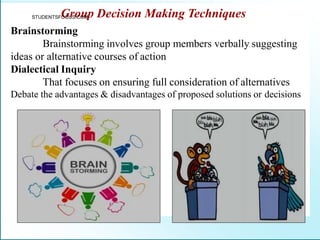
Brainstorming
Brainstorming involves group members verbally suggesting
ideas or alternative courses of action
Dialectical Inquiry
That focuses on ensuring full consideration of alternatives
Debate the advantages & disadvantages of proposed solutions or decisions
STUDENTSFG
OCU
r
So
.CO
u
Mp Decision Making Techniques
Nominal Group Technique
It is a structured decision making process which group
members are required to compose, list of their ideas or proposed
alternatives in writing
Delphi Technique
Project Manager
Opinion
Team Members
Opinion
Expert's
Opinion
Final
Decision
STUDENTSFG
OCU
r
So
.CO
u
Mp Decision Making Techniques
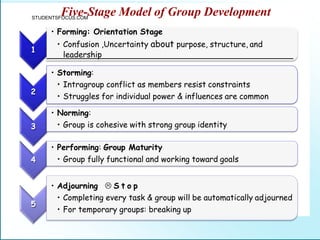
1
• Forming: Orientation Stage
• Confusion ,Uncertainty about purpose, structure, and
2
leadership
• Storming:
• Intragroup conflict as members resist constraints
• Struggles for individual power & influences are common
3
• Norming:
• Group is cohesive with strong group identity
4
• Performing: Group Maturity
• Group fully functional and working toward goals
5
• Adjourning  S t o p
• Completing every task & group will be automatically adjourned
• For temporary groups: breaking up
Five-Stage Model of Group Development
STUDENTSFOCUS.COM
Storming
Norming
Performing
Adjourning
STUDENTSFOCUS.COM
Forming
Group Formation Theories
1.Propinquity Theory
2.Homan’s Theory
3.BalanceTheory
4.Exchange Theory
STUDENTSFOCUS.COM
Managing Conflict in Group
STUDENTSFOCUS.COM
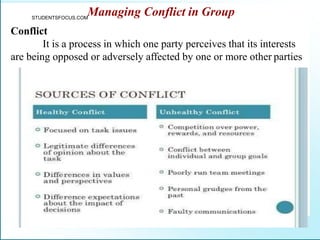
Conflict
It is a process in which one party perceives that its interests
are being opposed or adversely affected by one or more other parties
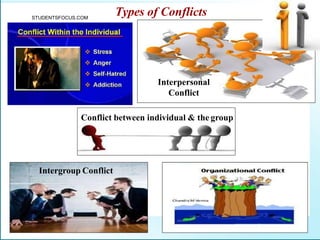
Types of Conflicts
Interpersonal
Conflict
Conflict between individual & the group
Intergroup Conflict
STUDENTSFOCUS.COM
Motivation
STUDENTSFOCUS.COM
Motivation
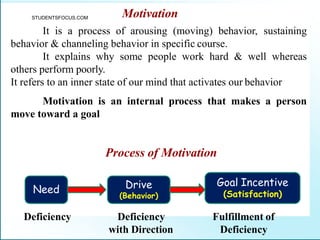
Need Drive
(Behavior)
Goal Incentive
(Satisfaction)
Deficiency Deficiency
with Direction
Fulfillment of
Deficiency
It is a process of arousing (moving) behavior, sustaining
behavior & channeling behavior in specific course.
It explains why some people work hard & well whereas
others perform poorly.
It refers to an inner state of our mind that activates our behavior
Motivation is an internal process that makes a person
move toward a goal
Process of Motivation
STUDENTSFOCUS.COM
Motivation is defined as the incentive that is given for inspiration
to accS
oT
U
mD
E
pN
lT
iS
sF
hO
C
sU
oS
.
mC
O
eM
thing
Motivation is an effective instrument in the hands of management
in inspiring the workforce
Motivation increases the willingness of the workers to work,
thus increasing efficiency & effectiveness of the organization
Importance of Motivation
It will help him achieve his personal goals
It will give personal Job Satisfaction
It will help in self development of individual
It may be Positive or Negative
It can be financial or non financial
It is a continuous process. It is not time
bounded process
Types of Motivation
STUDENTSFOCUS.COM
Positive Motivation
People are motivated by rewards & awards. The fall into two types
1. Financial Motivators 2. Non Financial Motivators
 Pay, Increment, Bonus, Commission, Incentive, Allowance etc
 Praise, Appreciation, Participation, Social Recognition,Awards,
Promotion
Negative Motivation
S
T
U
TD
E
hN
iT
sS
F
mO
C
oU
S
t.
iC
vO
aM
tionensures work performance through fear creation in
the minds of employees
1. Financial Motivators 2. Non Financial Motivators
 Fine, Penalty, Pay cut, with holding increment, pay recovery etc
 Demotion, Punishment, Transfer, Taking Disciplinary Action etc
STUDENTSFOCUS.COM
Theories of Motivation
1. Maslow’s Need Hierarchy Theory
2. McClelland’s Need Theory
3. Herzberg’s Two Factor Theory
4. McGregor’s X Theory & YTheory
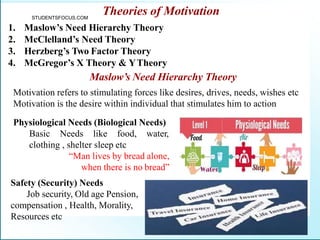
Maslow’s Need Hierarchy Theory
Motivation refers to stimulating forces like desires, drives, needs, wishes etc
Motivation is the desire within individual that stimulates him to action
Physiological Needs (Biological Needs)
Basic Needs like food, water,
clothing , shelter sleep etc
“Man lives by bread alone,
when there is no bread”
Safety (Security) Needs
Job security, Old age Pension,
compensation , Health, Morality,
Resources etc
STUDENTSFOCUS.COM
STUDENTSFOCUS.COM
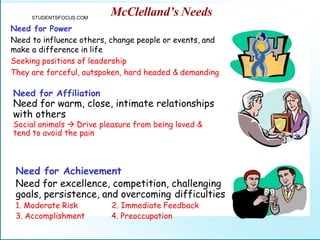
McClelland’s Needs
Need for Achievement
Need for excellence, competition, challenging
goals, persistence, and overcoming difficulties
1. Moderate Risk
3. Accomplishment
2. Immediate Feedback
4. Preoccupation
STUDENTSFOCUS.COM
Need for Power
Need to influence others, change people or events, and
make a difference in life
Seeking positions of leadership
They are forceful, outspoken, hard headed & demanding
Need for Affiliation
Need for warm, close, intimate relationships
with others
Social animals  Drive pleasure from being loved &
tend to avoid the pain
• Company policy and
administration
• Supervision
• Interpersonal relations
• Working conditions
• Salary
• Status
• Security
Hygiene factors avoid job
dissatisfaction
• Achievement
• Recognition
• Work itself
• Responsibility
• Advancement
• Growth & Learning in the Job
• Meaningfulness of the work
Motivation factors increase
job satisfaction
STUDENTSFOCUS.COM Herzberg’s Two-Factor Theory
(Motivation–Hygiene Theory)
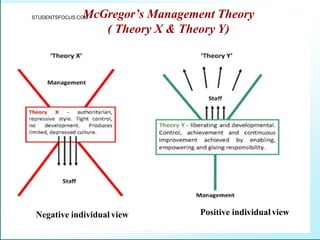
cGregor’s Management Theory
( Theory X & Theory Y)
Negative individual view Positive individualview
STUDENTSFOCUS.CO
M
M
Valence
It refers to emotional orientations which people hold with respect
to outcomes (Rewards)
Expectancy
It refers to employees different expectations & levels of confidence
about what they are capable of doing – the belief that effort will lead to
first order outcomes
Instrumentality
It refers to the perception of employees whether they actually
receive what they desire
STUDENTSF
E
OC
x
US
p
.Ce
OM
ctancy Theory ( Victor Vroom Theory)
STUDENTSFOCUS.COM
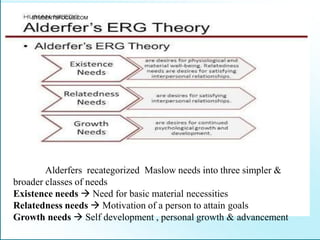
Alderfers recategorized Maslow needs into three simpler &
broader classes of needs
Existence needs  Need for basic material necessities
Relatedness needs  Motivation of a person to attain goals
Growth needs  Self development , personal growth & advancement
STUDENTSFOCUS.COM
Reinforcement Theory
STUDENTSFOCUS.COM
STUDENTSFOCUS.COM
STUDENTSFOCUS.COM
STUDENTSFOCUS.COM
STUDENTSFOCUS.COM
STUDENTSFOCUS.COM
Com
ST
m
UD
u
EN
n
TS
iF
cO
a
C
t
U
iS
o
.C
n
OM
Communication is the exchange and flow of information or ideas
From one person to another

POM UNIT-4.pptx

  • 1.
  • 2.
    Leadership Definition Leadership isthe process of influencing (power) the activities of an individual or a group towards the achievement of a goal in a given situation Leader  Show the direction and guide the group members towards the accomplishment of the company’s goal Leadership is defined as personal quality of an individual that influence the behavior of followers It is very important function of management “ A good leader thus does not stand behind a group to push But he places himself before the group & inspires the group to accomplish organizational goals “
  • 3.
    Knowledge  Whatto do & the why Skill  How to do Desire  Want to do or Motivation T C SFO h CU a S.C rO a M cteristics of Quality Leaders
  • 4.
    Q TSFO u CU a S.C lO iM ty characteristics ofLeadership Working Relationship Acceptance of leadership Assumptions of Responsibility Understanding Feelings & problems Exemplary Conduct Community of interest Spoke Person Qualities Physical & Mental Strength Emotional Stability Communication Skill Sociability Technical competence Ability to coordinate Self confidence & Will power Building Morale Functions Initiative Voice of the institution Encouragement & inspiration Integrator Planner Communicator Arbitrator (Judge) Proper use of Power To develop Team Spirit
  • 6.
    Characteristics of QualityLeaders (12 Behaviors )  Priority Attention to External & Internal Customers & theirneeds Continually evaluate the customers changing requirements  Empower rather then control, subordinates  Leaders have trust & confidence in the performance of subordinates  Provide the resources, training & good work environment to help subordinates do their jobs  Improvement rather than maintenance  “ If it isn’t perfect, improve it “ rather then “ If it ain’t broke, don’t fix it”  Continuous process improvement on a positive track  Prevention than Cure ”An ounce of prevention is worth a pound of cure”  Preventing problems & developing better
  • 7.
     Encourage Coordinationthan Competition among Department  Must be collaboration among & within units  Training & Guide than Directing & supervise  As coaches, they help their subordinates learn to do a betterjob  Learn from problems  When a problem exists, it is treated as an Opportunity  What caused it ? How can we prevent it in the future?  To improve Communications  Communications is two way-ideas will be generated by people when leaders encourage them & act upon them  Demonstrate involvement / Commitment to Quality  Leader walk their talk- their actions rather thanwords  Choose Suppliers Based Quality not Price  Suppliers are encouraged to participate on project teams & involved  Organization Structure –Quality  Encourage Team Work  Provide rewards & recognition individuals & teams
  • 8.
    Leadership Concepts To becomesuccessful ,leadership requires to understand human natures-Basic needs, wants and abilities of people. To effective a leader understand the following 1. People need, Gives Security & independence 2. People are sensitive to Rewards & punishments, yet are also strongly self motivated 3.People like to hear a Kind word of praise. Catch People doing something right, so you can pat them on the back 4. People can process only a few facts at time , a leader needs to keep things Simple 5. People trust their gut (burn) reaction more than statistical data 6.People distrust a leader’s expression if the words are inconsistent with the leaders actions
  • 9.
    Foundation for successon their character ethic  Integrity, humility, fidelity, temperance, courage, justice, patience,industry,simplicity,modesty & golden rule Personality ethic  Personality Growth,commuication skill training, education, Positive thinking N 7 TSFO H CUS a .CO b M its of highly effective people (Stephen R.Covey)
  • 10.
    Interdependence – Teamwork, cooperation, communication Independence – Character Growth Renewal Begin with the end in mind Put first things first Think win-win Seek first to understand, then to be understood Synergy Sharpen the saw Be p S r TU o D a EN c TS t F i O v CU e S.
  • 11.
    Reactive Proactive There isnothing I can do Let’s Look at our alternatives She makes me so mad I control my feelings I have to do that I will choose proper response I can’t I choose I must I prefer Things are getting worse What initiative can we use ? Proactive means taking responsibility for your life – the ability to choose the response to a situation Hab ST iU tD 1 EN : TS B FOC e US P .CO r M oactive (“You are the Creator & In charge”)
  • 12.
    Mental creation &Physical creation=Leadership & Management Based on Personal philosophy  Never compromise with Honesty  Maintain Positive Attitude  Remember the people involved  Keep a Sense of humor  Exercise Daily  Do not fear mistakes  Encourage Subordinates  Read Books for leadership Developments Leadership is doing the right things & Management is doing thingsright STUDENT H SFOa CUb S.C i Ot M-2 Begin with the end in mind (“First Creation and is based on Imagination ”)
  • 13.
    Time Management Matrix Important Urgent(Immediate attention) Not Urgent Importan t I Crises, Firefighting, Pressing Problems Deadline Driven Projects (KEY ROLES) II Prevention, Preventive & Corrective actions, Relationship, Building New Opportunities (YOUR’S OBJECTIVE) Not III Interruptions, Pressing Matters, Some Mails, Calls, Reports, Popular Activities (SCHEDULE TIME) IV Busy Work ,Time Wasters Pleasant Activities (WEEKLY SCHEDULE) Effective & Proactive people spent most of their time in Quadrant II , thereby reducing the time spent in Quadrant I Ha ST b UD i E t NT s S - FO 3 CUS P .CO u M t first Things First (Self Management)
  • 14.
    Habit-4 Think WinWin (Benefit all Human Interactions) Win Win based  character, relationships, agreements, systems, processes Obtain Win Win , Four step process See the Problem From Others Viewpoint Identify Key Issues Determine & Analyze Acceptable Results Seek New Options to Achieve Results STUDENTSFOCUS.COM
  • 15.
    o Key toeffective communication  Empathic Listening to what others SAY  Understand Person’s Emotions & Intellectual ,Credit or Character. o Understood “ Ethos (Personal character ) Pathos (Person communication) Logos (Logic or person presentation)” Y o u r others HabS i T t UD -E 5 NTSF S OC e U e S. k COM First to understand, then to be Understood
  • 16.
    Habit-6 Synergy (Whole>Parts)  Team Achieves More Than Individual Efforts  First 5 Habits towards Habit 6  Coordination & Understanding Reaches Better Solutions. Habit-7 Sharpen the Saw (Renewal) Four Dimensions personal Nature  Physical –Good nutrition, Rest & Relaxation  Spiritual- Prayer, Meditation &Spiritual Reading  Mental – Reading, seminars, & Writings  Social/Emotional –Our Relationship with others. STUDENTSFOCUS.COM
  • 17.
    Externally Focused Stability Flexibility Internally Focused 1 2 8 7 4 3 5 6 1. Mentor 2. Stimulator 3.Checker 4. Coordinator 5. Director 6. Producer 7. Negotiator 8. Innovator STUDENTSFOCUS.COM Role of TQM leaders
  • 18.
  • 19.
    Quality Council  Itis a team to provide overall direction for achieving the Total Quality Culture (TQC )  Quality council includes 1. CEO – Chief Executive Officer 2. Senior managers of the functional areas research manufacturing,finance,sales,marketing etc. 3. Coordinator 4. ** Union representative. Responsibilities of Quality Council Coordinator 1. To develop two way trust 2. To propose team requirements to the council 3. To share council expectations with the team 4. To brief the council on team progress It is the Driver for the TQM Engine STUDENTSFOCUS.COM
  • 20.
     To developthe Quality statements eg. Vision, Mission, Quality policy statements, Core values etc.  To develop strategic long-term plans and annual quality improvement programme.  Make a quality training programme  Monitor the costs of poor quality.  Determine the performance measures for the organization  Always find projects that improve the processes and produce customer satisfaction.  Establish work-group teams and measure their progress.  Establish and review the recognition and reward system for the TQM system Dut S i TU e DE s NTS o FOC fUS t.C h OM e Quality Council
  • 21.
     Vision statement– a short declaration of what the organization hopes to be tomorrow. “ To be world class enterprise in professional electronics “ BHARAT ELECTRONICS  Mission statement – a statement of purpose –who we are, who are our customers, what we do , and how we do it. “ Our mission is to help our customers achieve their business goals through excellence in global product realization. We will enable this through solutions based on innovative technologies, efficient processes & world class competencies in our people “ GEOMETRIC SOFTWARE STUDENTSFOCUS.COM Quality statements
  • 22.
    “Xerox is aquality company. Quality is the basic business principle for Xerox. Quality means providing our external & internal customers with innovative products & services that fully satisfy their requirements. Quality is the job of every employee” XEROX CORPORATION  Q STU u DE a NT lS iF t O y CUS P .CO o M licy – is a guide for everyone in the organization ,how they should provide products and services to the customers. Quality Policy is a important requirements of ISO 9000 Quality system
  • 23.
    Strategic Planning It setsthe long term direction of the organization in which it wants to proceed in future  Goals must be focused, Goals must be concrete  Goals must be based on statistical evidence  Goals must be specific, understandable  Goals must have plan or method with resources  Goals must have a time-frame & measurable  Goals must be challenging yet achievable Present Strategic Plan Vision of future Goals Long term planning : Objective  Short term Planning Goal is to win the war ; Objective is to capture the bridge 1.Growth rate in sales 2.Business into new lines 3.Type of products to be offered STUDENTSFOCUS.COM
  • 24.
  • 25.
    teps to StrategicPlanning 1.Customer needs ( To discover future needs of customers) Who will they be? Will your customer base change? What will they want? How will the organization meet & exceed expectations? S STUD e EN v TSF e OCn US.CO s M
  • 26.
    2.Customer position  Organizationswants to be in relation to the customer Do they want to retain, reduce or expand the customer base 3.Predict the future Must look into their crystal ball to predict future conditions that will affect their product or service Depends on economic, technology etc. STUDENTSFOCUS.COM
  • 27.
    4. Gap analysis(comparison of various Alternatives) To identify the gaps between current & future state of organization This concept known as “Value Stream Mapping” 5.Closing the gap (selecting the Best Alternative) Should develop a specific plan to close the gaps This process is known as “Process Improvement” STUDENTSFOCUS.COM
  • 28.
    The plan isdeveloped, must be aligned with the mission,vision,concepts of the organizations 7.Implementation Resources must be allocated, collecting data, corrective action, designing changes Note : Strategic plan is not ending process, It is a continuous improvement process 6. AS lT i U g DEN n TS m FOC e US n .CO tM
  • 29.
    ustomer satisfaction  Customeris the Boss or' King’  Customer dictates the market trends and direction  Satisfied customers will buy more, and buy more frequently, and pay their bill quickly  Understanding the customer's needs & expectations is essential to winning new business What is customer satisfaction? Is it due to Product quality? Is it due to pricing? Is it due to good customer service? Is it due to company reputation? Is it something more? Answer : It is difficult to measure STUDENTSFOCUS.CO C M
  • 30.
    Norman’s Customer satisfactionmodel Customer Quality C,Q Teboul’s Model of Customer Satisfaction Customer needs Company Product/Service offer Customer Satisfaction STUDENTSFOCUS.COM
  • 31.
    Customer Satisfaction Organizational Diagram CUSTOMERS Front-lineStaff Functional Department Staff Senior Managers CEO STUDENTSFOCUS.COM
  • 32.
    Who is Customer? STUDENTSFOCUS.COM
  • 33.
    Customer types Customers Most important people  not dependent on the origination. The organization depends on them  Life Blood of Business External Customers  current, prospective & lost customers  one who uses the product or service, the one who purchase the product, or the who influences the sale of the product Internal Customers Every person in a process is a customer of the previous operation (applies to design, manufacturing,sales,supplies etc)  Exchange, providers a product or service TQM is focus on both internal and external customers STUDENTSFOCUS.COM
  • 34.
    Inputs from external customers Outputsto external customers Internal customers/Suppliers Internal customer/Supplier relationships Questions asked by people to their internal customers What do you need from me? What do you do with my output? Are there any gaps between what you need and what you get? Good team-work and inter-Departmental harmony is required. Also the leaders role in supervising the internal customer- supplier chain STUDENTSFOC C US. u COM stomer/supplier chain
  • 35.
    Customer perception ofQuality  Performance Features Service  Warranty Price Reputation Others Availability Reliability Maintainability STUDENTSFOCUS.COM
  • 36.
     Customer feedbackmust be continually solicited and monitored - not one-time only Why Customer feedback ? To discover customer Dissatisfaction To identify customer needs To discover relative priorities of quality To compare performance with the competition To determine opportunities for improvement STUDENTSFOCUS.COM CUSTOMER COMPLAINTS Customer satisfaction/Dissatisfaction feedback
  • 37.
  • 38.
    Customer feedback methods Comment cards enclosed with warranty card when product is purchased.  Customer survey and questionnaire  Customer visits  Customer focus groups  Quarterly reports  Toll-free phones  E-mail, Internet newsgroups, discussion forums  Employee feedback  Mass customization STUDENTSFOCUS.COM
  • 39.
    1.Investigaste customer's experiencesby actively receiving the customer feedback and then acting promptly 2.Develop procedures for complaint resolution that include empowering front-line employee 3. Analyze complaints, try to put them in a category for speedy response 4. Work to identify process and material variations and then eliminate the root cause 5. After receiving the response, a senior manager should contact the customer and strive top resolve the concern 6. Establish customer satisfaction measures and constantly monitor them Han S d TU lD iE n NT g SFO tC h US e .CO c Mustomer complaints
  • 40.
    7 . C ST o UD m EN m TSF u OC n US ic .CO a M te complaintinformation, as well as the results of all inquiries and solutions, to all people in the organization 8. provide a monthly complaint report to the quality council for their evolution and if needed, the assignment of process improvement teams 9. Identify customer's expectations in advance rather than afterward through complaint analysis
  • 41.
    Service Quality Organization  Identifyeach market segment  Write down the requirements  Communicate the requirements  Organize processes & Organize physical spaces Customer Care  Meet the customer’s expectations  Get the customer’s point of view  Deliver what is promised  Make the customer feel valued  Respond to all complaints  Over-respond to the customer  Provide a clean and comfortable customer reception area STUDENTSFOCUS.COM
  • 42.
     Optimize thetrade-off between time & personal attention  Minimize the number of contact points  Provide pleasant,knowledgable & enthusiastic employees  Write documents in customer-friendly language. Front-line people  Challenge them to develop better methods  Give them the authority to solve problems  Serve them as internal customers  Be sure they are sufficiently trained  Recognize and reward performance Leadership  Lead by example  Listen to the front-line people  Strive for continuous process improvement Com STU m DEN u TS n FO iC c Ua S.C tO iM on
  • 43.
    Customer Retention  Customerretention is more powerful than customer Satisfaction  Customer retention represents the activities that produce the necessary customer scarification that creates customer loyalty  Over 60% of an organization’s future revenue will come from existing customers  Upto 96% of unhappy customers do not infact complain. But they are 3 times more likely to communicate a bad experience to other customers than a good one STUDENTSFOCUS.COM
  • 44.
  • 45.
    Attitudes • Evaluative statements–eitherfavorable or unfavorable- concerning objects, people or events • We are interested in attitudes about the work… – “I like my job” STUDENTSFOCUS.COM
  • 46.
  • 47.
    objectives None A lot Frustration A STU t DEN t TSF i OC t US u .COM des:..what determines Job Satisfaction? Satisfaction
  • 48.
    Personality Some people arequiet & passive, others are loud & aggressive Heredity : Physical Structure , skin color, Height , fat , tall etc Culture & Environment : Family norms, Friend Circle & Social Group Highly educated Personality qualities : Shy, Loyal & Lazy STUDENTSFOCUS.COM
  • 49.
    GpiIC-1A Foundations ofindividual behavior 5 Personality: The big five model. • Extraversion: – sociable, talkative • Agreeableness: – Good natured, cooperative and trusting. • Conscientiousness: – responsible, dependable, persistent and achievement oriented • Emotional stability: – Confidence , un depressed & not nervous • Openness to experience: – Bold & practical oriented STUDENTSFOCUS.COM
  • 50.
    Major personality attributes •Locus of control – Internals – Externals • self esteem • Self monitoring • Risk taking • Matching personalities & Jobs (Right Job Right Man) STUDENTSFOCUS.COM
  • 51.
    Learning Learning is permanent& it change in behavior that occurs as result of experience. • How do we learn? – Classical conditioning • Behavior depends on consequences (money, smiles,…) – Positive consequences: repeat. – Negative consequences: do no repeat. - Operant conditioning – slow, rewards, punishment. – Test and fail • Social Learning What we learn from our friends & family & society Reinforcement Theory +ive consequence  To be repeated - ive consequence  To be not repeated STUDENTSFOCUS.COM
  • 52.
    Foundations of GroupBehavior Groups Two or more individuals, interacting & interdependent, who come together to achieve particular objectives Classification of groups Formal Defined by the organization’s structure Informal  Neither formally structured nor organizationally determined Formal Groups Command – determined by the organization chart Task – working together to complete a job task Informal Groups Interest – affiliate to attain a specific objective of shared interest Friendship – members have one or more common characteristics STUDENTSFOCUS.COM
  • 53.
    Why Do PeopleJoin Groups? STUDENTSFOCUS.COM Security Joining a group we can reduce our insecurity- We feel stronger Self-esteem An individual can increase his self esteem through group membership Power United we stand, divided we fall Affiliation (Connection) == Proximity (Closeness) == Interaction
  • 54.
    Group Structure STUDENTSFOCUS.COM Group Size Small Groups & Big Groups  Increasing size of group results is decreased  Limit group size (≤10) Group Roles  Predetermined & assigned to members  Each role have specific responsibilities & duties  Work Role, Maintenance Role, Blocking Role (Task Oriented activities),( social emotional activities ),(Disrupt) Group Norms Norms define the acceptable standard or boundaries of acceptable & unacceptable behavior, shared by group members
  • 55.
    1.Gr So TU u DE p NTC SFO oC h US e .C sO iM veness The degree towhich members of the group are attracted to each other and motivated to stay in the group 2. Group Think A mode of thinking that people engage in when theyare deeply involved 3. Group Decision Making Strengths  Generate more complete information & knowledge  Increased diversity of views  Increased acceptance of a solution Weaknesses  Takes longer  Conformity pressures  Discussions can be dominated by one or a few members  Uncertain responsibility for the final outcome
  • 56.
    Brainstorming Brainstorming involves groupmembers verbally suggesting ideas or alternative courses of action Dialectical Inquiry That focuses on ensuring full consideration of alternatives Debate the advantages & disadvantages of proposed solutions or decisions STUDENTSFG OCU r So .CO u Mp Decision Making Techniques
  • 57.
    Nominal Group Technique Itis a structured decision making process which group members are required to compose, list of their ideas or proposed alternatives in writing Delphi Technique Project Manager Opinion Team Members Opinion Expert's Opinion Final Decision STUDENTSFG OCU r So .CO u Mp Decision Making Techniques
  • 58.
    1 • Forming: OrientationStage • Confusion ,Uncertainty about purpose, structure, and 2 leadership • Storming: • Intragroup conflict as members resist constraints • Struggles for individual power & influences are common 3 • Norming: • Group is cohesive with strong group identity 4 • Performing: Group Maturity • Group fully functional and working toward goals 5 • Adjourning  S t o p • Completing every task & group will be automatically adjourned • For temporary groups: breaking up Five-Stage Model of Group Development STUDENTSFOCUS.COM
  • 59.
  • 60.
    Group Formation Theories 1.PropinquityTheory 2.Homan’s Theory 3.BalanceTheory 4.Exchange Theory STUDENTSFOCUS.COM
  • 61.
    Managing Conflict inGroup STUDENTSFOCUS.COM Conflict It is a process in which one party perceives that its interests are being opposed or adversely affected by one or more other parties
  • 62.
    Types of Conflicts Interpersonal Conflict Conflictbetween individual & the group Intergroup Conflict STUDENTSFOCUS.COM
  • 63.
  • 64.
    Motivation Need Drive (Behavior) Goal Incentive (Satisfaction) DeficiencyDeficiency with Direction Fulfillment of Deficiency It is a process of arousing (moving) behavior, sustaining behavior & channeling behavior in specific course. It explains why some people work hard & well whereas others perform poorly. It refers to an inner state of our mind that activates our behavior Motivation is an internal process that makes a person move toward a goal Process of Motivation STUDENTSFOCUS.COM
  • 65.
    Motivation is definedas the incentive that is given for inspiration to accS oT U mD E pN lT iS sF hO C sU oS . mC O eM thing Motivation is an effective instrument in the hands of management in inspiring the workforce Motivation increases the willingness of the workers to work, thus increasing efficiency & effectiveness of the organization Importance of Motivation It will help him achieve his personal goals It will give personal Job Satisfaction It will help in self development of individual It may be Positive or Negative It can be financial or non financial It is a continuous process. It is not time bounded process
  • 66.
    Types of Motivation STUDENTSFOCUS.COM PositiveMotivation People are motivated by rewards & awards. The fall into two types 1. Financial Motivators 2. Non Financial Motivators  Pay, Increment, Bonus, Commission, Incentive, Allowance etc  Praise, Appreciation, Participation, Social Recognition,Awards, Promotion
  • 67.
    Negative Motivation S T U TD E hN iT sS F mO C oU S t. iC vO aM tionensures workperformance through fear creation in the minds of employees 1. Financial Motivators 2. Non Financial Motivators  Fine, Penalty, Pay cut, with holding increment, pay recovery etc  Demotion, Punishment, Transfer, Taking Disciplinary Action etc
  • 68.
  • 69.
    Theories of Motivation 1.Maslow’s Need Hierarchy Theory 2. McClelland’s Need Theory 3. Herzberg’s Two Factor Theory 4. McGregor’s X Theory & YTheory Maslow’s Need Hierarchy Theory Motivation refers to stimulating forces like desires, drives, needs, wishes etc Motivation is the desire within individual that stimulates him to action Physiological Needs (Biological Needs) Basic Needs like food, water, clothing , shelter sleep etc “Man lives by bread alone, when there is no bread” Safety (Security) Needs Job security, Old age Pension, compensation , Health, Morality, Resources etc STUDENTSFOCUS.COM
  • 70.
  • 71.
    McClelland’s Needs Need forAchievement Need for excellence, competition, challenging goals, persistence, and overcoming difficulties 1. Moderate Risk 3. Accomplishment 2. Immediate Feedback 4. Preoccupation STUDENTSFOCUS.COM Need for Power Need to influence others, change people or events, and make a difference in life Seeking positions of leadership They are forceful, outspoken, hard headed & demanding Need for Affiliation Need for warm, close, intimate relationships with others Social animals  Drive pleasure from being loved & tend to avoid the pain
  • 72.
    • Company policyand administration • Supervision • Interpersonal relations • Working conditions • Salary • Status • Security Hygiene factors avoid job dissatisfaction • Achievement • Recognition • Work itself • Responsibility • Advancement • Growth & Learning in the Job • Meaningfulness of the work Motivation factors increase job satisfaction STUDENTSFOCUS.COM Herzberg’s Two-Factor Theory (Motivation–Hygiene Theory)
  • 73.
    cGregor’s Management Theory (Theory X & Theory Y) Negative individual view Positive individualview STUDENTSFOCUS.CO M M
  • 74.
    Valence It refers toemotional orientations which people hold with respect to outcomes (Rewards) Expectancy It refers to employees different expectations & levels of confidence about what they are capable of doing – the belief that effort will lead to first order outcomes Instrumentality It refers to the perception of employees whether they actually receive what they desire STUDENTSF E OC x US p .Ce OM ctancy Theory ( Victor Vroom Theory)
  • 75.
  • 76.
    Alderfers recategorized Maslowneeds into three simpler & broader classes of needs Existence needs  Need for basic material necessities Relatedness needs  Motivation of a person to attain goals Growth needs  Self development , personal growth & advancement STUDENTSFOCUS.COM
  • 77.
  • 78.
  • 79.
  • 80.
  • 81.
  • 82.
  • 83.
    Com ST m UD u EN n TS iF cO a C t U iS o .C n OM Communication is theexchange and flow of information or ideas From one person to another