1
Process
Planning and Design
2
Process Planning …
 It is concerned with determining the method of
manufacture of a product, establishing the sequence
& type of operations involved, tools & equipment’s
required and analysing how the manufacturing of a
product will fit to the facilities.
3
Process Planning …
 Defined as “the systematic determination of
methods by which a product is to be
manufactured economically and
competitively. It consists of selecting the
proper machines, determining the sequence
of operations, specifying the inspection
stages, and tools, jigs and fixtures such that
the product can be manufactured as per the
required specifications.”
4
Designing Processes
Designing a process includes:
 selecting type of process
• streamlined, flexible, off-the-shelf, etc.
 outsourcing plans
• how much to make vs. buy
 type of technology and degree of automation
 facility design and layout
 routing of work
 equipment, materials, and personnel plans
 integrating process design with product design
5
Inputs:
• Product/Service Information
• Production System Information
• Operations Strategy
Process Planning & Design:
• Process-Type Selection
• Vertical Integration Studies
• Process/Product Studies
• Equipment Studies
• Production Procedures Studies
• Facilities Studies
Outputs:
• Process Technology
• Facilities
• Personnel Estimates
Process Planning and Design System
6
Major Factors Affecting Process Designs
1. Nature of product/service demand
2. Degree of vertical integration
3. Production flexibility
4. Degree of automation
5. Product/Service quality
7
Nature of Product/Service Demand
 Production processes must have adequate
capacity to produce the volume of the
products/services that customers need.
 Provisions must be made for expanding or
contracting capacity to keep pace with demand
patterns.
 Some types of processes are more easily
expanded and contracted than others.
 Product/service price affects demand, so
pricing decisions and the choice of processes
must be synchronized.
8
Degree of Vertical Integration
 Vertical integration is the amount of the
production and distribution chain that is
brought under the ownership of a company.
 This determines how many production
processes need to be planned and designed.
 Decision of integration is based on cost,
availability of capital, quality, technological
capability, and more.
 Strategic outsourcing (lower degree of
integration) is the outsourcing of processes in
order to react quicker to changes in customer
needs, competitor actions, and technology.
9
Production Flexibility
 Product flexibility -- ability of the production
(or delivery) system to quickly change from
producing (delivering) one product (or service)
to another.
 Volume flexibility -- ability to quickly increase
or reduce the volume of product( or service)
produced (or delivered).
10
Degree of Automation
 Advantages of automation
 Improves product quality
 Improves product flexibility
 Reduces labor and related costs
 Disadvantages of automation
 Equipment can be very expensive
 Integration into existing operations can be
difficult
11
Product/Service Quality
 Old viewpoint – high-quality products must be
made in small quantities by expert craftsmen
 New viewpoint – high-quality products can be
mass-produced using automated machinery
 Automated machinery can produce products of
incredible uniformity
 The choice of design of production processes
is affected by the need for superior quality.
12
Types of Processes
1. Conversion processes
2. Fabrication processes
3. Assembly processes
4. Analytic, Synthetic and Modifying
processes
13
Types of Process Designs
 Product-Focused
 Process-Focused
 Group Technology/Cellular Manufacturing
14
Product-Focused
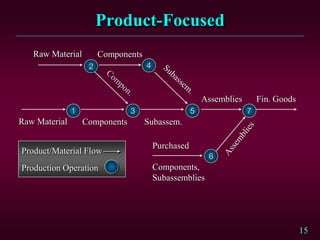
 Processes (conversions) are arranged based on
the sequence of operations required to produce
a product or provide a service
 Also called “Production Line” or “Assembly
Line”
 Two general forms
 Discrete unit – automobiles, dishwashers
 Process (Continuous) – petrochemicals,
paper
15
Purchased
Components,
Subassemblies
Product-Focused
2
3
1
4
1
7
6
5
Components Subassem.
Assemblies
Product/Material Flow
Production Operation
Raw Material Components
Raw Material
Fin. Goods
16
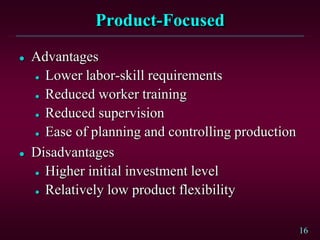
Product-Focused
 Advantages
 Lower labor-skill requirements
 Reduced worker training
 Reduced supervision
 Ease of planning and controlling production
 Disadvantages
 Higher initial investment level
 Relatively low product flexibility
17
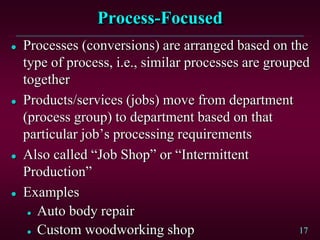
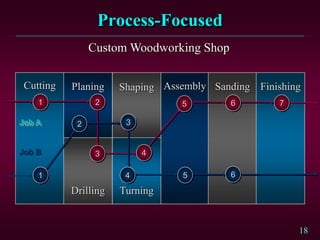
Process-Focused
 Processes (conversions) are arranged based on the
type of process, i.e., similar processes are grouped
together
 Products/services (jobs) move from department
(process group) to department based on that
particular job’s processing requirements
 Also called “Job Shop” or “Intermittent
Production”
 Examples
 Auto body repair
 Custom woodworking shop
18
Process-Focused
Cutting Assembly Sanding Finishing
Planing
Drilling
Shaping
Turning
1 5 7
3
2
1 6
3
6
4
2
Job A
Job B
4 5
Custom Woodworking Shop
19
Process-Focused
 Advantages
 High product flexibility
 Lower initial investment level
 Disadvantages
 Higher labor-skill requirements
 More worker training
 More supervision
 More complex production planning and
controlling
20
Group Technology/Cellular
Manufacturing
 Group Technology
 Each part produced receives a multi-digit
code that describes the physical
characteristics of the part.
 Parts with similar characteristics are
grouped into part families
 Parts in a part family are typically made on
the same machines with similar tooling
21
Group Technology/Cellular
Manufacturing
 Cellular Manufacturing
 Some part families (those requiring
significant batch sizes) can be assigned to
manufacturing cells.
 The organization of the shop floor into cells
is referred to as cellular manufacturing.
 Flow of parts within cells tend to be more
like product-focused systems
22
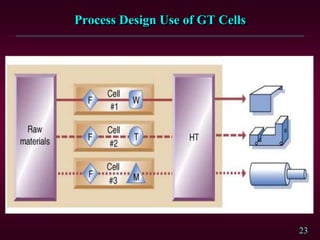
Cellular Manufacturing
 GT has the advantage of bringing the efficiencies of a
product layout to a process layout environment
23
Process Design Use of GT Cells
24
Group Technology/Cellular
Manufacturing
Advantages (relative to a job shop)
 Process changeovers simplified
 Variability of tasks reduced (less training
needed)
 More direct routes through the system
 Quality control is improved
 Production planning and control simpler
 Automation simpler
25
Group Technology/Cellular
Manufacturing
 Disadvantages
 Duplication of equipment
 Under-utilization of facilities
 Processing of items that do not fit into a
family may be inefficient
26
Process Design in Services
 Some of the factors important in process
design for products are also important in
services:
 Nature (level and pattern) of customer
demand
 Degree of vertical integration
 Production flexibility
 Degree of automation
 Service quality
27
Process Design in Services
 Three schemes for producing and delivering
services
 Quasi-Manufacturing
 Customer-as-Participant
 Customer-as-Product
28
Process Design in Services
 Quasi-Manufacturing
 Physical goods are dominant over intangible
service
 Production of goods takes place along a
production line
 Operations can be highly automated
 Almost no customer interaction
 Little regard for customer relations
 Example – Delivery services,
Telecommunications
29
Process Design in Services
 Customer-as-Participant
 Physical goods may be a significant part of
the service
 Services may be either standardized or
custom
 High degree of customer involvement in the
process
 Examples: ATM, self-service gas station
30
Process Design in Services
 Customer-as-Product
 Service is provided through personal
attention to the customer
 Customized service on the customer
 High degree of customer contact
 There is a perception of high quality
 Customer becomes the central focus of the
process design
 Examples: medical clinic, hair salon
31
Process Reengineering
 The concept of drastically changing an existing
process design
 Not merely making marginal improvements to
the process
 A correctly reengineered process should be
more efficient
 A smaller labor force is often the result
32

POM .ppt

  • 1.
  • 2.
    2 Process Planning … It is concerned with determining the method of manufacture of a product, establishing the sequence & type of operations involved, tools & equipment’s required and analysing how the manufacturing of a product will fit to the facilities.
  • 3.
    3 Process Planning … Defined as “the systematic determination of methods by which a product is to be manufactured economically and competitively. It consists of selecting the proper machines, determining the sequence of operations, specifying the inspection stages, and tools, jigs and fixtures such that the product can be manufactured as per the required specifications.”
  • 4.
    4 Designing Processes Designing aprocess includes:  selecting type of process • streamlined, flexible, off-the-shelf, etc.  outsourcing plans • how much to make vs. buy  type of technology and degree of automation  facility design and layout  routing of work  equipment, materials, and personnel plans  integrating process design with product design
  • 5.
    5 Inputs: • Product/Service Information •Production System Information • Operations Strategy Process Planning & Design: • Process-Type Selection • Vertical Integration Studies • Process/Product Studies • Equipment Studies • Production Procedures Studies • Facilities Studies Outputs: • Process Technology • Facilities • Personnel Estimates Process Planning and Design System
  • 6.
    6 Major Factors AffectingProcess Designs 1. Nature of product/service demand 2. Degree of vertical integration 3. Production flexibility 4. Degree of automation 5. Product/Service quality
  • 7.
    7 Nature of Product/ServiceDemand  Production processes must have adequate capacity to produce the volume of the products/services that customers need.  Provisions must be made for expanding or contracting capacity to keep pace with demand patterns.  Some types of processes are more easily expanded and contracted than others.  Product/service price affects demand, so pricing decisions and the choice of processes must be synchronized.
  • 8.
    8 Degree of VerticalIntegration  Vertical integration is the amount of the production and distribution chain that is brought under the ownership of a company.  This determines how many production processes need to be planned and designed.  Decision of integration is based on cost, availability of capital, quality, technological capability, and more.  Strategic outsourcing (lower degree of integration) is the outsourcing of processes in order to react quicker to changes in customer needs, competitor actions, and technology.
  • 9.
    9 Production Flexibility  Productflexibility -- ability of the production (or delivery) system to quickly change from producing (delivering) one product (or service) to another.  Volume flexibility -- ability to quickly increase or reduce the volume of product( or service) produced (or delivered).
  • 10.
    10 Degree of Automation Advantages of automation  Improves product quality  Improves product flexibility  Reduces labor and related costs  Disadvantages of automation  Equipment can be very expensive  Integration into existing operations can be difficult
  • 11.
    11 Product/Service Quality  Oldviewpoint – high-quality products must be made in small quantities by expert craftsmen  New viewpoint – high-quality products can be mass-produced using automated machinery  Automated machinery can produce products of incredible uniformity  The choice of design of production processes is affected by the need for superior quality.
  • 12.
    12 Types of Processes 1.Conversion processes 2. Fabrication processes 3. Assembly processes 4. Analytic, Synthetic and Modifying processes
  • 13.
    13 Types of ProcessDesigns  Product-Focused  Process-Focused  Group Technology/Cellular Manufacturing
  • 14.
    14 Product-Focused  Processes (conversions)are arranged based on the sequence of operations required to produce a product or provide a service  Also called “Production Line” or “Assembly Line”  Two general forms  Discrete unit – automobiles, dishwashers  Process (Continuous) – petrochemicals, paper
  • 15.
  • 16.
    16 Product-Focused  Advantages  Lowerlabor-skill requirements  Reduced worker training  Reduced supervision  Ease of planning and controlling production  Disadvantages  Higher initial investment level  Relatively low product flexibility
  • 17.
    17 Process-Focused  Processes (conversions)are arranged based on the type of process, i.e., similar processes are grouped together  Products/services (jobs) move from department (process group) to department based on that particular job’s processing requirements  Also called “Job Shop” or “Intermittent Production”  Examples  Auto body repair  Custom woodworking shop
  • 18.
    18 Process-Focused Cutting Assembly SandingFinishing Planing Drilling Shaping Turning 1 5 7 3 2 1 6 3 6 4 2 Job A Job B 4 5 Custom Woodworking Shop
  • 19.
    19 Process-Focused  Advantages  Highproduct flexibility  Lower initial investment level  Disadvantages  Higher labor-skill requirements  More worker training  More supervision  More complex production planning and controlling
  • 20.
    20 Group Technology/Cellular Manufacturing  GroupTechnology  Each part produced receives a multi-digit code that describes the physical characteristics of the part.  Parts with similar characteristics are grouped into part families  Parts in a part family are typically made on the same machines with similar tooling
  • 21.
    21 Group Technology/Cellular Manufacturing  CellularManufacturing  Some part families (those requiring significant batch sizes) can be assigned to manufacturing cells.  The organization of the shop floor into cells is referred to as cellular manufacturing.  Flow of parts within cells tend to be more like product-focused systems
  • 22.
    22 Cellular Manufacturing  GThas the advantage of bringing the efficiencies of a product layout to a process layout environment
  • 23.
  • 24.
    24 Group Technology/Cellular Manufacturing Advantages (relativeto a job shop)  Process changeovers simplified  Variability of tasks reduced (less training needed)  More direct routes through the system  Quality control is improved  Production planning and control simpler  Automation simpler
  • 25.
    25 Group Technology/Cellular Manufacturing  Disadvantages Duplication of equipment  Under-utilization of facilities  Processing of items that do not fit into a family may be inefficient
  • 26.
    26 Process Design inServices  Some of the factors important in process design for products are also important in services:  Nature (level and pattern) of customer demand  Degree of vertical integration  Production flexibility  Degree of automation  Service quality
  • 27.
    27 Process Design inServices  Three schemes for producing and delivering services  Quasi-Manufacturing  Customer-as-Participant  Customer-as-Product
  • 28.
    28 Process Design inServices  Quasi-Manufacturing  Physical goods are dominant over intangible service  Production of goods takes place along a production line  Operations can be highly automated  Almost no customer interaction  Little regard for customer relations  Example – Delivery services, Telecommunications
  • 29.
    29 Process Design inServices  Customer-as-Participant  Physical goods may be a significant part of the service  Services may be either standardized or custom  High degree of customer involvement in the process  Examples: ATM, self-service gas station
  • 30.
    30 Process Design inServices  Customer-as-Product  Service is provided through personal attention to the customer  Customized service on the customer  High degree of customer contact  There is a perception of high quality  Customer becomes the central focus of the process design  Examples: medical clinic, hair salon
  • 31.
    31 Process Reengineering  Theconcept of drastically changing an existing process design  Not merely making marginal improvements to the process  A correctly reengineered process should be more efficient  A smaller labor force is often the result
  • 32.