UNIT-II
Thin, Thick cylinders
Thin cylinders
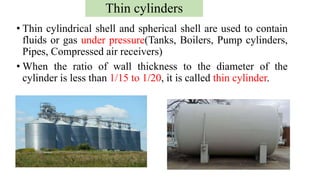
• Thin cylindrical shell and spherical shell are used to contain
fluids or gas under pressure(Tanks, Boilers, Pump cylinders,
Pipes, Compressed air receivers)
• When the ratio of wall thickness to the diameter of the
cylinder is less than 1/15 to 1/20, it is called thin cylinder.
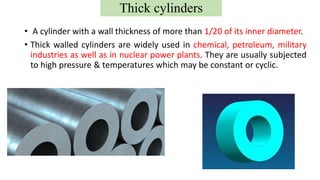
• A cylinder with a wall thickness of more than 1/20 of its inner diameter.
• Thick walled cylinders are widely used in chemical, petroleum, military
industries as well as in nuclear power plants. They are usually subjected
to high pressure & temperatures which may be constant or cyclic.
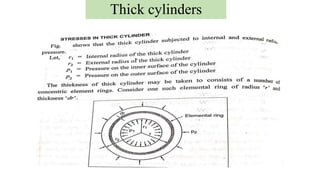
Thick cylinders
Stresses in thin cylinders
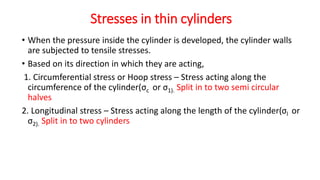
• When the pressure inside the cylinder is developed, the cylinder walls
are subjected to tensile stresses.
• Based on its direction in which they are acting,
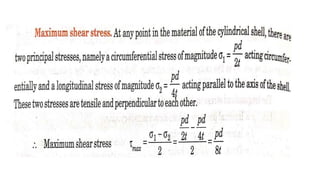
1. Circumferential stress or Hoop stress – Stress acting along the
circumference of the cylinder(σc or σ1). Split in to two semi circular
halves
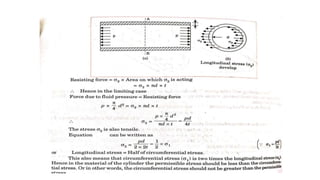
2. Longitudinal stress – Stress acting along the length of the cylinder(σl or
σ2). Split in to two cylinders
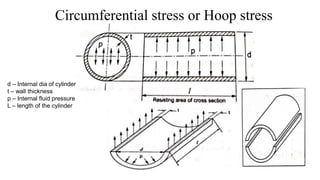
Circumferential stress or Hoop stress
d – Internal dia of cylinder
t – wall thickness
p – Internal fluid pressure
L – length of the cylinder
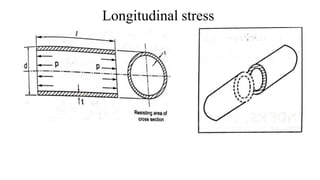
Longitudinal stress
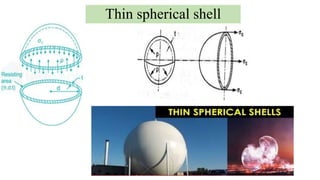
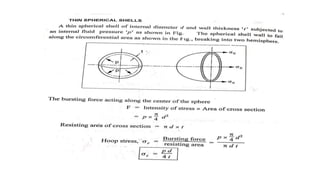
Thin spherical shell
Thick cylinders
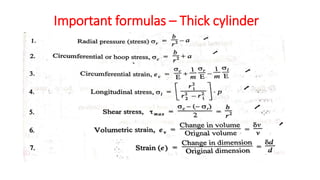
Important formulas – Thick cylinder

UNIT-III.ppt

  • 1.
  • 2.
    Thin cylinders • Thincylindrical shell and spherical shell are used to contain fluids or gas under pressure(Tanks, Boilers, Pump cylinders, Pipes, Compressed air receivers) • When the ratio of wall thickness to the diameter of the cylinder is less than 1/15 to 1/20, it is called thin cylinder.
  • 3.
    • A cylinderwith a wall thickness of more than 1/20 of its inner diameter. • Thick walled cylinders are widely used in chemical, petroleum, military industries as well as in nuclear power plants. They are usually subjected to high pressure & temperatures which may be constant or cyclic. Thick cylinders
  • 4.
    Stresses in thincylinders • When the pressure inside the cylinder is developed, the cylinder walls are subjected to tensile stresses. • Based on its direction in which they are acting, 1. Circumferential stress or Hoop stress – Stress acting along the circumference of the cylinder(σc or σ1). Split in to two semi circular halves 2. Longitudinal stress – Stress acting along the length of the cylinder(σl or σ2). Split in to two cylinders
  • 5.
    Circumferential stress orHoop stress d – Internal dia of cylinder t – wall thickness p – Internal fluid pressure L – length of the cylinder
  • 7.
  • 10.
  • 12.
  • 14.
    Important formulas –Thick cylinder